light AUDI Q7 2011 Owner´s Manual
[x] Cancel search | Manufacturer: AUDI, Model Year: 2011, Model line: Q7, Model: AUDI Q7 2011Pages: 392, PDF Size: 93.29 MB
Page 190 of 392
lffll.___H_ o_ m __ e_L_ i_n _k_ ®_ • _________________________________________________ _
-Press th e ap pro priate programmed button G) , @ or@
to activate the desired remote control function ::::>
& in
"Genera l informat io n" on
page 185. •
Applies to ve hicles : w ith Hom eli nk® univer sa l rem ote c ont rol
Reprogramming a single button
A Homelink ® button can be reprogrammed individually
without affecting the other button allocations.
Programming the ov erh ead keypad
- Press the appropriate Homelink ® button until the indi-
cator light begins flashing slowly .
Programming the bumper mounted transmit
ter
1. Hold the original remote control at a distance between 0 -
6
in . (0 -15 cm) from the bumper below the appropriate
headlight for your vehicle (use the shortest distance
possible).
2. Aim the remote control just below the
driver side head
light .
3 . Press and hold the ac tivation button on the remote
control.
4 . The emergency flashers will flash
three times (after about
15 -60 seconds) when the programm ing is successful.
N ow release the b utton on the remote control.
- If the device utilizes a rolling code , please follow phase 3
of =>
page 186 , "Programming the Homelink ® trans
mitter" for rolling code programming.
This pro cedur e will caus e th e ex is ting pr ogramming on th e
Homelink ® button to be era sed !•
Ap plies to veh icles: w ith Ho meli nk® un ive rsa l rem ote c ont rol
Erasing the programming of the
Homelink ® tr ansmitter
When you erase the programming, the programming on
all three of the transmitter channels with be lost!
- Perform steps 1 to 4 as described on ::::> page 186, "Phase
1 : programming the overhead keypad".
When completed , the Homel ink ® system will be in the programm ing
mode and is then ready to learn the codes for remote controlled
devices .
[I) Tips
• Programmed buttons cannot be erased individually.
• For security reasons you are advised to erase the programming of
the Homelink ® system before you sell your veh icle .•
Page 193 of 392
________________________________________________ D_ r_ i_ v _i_n ""'g "-- S_a_ f_ e_ l _,,y'-- __
Important things to do before driving
Safety is everybody's job! Vehicle and occupant safety always depends on the informed and careful driver.
For your safety and the safety of your passengers, before
driving always:
- Make sure that all lights and signals are operating
correctly.
- Make sure that the tire pressure is correct.
- Make sure that all windows are clean and afford good visi-
bility to the outside.
- Secure all luggage and other items carefully::::>
page 107.
-Make sure that nothing can interfere with the pedals.
- Adjust front seat, head restraint and mirrors correctly for your height .
- Instruct passengers to adjust the head restraints according to their height.
- Make sure to use the right child restraint correctly to
protect children ::::,
page 233, "Child Safety".
- Sit properly in your seat and make sure that your passen gers do the same::::,
page 85, "General recommenda
tions".
- Fasten your safety belt and wear it properly. Also instruct
your passengers to fasten their safety belts properly
=:> page 201. •
Controls and equip
ment Safety first Vehicle operation
What impairs driving safety?
Safe driving is directly related to the condition of the
vehicle, the driver as well as the driver's ability to concen
trate on the road without being distracted .
The driver is responsible for the safety of the vehicle and all
of its occupants. If your ability to drive is impaired, safety
risks for everybody in the vehicle increase and you also
become a hazard to everyone else on the road::::,,& . There
fore:
Do not let yourself be distracted by passengers or by using
a cellular telephone.
NEVER drive when your driving ability is impaired (by
medications, alcohol, drugs, etc.).
- Observe all traffic laws, rules of the road and speed limits
and plain common sense .
- ALWAYS adjust your speed to road, traffic and weather
conditions.
- Take frequent breaks on long trips. Do not drive for more than two hours at a stretch.
- Do NOT drive when you are tired, under pressure or when
you are stressed .
& WARNING
Impaired driving safety increases the risk of serious personal
injury and death whenever a vehicle is being used.•
Vehicle care Do-it-yourself service Technical data
Page 194 of 392
• ....__D_ r_iv _i_ n_, g=-- S_ a _ f_e _,Ly _ ______________________________________________ _
Proper occupant seating positions
Proper seating position for the driver
The proper driver seating position is important for safe,
relaxed driving.
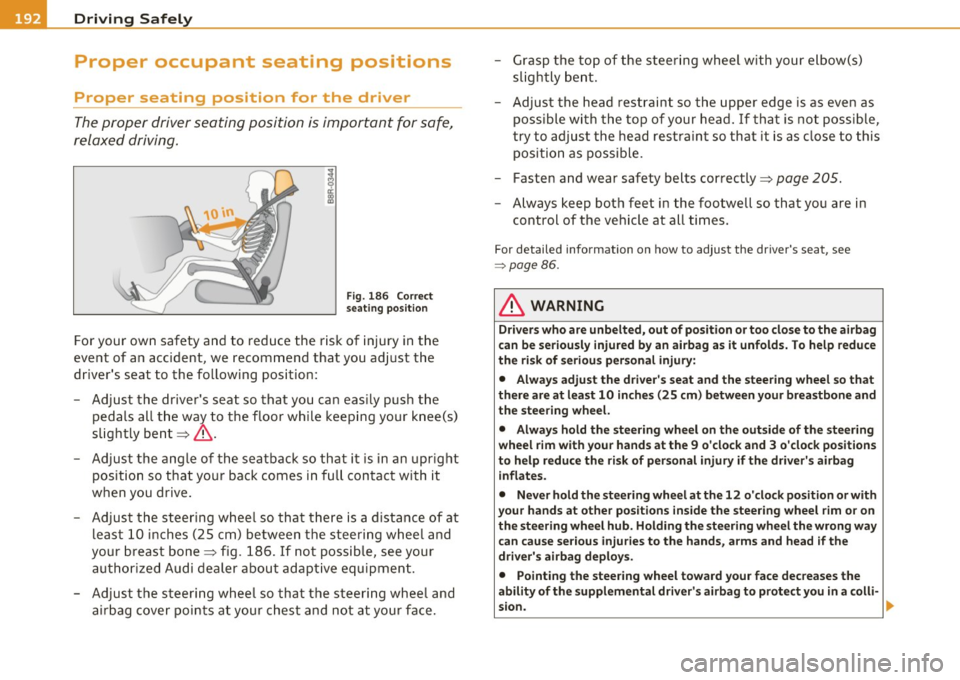
Fig. 186 Correct
seating position
For your own safety and to reduce the risk of injury in the
event of an accident, we recommend that you adjust the
driver's seat to the following position:
- Adjust the driver's seat so that you can easily push the
pedals all the way to the floor while keeping your knee(s)
slightly bent~&.
- Adjust the angle of the seatback so that it is in an upright
position so that your back comes in full contact with it
when you drive.
- Adjust the steering wheel so that there is a distance of at least 10 inches (25 cm) between the steering wheel and
your breast bone~ fig. 186. If not possible, see your
authorized Audi dealer about adaptive equipment.
- Adjust the steering wheel so that the steering wheel and airbag cover points at your chest and not at your face. -
Grasp the top of the steering wheel with your elbow(s)
slightly bent.
- Adjust the head restraint so the upper edge is as even as
possible with the top of your head. If that is not possible,
try to adjust the head restraint so that it is as close to this
position as possible.
- Fasten and wear safety belts correctly~
page 205.
-Always keep both feet in the footwell so that you are in
control of the vehicle at all times.
For detailed information on how to adjust the driver's seat, see
=> page 86.
& WARNING
Drivers who are unbelted, out of position or too close to the airbag
can be seriously injured by an airbag as it unfolds. To help reduce
the risk of serious personal injury:
• Always adjust the driver's seat and the steering wheel so that
there are at least 10 inches (25 cm) between your breastbone and
the steering wheel.
• Always hold the steering wheel on the outside of the steering
wheel rim with your hands at the 9 o'clock and 3 o'clock positions
to help reduce the risk of personal injury if the driver's airbag
inflates.
• Never hold the steering wheel at the 12 o'clock position or with
your hands at other positions inside the steering wheel rim or on
the steering wheel hub. Holding the steering wheel the wrong way
can cause serious injuries to the hands , arms and head if the
driver's airbag deploys.
• Pointing the steering wheel toward your face decreases the
ability of the supplemental driver's airbag to protect you in a colli-
sion.
~
Page 203 of 392
_______________________________________________ S_ a_ f_ e_ t_ y_ b_ e_ lt_s __ _
Safety belts
General notes
Always wear safety belts!
Wearing safety belts correctly saves lives!
This chapter explains why safety belts are necessary, how
they work and how to adjust and wear them correctly.
- Read all the information that follows and heed all of the
instructions and WARNINGS.
& WARNING
Not wearing safety belts or wearing them improperly increases
the risk of serious personal injury and death.
• Safety belts are the single most effective means available to
reduce the risk of serious injury and death in automobile acci
dents. For your protection and that of your passengers, always
correctly wear safety belts when the vehicle is moving.
• Pregnant women, injured, or physically impaired persons must
also use safety belts. Like all vehicle occupants, they are more
likely to be seriously injured if they do not wear safety belts. The
best way to protect a fetus is to protect the mother - throughout
the entire pregnancy. •
Number of seats
Vehicles with five seats: Your vehicle has two front seats and three
rear seats. Each seating position has a safety belt.
Vehicles with six seats:* Your vehicle has two front seats, two seats
in the second row and two seats in the third row. Each seating posi
tion has a safety belt.
Controls and equip ment Safety first Vehicle operation Vehicles with
seven seats:* Your vehicles has two front seats, three
seats in the second row and two seats in the third row . Each seating
position has a safety belt.
& WARNING
Not wearing safety belts or wearing them improperly increases
the risk of serious personal injury and death.
• Never strap more than one person, including small children,
into any belt. It is especially dangerous to place a safety belt over
a child sitting on your lap.
• Never let more people ride in the vehicle than there are safety
belts available.
• Be sure everyone riding in the vehicle is properly restrained
with a separate safety belt or child restraint. •
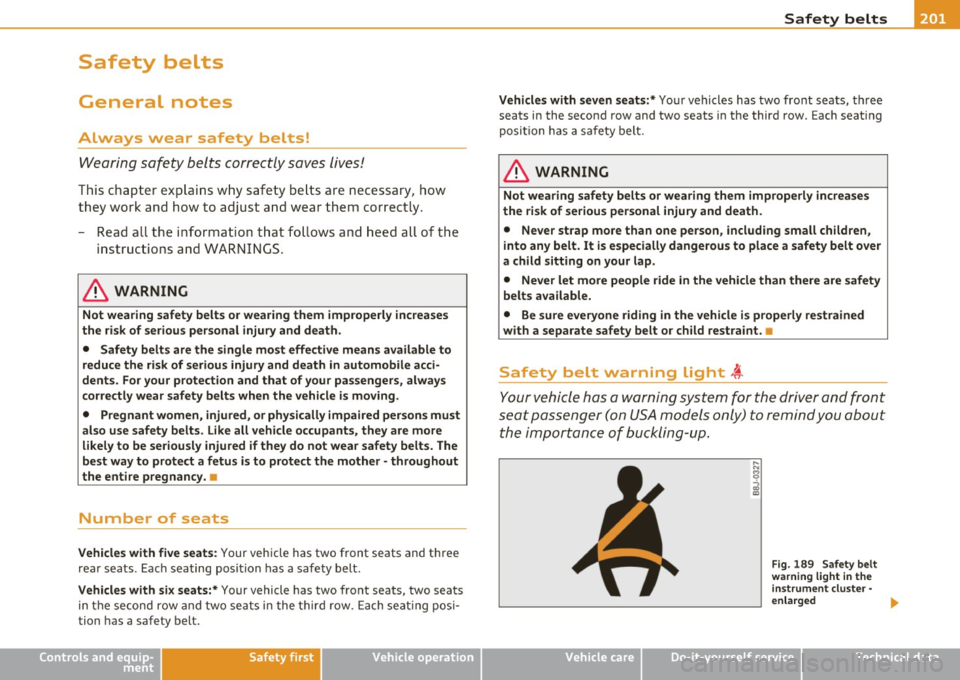
Safety belt warning light l
Your vehicle hos a warning system for the driver and front
seat passenger (on USA models only) to remind you about the importance of buckling-up.
Vehicle care
Fig. 189 Safety belt
warning light in the
instrument cluster·
enlarged ...
Do-it-yourself service Technical data
Page 204 of 392
... Safety belts PNM-- -=-------------------------------
Before driving off, always:
-Fasten your safety belt and mak e sure you are wea ring i t
p roperly .
- Make sure that your passengers also buckle up and prop
erly wear their safety be lts.
- Prot ect ch ildren w ith a child rest raint system appropriate
for the size and age.
T he warning light -if. in the instrument cluster lights up when the igni
tion is sw itched on as a reminder to fasten the safety belts. In addi
tion, you will hear a warning tone for a certa in period of time.
Fasten your safety belt and make s ure that your passenger s al so
properly put on their safety belts .
& WARNING
• Safety belts are the single most effective means available to
reduce the ri sk of serious injury and death in automobile a cci
dents. Fo r your protection and that of your passengers , always
c orrectly wear safety belts when the vehicle is moving.
• Failure to pay attention to the warning light that come on ,
could lead to personal injury. •
Why safety belts?
Frontal collisions and the law of physics
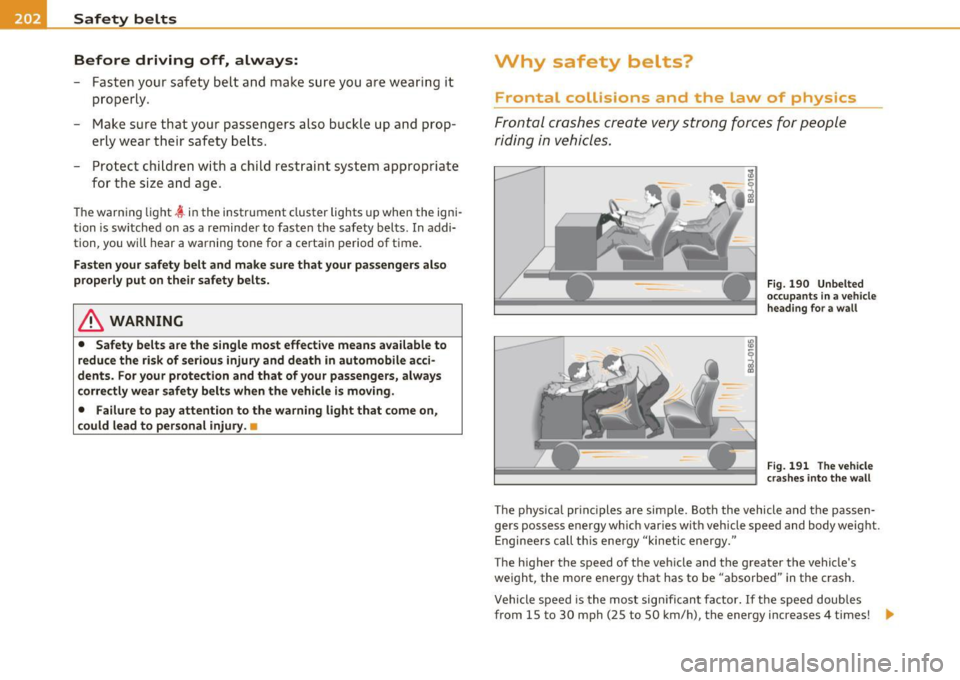
Frontal crashes cre ate very stron g forc es for people
ri din g i n vehi cles.
Fig . 19 0 Unbelted
o ccupa nts in a v ehicle
h eading f or a w all
Fig . 191 Th e vehicle
cr as hes into the wall
T he p hys ica l pr inc iples are simple. Both the vehicle and the passen
gers possess energy which var ies wit h veh icle speed and body weight.
E nginee rs ca ll t his ene rgy "kinetic energy."
The higher the speed of the veh icle and t he greater the vehicle's
we ight, the more energy that has to be "abso rbed" in the crash .
Vehicle speed is the most sig nifican t fa ctor. If t he speed doubles
from 15 to 30 mph (25 to 50 km/h), the energy increases 4 times! .,
Page 208 of 392
___ s_ a_ f_ e_ t_ y~ b_ e_ lt_s _____________________________________________ _
- Insert t he tongue into the correct buck le of your seat until
you hear it latch secure ly==> fig. 195 .
- Pull on the be lt to make sure tha t it is secure ly la tched in
the buck le.
Automatic safety belt retractors
Every safety be lt is equipped with an automatic be lt retractor on the
shoulder be lt. This feat ure locks the be lt whe n the belt is pulled out
fast, during hard braking and in an acc ident. The belt may also lock
w hen you dr ive up or dow n a steep hill or throug h a sharp curve.
Dur ing normal driv ing the belt lets you move freely.
Safety belt pretensioners
The safety belts are equipped w ith a belt pretensioner that helps to
t ighten the safety be lt and remove sla ck when the p re tensioner is
act ivated. The function of the pretensioner is monitored by a warn ing
light =>
page 17.
Switchable locking feature
Every sa fety be lt ex ce pt t he one on the driver sea t is eq uipped wi th a
switchab le locking feature that
must be used when the safety belt is
used to at tach a child safety seat. Be s ure to read t he importa nt info r
mation about this feature=>
page 243.
& WARNING
Imp roperly positioned safety belts can c au se se rious injury in a n
accident =>
page 206, "Safety b elt po sition ".
• Safety belts offer optimum protection only when the seatback
i s upr ight and belts are properly positioned on the body .
• Always make sure th at the rear seat backre st to which the
center rear safety belt is attached i s secur ely latched when ever the
rear cente r sa fety belt is be ing u sed . If the ba ckre st is not securely
latched, the pas senger will move forward with th e backre st during
sudde n braking, in a sudden maneuve r and especiall y in a crash .
& WARNING (continued )
• Never attach the safety belt to the buckle fo r another seat .
Attaching the belt to the wrong buckle will reduce safety belt
effectiveness and can cause ser ious personal injury.
• A pass enger who i s not properly restrained can be seriou sly
i njured by the safety belt itself when it mo ves from the stronger
part s of the body into critical area s like the abdomen.
• Alway s loc k the convertible locking retractor when you a re
securing a child safety seat in the vehicle=>
page 245. •
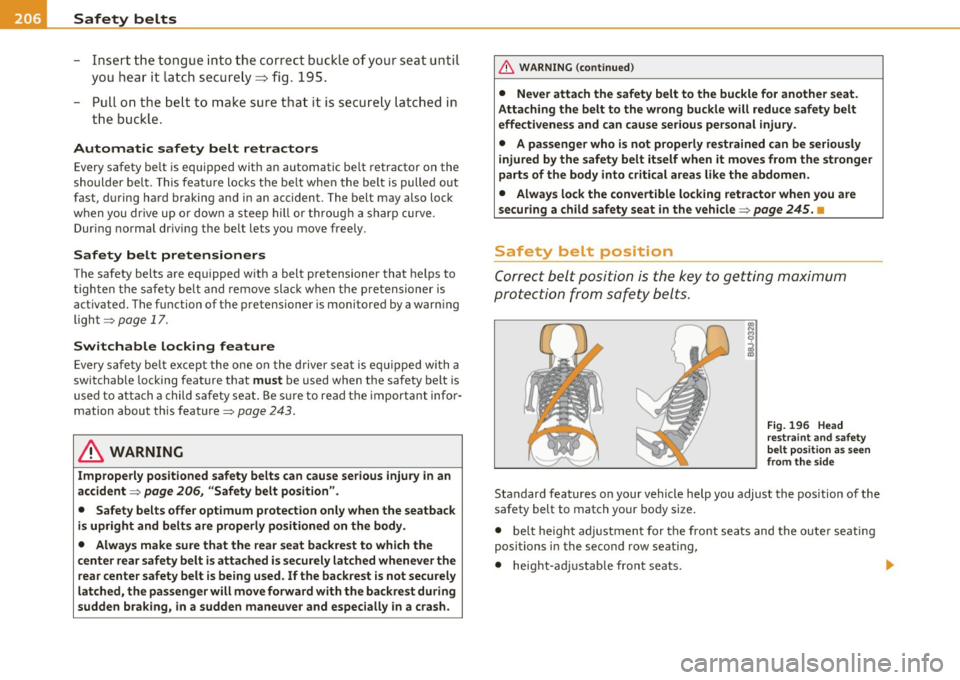
Safety belt position
Correct belt position is the key to getting maximum
pro tection from safety belts .
Fig. 196 Hea d
r e str aint a nd safet y
belt po sit ion a s seen
from the side
Standard features on your vehicle help you adjust the position of the
safety belt to match your bo dy size.
• belt h eigh t adjustment for the front seats and the oute r seat ing
positions in the second row seating,
• height-ad justable front seats. .,
Page 215 of 392
Airbag system Ill
----------------=--=---
Child restraints on the front seat - some important things to know
- Be su re to re ad t he i mpo rt a nt i nfo rmation a nd heed the
WA RNINGS fo r i mporta nt details about chil dre n and
Advanced Airbags ~
page 233.
Even t hough your ve hicle is eq uipped with an Advanced Airbag
System, ma ke ce rtain that a ll chi ld ren, especia lly those 12 years an d
younger, always r ide in the back seat prope rly rest rained fo r th eir age
and si ze. The airbag on the passenger side makes the front seat a
po tentially da ngerous place fo r a child to r ide. The fro nt seat is not
the safest place for a ch ild in a forward-facing child safety seat. It can
be a very dange rous place fo r an i nfan t or a child in a rearward-fac ing
seat.
Th e Advanced Ai rbag System in your vehicle has been cer tified to
comply with the req uirements of Un ited States Federa l Moto r Veh icle
Sa fety Standard 208 as applicable at the time your vehicle was manu
factured.
The Standard requires the front airbag on the passenger side to be
tu rne d off ("s uppressed") if a c hild up to abou t one ye ar of age
restra ined in o ne of the rear -facing or forward -fac ing infant
restra ints listed in Federa l Moto r Vehicle Safety Standard 208 with
whic h the Advanced Airbag System in yo ur vehicle was cert ified has
been installed on the front passenger seat. For a listing of the ch ild
restra in ts that were used to certify compliance with the US Saf ety
Standard =>
page 235.
The PASSENGER AIR BAG OFF ligh t in th e in st rume nt p anel t ells you
when the front Advanced A irbag on the passenger side has been
tur ned off by the ele ct ronic con trol uni t.
Each time you t urn on the ignition, t he
PASSENGER AIR BAG OFF
light will come on for a few seconds and:
• will stay on if th e front passenger se at is no t oc cupied
Controls and equip
ment Safety first
Vehicle operation
• will stay on if there is a small ch ild or child restra int on the front
p assenge r se at
• will go off if the front passenger seat is occup ied by an adult as
reg iste red by t he weight -sens ing mat =>
page 222 , "M oni tor ing t he
Advanced Airbag System" .
T he
PASSENGER AIR BAG OFF light comes o n when t he control unit
de tects a total weight on t he front passenger seat that req uires the
front airbag to be t urned off .
If th e total weight o n the front passenger seat is more than th at of a
typical 1 year-o ld child but less than the weight of a small adult, the
fr on t a ir bag on the passenge r si de c an deploy (t he
PASSENGER AIR
BAG OFF
light does not come on) . If the PASSENGER AIR BAG OFF
light does not come on, the front airbag on the passenger side has
not been turned off by the electronic co ntrol unit and can deploy if
the control unit senses an impact t hat meets the conditions stored in
its memory.
For example, the airbag may deploy if:
• a small child that is heavier than a typical 1 year -old child is on the
front passenger seat (regard less of whether the chi ld is in one of the
child safety seats listed =>
page 235), or
• a child who has outgrown child restraints is on the front passenger
sea t.
If the fro nt passenger a irbag is tur ned off, the
PASSENGER AIR BAG
OFF
lig ht comes on in the instr ument cluster an d stays on.
Th e fron t airbag on t he pa sse nger side may
not de ploy ( the
PASSENGER AIR BAG OFF li ght does not illum inate and stay lit) even
if a small ad ult or teenager, or a passenger who is no t sitting upright
with their back against a non-reclined backrest w ith the ir feet on the
vehicle floor in front of the seat is on the front passenger seat
=>
page 192, " P roper seat ing pos itio n for the dr iver".
If the front passenger ai rbag dep loys, the Federal Standard requires
t he a irbag to mee t the "low risk" deployme nt cr iter ia to reduce the
risk of inj ury through interaction with the a irbag. "Low r isk" deploy
me nt o ccurs in those cras hes t hat tak e pla ce a t lower decelerat io ns as
I),
Vehicle care Do-it-yourself service Technical data
Page 216 of 392
........ _A_ ir_ b_ a-=g :..- s.:o.y _s _t _e_ m _______________________________________________ _
defined in the elect ronic contro l unit~ page 223, "PASSE NGER AIR
BA G OFF l ight ".
Always r emembe r, a c hild safety seat o r infa nt ca rr ie r i nsta lled on th e
fro nt seat may be struc k and k noc ke d out of position by t he ra pidly
i nflat ing pass enge r's air ba g in a fr ontal c oll ision. Th e airba g could
g reat ly re duce the effectiveness o f th e ch ild restraint an d even seri
ousl y injur e th e child d uring inf lation .
For this r easo n, and b eca use the back seat is th e sa fest plac e for chil
dre n -whe n pro per ly restra ined acc ordin g to their age and size -we
s tr ong ly r ecommen d that childr en a lways sit in the back s eat
~ pa ge 233, "Child S afety".
& WARNING
A child in a rearward -facing child safety seat installed on the front
passenger seat will be seriously injured and can be killed if the
front airbag inflates - even with an Advanced Airbag System.
• The inflating airbag will hit the child safety seat or infant
carrier with great force and will smash the child safety seat and
child against the backrest, center armrest, door or roof .
• Always install rear-facing child safety seats on the rear seat.
• If you must install a rearward facing child safety seat on the
front passenger seat because of exceptional circumstances and
the PASSENGER AIR BAG OFF light does not come on and stay on,
immediately install the rear-facing child safety seat in a rear
seating position and have the airbag system inspected by your
authorized Audi dealer.
• Forward-facing child safety seats installed on the front
passenger's seat may interfere with the deployment of the airbag
and cause serious personal injury to the child.
& WARNING
If , in exceptional circumstances , you must install a forward-facing
child restraint on the front passenger's seat:
& WARNING (continued)
• Always make sure the forward-facing seat has been designed
and certified by its manufacturer for use on a front seat with a
passenger front and side airbag.
• Never put the forward-facing child restraint up against or very
near the instrument panel.
• Always move the passenger seat into its rearmost position in
the seat's fore and aft adjustment range, as far away from the
airbag as possible before installing the forward-facing child
restraint. The backrest must be adjusted to an upright position.
• Make sure that the PASSENGER AIR BAG OFF light comes on
and stays on all the time whenever the ignition is switched on.
& WARNING
To reduce the risk of serious injury, make sure that the PASSENGER AIR BAG OFF light will be displayed whenever a child
restraint is installed on the front passenger seat and the ignition
is switched on .
• If the PASSENGER AIR BAG OFF light does not stay on, perform
the checks described
~ page 222, " Monitoring the Advanced
Airbag System ".
• Take the child restraint off the front passenger seat and install
it properly at one of the rear seat positions if the PASSENGER AIR
BAG OFF light does not stay on .
• Have the airbag system inspected by your authorized Audi
dealer immediately.
• Always carefully follow instructions from child restraint manu
facturers when installing child restraints.
& WARNING
If , in exceptional circumstances , you must install a forward or
rearward-facing child restraint on the front passenger 's seat:
Page 219 of 392
_______________________________________________ A_ ir_ b_ a_,,,g '--- s.:.y _s _t_ e _ m ___ lffll
When a perso n is detected on t he front passenger seat, weigh ing
more th an t he tot al we igh t of a ch ild t hat i s abo ut 1 ye ar old
restra ined in o ne of the rea r-facing or forward-fac ing infant
restra ints (liste d in Fed eral Moto r Ve hicl e Safety Stan dard
20 8 with
w hic h the Advanced Airbag System in your veh icle was c ert ified), the
front airbag on the passenge r side may o r may not dep loy.
Th e
PASSENGER AIR BAG OFF ligh t comes on when the ele ct ro nic
control u nit detects a total weig ht on t he front passenger seat that
re qui res t he fr on t air bag t o be tur ned o ff. If the
PASSENGER AIR
BAG OFF
lig ht does not come on, the fro nt airbag o n the passenger
s ide has not been turned of f by the con trol un it and can dep loy i f the
cont rol un it se nses an impact that meets the conditions stored in its
memory.
If the tota l weight on the fro nt passenger sea t is more than that of a
typical
1 year-o ld, but less than the weight of a small adult, t he front
a irbag o n the p assenge r si de may dep loy (t he
PASSENGER AIR BAG
OFF
light does not come on).
For example , the airbag may deploy if:
• a small child tha t is heav ie r th an a typical 1 year-old child is on t he
front passenger seat (regard less of whet he r the ch ild is in one of the
c hild s afe ty sea ts listed=>
page 23 5),
• a child who has outgrown child restraints is on the fro nt passenger
se at.
If the front passe nger a irbag is turned off, the
PASSENGER AIR BAG
OFF
ligh t in the center o f the i nstr ument pa nel will come on and s tay
on .
T he front airbag on the passenger side may
not dep loy (t he
PASSENGER AIR BAG OFF light do es not illum inate and s tay lit) if:
• a small adu lt or teenager is on the fro nt passenger seat
• a p assenge r w ho is not si tt ing upri ght w it h t hei r ba ck again st a
non -reclined backrest with their feet on the veh icle floo r in front of
t he seat is on the fro nt pa ssenge r seat .
If the fro nt passenger airbag deploys, the Federa l Standard requ ires
t he a irb ag to mee t the " low r is k " deployme nt c riter ia to help reduce
Controls and equip
ment Safety first Vehicle operation
the
risk of i njury t hrough interaction with t he a irbag. "Low r isk"
dep loyment o ccurs in t hose cra sh es t hat tak e p lace at lowe r decele r
ations as defi ned in the elect ronic contro l u ni t.=>
page 222
Always remember: Even thou gh your vehicle is eq uipped with
Advanced A irbag s, th e sa fe st pla ce for childre n is properly res trained
on the back seat. Please be sure to rea d th e important informat io n i n
t he sec tio ns tha t foll ow and be su re to heed all of the WAR NIN GS.
& WARNING
To reduce the risk of injury when an airbag inflates, always wear
safety belts p roperly .
• If you are unrestrained, leaning forward, sitting sideways or
out of position in any way , your ri sk of injury is much higher.
• You will also receive serious injuries and could even be killed if
you are up again st the airbag or too close to it when it inflates -
even with an Advanced Airbag=>
page 211.
& WARNING
A child in a rearward-facing child safety seat installed on the front
pas senger seat will be seriously injured and can be killed if the
front airbag inflates - even with an Advanced Airbag System.
• Although the Advanced Airbag System in your vehicle is
designed to turn off the front airbag when a rearward-facing child
restraint has been installed on the front passenger seat, nobody
can absolutely guarantee that deployment is impossible in all
c onceivable situations that may happen during the useful life of
your vehicle .
• The inflating airbag will hit the child safety seat or infant
carrier with great force and will smash the child safety seat and
c hild against the backre st, center armre st, door , or roof .
• Always install rearward-facing child restraints on the rear seat.
• If you must install a rearward facing child safety seat on the
front passenger seat because of exceptional circumstances and
IIJ,,
Vehicle care Do-it-yourself service Technical data
Page 220 of 392
........ _A_ i_rb _ a_,g,:;._ s_, y'- s_ t_e _m ________________________________________________ _
& WARNING (conti nued)
the PASSENGER AIR BAG OFF light does not come on and stay on,
immediately ins tall the rear-facing child safety seat in a rear
seating position and have the airbag system inspected by your
authorized Audi dealer .
& WARNING
If, in exceptional circumstances, you must install a forward-facing
child restraint on the front passenger 's seat:
• Always make sure the forward-facing seat has been designed
and certified by its manufacturer for use on a front seat with a
passenger front and side airbag.
• Never put the forward-facing child restraint up against or very
near the instrument panel.
• Always move the passenger seat into its rearmost position in
the seat 's fore and aft adjustment range, as far away from the
airbag as possible, before installing the forward-facing child
restraint. The backrest must be adjusted to an upright position.
• Make sure that the PASSENGER AIR BAG OFF light come s on
and stays on all the time whenever the ignit ion is switched on .•
Advanced Airbag System components
T he front passenger seat in your veh icle has a lot of very important
parts o f the Advanced A irba g System in it. These parts incl ude t he
we igh t-sens ing ma t, sensors, wiring, brackets, and more. The func
t ion o f th e sys tem in the fron t passenger sea t is chec ked by the elec
tron ic control unit w hen the ignit ion is on . The contro l u ni t mo nitors
the Advanced Airbag System and tu rns the airbag indicator light on
w hen a malfunct ion in t he system components is de tected. The func
tion of the a irbag indicator light is descr ibed in greater detail below.
Be cau se the fr ont p assenge r se at con tain s im po rt an t p arts of th e
Advanced Airbag System, you m ust take care to prevent it from being damaged. Damage to the seat may prevent the Advanced A
irbag for
t he fro nt passenge r se at from do ing its job in a cr ash.
The front Advanced Airbag System consists of the
following:
• Cras h sensors in the front of t he veh icle that measure vehicle
a cc ele ra tion/de ce le ra tion to prov ide i nform ation to the Adv ance d
Airbag System about the severity of the crash .
• An e lec tron ic contro l uni t, w it h in tegr ate d cr ash sensor s fo r fron t
and side impacts. T he control unit "dec ides" w het her to fire the front
a irbags based on the info rm at ion rece ive d fr om t he c rash se nso rs.
The contro l unit also "decides" whether the safety be lt prete nsione rs
shoul d be activa ted .
• An Advanced Airbag with gas generator for the driver inside the
s t eeri ng wheel hub.
• An Advanced Airbag with gas generator inside the inst rument
p an el f or the front p assenge r.
• A weight-sensin g mat under the upho lstery padd ing of the front
passe nge r seat c ushion t hat measu res the tota l we ight on the sea t.
T he informat io n registered is sent cont inuously to the elect ronic
con trol uni t to reg ula te deploymen t of t he fr ont Adv anced A irbag o n
the passenger side.
• An airbag mo nitoring syste m and indi cator light in the inst ru m ent
cl uster ~
page 222.
• Th e PASSENGER AIR BAG OFF light com es on an d stays on in t he
center of the instr ument pane l=>
page 223, fig . 203 a nd tells you
w hen the fron t Advan ced A irbag on t he passe nger side has been
turned off.
• A senso r below t he saf ety belt la tc h for the front s eat p ass enge r
to meas ure the tens ion on the safety be lt . The tension on the safety
be lt a nd the we igh t regis tere d by the weig ht-sensing mat help t he
cont rol un it "dec ide" w hethe r th e front airbag fo r th e front
p assenge r seat should be turned o ff or not~
page 213, "Ch ild
restraints on the front seat -some important th ings to know" . ._