brake fluid AUDI Q7 2011 Owner´s Manual
[x] Cancel search | Manufacturer: AUDI, Model Year: 2011, Model line: Q7, Model: AUDI Q7 2011Pages: 392, PDF Size: 93.29 MB
Page 280 of 392
-~_C_ le_ a_n_ i_ n_ g=- a_ n_d___. p_ ro_ t_e _c_ t_ i_o _n ___________________________________________ _
Cleaning and protection
General information
Regular care preserves vehicl e val ue.
Any automobile is exposed to industria l fumes, co rrosive road salt,
e tc. A well ca red for Audi c an look lik e new many ye ars after pur cha se.
Regu lar and correct care w ill contribute to mai nta in ing t he bea uty
a nd valu e of your Au di.
Furthermore, good care may be a condition for substantiating a
warranty claim should corrosion damage or paint defects occur.
Yo ur au thori zed Audi d eale r h as a var iety of dedicated vehicle-care
products
and can advise w hich ones to use for clea ning the exterior
a n d inter io r of your ve hicle.
W het her you use products recommended by Aud i or other comme r
cia lly availab le cleaning agents , please make sure yo u appl y them
co rrectly .
& WARNING
• Cleaning agents may be poisonous . Keep them out of the reach
of children.
• Heed all caution labels .
• Always read directions on the container before using any
product. Follow the directions carefully.
• Most chemical cleaners are concentrated and have to be
diluted .
• Use spot removing fluids only in well ventilated areas.
• Do not use gasoline, kero sene , diesel fuel , nail polish remover
or other volatile fluids . They may be toxic, flammable or
hazardous in other ways. Do not wash, wax or dry the vehicle with
the ign ition on or the engine running .
& WARNING (continued )
• Do not clean the under sides of chassi s, fenders , wheel covers,
etc. without protecting your hands and arms. You may cut your
self on sharp-edged metal parts.
• Moisture and ice on brakes may impair braking efficiency
~ page 259, "General information ". Test the brakes carefully
each time you wash the vehicle .
'£> For the sake of the environment
Select only envir onmenta lly fr iendly clea ning produc ts . Leftover
cleaning pro ducts sho uld not dis posed of i n the household waste .•
Care of exterior
Washing
F re quent w ashin g protec ts th e vehicle.
T he best protection aga inst env ironmental influences is frequent
w ashi ng and w ax ing. How oft en thi s is requ ired depen ds on :
• How m uch the vehicle is used
• Whe re the ve hicle is parke d (gar age, in the o pen un der tr ees, etc.)
• The seasona l and weather conditions
• Environ mental influences
T he longer bird droppings , insects , tree resin, road and industria l
gr ime, t ar, soo t, road sa lt and o ther ma ter ia ls remain on t he veh icle
body, the more lasti ng their destructive effects w ill be. H igh temper
atu res cause d by ex pos ure to intense s unlight int ensify the co rrosive
effect, part icu larly when humid ity is high as we ll.
~
Page 303 of 392

____________________________________________ ....:C _h_ e..:......::. c....:k :..:..in :....:..::: g!....::. a:..:..n.:... d:.:......: f....: i.:..ll :.:.i.:...n ::.:gi!-- __
Closing the engine hood
- Pull the hood down until the pressure from the struts is
reduced.
- Let the hood
drop down and latch in place. Do not try to
push it shut;
it may fail to engage=:> &.
& WARNING
A hood that is not completely latched could fly up and block your
view while driving.
• When you close the engine hood, check it to make sure the
safety catch has properly engaged. The hood should be flush with
the surrounding vehicle body parts.
• If you notice while driving that the hood is not secured prop
erly, stop at once and close it. •
Working in the engine compartment
Be especially careful whenever you work in the engine
compartment.
Whenever you must perform any work in the engine compartment,
for example checking and filling different fluids, there is a risk of injury, burns and accidents. To prevent personal injury always
observe the following WARNINGS. The engine compartment of any
vehicle is a hazardous area=>& .
& WARNING
To help avoid injury, before you check anything under the hood:
• Turn off the engine.
• Remove the ignition key.
• Apply the parking brake.
Safety first
& WARNING (continued)
• Move selector lever to "P" (Park).
• Always let the engine cool down. Hot components will burn
skin on contact.
• To reduce the risk of being burned, never open the hood if you
see or hear steam or coolant escaping from the engine compart
ment. Wait until no steam or coolant can be seen or heard before
carefully opening the hood.
• Keep children away from the engine compartment.
• Never spill fluids on hot engine components. They can cause a
fire. • Never touch the radiator fan. The auxiliary electric fan is
temperature controlled and can switch on suddenly.
• Never open the coolant reservoir cap when the engine is still
warm. The coolant system is pressurized and hot coolant could
spray out.
• Protect your face, hands and arm from steam or hot engine
coolant by placing a thick rag over the cap when you open the
coolant reservoir.
• If work on the fuel system or the electrical system is necessary:
- Always disconnect the battery.
- Never smoke or work near heaters or open flames. Fluids in
the engine compartment could start a fire.
- Keep an approved fire extinguisher immediately available.
• To avoid electrical shock and personal injury while the engine is
running or being started, never touch:
-Ignition cables
- Other components of the high voltage electronic ignition
system.
• If you must perform a check or repair with the engine running:
- First, fully apply the parking brake, move selector lever to
"P" (Park). .,
Vehicle care Technical data
Page 304 of 392
., __ C_h_ e_c _k _i_n -=g :a,__ a_n_ d_ f_ i_ l _li _n _,g;._ __________________________________________ _
& WARNING (continued)
-Always use extreme caution to prevent clothing, jewelry, or
long hair from getting caught in the radiator fan, V-belts or
other moving parts, or from contacting hot parts. Tie back hair
before starting, and do not wear clothing that will hang or
droop into the engine.
• Minimize exposure to emission and chemical hazards=:>
/1::..
& WARNING
California Proposition 65 Warning:
• Engine exhaust, some of its constituents, and certain vehicle
components contain or emit chemicals known to the State of Cali
fornia to cause cancer and birth defects and reproductive harm. In
addition, certain fluids contained in vehicles and certain products
of component wear contain or emit chemicals known to the State
of California to cause cancer and birth defects or other reproduc
tive harm.
• Battery posts, terminals and related accessories contain lead
and lead compounds, chemicals known to the State of California
to cause cancer and reproductive harms. Wash hands after
handling.
0 Note
When adding fluids, a lways make sure that they are poured into the
proper container or filler open ing , otherwise serious damage to
vehicle systems wi ll occur.
ci> For the sake of the environment
To detect leaks in time, inspect the vehicle floor pan from underneath
reg ular ly. If yo u see spots from oil or other vehicle fl uids, have your
vehicle inspected by an authorized Audi dea ler .•
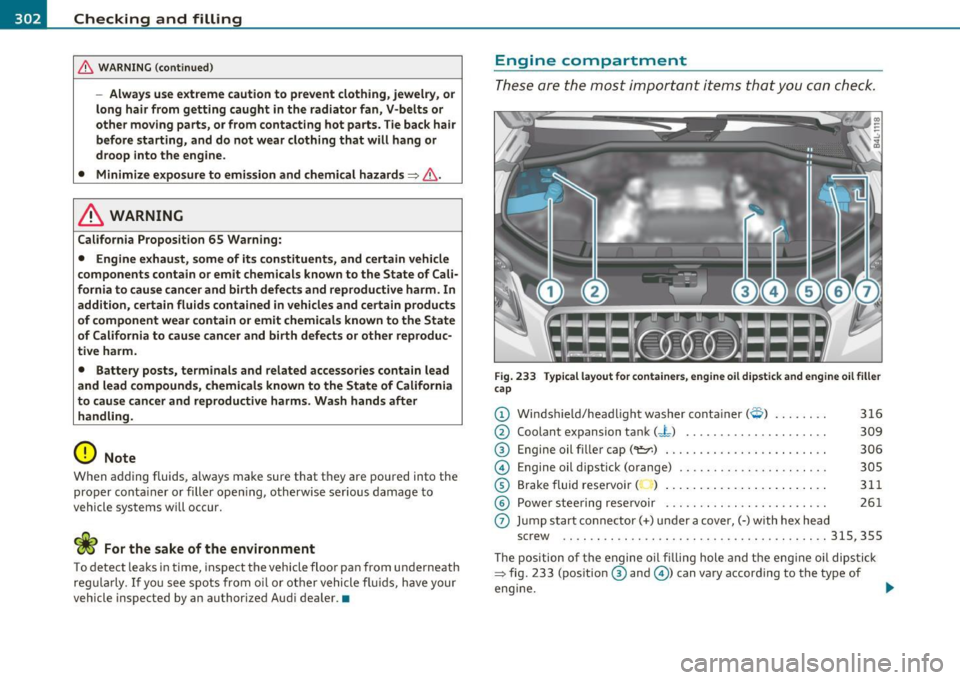
Engine compartment
These are the most important items that you can check.
Fig. 233 Typical layout for containers, engine oil dipstick and engine oil filler
cap
© Windshield/headlight washer container ( q ) ... .... .
@ Coolant expansion tank (- L ) ..... ......... ... .. . .
® Engine oil f iller cap ("l!::r.) .......... ...... .. .. .. . .
© Engine oil dipstick (orange) ... .. .... .. .. ... . .. .. .
® Brake fluid reservoir ( ) ................. ... .. . .
©
0
Power steering reservoir ... .... .. .... .. ... ..... .
Jump start connector( +) u nder a cover,(-) with hex head 316
309
306
305
311
261
screw .. ... ... ...... ........ ......... .... .. .. 315,355
The position of the engine oil filling hole and the engine oil dipstick
=:> fig. 233 (position ® and ©> can vary according to the type of
eng ine.
Page 313 of 392

Checking and filling -
------------- ------=------=:;______,.J,,...
<£> For the sake of the environment
Drained coolant sho uld not be reused. A lways dispose of used coolan t
w hile observing a ll enviro nmental regulations .•
Radiator fan
The radia tor fa n switc hes on a utoma tically by itself
The radiator fan is driven by the engine via the V-belt. The v iscous
cl utch reg ulates the spee d of t he fan accord ing to t he tem pera ture o f
the coolant.
An aux ili ar y e lec tric r adi ator fan* sw itches on and o ff depend ing o n
coo la nt temperat ure and other vehicle operating conditions.
After you switch the engine off, the auxiliary fan can continue r unning
for up to 10 minutes -eve n w it h t he igni tion o ff.
It can even swit ch on
again later by itse lf => & , if
• t he tem pera ture of the e ngi ne coola nt rises due to the hea t build
up from the eng ine in the engine compa rtment, o r
• th e engine compar tmen t heats up because the ve hicl e is parked in
intense s unlight.
& WARNING
• To reduce the risk of personal injury never touch the radiator
fan .
• The auxiliary electric fan is temperature cont rolled and can
switch on suddenly even when the engine i s not running.
• The auxiliary radiator fan switche s on automatically when the
engine coolant reaches a certain temperatu re and will continue to
run until the coolant temperature drops. •
Vehicle OP-eration
Brake fluid
Checking brake fluid level
The brake flu id l eve l can be checke d with a quick gl ance .
Fig . 238 E ngine
compa rtment : Brake
fluid rese rvoir
Before you check a nyt hin g i n th e eng ine compa rtment ,
always read and heed all WARNINGS=> & in " Working in
the e ng ine compartmen t" on
page 301 .
-Read the brake fluid level from t he bra ke flu id reservoir
=> fig. 238 . T he bra ke fluid leve l must be between the
" MIN " and "MAX" markings.
Th e brake fl uid rese rvoir is located at the rear partition of t he engine
compartment on the left side=>
page 302.
The fluid level may drop slightly after some time due to the auto
m atic adjus tment o f th e brake pads. This is no t ca use for alarm .
If the brake fluid level falls
considerably below the "MIN" mark, t he
brake warn ing/i nd icator lig ht ( U.S. models :
BRAKE, Canadian mode ls:
ill ) will come on=> page 20 and=> page 34. Do not continue to
operate the vehicle . The complete brake system s hould be thorough ly
che cked by an au thori zed Aud i dea le r o r q ua lified wor kshop a nd the
cause corrected.
If t h e brake fl uid leve l is too low, the brake .,,_
Vehicle care Do-it-yourselt service iTechnical data
Page 314 of 392
![AUDI Q7 2011 Owner´s Manual Ill Checking and filling
---=-----=----------------
warning/ind icator light will illum inate . Contac t an authorized Aud i
de aler
immediately .
[ i ] Tips
T he b rake fl uid reservoir](/img/6/40276/w960_40276-313.png "AUDI Q7 2011 Owner´s Manual Ill Checking and filling
---=-----=----------------
warning/ind icator light will illum inate . Contac t an authorized Aud i
de aler
immediately .
[ i ] Tips
T he b rake fl uid reservoir")
Ill Checking and filling
---=-----=----------------
warning/ind icator light will illum inate . Contac t an authorized Aud i
de aler
immediately .
[ i ] Tips
T he b rake fl uid reservoir is located unde rneath t he cover. •
Changing brake fluid
Have the b rake fluid chan ged by an exp eri enc ed t echni
cian.
B ra ke flui d absorbs mois ture fro m th e air . If the w ater con ten t in the
brake fl uid is too high, corros io n in th e brake system may result afte r
a p eriod of time. The boil ing po int of the br ake fl uid will also de cre as e
cons iderab ly and decr ease brak ing performa nce.
Th erefo re, the brake fl uid m ust be changed
every two years. Always
use new br ake fluid w hich conforms to Federal Motor Veh icle Stan
dard "FMVSS 1 16 DOT
4" .
The b rake fl uid reservo ir can be diffi cult to rea ch, there fore, we
recommend that you have the brake fluid c hanged by your author ized
Audi dealer. Your dea ler has the correct tools, the rig ht b rake f luid
and the k now-how to do t his for you .
& WARNING
• Brake fluid is poisonous. It must be stored only in the closed
original container out of the rea ch of children!
• Brake failure can result from old or inappropriate brake fluid.
Observe these precautions:
-Use only brake fluid that meets SAE specification
J 1703 and
conforms to Federal Motor Vehicle Standard 116. Alway s check
with your authorized Audi dealer to make sure you are using
the correct brake fluid. The correct type of brake fluid is also indicated on the brake fluid reservoir .
& WARNING (co ntinued )
-The brake fluid must be new. Heavy use of the brakes can
cause a vapor lock if the brake fluid is left in the system too
long . This can seriously affect the efficiency of the brakes as
well as your safety . This could result in an accident.
0 Note
B rak e fluid will dam age the pai nt of yo u r ve hicl e.
<£> For the sake of the environment
Beca u se of the pr oblem of pro per dispo sal o f b rak e fl uid as we ll a s
the spec ia l too ls req uired and the necessary expertise, we recom
me nd that you h ave t he brake f luid chan ged b y yo ur a uth oriz e d Audi
dea ler. •
Battery
General information
Under normal operat ing co ndit io ns, the battery in your Aud i does not
need any maintenance. With high outs ide temperatures or long daily
dr iv es we re comme nd that yo u have th e ele ct rolyte level checked by
an a uth orized Audi dealer o r qualified wor kshop. The electro lyte leve l
s ho uld a ls o be che cked e ach time the batte ry is ch arge d=>
page 315.
Have the batte ry chec ked when yo u take yo ur vehicle in for serv ice.
Yo u ar e well advised to rep lace a batte ry that is older th an 5 years .
W ith certa in types of airbag deployme nt, the ba ttery is disconnected
from the vehicle e lectrica l system for safety reasons=>
& in "Repair,
c are and dis posa l o f the air bag s" on
page 225. ~
Page 331 of 392
________________________________________________ T_i_re _ s_ a _ n_d_ w_ h_ e_ e_l_s __ _
Tire pressure
Incorrect tire pressure cau se s prema ture we ar and c an cau se sudden
ti re blow-o ut. Fo r this reaso n, tir e press ure must be ch ecked at l eas t
once a mo nth ;:::,
page 324 .
Driving style
Driv in g fast aro und curves, heavy a cce le ra ti on and hard bra kin g
increase tire wea r.
Rotating tires for more even wear
Fo r all fou r tir es on your ve hicle to have the same service life, we
re co mm end th at t he fron t and rear tire s ar e rotat ed acco rd ing t o the
tire ma nufact urer's s uggested tire rotation intervals. Please
remem be r th e fo llow ing:
• Tir e ro tat io n in terv als ma y differ from t he ve hicle serv ice in terv als
out lined in your Warranty
& Maintenance bo oklet .
• Th e long er o ne tire is used i n one location on t he veh icle, t he mo re
it wears at certa in po ints; t herefore, we recommend t hat you follow
th e tir e m an ufac ture r's sugges ted tire r ota tion in te rv a ls .
• Vehicles w ith fro nt-w hee l dr ive experience mo re tread wea r on the
fron t w heels compared to all-whe el driv e (qua ttro ®).
• P leas e ro tate tires as sh own ;:::, fig. 244.
• Extra care m ust be ta ken when rotat ing direction-specific tires
=:, p age 3 48 .
Wheel balancing
The w heels on new ve hicl es a re bala nced. However, v ario us sit uatio ns
dur ing everyday driving can cause them to become unba lanced,
re su lt ing in vibra tions yo u can usually fee l throug h the stee rin g
w hee l.
Unbalanced whee ls mus t be rebalanced to avoid excessive wear on
s t eer ing, suspension and t ir e s. A wheel must also b e rebalanced
w hen a new tire is installed.
Safety first
Incorrect wheel alignment
Incorrec t wheel a lignment can c ause excessive t ire wear, im pair ing
t he sa fety o f the ve hicle . If t ires s how exc essive wear, hav e the wheel
alignment checked by an author ized A udi dealer o r qualifie d wo rk
shop.
All Wheel Drive
Vehicles with quattro ® must a lways have tires of the same s ize,
constr uctio n an d trea d type . For details see ;:::,
page 262.
& WARNING
Sudden tire failure can lead to loss of control, a crash and serious
personal injury!
• Never drive a vehicle when the tread on any tire is worn down
to the wear ind icators .
• Worn tires are a safety hazard, they do not grip well on wet
roads and increase your risk of "hydroplaning" and loss of control.
• Always keep chemicals that can cause tire damage, such as
grease, oil , gasoline and brake fluid away from tires.
• Tires age even if they are not being used and can fail suddenly,
especially at high speeds. Tires that are more than 6 years old can
only be used in an emergency and then with special care and at
lower speeds.
• Never mount used tires on your vehicle if you are not sure of
their "previous history." Old used tires may have been damaged
eventhoughthedamagecannotbeseenthatcanleadtosudden
tire failure and loss of vehicle control. •
Vehicle care Technical data
Page 377 of 392

Alphabetical index -________________ fWI
Alternator Auto-Check Control ..... .. .. .... ...... 32 State of charge ......... ..... .... 263
Malfunction ............. ........ . 34 Automatic belt retractor ............. 205 Voltage
......................... . 39
Ambience lighting Lighting profiles ................. . 73
Anti -freeze
See Engine coolant system ......... 308
Anti-glare inside day-night mirror . . . 79, 80
Anti -lock brake system
How the ABS system works ......... 260
Warning/indicator lights ... .. .... .. 19
Anti-S lip Regulation System (ASR)
How the system works ... .... .. .. . 258
Anti-theft systems
Anti-theft alarm system ........ .. .. 57
Electronic immobilizer ............. 45
Approach/departure angle ............ 270
Ashtray . ............. .. .. .. .. .... . 105
ASR How the Anti-Slip Regulation System works . ..... ... ... .. .. ......... 258
Asterisk What does it mean when something is
marked with an asterisk? ........... 6
Audi braking guard .................. 151
Error messages ............... ... 153
Settings ................ ..... ... 153
Status messages ................. 153
Switching on and off .............. 153
Audi Service Repair Manuals and Literature
368
AU TO mode
AC climate contro ls ...... .... .. .. . 114
Auto Safety Hotline .... .... ......... 199
Controls and equip
ment Safety first
Automatic car wash
See Washing
.................... 279
Automatic mode Four-zone automatic comfort air
conditioning ........... ...... .. 119
Automatic Sh ift Lock (ASL) ............ 165
Automatic transmission ... .. ......... 163
Automatic Shift Lock (ASL) ......... 165
Driving ......................... 163
Dynamic shift program ... .. .. ..... 166
Emergency release for selector lever . 168
Fail-safe mode ................ ... 168
Ignition key safety lock ............ 127
K ick-down .. ... .... .. .. .. ... .... 166
Manual shift program .. .. .. .. .. ... 167
Selector lever ............ ...... .. 164
Shift buttons . .. ................. 168
Steering wheel with tiptronic ® .... .. 168
Average speed ......... .. .. .......... 26
Avoid damaging the vehicle ........... 267
B
Bass box ... .. .. .... ............... 341
Battery . .. .... .. ... ....... ......... 312
Batte ry location ..... .. .. .... ..... 313
Charging ................ .. ... ... 315
Important warnings when working on the battery . .................... ... 313
Jump start ing ... ....... ....... ... 355
Low .... ........ ............. ... 263
Replacing the battery .... .. .. .. ... 316 Winter operation
................. 312
Working on the battery .. .......... 313
Before driving .. ................... . 191
Blended gasoline . .. .. ...... ....... . 291
Body cavity seal ing .................. 284
Booster seats .................... .. 241
Brake assistant . .. .................. 261
Brake booster ...................... 260
Brake fluid
Changing the b rake fluid .......... . 312
Checking the brake fluid level ....... 311
Reservoir ..... ................ .. 311
What is the correct brake fluid level? . 311
What should I do if the brake fluid warning
light comes on? . .. .... .......... 311
Brake light
Defective ... .. ................... 24
Brake system ..... .......... ...... .. 311
Anti-lock brake system ... .......... 19
Brake fluid .. .. ................ .. 311
Brake fluid spec ificat ions for refill and
replacement . .. .. ...... ....... . 312
Brake pads . ... ................ .. 265
General information ............ .. 259
How does moisture or road salt affect the brakes? . .... .. .. ..... ..... ... . 259
Ma lfunction .............. ...... .. 34
Parking brake .................... 132
Wa rning/indicator lights ... .... .. .. 20
Worn brake pads symbol ........... 39
Vehicle operation Vehicle care Do-it-yourself service Technical data
Page 381 of 392
___________________________________________ A_ l::.. p _h _a_ b_ e_t _ic _a_ l_ in_ d _ e_x __ _
Oil grades ...... ....... ..... .. .. . 303
Recommended oil check intervals ... 305
Specification and viscosity ......... 303
Engine oil level ...................... 40
Engine oil pressure
Malfunction ........ .... .. .. .. .. .. 36
Engine oil sensor defective ............. 40
Engine speed limitation ............... 40
Entry assist
Rear seats ......... ...... .. .. .. .. 91
Environment Break-in period .. .. .............. 265
Catalytic converter . .. ... ... .. ..... 266
Diesel particulate filter ... .. .. .. .. . 267
Disposing of your vehicle battery ... . 316
Driving at high speeds .......... .. . 268
Driving to minimize pollution and noise . 267
Fuel ............... ...... .. .. .. . 294
Fuel economy ............... ..... 267
Leaks under your vehicle .......... . 301
Letting the vehicle stand and warm up ..
268
Proper disposal of drained brake fluid 312
Proper disposal of drained engine coolant 310
Proper disposal of drained engine oil 306,
307
Recycling used engine oil ......... . 306
Unleaded fuel ........... .... .... 291
What should I do with an old battery? ...
316
EPC
See Electronic power control ........ 16
Controls and equip
ment Safety first
ESP
See Electronic
stabHization program (ESP)
16
Event Data Recorder (EDR) . ... ..... ... 256
Exhaust tai l pipes
Cleaning ...................... .. 285
Expansion tank .. ........... .. .. .. .. 309
Explanation of some technical terms ... 270
Exterior lighting in the mirror housing . .. 70
Eyeglasses compartment .... ......... 109
F
Fall line ...... ...... .... .. .. .. ..... 270
Fan Four -zone automatic comfort air
conditioning ................... 119
Radiator ................ .. ... ... 311
Fastening Booster seats ............ ...... .. 241
Convertible child safety seats ..... .. 239
Infant seats .. ................... 238
Filler flap ... .. .. .. ..... ... .... ... .. 298
Flat tire Changing . ... ................... 343
Floor mats ....................... .. 196
Fog lights ................. .. .. .. .. . 69
Folding chocks .. ... ....... ......... 340
Folding master key with remote control .. 42
Foot pedals ..... .. ................. 196
For the sake of the environment
Gasoline fumes an d the env ironment 294
Letting your engine warm up .. ..... 127 Reducing engine
noise by early upshifting
10
Refueling ... .. .. .. .............. 294
Saving fuel by early upshifting ....... 10
Using the rear window defogger .... 115
Four-zone automatic comfort air conditioning 118
Automatic mode in rear . .......... 119
Heated rear seats ...... ..... .. .. . 122
Rear air distribution ..... .. .. .. .. . 119
Rear controls ............ ... .. ... 118
Rear fan ............ .... ... ..... 119
Rear operation ...... ...... .. .. .. . 121
Reartemperature ............. .. . 119
Synchron ization .. .. ............. . 120
T urning on/off ................... 118
Front airbags Description .. .. .... ............. . 215
How they wo rk ...... ...... .. .. .. . 220
Front fog lights .......... .... .. .. .. .. 69
Front seats ......................... 85
Adjusting ....................... 193
Child restraints in the front seat ... . 213
Frontal collisions and the laws of physics 202
Fuel Additives ................ ...... . 291
Blended gasoline ................. 291
Consumption ........ . ... ... .. ... . 26
Filler neck . .. .. ... ... .. ...... .... 293
Fuel gauge .. .... .. .. .. ........... 12
Gasoline ........... .. .. .. .... .. . 291
Gasoline additives .. .............. 292
Low fuel leve l . . . . . . . . . . . . . . . . . 12, 39
Octane rating ....... .. .... .. .. ... 291
Vehicle operation Vehicle care Do-it-yourself service Technical data