height AUDI Q7 2011 Owner´s Manual
[x] Cancel search | Manufacturer: AUDI, Model Year: 2011, Model line: Q7, Model: AUDI Q7 2011Pages: 392, PDF Size: 93.29 MB
Page 210 of 392
•--=S..:a :..:f..:e :..:t:= Y :....:: b:....:e:..: l:..: t :..::s _____________________________________________ _
& WARNING
Improperly positioned safety belts can cause serious personal
injury in an accident.
• Expectant mothers must always wear the lap portion of the
safety belt as low as possible across the pelvis and below the
rounding of the abdomen.
• Always read and heed all WARNINGS and other important
information ~
& in "Fastening safety belts" on page 205. •
Unfastening safety belts
Unbuckle the safety belt with the red release button only
after the vehicle has stopped.
Fig. 198 Releasing
the tongue from the
buckle
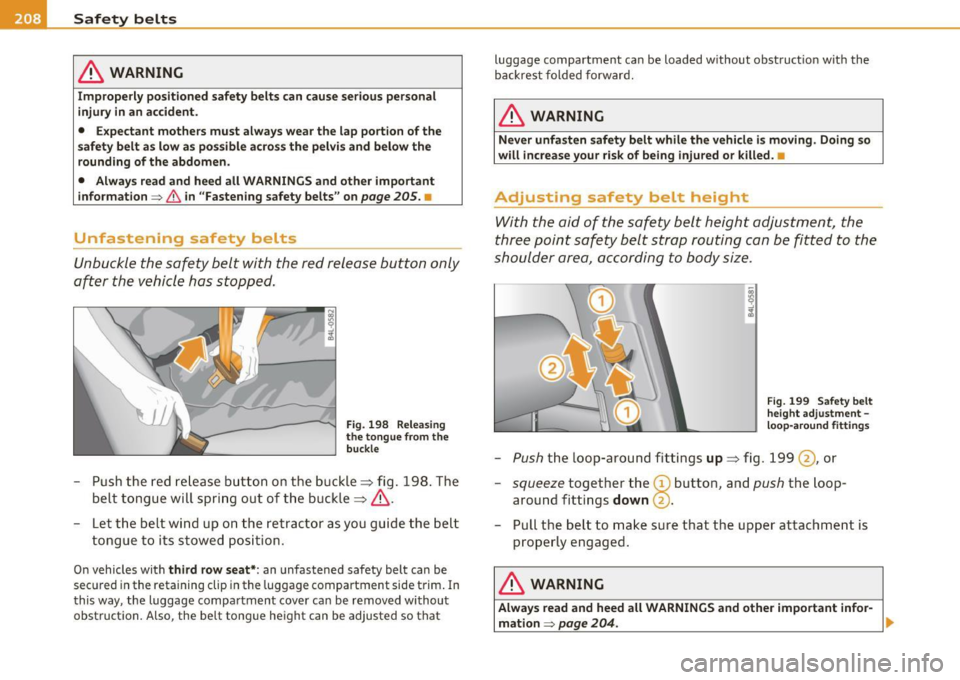
- Push the red release button on the buckle=> fig. 198. The
belt tongue will spring out of the buckle=>& .
- Let the belt wind up on the retractor as you guide the belt
tongue to its stowed position.
On vehicles with third row seat* : an unfastened safety belt can be
secured in the retaining clip in the luggage compartment side trim. In
this way, the luggage compartment cover can be removed without
obstruction. Also, the belt tongue height can be adjusted so that luggage compartment can be loaded without obstruction with the
backrest folded
forward.
& WARNING
Never unfasten safety belt while the vehicle is moving. Doing so
will increase your risk of being injured or killed.•
Adjusting safety belt height
With the aid of the safety belt height adjustment, the
three point safety belt strap routing can be fitted to the
shoulder area, according to body size .
Fig. 199 Safety belt
height adjustment -
loop-around fittings
-Push the loop-around fittings up => fig. 199 @ , or
- squeeze together the© button, and push the loop-
around fittings
down @.
- Pull the belt to make sure that the upper attachment is
properly engaged.
& WARNING
Always read and heed all WARNINGS and other important infor- mation :::;:,
page 204. .,
Page 211 of 392

_____________________________________________ S_a _f _e _t _y _b_ e_lt _ s __ _
[I) Tips
• T he shoulder belt part shou ld route approximate ly over the
middle of your shoulder -under no circumstances shou ld it route over
you r neck a nd throat area~
& in "Safety belt position" on page 206 .
• With the front seats, the height adjustment of the seat can also
be used to adjust the position of the safety belts. •
Improperly worn safety belts
Incorrectly positioned safety belts can cause severe inju
nes.
Wearing safety belts improperly can cause serious injury or
death. Safety belts can only work when they are correctly
positioned on the body . Improper seating positions reduce
the effectiveness of safety belts and will even increase the
ris k of injury and death by moving the safety belt to critical
areas of the body . Improper seating positions also increase
the risk of serious injury and death when an airbag deploys
and str ikes an occupant who is not in the correct seating posi
tion. A driver is responsible for the safety of all vehicle occu pants and especially for children. Therefore:
- Never permit anyone to assume an incorrect sitting posi
tion in the vehicle while traveling
~ & .
& WARNING
Impr ope rly w orn safet y belts inc re a se the ris k of se rious pe rsonal
injur y and de ath when ever a vehi cle i s bei ng u sed.
• Alw ay s m ake sure th at all vehicle occup ants are corre ctl y
r es trained an d stay in a correct seating po sition wh enever the
ve hicle is being used.
Controls and equip ment Safety first Vehicle operation
& WA
RNING (continu ed)
• Alw ays re ad and heed all WARNINGS and o ther imp ort ant
information ~
page 204. •
Safety belt pretensioners
How safety belt pretensioners work
In front, side and rear -end collisions above a particular
severity and in a rollover, safety belts ore tensioned auto matically.
The safety belts are equ ipped with safety belt pretensioners. The
system is activated by sensors in front, side and rear-end collisions of
great sever ity and in a rollove r. This tightens the belt and takes up
belt slack ~
& in "Service and disposal of safety belt pretens ioner"
on
page 210. Ta king up the slack helps to reduce forward occupant
movement during a collision.
0 Note
Never let the belt rema in over a rear seatback that has been folded
forward .
[ i ] Tips
Th e safety belt pretensioner can only be activated once .
• In m inor fronta l and side collisions, in rear-end coll isions and in
acc idents involving very little impact force, the safety belt preten
sioner are not activated.
• Whe n the safety belt p retensioners are activated, a fine dust is
re leased. This is normal and is not caused by a fire in the vehicle.
• T he relevant safety requirements must be observed when the
vehicle or components of the system are s crapped. An authori zed
Vehicle care Do-it-yourself service Technical data
Page 243 of 392
& WARNING (continued)
• Make sure the forward-facing seat has been designed and certi·
fied by its manufacturer for use
on a front seat with a passenger
front and side airbag.
• Always follow the manufacturer's instructions provided with
the child safety seat or infant carrier.
• Always move the front passenger seat into the rearmost posi
tion of the passenger seat's fore and aft adjustment range, and as
far away from the airbag as possible before installing the child
restraint.
• Always make sure that nothing prevents the front passenger's
seat from being moved to the rearmost position in its fore and aft
adjustment range.
• Always make sure the backrest is in an
upright position.
• Make sure that the PASSENGER AIR BAG
OFF light comes on
and stays on all the time whenever the ignition is switched
on.
• If the light does not stay on, perform the checks => page 222,
"Monitoring the Advanced Airbag System".
• Take the child restraint off the front passenger seat and install
it properly at one of the rear seat positions if the PASSENGER AIR
BAG
OFF light does not stay on whenever the ignition is switched
on. a
Safety first Vehicle OP-eration
Child Safety
Booster seats and safety belts
Properly used booster seats can help protect children
weighing between about 40 lbs. and 80 lbs. (18 kg and
36 kg) who are less than 4 ft.
9 in.
(57 inches/1.45 meters) tall .
Fig. 211 Rear seat:
child properly
restrained in a booster
seat
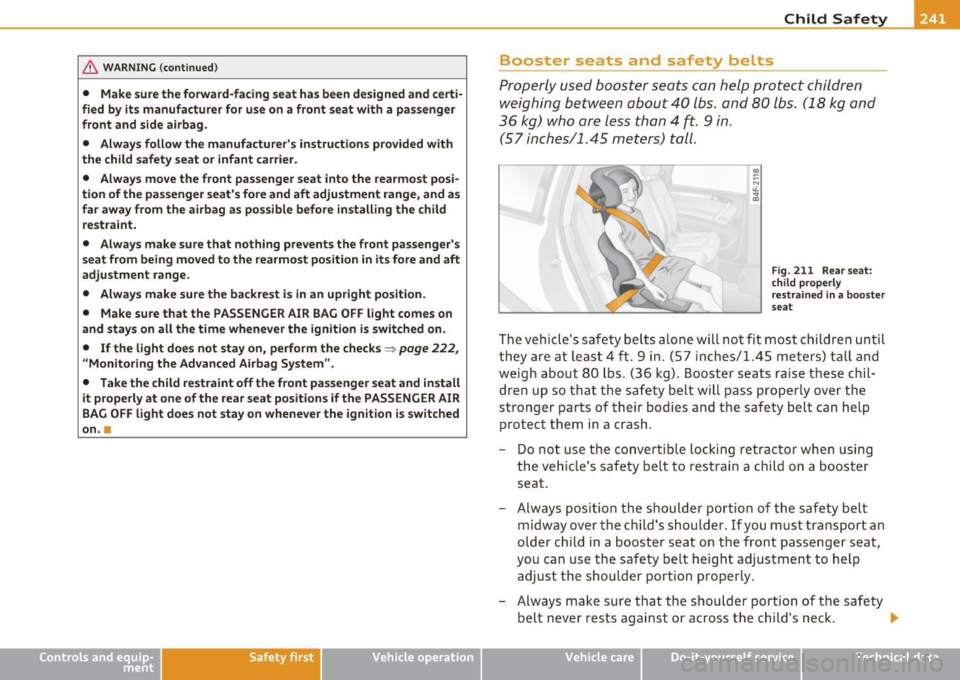
The vehicle's safety belts alone will not fit most children until
they are at least 4 ft. 9 in. (57 inches/1.45 meters) tall and
weigh about 80 lbs. (36 kg). Booster seats raise these chil
dren up so that the safety belt will pass properly over the
stronger parts of their bodies and the safety belt can help
protect them in a crash.
- Do not use the convertible locking retractor when using
the vehicle's safety belt to restrain a child on a booster
seat.
- Always position the shoulder portion of the safety belt
midway over the child's shoulder. If you must transport an
older child in a booster seat on the front passenger seat,
you can use the safety belt height adjustment to help
adjust the shoulder portion prop erly.
- Always make sure that the shoulder portion of the safety
belt never rests against or across the child's neck.
9'>
Vehicle care Do-it-yourselt service iTechnical data
Page 276 of 392

Trailer towing
~-----------------------------------------
& WARNING (cont inued)
• The Gro ss Vehicle Weight Rating for your Audi Q7 vehicle,
found on the safety compliance label on the driver's side B-pillar, must never be exceeded under any circumstances . Exceeding the
Gross Vehicle Weight Rating of your vehicle is likely to damage
your vehicle, and such damage will not be covered by your Limited
New Vehicle Warranty. Exceeding the Gross Vehicle Weight
Rating will also change the performance and handling character
istics of your vehicle, whi ch could cause a crash resulting in serious
injury or death.
• The Gro ss Vehicle Weight Rating for your Audi Q7 would be
exceeded if your vehicle is simultaneously equipped with
Panoramic sliding sunroof; third-row seating ; trailer towing
equipment (factory or dealer-installed ), and running boards
(dealer-installed) . UNDER NO CIRCUMSTANCES MAY ALL SUCH
ITEMS BE INSTALLED ON THE SAME VEHICLE .•
Operating instructions
M AX 6 .9"
MA X
175mm
Trailer towing weights
Fig. 223 Permitted
ball position of the
tra iler hit ch
With a factory -installed tra ile r hi tch, the maximum pe rmissib le
t ra iler weig ht is 6,615 lbs (3,000 kg). The maximum pe rmissib le
unbraked trailer we igh t is 1,650 lbs (750 kg) . With an
aftermarket
trail er hi tch, the m axi mum permissibl e traile r weig ht i s 5,5 12 lbs (2,500
kg) . These specifications app ly when driv ing on roads havi ng
an in cline o f less t han 12%.
Permissible tongue load
For best ve hicle handl ing un der t hese ch ange d co ndition s, adju st the
tra ile r l oad so that the tongue load is at the maxim um a llowab le or
sligh tly lower. You can get an app roxim atio n of the tongue load w it h
a bat hroom scale or you ca n measure the load at a t ruc king company
or we ighing st ation.
W it h a
factory-installed trailer h itch, the max imum pe rmissible load
on t he ba ll hitc h may not exceed 662 lbs (300 kg). W it h an
after
market
tra ile r hi tc h, t he ma ximum pe rm issi ble loa d on the b all hi tch
may not exceed 551 lbs (250 kg). It is recommended to use the
maxim um permi ssible loa d.
Trailer load distribution
Be su re the load in t he tra ile r i s held se curely in p lace to p revent it
from shi fting forward, backwa rd or sideways.
Never allow a passenger to ride in a trailer=> & in "Dr ivin g in struc
t ions" on
page 275.
Ball mount
The tra ile r hitch may on ly be used w ith suitable ball mount and ball
=> fi g. 223 . Ins tallat ion of the hi tch b all mus t be c arrie d out in acco r
dance with the manufacturer's instructions . At the height d imension
of 1. 5 in (38 .5 mm) a toler ance of+/- 0.5 in ( 12. 7 mm ) is per miss ible
Engine cooling system
Towing a trailer makes t he eng ine work harder. It is impo rtant that
t he cooling system 's performan ce is up to the addi tional loa d. Mak e
sure that the coo ling system has enough fluid .
Tire pressure
When towing a trailer, inf late the tires ofyourvehicle to the cold tire
pre ssure listed unde r "Full lo ad" on t he tire pre ssu re lab el. Th e tire ...
Page 281 of 392

____________________________________________ C_l_e _a_ n_ i n--= g=--- a_n_ d----' p,__ r_o _t_ e_ c_ t_ i _o_ n __ _
Under certain circumstances, weekly washing may be necessary .
Under o ther conditions, a mont hly w ashi ng and waxi ng may be
adequate.
After the winter, the underside of the vehicle s hou ld be tho roughly
washed, p refe rably in a profess ional car was h.
& WARNING
Always read and heed all WARNINGS and other information
~ page 278. •
Automatic car wash
The vehicle can be washed in almost any mod ern auto
matic car wash.
T he vehi cle p aint is so dura ble tha t the vehicle c an norm ally be
washed without problems in an automatic car wash . H owever, the
effect on t he pa int depends to a la rge ex ten t on t he desig n of the
facility, the filter ing of the was h water, t he type of wash and care
material, etc . If t he pa int has a dull appearance after going through
t he ca r wash or is sc ratched, bring this to the attention of the ope r
ator immediately . If necessary, use a different car wash .
Be fore goi ng th ro ugh a car wash, be s ure to take the usual precau
tions such as clos ing the windows and the Panoramic s lid in g su nroof.
Fa cto ry inst alled a ntennas must no t be removed .
If you have installed addit ional accessories on the vehicle -such as
spoilers, roof rack, etc . - it is best to ask the car wash ope rator if these
sho uld be removed.
& WARNING
Please take note of the following points before going through an
automatic car wa sh with your vehicle , so that you can avoid
damage to your veh icle.
Safety first
& WARNING (co ntinued )
• Compare the tra ck of your vehicle with the d istance between
the guide rails of the facility -there is a risk of damage to the
wheels and tires.
• Compare the height and width of your vehicle with the height
and width of the tunnel at the facility.
• Fold the exterior mirrors flat -there is a risk of damaging the
e xterior mirrors . Power folding e xterior mirrors* must not be
folded in or out by hand. Use the power function!
• Do not allow the wiper blade to fall onto the wind shield after
the vehicle is dr ied · there is a risk of damag ing the paint on the
hood .
• Always read and heed all WARNINGS and other information
~page 278. •
Washing the vehicle by hand
A lot of water is needed wh en washing a vehicl e by hand.
- Before you start washing , ma ke sure you have read and
u nders tood the WARNIN GS =>
& in "General informa
t io n" o n page
278.
- Fir s t soak all dried dir t until it is soft, the n rinse it off.
- As yo u clean yo ur vehic le, start w ith th e roof and work you r
way do wn to the bottom, us ing a sponge , a sponge g love
or a clean bru sh .
- Rin se the sp ong e or t he s po nge glo ve o ften, flushing it
cl ean each t im e.
- U se spe cia l car shampoo only for ve ry pe rsiste nt dirt .
- Rinse the car thoroug hly with wate r.
- U se a ch amo is leat her to gently w ipe t he ex ter ior d ry . •
Vehicle care Technical data
Page 332 of 392
___ T_ i_ r _e _s_ a_n_ d_ w_ h_ e_e_ l_ s _______________________________________________ _
New tires and replacing tires and wheels
New tires and wheels have to be broken in.
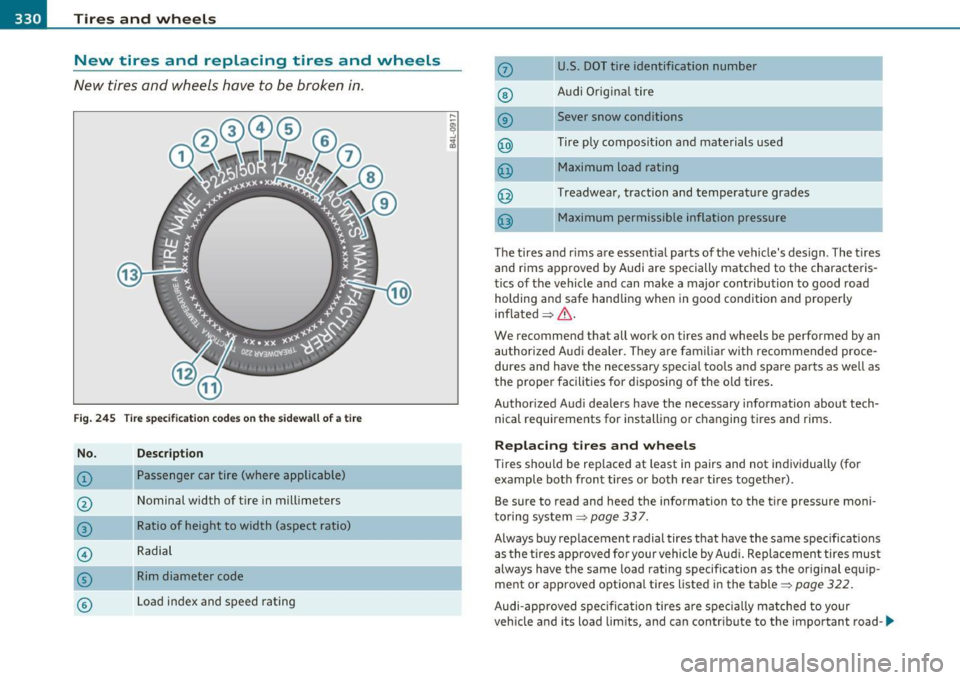
Fig. 245 Tir e speci fication co des o n the sidew all of a tire
No.
©
@
®
©
©
©
Des cript ion
Passenger car tire (where applicable)
Nominal width of t ire in mill imeters
Ra tio of height to width (aspect ratio)
Radial
Rim diameter code
Load index and speed rating
0
©
®
@
@
U.S . DOT tire identification number
A udi O rigi na l tire
Sever snow conditions
Tire ply composit io n and materials used
Maximum load rating
@ Treadwear, traction and temperature grades
@ Maximum permissible inflation pressure
The tires and r ims are esse ntial parts of the vehicle's des ign. The tires
and r ims approved by Audi are specially matched to the characteris
tics of the vehicle and can make a major contribution to good road holding and safe hand ling when in good condition and properly
inflated
~ & .
We recommend that all work on tires and wheels be performed by an
author ized Aud i dea le r. They a re fam iliar with recommended proce
dures and have the necessary special tools and spare parts as well as
the prope r facilit ies for d isposing of the old tires .
Author ized Aud i dea le rs have the necessary information about tech
nical requireme nts for installing or changing tires and rims .
Replacing tires and wheels
Tires shou ld be rep laced at least in pairs and not individually (for
example both front tires or both rear t ires togethe r) .
Be sure to read and heed the information to the t ire pressure moni
t oring system~
page 33 7.
Always buy replacement radial tires that have the same spec ificat ions
as the ti res approved fo r your vehicle by Aud i. Replacemen t tires mus t
always have the same load rating specif ication as the or iginal eq uip
me nt or approved opt iona l tires listed i n the table ~
page 322.
Audi -app roved spe cifi cati on tires are spe cia lly mat ched to yo ur
vehicle and its load lim its, and can contr ibute to the important road-..,_
Page 333 of 392

Tires and wheels Ill
----------------
holding, driving characteristics, and safety of the vehicle. The table
( =>
page 322) lists specifications of the tires approved for the Audi
models covered by your Owner's Literature .
Th e tire pressure label located on the driver's side B-pillar
=> page 322, fig. 242 lists the specifications of the original equ ip
ment tires insta lled on your vehicle at the time it was manufactured.
Federal law requires tire manufacturers to place standardized infor
mation on the sidewall of all tires=>
page 330, fig. 245. This infor
mation identifies and describes the fundamenta l characteristics, the
quality grade of the tir e and also provides a tire ident ification number
for safety standard certification and in case of a reca ll.
Tire specifications
Knowledge of tire specifications makes it easier to choose the correct
tires . Radial tires have the tire spec ifications marked on the s idewall,
for example:
P255 / 55 R 18 109 H XL
This contains the following information:
P Indicates the tire is for passenger cars (where applicable)
255 Nominal tire width in mm of the tire from sidewall edge to side-
wall edge. In general, the larger the number, the wider the tire
55 Height/width ratio in percent (aspect ratio)
R Tire construction: Rad ial
18 Rim d iameter code ( in inches)
109 Load rating code
H Speed rating letter code
XL (or "xl", "EXTRA LOAD", or "RF" Indicates that the tire is a"Rein
forced" or an "Extra Load" tire
M+S (or "M/5") Indicates that the t ire has some mud and snow capa
bility
The tires could also have the info rmation of direction of rotation
=> page 318.
Safety first
Tire manufacturing date
The manufacturing date is a lso indicated on the tire sidewa ll
(poss ibly only on the
inner side of the wheel):
"DOT ... 2210 ... "means, for example, that the tire was produced in
t he 22nd week of 2010.
Speed rating (Letter code)
The speed rat ing letter code on the wheels ind icates the maximum
permissible road speeds =>
& in "Winter tires" on page 334.
P up to 93 mph (150 km/h)
Q up to 99 mph (158 km/h)
R up to 106 mph (1 70 km/h)
S up to 110 mph (180 km/h)
T up to 118 mph ( 190 km/h)
U up to 124 mph (200 km/h)
H up to 130 mph (210 km/h)
V up to 149 mph (240 km/h)
3>
Z over 149 mph (240 km/h)3>
W up to 168 mph (270 km/h)3
)
Y up to 186 mph (298 km/h)3>
Your vehicle is normally factory equ ipped with t ires, which possess
excellent driving characte ristics and give yo ur Audi opt imum dr iv in g
comfort. An electronic speed limiter=>
page 30 will normally prevent
your vehicle from going faster than the tire speed rating
=> &.
U.S. DOT Tire Identification Number (TIN) and tire
manufacture date
Th is is the tire's "ser ial number" . It begins w ith the letters "DOT" and
indicates that the tire meets all federal standards. The next two
numbers or letters indicate the plant where it was manufactured, and
the last four numbers represent the week and year of manufacture .
For example, the numbers 2210 mean that the tire was produced in
~
3> F o r tires w ith a maximum speed capab ili ty over 149 mph (240 km/h), tire
manufact urers somet imes use the letters "ZR."
Vehicle care Technical data
Page 354 of 392
-Fuses and bulbs PW.___ ______________ _
No. Consumer
10 HomeLink
11 Control module Gateway
1 2 Headlight range adjustment
Right cockpit fuse assignment
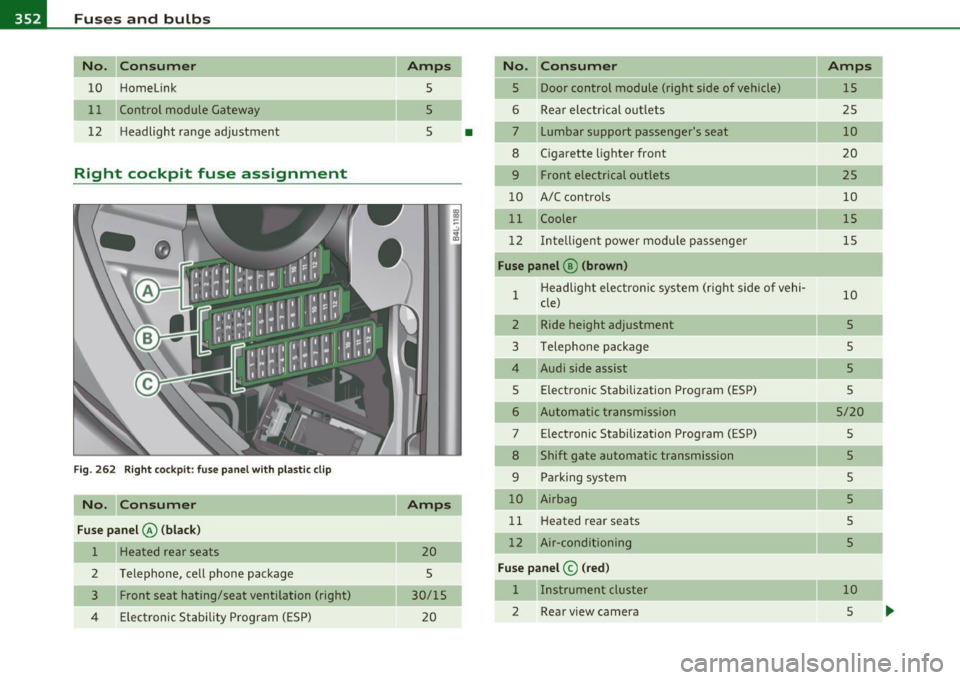
Fi g. 262 Right co ckp it : fu se pane l with plastic cl ip
No. Consumer
Fuse p anel © (black )
1 Heated rear seats
2 Telephone, ce ll phone package
3 Front seat hating/seat ventilation (right)
4 Electronic S tabi lity Program (ESP)
•
Amps
5
5
5
Amps
20
5
30/15
20
•
No . Consumer
5
Door control module (right side of vehicle)
6 Rear electrical ou tlets
7 Lumbar support passenger's seat
8 C igarette lighter front
9 Fron t electrical outlets
1 0 A/C contro ls
11 Cooler
12 I ntelligent power mo du le passenge r
Fuse panel® (brown)
1
2
3
4
5
6
7
8
Headlight ele ct ro nic sys tem (r ight side of vehi
cle)
Ride height adjustment
Telephone package Audi side assist Electronic Stabilization Program (ESP)
Automat ic transmission
Electronic Stabilization Program (ESP)
Shift gate automatic transmission
9 Pa rk ing system
11 Heated rear seats
12 Air-condition ing
Fuse panel © ( red )
1 Instrumen t cluster
2 Rear view camera
II Amps
15
25
10
20
25
10
15
15
10
5
5
5
5
5/20
5
5
5
5
5
5
1 0
5
Page 355 of 392
Fuses and bulbs -_______________ __.fWI
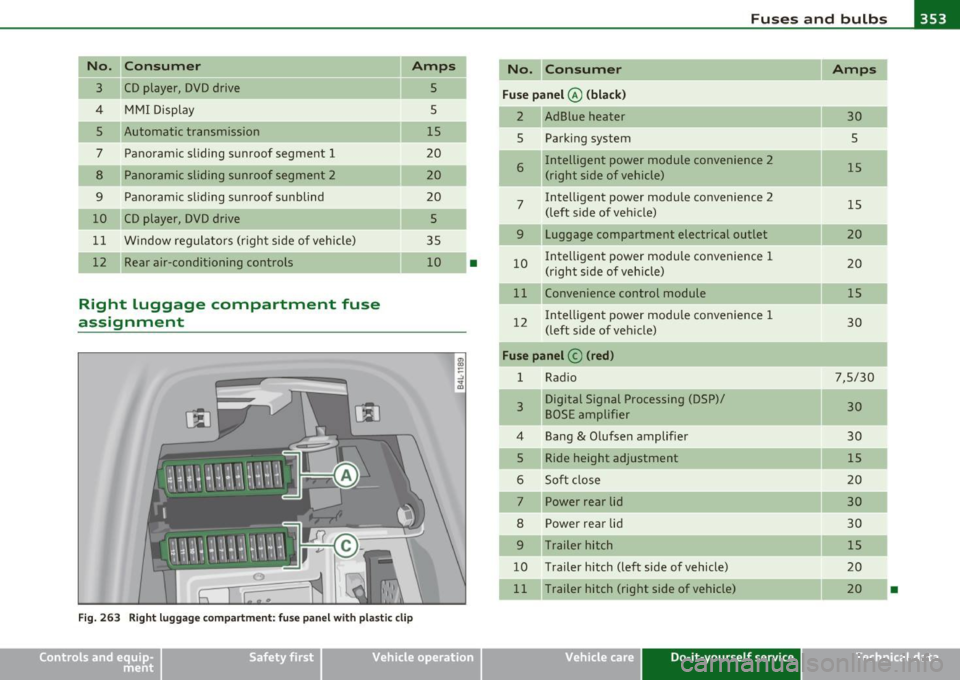
No. Consumer
3 CD player, DVD drive
4 MMI
Display
5 Automatic transmission
7 Panoramic sliding sunroof segment
l
8 Panoramic sliding sunroof segment 2
9 Panoramic sliding sunroof sunblind
CD player, DVD drive
11 W
indow regulators (right side of vehicle)
12 Rear air-conditioning controls
Right luggage compartment fuse
assignment
Amps
5
5
15
20
20
20 5
35 10
Fig. 263 Right luggage compartment: fuse panel with plastic clip
•
"' Q)
-
Vehicle OP-eration
No. Consumer Amps
Fuse panel @ (black)
2 AdBlue heater
30
5 Parking system
5
-
6 Intelligent power module convenience
2
15
(right side of vehicle)
7 Intelligent power module convenience 2
15
(left side of veh icle)
9 Luggage compartment electrical outlet 20
10 I
ntell igent power modu le convenience 1
20
(right side of vehicle)
11 Convenience control module
15
12 I
ntell igent power module convenience 1
30
(left side of veh icle)
Fuse panel © (red)
1 Rad io 7,5/30
3 Digital Signal Processing (DSP)/
30
BOSE amplifier
4 Bang & Olufsen amplifier 30
5 Ride height adjustment
15
6 Soft close 20
7 Power rear lid
30
8 Power rear lid 30
9 Trailer hitch 15
10 Trailer hitch (left side of vehicle)
20
1 1 Trailer hitch (right side of vehicle)
20
•
Vehicle care Do-it-yourself service iTechnical data
Page 386 of 392
___ A_ l_. p_ h _ a_b_ e_ t_ic _a_ l_ in_ d_e _ x ____________________________________________ _
Retractor ... .. .. .... .. .. .. ... ... . .. 205
Rims Cast a lloy . ... ... ... ... ... .... ... 284
Roof rack . .. .. .................. ... 102
Loading ..... ................. .. 103
Mounting locat ions . .. .. .. .. .. .. .. 103
Roof we ight ....... ... ............. 103
Rule of behavior offroad 270
s
Safe driving habits ... .. .. .. .. .. .. ... 190
Safety belt he ight ad justment .. .. .. .. . 208
Safety belt position .. .. .... ......... 206
Safety belt he ight adjustment ...... 208
Safety belts worn by pregnant women ...
2 07
Safety belt p retensioner ............. 209
Service and disposal ........ .... .. 210
Safety belt warn ing light .... .. .. .. 18, 201
Safety bel ts ... ................... .. 20S
cleaning ...................... .. 28 9
Dange r to passengers who do no t wear a
safety belt ............ ... ... ... 203
Fasten ing ... ...... .............. 205
Improperly worn .. .... .. ......... 209
N ot wo rn .... ................. .. 203
Safety bel t position ....... .. .. .. .. 206
Sa fety ins truc tions . .... ... .... . .. 204
Sec uring child sa fety seats ...... .. . 243
Special considerations fo r pregnant Why YOU MUST wear them .
.. .. .. . 201
Worn properly ............... ... . 204
Safety compliance sticker . ... .... ... . 362
Safety equipment ................... 190
Safety features for occupant restraint and protection . . . . . . . . . . . . . . . . . . . . . 19 0
Safety guidelines Seat adjustment ................ .. 85
Safety instructions Engine compartme nrt ...... .. .. .. . 301
for side curtain airbags ........... . 232
for using child safety seats .. .. .... . 236
for using safety be lt s ... .. ... .. .. . 204
Monitor ing the Advanced Airbag System
224
Safety lock
Igni tion key, au tomatic transmission 1 27
Seat ad justment
Adjusting the seat height manually ... 88
Adjusting the seatback ma nua lly . .. .. 88
Dr iver's seat .......... .... ....... 85
Dr ive r's seat memory ............ .. 89
Front passenger's seat .. .. .. ... .... 86
Front sea ts . . . . . . . . . . . . . . . . . . . . . . 85
Head res trai nts ......... .. .. .. 92, 19 4
M anu al con trols . ................. 88
Moving the seat forward o r bac kward
manua lly ....... ..... ........ ... 88
Powe r .. .. .. .. .. ... .... .. .. ... ... 86
Seat be lts
See Safety be lts ................ . 201
women .. ..... ........ ...... .. 207 Seat memory ...... .... ... . ... .... . . 8 9
Unfasten ing ·· ············ ···· ··· 208 Seat vent ilat ion .. ..... .... . ... .. .. . 121
Wa rning/ind icator light .. ......... 201 Seat
ing capac ity . ... ... .. . .. .. .. .. .. 201
Seat ing pos it ion
Driver ... .. .. .. ... ... ... .. .. . ... 192
Front passenger ... ... ... .. .. . ... 193
How to adjust the front seats ...... 193
Incorrect seat position ... ......... 195
Occupants . .. .. .... ............. 192
Rear passengers
Seats Numbe r of seats 194
201
Selective un lo ck feat ure .. .. ..... .. ... 49
Selector lever . .. .... .. ........... .. 164
Service and disposal Safety belt pretensioner . .... ... ... 2 10
Serv ice in terva l disp lay . ........... .. . 25
Service posit ion
Windshield wipers .. .... .......... 77
Servo tro n ic
Powe r stee ring . ..... .. .. .. .... .. 2 61
Shift buttons ..................... . 168
Side airbags Description ........ ............. 227
How they work ............ .... .. 228
Side ass ist
Act ivat ing and deact ivat ing . .. .. ... 154
Description . ... .. .. ..... ..... .. . 154
Informational and a lert stage signals 156
Messages in instrument cluster disp lay ..
16 1
MM I setti ngs ........ .. .... .... .. 160
Ope ra tion ..... .. .. ... .... .. . ... 156
Safety tips ..... .. .. .. .. ... .. . ... 162
Sensor detect ion area . ... ... ... ... 1 56