transmission AUDI Q7 2011 Owner´s Manual
[x] Cancel search | Manufacturer: AUDI, Model Year: 2011, Model line: Q7, Model: AUDI Q7 2011Pages: 392, PDF Size: 93.29 MB
Page 292 of 392
-~_C_ le_ a_n_ i_ n_ g=- a_ n_d___. p_ ro_ t_e _c_ t_ i_o _n ___________________________________________ _
Engine compartment
Be especially careful when cleaning the engine compa rt
men t.
Always switch off the ignition before cleaning the engine=:>& .
Plenum panel
Remove leaves from the plenum panel in front of the win dshi eld
unde r th e eng ine hood . T hi s prevents the water d rain holes from
becoming b locked, and it prevents debris from entering the vehicle
inter io r th rough the heat ing and vent ilation ducts .
Corrosion protection
The eng ine compartment and transmission have been cor rosion
protected at the factory.
Good ant i-cor rosion treatment is very impo rtant , pa rtic ular ly in the
w inter . If the vehicle is frequently driven on sa lt treated roads, the
en tire eng ine compar tment and plenum p anel sho uld be thoroug hly
cleaned at the end of winter and retreated to prevent salt damage. At
t he same t ime, the underside of the vehi cle should be washed as well.
If the e ng ine compartment is clea ned at any t ime with grease
removing so lutions
2l , or i f you have the engine washed , the anti
co rros io n treatment is a lmost a lways removed as w ell.
It is t herefore
essential to have a long-last ing corrosion p rotect ion reapplied to all
surfa ces, seams, jo ints and compo nents in the engi ne co mpa rt ment .
& WARNING
Be aware: The engine compartment of any motor vehicle is a
potentially hazardous area .
• Before working in the engine compartment, be sur e to read the
information =:>
page 290.
2
l Use on ly th e co rr ect clean ing so lut ions. Never use gaso line or diese l fuel.
& WARNING (c on tinued )
• Before reaching into the front plenum panel , alway s remove
the ignition key. Otherwise, the windshield wiper system could unintentionally be switched on , possibly causing personal injury
from the moving wiper linkage.
• Never reach into the area around or touch the radiator fan. The
auxiliary fan is temperature controlled and can switch on suddenly
· ev en when the ignition is off.
• Do not wash, wax or dry the engine with th e engine running.
Moving or hot pa rts could injure you.
• Do not clean the underside of the chass is, fenders, wheel
covers, or other hard to reach part s without protecting your hands
and arm s. You may cut yourself on sharp-edged metal parts.
• Always read and heed all WARNINGS and other information
=:> page 2 78. •
Page 321 of 392
________________________________________________ T_i_re _ s_ a _ n_d_ w_ h_ e_ e_l_s __ _
& WARNING (co ntinued )
• Tires age even if they are not be ing used and can fail suddenly ,
e specially at high speeds . Tires that are more than 6 year s old can
only be used in an emergency and then with special care and at low
s peed .
Glossary of tire and loading terminology
Accessory weight
means the combined weigh t (in excess of those sta ndard items wh ich
may be replaced) of automatic transmission, power steer ing, power
bra kes, powe r win dows, power sea ts, radio, and heate r, to the exte nt
that these items are available as factory-insta lled equipment
(whet her i ns ta lled or no t).
Aspect ratio
means the r atio of t he he ight to t he widt h of the t ire in percent.
N umbers of 55 or lower indicate a low sidewa ll for improved steer ing
res ponse and bet ter over all h andling on dry p avemen t.
Bead
means the part of the t ire that is made of stee l wi res, w rapped or
re in forced by ply cords and that is shaped to fit the rim.
Bead separation
means a brea kdown of the bond between components in the bead.
Cord
means the st rands forming the plies in the ti re.
Safety first
& W ARNING (co ntinued )
• Never mount u sed tires on your vehicle if you are not sure of
their "previous history ." Old u sed tires may have been damaged
eventhoughthedamagecannotbeseenthatcanleadtosudden
tire failure and loss of vehicle control.
• If you notice unusual vibr ation or if the vehicle pulls to one side
when driving, always stop as soon as it is safe to do so and check
the wheels and tires for damage. •
Cold tire inflation pressure
means the t ire pressu re recom mended by the vehicle manufa ctu rer
for a tire of a desig nate d size that has not been driven for more than
a couple of m iles ( kilomete rs) a t low speeds in the t hree hour per io d
before the tire pressu re is measured or adjusted.
Curb weight
means the weight of a moto r vehicle wit h standard equipment
incl uding the max imum ca pac it y of fue l, o il, and coo lan t, air condi
tioning and additiona l weig ht of optional eq uipment.
Extra load tire
means a tire design to operate at higher loads and at higher inflat ion
pressures than t he co rresponding sta ndard t ire. Extra load tires may
be identif ied as "XL", "xl", "EXTRA LOAD", or "RF" on the sidewa ll.
Gross Axle Weight Rating ( "GAWR ")
means the loa d-carrying capac ity of a sing le ax le system, measure d at
the t ire-grou nd interfaces.
Gross Vehicle Weight Rating ("GVWR")
mea ns the maximum tota l loaded we ig ht of the vehicle .
Vehicle care Technical data
Page 346 of 392
1111.___W_ h_ a_t _ d_ o_ I_d_ o_ n_o _w_ ? ____________________________________________ _
-Block the diagonally opposite wheel with the folding
chocks or other objects.
- Take the
jack and the inflatable spare tire out of the
luggage compartment =>
page 340.
& WARNING
You or your passengers could be injured while changing a wheel if
you do not follow these safety precautions:
• If you have a flat tire, move a safe distance off the road. Turn
off the engine, turn the emergency flashers on and use other
warning devices to alert other motorists.
• Make sure that passengers wait
in a safe place away from the
vehicle and well away from the road and traffic.
• To help prevent the vehicle from moving suddenly and possibly
slipping off the jack, always fully set the parking brake and block
the wheel diagonally opposite the wheel being changed with the
folding chocks or other objects. When one front wheel is lifted off
the ground, placing the Automatic Transmission in "P" (Park) will
not prevent the vehicle from moving.
• Before you change a wheel, be sure the ground is level and
firm. If necessary, use a sturdy board under the jack.
• After installing the inflatable spare tire, make sure that you
replace the flat tire/wheel in its storage area properly and tighten
the knurled retaining screw securely. •
Changing a wheel
When you change a wheel, follow the sequence described
below step-by-step and in exactly that order .
1. Activate the vehicle jack mode (only vehicles with Adaptive
Air Suspension) =>
page 182.
2. Remove the decorative wheel cover*. For more details see
also =>
page 345, "Decorative wheel covers" or
=>
page 345, "Wheels with wheel bolt caps".
3. Loosen the
wheel bolts=> page 346.
4. Locate the proper mounting point for the jack and align
the jack below that point=>
page 346.
5. Lift the car with the jack=> page 346.
6. Remove the wheel with the flat tire and then install the
inflatable spare tire=> page 348.
7. Tighten all wheel bolts lightly.
8.
Lower the veh icle with the jack .
9. Use the wheel bolt wrench and
firmly tighten all wheel
bolts =>
page 346.
10. Replace the decorative wheel cover*.
11. Deactivate the vehicle jack mode (only vehicles with
Adaptive Air Suspension)=>
page 182.
& WARNING
Always read and follow all WARNINGS and information:::::, & in
"Raising the vehicle" on
page 346 and => page 349. •
After changing a wheel
A wheel change is not complete without the doing the
following.
- Store and secure the wh eel you replaced in the spare
wheel well.
- Replace the tools and the jack in their proper location .
Page 354 of 392
-Fuses and bulbs PW.___ ______________ _
No. Consumer
10 HomeLink
11 Control module Gateway
1 2 Headlight range adjustment
Right cockpit fuse assignment
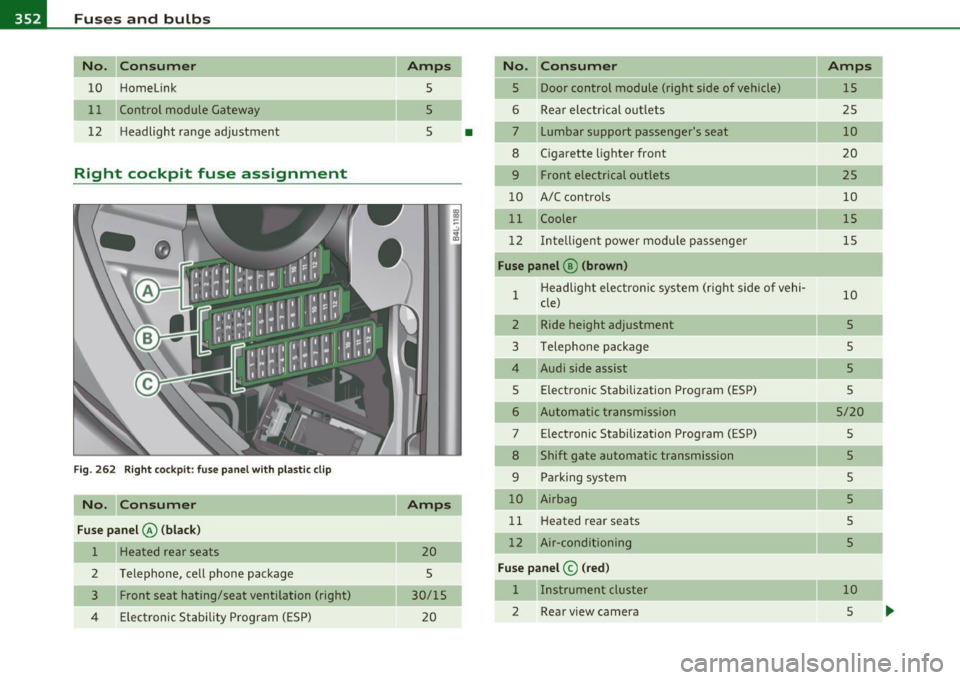
Fi g. 262 Right co ckp it : fu se pane l with plastic cl ip
No. Consumer
Fuse p anel © (black )
1 Heated rear seats
2 Telephone, ce ll phone package
3 Front seat hating/seat ventilation (right)
4 Electronic S tabi lity Program (ESP)
•
Amps
5
5
5
Amps
20
5
30/15
20
•
No . Consumer
5
Door control module (right side of vehicle)
6 Rear electrical ou tlets
7 Lumbar support passenger's seat
8 C igarette lighter front
9 Fron t electrical outlets
1 0 A/C contro ls
11 Cooler
12 I ntelligent power mo du le passenge r
Fuse panel® (brown)
1
2
3
4
5
6
7
8
Headlight ele ct ro nic sys tem (r ight side of vehi
cle)
Ride height adjustment
Telephone package Audi side assist Electronic Stabilization Program (ESP)
Automat ic transmission
Electronic Stabilization Program (ESP)
Shift gate automatic transmission
9 Pa rk ing system
11 Heated rear seats
12 Air-condition ing
Fuse panel © ( red )
1 Instrumen t cluster
2 Rear view camera
II Amps
15
25
10
20
25
10
15
15
10
5
5
5
5
5/20
5
5
5
5
5
5
1 0
5
Page 355 of 392
Fuses and bulbs -_______________ __.fWI
No. Consumer
3 CD player, DVD drive
4 MMI
Display
5 Automatic transmission
7 Panoramic sliding sunroof segment
l
8 Panoramic sliding sunroof segment 2
9 Panoramic sliding sunroof sunblind
CD player, DVD drive
11 W
indow regulators (right side of vehicle)
12 Rear air-conditioning controls
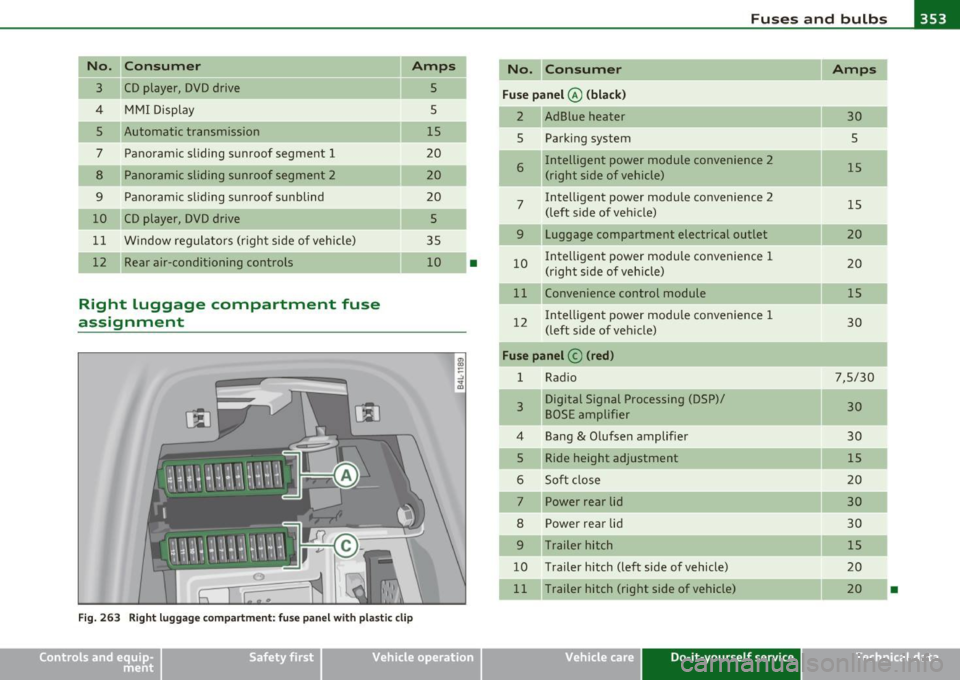
Right luggage compartment fuse
assignment
Amps
5
5
15
20
20
20 5
35 10
Fig. 263 Right luggage compartment: fuse panel with plastic clip
•
"' Q)
-
Vehicle OP-eration
No. Consumer Amps
Fuse panel @ (black)
2 AdBlue heater
30
5 Parking system
5
-
6 Intelligent power module convenience
2
15
(right side of vehicle)
7 Intelligent power module convenience 2
15
(left side of veh icle)
9 Luggage compartment electrical outlet 20
10 I
ntell igent power modu le convenience 1
20
(right side of vehicle)
11 Convenience control module
15
12 I
ntell igent power module convenience 1
30
(left side of veh icle)
Fuse panel © (red)
1 Rad io 7,5/30
3 Digital Signal Processing (DSP)/
30
BOSE amplifier
4 Bang & Olufsen amplifier 30
5 Ride height adjustment
15
6 Soft close 20
7 Power rear lid
30
8 Power rear lid 30
9 Trailer hitch 15
10 Trailer hitch (left side of vehicle)
20
1 1 Trailer hitch (right side of vehicle)
20
•
Vehicle care Do-it-yourself service iTechnical data
Page 357 of 392

Emergency situations --------------=----PfN:t'II
Emergency situations
General
This chapter is intended for trained emergency crew s and working
personnel who ha ve the necessar y tools and equipment to perform
the se operations . •
Starting by pushing or towing
(D Note
Your vehicle is equipped with an a utomat ic transmission. Conse
que ntly, the eng ine can not be started by pushing or towing. •
Starting with jumper cables
If necess ary, the engine can be started by connecting it to
the battery of an other vehicle .
If the engine shou ld fai l to start because of a discharged or weak
battery, the battery can be co nnecte d to the battery of
another
vehicle, using a pair of jumper cable s to start the engine .
Jumper cables
Use only jumpe r cables of suffic iently large cross section to carry t he
sta rter cur ren t safely . Refe r to the manufacture r's specifications.
Use on ly j umper cab les with
insulated te rm ina l clamps w hich are
distinct ly marked :
plus(+) cable in most cases colo red red
minus (-) cable i n most cases colored black.
Safety first
& WARNING
Batterie s contain electricity, acid, and gas . Any of these can cause
very serious or fatal injury . Follow the inst ructions below for safe
handling of your vehicle 's battery .
• Always shield your eyes and avoid leaning over the battery
whenever possible.
• A discharged battery can freeze at temperatures just below
32 °F (0 °C). Before connecting a jumper cable, you must thaw the
frozen battery completely , otherwise it could explode.
• Do not allow battery acid to contact eyes or skin . Flush any
contacted area with water immediately .
• Improper use of a booster battery to start a vehicle may cause
an explosion.
• Vehicle batteries generate e xplos ive gases. Keep spa rks, flame
and lighted cigarettes away from batteries.
• Do not try to jump start any vehicle with a low acid level in the
battery.
• The voltage of the booster battery must also h ave a 12 -Volt
rating. The capacity (Ah) of the booster battery should not be
lower than that of the discharged battery. Use of batter ies of
different voltage or sub stantially different "Ah " rating may cau se
an explosion and personal injury.
• Never charge a frozen battery . Ga s trapped in the ice may cause
an e xplosion.
• Never charge or use a battery that has been frozen. The battery
case may have be weakened.
• Use of batteries of different voltage or substantially different
capacity (Ah ) rating may cause an explosion and injury . The
capacity (Ah ) of the booster battery should not be lower than that
of the discharged battery. _..
Vehicle care Do-it-yourself service Technical data
Page 358 of 392

lffll.___E_ m_ e_r-= g:.. e_ n_c-= y'-- s_ i_t _u _a_ t_ i_ o _ n_ s ____________________________________________ _
& WARNING (continued)
• Before you check anything in the engine compartment, always
read and heed all WARNINGS ~
page 290, "Engine compart
ment".
0 Note
• Applying a higher voltage booster battery will cause expensive
damage to sensitive electronic components, such as control units,
relays, radio, etc.
• There must be no electrical contact between the vehicles as other
w ise current could already start to flow as soon as the positive(+)
terminals are connected.
[ i ] Tips
• The discharged battery must be properly connected to the
vehicle's electrical system. When jump starting or charging the
battery, never connect the negative ground cable to the battery nega
tive post because the battery manager system must be able to detect
the battery's state of charge. Always connect the negative ground
cable to the negative ground post of the battery manager control
unit. •
Use of jumper cables
fvfake sure to connect the jumper cable clamps in exactly
the order described below!
Fig. 264 Engine
compartment: Connec
tors for jumper cables
and charger
Fig. 265 Jump
starting with the
battery of another
vehicle: A -discharged
vehicle battery, B -
booster battery
The procedure described below for connecting jumper cables
is intended to provide a jump start for your vehicle.
Vehicle with discharged battery:
-Turn off lights and accessories, move lever of automatic
transmission to
N (Neutral) or P (Park) and set parking
brake.
~
Page 360 of 392
III...__E_ m_ e_r -=g :.. e_ n_c -=y '-- s_i_t _u _a _ t_ i_ o _ n_ s ____________________________________________ _
Emergency towing with
commercial tow truck
General hints
Your Audi requires special handling for towing.
The following information is to be used by commercial tow truck
operators who know how to operate their equipment safely.
• Never tow your Audi, towing will cause damage to the engine
and transmission.
• Never wrap the safety chains or winch cables around the brake
lines.
• To prevent unnecessary damage, your Audi must be transported
with a flat bed truck.
• To load the vehicle on to the flat bed, use the towing loop found
in the vehicle tools and attach to the front or rear anchorage
~ page 358 and~ page 359 .
& WARNING
A vehicle being towed is not safe for passengers. Never allow
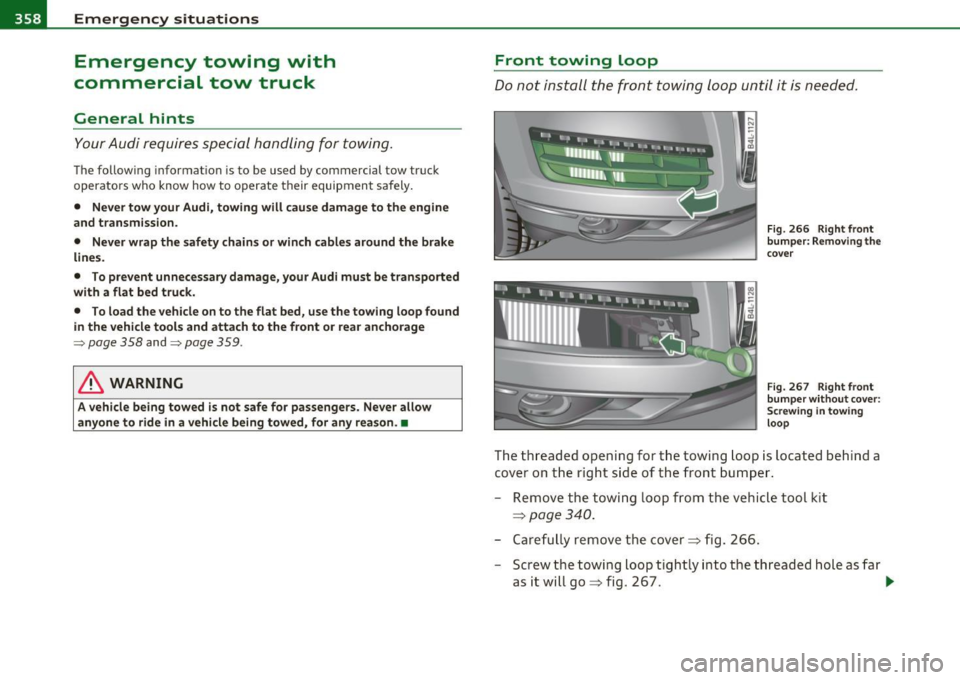
anyone to ride in a vehicle being towed, for any reason. • Front towing Loop
Do not install the front towing loop until it is needed.
Fig. 266
Right front
bumper: Removing the
cover
Fig. 267 Right front
bumper without cover:
Screwing in towing
loop
The threaded opening for the towing loop is located behind a
cover on the right side of the front bumper.
- Remove the towing loop from the vehicle tool kit
=> page 340.
- Carefully remove the cover=:> fig. 266.
- Screw the towing loop tightly into the threaded hole as far
asitwillgo =:>fig .267 . ..,
Page 363 of 392

_______________________________________________ E_ m_ e_r_, g::;._ e_n _ c""' y:.- s_ it_u_ a_t _ i_o _n_ s __ _
- Insert a rub ber pad between the floor jack/workshop hoist
and the lift ing points .
If you must lift your vehicle with a floor jack to work underneath,
be sure the vehicle is safely supported on stands intended for this
purpose .
Front lifting point
The lifti ng point is located o n the flo or pan reinfo rcemen t about a t
the same leve l as the jack mounting point::::;,
page 360, fig. 271. Do
not lift th e vehicle at the vertical sill reinforcement.
Rear lifting point
T he lifting po int is loc ated on the ve rtic al rei nfo rcement of the lowe r
sill for the on boa rd jack ::::;,
page 360, fig. 272.
Lifting with vehicle jack
Refer to ::::;, page 346.
& WARNING
• To reduce the risk of serious injury and vehicle damage.
- Always lift the vehicle only at the special work shop hoist and
floor jack lift points illustrated::::;,
page 360, fig. 2 71 and
::::;, page 360, fig. 272.
- Failure to lift the vehicle at these po int s could cause the
vehicle to t ilt or fall from a lift if there i s a change in vehicle
weight di stribution and balance. This m ight happen , for
ex ample, when heavy components such as the engine block or
transmission are removed.
• When removing heavy component s like these, anchor vehicle
to hoist or add corre spo nding weights to maintain the center of
gravity. Otherwise, the vehicle might tilt or slip off the ho ist,
causing serious personal injury.
Safety first
0 Note
• Be aware of the following poin ts before lifting the vehi cle:
- The vehicle should never be lifted or jacked up from under
neath the engine oil pan , th e tran smis sion housing , the front or
rear a xle or the body side members. Th is could lead to serious
damage .
- To avoid damage to the underbody or chassis frame, a rubber
pad mu st be inserted betwe en the floor jack and the lift points .
- Before driving over a wo rkshop hoist , check that the vehicle
weight doe s not ex ceed the permis sible lifting capacity of the
ho ist.
- Before driving ov er a work shop hoist , en sure that there is
sufficient clearance between the hoist and low parts of the
vehicle .•
Vehicle care Do-it-yourself service Technical data
Page 364 of 392

., __ G_ e_n_ e_r _a _ l_ in_ f_o _r_ m_ a_ t_io _ n _______________________________________________ _
General information
Explanation of technical data
Some of the technical data listed in this manual requires
further explanation.
The technical data for your vehicle is listed in the charts starting on
~ page 365. This sect ion prov ides genera l information, notes and
restrictions which app ly to this data .•
Veh icle identification
The key data is given on the vehicle identification number
(VIN) plate and the vehicle data sticker.
F ig. 273 V ehicle I den
t ifi ca tion Nu mbe r
(V IN ) plate: locat io n
o n d river's s id e d ash
p an el Fi
g. 27 4 Th e vehi cle
i d enti ficati on l abel -
in side the l ugga ge
co mpa rtme nt
The Vehicle Id ent ifi cat ion Number (VlN )
is located on the driver's s ide so that it is visible from the outside
through the windshield ~ fig . 273 . You can also d isp lay the Vehicle
Identification Number of your vehicle in the MMI. Se lect funct ion
button [CAR]>
S yst em s* > Vehicle ID number (VIN ).
The vehicle identifica tion lab el
is located in the luggage compartment under the cargo floor cover.
The label~ fig . 274 shows the following vehicle data:
© Production control No.
@ Vehicle identification No.
® Type code n umber
@ Type designat io n/eng ine output in Kilow atts
© Engine and transmission code letter
© Paint No./Interior
(j) Optional equipment No.'s
Vehicle data 2 to 7 are also found in your Warranty
& Maintenance
booklet . .,,