door lock AUDI Q7 2011 Owner´s Manual
[x] Cancel search | Manufacturer: AUDI, Model Year: 2011, Model line: Q7, Model: AUDI Q7 2011Pages: 392, PDF Size: 93.29 MB
Page 134 of 392
Ill On the road ..___ ______________ _
• If you close the driver's door and lock your vehicle from the
outs ide. •
Parking brake
Op eration
The parking brake replaces the handbrake.
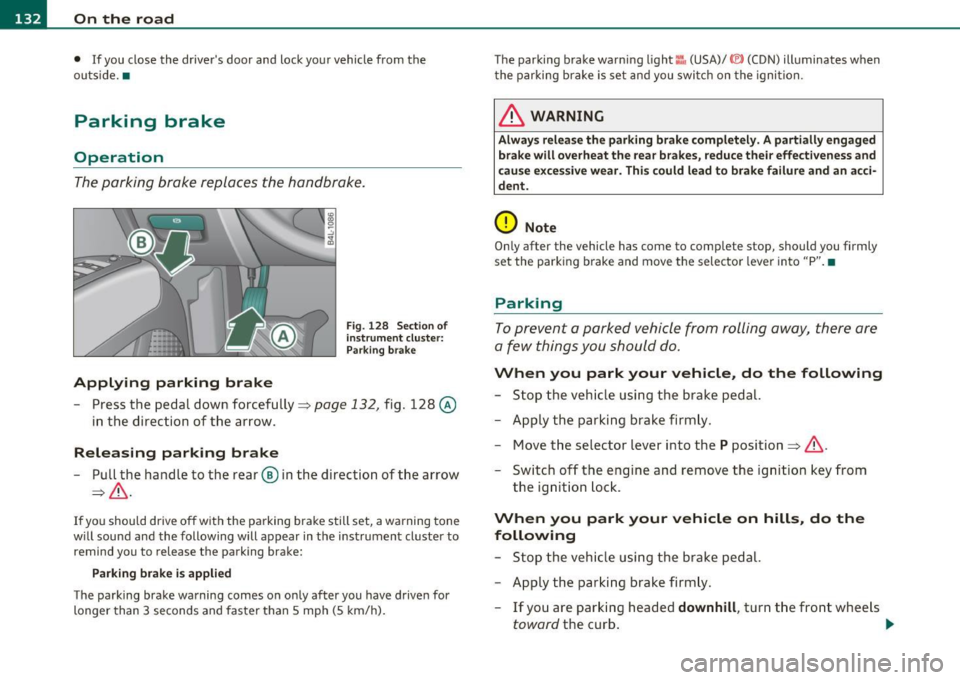
Applying parking brake
Fig. 128 Sect ion of
instrument cluster: Par king brake
- Press the pedal down forcefully~ page 132, fig. 128 @
in the d irection of the arrow.
Releasing parking brake
-Pull the handle to the rear ® in the direction of the arrow
~& -
If you should drive off with the parking brake still set, a warning tone
w ill sou nd and the following will appear in the instrument cluster to
remind you to release the parking brake:
Parking brake i s applied
The parking brake warning comes on only after you have driven for
longer than 3 seconds and faster than 5 mph (5 km/h). The parking brake warn
ing light ::, (USA)/ © (CON) illuminates when
the parking brake is set and you switch on the ignition.
& WARNING
Always release the parking brake completely. A partially engaged
brake will overheat the rear brakes, reduce their effectiveness and
c ause excessive wear. This could lead to brake failure and an acci
dent.
0 Note
Only after the vehicle has come to complete stop, should you firmly
set the parking brake and move the selector leve r into "P". •
Parking
To prevent a parked vehicle from rolling away, there are
a few things you should do.
When you park your vehicle, do the following
-Stop the vehicle using the brake pedal.
- Apply the parking brake firmly.
- Move the selector lever into the
P position =;,& .
- Switch off the engine and remove the ignition key from
the ignition lock .
When you park your vehicle on hills, do the
following
- Stop the vehicle using the brake pedal.
- Apply the parking brake firmly.
- If you are parking headed
downhill , turn the front wheels
toward the curb . .,_
Page 135 of 392

On the road -
----------------
- If you are parki ng h eaded uphill, turn t he fro nt w heel s
away from t he curb.
- Move th e se lector lever i nto t he
P posit ion.
- Swi tc h off the eng ine and rem ove t he ignit ion key from
t h e ign ition loc k.
& WARNING
This is how you can reduce the risk of injury when leaving your
vehicle.
• Never park the vehicle where it can come in contact with dry
grass, spilled fuel or any other flammable material s.
• When parking on hills, always turn the wheel s so that the front
wheel s will fir st roll into the curb, if the vehicle should start to
roll.
• Never allow anyone -especially small children -to remain
in
the vehicle when it is loc ked. Locked doors make it more difficult
for res cuer s to ac ce ss the pa ssenger compartment in the event of
an emergency. Danger to life!
• Never leave children un supervised in the vehicle . Children
could release the parking brake or move the gearshift lever out of
gear . The vehicle could start to roll away and cause an accident.
• No matter what the season is , the temperature in a parked
vehicle can reach dangerou s levels.
0 Note
• Please exer cise care w hen you par k your vehicle in pa rking areas
with park ing barriers or c urbs. Pa rking barriers and c urbs vary in
heig ht and co uld dam age yo ur bumpe r and related co mponen ts as
the front of your vehicle moves over a barrier or curb that is too h igh,
as yo u p ark or as you back out of a par king s pot. I n or der to be sure
that no such damage can occur, you may wish to stop short of havi ng
t he front t ires of your car touch the park ing barrier or c urb.
Controls and equip
ment Safety first
•
Please also exerc ise exceptiona l care w hen you dr ive up or dow n
stee p ramps or dr ive ove r cur bs or o ther obs ta cl es, for w hich t he
vehicle is not des igned, beca use components of the vehicle close to
the groun d, such as bumper covers, spoilers and s uspension and
ex haust system componen ts, may become damaged .•
Starting on hills
H ill Hold makes it easier to s tart on hills .
The system is activated when the brake peda l is depressed
for a few
seconds .
Fo r t his, t he vehicle mus t be st anding in uphill driving direc
tion.
After releas ing t he brake pedal, the brake power is he ld for a
brief
moment to prevent the vehicle from rolling back when sta rt ing . At
this time, you can easi ly begin to move your vehicle .
& WARNING
• If you did not begin moving immediately after relea sing the
brake pedal, under certain circumstances, the vehicl e would begin
to roll backward. Depress the brake pedal immediately or engage
the parking brake .
• Should the engine stall, depre ss the brake pedal immediately
or engage the parking brake.
• In order to prevent the vehicle from rolling back unintention
ally when starting in stop-and-go traffic , keep the brake pedal
depre ssed for a few se cond s before driving off .
• When you leave the vehicle -even if only briefly -, sw itch off
the ignition and make sure to remove the ignition key . Also
engage the parking brake to prevent your vehicle from rolling
unintentionally . This particularly applies if children are left in the
veh icle -danger of accident! •
Vehicle care Technical data
Page 200 of 392
• ....__D_ r_iv _i_ n_, g=-- S_ a _ f_e _,Ly _ ______________________________________________ _
& WARNING (conti nu ed )
• Pleas e obse rve information on s afe driving => page 190.
& WARNING
To help prevent poi sonous exhau st ga s from being drawn into the
vehicle, always keep the rear lid closed while driving.
• Never transport object s larger than tho se fitting completely
into the luggage area because the rear lid cannot be fully closed.
• If you ab solutely must drive with the rear lid open, observe the
following notes to reduce the ris k of po isoning:
- Close all windows,
- Close the Pano ramic sliding sunroof*,
- Open all air outlets in the instrument panel,
- Swit ch off the air recirculation,
- Set the fresh air fan to the h ighest speed.
& WARNING
Alway s make sure that the doors, all windows, the Panorami c
sliding sunroof* and the rear lid are secur ely closed and locked to
reduce the risk of injury when the vehicle is not being used.
• After closing the rear lid, always make sure that it is properly
clo sed and locked .
• Never leave your vehicle unattended especially with the rear lid
left open . A child could crawl into th e vehicle through the luggage
compartment and close the rear lid becoming trapped and unable
to get out . Being trapped in a vehicle can lead to serious personal
injury.
• Never let children play in or around the vehicle.
• Never let passengers ride in the luggage compartment. Vehicle
occupants must alway s be properly restrained in one of the
vehicle 's seating positions.
W Tips
• Air circulation helps to reduce window fogging. Sta le air escapes
to the outside th rough vents in the trim panel. Be sure to keep these
slo ts free and open.
• Th e tire pressure m ust correspond to the load . The tire pressure is
shown o n th e t ire pressu re label. The tire pressure label is located o n
the driver's side 8-pillar . The tire p ress ure label lists the recom
me nded co ld tire inflation pressures fo r th e ve hicle at its max imum
capacity weight and the tires that were on your vehicle at t he time it
was manufactured. For recommended t ire pressu re s for normal loa d
conditions, p lease see chapter=>
page 322. •
Tie-downs
The lug gage c omp artm ent is equ ipped with fo ur tie
do wns to secur e luggag e and oth er items .
Use the t ie-downs to sec ure yo ur cargo properly => page 197,
"Load ing the l uggage comp artmen t".
In a co llision , the laws of physics mean that even smaller items that
are loose in the vehicle will become heavy m issi les t hat can ca use
ser ious injury. Items in the vehicle possess energy which va ry with
veh icle speed and the weight of the item . Vehicle speed is the most
sign ifi cant factor .
For example, in a frontal coll is ion at a speed of 30 mp h (48 km/h),
the forces a cting on a 1 0-lb (4.5 kg) o bje ct are about 20 times the
normal weight of the item. This means that the weight of the item
wou ld sudden ly be abo ut 200 l bs. (9 0 kg). You can imagine the inju
r ies that a 200 lbs. (90 kg) item flying freely through the passenger
compar tment cou ld cause in a collision like this .
liJ,
Page 226 of 392

-L___:_A~ i r'....: b~ a ::::: gL:: s~y -=s ::..:t :.:e :..: m..:..:.. ______________________________________________ _
• make sure that thi ngs that may increase the weig ht o f the child
and ch ild safe ty se at are not be ing transported on t he front
passenger seat;
• make sure that the safety belt tens ion sensor is not blocked.
Shake the safety belt latch on the front passenger seatback and forth;
• If a strap or tether is being used to t ie the child safety seat to the
front passenger seat, make sure that it is not so tight that it causes
t he weight-sensing mat to meas ure more weight than is actua lly on
the seat .
If the PASSENGER AIR BAG OFF l ight still doe s not come on and
does not stay on cont inuously (when the ignition is switched on),
• take the child restraint off the f ront passenger seat and install it
properly at one of the rear seat positions . Have the airbag sys tem
inspected by your authori zed Audi dealer immediately .
• move the child to a rea r seat position and ma ke s ure that the child
is properly restrained in a ch ild restraint that is appropriate for its
size and age .
The
PA SSENG ER AIR BAG OFF light should NOT come on when the
ignition is on and an adult is sitting i n a proper seating position on the
front passenger seat . If the
PASSENGER AIR BAG OFF light comes on
and stays on or flashes for abo ut 5 seconds while driving, under these
circumstances, make sure that:
• the adult on the front passenger seat is properly seated on the
c en ter of the sea t cushion wi th his or her back up against the backrest
and the backrest is not reclined::::;,
page 192, "Proper occupant
seating positions",
• the adult is not taking weight off the seat by holding on to the
passenge r assis t handle above the fron t passenger door or
supporting their weight on the armrest,
• t he safety bel t is be ing properly wor n and that the re is not a lot of
slack in the safety belt webb ing,
• accessory seat cove rs or cushions o r othe r th ings that may ca use
an incor rect read ing or impress ion on the weight-sensing mat under the upholstery of the seat have bee
n removed from the front
p assenge r seat,
• a safety belt extender has not been left in the safety belt latch for
t he front passenge r se at.
In add it io n to the
PASSENGER AIR BAG OFF light in the center of the
instrument panel, the message
PASSENGER AIR BAG OFF or
PASSENGER AIR BAG ON will br iefly appear in the instrument cluster
display . This is to inform the driver of the current front passenger
airbag status .•
Important safety instructions on
monitoring the Advanced Airbag System
& WARNING
An a irbag syst em that is not fun ction ing properly cannot provide
supplemental protect ion in a frontal crash.
• If th e airbag indic ator light comes on , it means th at there may
be something wrong with the Advanc ed Airbag S ystem . It i s
poss ible that th e airbag will inflat e when it is not suppos ed to , or
will not inflate when it should.
• Have the a irb ag system inspected immediately by your autho
rized Audi dealer .
& WARNING
If the front airb ag inflate s, a child without a child restraint, or in
a rearwa rd -facing child safet y seat, o r in a fo rwa rd-facing child
re straint that h as not b een properl y install ed will be seriou sly
i njured and can b e killed.
• Even though your v ehicl e is equipped with an Advan ced Airbag
S y stem , ma ke certain that all children , especi ally 1 2 yea rs and
y ounger, alway s ride on the back seat properly restra ined for their
a ge and size . .,,_
Page 242 of 392
___ C_h_ i_ l _ d _S_ a_f _e _t ,,.,Y _____________________________________________ _
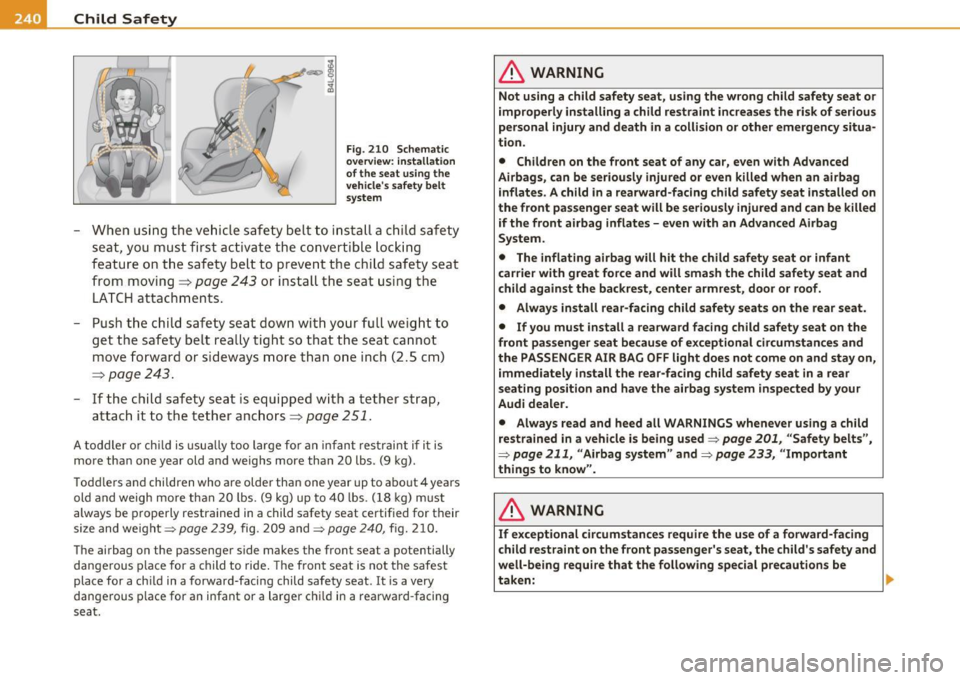
Fig. 210 Schematic
overview: installation
of the seat using the
vehicle's safety belt
system
- When using the vehicle safety belt to install a child safety
seat, you must first activate the convertible locking
feature on the safety belt to prevent the child safety seat
from moving~
page 243 or install the seat using the
LATCH attachments.
- Push the child safety seat down with your full weight to get the safety belt really tight so that the seat cannot
move forward or sideways more than one inch
(2.5 cm)
=>
page 243.
- If the child safety seat is equipped with a tether strap, attach it to the tether anchors=>
page 251.
A toddler or child is usually too large for an infant restraint if it is
more than one year old and weighs more than 20 lbs . (9 kg) .
Toddlers and children who are older than one year up to about 4 years old and weigh more than 20 lbs. (9 kg) up to 40 lbs. (18 kg) must
always be properly restrained in a child safety seat certified for their
size and weight~
page 239, fig. 209 and~ page 240 , fig. 210.
The airbag on the passenger side makes the front seat a poten tially
dangerous place for a child to ride. The front seat is not the safest
place for a child in a forward-facing child safety seat . It is a very
dangerous place for an infant or a larger child in a rearward-facing
seat .
& WARNING
Not using a child safety seat, using the wrong child safety seat or
improperly installing a child restraint increases the risk of serious
personal injury and death in a collision or other emergency situa
tion.
• Children on the front seat of any car, even with Advanced
Airbags, can be seriously injured or even killed when an airbag
inflates. A child in a rearward-facing child safety seat installed on
the front passenger seat will be seriously injured and can be killed
if the front airbag inflates -even with an Advanced Airbag
System.
• The inflating airbag will hit the child safety seat or infant
carrier with great force and will smash the child safety seat and
child against the backrest, center armrest, door or roof.
• Always install rear-facing child safety seats on the rear seat.
• If you must install a rearward facing child safety seat on the
front passenger seat because of exceptional circumstances and
the PASSENGER AIR BAG OFF light does not come on and stay on,
immediately install the rear-facing child safety seat in a rear
seating position and have the airbag system inspected by your
Audi dealer.
• Always read and heed all WARNINGS whenever using a child
restrained
in a vehicle is being used ~ page 201, "Safety belts",
~ page 211, "Airbag system" and~ page 233, "Important
things to know".
& WARNING
If exceptional circumstances require the use of a forward-facing
child restraint on the front passenger's seat, the child's safety and
well-being require that the following special precautions be
taken:
11'-
Page 247 of 392

_____________________________________________ C _h_i_ld _ S_ a_ f_ e_ t ... Y'--- __
& WARNING
Rearward-facing child restraints:
• A child in a rearward-facing child safety seat installed on the
front passenger seat will be seriously injured and can be killed if
the front airbag inflates -even with an Advanced Airbag System.
• The inflating airbag will hit the child safety seat or infant
carrier with great force and will smash the child safety seat and
child against the backrest, center armrest, door or roof.
• Always be especially careful if you must install a rearward
facing child safety seat on the front passenger seat in exceptional
circumstances.
• A tight tether strap on a rearward-facing child restraint
attached to the front passenger seat can put too much pressure on
the weight-mat in the seat and register a heavier weight in the
Advanced Airbag System. The heavier weight registered can make
the system work as though an adult were on the seat and deploy
the Advanced Airbag when it must be suppressed causing serious
or even fatal injury to the child.
• Make sure that the PASSENGER AIR BAG OFF light comes on
and stays on all the time whenever the ignition is switched on.
• If the PASSENGER AIR BAG OFF light does not come on and
stay on, immediately install the rear-facing child safety seat in a
rear seating position and have the airbag system inspected by
your Audi dealer. •
Activating the convertible Locking retractor
Use the convertible locking retractor to secure a child
restraint.
Always heed the child safety seat manufacturer's instruc
tions when installing a child restraint in your vehicle. To acti
vate the convertible locking retractor:
Controls and equip
ment Safety first Vehicle operation
-
Place the child restraint on a seat, preferably on the rear
seat.
- Slowly pull the belt
all the way out.
- Route it around or through the child restraint belt path
=>& .
- Push the child safety seat down with your full weight to
get the safety belt really tight.
- Insert the belt tongue into the buckle for that seating
position.
- Guide the safety belt back into the retractor until the belt
lies flat and snug on the child safety seat.
- You should hear a "clicking" noise as the belt winds back
i nto the inertia reel. Test the convertible locking retractor
by pulling on the belt. You should no longer be able to pull
the belt out of the retractor. The convertible locking
retractor is now activated.
- Make sure that the red release button is facing away from
the child restraint so that it can be unbuckled quickly.
- Pull on the belt to make sure the safety belt is properly
tight and fastened so that the seat cannot
move forward
or sideways more than one inch (2.S cm).
& WARNING
Using the wrong child restraint or an improperly installed child
restraint can cause serious personal injury or death in a crash.
• Always make sure that the safety belt retractor is locked when
installing a child safety seat. An unlocked safety belt retractor
cannot hold the child safety seat in place during normal driving or
in a crash. ._
Vehicle care Do-it-yourself service Technical data
Page 282 of 392

-~_C_ le_ a_n_ i_ n_ g=- a_ n_d__. p_ ro_ t_e _c_ t_ i_o _n ___________________________________________ _
Use a separate sponge for cleaning the w heels, door sills and ot her
reg ions exposed to road dirt. I n th is way, yo u w ill not scr atch the
paint w ith coarse part icles imbedded in the sponge the next t ime you
wash the car.
& WARNING
• Do not clean the under side of the chass is, fende rs, wheel
co ve rs, or other hard to reach parts without p rotecting your hands
and arm s. You m ay cut yourself on sharp -edged metal part s.
• Always read and heed all WARNINGS and other information
=;, page
278.
0 Note
• Never try to remove dirt, mud o r dust if the s urface of the vehicle
is dry . Never use a dry cloth or sponge, s ince this could scratch your
vehicle's paint or windows .
• Never was h your car in bright sunlight. Drops of water act as
m agnifying lenses and may dam age your p aint.
• When you wash yo ur car in the winter: if you rinse your vehicle w ith
a hose, be c are ful no t to aim the s tream of w ate r d ir ect ly at locks, or
at door or hatch openings - they can freeze shut.
• Never use s ponges des igned to remove inse cts, o r any ki tchen
sco uring sponges or similar prod ucts. They can damage your paint
fi ni sh .
• You shou ld remove debris (s uch as insects) from the head light
lenses o n a regu lar bas is, for examp le w hen refue ling your veh icle.
Never use a dry cloth or sponge to clean the headlights. On ly use wet
clot hs or sponges to preven t scr atches.
It is be st to use so apy water.
'00' For the sake of the environment
In the in terest of t he env ironme nt, the ve hicl e shoul d onl y be wa shed
in special wash bays. •
Washing your vehicle with a power washer
Cleaning the ex terior of your c ar with a high-pressure
po wer washer is safe as long as y ou obser ve a few sim ple
rules.
- Before using the power washer, make su re you have read
and unders tood the WA RNINGS=>
& in "General info r
ma tion" on
page 2 78.
- Always fo llow t he operat ing inst ructions fo r the powe r
washer.
- Make sure t hat the jet o n the spray hose produces a "fa n
shaped spray".
- Do
not hold the spr ay nozz le too close t o soft ma ter ials .
When cleani ng the vehicle wi th a p owe r w ashe r always follow the
operat ing instruct ions . T his applies part icu larly to the
operating
pressure
and the spraying distance. M ain tain a suffic ien t distan ce to
so ft mater ia ls such as rubber hoses and sound/vibration deaden ing
materials (particularly on the unde rside o f the engine hood). Do no t
use a jet wh ic h sprays water in a
direct stream or o ne that has a
rotating jet.
W ate r temperatu re s hou ld not ex ceed 140
°F (6 0 °().
& WARNING
Never wash tires with a jet that sprays water in a direct stream .
This could cause invisible damage to the tires and weaken them ,
even if the spray i s from a relatively long distance and for a short
time . Damaged and weakened tires can fail and c ause accidents
and personal injury .
~
Page 297 of 392
Putting the fuel cap back on
- After filling your tank, twist the fuel fi ller cap c lockwise as
f ar as it w ill go.
- Close t he fue l fi ller flap.
To avoid fuel spi lling or evapo rating from the f uel tank a lways close
fue l filler cap properly and comp lete ly . An impro perly closed fuel
filler cap may also ca use the MIL lamp~
page 30 to come on (only
vehicle s wi th gaso lin e e ngine).
& WARNING
Improper refueling or handling of fuel can cause fire, explosion
and severe burns .
• Fuel i s highly flammable and can cause severe burns and other
injuries.
• Failure to shut the engine off while refueling and /or to insert
the pump nozzle fully into the fuel filler neck could cause fuel to spray out of filler n eck or to overflow. Fuel spray and ov erflowing
fuel can cause a fire.
• Never use a cellular telephone while refueling. The electromag
netic radiation can cau se sparks that can ignite fuel vapors and
cause a fire.
• Never get back into your vehicle while refueling. If in excep
tional cir cumstan ces you must get ba ck in your v ehicle while refu
eling, make certain that you close the door and touch metal to
discharge static electricity before touching the filler nozzle again .
Static electricity can cause sparks that can ignite fuel vapo rs
released during refueling.
• Never smoke or have an open flame anywhere in o r near your
vehicle when refueling or filling a portable fue l container.
• For your safety , we strongly recommend that you do not travel
with a portable fuel container in your vehicle . The container , full
or empty may leak and could cau se a fire , especially in a crash.
Safety first
Fuel supply and filling your fuel tank
& WARNING (co ntinued )
• If, under exceptional circumstances , you must tran sport a
portable fuel container, please observe the following:
-Never fill a portable fuel container while it is anywhere in or
on the vehicle (for example, in the luggage compartment, or
on the trunk ). Static electricity can build up while filling and
can ignite fuel vapors causing a fire .
- Always place a portable fuel container on the ground before
filling .
- Always keep the filler nozzle completel y inside the portable
container before and during filling.
- If filling a portable container made of metal, the filler nozzle must always be in contact with the container. This will help
prevent static ele ctricity from discharging and cause a fire .
- Ne ver spill fuel inside the vehicle or luggage compartment .
Fuel vapor s are highly flammable.
- Always observe local and state /provincial laws regarding the
use, storage and tran sportation of fuel containers .
-Make certain the fuel container meets industry standards
( ANSI / ASTM F852-86 ).
0 Note
If any f uel has spilled o nto the ca r, it should be remove d immed iate ly
to prevent damage to the paint.
f or t he firs t time, the t ank i s full. Do no t try to ad d mo re fuel bec ause
fue l may spill out. In addition, the expansion space in the fuel tank
w ill be fi lled -caus ing the fue l to overf low when it becomes wa rm and
poll ute the enviro nment . .,_
Vehicle care Technical data
Page 353 of 392

____________________________________________ .!:F~u~s~e~s ~a~n~d~b~u~l~b~S ~_J-
• The crank in the fuse cover is used for emergency operation of the
Panoramic slid ing sunroof*. •
Left cockpit fuse assignment
Fig . 26 1 L eft coc kpit : fu se panel w ith p lastic clip
Amps
Fu se panel © (re d )
1 DC/DC converter
5
3 MMI 7,5
6 Lumbar support driver's seat 10
7 Window regulators (left side of vehicle)
35
8 Door control module (left side of vehicle)
15
9 Tire pressure monitoring system
5
Vehicle OP-eration
No. Consume r
10
11
.,
Electronic ignition lock,
power steering column adjustment
Switch module steering column
12 Intelligent power module convenience
Fu se pa nel© {b row n)
3 Seat ventilation (left)
4
5
6
7
8
9
10
Wiper system
Rain sensor
Horn
Intelligen t power module driver
Intelligent power modu le dr iver
(lights left side of vehicle)
Intelligen t power module driver
(lights right side of vehicle)
I nstrument cluster
11 Headlight washer system
12 Diagnostic connector
Fuse panel © {black )
1 Headlight electronic system (left side of vehicle)
2 Adaptive Cruise Control
6 Term
inal 15 (interior)
7 Oil level sensor
8 Diagnostic connector
9 Automatic dipping interior mirror
Vehicle care Do-it-yourself service
Amps
30
10
5
15
30
5
25
30
25
25
10
30
10
10 5
5
5
5
5
iTechnical data
Page 380 of 392
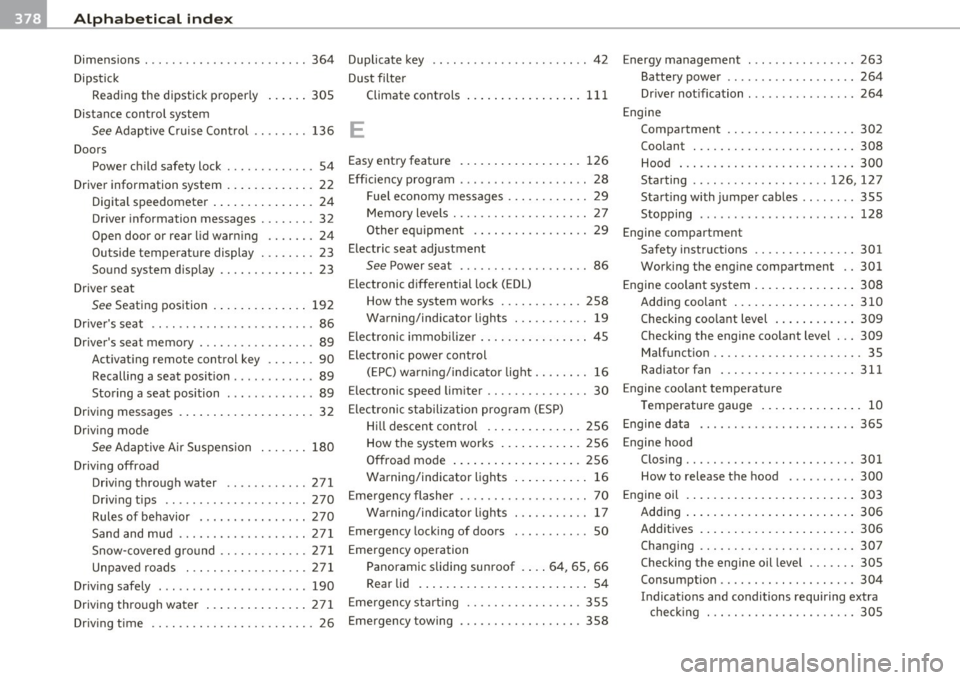
-Alphabetical inde x _ ___,_ ______ .::..:....=.:..:..__ __________________________ _
Dimensions ... ............ ....... .. 364 Duplicate key .. .. .. ..... ..... ... .. .. 42
Dipstick Dust filter
Reading the dipstick properly ......
305 Climate controls ................. 111
Distance control system
See Adaptive Cruise Control ........ 136 E
Doors
Power child safety lock .............
54 Easy entry feature ............ ..... . 126
Eff . Driver information system ......... .... 22 iCJency program ......... .... .. .. .. 28
Digital speedometer ............... 24 Fuel economy messages ............ 29
Driver information messages ........ 32 Memory levels . ....... .. .. .. .. .. .. 27
Open door or rear lid warning ....... 24 Other equipment ...... .. ....... .. 29
Outside temperature display ..... ... 23 Electric seat adjustment
Sound system display .. .. ..... .....
23 See Power seat ............ ... .. .. 86
Drive r seat Electronic differential lock (EDL)
See Seating position .............. 192 How the system works ............ 258
Driver's seat .... .. .. .. .. .. .......... 86 Warning/indicator l ights ... .. .... .. 19
Driver's seat memory .............. ... 89 Electronic immobilizer .............. .. 45
Activating remote control key .... ...
90 Electronic power control
Recalling a seat position ............
89 (EPC) warn ing/indicator light ........ 16
Storing a seat position ... ..... ..... 89 Electronic speed limiter ............... 30
Driving messages .................... 32 Electronic stabilization program (ESP)
Driving mode
See Adaptive Air Suspens ion . .... .. 180
Driving offroad
Driving through water .... .. ... ...
271
Dr iving tips .. ............ .... ... 270
H ill descent contro l ....... .. .. .. . 256
How the system works .......... .. 256
Offroad mode ................... 256
Warning/indicator l ights .. . .. .... .. 16
Emergency flasher ............. .... .. 70
Rules of behavior ........ .... .... 270 Wa rning/indicator l ights . .. .. .... .. 17
Sand and mud ................. .. 271 Emergency locking of doors ... ... ... .. SO
Snow -covered g round .. .. .... .....
271 Emergency operation
Unpaved roads . .. .. .. .. .... .....
271 Panoramic sliding sunroof . ... 64, 65, 66
Driving safely . .. ..... ... ........... 190 Rear lid ............ .... . .. .... .. 54
Driving through water ... .. .. .. .... .. 271 Emergency starting .......... .. .. .. . 355
D. . t· riving 1me .... .... ...... .......... 26 Emergency towing ...... ... . ... .. .. . 358
Energy management ... ............ . 263
Battery power .............. ... .. 264
Driver notification ................ 264
Engine
Compartment ............. .... ..
302
Coolant . ........... ...... .. .. .. 308
Hood . .. ................. .... .. 300
Starting .. .. . ... .. .. .. .. .... 126, 127
Starting with jumper cables .. .. .. .. 355
Stopping ............ .... ... ... . 128
Engine compartment
s f . . a ety instructions .............. .
Working the engine compartment .. 301
301
Engine coolant system ............... 308
Adding coolant .............. .. .. 310
Checking coo lant level ............ 309
Checking the engine coolan t level ... 309
Malfunction .. ... . .. .... .......... 35
Radiator fan . ................... 311
Engine coolant temperature
Temperature gauge ....... ... .. .. .
10
Engine data .. ............ .... ... .. 365
Engine hood
Closing ......... .. ... . .. .. .... ..
301
How to release the hood .......... 300
Engine oil ............. .. ... ..... .. 303
Adding .............. .... ..... .. 306
Additives ................ ... .. .. 306
Changing ............. .... .... .. 307
Checking the engine oil level ....... 305
Consumption .... .. ... . .. .. .. .. .. 304
Indications and conditions requiring extra
checking ... .. .. .. .............
305