service AUDI Q7 2011 Owner´s Manual
[x] Cancel search | Manufacturer: AUDI, Model Year: 2011, Model line: Q7, Model: AUDI Q7 2011Pages: 392, PDF Size: 93.29 MB
Page 99 of 392
& WARNING (cont inued )
damage to webbing, bindings , buckles, or retractors must be
replaced.
& WARNING
Always read and heed WARNINGS=> & in "Loading the luggage
compartment " on
page 197.
0 Note
• When fo lding the backrest back i nto place, ma ke sure the safety
bel t does no t ge t ca ugh t, b ec ause i t can be damaged .
A damaged bel t
can fail to provide safe rest raint.
• Th e heating wires in th e rear w indow ca n be damaged by abrasive
objects on t he parcel s he lf . •
Tie-down rings
Th er e a re f our tie-d own rings in the lu ggage com part
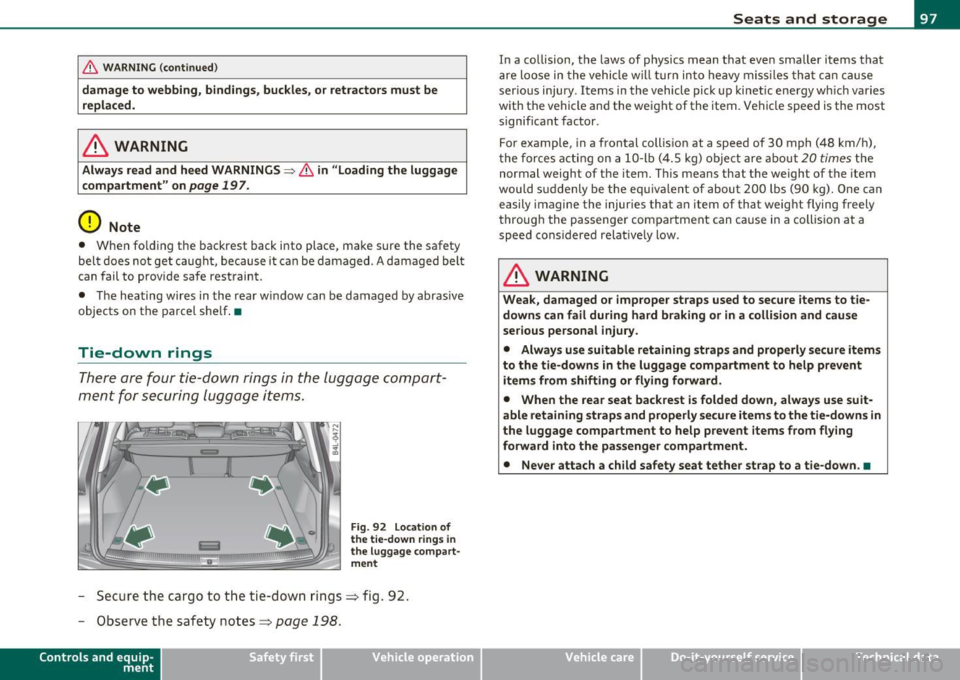
m en t for s ecuring lugg age items.
Fig . 92 Loca tion of
the tie-down rings in
the lug gag e c ompa rt ·
ment
- Sec ure the c argo to the tie-dow n rings => fig. 9 2.
- O bserve the safety notes=:> p age 19 8.
Con tro ls a nd e quip
m en t Vehicle
OP-eration
Seats and storage
In a co llision, the laws of physics mean that eve n smaller items that
a re lo ose in the vehicle w ill turn in to heavy mis siles th at can c ause
ser ious injury. Items in the vehicle pick up kinet ic en ergy w hich varies
with the ve hicle an d th e we ight of the item. Vehi cle speed is the most
signif ica nt factor .
For example, in a frontal collis ion at a speed of 30 mph (48 km/ h),
t he force s acti ng on a 10- lb
(4 .5 kg) object a re a bout 20 times the
normal weight of t he item. T his means that t he weight of t he item
wou ld su ddenly be t he e quiva le nt of abou t 200 lbs (9 0 k g). One can
easily imagine the injur ies that an item of that weight flying freely
t hroug h the passenger com par tment can cause in a collis ion at a
speed considered relative ly low .
& WARNING
Weak , damaged or improper straps used to secure items to tie
downs can fail during hard braking or in a collision and cause
serious personal injury.
• Always use suitable r etaining straps and properly secure items
to the tie -downs
in the luggage compartment to help prevent
items from shifting or flying forward .
• When the rear seat backrest is folded down, always use suit·
able retaining straps and properly secure items to the tie-downs in
the luggage compartment to help prevent items from flying
forward into the passenger compartment.
• Never attach a child safety seat tether strap to a tie-down .•
Vehicle care Do-it-yourselt service iTechnical data
Page 101 of 392

-Hook t he ends of the rod in t he openings in the left and
r ight side trim panels==> fig. 94
@ .
Rolling up front Luggage compartment cover
- Pull the ends of the cover out of the attachi ng eyes in the
seatback .
- Allow the cover to ro ll up slow ly.
Rolling up rear Luggage compartment cover
- Pull t he rod out o f the op enings in t he side trim panels.
- Allow the cover to ro ll up slow ly .
Removing the Luggage compartment cover
- Pull the lever in the direc tion of the arrow==> fig. 95 and at
the same time lift the cover up and out .
Installing the Luggage compartment cover
-Lay the cover i n the left retaine r in the side trim and then
press it into the right reta iner until i t latches.
& WARNING
Whenever driving, nev er place any hard or he avy objects on the
luggage compartment or allow pets to sit on the luggage
compa rtment cover . They could become a hazard to v ehicle occu
pants in the e vent of sudden b raking o r in an accident.
0 Note
• Make sure th at the heating wires in the rear lid do not get
damaged by objects scraping agai nst them .
Contro ls a nd e quip
m en t Vehicle
OP-eration
Seats and storage
• The two inner attach ing eyes on the left and right in the seatback
~ fig . 94 (Dare not sui table for ty ing down ca rgo -ris k of dam age.
Only t he luggage compa rtment cover s hou ld be attac hed here.
(I] Tips
• You can use the luggage compartment cover to store light we ight
clothing or articles but do not leave any heavy or sharp objects in the
pockets of the clothing .
• Remember that p lac ing clothing or articles on the luggage
compartment cover can block the driver's vision in the rear v iew
mirror . This also applies especially when you have to transport large
objects.
• So that stale ai r can escape from the vehicle be sure not to cover
the ventilatio n slot between the rear lid and the luggage compart
ment cover .•
Protective liner
Dirty or wet objects can be transported under the cargo
floor in a protective troy.
Fig . 9 6 Ca rgo flo or:
fold ed upr ight ...
Vehicle care Do-it-yourselt service iTechnical data
Page 103 of 392
_______________________________________________ S_ e_ a_t _s_ a_n_ d_ s_ t_ o _ r_a """g::;. e _ __._
App lies to veh icles : w ith ski sac k
Ski sack
The ski sack allows a maximum of 4 pairs of skis or 2
snowboards to be carried inside the vehicle.
Loading
Fig. 98 Securing the
ski sack at the center
rear seat belt buckle
- Fold the center seatback forward==> page 96.
- Remove the sack from the luggage compartment and
unfold it.
- Place the empty sack over the lowered seatback so that the end with the zip fastener is in the luggage compart
ment .
- Load objects from the luggage compartment into the ski
sack ==>& .
Securing
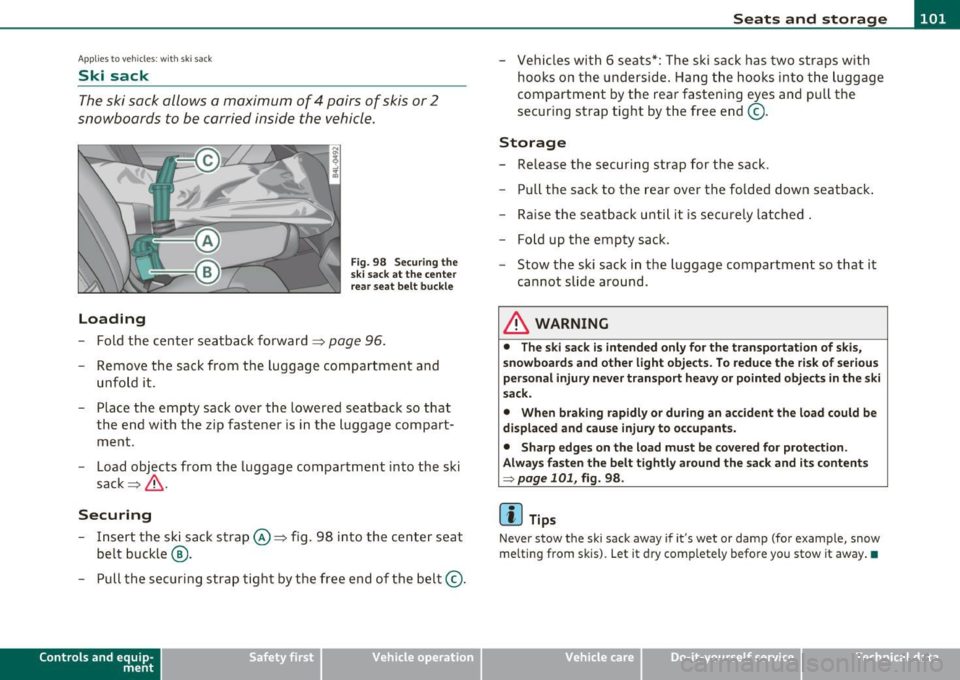
- Insert the ski sack strap©==> fig. 98 into the center seat
belt buckle @.
- Pull the securing strap tight by the free end of the belt ©.
Con tro ls a nd e quip
m en t Vehicle
OP-eration
-Vehicles with 6 seats*: The ski sack has two straps with
hooks on the underside. Hang the hooks into the luggage
compartment by the rear fastening eyes and pull the
securing strap tight by the free end ©-
Storage
- Release the securing strap for the sack.
- Pull the sack to the rear over the folded down seatback.
- Raise the seatback until it is securely latched .
- F old up the empty sack.
- Stow the ski sack in the luggage compartment so that it
cannot slide around .
& WARNING
• The ski sack is intended only for the transportation of skis,
snowboards and other light objects. To reduce the risk of serious
personal injury never transport heavy or pointed objects in the ski
sack.
• When braking rapidly or during an accident the load could be
displaced and cause injury to occupants.
• Sharp edges on the load must be covered for protection.
Always fasten the belt tightly around the sack and its contents
:::} page 101, fig. 98.
(I] Tips
Never stow the ski sack away if it's wet or damp (for example, snow
melting from skis). Let it dry completely be fore you stow it away. •
Vehicle care Do-it-yourselt service iTechnical data
Page 105 of 392
_______________________________________________ S_ e_ a_t _s_ a_n_ d_ s_ t_ o _ r_a """g::;. e _ __.fflll
Roof rack mounting locations
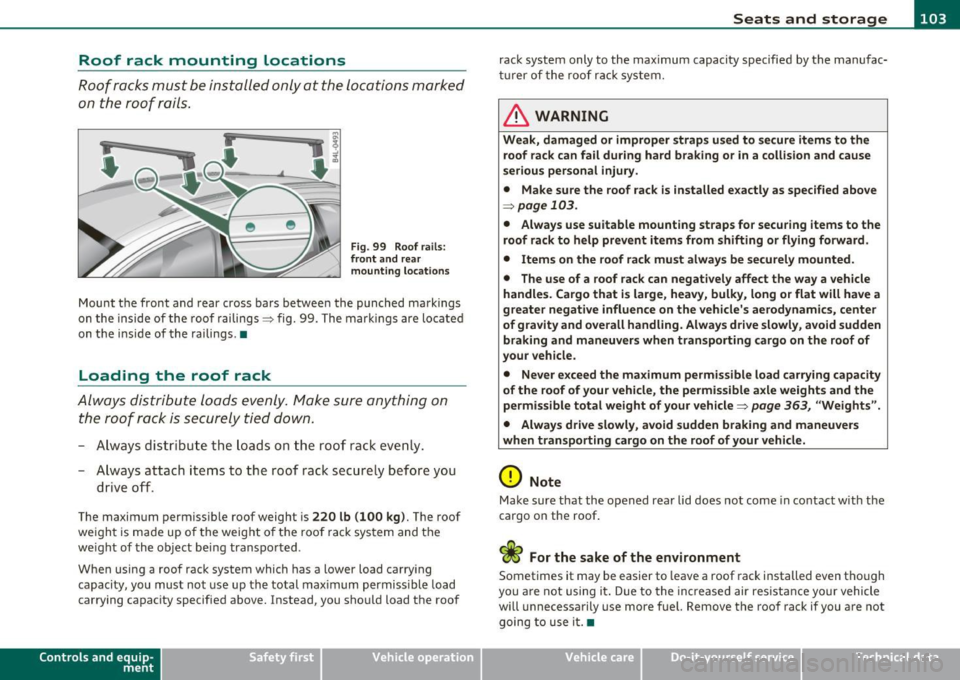
Roof racks must be installed only at the locations marked
on the roof rails .
Fig. 99 Roof ra ils :
fr ont and rear
m ounting l ocations
Mount the front and rear cross bars betwee n the punched markings
on the inside of the roof railings :::> fig. 99 . The marki ngs are lo cate d
on t he inside of the railings .•
Loading the roof rack
Always dist ribu te loads evenly . Make sure anything on
the roof rack is securely tied down.
- A lways distr ibu te the loads o n the roof rack even ly.
- A lways attach items to the roof rack secure ly before you
drive o ff.
The maximum permiss ible roof weight is 220 lb (100 kg ). The roof
we ight is made up o f the weight of the roof rack system and the
we ight of the object being transported .
When using a roof rack system which has a lower load carry ing
capacity, you must not use up th e total max imum permiss ible load
carrying capac ity specified above. Instead, you should load the roof
Con tro ls a nd e quip
m en t Vehicle
OP-eration
rack system only to the max imum capacity specified by the manufac
tur er of the roof ra ck system.
& WARNING
Weak, damaged or improper straps u sed to secure item s to the
roof rack can fail during hard braking or in a collision and cause
s e riou s personal injury .
• Make sure the roof rack is i nstalled e xactly as spe cified abo ve
~ page 103 .
• Always u se suitable mounting strap s fo r se curing items to the
roof rack to help pre vent items from shifting or fl ying forward .
• Item s on the roof rack mu st alwa ys be secu rel y mounted.
• The use of a roof rac k can negati vely affect the way a vehicle
handle s. Cargo that i s large , he avy , bulky, long or flat will have a
greater negative influence on the vehicle 's a erodynami cs, center
of gr avit y and overall h andling . Alway s drive slowl y, avoid sudden
braking and maneuvers when tran sporting cargo on the roof of
your veh icle .
• Never e xceed the maximum permi ssible load carr ying capacity
of the r oof of your vehicle , the permi ssible a xle weight s and the
permissible tot al weight of your v ehicl e=>
page 363 , "W eights ".
• Alway s drive slowly , avoid sudden braking and maneuver s
when t ran sport ing cargo on th e ro of of y our veh icle.
0 Note
Make sure that the opened rear lid does not come in contact with the
cargo on the roof .
c£> For the sake of the environment
Sometimes it may be easier to leave a roof rack installed even tho ugh
you a re not using i t. Due to the inc reased air res istance your vehicle
will unnecessarily use more fuel. Remove the roof rack if you are not
going to use it. •
Vehicle care Do-it-yourselt service iTechnical data
Page 107 of 392
_______________________________________________ S_ e_ a_t _s_ a_n_ d_ s_ t_ o _ r_a """g::;. e _ __.llfflll
The holder @adjusts to the beverage ho lde r. The cupholder is
desig ned to hold no more th an two c ups or cans.
& WARNING
Spilled hot liquid can cau se an accident and personal injury.
• Never carry any beve rage containe rs with hot liquids , such a s
hot coff ee or hot tea, in the vehicle wh ile it is moving. In case of
an accident , sudden br aking or other vehicle movement , hot liquid
c ould spill, cau sing scalding burn s. Spilled hot liquid can also
cause an accident and pe rsonal injury.
• Use only soft cups in the cuph older . Hard cups and glasses can
cause inju ry in an accident .
0 Note
Only drink containers with lids should be carried in the cupholder.
L iquid could spill ou t and damage your vehicle 's e lec tron ic eq uipment
or sta in the upho lstery, etc. •
Beverage holders in the door pockets
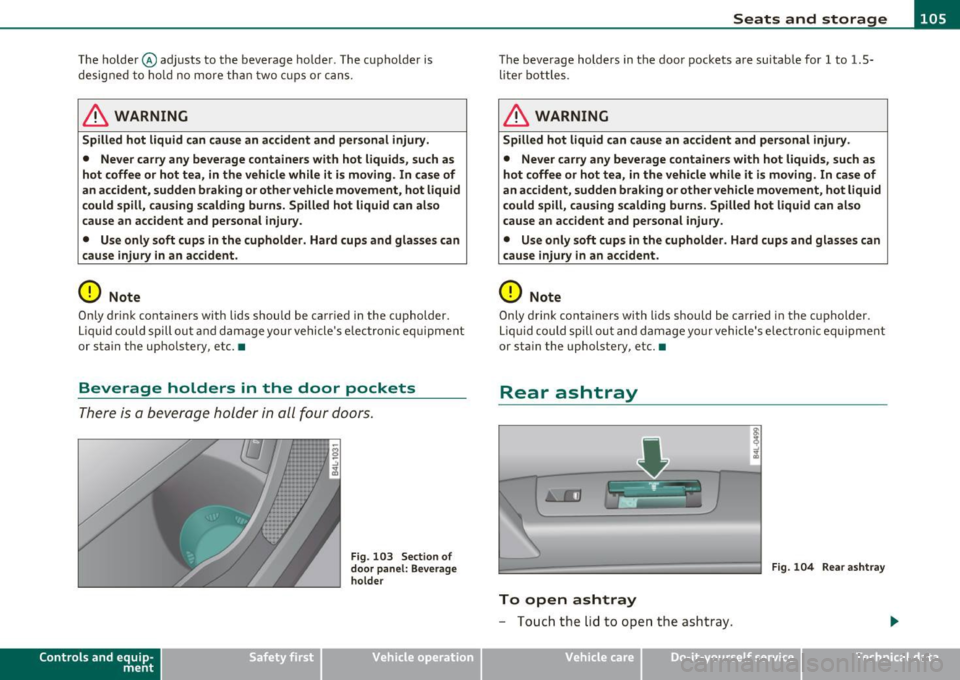
There is a beverage holder in all four doors .
Controls a nd e quip
m en t
Fig . 103 Sect ion of
doo r pan el: Bev era g e
ho ld er
Vehicle OP-eration
The beverage holders in the door pockets are su itab le for 1 to !.S
lite r bottles .
& WARNING
Spilled hot liquid can cau se an accident and p ers onal injury .
• Ne ver carry any beve rage containers with hot liquids , such a s
hot coff ee or hot tea, in the vehicl e while it i s mov ing . In ca se of
a n accident, sudde n bra king or other vehicle mo ve m ent , hot liqu id
c ould spill, cau sing scalding burn s. Spilled hot liquid can al so
cause an accident and pe rsonal injur y.
• Use only soft cups in the cuph older. H ard cups and gl asses can
c au se inj ury in an a ccident.
0 Note
Only drink containers with lids should be carr ied in the c upholder .
L iq ui d could spill out and dam age yo ur vehicle's e lec tron ic equipment
or sta in the upholstery, etc. •
Rear ashtray
Fig. 1 04 R ear as htray
To open ashtray
- Touch the lid to open the ashtray.
Vehicle care Do-it-yourselt service iTechnical data
Page 111 of 392
_______________________________________________ S_ e_ a_t _s_ a_n_ d_ s_ t_ o _ r_a """g::;. e _ __.ffl'I
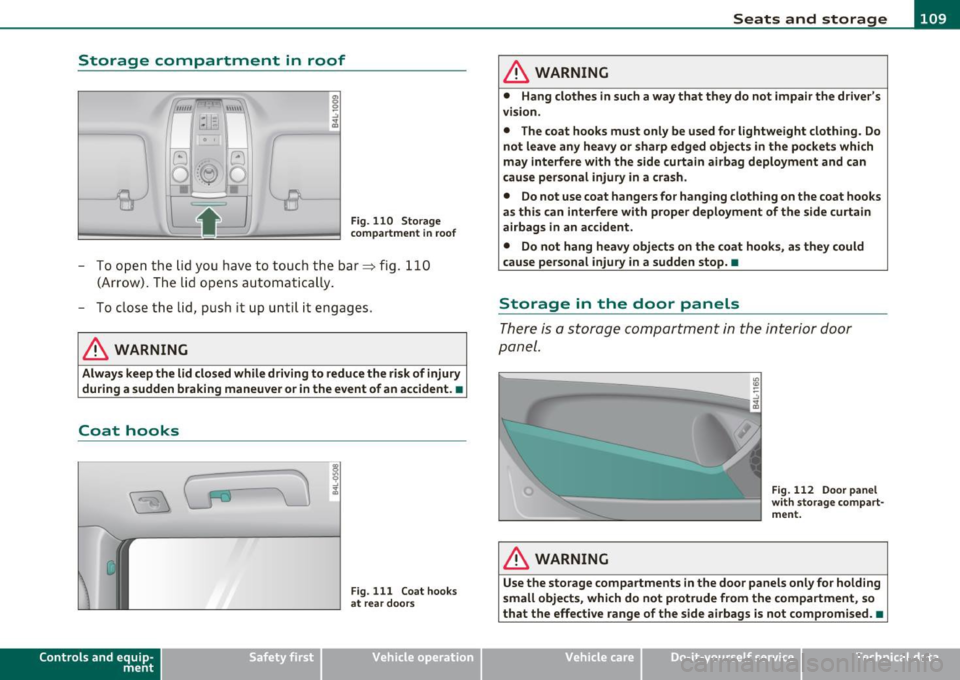
Storage compartment in roof
Fig. 110 Storage
compartment in roof
- To open the lid you have to touch the bar~ fig. 110
(Arrow). The lid opens automatically.
- To close the lid, push it up until it engages .
& WARNING
Always keep the lid closed while driving to reduce the risk of injury
during a sudden braking maneuver or in the event of an accident. •
Coat hooks
Controls a nd e quip ·
m en t
Fig . 111 Coat hooks
at rear doors
Vehicle OP-eration
& WARNING
• Hang clothes in such a way that they do not impair the driver's
vision.
• The coat hooks must only be used for lightweight clothing. Do
not leave any heavy or sharp edged objects in the pockets which
may interfere with the side curtain airbag deployment and can
cause personal injury in a crash.
• Do not use coat hangers for hanging clothing on the coat hooks
as this can interfere with proper deployment of the side curtain
airbags in an accident.
• Do not hang heavy objects on the coat hooks, as they could
cause personal injury in a sudden stop. •
Storage in the door panels
There is a storage compartment in the interior door
panel.
& WARNING
"'
"'
Fig. 112 Door panel
with storage compart·
ment.
Use the storage compartments in the door panels only for holding
small objects, which do not protrude from the compartment, so
that the effective range of the side airbags is not compromised. •
Vehicle care Do-it-yourselt service iTechnical data
Page 113 of 392
Warm and cold -
----------------
Warm and cold
Climate control
Description
The air conditioner is fully automatic and is designed to
maintain a comfortable and uniform climate inside the
vehicle.
We recommend the following settings:
- Set the temperature to 72
°F (+22 °C).
- Press the
[AUTO] button.
With this setting, you attain maximum comfort in the least amount
of time. Change this setting , as desired , to meet your personal needs.
The climate controls are a combination of heating, ventilation and cooling systems, which automatically reduce humidity and cool the
air inside your vehicle .
The air temperature, air flow and air distribution are automatically regulated to achieve and maintain the desired passenger compart
ment temperature as quickly as possible.
The system automatically compensates for changes in outside
temperature and for the intensity of the sunlight entering the
vehicle. We recommend you use the
Automatic mode ~ page 114
for year-round comfort .
Please note the following:
Turn on the air conditioner to reduce humidity in the vehicle. This also
prevents the windows from fogging up.
When the outside temperature is high and the air is very humid,
condensation from the evaporator may drip under the vehicle . This is
normal and does not indicate a leak.
Controls and equip
ment Safety first
If the outside temperature is
low, the fan normally only switches to a
higher speed once the engine coolant has warmed up sufficiently .
The air conditioner temporarily switches off when you drive off from
a standstill using full throttle to save engine power.
The compressor also switches off if the coolant temperature is too
high, so that the engine can be adequately cooled under extreme
loads.
Air pollutants filter
The air pollutants filter (a combined particle filter and activated char
coal filter) reduces or prevents outside air pollution (dust, or pollen)
from entering the vehicle. The air is also filtered in air recirculation
mode.
The air pollutants filter must be changed at the intervals specified in
your Warranty
& Maintenance booklet, so that the air conditioner can
properly work.
If you drive your vehicle in an area with high air pollution, the filter
may need to be changed more frequently than specified in your Audi
Warranty
& Maintenance booklet. If in doubt, ask your authorized
Audi Service Advisor for advice .
Key coded settings
The air conditioner settings selected are automatically stored and
assigned to the key being used. When the vehicle is started, the air
conditioner automatically selects the settings assigned to that key.
This way every driver will maintain his/her own personal settings and
does not have to reset them manually.
If a different driver uses your key and changes the air conditioner
settings, the latest adjustments will erase and replace the settings
you have stored. _.,
Vehicle care Technical data
Page 125 of 392

Warm and cold Ill _______________ __.
Appli es to veh icles: wi th st eering whee l he atin g
Steering wheel heat ing (j)
The steering wheel can be heated electrically.
F ig . 12 1 Stee rin g
wheel: butto n for
st ee rin g whe el heati ng
-Press the I~] button to turn the steering wheel heating on
and off=> fig. 121 . The message
Steering wheel heat ing on ! or
Steering whee l heat ing off ! appears in the instrument
cluster display .
A nearly constant temperature is maintained when the steer ing
wheel heating is switched on.
T he last sett ing se lected for the steer ing wheel heat ing (on or off) is
automatically saved when the veh icle is shut off and is assigned to the
remote key. •
Contro ls a nd e quip
m en t Vehicle
OP-eration Vehicle care Do-it-yourselt service iTechnical data
Page 127 of 392

On the road Ill _______________ __.
Applies to veh icles : w ith electrically adju stab le steer ing wheel
Electrically adjustable steering wheel
The height and reach of the stee ring wheel ca n be ele ctri
c ally adj usted to sui t th e d river.
Firs t, a djust t he dr iver's se at correct ly.
Height adjustment
Fig . 123 Sw itch for
s teering whee l ad ju st
ment
- Push t he s witch © up or down=> fig. 12 3. The st ee ring
w he el heig ht chang es f or as long as you press t he swi tch .
Reach adjustment
- Push t he switc h© forward or backward=> fig . 123 . T he
ste ering w hee l reac h changes for as long as you press the
swi tch .
The re m ust be at least 10 inches (25 cm) between you r chest and the
cen ter of the steering whee l. If you cannot sit more than 10 inches
(25 cm) from the steer ing wheel, see if adapt ive equ ipment is ava il
able to h elp you reach the pedals and increase the distance from the
steeri ng wheel.
For detailed information on how to adjust the dr iver 's seat , see
~ page 86.
Con tro ls a nd e quip
m en t Vehicle
OP-eration
The steering wheel ca n be adjusted even when the ign ition is turned
O ff. For veh icles with sea t memory, the individu al pos it io ns for the
steer ing wheel can be sto red along with t he seat pos it ion.
& WARNING
Improper use of steering wheel adjustment and imprope r seating
position can cau se seriou s per sonal injury.
• Adjust the steering wheel column only when the vehicle i s not
moving to prevent loss of vehicle control.
• Adjust the driver 's seat or steering wheel so that there is a
minimum of 10 in ches (25 cm) between your chest and the
steering wheel~
page 192, fig. 186. If you cannot maintain this
minimum distance , the airbag system cannot prote ct you prop
erly.
• If phy sical limitations prevent you from sitting 10 inches (25
cm ) or more from the steering wheel, check with you r authorized
Audi dealer to see if adaptive equipment is available .
• If the steering wheel is aligned with your face , the supple·
mental driver 's airbag cannot provide as much protection in an
accident. Always make sure that the steering wheel is aligned with
your che st.
• Always hold the steering wheel with your hands at the 9 o'clock
and 3 o'clock po sition s to reduce the risk of personal injury if the
drive r's airbag deploys.
• Never hold the steering wheel at the 12 o'clock po sition or with
your hands inside the steering wheel rim or on the steering wheel
hub. Holding the steering wheel the wrong way can cause serious
injuries to the hands, arms and head if the driver's airbag
deploy s.•
Vehicle care Do-it-yourselt service iTechnical data
Page 129 of 392

_________________________________________________ O_ n_ t_ h_ e_ r _o_ a_d _ __.fflll
& WARNING
• Never remove the key from the ignition lock while the vehicle
is moving. The steering wheel will lock , cau sing loss of control.
• If you ha ve to leave your vehicle, even for ju st a minute, alw ays
remove the ignition key and take it with you. This i s especially
important if you are going to leave children unattended in the
vehicle. The children could start the engine or use other vehicle c ontrols . Unsupervised us e of vehicle controls (for example, power
windows) can cause serious personal inju ries.
0 Note
• If the ~ symbol in the display blinks, there is a malfunction in the
electronic stee ring column lock. Follow the instr uctions in
~ page 36, "Steering malfu nction i" .
• If the ~ symbol in the display blinks, there is a malfunction in the
electronic ignition lock . Follow the instr uctions in~
page 37, "Igni
t ion lock malfunct ion ~" .
(I] Tips
• If you release the ignit ion key i n pos it io n @ , the key automatically
returns to pos ition
(D .
• If you open the driver 's doo r whe n the ignition is sw itched on, a
buzze r sounds and the message
Ignition is on appears in the instru
ment cl uster d isplay. Please swi tch the ignition off.
• T o prevent malf unctions in the ignition lock, remove any dirt or
deposits from t he key bit so that t hey do not ente r th e ignit ion lock. •
Contro ls a nd e quip
m en t Vehicle
OP-eration
Ignition key safety Lock
The ignition key can only be r emoved when the selector
le ver is in the "P" (Park) position .
After turning off the ignition, the ignition key can only be removed
from the igni tion lock when t he se lector lever is in the "P" (Park) posi
tion. A fter you have removed the key, the selector lever is locked and
cannot be move d.•
Starting and stopping the engine
Starting the engine
The engine can only be sta rted with you r origina l A udi
key.
Fig . 125 I gnition key
pos iti ons
Vehicles with gasoline engine:
- Step on the brake.
- Move the se lector leve r into P or N
=> &.
- Turn the ig nition key to position @=> fig . 125 -do not
dep ress th e gas pedal when s tarting the engine .
Vehicle care Do-it-yourselt service iTechnical data