child lock AUDI Q7 2012 Owner´s Manual
[x] Cancel search | Manufacturer: AUDI, Model Year: 2012, Model line: Q7, Model: AUDI Q7 2012Pages: 342, PDF Size: 86.42 MB
Page 100 of 342

98 Warm and cold
Synchronizin g rear ai r conditioni ng: By
pressing and holding the regulator on the rear
left side, the temperature setting of the rear
left side can be switched to the rear r ight side
and v ice versa. The new temperature is shown
in the display .
Turning on and off~
App lies to vehicles: with four -zone automat ic comfort a ir
co nd it io nin g
Tu rning on rear air conditi on ing
"' Press the !ON/OFF I button, or
"' Press the
!AU TO I button.
Turning off r ear air condit ioning
"' Press the !ON /O FF I button to swi tch the air
conditioning off and to b lock the air supp ly
from the outside .
The air conditioner turns back on when yo u
press the
temp eratu re reg ula tor or one of the
buttons .
{D) Tips
If the power child safety lock is on, the
rea r air condi tioning control element wi ll
not operate . In this case, dashes" ••• " wi ll
appear in the air condit ion ing control ele
ment d isp lay.
Automat ic mode in rear~
Applies to vehicles: with four-zone automat ic comfort a ir
co nd it io nin g
The automatic mode is the standard setting
for all seasons.
"' Se lect temperature between 60 °F (+16 °C)
and
84 °F (+28 °().
"' Press the
!AUTO I button.
Automatic operation ensu res constant tem
pe ratures in the inter io r and dehum idifies the
a ir i nside the vehicle. Ai r temperature, vo lume
and d istr ibu tion a re con trolled a utomat ically
to reach or maintain the desired inter ior tem
perat ure as quickly as possible . Fl uctuations
in exterior t emperat ure and the effects of temperature from the position of the s
un are
compensated for automatically .
T his operating mode works on ly in the adj ust
able temperature range, from
60 ° F (+ 16 °C )
to
84 °F ( + 28 °C) . If a temperature below 60
°F (+ 16 °C) is se lected, LO appears in the dis
play . At temperatures above
84 ° F (+ 28 °(),
HI is displayed . At bot h extreme sett ings, cli
mate control runs contin uously at maximum
cooling o r heating power . There is no temper
ature regulat ion.
Setting rear temperature
App lies to vehicles: wit h four-zone auto matic comfort air
conditio ning
The temperature can be separately adjusted
for the rear left and right sides .
"' Rotate the regulator to the left to red uce
the temperature, or to the r ight to increase
the temperature .
T he selected temperature appea rs on the cl i
mate control display.
Rear fan~
Appl ies to vehicles : wit h four-zone auto matic co mfo rt air
condition ing
The automatically preset fan speed can be re
duced or increased .
"' Press the~ butto n.
"' Rotate the regulator to the des ired fan
speed.
The climate control system automatically reg u lates fan speed depending on inter ior tem
perature. You ca n adjust the volume of air p ro
duced by the fan to your own requirements .
(D Tips
It is possible that the fan speed may
change automatically. This occurs to en
su re that the des ired temperature setting
i s reached as quickly as possible.
Page 112 of 342
110 On the road
The parking brake warning light. (USA)/ .
(CON) illuminates when the parking brake is
set and you switch on the ignition.
_& WARNING
-
Always release the parking brake com
pletely. A partially engaged brake will
overheat the rear brakes, reduce their ef
fectiveness and cause excessive wear. This could lead to brake failure and an accident .
(D Note
Only after the vehicle has come to com plete stop, should you firmly set the park
ing brake and move the selector lever into
"P".
Parking
To prevent a parked vehicle from rolling
away, there are a few things you should do .
When you park your vehicle, do the
following
• Stop the vehicle using the brake pedal.
• Apply the parking brake firmly .
• Move the selector lever into the
P position
~ &.
• Switch off the engine and remove the igni-
tion key from the ignition lock.
When you park your vehicle on hills, do
the following
• Stop the vehicle using the brake pedal.
• Apply the parking brake firmly.
• If you are parking headed downhill, turn
the front wheels
toward the curb.
• If you are parking headed uphill, turn the
front wheels
away from the curb.
• Move the selector lever into the
P position.
• Switch off the engine and remove the igni
tion key from the ignition lock.
_& WARNING
This is how you can reduce the risk of in
jury when leaving your vehicle. -
Never park the vehicle where it can come
in contact with dry grass, spilled fuel or
any other flammable materials.
- When parking on hills, always turn the
wheels so that the front wheels will first
roll into the curb, if the vehicle should
start to roll.
- Never allow anyone - especially small
children - to remain in the vehicle when
it is locked. locked doors make it more
difficult for rescuers to access the pas
senger compartment in the event of an
emergency. Danger to life!
- Never leave children unsupervised in the
vehicle. Children could release the park
ing brake or move the gearshift lever out
of gear. The vehicle could start to roll
away and cause an accident.
- No matter what the season is, the tem
perature in a parked vehicle can reach
dangerous levels.
@ Note
-Please exercise care when you park your
vehicle in parking areas with parking bar
riers or curbs. Parking barriers and curbs
vary in height and could damage your
bumper and related components as the
front of your vehicle moves over a barrier or curb that is too high, as you park or as
you back out of a parking spot. In order to be sure that no such damage can oc
cur, you may wish to stop short of having
the front tires of your car touch the park
ing barrier or curb.
- Please also exercise exceptional care
when you drive up or down steep ramps
or drive over curbs or other obstacles, for
which the vehicle is not designed, be
cause components of the vehicle close to
the ground, such as bumper covers, spoilers and suspension and exhaust sys
tem components, may become dam aged.
Starting on hills
Hill Hold makes it easier to start on hills.
Page 164 of 342
162 Driving Safely
• Always keep both feet in the footwell so
that you are in control of the vehicle at all
times.
For detailed information on how to adjust the
driver's seat, see
¢ page 72.
A WARNING
Drivers who are unbelted, out of position
or too close to the airbag can be seriously
injured by an airbag as it unfolds. To help
reduce the risk of serious personal injury:
- Always adjust the driver's seat and the
steering wheel so that there are at least
10 inches (25 cm) between your breast
bone and the steering wheel.
- Always hold the steering wheel on the
outside of the steering wheel rim with
your hands at the 9 o'clock and 3 o'clock positions to help reduce the risk of per
sonal injury if the driver's airbag inflates.
- Never hold the steering wheel at the
12 o'clock position or with your hands at
other positions inside the steering wheel
rim or on the steering wheel hub. Hold
ing the steering wheel the wrong way
can cause serious injuries to the hands,
arms and head if the driver's airbag de
ploys.
- Pointing the steering wheel toward your
face decreases the ability of the supple
mental driver 's airbag to protect you in a
collision .
- Always sit in an upright position and nev
er lean against or place any part of your
body too close to the area where the air
bags are located.
- Before driving, always adjust the front
seats and head restraints properly and
make sure that all passengers are prop
erly restrained.
- Never adjust the seats while the vehicle
is moving . Your seat may move unexpect
edly and you could lose control of the ve
hicle.
- Never drive with the backrest reclined or
tilted far back! The farther the backrests
are tilted back, the greater the risk of in- jury due to incorrect positioning of the
safety belt and improper seating posi
tion.
- Children must always ride in child safety
seats ¢
page 200. Special precautions
apply when installing a child safety seat
on the front passenger seat¢
page 179 .
Proper seating position for the front
passenger
The proper front passenger seating position
is important for safe, relaxed driving .
For your own safety and to reduce the risk of
injury in the event of an accident, we recom
mend that you adjust the seat for the front
passenger to the following position :
• Adjust the angle of the seatback so that it is
in an upright position and your back comes
in full contact with it whenever the vehicle is
moving .
• Adjust the head restraint so the upper edge
is as even as possible with the top of your
head. If that is not possible, try to adjust
the head restraint so that it is as close to
this position as possible ¢
page 163.
• Keep both feet flat on the floor in front of
the front passenger seat .
• Fasten and wear safety belts correct
ly ¢
page 174 .
For detailed information on how to adjust the
front passenger's seat, see ¢
page 71.
A WARNING
-Front seat passengers who are unbelted,
out of position or too close to the airbag
can be seriously injured or killed by the air
bag as it unfolds. To help reduce the risk of
serious personal injury:
- Passengers must always sit in an upright
position and never lean against or place
any part of their body too close to the
area where the airbags are located.
- Passengers who are unbelted, out of po
sition or too close to the airbag can be
seriously injured by an airbag as it
Page 169 of 342
to reduce the risk of injury when the vehi
cle is not be ing used.
- After closing the rear lid, always make
sure that it is properly closed and locked.
- Never leave your vehicle unattended es
pecially with the rear lid left open . A
child could crawl into the vehicle through
the luggage compartment and close the
rear lid becoming trapped and unable to
get out . Be ing trapped in a vehicle can
lead to serious persona l injury .
- Never let children play in or around the vehicle .
- Never let passe ngers r ide in the luggage
compartment . Ve hicle occupants must
always be properly restrained in one of
the vehicle's seating positions.
(D Tips
- Air c irculation helps to reduce window
fogging . Sta le air escapes to the outside
th rough vents in the trim pane l. Be su re
to keep these slots free and open .
-The t ire pressure must correspond to the
load. The t ire pressur e is shown o n the
tire p ress ure label. The tire pressure la
bel is loc ated on the d river's s ide B-pi ll a r.
The t ire pressure label lists the recom
mended cold ti re inflat ion pressu res for
the vehicle at its maximum capacity
weig ht and the tires that were on you r
vehicle at the time it was man ufactured .
For recommended t ire pressures fo r nor
mal load conditions, please see chap ter
c:> page278 .
Tie-downs
The luggage compartment is equipped with
four tie-downs to secure luggage and other
items .
Use the tie-downs to secure your cargo prop
erly
c:> page 166, Loading the luggage com
partment.
In a coll is ion, the l aws of phys ics mean that
even smalle r items that are loose in the vehi
cle will become heavy missiles that can cause
Dr iving S afel y 167
serious injury. Items in the ve hicle possess en
ergy which vary with vehicle speed and th e
weight o f the item . Vehicle speed is the most
s ignificant factor.
Fo r example, in a fronta l collision at a speed
of 30 mph (48 km/h), the forces acting on a
10 -lb (4.5 kg) object are about 20 t imes the
no rmal weight of the item. This means t hat
the weigh t of the item would sudden ly be
about 200 lbs. (90 kg) . You can imag ine the
i njur ies that a 200 lbs . (90 kg) item fly ing
fr eely th ro ugh the passenger compar tme nt
c ould cause in a co lli sion like this.
A WARNING
We ak, dam aged or imprope r str aps used
to secure items to tie -downs can fail dur
ing hard braking or in a collision and cause
serio us personal injury .
-Always use s uita ble mount ing stra ps and
properly secu re items to the tie-downs in
the l uggage compa rtme nt to he lp pre
vent items from shift ing or f ly ing fo r
ward as dangerous missiles .
-When the rea r seat backrest is folded
down, a lways use suitable mounting
straps and properly secure items to the
tie-downs in the luggage compartment
to hel p prevent items from fly ing for
ward as da ngerous missiles into the pas
s enger compartment .
- Never attach a chi ld safety seat te th er
s trap to a t ie- down .
Reporting Safety
Defects
Applicable to U.S.A.
If you b elieve that your v ehi cle
has a d efe ct whi ch could cause
a crash or could cause injury or
d eath, you should imm ediately
inform the National Highway
Tr affic Safet y Admini stration ..,.
•
•
Page 177 of 342
the wrong buckle will reduce safety belt
effectiveness and can cause serious per
sonal injury.
- A passenger who is not properly restrain
ed can be seriously injured by the safety
belt itself when it moves from the stron
ger parts of the body into critical areas
like the abdomen .
- Always lock the convertible locking re
tractor when you are secur ing a child
safety seat in the vehicle
~ page 211 .
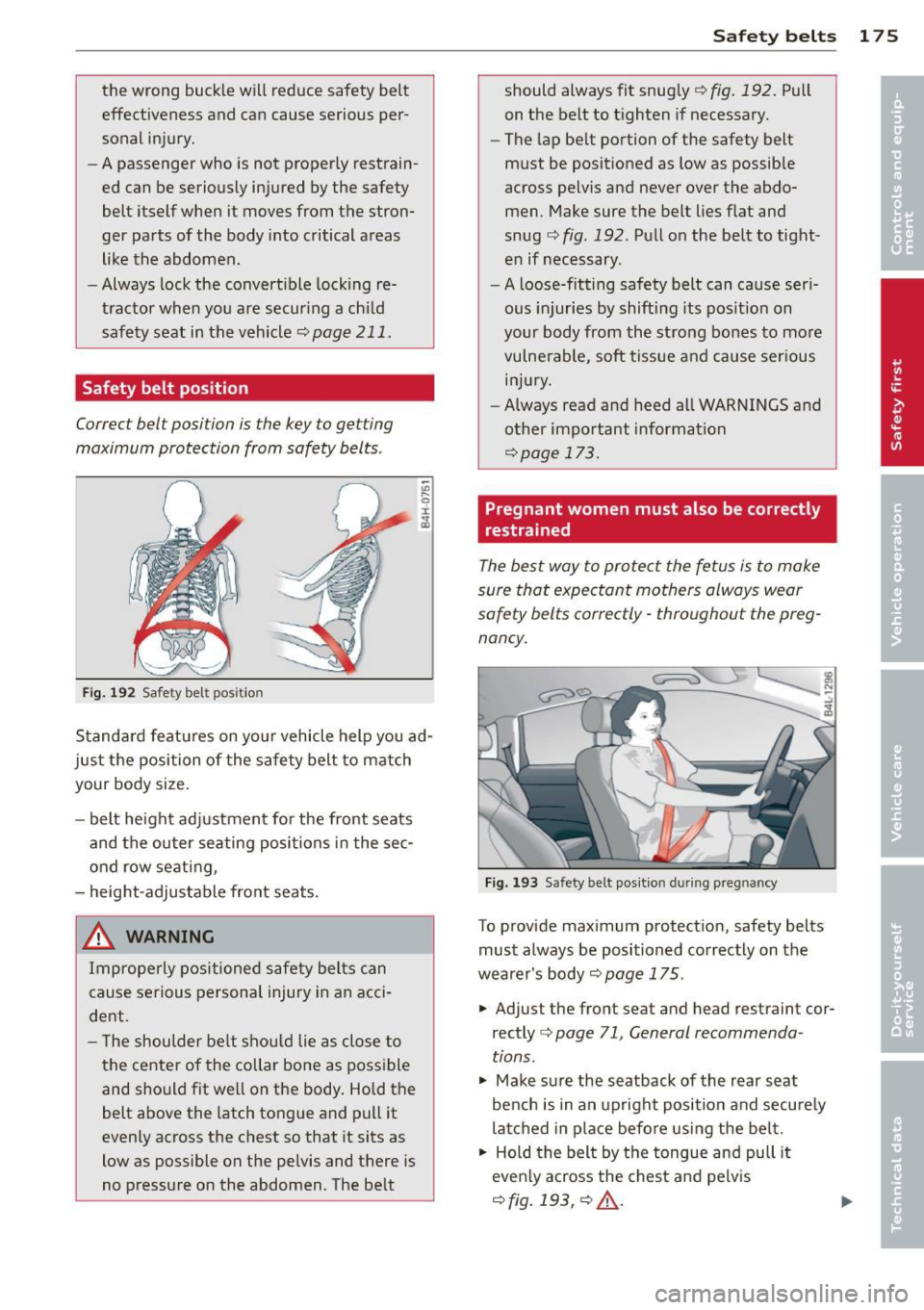
Safety belt position
Correct bel t posi tion is the key to getting
maximum protection from safety belts .
Fig. 192 Safety be lt pos it io n
Standard features on your vehicle help you ad
just the position of the safety belt to match
your body size.
- belt height adjustment for the front seats
and the outer seating positions in the sec
ond row seating,
- height-adjustable front seats.
A WARNING
Improperly positioned safety belts can
cause serious personal injury in an acci
dent.
-
- The shoulder belt should lie as close to
the center of the collar bone as possible
and should fit well on the body. Hold the
belt above the latch tongue and pull it
evenly across the chest so that it sits as
low as possible on the pelvis and there is
no pressure on the abdomen . The belt
Safety belts 175
should always fit snugly¢ fig. 192. Pull
on the belt to tighten if necessary.
- The lap belt portion of the safety belt
must be positioned as low as possible
across pelvis and never over the abdo
men . Make sure the belt lies flat and
snug ¢
fig. 192 . Pull on the belt to tight
en if necessary .
- A loose-fitting safety belt can cause seri
ous injuries by shifting its pos ition on
your body from the strong bones to more
vulnerable, soft tissue and cause serious
injury.
- Always read and heed all WARNINGS and
other important information
¢ page 173.
Pregnant women must also be correctly
restrained
The best way to protect the fetus is to make
sure that expectant mothers always wear
safety belts correctly -throughout the preg
nancy.
Fig. 193 Safety belt pos ition du ring pregnan cy
To provide max imum protection, safety belts
must always be positioned correctly on the
wearer's body¢
page 175 .
.,. Adjust the front seat and head restraint cor
rectly ¢
page 71 , General recommenda
tions .
.,. Make sure the seatback of the rear seat
bench is in an upright position and securely
latched in place before using the belt.
... Hold the belt by the tongue and pull it
evenly across the chest and pelvis
¢fig. 193, ¢ A.
Page 193 of 342

-a car bed has been insta lled on the front
seat, or
- a rearward-facing chi ld restraint has been
installed on the front passenger seat, or
- a forward -facing child restraint has been in
sta lled on the front passenge r seat, or
- the weight registered on the front passen
ger seat is equa l to or less than the com
bined weight of a typical 1 year -old restrain
ed in one of the rear-fac ing or forward-fac
ing infant restraints listed in Federal Motor
Vehicle Safety Standard 208 w ith which the
Advanced Airbag System in your veh icle was
certified.
If the front passenger seat is not occupied,
the front airbag will not deploy, and the
P A S
S ENGER AIR BA G OF F
light w ill stay on. Nev
er install a rearward -fac ing ch ild restra int on
the front passenger seat, the safest place for
a child in any ki nd of child restraint is at one
of the seating positions on the rear seat
~ page 181, Child restraints on the front seat
- some important things to know
and
~ page 200, Child Safety.
If the PASSENGER AIR BAG OFF light c om es
o n
when one of the conditions listed above is
met, be sure to check the light regularly to
make certain that the
PASSENGER AIR BAG
OF F
light stays on continuous ly whenever the
ignition is on. If the
PA SSE NGER AIR BAG
OFF
light does not appear on and does not
stay on all the time, stop as soon as it is safe
to do so and
- react ivate the system by turning the ignition
off and then turning it on again;
- remove and reinstall the chi ld restraint .
Make sure that the child restraint is properly
installed and that the safety belt for the
front passenger seat has been correctly routed throug h the child restraint as descri
bed in the chi ld restraint manufactu rer's in
structions;
- make sure that the convertible locking fea
tu re on the safety be lt fo r the front passen
ger seat has been activated and that the sa fety belt has been pulled tight. The bel t
mus t not be loose o r have loops of slack so
A irbag system 19 1
that the sensor below the sa fety be lt latch
on the seat can do its job
~ page 209.
- make sure that things that may increase the
weight of the child and chi ld safety seat are
not being transported on the front passen
ger seat;
- make sure t hat the safety belt tension sen
sor is not blocked. Shake the safety belt
latch on the front passenger seatback and
forth;
- If a strap or tether is be ing used to tie the
child safety seat to the front passenger
seat, make sure that it is not so tight that it
causes the weight -se nsing mat to measure
more weight than is actually on the seat .
If the P ASS ENGER AIR B AG OFF light still
do es not come on
and does not stay on con
tinuously (whe n the ignition is switched on),
- take the child restraint off the front passen-
ger seat and install it properly at one of the
rear seat positions. Have the airbag system
inspected by your authorized Aud i dealer
immed iate ly.
- move the child to a rear seat position and
make sure t hat the ch ild is properly restra in
ed in a ch ild restra int that is appropriate for
its size and age.
The
PAS SENG ER A IR BAG OFF light should
NOT come on when the ignit ion is on and an
adult is s itting in a proper seating position on
t h e front passenger seat. If the
PASSENGER
AIR BAG OFF
light comes on and stays on o r
flashes fo r about 5 seconds wh ile d riving, un
der these c ircumstances, make sure that :
- the adult on t he front passenge r seat is
prope rly seated on the cente r of the seat
cushion with his o r he r back up ag ainst the
backrest and the backrest is not reclined
~ page 161, Proper occupant seating posi
tions,
- the adult is not taking weight off the seat by
holding on to the passenger assist handle
above the front passenger door or support-
ing their weight on the armrest, .,_
•
•
Page 205 of 342
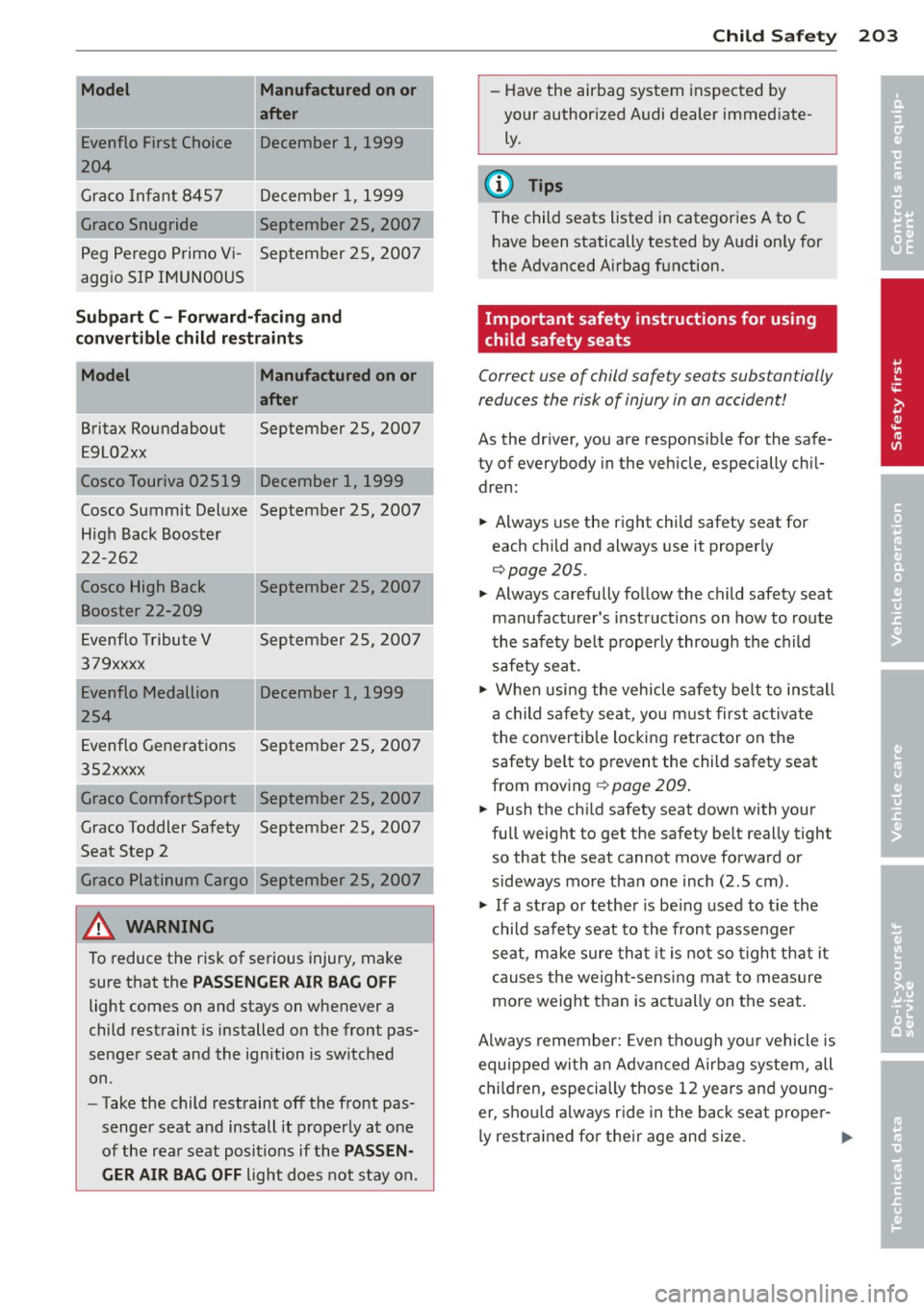
-Model Manufactured on or
after
Evenflo First Choic e December 1, 1999
1204
G raco Infant 8457 December 1, 1999
Graco Snug ride September 25, 2007
Peg Perego Primo Vi -September 25, 200 7
aggio SIP I MUN00US
Subpart C -Forward -facing and
con vertible child restraints
Model Manufactured on or
after
Britax Roundabout September 25, 2007
E9L02xx
Cosco Touriva 02519 December 1, 1999
Cosco Summit Deluxe September 25 , 2007
High Back Booster
22 -26 2
! Cosco High Back September 25, 2007
Booster 22-209
E venflo Tribu te V September 25, 200 7
379xxxx
Evenflo Medallion December 1, 1999
254
Evenflo Generations Septem ber 25, 2007
352xxxx
Graco ComfortSport September 25, 200 7
Graco Toddler Safety September 25, 2007
Seat Step 2
Graco Platinum Cargo September 25, 2007
&_ WARNING
To reduce the risk of serious injury, make sure that the
PASSENGER AIR BAG O FF
light comes on and stays on whenever a
child rest raint is installed on the front pas
senger seat and the ignition is switched
on.
- Take the child rest raint off the front pas
senger seat and install it properly at one
of the rea r seat posi tions if the
PASSEN
GER AIR BAG OFF
light does not stay o n.
Child Sa fet y 203
-Have the airbag system inspected by
your author ized Audi dealer immed iate
ly.
(D Tips
The child seats listed in categor ies A to C
have been statically tested by A udi on ly for
the Advanced A irbag function.
Important safety instructions for using
child safety seats
Correct use of child safety seats substantially
reduces the risk of injury in an accident!
As the dr iver, you are responsib le for the safe
ty of everybody in the veh icle, especially ch il
dren:
... Always use the r ight chi ld safety seat for
each child and always use it properly
¢page 205.
... Always carefully fo llow the child safety seat
manufactu rer's inst ruct io ns on how to route
th e safety belt properly through the child
safety sea t .
... When usi ng the vehicle safe ty belt to install
a child s afety se at, you m ust first a ctiv ate
t he conve rtible locking retractor on the
safety belt to prevent the child safety seat
from mov ing
¢ page 209 .
... Push the ch ild safety seat down with your
full weight to get the safety be lt really tight
so that the seat cannot move forward or
sideways mo re tha n one inch (2 .5 cm) .
... If a strap o r tethe r is be ing used to tie th e
child safety seat to the front passenger
seat, make sure tha t it i s not so tigh t that i t
causes the weigh t-sens in g m at to measure
more weight than is act ually on the seat.
A lways remember: Even tho ugh you r vehicle is
equippe d wi th an Advanced Airbag system, all
c h ildren, especially those 1 2 years and young
er, s ho ul d always ride in the back seat prope r-
l y restrained for the ir age and size.
ll>
•
•
Page 207 of 342
as possible before installing the child
restraint.
- Always make sure that nothing pre
vents the front passenger's seat from
be ing moved to the rearmost position
in its fore and aft adjustment range.
- Always make sure that the backrest is
in the upr ight position.
- Always buck le the child safety seat firmly
in place even if a child is not sitting in it.
A loose ch ild safety seat can fly around
dur ing a sudden stop or in a col lision .
- Always read and heed all WARNINGS
whenever using a child restrained in ave
hicle is being used~
page 170, Safety
belts,
~ page 179, Airbag system and
¢ page 200, Child Safety.
A WARNING
T o reduce t he ris k of serious injury, make
sure that the
PASSENGER AIR BAG OFF
light comes on and stays on whenever a
child rest raint is installed on the front pas
senger seat and the ignition is switc hed
on.
- Take the child restraint off t he fro nt pas
senger seat and install it properly at one
of the rear seat positions if the
PASSEN ·
GER AIR BAG OFF
light does not stay on.
- Have the airbag system inspected by
your authorized Aud i dealer immediate
ly.
A WARNING
A child in a child rest raint installed w ith
the LATCH lower anchorages or w ith the
standard safety belt on the rear seat may
play wi th unused rear seat safety belts and
become entangled res ulting in ser ious per
sonal inj ury and even dea th.
- Always bu ckle unused rea r seat safety
bel ts out of re ach of chi ld ren in ch ild
sea ts and properly a ctivate the converti
ble locking retrac tor so that the child
cannot un reel the safety belt from the
retractor .
-
Child S afety 205
Child safety seats
Infant seats
Babies and infants up to about one year old
and 20 lbs. or 9 kg need special rearward-fac
ing child restraints that support the back,
neck and head in a crash.
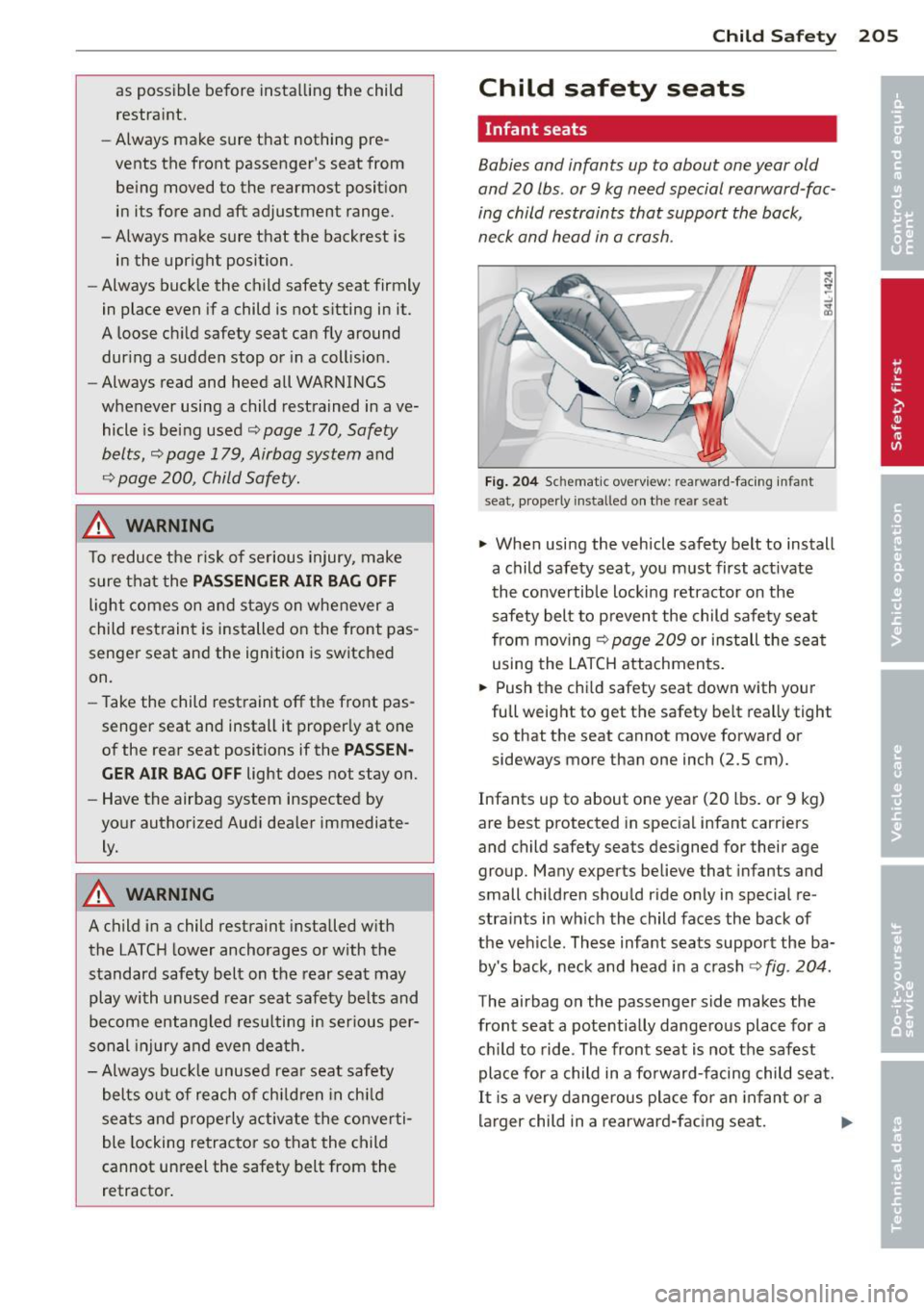
F ig . 20 4 Schematic overview: rearward-fac ing infant
seat, properly installed on t he rear seat
... When usi ng the vehicle safety belt to install
a child safety seat, you m ust first activate
the convertib le locki ng retractor on the
safety belt to p revent the child safety seat
from moving~
page 209 or install the seat
using the LATCH attachmen ts .
... Push the chi ld safety seat down with your
full weig ht to get the safety belt really tight
so that the seat cannot move forward or
sideways more than one inch (2.5 cm).
Infants up to about one year
(20 l bs. or 9 kg)
are best protected in specia l infant carriers
and child safety seats designed for their age
group. Many experts believe that infants and
small children should r ide on ly in special re
stra ints in wh ich the child faces the back of
the vehi cle. These infant seats support the ba
by 's back, ne ck and head in a crash
¢ fig. 204.
The airbag on the passenger side makes the
front seat a pote ntia lly dange ro us place for a
ch ild to ride. Th e front seat is not t he safest
pla ce for a child in a fo rward-facing child sea t.
It is a very dangerous place fo r an in fant or a
larger child in a rearward-facing seat. .._
Page 208 of 342
206 Child Safe ty
& WARNING
Not using a child safety seat, using the
wrong ch ild safety seat or improperly in
stall ing a child restraint increases the risk
of serious personal injury and death in a
crash.
- Never install rear-fac ing ch ild safety
seats or infant carriers on the front pas
senger seat - even with an Advanced Air
bag System. A child will be seriously in
jured and can be killed when the inflat
ing airbag hits the child safety seat or in
fant carrier with great force and smashes
the child safety seat and child against
the backrest, center armrest, door or
roof
c:> page 181, Child restraints on the
front seat -some important things to
know.
- Always install rear-facing child safety
seats or infant carriers on the rear seat.
- Never install a rear-facing child restraint
in the forward-facing direction. Such re
st raints are des igned for the spec ial
needs of infants and very small childre n
and cannot p rotect them proper ly if the
seat is forward-fac ing.
- If you must install a rea rward facing
child safety seat on the front passenge r
seat because of exceptional circ umstan
ces and the
PASSENGER AIR BAG OF F
light does not come on and stay on, im
mediately install the rear-facing child
safety seat in a rear seating position and
have th e a irbag system inspected by your
Audi dealer.
- Always read and heed all WARNINGS
whenever using a child restrained in ave
hicle is being used-:;.
page 170, Safety
belts,-:;, page 179, Airbag system
and
c:> page 200, Important things to know.
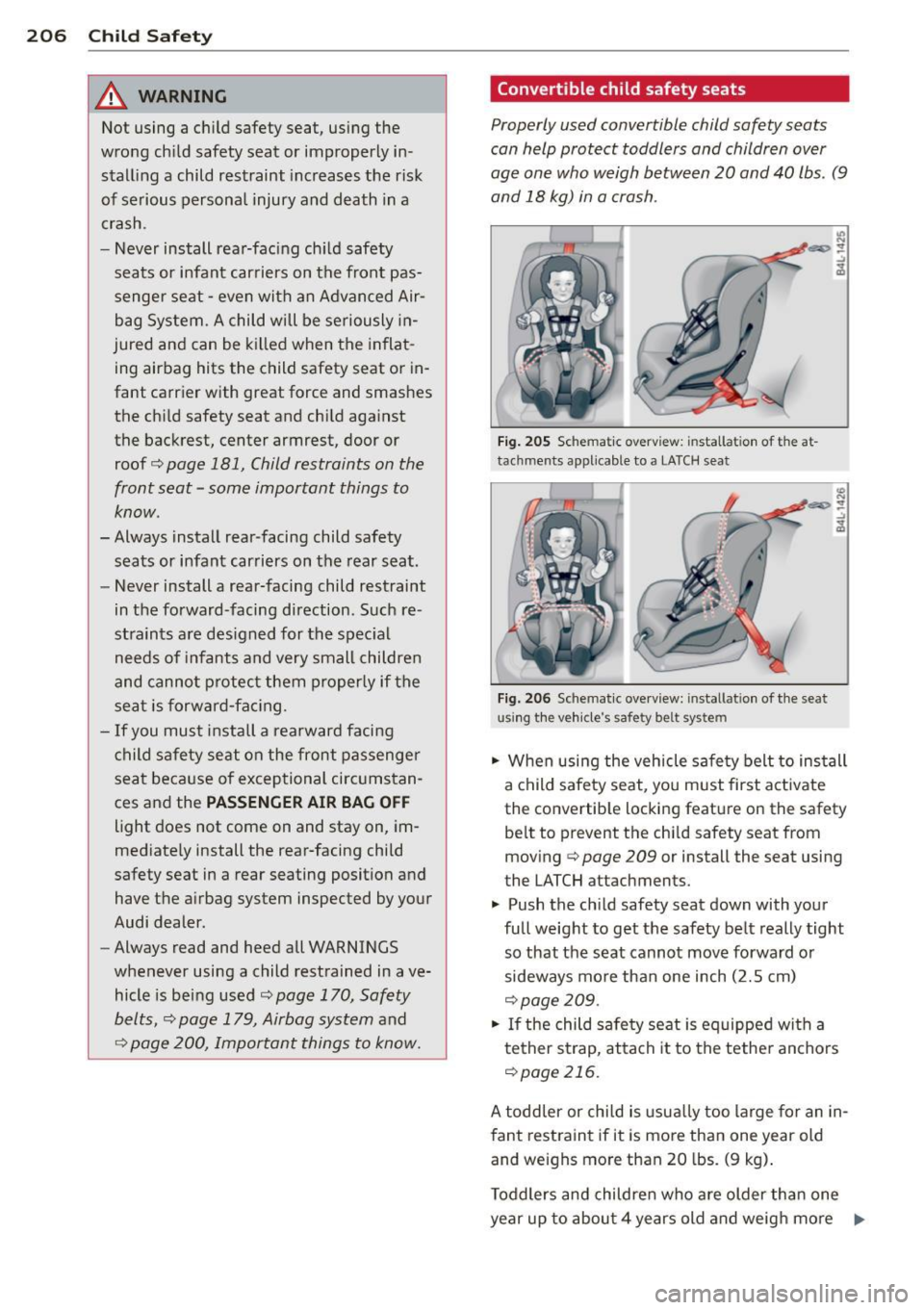
Convertible child safety seats
Properly used convertible child safety seats
can help protect toddlers and children over
age one who weigh between 20 and
40 lbs. (9
and 18 kg) in a crash.
Fig. 205 Schemat ic overview: installat ion of t he at
tachments appl icable to a LATCH seat
Fig . 206 Schema tic overview: installat ion of the seat
us ing the vehicle 's safety belt system
.,. When using the vehicle sa fe ty belt to install
a child safety seat, you must first activate
the convertib le locking feature on the safety
be lt to prevent the child safety seat from
moving
c:> page 209 or install the seat using
the LATCH attachments.
., Push the child safety seat down with your
full weight to get the safety belt really tight
so that the seat cannot move forward o r
sideways mo re than one inch (2.5 cm)
c:> page 209 .
.,. If the child sa fe ty seat is eq uipped with a
t ether strap, attach it to the tethe r anchors
c:>page 216.
A toddler or chi ld is usua lly too large for an in
f ant restraint if it is more than one year old
and weighs more than 20 lbs. (9 kg).
T oddlers and childre n who a re older tha n one
year up to abou t 4 years old and weigh more ..,.
Page 210 of 342
208 Child Safet y
of the rear seat positions if the PASSEN·
G ER AIR B AG OFF
light does not stay on
whenever the ignition is switched on.
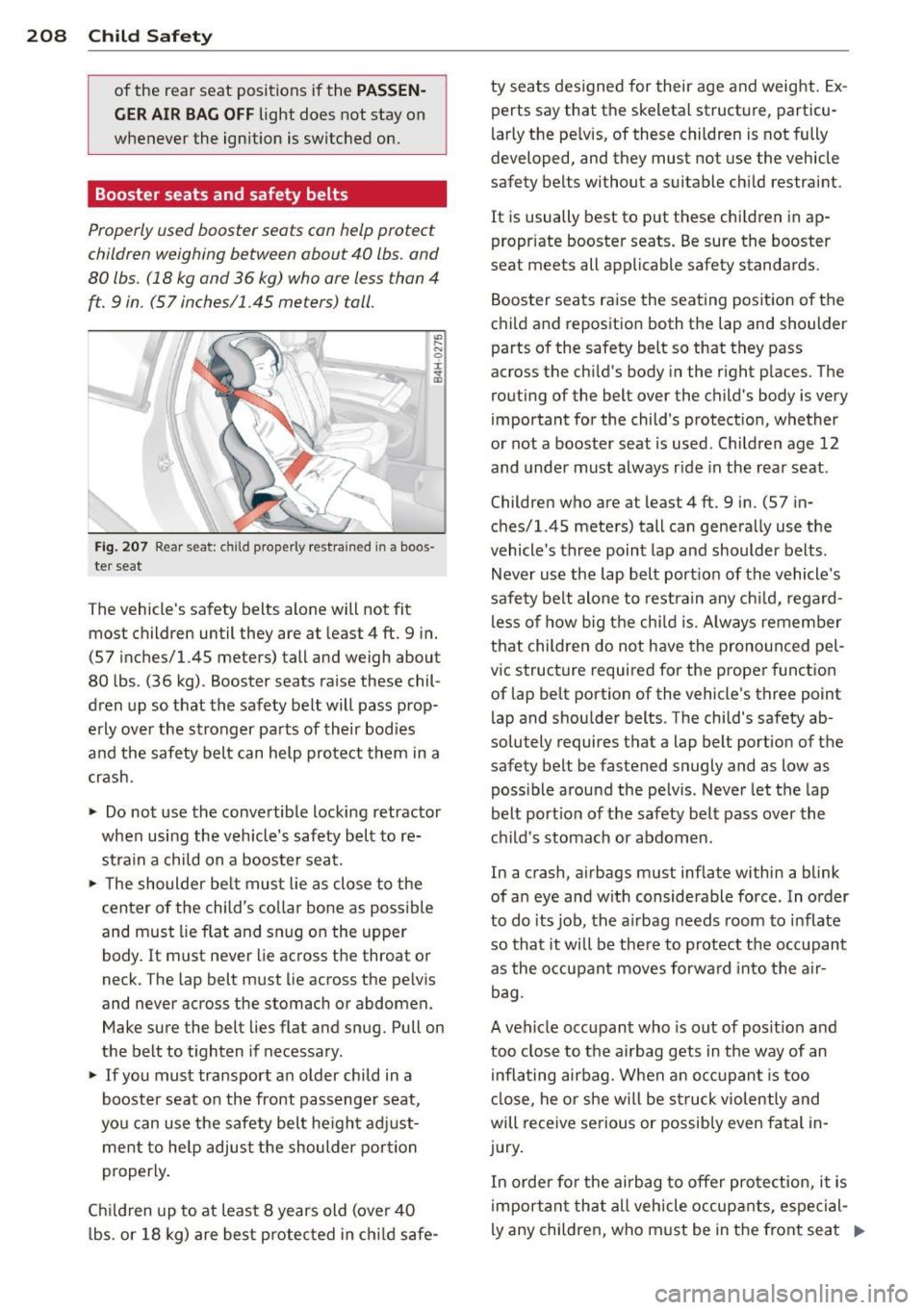
Booster seats and safety belts
Properly used booster seats con help protect
children weighing between about 40 lbs. and
80 lbs. (18 kg and 36 kg) who ore less than
4
ft. 9 in. (57 inches/1.45 meters) toll.
"' .... N 0 r
~
Fig. 207 Rear seat: child properly restra ined in a boos·
ter seat
The vehicle's safety belts alone will not fit
most children until they are at least 4
ft. 9 in.
(57 inches/1.45 meters) tall and weigh about
80 lbs . (36 kg) . Booster seats raise these chil
dren up so that the safety belt will pass prop·
erly over the stronger parts of their bod ies
and the safety belt can help protect them in a
crash.
• Do not use the convertible locking retractor
when using the veh icle's safety belt to re
strain a chi ld on a booster seat.
• The shoulder be lt must lie as close to the
center of the child's co llar bone as possible
and must lie flat and snug on the upper
body. It must never lie across the throat or
neck. The lap belt must lie across the pelvis
and never across the stomach or abdomen.
Make sure the belt lies flat and snug. Pull on
the belt to t ighten if necessary.
• If you must transport an older child in a
booster seat on the front passenge r seat,
you can use the safety belt he ight adjust
ment to help adjust the shoulder por tion
properly .
Ch ildren up to at least 8 years old (over 40
lbs. or 18 kg) are best p rotected in ch ild safe- ty seats designed for their age and weight. Ex
perts say that the skeletal structure, particu
larly the pe lvis, of these children is not fully
developed, and they must not use the vehicle
safety belts without a suitable chi ld restraint.
It is usually best to put these chi ldren in ap
propr iate booster seats. Be sure the booster
seat meets all applicable safety standards.
Booster seats raise the seating position of the
c h ild and reposition both the lap and shoulder
parts of the safety belt so that they pass
across the ch ild's body in the right p laces. The
ro uting of the belt over the child's body is very
important for the child's protect ion, whether
o r not a booster seat is used. Chi ldren age 12
and under must always r ide in the rear seat .
Children who are at least 4
ft. 9 in. (57 in
ches/1.45 meters) tall can generally use the
vehicle's three point lap and shoulder belts.
Never use the lap belt port ion of the vehicle's
safety belt alone to restrain any ch ild, rega rd
less of how big the chi ld is. A lways remember
that children do not have the pronounced pel
vic structure required for the proper funct ion
of lap belt portion of the vehicle's three point
l ap and shou lder belts . The child's safety ab
solutely requires that a lap belt portion of the
safety belt be fastened snugly and as low as poss ible around the pelvis . Never let the lap
belt port ion of the safety belt pass over the
child's stomach or abdomen.
In a crash, a irbags must inflate within a blink
of an eye and with considerable force. In order
to do its job, the a irbag needs room to inflate
so that it will be the re to protect the occ upant
as the occupant moves forward into the a ir
bag .
A vehicle occupant who is out of pos it ion a nd
too clos e to the a irbag gets in the way of an
inflating airbag . When a n oc cupant is too
cl ose, he or she will be s truck violently and
will receive serious or possibly even fatal in
Ju ry.
In order fo r the ai rbag to offer pro tectio n, i t is
importan t tha t al l vehicle occup ants, especial-
ly any children, who m ust be in the front seat ..,_