child lock AUDI Q7 2012 Owner´s Manual
[x] Cancel search | Manufacturer: AUDI, Model Year: 2012, Model line: Q7, Model: AUDI Q7 2012Pages: 342, PDF Size: 86.42 MB
Page 211 of 342
because of exceptional circumstances, be
properly restrained and as far away from the
airbag as poss ib le . By keep ing room between
the child's body and the front of the passen
ger compartment, the airbag can inflate com
p letely and provide supplemental protection
i n certa in frontal collis ions .
A WARNING
Not using a booster seat, us ing the boos
ter seat imprope rly, i ncorrect ly ins tall ing a
booste r seat or using the vehicle safety
bel t improperly increases the risk of seri
ous personal injury and death in a collision
or other emergency s ituation. To help re
duce the risk of ser ious persona l injury
and/or death:
- The shoulder be lt must lie as close to the
center of the child's co llar bone as possi
ble and must lie flat and snug on the up
per body. It must never lie across the
throat or neck. The lap belt must lie
across the pelvis and never across the
stoma ch or abdomen. Make su re the bel t
lies flat and snug. P ull on the be lt to
t igh ten i f ne cessary.
- Failure to properly route safety belts
over a ch ild' s body will cause severe inju
ries in an a cciden t or o ther emergency
situation ¢
page 170.
-The rea r side of the child s afety se at
sho uld be positioned as close as possible
to the back rest on the ve hicle seat. A d
just or remove the rear seat head re
straint if it is difficult to install t he child
seat with the head restrai nt in place
¢
page 77. Install the head restra int
agai n immed iate ly once the child sea t is
removed. Driving w ithout head rest raints
o r with head res traints tha t are no t prop
e rl y adju sted incre ases the risk of ser ious
o r f atal neck injury dramat ica lly.
- Children on the front seat of any car,
even with Advanced A irb ags, can be seri
o usly inju red or even killed when an a ir
bag inf lates .
- Never le t a child st and or knee l on any
sea t, for examp le the front seat.
-
Child Sa fet y 209
-Never let a chi ld r ide in the cargo area of
your veh icle.
- Always remember t hat a c hild leaning
forward, sitting sideways or out of posi
tion in any way d uring an accident can be
struck by a dep loying a irbag. This will re
sult in ser ious personal inju ry or death .
- If you must install a booster seat on the
front passenger seat because of excep
tional ci rcumstances the
PASSENGER
AIR BAG OFF
li ght m ust come o n and
s tay on, w henever the ign ition is switc h
ed on.
- If the
PASSENGER AIR BAG OFF li ght
does not come on and stay on, pe rform
the c heck s descr ibed¢
page 190, Moni
toring the Advanced Airbag System .
- Take the chi ld restraint off the fron t pas
senger sea t and inst all it prope rly at one
of the rear sea t positions if the
PASSEN
GER AIR BAG OFF
li ght does not stay on
whenever the ignit ion is switched on .
-A lways read an d heed a ll WAR NIN GS
wheneve r using a chi ld restrained in ave
hicle is being used
¢ page 170, Safety
belts,
¢ page 179, Airbag system and
¢ page 200, Important things to know.
Installing a child safety
seat
Securing a child safety seat using a
safety belt
Safety belts for the rear seats and the front
passenger con be locked with the convertible locking retractor to properly secure child
safety seats.
The safety belts emergency locking retractors
for the rear seats safety belts and for the
front passenger's seat safety be lt have a co n
vertib le locking retractor for child rest raints.
T he safety belt must be locked so that be lt
webb ing cannot unreel. The retractor can be
activated to lo ck the safe ty belt and prevent
t h e safety be lt webbing from looseni ng up
during norma l dr iving . A chi ld safety seat can
o nl y be properly installed when the safety belt.,.. •
•
Page 212 of 342
210 Child Saf ety
is locked so that the child and child safety
seat will stay in place .
A lways remember: Even though your veh icle is
equipped w ith an Advanced A irbag system, all
children, especially those 12 years and young
er, should always ride in the back seat proper
ly restrained fo r their age and s ize.
.&_ WARNING
Improperly installed child safety seats in
crease the risk of ser ious personal injury
and death in a collision.
- Always make sure that the safety belt re
tractor is locked when installing a child
safety seat . An unlocked safety belt re
tractor cannot hold the child safety seat in place during normal driving or in a
crash .
- Always buck le the child safety seat firmly
in place even if a child is not sitting in it.
A loose ch ild safety seat can fly around
dur ing a sudden stop or in a col lision .
- Always make su re that the rear seat
backrest to which the center rear safety
belt is attached is sec urely latched when
ever the rear center safety be lt is being
used to sec ure a child restraint.
- If the backrest is not securely latched,
the chi ld and the child restraint will be
thrown forward together with the back
rest and will strike parts of the veh icle
inter ior. The child can be serious ly in
jured or killed.
- Never install rear-facing chi ld safety
seats or infant carriers on the front pas
senger seat . A ch ild will be ser iously in
jured and can be k illed when the passen
ger ai rbag inflates.
- T he inflating a irbag will hit the child
safety seat or infant carri er w ith great
force and w ill smash the ch ild safety sea t
and child against the backrest, center armrest, door or roo f.
- Always install rear-facing child safety
sea ts or infant carriers on the rear seat.
- Forward-fa cing ch ild safety seats or in
f ant ca rr iers installed on the front pas- senger's seat may interfere with the de
ployment of the a irbag and cause serious
injury to the child.
- It is safer to install a forward-facing
child safety seat on the rear seat.
- Always read and heed all WARNINGS
whenever using a child restrained in ave
hicle is being used ¢
page 200. Special
precautions apply when insta lling a child
safety seat on the front passenger seat
¢ page 181, Child restraints on the front
seat -some important things to know .
.&_ WARNING
Always take specia l precautions if you
must install a forw ard or rearward-fa cing
chi ld restraint on the front p assenge r's
seat in exceptional situations:
- W henever a forw ard or rearward-facing
child restraint is installed on the front
passenger seat , the
PASSENGER AIR
BAG OFF
light must come on and stay on
whenever the ignit ion is switched on.
- If the
PASSENGER AIR BAG OFF light
does not come on and stay on, perform
the checks described¢
page 190, Moni
toring the Advanced Airbag System.
- Take the chi ld restraint off the front pas
senger seat and install it properly at one
of the rear seat positions if the
PASSEN
GER AIR BAG OFF
light does not s tay on
wheneve r the ignit ion is switched on.
- Imprope r installation of ch ild restra ints
can reduce their effectiveness or even
p revent them from providing any protec
tion .
- An improperly installed ch ild restra int
can int erfere with the airbag as it de
p loys and se riously injure o r even k ill the
child.
- Always carefu lly follow the manufact ur
er's ins tructions p rov ided with t he chi ld
safety sea t or carrier.
- Neve r place add itiona l it ems on the seat
that c an in crease the tot al weight reg is
tered by the weight-sensing mat and can
cause injury in a crash.
~
Page 213 of 342
A WARNING
Forward-facing child restraints:
- Always make sure the forward-fac ing
seat has been des igned and certified by
its manufacturer for use on a front seat
with a passenger front and side airbag.
- Never put the forwa rd -facing child re
straint up, against or
very near the in
strument panel.
-Always
move the passenger seat into its
rearmost position in the seat's fore and
aft adjustment range, as far away from
the a irbag as poss ible before installing
the forward-facing child restraint. The backrest must be adjusted to an upr ight
posit ion .
- Make sure that the
PA SSENGER AIR BAG
OFF
light comes on and stays on all the
t ime whenever the ignition is switched
on.
A WARNING
Rearward-fac ing c hild restra ints:
- A ch ild in a rearwa rd-facing child safety
seat installed on the front passenge r
sea t will be ser iously injured and can be
killed if the front airbag inflates -
even
with an Advanced Airbag System.
- T he inflating a irbag w ill hit the child
sa fety sea t or infant carrier w ith g reat
f orce and w ill smash the ch ild safety seat
and child against the backrest, cente r
armrest, door or roo f.
- Always be especially caref ul if you must
install a rearward facing child safety seat
on the front passenger seat in exception
al circumstances.
- A tight tether strap on a rearward-facing
child restraint attached to the front pas
senger seat can put too much pressure
on the weight-mat in the seat and reg is
ter a heavier weight in the Advanced A ir
bag System. The heav ier we ight regis
tered can make the system work as
th ough an adult were on the seat and de
ploy the Advanced Ai rbag when it must
Child Sa fet y 211
be suppressed causing serio us or even
fatal injury to the ch ild.
- Make sure that the
PASSENGER AIR BAG
OFF
li ght comes on and stays on all the
time whenever the ignit ion is switched
on.
- I f the
PASSENGER AIR BAG OFF light
does not come on and stay on, immed i
ately insta ll the rear-facing child safety
seat in a rea r seat ing pos ition and have
the airbag system inspected by your Audi dea le r.
Activating the convertible locking
retractor
Use the convertible locking retractor to se
cure a child restraint.
Always heed the ch ild safety seat manufactur
er's instr uctions when installing a child re
stra in t in your veh icle. To a ctivate the conve r
t ible Lac king re tr actor:
"' Place the child rest raint on a seat, p re fera
bly on the rea r seat.
"' Slowly pu ll the belt
all the way out .
"' Route i t aroun d or throug h the ch ild re
s train t belt path
¢ .&_ .
"' Push the chi ld safety seat down with your
fu ll weight to get t he safety be lt really tight.
"' Insert the belt tong ue into the b uckle for
that seating position.
"' Guide the safety be lt back into the retractor
until the be lt lies flat and snug on the ch ild
safety sea t.
"' Yo u should hear a " clicking" no ise as the
be lt winds back i nto the inertia ree l. Test the
c onvert ible lo cki ng ret ra ctor by pulling on
the belt . You sho uld no longer be able to
pull t he be lt out of the retractor . The con
vertible locking retractor is now activated.
"' Ma ke s ure that the red release button is fac
ing away from the child restraint so that it
can be unbuckled qu ick ly.
"' Pull on the belt to make sure t he safety belt
is prop erly tight and fasten ed so tha t the
seat ca nnot
move forwa rd or sideways more
t han one inch (2.5 cm). .,. •
•
Page 214 of 342
212 Child Saf ety
_& WARNING
Using the wrong child restraint or an im
properly insta lled child restraint can cause
ser ious persona l injury or death in a crash .
- Always make sure that the safety be lt re-
tractor is locked when installing a child
safety seat. An unlocked safety belt re
tractor cannot hold the child safety seat in place during normal driving or in a
crash .
- Always buck le the child safety seat firmly
in place even if a child is not s itting in it.
A loose ch ild safety seat can fly around
dur ing a sudden stop or in a crash .
-Always make sure the seat backrest to wh ich the child restraint is installed is in
an upr ight position and securely latched
into p lace and cannot fo ld forwa rd. Oth
erwise, the seatbac k w ith the child safety
sea t attached to it could fly forward in
the event of an accident or other emer gency situation .
- Always read and heed all WARNINGS whenever using a child restrained in ave
hicle is being used ¢
page 200. Special
precautions apply when installing a ch ild
safety seat on the front passenger seat
¢ page 181, Child restraints on the front
seat -some important things to know .
Deactivating the convertible locking
retractor
The convertible locking retractor for child re
straints will be deactivated automatically when the belt is wound all the way back into the retractor.
.. Press the red button on the safety be lt
buc kle. The belt tongue wi ll pop out of the
b uck le .
.. Gui de t he safety belt all the way back in to
its s towed posit ion .
A lways le t the safety bel t retract complete ly
in to i ts stowed posit ion. The safety belt can
now be used as an ordinary sa fe ty belt with
out the convert ib le lock ing retractor for chi ld
restraints.
-
If the convertib le locking retractor should be
activated inadvertent ly, the safety be lt must
be unfastened and guided complete ly back in
to its stowed posit ion to deactivate this fea
ture. If the convert ible locking retractor is not
deact ivated, the safety belt w ill gradually be
come tighte r and uncomfortable to wear .
_& WARNING
=
Improperly installed ch ild safety seats in-
crease the risk of serious pe rsonal injury
and death in a co llision.
- Never u nfasten the safety belt to deacti
vate the conve rtible locking retrac to r f or
child res traints while the vehicle is mov
ing . You would not be restrained and
could be se riously injured in an accident .
- Always rea d and heed a ll WAR NIN GS
whenever using a chi ld restrained in ave
hicle is being used¢
page 200 . Special
preca utions apply when insta lling a child
safety seat on the front passenger seat
¢ page 181, Child restraints on the front
seat -some important things to know .
LATCH Lower
anchorages and tethers
for children
Child Restraint System anchors and how
are they related to child safety
T o p rov ide a simple r and more practicable way
to attach the child restraint on the vehicle
seat, Federal regulat ions req uire spec ial lower
anchorages in vehicles and devices on new
child restra ints to attach to the veh icle ancho
rages .
The combination of t he tether anchorages and
the lower anchorages is now generally ca lled
the
L ATCH system for " Lower Anchorages and
T ethers for C hildren ."
Forward-facing chi ld restraints man ufactured
after September 1, 1999, are required by U.S.
federa l reg ulations to comply with new child
head movement performance requirements . .,._
Page 217 of 342
.. Make sure that each of the two guidance fix
tures per seat snaps into p lace.
Rem oving the guidance fi xture s
.. Remove the child restrai nt according the
child restra int manufacturer's instruct ions .
.. Push down on the seat cushion so that the
lower anchorages are visib le .
.. Pull
off the guida nee fix t u res from the low
er anchorages.
.,. Always remove the guidance fixtures and
keep them in a safe place when not in use.
You may find it easier to install child re
straints equipped with hooks attached to
straps without the guidance f ixtures in place.
If this is the case, remove the guidance fix
tures by pull ing them
off the anchorages .
H owever, the guidance fixtures can he lp you
to locate the
LATCH anchorages.
_& WARNING
Improper use of tether anchorages or low
er anchorages can cause serious personal
injury in a crash .
- Always carefully follow the ch ild re
straint manufacturer 's instruct ions for
proper installation and use of child re
straint systems.
- Never use the
LATCH or tether anchorag
es to attach safety belts o r other kinds of
occupant restraints .
- Child restraint tether attachments and
lower attachments are only designed to
secure a child restraint that has been equipped to use these anchorages.
- Tether anchorages and lower anchorages
are designed to withstand only those
loads imposed by correctly fitted chi ld
restraints. Under no circumsta nces can
they be used safely for adu lt or chi ld
safety belts o r harnesses .
- Never mount more than one ch ild re
st raint to a sing le tether or to a lower an
cho rage point. Attach ing two ch ild re
st raints to a single anchorage point can
ca use the anchorage to fail and cause se
rious persona l injury in a crash .
Child Safety 215
(D Note
-Remove the g uidance fixtures before
folding the rear seatback to prevent damaging the seat cushion .
- If you leave the guidance f ixtures instal
led for several days , they could leave a
mark on the upholstery on the seat cush
ion and backrest in the area that the
guidance fixtures were installed . The up
holstery would also be permanently
st retched a round the guidance fixtures.
T hi s app lies especia lly to leather seats.
Installing a child restraint with LATCH
lower anchorages
Whenever you install a child restraint always
follow the child restraint manufacturer's in
structions.
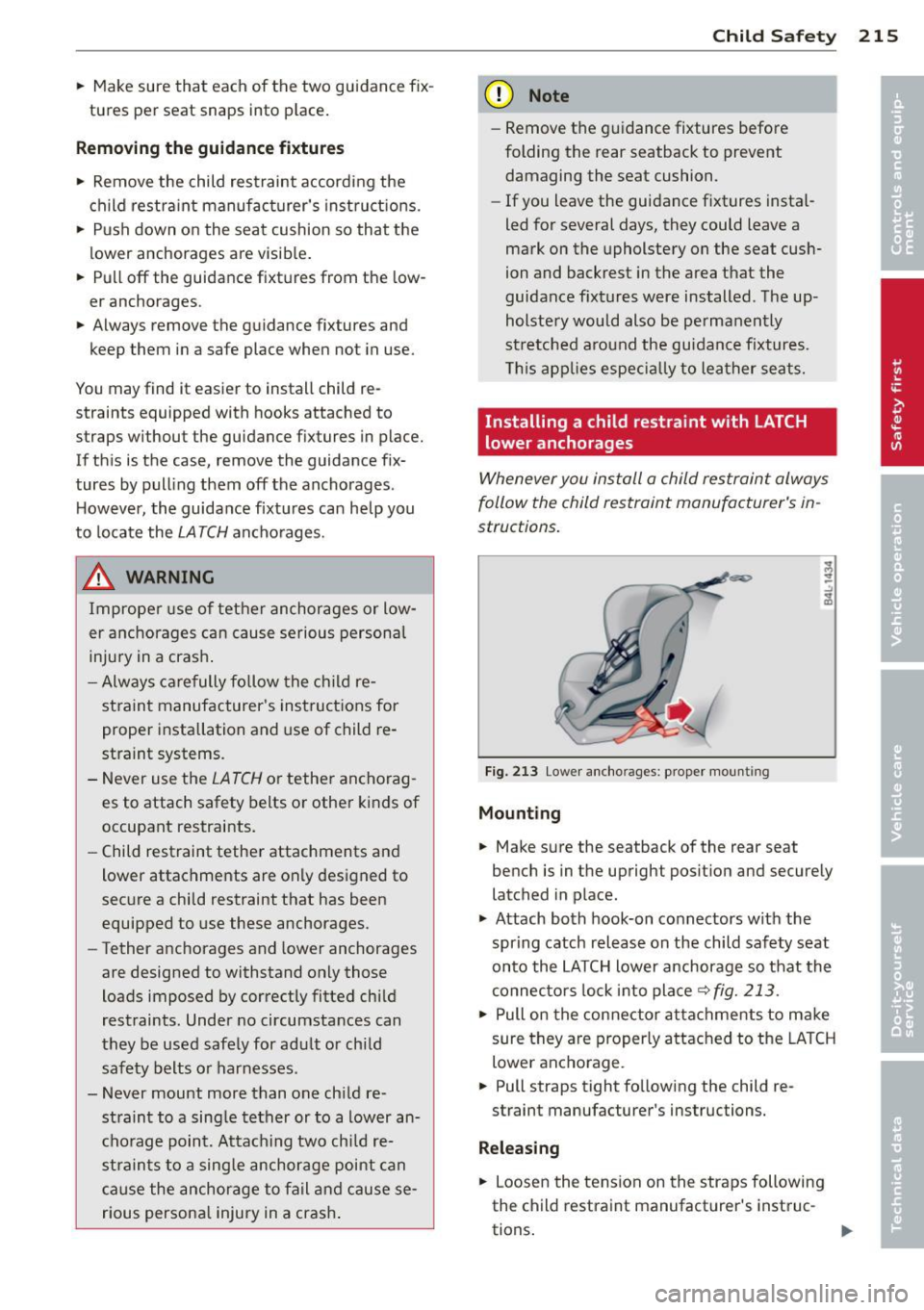
F ig. 213 Lowe r anc horages : prope r mount ing
Mountin g
.. Make sure the seatback of the rear seat
bench is in t he upright position and securely
latched in place .
.. Attach both hook-on co nnectors with the
spring catch release on the child safety seat
onto the LATCH lower anchorage so that the
connecto rs lock into place
~ fig. 213.
.. Pull on the connector attachments to make
sure they are properly attached to the LATCH
lower ancho rage .
.. Pull straps tight fo llowing the child re
straint manufacturer's instructions.
Relea sing
.. Loosen the tension on the straps following
the child restraint manufact urer's instruc
tions .
Page 269 of 342
Coolant loss
Coolant loss may indicate a leak in the cool ing
system . In the event of coolant loss, the cool
ing system should be inspected immediately
by your authorized Audi d ealer. It is not
enough merely to add coolant.
I n a
sea led system, losses can occur only if
the boiling point of the coolant is exceeded as
a result of overheating.
A WARNING
The cooling system is under pressure and can get very hot. Reduce the risk of scald
ing from hot coolant by following these
steps.
- Turn off the engine and allow it to coo l
down.
- Protect your face, hands and arms from
escaping fluid and steam by covering the
cap with a large, thick rag .
- Turn the cap slowly and very carefully in
a counter -clockwise direction wh ile ap
plying light, downward pressure on the
top of the cap .
- To avoid be ing burned, do not spill ant i
freeze or coolant on the exhaust system
o r hot eng ine parts. Under certai n condi
t ions, the ethy lene g lycol i n engine cool
an t ca n ca tch fire.
(D Note
Do not add any type of rad iator leak seal
ant to you r vehicle's eng ine coolant. Add
ing radiator repair f luid may adversely af
fec t the function and pe rformance of your
cooling system and could res ult in damage
not covered by your New Vehicle Limited
Warranty .
Adding coolant
Be very careful when adding engine coolant.
Before you check anything in the engi ne com
partment ,
alwa ys read and heed all WARN
INGS c:> A in Working in the engine compart
ment on page 258 .
Checking and fillin g 267
.. Turn off the engine .
.. Let the engine coo l down .
.. Place a thick rag over the coo lant expansion
tank
c:> page 266 , fig . 233 and carefully
twis t the cap coun ter-clockwise c:> &, .
.. Add coo lant .
.. Twist the cap on aga in
tightly.
Rep lacemen t engine coolant must conform to
exact spec ificat ions
c:> page 265, Coolant . We
recommend us ing on ly coo lant additive G12+
+, G 13 or in an eme rgency G12 +. Do
not use a
different additive. In an emergency use pla in
water until you can ge t the co rrect addi tive
and can restore the correc t ratio. This sho uld
be done as soon as possible.
If you have lost a cons iderab le amount of
coolant , the n you sho uld add cold ant ifree ze
and cold wate r on ly when the engine is cold.
Always use
n ew engine coolant when refilling .
Do not f ill coolant above the "MAX" mark. Ex
cess coola nt will be forced out through the
pressure relief valve in the cap when the en
gine becomes hot .
A WARNING
- The cooling system is under pressure and
can get ve ry hot. Reduce the risk of
scalding from hot coolan t by following
these steps.
- Turn off the engine and allow it to coo l
down .
- Protect your face, hands and arms from
escaping fluid and steam by covering
the cap w ith a large, th ick rag .
- Turn the cap s lowly and very carefully
i n a counter-clockwise direction while
applying light, downward pressure on
the top of the cap.
- To avoid being burned, do not spill a n
tifreeze o r coolant on the exhaust sys
tem or hot engi ne pa rts. Under certain
c ond it ions, the ethy lene glycol in en
gine coolant c an catch fire .
- Antifree ze is po isonous. Always s to re an
tifree ze in its o rigina l container and well
ou t of the rea ch of child ren. .,.
•
•
Page 272 of 342
2 70 Chec king and filling
should only be disconnected from the vehicle
e lectrical system when absolutely necessary
for repairs.
Vehicles not driven for long periods
If you do not drive your vehicle over a pe riod
of several days or weeks, electrical compo
nents are gradually cut back or switched off.
This reduces energy consumption and main
tains starting capab ility over a longer period
c;, page225.
Take into consideration that when you un lock
your vehicle, some convenience functions, such as the interior lights or the power seat
adjustment, may not be available. The con
venience functions will be available again
when you turn on the ignition and start the
engine .
Winter operation
During the winter months, battery capacity
tends to decrease as temperatures drop . This
is because more power is also consumed while
starting, and the headlights, rear window de
fogger, etc., are used more often .
Avoid unnecessary power consumption, par
ticularly in city traffic or when traveling only
short d istances . Let your authorized Audi
dealer check the capacity of the vehicle bat
tery before w inte r sets in
¢ page 271. A well
cha rged battery w ill not only prevent starting
p rob lems when the weather is cold, but will
a lso last longer.
(D Tips
If your vehicle is left standing for several
weeks at extremely low temperatures, the
vehicle battery should be removed and
stored where it will not freeze . This wi ll
prevent it from being damaged and having
to be replaced.
Working on the battery
Be especially careful when working on or near
the battery.
The battery is located under the driver 's seat.
Before you check anyth ing under the driver 's
seat,
read and heed all WARNINGS c:;, _&.
Always heed the safety warnings, when work
ing on the vehicle battery or the vehicle elec
trical system to prevent injury.
The following WARNINGS are very
important when working on the battery:
Always heed the following WARNING SYM BOLS and safety precautions when working
on the battery.
@!) Always wear eye protection .
b.. Battery acid contains sulfuric acid . Al
~ ways wear gloves and eye protection.
~ No
\!:51 -sparks
- flames
- smoking.
A. When a battery is charged, it produces
~ hydrogen gas which is explosive and
could cause personal injury.
~ Always keep the battery well out of
~ reach of children.
,&. WARNING
Whenever working on the battery or on
the electrical system, there is the risk of
injury, accident and even fire . Read and
heed the following WARNINGS:
- Always wear eye protection. Do not let
battery ac id or any lead particles get on
your skin or clothing. Shield your eyes .
Exp losive gases can cause blindness or
other injury.
- Battery acid contains sulfuric acid. Sulfu
ric acid can cause blindness and severe
burns.
- Always wear g loves and eye protection.
-
Do not tilt the battery because acid ~
Page 328 of 342
326 Index
Brake system .. .... ..... ... .. .. .... . 268
Anti-lock brake system . ... .. ... ... .. 1 8
Bra ke fl uid .... ... .... ... .. .. .... . 268
Brake fl uid spec ificat ions for refill and re-
p lacement ... ............. .. .... . 269
Brake pads . .............. ... .. ... 228
Ge ne ral informat ion ... ... .. .. .. .. . 222
H ow does mo isture or road salt affect the
b rakes? .. .. ............. .... .. .. . 22 2
M alfunct io n ............. .. .. .... .. 3 2
P ark ing brake ... ...... ... .. .. .... . 109
Warning/indicator lights ... .. .. .... . . 19
Worn brake pads symbol ... .. ... ... .. 36
B raki ng gua rd
refer to Audi br aking gua rd . .. .. .. .. . 126
Break- in period . .. ...... .... ... .. .. . 228
Brake pads ... .. ...... .... ... .. .. . 228
Tir es .. .. .. ................ ... ... 228
Breakover ang le ........... .... .... . 232
B ulbs . .. .. ... ............ .. .. .. .. . 30 6
Bumper cover Ca ution w hen parki ng nea r a parking ba r-
ri er or curb . ... .. ..... ... .. .. .. .. . 110
C
Ca lifo rnia Proposit ion 65 Wa rning .. ... 259
B attery spec ific .... ...... .. .. .. .. . 27 1
Capac it ies . .. ............. .. .. .. ... 316
C ar -Systems
Ambience lighting . . . . . . . . . . . . . . . . . . 62
Lighting profi les .. ..... ... .. .. .... .. 62
Ca r ca re . .. .. ................ ... .. . 239
I n ter ior . . . . . . . . . . . . . . . . . . . . . . . . . . 24 4
Pl asti c and v inyl .......... .. .. .. .. . 24 2
Care of exte rior .. .... .... .. .. .. .. .. . 239
Cargo area
refer to loading the luggage compart-
ment .. .. ................. .. .... . 166
C ar go floor ............... .. .. ...... 8 2
Cargo net .... .. ........ .... ... .. .. .. 80
Cata lytic converter . ..... ... .. .. .... . 229
Cente r arm rest
Cup holder . . . . . . . . . . . . . . . . . . . . . . . . 77
S to rage compartment . . . . . . . . . . . . . . . 7 7
Center console in rear ........ ... .. .... 78 Cen
tral lock ing
Emergency locking . .... ..... ... .. .. . 45
Pano ram ic s liding s unroo f . . . . . . . . . . . . 55
Certification .. .. .. ............. .. .. 3 22
Chang ing a flat t ire . .. .. ...... ... .. .. 298
Chang ing a wheel . .... .. ..... ... .. .. 298
Chang ing engine oil 264
Chassis Undercoating .... ............. .... 244
also refer to Adaptive Air Suspen-
s io n . . . . . . . . . . . . . . . . . . . . . . . . 150, 152
CHECK button ..... ... .. ..... ... .. .. . 12
Checking En gine coolant level ............ .. .. 266
Checking t ire pressure ........ ...... . 280
Child rest raints
Danger of using child restraints in the
front seat . ................... .... 181
Where can I get additional informat io n
about child rest raints and the ir use? .. 218
Child rest raint system anchors . ... .. .. 212
Child safe ty . ...... ............. .... 200
Co nvertib le lo cking retractor ... .. .. .. 209
G ui dance fixtures for lower ancho rages 214
Important sa fe ty instru ctions for using
child safety seats .... .. ..... ... .. .. 203
Important things to know when driving
with children .. .. ... .......... .. .. 200
Installing a c hild restra int using the
LATCH system .. .. .......... ...... . 215
Mounting and releasing the anchorage
hook ........ ... .. .............. . 215
T e ther anchors ... ............. .... 216
T e ther s traps .... ............. .... 216
Child safety lock
r ear doors (powe r) . . . . . . . . . . . . . . . . . . 48
Child safety seats . ... .... .... ... .. .. 205
Booster seats .... ............. .... 208
Co nvertib le child seats ......... .. .. 206
Co nvertib le locking retractor ... .. .. .. 209
Danger of using child restraints i n the
front seat ..... .. .......... ... ... . 181
How do I properly i nstall a chi ld safe ty
seat in my ve hicle? ............. .. .. 203
Infan t seats ... .. .. .... .... ... .. .. 205
Installing ..... .. .. ... ..... ... .. .. 209
Page 329 of 342
LA T CH sys tem ....... ..... .. .. .. ... 215
Safety instructions ..... ... .. .. .. .. . 203
C hi ld seats
L ower ancho rages ........ .. .. .. .. . 213
C lea ning
A lcantara (synthet ic suede) ..... ... .. 247
Eng ine compartment ........... .... 248
E xhaust tail p ipes ......... .. .. .. .. . 244
F ab rics and fabr ic coverings .. .. .. .. . 245
I ns trumen t panel ......... .. .. .. .. . 24 5
I nterior . . . . . . . . . . . . . . . . . . . . . . . . . . 24 4
L eather .... .. ... ..... ... .. .. .. ... 247
MMI contro l conso le ... ... .. .. .. .. . 244
MMI display ............. .... .. .. . 244
P lastic and v inyl .......... .. .. .. ... 242
P lastic parts
Safety belts 245
248
tr im str ips . ................ ... ... 242
Trim str ips . ............. .... .. .. . 242
Cleaning and protection ..... .. .. .. .. . 239
Climate con trol . . . . . . . . . . . . . . . . . . . . . . 91
Synchronizing .... ..... ... .. .. .. .... 92
Warm and cold . ....... ... .. .. .. .... 91
Clima te con trols
A ir cond itione r o n/off ..... .. .. .. .. .. 93
A ir dist ribution . .. ..... ... .. .. .. .... 94
A ir outlets ... .... .... ... .. .. .. .... 96
Air outlets (rear) . ..... ... .. .. .. .. .. 96
A ir rec irculation .......... .. .. .. .... 95
AUTO (standard setting) . . . . . . . . . . . . . 94
Basic settings . . . . . . . . . . . . . . . . . . . . . . 99
Controls ................... ... ... . 92
D efrosting/defogging . . . . . . . . . . . . . . . 94
D escr ipt io n ... ........... .. .. .. .... 9 1
E ne rgy management ...... .. .. .. .. .. 9 1
F a n ... .. .. .... ............. .. .. .. 94
Fr ont seat vent ilation .. ... .. .. .. .. . 100
Heated seats, front .... ... .. .. .. .. . 100
Key coded setting . ..... ... .. .. .. .. .. 91
Recirculation mode (automatic) . . . . . . . 99
Recommended sett ings .... .. .. .. .. .. 91
Residua l heat ............. ... ... ... 93
Sett ing t he temperature ........ .... . 94
Supp lementary heater ..... .. .. .. .. . 100
Synchron izat ion . . . . . . . . . . . . . . . . . . . . 99
T u rn ing o n and off ........ .. .. .. .. .. 93
Using climate cont rol economically . . . . 9 7
Clock ..... ... ...... ............. ... 11
Inde x 327
Closing
Pano ramic s liding sunroof . . . . . . . . . . . . 55
Coat hoo ks . .. .. .. ................. . 89
Cold t ire inflation pressure ........ .. .. 278
Compass mir ro r . . . . . . . . . . . . . . . . . . . . . 69
Compliance . .. .. .... ... ....... ..... 322
Consumer Information . . . . . . . . . . 167,319
Contacting NHTSA . ............. .. .. 16 7
Convenience key . . . . . . . . . . . . . . . . . . . . . 49
D river messages .. .. .. .. ...... .... . 108
Locking vehicle . . . . . . . . . . . . . . . . . . . . . 50
START butto n .. .. .... ........... .. 10 7
Star ting engi ne ................... 107
STOP butt on ... .. .. . .............. 108
S wi tching engine off . .. ..... ... .. .. 108
Switching on ignition . .. ..... ... .. .. 107
U nlocking vehicle .... .. ..... ... .. .. . 49
Co nve rtib le child safety se ats ..... .. .. 206
Convertib le locking retractor
Activating ....... .. ............... 211
Deact ivating . .. .... .. .. ...... ..... 212
U sing to secure a child safety seat 2.09, 211
Coolant system .. .. ................. 265
Cooling box in glove compa rtment ... .. . 88
Cooling System Expansion tank ... .. ............... 266
Cornering light . . . . . . . . . . . . . . . . . . . . . . 59
C ruise cont ro l
Changi ng speed ..... .. ..... ... .. .. 112
Presett ing your speed .. ..... ... .. .. 112
Switching off . ..... . .. .. ..... ... .. 112
Switching on ... .. ................. 111
Warning/ind icator lights .......... .. . 18
also refer to Adaptive c ruise control . .. 113
Cruising range . . . . . . . . . . . . . . . . . . . . . . . 24
(upholder . . . . . . . . . . . . . . . . . . . 78, 85, 86
D
Damp ing
refer to Adapt ive A ir Suspens ion . 150, 152
Data ......... .. .. .... ............. 316
Data recorder . . . . . . . . . . . . . . . . . . . . . . 219
Date d is p lay . . . . . . . . . . . . . . . . . . . . . . . . 11
Daytime running lights. .. ..... ... . 57, 58
•
•
Page 330 of 342
328 Index .:..:..:..::....::.....:..._ ___________________________ _
Declaration of compliance
Adaptive cruise control ............. 322
Audi side assist ................... 322
Cell phone package ....... .. .. .... . 322
Convenience key .......... .... .... . 322
Electronic immobilizer ......... .. ... 322
H omelink ® universal remote control .. 322
Remote control key ........... .. .. . 322
def What does this mean when it appears in
the trip odometer display? ..... .. .. .. 12
Defective light bulb warning . . . . . . . . . . . 23
Defrosting/defogging the windows . . . . . . 94
Defrosting/defogging windows ... .... .. 96
Determining correct load limit ... .. .. . 282
Diesel fuel . . . . . . . . . . . . . . . . . . . . . . . . . 2 5 1
Diesel particu late filter . . . . . . . . . . 37, 229
Digital clock . .. . ........ .. .. .. .. .. .. 11
Digital compass ........... .. .. .. .. .. 69
Digital speedometer ............ .... .. 22
Dimensions .. ................ ... ... 315
Dimming the rearview mirror .. .. ...... 69
Dipstick Reading the dipstick properly ..... .. . 263
Distance control system
refer to Adaptive cruise contro l .. .. .. . 113
Doors Power child safety lock .... .. .. .... .. 48
Driver information system ............. 21
Digital speedometer .............. . . 22
Driver information messages . . . . . . . . . 30
Open door or rear lid warning . . . . . . . . . 22
Outside temperature display .. .. .. .... 22
Sound system display ......... .. .. .. 21
Driver seat
refer to Seating position ... .. .. .... . 161
Driver's seat . . . . . . . . . . . . . . . . . . . . . . . . 72
Driver 's seat memory . . . . . . . . . . . . . . . . . 73
Activating remote control key ... .. .... 74
Recalling a seat posit ion . . . . . . . . . . . . . 73
Storing a seat position ....... .. .... .. 73
Driving message s . . . . . . . . . . . . . . . . . . . . 30
Driving mode
refer to Adaptive Air Suspension . 150, 152 Driving
offroad
Driving through water ............ .. 233
Driving tips . ... .. ... .......... .. .. 232
Ru les of behavior . ............. .... 232
Sand and mud ... ............. .... 233
Snow -covered g round ............. . 233
Unpaved roads ... ... ... .... ..... .. 233
Driving safe ly ... .. ... .......... .. .. 160
Driving through water ........... .... 233
Driving time . . . . . . . . . . . . . . . . . . . . . . . . 24
Duplicate key ..... .. ........... .. .. . 38
Dust filter Climate controls ............... .. .. . 91
E
Easy entry feature .. ... ... .... ..... .. 104
Efficiency program .............. .. .. . 26
Fuel economy messages ........ .. .. . 27
Memory levels . . . . . . . . . . . . . . . . . . . . . 25
Other equ ipment . .......... ...... .. 27
E lectric seat adj ustment
refer to Power seat . . . . . . . . . . . . . . . . . 72
El ectronic differential lock ( EDL )
How the system works .......... .... 221
Warning/indicator lights ........ .. .. . 18
Electronic immob ilizer ... ........... .. 40
E lectronic power contro l
(EPC) warning/indicator light . . . . . . . . . 15
Electronic speed limiter .......... .. .. . 28
Electronic Stability Control (ESC)
Hill descent control ............... . 219
How the system works .......... .. .. 219
Offroad mode .. .. ............. .. .. 219
Warning/indicator lights ........ .. .. . 16
Emergency flasher ........... ...... .. 60
Warning/indicator lights ........... .. 16
Emergency lock ing of doors ......... .. . 45
Emergency operation Rear lid ... .... .. .. ........... .. .. . 48
Emergency starting ..... .. ... ..... .. 308
Emergency towing .............. .... 310
En ergy management .............. .. 225
Battery power ... .. ........... .. .. 227
Driver notification . . . . . . . . . . . . . . . . . 22 7