driver seat adjustment AUDI Q7 2012 Owner´s Manual
[x] Cancel search | Manufacturer: AUDI, Model Year: 2012, Model line: Q7, Model: AUDI Q7 2012Pages: 342, PDF Size: 86.42 MB
Page 228 of 342
226 Intelligent technology
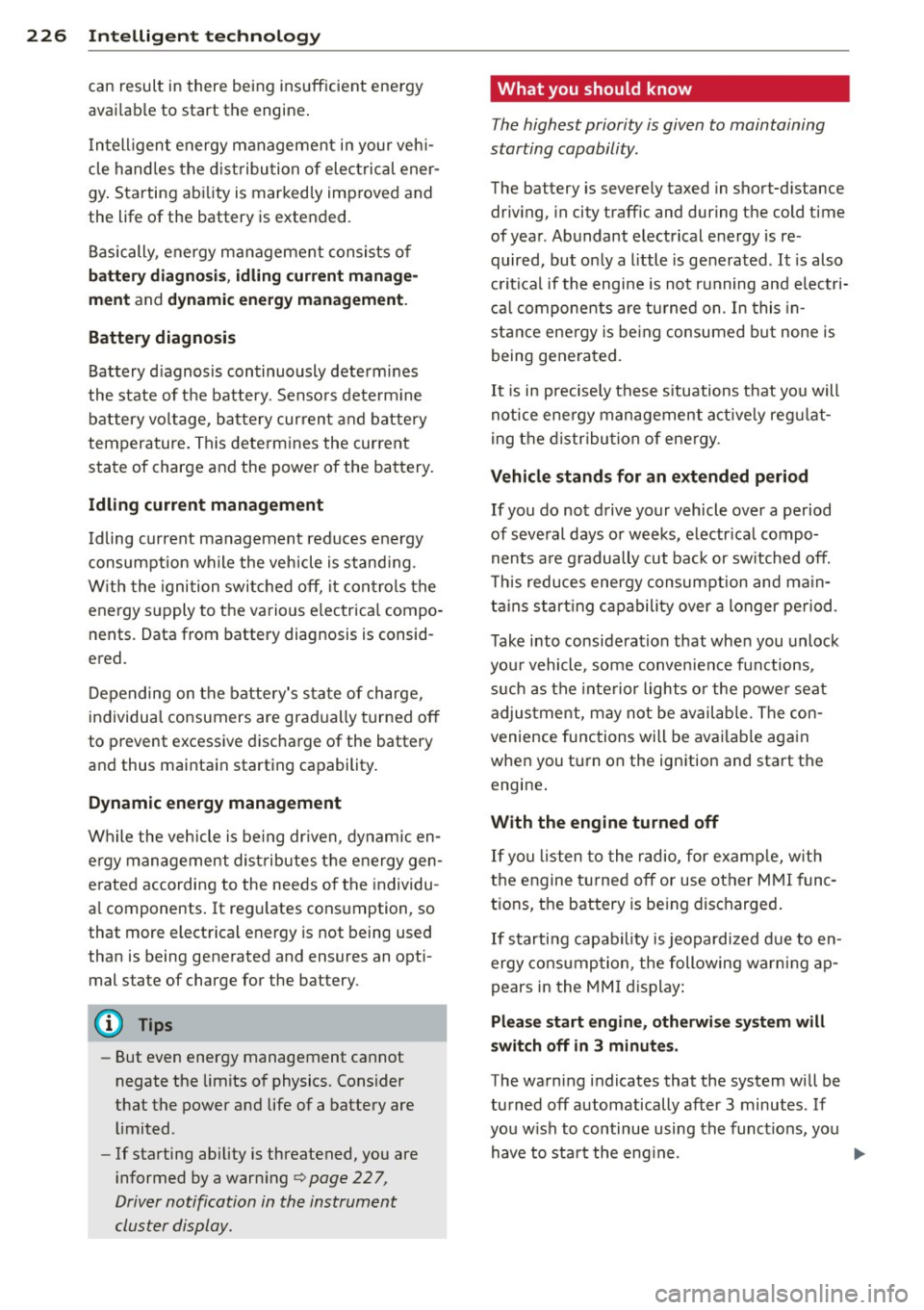
can result in there being insufficient energy
avai lab le to start the engine .
I ntell igent energy management in your vehi
cle handles the distribution of electrical ener
gy . Starting abi lity is markedly improved and
the life of the battery is extended .
Basically , energy management consists of
battery diagnosis , idling current manage
ment
and dynamic energy management.
Battery diagnosis
Battery diagnosis continuously determines
the state of the battery. Sensors determine
battery volta ge, battery current and battery
temperature. This determines the current
state of charge and the power of the battery.
Idling current management
Idling current management reduces energy
consumption while the vehicle is stand ing.
With the ignition switched off, it contro ls the
energy supply to the various e lectrica l compo
nents. Data from battery diagnosis is consid
ered.
Depending on the battery's state of charge,
individua l consumers are gradually turned off
to prevent excessive discharge of the battery
and thus maintain starting capability.
Dynamic energy management
While the vehicle is being dr iven , dynamic en
e rg y management distributes the energy gen
erated according to the needs of the individu
a l components. It regulates consumption, so
that more ele ctrical energy is not being used
than is being generated and ensures an opti mal state of cha rge for the battery.
{D) Tips
- But even energy management cannot
negate the limits of physics. Consider
that the power and life of a battery are
limited .
- If starting ab ility is threatened, you are
i nformed by a warn ing
c> page 22 7,
Driver notification in the instrument
cluster display .
What you should know
The highest priority is given to maintaining
starting capability .
The battery is seve rely taxed in shor t-distance
driving, in city tra ffic and dur ing the cold time
of year . Abundant electrical energy is re
quired, but only a little is generated . It is also
critical if the engine is not running and e lectri
ca l components are turned on . In this in
stance energy is being consumed but none is
being generated.
It i s in precisely these situations that you will
notice energy management actively regulat
ing the distribution of energy.
Vehicle stands for an extended period
If you do not drive your vehicle over a period
of several days or weeks , e lectr ica l compo
nents are gradually cut back or sw itched off.
T his reduces energy consumption and main
ta ins start ing capability over a longer period .
Take into consideration that when you unlock
your vehicle , some conven ience functions ,
s uc h as the inte rior lights or the power seat
adjustment, may not be available. The con
venience functions will be available again
when you turn on the ignition and start the e ngine .
With the engine turned off
If you listen to the radio, for example, w ith
the engine turned off or use other MMI func
tions, the battery is being discharged .
If starting capability is jeopardized due to en
ergy consumption , the following warning ap
pears in the MMI display:
Please start engine, otherwise system will
switch off in 3 minutes .
The warning indicates that the system will be
turned off automatically after 3 minutes . If
you w ish to continue using the funct ions, you
have to sta rt the eng ine.
1111>
Page 272 of 342
2 70 Chec king and filling
should only be disconnected from the vehicle
e lectrical system when absolutely necessary
for repairs.
Vehicles not driven for long periods
If you do not drive your vehicle over a pe riod
of several days or weeks, electrical compo
nents are gradually cut back or switched off.
This reduces energy consumption and main
tains starting capab ility over a longer period
c;, page225.
Take into consideration that when you un lock
your vehicle, some convenience functions, such as the interior lights or the power seat
adjustment, may not be available. The con
venience functions will be available again
when you turn on the ignition and start the
engine .
Winter operation
During the winter months, battery capacity
tends to decrease as temperatures drop . This
is because more power is also consumed while
starting, and the headlights, rear window de
fogger, etc., are used more often .
Avoid unnecessary power consumption, par
ticularly in city traffic or when traveling only
short d istances . Let your authorized Audi
dealer check the capacity of the vehicle bat
tery before w inte r sets in
¢ page 271. A well
cha rged battery w ill not only prevent starting
p rob lems when the weather is cold, but will
a lso last longer.
(D Tips
If your vehicle is left standing for several
weeks at extremely low temperatures, the
vehicle battery should be removed and
stored where it will not freeze . This wi ll
prevent it from being damaged and having
to be replaced.
Working on the battery
Be especially careful when working on or near
the battery.
The battery is located under the driver 's seat.
Before you check anyth ing under the driver 's
seat,
read and heed all WARNINGS c:;, _&.
Always heed the safety warnings, when work
ing on the vehicle battery or the vehicle elec
trical system to prevent injury.
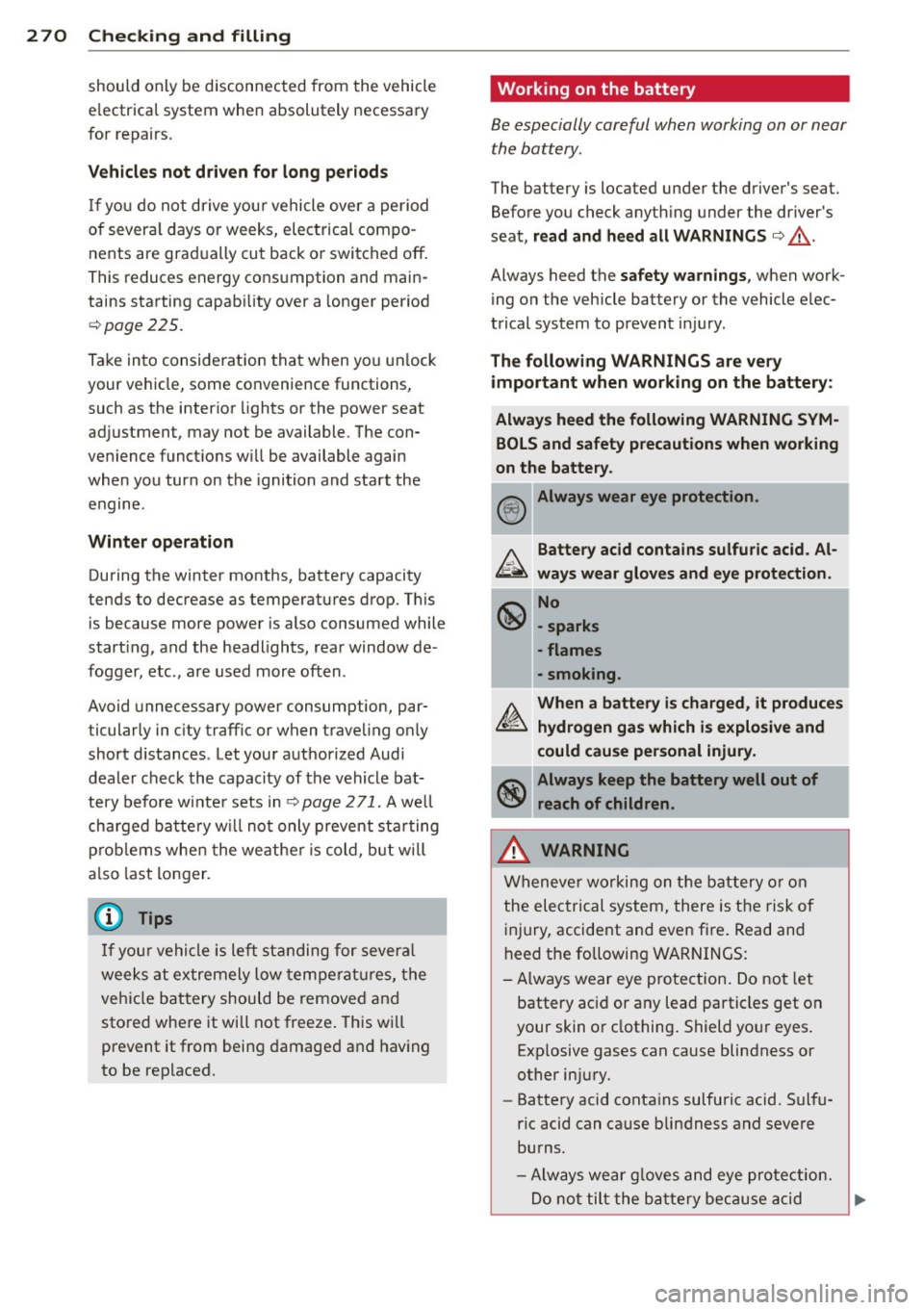
The following WARNINGS are very
important when working on the battery:
Always heed the following WARNING SYM BOLS and safety precautions when working
on the battery.
@!) Always wear eye protection .
b.. Battery acid contains sulfuric acid . Al
~ ways wear gloves and eye protection.
~ No
\!:51 -sparks
- flames
- smoking.
A. When a battery is charged, it produces
~ hydrogen gas which is explosive and
could cause personal injury.
~ Always keep the battery well out of
~ reach of children.
,&. WARNING
Whenever working on the battery or on
the electrical system, there is the risk of
injury, accident and even fire . Read and
heed the following WARNINGS:
- Always wear eye protection. Do not let
battery ac id or any lead particles get on
your skin or clothing. Shield your eyes .
Exp losive gases can cause blindness or
other injury.
- Battery acid contains sulfuric acid. Sulfu
ric acid can cause blindness and severe
burns.
- Always wear g loves and eye protection.
-
Do not tilt the battery because acid ~
Page 306 of 342
304 Fuses and bulb s
.
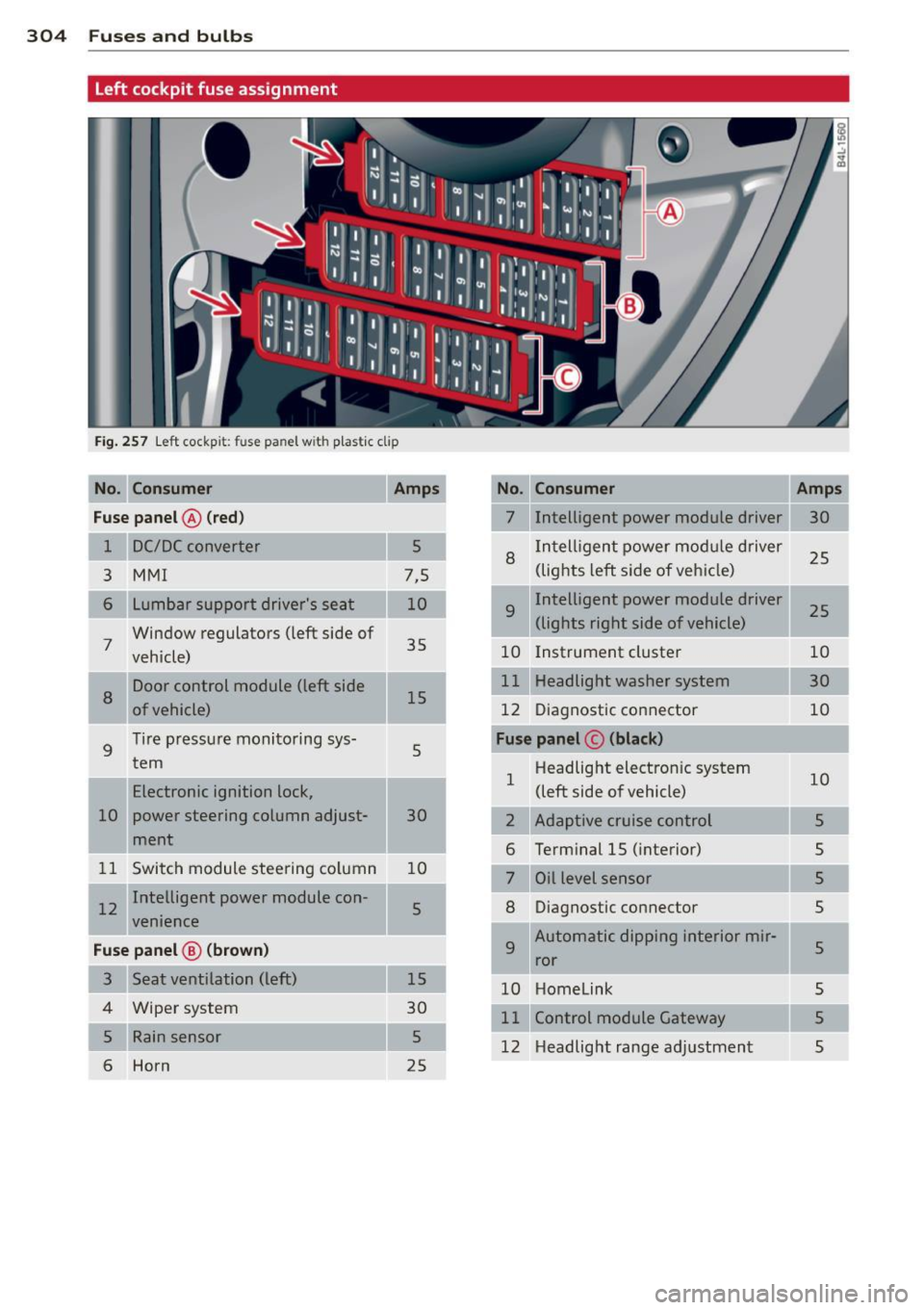
Left cockpit fuse assignment
Fig. 257 Left cockpi t: fu se pa nel w ith plas tic cl ip
Fu se pa nel @ (red )
1
3 MMI
6
7
8
9 Lumbar support driver's seat
Window regulators (left side of
vehicle) Door control module (left side
of vehicle)
Tire pressure monitoring sys
tem Electronic ignition lock,
10 power steering column adjust-
I ment
11 Switch module steering co lumn
Intelligent power module con
venience
F u se pa nel @ (b ro wn)
3
6 Horn
5
7,5
35
15
5
30
10
5
5
25
No .
7
8
9
Consumer
Intelligent power module driver
I ntell igent power mod ule driver
(lights left side of vehicle)
Intelligent power module driver (lights right side of vehicle)
10 Instrument cluster
11 Headlight washer system
12 Diagnostic connector
Fuse pane l c (black )
1 Headlight electron
ic system
(left side of vehicle)
Adaptive cruise control
Terminal 15 (interior)
Diagnostic connector
9 Automatic dipping interior mir-
ror
10 Homelink
11 Control module Gateway
12 Headlight range adjustment
-Amps
30
25
25
10
30
10
10
5
5
5 5
5
5
Page 337 of 342
for using safety belts . . . . . . . . . . . . . . . 17 3
Mo nitoring the Advanced Airbag Sys-
tem ... .. .. .. ... ....... ... .. .. .. . 192
Safety lock Ignition key, au tomatic transmission . . 105
Safety systems
Warn ing/ indicato r lights ............. 16
Seat adjustment
Driver 's seat ............. .... .. .. .. 71
Driver's seat memory . . . . . . . . . . . . . . . . 73
Front passenger's seat . . . . . . . . . . . . . . . 72
Front seats ..................... ... 71
H ead restraints . . . . . . . . . . . . . . . 76, 163
Powe r ... .. .... ............. .. .. .. 72
Seat belts
refer to Safety belts . . . . . . . . . . . . . . . . 170
Seating capacity
Seating position 170
Driver . .. .. .... ........... .. .. ... 16 1
Fr ont passenger . . . . . . . . . . . . . . . . . . . 162
How to adjus t the front seats ... .. .. . 162
Incorrect seat position .. ... .. .. .. .. . 164
Occupants .. ............. .... .. .. . 161
Rear passengers . . . . . . . . . . . . . . . . . . . 163
Seat memo ry ............. .... .. .... 73
Seats Number of seats ................ .. 170
Seat ventilat ion . . . . . . . . . . . . . . . . . . . . 100
Select ive cataly tic red uct ion
refer to Ad Blue . .. ..... ... .. .. .. ... 255
Select ive unlock feature ....... .. .. .. .. 44
Selector lever .. ........... .. .. .. ... 138
Service and disposal Safety belt pre tens ioner ... .. .. .. .. . 177
Service interval disp lay . . . . . . . . . . . . . . . . 23
Service position W indshield wipers ........ .. .. .. .. .. 66
Servotronic Power steering . .. ..... ... .. .. .. ... 224
Shift buttons . . . . . . . . . . . . . . . . . . . . . . . 14 1
Side airbags Descr ipt ion . ............. .... .. ... 194
H ow they work .................... 196
Side assist Activating and deactivating ... .. .. .. . 129
Description ... .... .... ... .. .. .. ... 129
Informational and alert stage signals . 131
Inde x 335
Messages in instrument cluster display 135
MMI settings .. .. .. . ... ...... ... .. 134
Operation . . . . . . . . . . . . . . . . . . . . . . . . 131
Safety tips .. .. .. ................. 136
Sensor detection area .............. 130
Side curta in airbags
Description . ..... .. . .. .. ..... ... .. 197
How they wor k . . . . . . . . . . . . . . . . . . . . 198
Safety instructions ............. .. .. 199
S ide cur tain a irbags) .. . .......... .... 197
S ide marker lights . . . . . . . . . . . . . . . . . . . 57
Ski sack . ... .. .... .. . .. .. ..... ... .. . 82
Snow cha ins .. .. .. .. . .............. 290
Sockets ............................ 87
Sound sys tem disp lay
Driver informatio n disp lay .... ... .. .. . 21
Sources of information abo utch ild re-
stra ints and their use . ........... .. .. 218
Speed control system
refer to Adaptive cruise control ....... 113
Speedometer . . . . . . . . . . . . . . . . . . . . . . . 12
Speed rat ing letter code .............. 286
Speed warning system ........... .... . 28
Starting on h ills
Hill ho ld . ... .... .. . .. .. ..... ... .. 110
Start ing the engine . . . . . . . . . . . . 105, 106
What shou ld I do if the engine does not
st art ? ........................... 106
Steering .......... .. ............... 103
Easy entry feature .. . .. .. ... ..... .. 104
El ectr ica lly adjust ing the steering
whee l ........................... 103
L ocking the steering ........... .. .. 1 05
Malfunction . . . . . . . . . . . . . . . . . . . . . . . 33
Manually adjusting the steering wheel . 103
Stee ring wheel column
Adjus ting electrically ............... 103
Adjus ting man ua lly ............ .... 103
Steering wheel heat ing ......... .... . 101
Steps for determining correct load limit . 282
Stoppi ng the eng ine ............. .... 106
Storage ............................ 87
(upholder . .. .. .. .. ................ 85
(upholder door pockets .............. 86
(upholder in the rear center conso le .. . 78
( u pholder rea r cente r arm rest ... .. .. . 85
G love compa rtme nt ............ .... . 88
•
•