battery AUDI Q7 2012 Owner´s Manual
[x] Cancel search | Manufacturer: AUDI, Model Year: 2012, Model line: Q7, Model: AUDI Q7 2012Pages: 342, PDF Size: 86.42 MB
Page 271 of 342
thoroughly checked by an authorized Audi
dealer or qualified workshop and the cause
corrected .
If the brake fluid level is too low ,
the brake warning/indicator light will i llum i
nate. Con tact an au thori zed Aud i dealer
im ·
mediately .
@ Tips
The brake fluid reservoir is located under
neath the cover.
Changing brake fluid
Have the brake fluid changed by an experi
enced technician .
Brake fluid absorbs moist ure from the a ir. If
the water content in the brake fluid is too
h igh, corrosion in the brake system may result
after a per iod of t ime . The bo iling po int of the
brake fluid w ill also decrease considerably and
decrease b raking performance .
Therefore, the brake flu id must be changed
every two years . Always use new brake fluid
which conforms to Federal Motor Vehicle
Standa rd "FMVSS 116 DOT 4".
The brake f lu id reservoir can be difficult to
reach, therefore, we recommend that yo u
have the brake f lu id changed by your author
i zed
Audi dea ler . Your deale r has the co rrect
too ls, the right b rake fluid and the know-how
to do this fo r you.
_& WARNING
- Br ake fluid is po isonous . It must be s to r
ed only in the closed orig inal con tainer
o ut of the reac h of c hildren!
- Br ake f ailure can resu lt from old or in ap
propr iate b ra ke fluid. Observe these pre
caut ions:
- Use on ly brake fluid that meets SAE
specif ication
J 1 703 and conforms to
Federal Motor V ehicle Sta ndard 116.
A lways check wi th you r auth o riz ed Audi
deale r to ma ke s ure you are using the
correct brake flu id . T he correc t type of
Checkin g and fillin g 269
brake f luid is also ind icated on t he
brake f luid rese rvoir.
- The bra ke fl uid must be new. Heavy use
of the brakes can cause a vapo r lock if
the brake fluid is left in the system too
l ong. This can seriously affect the effi
c iency of the brakes as well as your
safe ty. This co uld resu lt in an accide nt.
(1) Note
Brake fluid will damage the paint of your
vehicle.
@) For the sake of the environment
Because o f the prob lem of proper disposal
of brake fluid as well as the spec ial too ls
required and the necessary expertise, we
recomme nd that you have the brake flu id
changed by you r autho rized Aud i deale r.
Battery
General information
U nder normal operating cond itions, the bat
tery in your Audi does not need any ma inte
nance. With
high outside temperatures or
long da ily drives we recommend that you have
the e lectrolyte level chec ked by an au thorized
Audi dealer or qualified wo rkshop . The elec
t ro lyte level should also be che cked each time
t h e battery is cha rged
~ page 271.
Have the battery checked when you take your
vehicle in for se rv ice . You a re well advised to
replace a battery that is o lde r th an 5 years .
With certain types of airbag deployment, the ba tte ry is disconnected from the ve hicle elec
t rical sys tem for safety reasons
~ A in Re
pair, care and disposal of the airbags on
page 193.
Disconnecting the battery terminals
Some vehicle fu nctions (power window regu
lators, fo r example) are lost if the battery te r
mina ls are disconn ected . T hese functions have
to be relearned after the bat tery termina ls are
conne cte d ag ain. To p revent t his, the battery .,. •
•
Page 272 of 342
2 70 Chec king and filling
should only be disconnected from the vehicle
e lectrical system when absolutely necessary
for repairs.
Vehicles not driven for long periods
If you do not drive your vehicle over a pe riod
of several days or weeks, electrical compo
nents are gradually cut back or switched off.
This reduces energy consumption and main
tains starting capab ility over a longer period
c;, page225.
Take into consideration that when you un lock
your vehicle, some convenience functions, such as the interior lights or the power seat
adjustment, may not be available. The con
venience functions will be available again
when you turn on the ignition and start the
engine .
Winter operation
During the winter months, battery capacity
tends to decrease as temperatures drop . This
is because more power is also consumed while
starting, and the headlights, rear window de
fogger, etc., are used more often .
Avoid unnecessary power consumption, par
ticularly in city traffic or when traveling only
short d istances . Let your authorized Audi
dealer check the capacity of the vehicle bat
tery before w inte r sets in
¢ page 271. A well
cha rged battery w ill not only prevent starting
p rob lems when the weather is cold, but will
a lso last longer.
(D Tips
If your vehicle is left standing for several
weeks at extremely low temperatures, the
vehicle battery should be removed and
stored where it will not freeze . This wi ll
prevent it from being damaged and having
to be replaced.
Working on the battery
Be especially careful when working on or near
the battery.
The battery is located under the driver 's seat.
Before you check anyth ing under the driver 's
seat,
read and heed all WARNINGS c:;, _&.
Always heed the safety warnings, when work
ing on the vehicle battery or the vehicle elec
trical system to prevent injury.
The following WARNINGS are very
important when working on the battery:
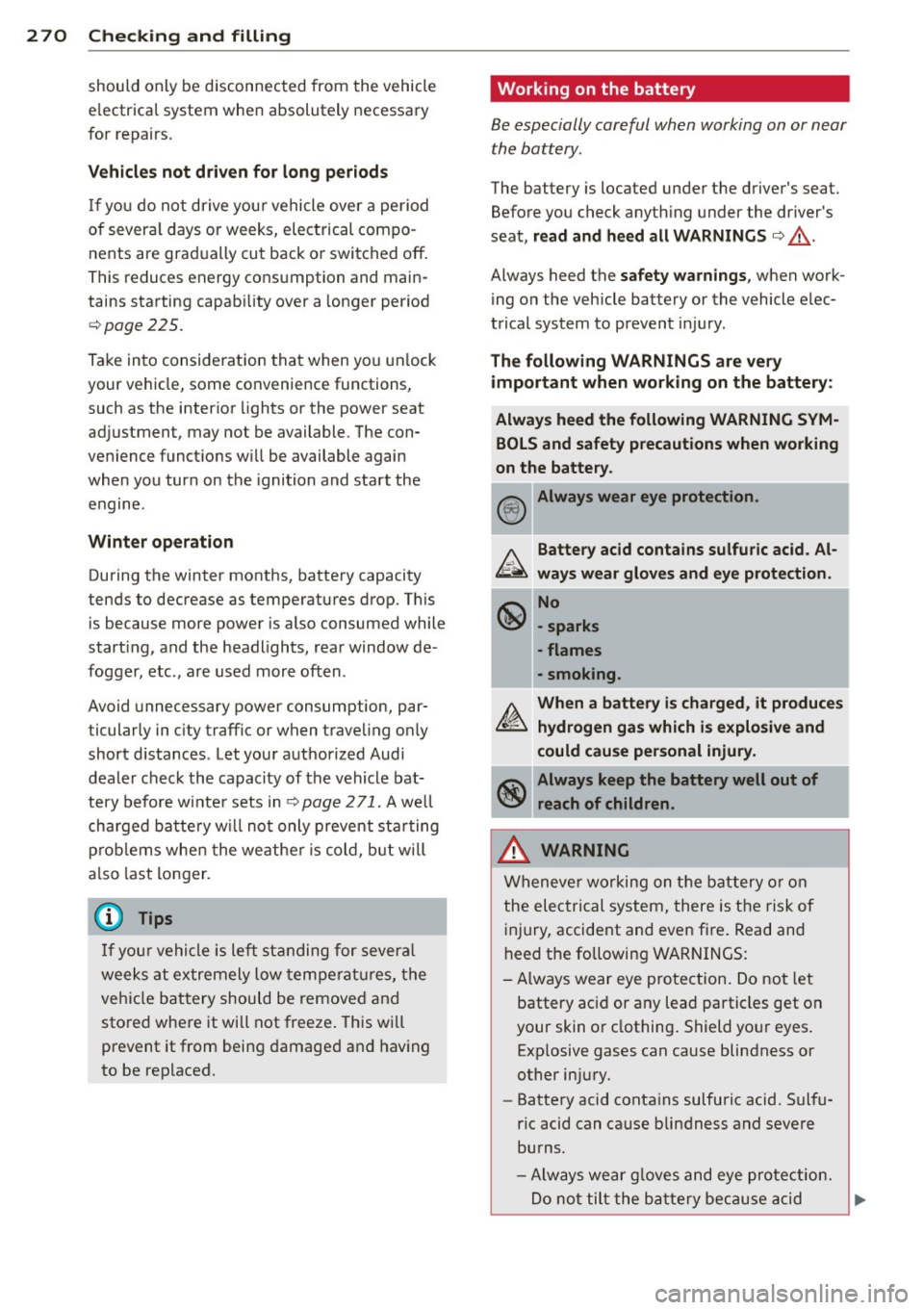
Always heed the following WARNING SYM BOLS and safety precautions when working
on the battery.
@!) Always wear eye protection .
b.. Battery acid contains sulfuric acid . Al
~ ways wear gloves and eye protection.
~ No
\!:51 -sparks
- flames
- smoking.
A. When a battery is charged, it produces
~ hydrogen gas which is explosive and
could cause personal injury.
~ Always keep the battery well out of
~ reach of children.
,&. WARNING
Whenever working on the battery or on
the electrical system, there is the risk of
injury, accident and even fire . Read and
heed the following WARNINGS:
- Always wear eye protection. Do not let
battery ac id or any lead particles get on
your skin or clothing. Shield your eyes .
Exp losive gases can cause blindness or
other injury.
- Battery acid contains sulfuric acid. Sulfu
ric acid can cause blindness and severe
burns.
- Always wear g loves and eye protection.
-
Do not tilt the battery because acid ~
Page 273 of 342
could leak out of the ventilation open
ings.
- If you get battery acid in your eyes or
on your skin, immediately rinse with
cold water for several minutes and get
medical attention.
- If you should ingest any battery acid,
seek medical attention immediately.
- Do not expose the battery to an open
flame, electric sparks or an open light.
- Do not smoke.
- Do not interchange the positive and neg-
ative cables.
- When working on the battery, be sure
not to short-circuit the terminals with
tools or other metal objects. This would cause the battery to heat up very quickly,
which could lead to damage or explosion
and personal injury.
- When a battery is charged, it produces hydrogen gas which is explosive and
could cause personal injury.
- Always keep the battery well out of the
reach of children.
- Before work is done on the electrical sys tem, disconnect the negative ground ca
ble .
- Before performing any work on the elec
trical system, switch off the engine and
ignition as well as any electrical equip
ment . The negative cable on the battery
must be disconnected. If you are just go
ing to rep lace a light bulb, then it is
enough to switch off the lights.
- Before disconnecting the battery, switch
off the anti-theft alarm system! Other
wise you will set off the alarm.
- When disconnecting the battery, first
disconnect the negative cable and then
the positive cable.
- Before reconnecting the battery, make
sure all electrical consumers are switch
ed off. Reconnect the positive cable first
and then the negative cable. Never inter
change the cables -this could start a fire!
- Never charge a frozen or a thawed-out
battery. It could explode! If a battery has
frozen, then it must be replaced. A dis-
Checking and filling 2 71
charged battery can freeze over at 32 °F
(0 oc) .
-Make sure the vent hose is always attach
ed to the opening on the side of the bat
tery .
- Never use batteries which are damaged.
There is the danger of an explosion! Al
ways replace a damaged battery.
A WARNING
California Proposition 65 Warning:
- Battery posts, terminals and related ac
cessories contain lead and lead com pounds, chemicals known to the State of
California to cause cancer and reproduc
tive problems . Wash hands after han
dling.
(D Note
- Do not disconnect the vehicle battery
when the ignition is switched on or when the engine is running, otherwise, you will
damage electron ic components in the
electrical system.
- If your vehicle is going to stand for a
long period of time without being driven,
protect the battery from "freezing", oth
erwise it will be damaged and will then
have to be replaced.
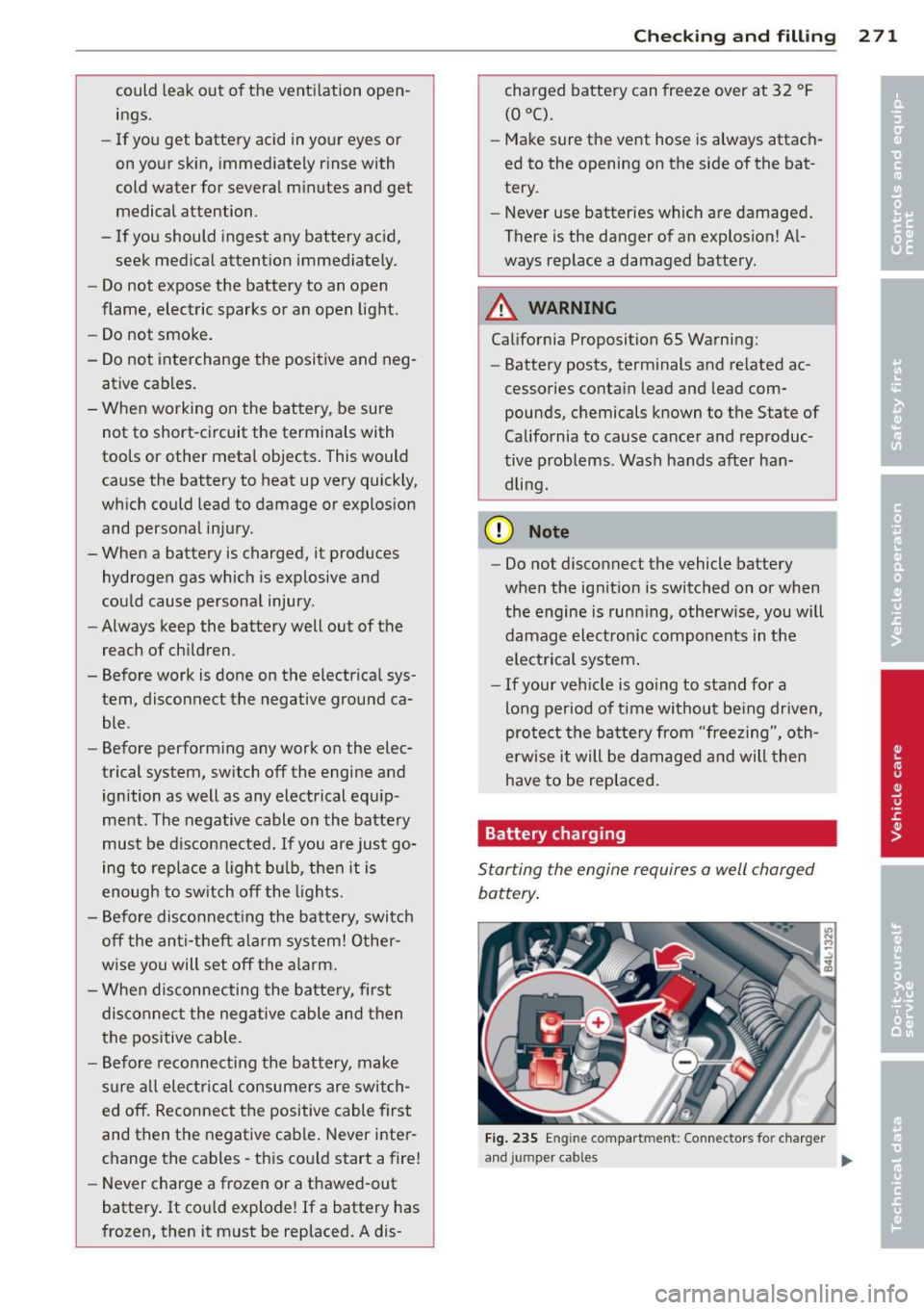
Battery charging
Starting the engine requires a well charged
battery.
Fig. 235 E n gin e compart men t: Co nnectors fo r charger
and j umper ca bles ..,_
Page 274 of 342
272 Ch eck ing and filling
Al ways read and h eed all WARNING S below
¢
A and ¢ A in Working on the bottery on
page 270.
.,. Turn off the ign it ion and a ll electri cal con
sumers .
.,. Make sure the area is well venti lated when
yo u charge the battery.
.,. Open the hood¢
page 258.
.,. Open the red cover on the posit ive pole
¢ fig . 235.
.,. Co nnect the charger connectors accord ing
to the instruct ions to the
jump start b olt s.
(Bolts under the red cover= "positive", Bolts
with hex head= "negative") .
.,. Only now plug the mains lead for the charg
ing equipment into the wall outlet and turn
it on ¢.&_ .
.,. Ma ke s ure the charging ra te i s n ot o ver
30 amp s/14. 8 Volt.
.,. When the battery is fully charged: Turn the
charging equ ipment off and remove the
mains lead from the wall outlet .
.,. Now remove the clamps for the charging
equipment.
.,. Close the red cove r o n the pos it ive pole.
.,. Close the hood ¢
page 2 58.
A discharged batte ry can fre eze at tempera
tures of on ly O
0C. Allow a frozen batte ry to
thaw comp lete ly before at tempting to charge
it ¢& . However, we recommend not using a
thawed battery again because the battery cas
ing can be cracked due to ice formation and
can leak battery acid .
Battery charging (Ma ximum charging rate
of 30 amp s/14 .8 Volt)
When charging at low voltages (e.g . w ith a
tri ckle ch arger ), the battery cables do not
have to be d isconnected first. The battery
caps should
not be opened when charging a
battery .
It is not necessary to remove the battery from
the luggage compartment.
Fast chargin g the battery (ch arging rate
ab ove 14.8 V olt s)
For technical reasons do not use a battery
charger that uses voltage greater than 14.8
Volts to charge your vehicle's battery.
A WARNING
= -
Charging a battery can be dangerous .
-Always follow the operating instructions
provided by the battery charger manu
facturer when charg ing your battery .
- Never charge a frozen battery. It may ex
plode because of gas trapped in the ice.
Allow a frozen battery to thaw out f irst .
- Do not reuse batteries wh ich were fro
zen. The battery housing may have
cracked and weakened when the battery
froze.
- Charge the battery in a well ventilated
area. Keep away from open flame or elec
tr ica l spark. Do not smoke. Hydrogen gas
generated by the battery is explos ive .
- To reduce the danger of explosion, never
connect or d isconnect charger cab les
while the charger is ope rat ing .
- Fast cha rging a battery is dangerous and
should only be attempted by a compe
tent techn ic ian with the proper equip
ment .
- Battery acid that may sp ill dur ing cha rg
ing should be washe d off wi th a solut ion
of wa rm water and baking soda to neu
tralize the ac id.
(D Note
Neve r use a fast charger as a booster to
start the eng ine. Th is w ill seriously dam
age sensit ive e lectronic components, such
as contro l units, re lays, radio, etc., as well
as the battery charger.
Page 275 of 342
Battery replacement
The new battery must have th e sam e specifi
cations and dim ensions as the original equip
ment battery.
Intell igent energy management in your vehi
cle is respons ible for d istr ibuting the e lectr i
cal energy throughout your vehicle
¢
page 225. The intel ligent e nergy ma nage
men t system w ill keep the eng ine ba tte ry
ch arged be tte r th en vehicles w ithout t his sys
tem . To make sure the additional e lectrica l en
e rgy is available once again after you have
changed the battery, we recommend that you install batteries of the same type and man u
facture only (the same as those installed at
the time your vehicle was delivered). Specifi
cations a re listed on the battery hous ing . Your
author ized dealer must code the battery in
the energy manageme nt system to enable yo u
to use the energy managemen t fu nctions co r
rectly after rep lac ing the b attery .
If it is not poss ible to use a battery of this
type, the new battery must have the same ca
paci ty, voltage ( 12 volts) , a mpe rage , con
s truc tion and pl ug sea ling.
W hen insta lli ng the battery, make sure the ig
ni tion and all e lectr ical c ons umers a re turned
off.
CD Note
Ma ke s ure the venti lation hose on the s ide
of the bat tery is connected, ot he rwise
fumes or ba ttery a cid c an leak out.
@, For the sake of the environment
Because of the probl em of proper d isposa l
of a batte ry, we recommend your autho r
i z e d Au di d ealer change the batt ery f or
you. Batter ies co ntain s ulfu ric ac id and
lead and m ust always be dis posed of prop
erly i n complia nce w ith all environmenta l
reg ulations. D isposin g of vehicle batteries
improper ly is very dangerous to the envi
ronment.
Checkin g and fillin g 273
Windshield/headlight
washer container
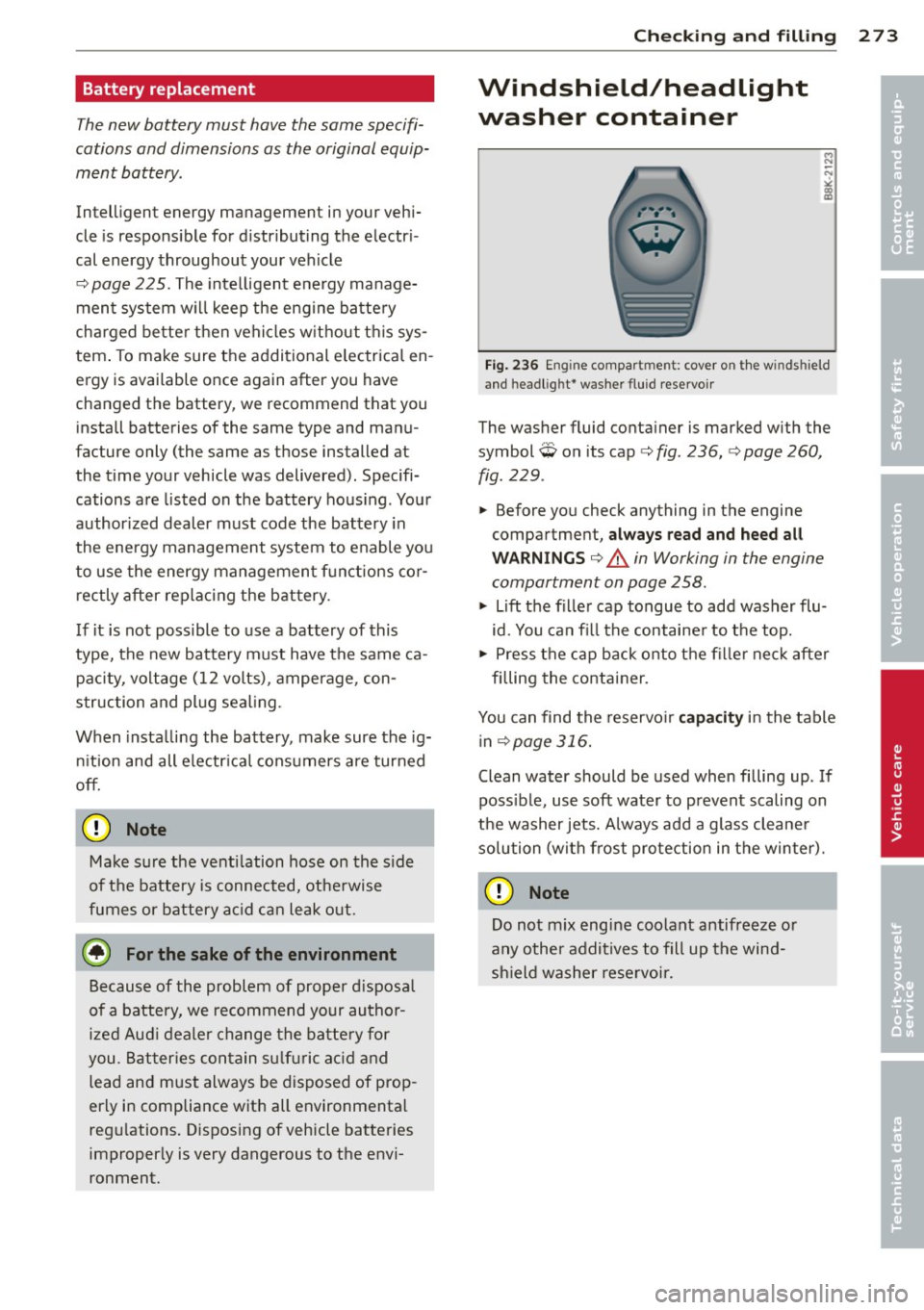
Fig. 2 36 En gin e compart ment: cover on t he w inds hield
a n d head lig ht* was her fl ui d reservo ir
The washer fluid conta iner is marked w ith the
symbol Won its cap ¢
fig. 236, ¢ page 260,
fig . 229 .
.. Before yo u check anything in the engine
compartment,
always read and heed all
WARNINGS ¢ &. in Working in the engine
compartment on page 258 .
.. Lift t he fi ller cap tongue to add washer flu
id. You can fi ll the containe r to t he top .
.. Press the cap back o nto the fi lle r ne ck afte r
filling the container.
You can find the reservo ir
capacity in t he table
in
¢ page 316.
Clean water should be used when filling up . If
poss ible , use soft water to prevent scaling on
the washer jets. A lways add a glass cleane r
solution (with frost pro te ction in t he winter).
CD Note
Do not mix engine coo lant antifreez e or
a ny other addit ives to f ill up t he win d
sh ield washer rese rvo ir.
•
•
Page 310 of 342
308 Emergency situations
Emergency situations
General
This chapter is intended for trained emer
gency crews and working personnel who
have the necessary tools and equipment to perform these operations.
Starting by pushing or
towing
Q;) Note
Your vehicle is equipped with an automatic
transmission. Consequently, the engine
cannot be started by pushing or towing.
Starting with jumper
cables
If necessary, the engine can be started by
connecting it to the battery of another vehi
cle.
If the engine should fail to start because of a
discharged or weak battery, the battery can be
connected to the battery of
another vehicle,
using a
pair of jumper cables to start the en
gine .
Jumper cables
Use only jumper cables of sufficiently large
cross section to carry the starter current safe
ly. Refer to the manufacturer's specifications.
Use only jumper cables with
insulated termi
nal clamps which are distinctly marked:
plus(+) cable in most cases colored red
minus(-) cable
in most cases colored black .
A WARNING
Batteries contain electricity, acid, and gas.
Any of these can cause very serious or fatal
injury. Follow the instructions below for
safe handling of your vehicle's battery.
- Always shield your eyes and avoid lean
ing over the battery whenever possible. -
A discharged battery can freeze at tem
peratures just below 32 °F (0 °C). Before
connecting a jumper cable, you must
thaw the frozen battery completely, oth
erwise it could explode.
- Do not allow battery acid to contact eyes
or skin . Flush any contacted area with
water immediately .
- Improper use of a booster battery to
start a vehicle may cause an explosion.
- Vehicle batteries generate explosive gas
es . Keep sparks, flame and lighted ciga
rettes away from batteries.
- Do not try to jump start any vehicle with
a low acid level in the battery .
- The voltage of the booster battery must
also have a 12-Volt rating. The capacity
(Ah) of the booster battery should not be
lower than that of the discharged bat
tery . Use of batteries of different voltage
or substantially different "Ah" rating
may cause an explosion and personal in
jury.
- Never charge a frozen battery. Gas trap
ped in the ice may cause an explosion.
- Never charge or use a battery that has
been frozen. The battery case may have
be weakened.
- Use of batteries of different voltage or
substantially different capacity (Ah) rat
ing may cause an explosion and injury.
The capacity (Ah) of the booster battery
should not be lower than that of the dis
charged battery.
- Before you check anything in the engine
compartment, always read and heed all
WARNINGS¢
page 248, Engine com
partment.
@ Note
- Applying a higher voltage booster bat
tery will cause expensive damage to sen
sitive electronic components, such as
control units, relays, radio, etc.
- There must be no electrical contact be
tween the vehicles as otherwise current
could already start to flow as soon as the
positive(+) terminals are connected. ..,.
Page 311 of 342
@ Tips
-The discharged battery must be properly
connected to the vehicle's electrical sys
tem. When jump start ing or charging the
battery, never connect the negative
ground cable to the battery negative
post because the battery manager sys
tem must be able to detect the battery's
state of cha rge. A lways connect the neg
ative g round cab le to the negative
gro und post o f the battery manage r con
trol uni t.
Use of jumper cables
Make sure to connect the jumper coble
clomps in exactly the order described below!
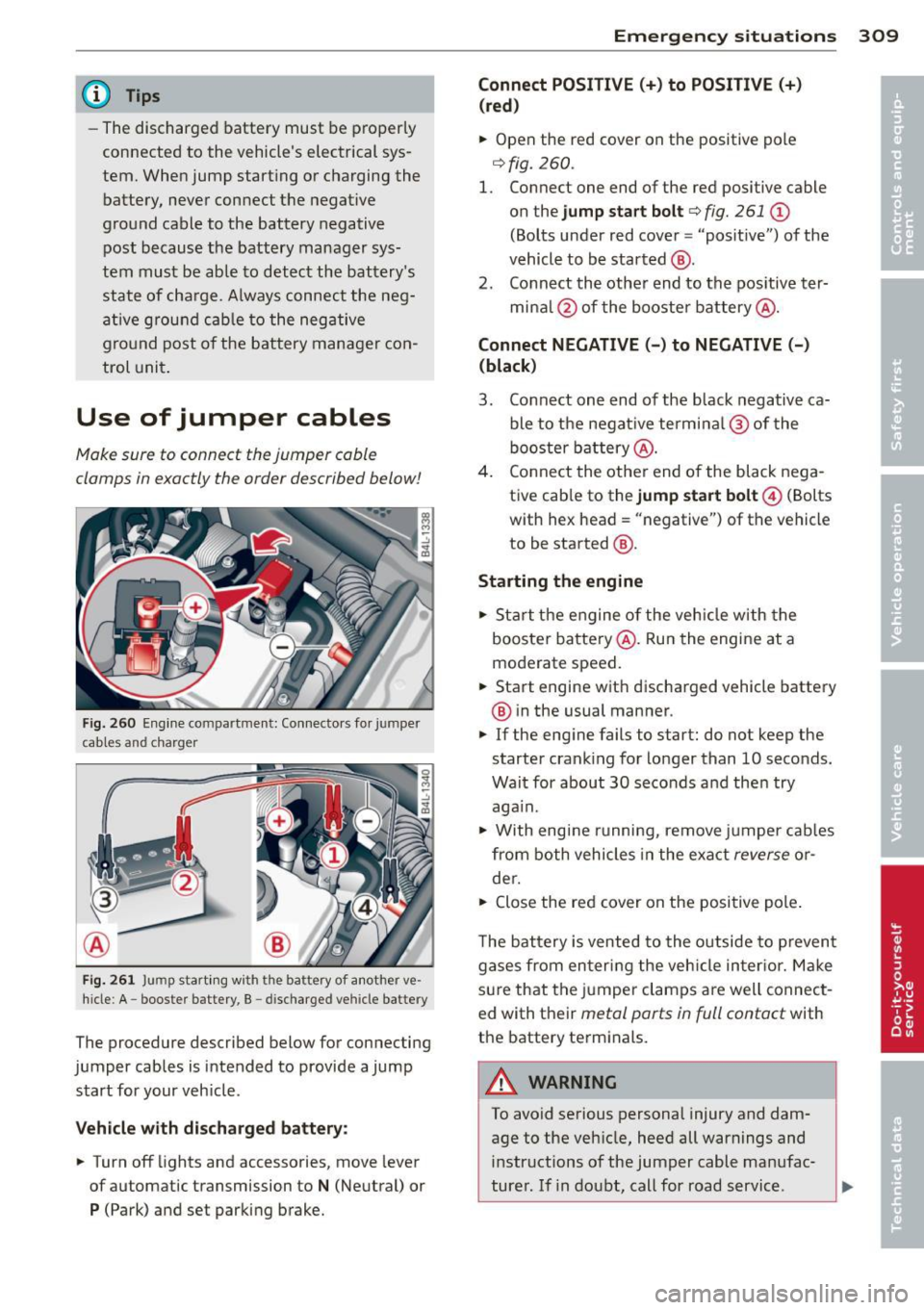
F ig. 260 Engine co mpa rtment: Con nectors fo r ju mpe r
cables and charger
Fi g. 2 61 Ju mp start ing w ith the battery of a not her ve
h icle :
A-booster battery, B -discha rged ve hicle batte ry
The procedure described below for connecting
jumper cables is intended to provide a jump
start for your veh icle .
Vehicle with discharged batter y:
.. Turn off lights and accessories, move lever
of automatic transmission to
N (Neutral) or
P (Park) and set parking brake.
Emergenc y situ ation s 309
Connect POSI TIVE(+ ) to POSITIVE (+ )
(red )
.. Open the red cover on the positive pole
¢fig. 260 .
1. Connect one end of the red positive cable
on the
jump sta rt bolt ¢ fig. 261 (D
(Bolts under red cover = "posit ive") of the
vehicle to be started ®·
2. Co nnect th e other end to the pos itive ter-
mina l@ of the booster battery @.
Connect NEGATIVE( -) to NEGATIVE(-)
( black )
3. Connect one end of the black negative ca
ble to the negat ive termina l@ of the
booster b attery @.
4 . Connect the othe r end of the black nega
tive cab le to the
jump start bolt@ (Bolts
with hex head= "negative") of the vehicle
to be started @.
Sta rting the engine
.,. Sta rt the e ngine of the veh icle with the
booster ba tte ry @ . Ru n the engine at a
moderate speed .
.. Start engine with discharged vehicle battery
® in the usual manner .
.. If the eng ine fails to start: do not keep the
starter crank ing fo r longer than 10 seconds.
Wa it for about 30 seco nds a nd the n try
again .
.,. With engine runni ng, remove jumper cab les
from both vehicles in the exa ct
reverse or
de r .
.. Close the red cover on the posi tive po le .
T he battery is vented to the outside to p reven t
gases from en ter ing the veh icle inter ior. Make
s ur e that the jumper clamps a re well connect
ed with their
metal ports in full contact with
the battery term inals.
.&_ WARNING
-To avoid serious personal injury and dam
age to the ve hicle, heed all warnings and
i n structions of the jumper cable manufac-
-
turer . If in doubt, call for road service . IIJ>
Page 312 of 342
310 Emergency sit uat ions
-Jumper cables mus t be long enough so
that the vehicles do not touch.
- W hen connecting jumper ca bles, make
sure that they cannot get caught in any moving parts in the eng ine compart
ment.
- Before you check anything in the engine compartment, always read and heed all
WARNINGS
c> page 248, Engine com
partment.
({D Note
Improper hook-up of jumper cables can r u
in the generator.
- Always connect POSITIVE( +) to POSI
TIVE(+), and NEGATIVE( -) to NEGATIVE
( - ) ground post of the battery manager
control unit.
- Check that all screw plugs on the battery
ce lls are screwed in firmly. If not, tighten
plugs prior to connecting clamp on nega
tive battery terminal.
- Please note that the procedure for con
nec:t i ng a jumper cable as described
above applies spec ifically to the case of
you r vehicle being jump started. When
you are giving a jump st art t o anothe r ve
hicle, do
not connect the negat ive (-) ca
ble to the negat ive (-) terminal on the
discharged battery ©
c> fig. 261. In
stead, securely connect the negative(-)
cable to e ither a solid metal component
that is firmly bolted to the engine block
or to t he engine block itse lf. If the bat
te ry that is being charged does not vent
to t he outside, es caping batte ry gas
could ignite and explode!
Emergency towing
with commercial tow
truck
General hints
Your Audi requires special handling for tow
ing.
T he following information is to be used by
commercial tow truck operators who know
how to operate their equipment safely.
- Ne ver tow your Audi , towing will cau se
damage to the engine and tr an smi ssion .
- Ne ver wrap th e safet y chain s or winch ca
ble s around the brak e lines.
- To prevent unne ces sary damage, your Audi
must be tr an sp o rt ed with a flat bed tru ck.
- To load th e vehi cle on to the fl at bed, use
the towing l oop found in the ve hicle to ols
and att ach to th e front or rea r anchorage
i=> page 311 and i=>page 311 .
& WARNING
--==
A vehicle being towed is not safe for pas-
sengers. Never allow anyone to ride in a
vehicle be ing towed, for any reason.
-
Page 327 of 342
Alternator Malfunction . . . . . . . . . . . . . . . . . . . . . . . 31
Ambience lighting Lighting p rofiles .......... .. .. .. .... 62
Anti-freeze
refer to Engine coolant system .. ... .. 265
Anti-lock brake system How the ABS system works . .. .. .. .. . 223
War ning/ indicator lights ... .. .. .. .. .. 18
Anti-Slip Regulation System (ASR) How t he system works .. ... .. .. .. .. . 22 1
Anti-theft systems Anti- theft alarm system . . . . . . . . . . . . . SO
E lect ronic immobilize r ..... .. .. .. .. .. 40
App roach/departure angle . ......... .. 232
Ashtray ..... ... .. .. ..... ... .. .. .... 86
ASR How t he A nti-Sli p Regula tion System
works ... .. ................. .. ... 22 1
Aster isk
What does it mean whe n someth ing is
marked with an aste risk? . . . . . . . . . . . . . . 6
Aud i brak ing guard ......... .. .. .. .. . 126
Error messages .......... .... .. ... 128
Sett ings ................... ... ... 128
Stat us messages .... ..... .. .. .. .. . 128
Sw itching on and off ...... .. .. .. .. . 128
Aud i parking system plus with rearv iew
camera ... .. ................. .. ... 144
Adjusting the display ......... .... .. 148
Adjusting the warni ng tones .. .. .. .. . 14 8
Rearview camera - pa rking mode 1 ... . 147
Rearview camera - pa rk ing mode 2 . .. . 14 7
Safety precau tions ........ .. .. .. .. . 14 4
Sw itch ing on and off ... ... .. .. .. .. . 146
Trailer hitch . . . . . . . . . . . . . . . . . . . . . . 14 9
Aud i Servic e Repa ir Manuals and Litera-
ture .. .. .. .. ................. .. .. . 319
Auto-Check Control . . . . . . . . . . . . . . . . . . 30
Automatic belt retrac to r . . . . . . . . . . . . . 17 4
Automatic ca r wash
refer to Was hing ......... .. .. .. .. . 24 0
Automatic mode Four- zone automatic comfort a ir cond i-
tioning .. ............ ...... .... ... 98
Automatic S hift Lock (ASL) . ... .. .. ... 139
Inde x 325
Automat ic transm iss ion .. ..... ... .. .. 137
Automatic Shift Lock (ASL) ... ... .. .. 139
Driving ... .. .. .. .. . .. ... .... ... .. 137
Dynam ic shift program ............. 140
Emergency mode . ................. 141
Emergency re lease for selecto r lever .. 142
Ig nition key safety lock . .. .. ... ... .. 105
Ki ck-down . . . . . . . . . . . . . . . . . . . . . . . . 140
Manua l shift prog ram .......... .... 140
Se lector lever .. .. .... ........... .. 138
S hi ft buttons . . . . . . . . . . . . . . . . . . . . . 141
Steering wheel with tiptronic ®
A UTO mode 141
AC climate cont ro ls . . . . . . . . . . . . . . . . . 94
Auto Safety Hotline ............. .... 167
Ave rage speed . . . . . . . . . . . . . . . . . . . . . . . 24
Avoid damaging the vehicle .......... . 230
B
Bass box . .. .. .. .. ... ... ... .. .. .. .. 296
Battery . ... .. .... .. . .. .. ..... ... .. 269
Battery location .. .. . ... .... ... .. .. 270
Charg ing .. .. .. .. ................. 271
Important warnings when working on
the battery .. .. .. .. . .. .. ..... ... .. 270
Jump start ing .. .. .. ............... 308
Low .. .. .. .. .. .. .. . .. .... .... .... 225
Rep lac ing the battery .......... .. .. 273
State of cha rge . .. ................. 225
Voltage ... .. .. .. .... ........... .. . 36
Win ter operation ... . .. ..... ... .. .. 269
Working on the battery . ..... ... .. .. 270
Befo re d rivi ng . .. .. .. ............... 160
B lended gasoline .. ............. .. .. 2SO
Body cavity sealing ... . .. ..... ... .. .. 244
Boos ter seats ..... .. ............... 208
B rake assistant .. .... . ... ...... ... .. 224
B ra ke booste r ... .. .... ............. 223
Brake fluid Changi ng the brake fluid . .......... . 269
Checking the brake fluid level ....... . 268
Rese rvoir . .. .. .. .. . ....... ..... .. 268
What is the correct bra ke fluid level? .. 268
Wha t should I do i f the brake fluid w arn-
ing light comes on? .. .. ..... ... .. .. 2 68
B rake light
Defec tive . . . . . . . . . . . . . . . . . . . . . . . . . 23
•
•
Page 330 of 342
328 Index .:..:..:..::....::.....:..._ ___________________________ _
Declaration of compliance
Adaptive cruise control ............. 322
Audi side assist ................... 322
Cell phone package ....... .. .. .... . 322
Convenience key .......... .... .... . 322
Electronic immobilizer ......... .. ... 322
H omelink ® universal remote control .. 322
Remote control key ........... .. .. . 322
def What does this mean when it appears in
the trip odometer display? ..... .. .. .. 12
Defective light bulb warning . . . . . . . . . . . 23
Defrosting/defogging the windows . . . . . . 94
Defrosting/defogging windows ... .... .. 96
Determining correct load limit ... .. .. . 282
Diesel fuel . . . . . . . . . . . . . . . . . . . . . . . . . 2 5 1
Diesel particu late filter . . . . . . . . . . 37, 229
Digital clock . .. . ........ .. .. .. .. .. .. 11
Digital compass ........... .. .. .. .. .. 69
Digital speedometer ............ .... .. 22
Dimensions .. ................ ... ... 315
Dimming the rearview mirror .. .. ...... 69
Dipstick Reading the dipstick properly ..... .. . 263
Distance control system
refer to Adaptive cruise contro l .. .. .. . 113
Doors Power child safety lock .... .. .. .... .. 48
Driver information system ............. 21
Digital speedometer .............. . . 22
Driver information messages . . . . . . . . . 30
Open door or rear lid warning . . . . . . . . . 22
Outside temperature display .. .. .. .... 22
Sound system display ......... .. .. .. 21
Driver seat
refer to Seating position ... .. .. .... . 161
Driver's seat . . . . . . . . . . . . . . . . . . . . . . . . 72
Driver 's seat memory . . . . . . . . . . . . . . . . . 73
Activating remote control key ... .. .... 74
Recalling a seat posit ion . . . . . . . . . . . . . 73
Storing a seat position ....... .. .... .. 73
Driving message s . . . . . . . . . . . . . . . . . . . . 30
Driving mode
refer to Adaptive Air Suspension . 150, 152 Driving
offroad
Driving through water ............ .. 233
Driving tips . ... .. ... .......... .. .. 232
Ru les of behavior . ............. .... 232
Sand and mud ... ............. .... 233
Snow -covered g round ............. . 233
Unpaved roads ... ... ... .... ..... .. 233
Driving safe ly ... .. ... .......... .. .. 160
Driving through water ........... .... 233
Driving time . . . . . . . . . . . . . . . . . . . . . . . . 24
Duplicate key ..... .. ........... .. .. . 38
Dust filter Climate controls ............... .. .. . 91
E
Easy entry feature .. ... ... .... ..... .. 104
Efficiency program .............. .. .. . 26
Fuel economy messages ........ .. .. . 27
Memory levels . . . . . . . . . . . . . . . . . . . . . 25
Other equ ipment . .......... ...... .. 27
E lectric seat adj ustment
refer to Power seat . . . . . . . . . . . . . . . . . 72
El ectronic differential lock ( EDL )
How the system works .......... .... 221
Warning/indicator lights ........ .. .. . 18
Electronic immob ilizer ... ........... .. 40
E lectronic power contro l
(EPC) warning/indicator light . . . . . . . . . 15
Electronic speed limiter .......... .. .. . 28
Electronic Stability Control (ESC)
Hill descent control ............... . 219
How the system works .......... .. .. 219
Offroad mode .. .. ............. .. .. 219
Warning/indicator lights ........ .. .. . 16
Emergency flasher ........... ...... .. 60
Warning/indicator lights ........... .. 16
Emergency lock ing of doors ......... .. . 45
Emergency operation Rear lid ... .... .. .. ........... .. .. . 48
Emergency starting ..... .. ... ..... .. 308
Emergency towing .............. .... 310
En ergy management .............. .. 225
Battery power ... .. ........... .. .. 227
Driver notification . . . . . . . . . . . . . . . . . 22 7