fuel AUDI Q7 2012 Owner´s Manual
[x] Cancel search | Manufacturer: AUDI, Model Year: 2012, Model line: Q7, Model: AUDI Q7 2012Pages: 342, PDF Size: 86.42 MB
Page 99 of 342

@ Tips
If the climate control system is operating
in cooling mode, a ir flows primarily from
the outlets in the center conso le and in the
door pillars. To achieve adequate cooling,
you should never close the outlets com
pletely .
Using climate control economically
Using the climate controls prudently can help
save fuel.
When you use the air conditioner, engine pow
er is reduced and fuel consumption increases.
To save fuel, you should use the air condition
e r only when necessary. Also please note the
following points :
.,. To save fuel, turn off cooling mode by press
ing the
I AC ! button (indicator light goes
out) .
.,. In add ition, if you open the window or the
Panoramic sliding sunroof* while driving,
turn off cooling mode by p ress ing the
IACI
button (indicator light goes out).
.,. If the vehicle is extremely hot due to the
heat of the sun, briefly open doors and win
dows.
@ For the sake of the environment
By reducing the amount of fue l you use,
you also reduce the amount of poll utants
emitted into the air. W
arm and cold 9 7
Rear Air Conditioning
Rear air conditioning - controls
Applies to vehicles: with four-zone automatic comfort air
conditio nin g
This overview is to assist you in familiarizing
yourself with the rear air conditioning con
trols.
lll ... :;
- --- ------------....... ~
Fig . 113 Rea r air conditioning controls
The left display indicates the temperature se
lected for the rear left passenger, the right
display indicates the temperature selected for
the rear right passenger . If the settings for
seat heating *, air distribution or the air condi
tioning fan are changed, the relevant indica
tor will appear br iefly on the display .
Funct io ns are set by ro tating the control or
are switched on and off by tapping the but
tons. The indicator light in the button illumi
nates when the function is active.
Button (s) Function
ION/OFFI Climate control on/off
¢ page98
-
IAUTOI Automatic mode
¢page98
Regulatoral El Temperature selection
¢page98
Qi Seat heating *
¢page 101
~
Fan
¢page98
~
Air distribution
¢page99
a) The regu lator is also u sed to set the fan sp ee d, air dis-
tribut ion and seat heating .
IIJ,
Page 112 of 342
110 On the road
The parking brake warning light. (USA)/ .
(CON) illuminates when the parking brake is
set and you switch on the ignition.
_& WARNING
-
Always release the parking brake com
pletely. A partially engaged brake will
overheat the rear brakes, reduce their ef
fectiveness and cause excessive wear. This could lead to brake failure and an accident .
(D Note
Only after the vehicle has come to com plete stop, should you firmly set the park
ing brake and move the selector lever into
"P".
Parking
To prevent a parked vehicle from rolling
away, there are a few things you should do .
When you park your vehicle, do the
following
• Stop the vehicle using the brake pedal.
• Apply the parking brake firmly .
• Move the selector lever into the
P position
~ &.
• Switch off the engine and remove the igni-
tion key from the ignition lock.
When you park your vehicle on hills, do
the following
• Stop the vehicle using the brake pedal.
• Apply the parking brake firmly.
• If you are parking headed downhill, turn
the front wheels
toward the curb.
• If you are parking headed uphill, turn the
front wheels
away from the curb.
• Move the selector lever into the
P position.
• Switch off the engine and remove the igni
tion key from the ignition lock.
_& WARNING
This is how you can reduce the risk of in
jury when leaving your vehicle. -
Never park the vehicle where it can come
in contact with dry grass, spilled fuel or
any other flammable materials.
- When parking on hills, always turn the
wheels so that the front wheels will first
roll into the curb, if the vehicle should
start to roll.
- Never allow anyone - especially small
children - to remain in the vehicle when
it is locked. locked doors make it more
difficult for rescuers to access the pas
senger compartment in the event of an
emergency. Danger to life!
- Never leave children unsupervised in the
vehicle. Children could release the park
ing brake or move the gearshift lever out
of gear. The vehicle could start to roll
away and cause an accident.
- No matter what the season is, the tem
perature in a parked vehicle can reach
dangerous levels.
@ Note
-Please exercise care when you park your
vehicle in parking areas with parking bar
riers or curbs. Parking barriers and curbs
vary in height and could damage your
bumper and related components as the
front of your vehicle moves over a barrier or curb that is too high, as you park or as
you back out of a parking spot. In order to be sure that no such damage can oc
cur, you may wish to stop short of having
the front tires of your car touch the park
ing barrier or curb.
- Please also exercise exceptional care
when you drive up or down steep ramps
or drive over curbs or other obstacles, for
which the vehicle is not designed, be
cause components of the vehicle close to
the ground, such as bumper covers, spoilers and suspension and exhaust sys
tem components, may become dam aged.
Starting on hills
Hill Hold makes it easier to start on hills.
Page 142 of 342
140 Automatic transmission
Kick-down
The kick-down feature allows the vehicle to
generate maximum acceleration.
When you press the accelerator pedal beyond
the resistance point that is reached at full
throttle, the transmission will select a lower
gear ratio based on vehicle speed and eng ine
RPM. The engine RPM will be controlled to
produce maximum vehicle accelerat ion as
long as you continue to press the accelerator
pedal beyond this resistance point .
& WARNING ,--
Be careful when using the kick-down fea
ture on slippery roads. Rapid acceleration may cause the vehicle to skid.
Dynamic shift program (DSP)
The automatic transmission is electronically
controlled .
The transmission is self adapting and will au
tomatically
select the best shift program suit
ed to the driving conditions and driving style.
The transmission will select one of the
econo
my
programs when you drive at a steady
speed or a gradually changing speed without
heavy acceleration. This achieves optimum
fuel efficiency, with early upshifting and de
layed downshifting.
The transmission will automatically select the
sporty shift programs when you drive at high
er speeds, or with heavy acceleration and fre
quent ly changing speeds. Upshifts are delayed
to make full use of engine power. Oownshift
ing takes place at higher engine speeds than
in the economy programs.
The selection of the most suitable shift pro
gram is a continuous, automatic process. The
driver can also make the transmission switch
to a sporty program by
quickly pressing down
the gas pedal.
This causes the transmission to shift down to
a lower gear to achieve rap id acceleration, e.g .
for quickly passing another veh icle. You do not need to press the gas pedal into the
kick-down
range. After the transmission has upshifted,
the or iginal program is selected according to
your driving style.
An additional shift program allows the automatic transmission to select the proper gear
for uphill and downhill gradients.
This keeps the transmission from shifting up
and down unnecessarily on hills . The trans
mission will shift down to a lower gear when
the driver presses the brake pedal on a down
hill gradient. This makes use of the braking ef
fect of the engine without the need to shift
down manually.
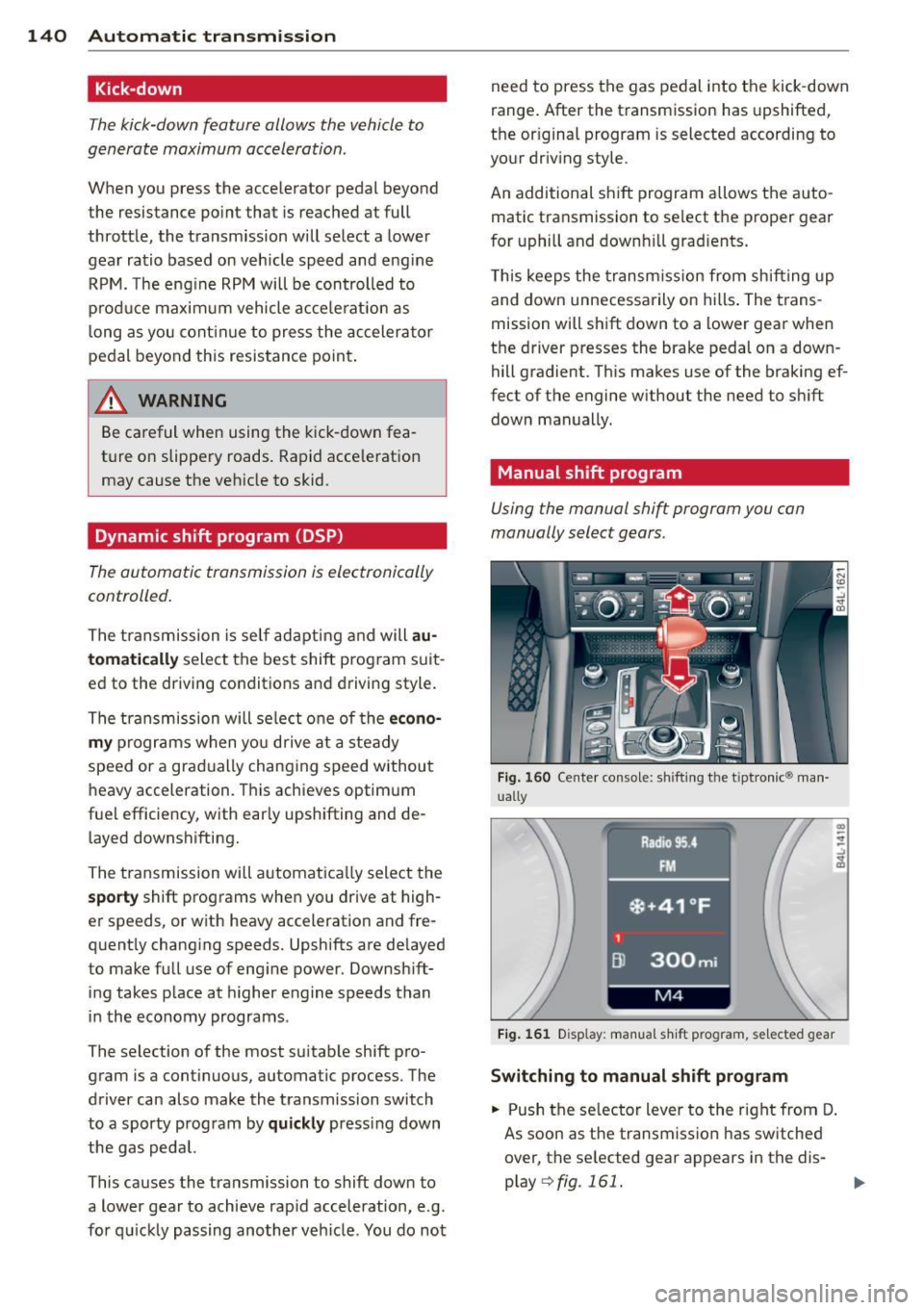
Manual shift program
Using the manual shift program you can
manually select gears.
Fig. 160 Cente r conso le: shifting the t iptronic® man
ually
Fig. 161 D isplay: manual shift program, selected gear
Switching to manual shift program
.. Push the selector lever to the right from D.
As soon as the transmission has switched
over, the selected gear appears in the dis
play
Q fig . 161.
Page 143 of 342
To upshift
• Push the selec tor leve r forw ard to the pl us
pos ition
0 ¢ fig. 160 .
To downshift
• Push the lever to the m in us position Q .
When acce lerating, the transm iss ion w ill au
tomatically sh ift into the next gear before the
e ngine reaches its maxim um RPM .
If you app ly a light throttle when accelerat
ing , tiptronic ® will automatically shift from
1st to 2nd gear to save fuel. If you apply a
h eavy thrott le, the transmission will stay in
1st gear unt il n ear maximum R PM is reached,
or until the d river sh ifts i nto 2nd gear .
If you take your foot off the accelerator peda l
when dr iv ing down a steep incli ne , tiptronic ®
will downshift from th e se lected gear into the
n ex t lowe r gear until it reaches 1st gea r,
b ased on ro ad s peed and eng ine RPM . A uto
mat ic downshifting is in ter rupted as soon as
you apply t he thrott le again.
@ Tips
- Wh en you sh ift i nto the next lower ge ar,
t h e transm iss io n will dow nshi ft only
whe n there is no possibility of over-rev
v ing the engine.
- When t he kick -down comes on, t he
transmission will s hift down to a lower
gear, depending on ve hicle and engine
speeds .
- tiptron ic® is inoperative w hen the trans
mission is in the fail-sa fe mode.
Autom atic transm ission 141
Steering wheel with tiptronic ®
Applies to vehicles: w ith t iptronic-steering wheel
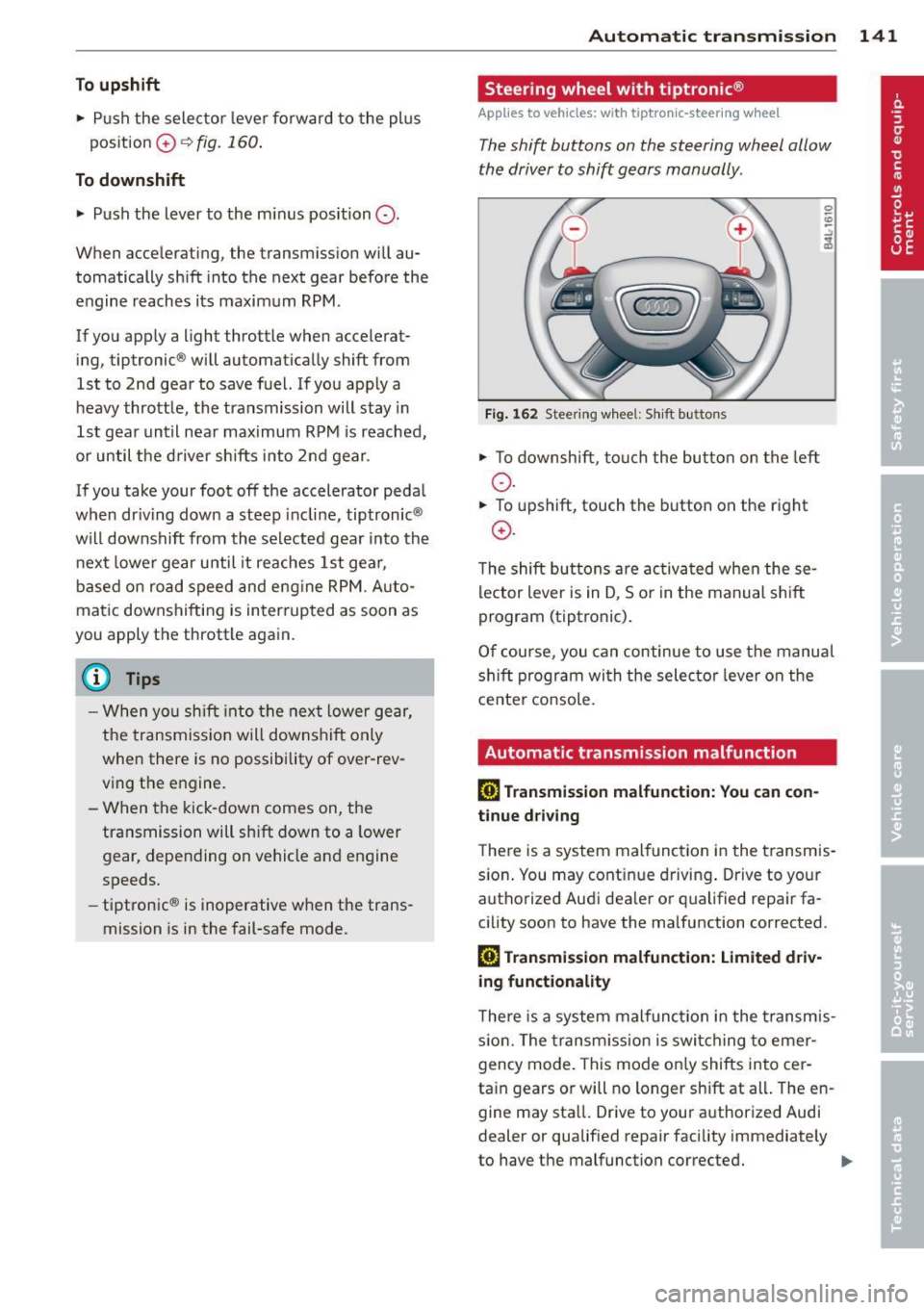
T he shift buttons on the steering wheel allow
the driver to shift gears manually .
Fig. 162 Steering w hee l: S hift b utt ons
• To down shi ft, tou ch the bu tton on t he left
o .
• To upshift, touch the button on the right
0 .
The shift bu tton s a re activ at ed when these
lector lever is in D, So r in the manual s hift
program (tiptronic) .
O f c ourse , you can c ontinue to use the manu al
s hift p rogram wi th the selecto r leve r on the
cente r co nsole.
Automatic transmission malfunction
[O] Transmission malfunction: You can con
tinue driv ing
T he re is a system mal func tion in the t ransmis
s io n. You may cont inue dr iving . Drive to your
a u tho rized Aud i dea ler o r qualified repa ir fa
cility soon to have the ma lfunction corrected.
[O] Transmis sion malfunction: Limited driv
ing functionality
T he re is a system mal func tion i n the t ransmis
s io n. The transm iss ion is swi tching to emer
gency mode. This mode o nly shifts into cer
ta in gears o r will no longer shift at all . The en
gine may sta ll. Drive to your a uthorized Audi
dealer or qualified repair facility immediately
to have the malfunction correcte d.
IJJ,,
Page 153 of 342
possible to raise the suspension to a high leve l
above certain speeds .
When a speed of about 75 mph (120 km/h) is
exceeded for more than 30 seconds, the vehi
cle is automatically lowe red to
low level when
in comfort and automatic mode. Ground
clearance is about 0.6 inch (15 mm) less,
compared to the
normal level.
When a speed of about 100 mph (160 km/h)
is exceeded for more than 20 seconds , the ve
h icle is automat ica lly lowered to
highway lev
el
when in automatic and dynamic mode.
Ground clearance is about 1.4 inches (35 mm)
less, compared to the
normal level. Road
holding is opt imized as a result of the lower
center of gravity, and fuel consumption is re
duced as a result of reduced wind resistance .
Level adjustment
high level 2
high level 1
normal leve l
low level
highway level
Ground clearance
about 9 .4 inches
(240 mm)
about
8 inches
(205 mm)
about 7 inches (180 mm)
about 6 .5 inches
(165 mm)
about 5.7 inches (145 mm)
The segment disp lay @ in the MMI Display
c:::> page 152 or in the instrument cluster dis
p lay
i:> page 153 shows the current vehicle
level.
Automatic
Select the automatic mode if you prefer a bal
anced, comfortable suspension setting . The
damping characteristics are adjusted accord
ingly.
- Automatic lowe ring: When a speed of
about 75 mph (120 km/h) is exceeded for
more than 30 seconds, the vehicle is auto
matically lowered by about 0.6 inch (15
mm) to the
low level, wh ich is more suitable
for highway speeds. Road hold ing is opti
mized as a result of the lower center of grav-
Ad aptive Air Su sp en sion 15 1
ity and fuel consumption is reduced as a re
sult of reduced wind resistance . When a
speed of about 100 mph (160 km/h) is ex
ceeded for more than 20 seconds, the veh i
cle is automatically lowered by an addit ional
0 .8 inch (20 mm) to
highway level.
- Automat ic raising: When the vehicle is at
highway level and the speed falls below
about 80 mph (130 km/h) for more than 20
seconds, the vehicle is automatically raised
to
low level. T he ve hicle is automat ica lly
ra ised aga in to
normal level if the speed
fa lls below abo ut 44 mph (70 km/h) for a
period of 2 minutes . The vehicle is raised im
mediately when speed fa lls below abo ut 22
mph (35 km/h).
Dynamic
Se lect the dynamic mode if you prefer a spo r
ty suspension setting. In t his mo de, the veh i
cle is lowered to
low level while it is still sta
tionary and sporty damping characteristics
are se lected . The warning light
Ill in the in
strument cl uster will come on for a few sec
onds just to rem ind you of the reduced ground
clearance .
If you switc h off the engine whi le the vehicle
is in the dynamic mode and then switch on the
ignition once aga in, the
Ill warning light will
also come on aga in for a few seconds as a re
minder .
-Automa tic lo weri ng : When a speed of
about 100 mph (160 km/h) is exceeded for
more than 20 seconds, the vehicle is auto
matically lowered by 0 .8 inch (20 mm) to
highway level .
-Automat ic ra is ing: The veh icle is automati
cally ra ised to
low level aga in, if the speed
fa lls below about 80 mph (130 km/h) fo r a
pe riod of 20 seconds. The veh icle is raised
immed iate ly w hen speed falls be low about
22 mph (35 km/h).
Comfort
Select the comfort mode if you desire a s us
pension setting with a special emp hasis on
comfort . Damp ing cha racte ristics w ith a clea r
Iii-
Page 230 of 342
228 Driving and environment
Driving and
environment
The first 1,000 miles
(1,500 km) and
afterwards
New engine
The engine needs to be run-in during the first
1,000 miles (1,500 km).
For the fir st 600 miles (1,000
kilometers):
.,. Do not use full throttle.
... Do not drive at engine speeds that are more
than 2/3 of the maximum permitted RPM.
From 600 to 1,000 miles (1,000 to
1,500 kilometers):
.,. Speeds can gradually be increased to the
maximum perm iss ible road or engine speed .
During and after break-in period
... Do not rev the engine up to high speeds
when it is cold. This applies whether the
t ransmission is in N (Neutral) or in gear.
After the break-in period
... Do not exceed maximum engine speed un
der any circumstances.
... Upshift into the next higher gear
before
reaching the red area at the end of the tach
ometer scale¢
page 10.
During the first few hours of driving, the en
gine's internal friction is higher than later
when alt the moving parts have been broken
in. How welt this break-in process is done de
pends to a considerable extent on the way the
vehicle is driven during the first 1,000 miles
(1,500 kilometers).
(D Note
Extremely high engine speeds are auto
mat ica lly reduced . However, these rpm
lim its are programmed for an engine welt
run- in, not a new engine.
{® For the sake of the environment
Do not drive with unnecessarily high en
gine speeds - upshifting ear ly saves fuel,
reduces noise and protects the environ
ment.
, New tires
If your vehicle is running on new tires, drive
part icularly careful for the first 350 miles
(500 kilometers) after fitting.
A WARNING
New tires tend to be slippery and must al
so be "broken -in". Be sure to remember
this during the first 350 miles (500 kilo
meters). Brake gently. Avoid following
closely behind other vehicles or other sit
uations that might require sudden, hard
braking.
New brake pads
Remember that new brake pads do not have a
full brak ing effect dur ing the first 250 m iles
(400 kilometers) after they are insta lled.
New brake pads have to be "burnished in" be
fore they have optimal grab¢
A.
During the break- in period, you should avoid
putting severe loads on the brakes. Severe
loads include, for example, sudden hard brak
i ng, in particular at very high speeds or, for
example, on mountain passes .
A WARNING
New brake pads don't have the best stop
ping power and must be "broken-in" dur
i ng the initia l 100 to 150 miles (150 to
200 kilometers) of normal city driving. You
can compensate for this by pressing the
brake pedal more firm ly. This also applies
later when new pads are installed.
Page 231 of 342
Catalytic converter
Applies to vehicles: with gasoline engine
It is very important that your emission control system (catalytic converter) is function
ing properly to ensure that your vehicle is run
ning in an environmentally sound manner .
... Always use lead-free gasoline¢ page 250,
Gasoline .
... Never run the tank down all the way to
empty .
... Never put too much motor oil in your en-
gine ¢
page 264, Adding engine oil~-
.,. Never try to push- or tow-start your veh icle.
The catalytic converter is an eff icient "clean
up" device built into the exhaust system of
the vehicle. The catalytic converter burns
many of the poll utants in the exhaust gas be
fore they are released into the atmosphe re.
The exclusive use of unleaded fuel is cr it ically
i mportant for the life of the cata lytic convert
e r and proper fu nctioning of the engine.
A WARNING ,~
- Do not park or operate the veh icle in
areas where the hot exhaust system may
come in contact with dry grass, brush,
fuel spill or other material which can
cause a fire.
- Do not apply additional undercoating or
rustproofing on or near the exhaust
man ifold, exhaust p ipes, catalytic con
verter or heat shie lds . During driving, the
substance used for undercoating could
overheat and cause a fire.
{[) Note
-Be aware that just one tank fi lling with
le aded fuel will already seriously de
grade the performance of the catalytic
conve rter .
- Do not exceed the correct engine oil level
¢ page 264.
-Do not drive until the fuel tank becomes
completely empty. The eng ine could mis
fire . U nburned fuel could a lso get into
Dri vin g and en vironm ent 229
the exhaust system and this cou ld cause
the catalytic converter to overheat .
- Do not turn off the igni tion while the ve
hicle is moving.
- Do not con tinue to ope rate your veh icle
unde r these conditions, as othe rwise fuel
can reach the catalytic converter. This
co uld result in overheating o f the con
verter, requir ing its replacement.
- To assure efficient operation of the Emis
sion Control System:
- H ave your vehicle maintained prope rly
and in accordance w ith the se rv ice rec
ommendat ions in you r Warranty &
M ain tenance boo klet.
- L ack of prope r maintenance as we ll as
improper use of the vehi cle w il l impair
the function of the em ission contro l
system and could lead to damage .
@ For the sake of the environment
Even when the Emiss io n Control System is
operat ing properly, the exha ust gas can
have a sul fur -li ke exhaust gas smell under
some operating states . This depends on
the sulfur content of the fuel being used .
Using a different brand of fue l may help,
or f illing the tank with lead-free super
grade gasoline .
Diesel particulate filter
Applies to vehicles : with diese l eng ine
The diesel part ic u late filter filters nearly all of
the soot particles out of the exhaust . The fil
ter cleans itself automat ica lly under normal
driv ing cond itions . If the filter ca nnot clean it
self (for example, because you a re o nly dr iving
short distances), the fi lter becomes clogged
with soot and the. symbo l for the diesel
particu late filter ill uminates ¢
page 3 7.
A WARNING
- Do not park your vehicle over flammable
materia ls such as grass or leaves because
the high temperature of the diesel par-
ticulate fi lter could start a fire. ..,. •
•
Page 232 of 342
230 Driving and en vironm ent
- Do not apply an underbody protectant in
the exhaust system area or a fire could
start.
Avoid damaging the
vehicle
When you are driving on poor roads, or over
curbs, steep ramps, etc., make certain that
l ow-lying parts such as spoi lers and exhaust
system parts do not bottom out and get dam
aged.
This is especially true for vehicles with low
slung chassis (sports chassis)* and fully load
ed veh icles .
Operate your vehicle
economically and
minimize pollution
General
Your personal style of driving will determine
the economy of your vehicle, as well as ex
haust and noise levels.
Fuel economy, environmental impact, and
wear on your engine, brakes and tires largely
depend on three factors:
- your persona l driving style
- operating conditions
- technical lim itations
If you anticipate what you need to do next and
drive economically, you can easily cut your
fuel consumption by 10-15 percent. This sec
tion will give you some t ips on how you can
help the environment and your pocketbook .
(D Tips
The consumption estimates as published
by ENVIRONMENTAL PROTECTION AGENCY
(EPA) and Transport Canada may not corre
spond to your actual consumption on the
road, wh ich will vary depending upon vehi
cle load and speed, road and weather con
ditions, tr ip length, etc.
Drive smoothly and keep a lookout
ahead
Vehicles use the most fuel when they are ac
celerating.
.,. Avo id unnecessary accelerating and braking.
Vehicles use the most fuel when they are ac
ce lerating . If you anticipate what is going to
happen next, you will need to brake less and,
thus, accelerate less. Let the vehicle coast
whenever possible -for examp le when you see
that the next traff ic light is red.
Avoid full throttle
Driving at moderate speeds saves fuel and
improves your mileage.
.,. Try and keep well below your car's maxi -
mum speed .
Accelerating gently reduces fue l consump
tion, engine wear, and does not disturb the environment.
Fuel consumpt ion, exhaust emissions and en
gine noise increase disproportionately at high
speeds. If you drive at approximately three
quarters of top speed, fuel consumption will
be reduced by one half. Never drive faster
than the posted speed limit and weather con ditions perm it.
Reducing unnecessary idling
Even when your car is just idling it burns up
fuel.
.,. Shut the engine off when you are not d riv
ing the vehicle .
.,. Do not warm up the vehicle by letting the
eng ine run at idle.
It makes sense to shut off the engine in traffic
jams, when wa it ing for tra ins to pass at rail
road crossings, o r at traffic lights that have
long waits on red. Turning the engine
off for
just 30-40 seconds saves more fuel than is
burned starting the engine again .
IJII>
Page 233 of 342
It takes a long time for the engine to warm up
fu lly when it is running at idle. However , wear
and nox ious em issions are especially high
when the engine is warming up. So you should drive away as soon as you start the engine and
avoid running at high rpms while the engine is
still warming up .
(D Note
Do not leave engine idling unattended af
ter starting . If warning lights should come
on to indicate improper operation, they
wou ld go unheeded. Extended idling also
p roduces heat, which cou ld resu lt i n over
heating or other damage to the vehicle or
other property.
Regular maintenance
A badly tuned engine unnecessarily wastes a lot of fuel.
"' Have your vehicle serv iced at regular inter-
vals.
By having your vehicle regularly serviced by an
author ized Audi dealer helps to ensure that it
r uns p roper ly and economically. The condition
of your vehicle not only affects its safety and
ab ility to hold its value, it also affects
fuel
c on sumpt ion .
Ch eck your oil each tim e yo u fill your tank .
The amount of oil used is related to engine
load and speed .
It is normal for the oil consumption of a new
engine to reach its lowest v alue after a certain
mileage has been dr iven .
You must drive your vehicle about 3,000 miles (S,000 ki lometers) before you can properly
assess o il consumption .
This a lso applies to fuel consumption and en
gin e output.
0 Note
- Have yo ur vehicle maintained properly
and in accordance wit h the service rec
ommendations in your War ranty
& Main-
Dri vin g and en vironm ent 231
tenance book let. Lack of proper mainte
nance as well as improper use of the ve
hicle will impair the function of the
em ission contro l system and could lead
to damage.
- Do not alter or remove any component of the Emission Control System unless approved by the manufacturer.
- Do not alter or remove any device, such as heat shie lds, switches, ign ition w ires,
valves, which are designed to protect
your vehicle's Emission Control System and other important vehicle compo
nents.
Fewer short trips
Fuel consumption will always be relatively
high on short trips .
"' Try to avoid driv ing short distances w ith a
cold engine .
The eng ine and cataly tic converter have to
reach their opt imal
op erat ing temperature t o
reduce fuel consumpt ion and nox ious em is
s ions effect ively .
Just after starting, a co ld eng ine in a mid-s iz e
car only achieves a fuel economy of 6-8 miles
per gallon (30 -40 l/l00km). After about a
half a mile , fuel economy cl imbs to 12 mpg
(20 l/100 km) . After about
2.5 miles (4 km),
the engine is at i ts p rope r opera ting tempe ra
tu re and f uel economy has reached a normal
l evel. So you can see that yo u should avo id
short trips whenever possible.
T he
out sid e t emperat ure is also cr itica l in th is
regard. Your car consumes more fue l in the
winter than in the summer.
•
•
Page 241 of 342
Cleaning and protect ion
General information
Regular core preserves vehicle value.
Any automobile is exposed to industrial
fumes , corrosive road salt, etc. A well cared
for Audi can look like new many years after purchase . Regu lar and correct care w ill con
tr ibute to maintaining the beauty and value of
your Aud i.
F u rth ermor e, good c are may be a conditi on
for subs tantiati ng a w arrant y claim sho uld
c orrosion d amag e or paint d efects oc cur.
Your authorized Audi dealer has a variety of
dedic ated veh icle-car e products and can ad
vise which ones to use for cleaning the exter i
or and interior of your vehicle.
Whether you use products recommended by
Aud i or other commercially available clean ing
agents, please make sure you apply them cor
rectly .
.&, WARNING
-Cleaning agents may be poisonous. Keep
them out of the reach of children.
- Heed all caut ion labels.
- Always read directions on the container
before using any product. Follow the di
rect ions carefu lly.
- Most chemical cleaners are concentrated
and have to be diluted .
- Use spot removing fluids only in well
ventilated areas.
- Do not use gasoline, kerosene, d iesel
fuel, nail polish remover or other volatile
fluids. They may be toxic, flammab le or
haza rdous in other ways. Do not wash,
wax or dry the vehicle with the ign it ion
on or the engine running.
- Do not clean the undersides of chassis,
fenders, wheel covers, e tc. w ithout pro
tecting your hands and arms. You may c u t yourself on sharp -edged metal parts .
Cleaning and protec tion 239
- Moisture and ice on brakes may impair
brak ing effic iency¢
page 222, General
information.
Test the brakes carefully
each time you wash the vehicle.
@) For the sake of the environment
Select on ly environmentally friend ly clean
i ng products . Leftover cleaning products
should not d isposed of in the household
waste.
Care of exterior
Washing
Frequent washing protects the vehicle .
The best protection against environmental i n
fluences is
frequent washing and waxing . How
often t his is required depends on:
- How much the veh icle is used
- Where the veh icle is parked (garage, in the
open under trees, etc.)
- The seasonal and weather conditions
- Environmental infl uences
T he longer b ird droppings, insects, tree resin,
road and indus tria l gr ime, ta r, soot, road salt
and other materials remain on the vehicle body, the more lasting their destructive ef
fects wi ll be . High temperatures caused by ex
posure to intense sun light intens ify the corro
s ive effect, particularly when humid ity is high
as well.
Under certain circumstances,
weekl y washing
may be necessary. Under other cond itions, a
monthly washing and waxing may be ade
quate .
After the winter, the underside of the vehicle
should be thoroughly washed, preferab ly in a
professional car wash .
.&, WARNING ,_
A lways read and heed all WARNINGS and
other information ¢
page 239.
•
•