oil AUDI Q7 2013 Owner´s Manual
[x] Cancel search | Manufacturer: AUDI, Model Year: 2013, Model line: Q7, Model: AUDI Q7 2013Pages: 348, PDF Size: 87.72 MB
Page 112 of 348
110 On the road
The parking brake warning light. (USA)/ .
(CON) illuminates when the parking brake is
set and you switch on the ignition.
A WARNING
-
Always release the parking brake com
pletely. A partially engaged brake will
overheat the rear brakes, reduce their ef
fectiveness and cause excessive wear. This could lead to brake failure and an accident .
(D Note
Only after the vehicle has come to com
plete stop, should you firmly set the park
ing brake and
move the selector lever into
"P".
Parking
When you park your vehicle, do the
following
• Stop the vehicle using the brake pedal.
• Apply the parking brake firmly.
• Move the selector lever into the P position
c:>A .
• Switch off the engine and remove the igni-
t ion key from the ignition lock.
When you park your vehicle on hills, do
the following
• Stop the vehicle using the brake pedal.
• Apply the parking brake firmly.
• If you are parking headed
downhill, turn
the front wheels
toward the curb.
• If you are parking headed uphill, turn the
front wheels
away from the curb.
• Move the selector lever into the
P position.
• Switch off the engine and remove the igni
tion key from the ignition lock.
A WARNING
This is how you can reduce the risk of in
jury when leaving your vehicle.
- Never park the vehicle where it can come
in contact with dry grass, spilled fuel or
any other flammable materials. -
When parking on hills, always turn the
wheels so that the front wheels will first roll into the curb, if the vehicle should
start to roll.
- Never allow anyone - especially small
children - to remain in the vehicle when
it is locked. Locked doors make it more
difficult for rescuers to access the pas
senger compartment in the event of an
emergency. Danger to life!
- Never leave children unsupervised in the
vehicle. Children could release the park
ing brake or
move the gearshift lever out
of gear. The vehicle could start to roll
away and cause an accident.
- No matter what the season is, the tem
perature in a parked vehicle can reach
dangerous levels.
(D Note
- Please exercise care when you park your
vehicle in parking areas with parking bar riers or curbs. Parking barriers and curbs
vary in height and could damage your
bumper and related components as the
front of your vehicle moves
over a barrier
or curb that is too high, as you park or as
you back out of a parking spot. In order
to be sure that no such damage can oc
cur, you may wish to stop short of having
the front tires of your car touch the park
ing barrier or curb.
- Please also exercise exceptional care
when you drive up or down steep ramps
or drive over curbs or other obstacles, for
which the vehicle is not designed, be
cause components of the vehicle close to
the ground, such as bumper covers, spoilers and suspension and exhaust sys
tem components, may become dam
aged.
Starting on hills
Hill Hold makes it easier to start on hills.
The system is activated when the brake pedal is depressed
for a few seconds. For this, the ll-
Page 132 of 348
130 Audi side assist
-The radar sensor's vision can be reduced
or entirely blocked by rain, snow, and
heavy spray . This can result in side assist
not adequately detecting vehicles or, in
some cases, not detecting them at all.
Always keep an eye on the direction you
are traveling and the relevant area
around the vehicle.
- Please note that side assist indicates
there are approaching vehicles, or
vehicles in your blind spot, only after
your vehicle has reached a driving speed
of at least 19 mph (30 km/h).
- Side assist signal does not work around
tight corners (turning radius less than
328 feet, or 100 m).
- Side assist is no replacement for the driv
er's full attention. The driver alone is re
sponsible for lane changes and similar
driving maneuvers. Always keep an eye
on the direction you are traveling and the relevant area around the vehicle.
- To ensure that you do not adversely af
fect side assist, do not block the area on
the rear bumper where the radar sensors
are located with foreign objects (such as
stickers or bicycle racks).
- Make sure that the signal light on the
outside mirror is not blocked by stickers
or other items.
(Di Tips
- Side assist automatically deactivates if it
detects that the radar sensors are
blocked ¢
page 135. The indicator light
on the button goes out .
- The area on the bumper where the radar
sensors are located must consistently re
main free of snow, ice, and heavy soiling
so that side assist can function properly.
Follow the additional notes on
¢page 136.
-For vehicles with a factory installed tow
ing hitch* or a trailer hitch* that was in
stalled later according to factory specifi
cations, side assist is automatically deac- tivated
as soon as the electrical connec
tion to the trailer electrical socket is made
¢ page 135.
-For vehicles with a trailer hitch that was
not installed according to factory specifi
cations, switch off the side assist when
towing a trailer .
- Additional tinting on the front side win
dows can make it harder to see and cor
rectly understand the signal light on the
outside mirror.
- For Declaration of Compliance to United
States FCC and Industry Canada regula
tions¢
page 328.
Sensor detection area
Applies to vehicles: with side assist
-----··· .... ·--·--
@ / ,
--
ill b''T -
Fig. 150 Sc hematic illustration: Sensor detectio n area
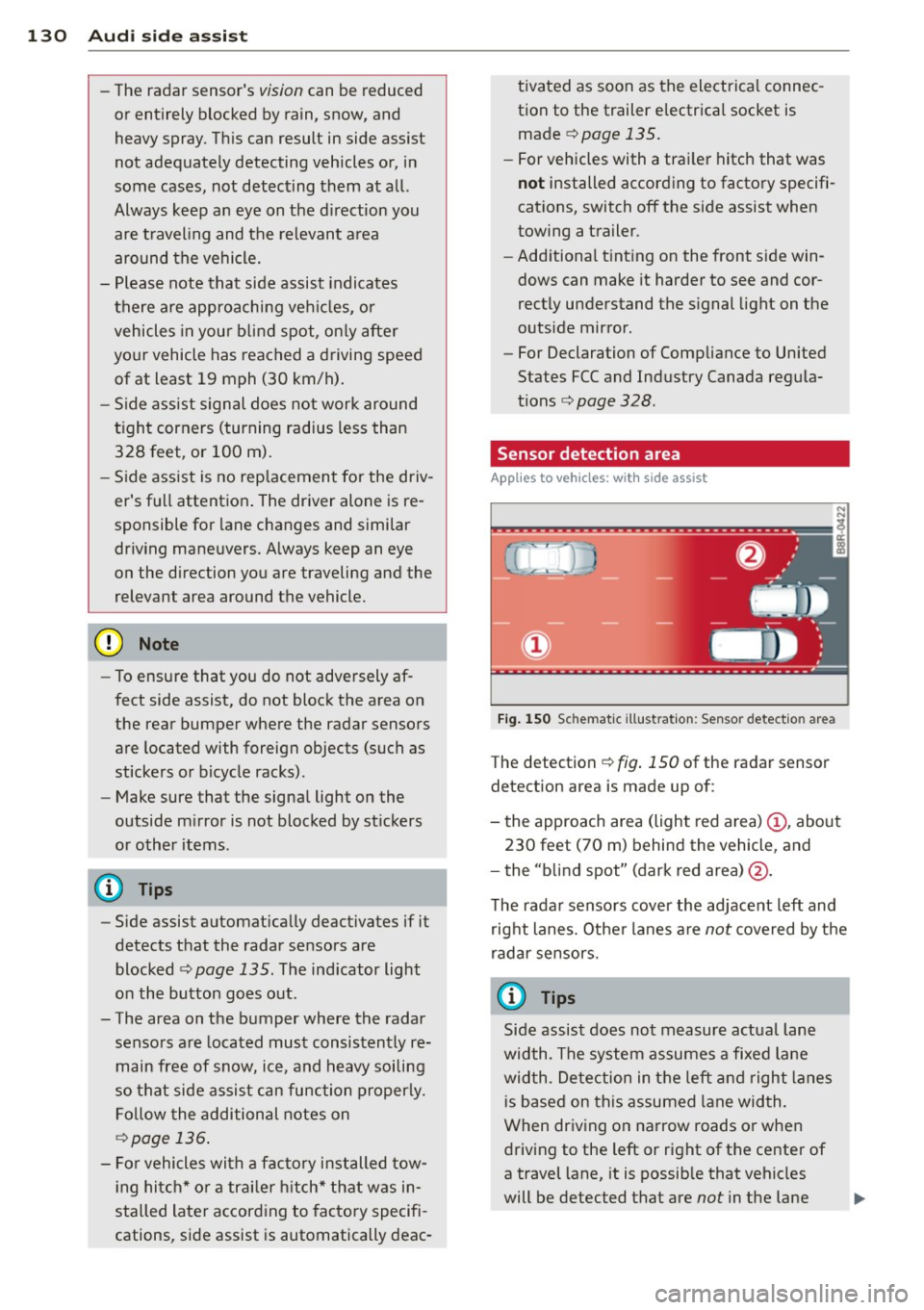
The detection ¢ fig. 150 of the radar sensor
detection area is made up of:
-
- the approach area (light red area) (D, about
230 feet (70 m) behind the vehicle, and
- the "blind spot" (dark red area) @.
The radar sensors cover the adjacent left and
right lanes. Other lanes are
not covered by the
radar sensors.
(D Tips
Side assist does not measure actual lane
width. The system assumes a fixed lane
width . Detection in the left and right lanes
is based on this assumed lane width.
When driving on narrow roads or when
driving to the left or right of the center of
a travel lane, it is possible that vehicles
will be detected that are
not in the lane
Page 231 of 348
-Before descending a steep grade, reduce
speed and shift transmiss ion into a lower
gear or lower driving range. Do not ride
the brakes or hold the pedal down too
long or too often. This could cause the
brakes to get hot and dimin ish braking
efficiency.
- Do not "r ide the brakes" by resting your
foot on the pedal when you do not intend
to brake. Th is may cause the brakes to
overheat, prema ture wear and increased
stopping distance .
- Under certain climat ic and operating
condit ions such as passing through wa
ter, driving in heavy rain or after washing
the vehicle, the effectiveness of the
brakes can be reduced . In winter, ice can
accumulate on the brake pads, linings,
discs and drums. Carefully apply brakes
for a test . Brakes will dry and ice coat
ings will be cleaned off after a few care
ful brake applications.
- Driv ing for an extended period of time on
salt-covered roads w ithout us ing your
brakes can also affect braking efficiency .
Clean off accumulated salt coating from
brake discs and pads w ith a few caref ul
brake applicat ions.
- If you damage the front spoiler, or if you
install a different spoiler, be sure the air
flow to the front brakes is not obstruct
ed. Otherwise the brake system could
overheat reducing the effectiveness of
the entire brake system.
- Failure of one brake circuit will impair
the braking capability resulting in an in
creased stopp ing distance. Avoid driv ing
the vehicle and have it towed to the near
est author ized Audi dealer or qualified
workshop .
Brake booster
The brake booster adds extra braking power.
The brake booster works with vacuum pres
sure which is created only when the engine is
running¢ &,.
Int ellig ent technolog y 229
A WARNING
-Never let the veh icle roll to a stop with
the engine shut off .
- If the brake booster is not working, for
example when towing your vehicle, or because the brake booster has somehow
been damaged, the brake pedal must be
pressed considerably harder to make up
for the lack of booster assistance .
Functioning of Anti-Lock Brake System
(ABS)
ABS prevents the wheels from locking up un
der braking.
T he ABS contributes effect ively to vehicle con
trol s ince it preve nts the whee ls from
locking
when the brakes are applied. This means that
the vehicle remains steerable and is less likely
to skid .
With ABS y ou do not n eed to pump the
bra ke. Just h old t he br ake ped al d own .
However, do not expect the ABS to shorten
braking distance under
all circumstances.
When dr iving on g ravel or on new ly fallen
snow o n top of icy s urfaces, braking dis tance
may be even longer, therefore, under these
circumstances, it is especia lly important that
you drive s low ly and with great care.
How the ABS s ystem works
An a utomat ic check is made when a speed of
about 12 mph (20 km/h) is reached . When
th is happens, a pumping noise can be heard.
If an ind iv idual whee l begi ns to rotate too
s low ly in relation to vehicle speed and tends
to lock, the ABS automatically reduces brake
pressure to prevent that whee l from locking .
T his automatic adjustment p rocess will cause
a
sli ght vibrati on of the brake pedal and some
noises to a le rt you that ve hicle speed m ust be
adapted to existing road and traffic condi
tions. •
•
Page 233 of 348
@ Tips
- When the engine is running, never hold
the steer ing whee l turned a ll the way to
the right or t o the left f or longer than 15
seconds. The power steering pump w ill
overheat the hydraulic f lu id if you keep
hol ding the steer ing wheel turned all the
way. This is likely to damage the power
steering system.
- If the power steer ing system should fail
ent irely, or if the engine is not running
(fo r example, while being towed), you
will still be ab le to steer the vehicle.
However,
considerably more effort will
be required to do so.
- If the power s teer ing system should
have a leak, or is not functioning proper
l y, contact yo ur authorized Audi dealer
immediately.
- The power stee ring system requires a
spec ially formulated hydraulic fluid. The
power steering reservo ir is the one locat
ed farthest to the rear on the left side of
the engine compartment
c> page 266.
The co rrect flu id level in the reservoir is
i mportant for proper functioning of the
power steer ing .
Driving with your
quattro ®
With all-wheel drive, oil four wheels ore driv
en.
Gener al information
W ith all -whee l dr ive , power is distributed to
a ll fo ur wheels. This happens automatica lly
depending on yo ur driving sty le and the road
conditions at the time . See also
¢ page 227,
Electronic differential lock (EDL) .
Winter tires
When driving in the w inter, your ve hicl e w it h
all -wheel drive has an advan tage, even with
regu lar tires . In winter road conditions it may
be advisable to mount winter tires (or all -sea
son t ires) for improved driveability and brak-
Int ellig ent technolog y 231
ing: these tires must be mounted on all four
wheel s. See also ¢
page 295, Winter tires .
Tire chains
Where tire chains are mandatory o n certain
roads, this no rma lly also app lies to veh icles
with all-wheel drive¢
page 296, Snow
chains.
Replacing wheels /tires
Vehicles with all-wheel drive must always have ti res of t he same s ize. A lso avo id tires
with different t read depths. For det ails see
page
c!;> page 291, New tires and replacing
tires and wheels .
_& WARNING
A lways adj ust yo ur driv ing to road and traf
f ic conditions. Do not let the extra safety
afforded by all-wheel drive tempt you into
taking extra risks.
-Altho ugh the all-wheel drive is very ef
fective, always remember that braking
capacity is lim ited by tire traction. You
should therefore not drive at excessive
speeds on icy or slippe ry road surfaces .
- On wet road surfaces, be careful not to drive too fast because the front wheels
could begin to slide o n top of the water
(aquaplaning). If th is should occur, yo u
will have no warning from a s udden in
crease in engine speed as w ith a front
wheel drive vehicle. Always drive at
speeds which are suited to the road con
ditions -risk of crash.
Energy management
Starting ability is optimized
Energy management controls the distribution
of electrical energy and thus optimizes the
availability of electrical energy for starting the engine.
If a vehicle with a conventiona l energy system
is not driven for a long per iod of t ime, the bat
te ry is discharged by idling cur rent consume rs
(e.g. immobi liz e r). In certa in circumstan ces it ..,_
•
•
Page 237 of 348
Catalytic converter
Applies to vehicles: with gasoline engine
It is very important that your emission control system (catalytic converter) is function
ing properly to ensure that your vehicle is run
ning in an environmentally sound manner .
... Always use lead-free gasoline¢ page 256,
Gasoline .
... Never run the tank down all the way to
empty .
... Never put too much motor oil in your en-
gine
¢ page 270, Adding engine oil~-
.,. Never try to push- or tow-start your veh icle.
The catalytic converter is an eff icient "clean
up" device built into the exhaust system of
the vehicle. The catalytic converter burns
many of the poll utants in the exhaust gas be
fore they are released into the atmosphe re.
The exclusive use of unleaded fuel is cr it ically
i mportant for the life of the cata lytic convert
e r and proper fu nctioning of the engine.
A WARNING ,~
- Do not park or operate the veh icle in
areas where the hot exhaust system may
come in contact with dry grass, brush,
fuel spill or other material which can
cause a fire.
- Do not apply additional undercoating or
rustproofing on or near the exhaust
man ifold, exhaust p ipes, catalytic con
verter or heat shie lds . During driving, the
substance used for undercoating could
overheat and cause a fire.
{[) Note
-Be aware that just one tank fi lling with
le aded fuel will already seriously de
grade the performance of the catalytic
conve rter .
- Do not exceed the correct engine oil level
¢ page 270.
-Do not drive until the fuel tank becomes
completely empty. The eng ine could mis
fire . U nburned fuel could a lso get into
Dri vin g and en vironm ent 235
the exhaust system and this cou ld cause
the catalytic converter to overheat .
- Do not turn off the igni tion while the ve
hicle is moving.
- Do not con tinue to ope rate your veh icle
unde r these conditions, as othe rwise fuel
can reach the catalytic converter. This
co uld result in overheating o f the con
verter, requir ing its replacement.
- To assure efficient operation of the Emis
sion Control System:
- H ave your vehicle maintained prope rly
and in accordance w ith the se rv ice rec
ommendat ions in you r Warranty &
M aintenance boo klet.
- L ack of prope r maintenance as we ll as
improper use of the vehi cle w il l impair
the function of the em ission contro l
system and could lead to damage .
@ For the sake of the environment
Even when the Emiss ion Control System is
operat ing properly, the exha ust gas can
have a sul fur -li ke exhaust gas smell under
some operating states . This depends on
the sulfur content of the fuel being used .
Using a different brand of fue l may help,
or f illing the tank with lead-free super
grade gasoline .
Diesel particulate filter
Applies to vehicles : with diese l eng ine
The diesel part iculate filter filters nearly all of
the soot particles out of the exhaust . The fil
ter cleans itself automat ica lly under normal
driv ing cond itions . If the filter ca nnot clean it
self (for example, because you a re o nly dr iving
short distances), the fi lter becomes clogged
with soot and the
II symbo l for the diesel
particu late filter ill uminates ¢
page 3 7.
A WARNING
- Do not park your vehicle over flammab le
materia ls such as grass or leaves because
the high temperature of the diesel par-
ticulate f ilter could start a fire. ..,. •
•
Page 239 of 348
It takes a long time for the engine to warm up
fu lly when it is running at idle. However , wear
and nox ious em issions are especially high
when the engine is warming up. So you should drive away as soon as you start the engine and
avoid running at high rpms while the engine is
still warming up .
(D Note
Do not leave engine idling unattended af
ter starting . If warning lights should come
on to indicate improper operation, they
wou ld go unheeded. Extended idling also
p roduces heat, which cou ld resu lt i n over
heating or other damage to the vehicle or
other property.
Regular maintenance
A badly tuned engine unnecessarily wastes a lot of fuel.
"' Have your vehicle serv iced at regular inter-
vals.
By having your vehicle regularly serviced by an
author ized Audi dealer helps to ensure that it
r uns p roper ly and economically. The condition
of your vehicle not only affects its safety and
ab ility to hold its value, it also affects
fuel
c on sumption.
Ch eck your oil each time you fill your tank .
The amount of oil used is related to engine
load and speed .
It is normal for the oil consumption of a new
engine to reach its lowest v alue after a certain
mileage has been dr iven .
You must drive your vehicle about 3,000 miles (5,000 ki lometers) before you can properly
assess o il consumption .
This a lso applies to fuel consumption and en
gin e output.
0 Note
- Have yo ur vehicle maintained properly
and in accordance wit h the service rec
ommendations in your War ranty
& Main-
Dri vin g and en vironm ent 237
tenance book let. Lack of p roper mainte
nance as well as improper use of the ve
hicle will impair the function of the
em ission contro l system and could lead
to damage.
- Do not alter or remove any component of the Emission Control System unless approved by the manufacturer.
- Do not alter or remove any device, such as heat shie lds, switches, ign ition w ires,
valves, which are designed to protect
your vehicle's Emission Control System and other impo rtant vehicle compo
nents.
Fewer short trips
Fuel consumption will always be relatively
high on short trips .
"' Try to avoid driv ing short distances w ith a
cold engine .
The eng ine and cataly tic converter have to
reach their opt imal
operat ing temperature t o
reduce fuel consumpt ion and nox ious em is
s ions effect ively .
Just after starting, a co ld eng ine in a mid-s iz e
car only achieves a fuel economy of 6-8 mi les
per gallon (30 -40 l/l00km). After about a
half a mile , fuel economy cl imbs to 12 mpg
(20 l/100 km) . After about
2.5 miles (4 km),
t he engine is at i ts p rope r opera ting tempe ra
tu re and f uel economy has reached a normal
l evel. So you can see that yo u should avo id
short trips whenever possible.
T he
out sid e t emperature is also cr itica l in th is
regard. Your car consumes more fue l in the
winter than in the s ummer.
•
•
Page 240 of 348
238 Driving off road
Driving off road
Driving in difficult road
conditions and offroad
General information
The operation of the E lectronic Stabilization
Control (ESC) is expanded for operation away
from paved roads. In situations where slip or a
differential locking function is required, the ESC offroad mode can be activated
c::> page 225 . Hill descent control is also availa
ble in the ESC offroad mode, which automati
cally brakes the vehicle and thereby keeps
speed constant when diffe rent wheel speeds
a re detected when descending a hill
c::> page 226. Your Audi also has permanent
a ll-wheel drive in addition.
H owever, your Aud i is not a pure off road vehi
cle .
It was not built for d riving unde r extreme
conditions, e.g. fo r trips that are in the nature
of an expedition.
Dri ve only on road s and offroad section s
which mat ch the de sig n of your vehi cle and
y our a biliti es as a driver. Ne ver t ake ris k s!
Before driving offroad
- Check the eng ine oil level, tire pressure,
coolant level , and the fluid level in the w ind
shield washe r reservo ir.
- Stow luggage items and other objects in the
luggage compartment, and secure them
against s lid ing aro und .
After driving offro ad
- After trips offroad, remove any twigs and
other foreign objects from the grill, the underbody and the wheels. Pay spec ia l atten
t ion to fore ign objects (stones) which have
become lodged in the tire tread.
- Clean the body and the veh icle unders ide,
and inspec t the veh icle for poss ible damage.
- Clean dirty w indows , headlamp lenses , rear
l ights, and license plates .
- Perform a brake check (part icularly after
t ravel ling through water) .
A WARNING
-Drive especially attentively and plan
ahead in d iff icu lt road conditions and
when offroad. Excessive speed o r inco r
rect maneuvers can cause injuries and
damage to the vehicle.
-
- Always adapt your speed and driving
style to road, offroad, t raff ic, and weath
er cond itions. Drive especially slowly off
road when you r view is res tricted.
- Please be awa re that in ESC off road
mode, particularly on a smoo th and s lip
pery road, the wheels may have an in
creased tendency to spin and the vehicle may break away -danger of skidding!
- Stability is limited in the ESC off road
mode .
@) For the sake of the environment
Avoid damage to the environment and re
spect nature .
(D Tips
Only drive w here it is permitted and stay
on marked roads and paths.
Explanation of some technical terms
T he following data refe r to ideal cond itions.
Depend ing on veh icle load and ground condi
tions and the environment, the numbers may
vary. It is the driver's responsibility to decide
whether a vehicle can overcome a specific s it
uat ion
c::> ,&. .
Gradient angle
The number of meters in alt itude gained over
a distance of 109.4 yards or 100 meters
(grade) are given as a percentage or degrees.
Information about the gradient the vehicle
can climb under its own power (depends in
part on the road surface and engine power) .
Max imum perm itted grade : 3 1
°
Late ral angle (slope of vehicle )
Indicates the angle up to which the vehicle
can be driven diagonally or across the fall line ..,.
Page 248 of 348
24 6 Cl eaning and protec tio n
Automatic car wash
The vehicle can be washed in almost any
modern automatic car wash .
The vehicle paint is so durable that the vehicle
can normally be washed without problems in
an automatic car wash. However, the effect on
the paint depends to a large extent on the de
sign of the facility, the filtering of the wash
water, the type of wash and care mater ial , etc.
I f the pa int has a dull appearance afte r going
through the car wash or is scratched, bring
this to the attention of the operator immedi
ately. If necessary, use a different car wash.
Before going through a car wash, be sure to
take the usual precautions such as closing the
windows and the Panoramic sliding s unroof.
Factory installed antennas must not be re
moved.
I f you have installed additional accessories on
the vehicle - such as spoilers, roof rack, etc. -
it is best to ask the car wash operator if these
should be removed.
A WARNING
Please take note of the following po ints
before going through an automatic car
wash with your vehicle, so that you can avoid damage to your vehicle .
- Compare the track of your vehicle with the distance between the gu ide rails of
the fac ility- there is a risk of damage to
the whee ls and t ires.
- Compare the height and w idth of your
vehicle with the height and width of the
tunnel at the facility.
- Fold the exte rior mirrors flat - there is a
risk of damag ing the exte rior m irrors.
Power folding exterior mirrors* mus t not
be folded in or out by hand. Use the pow
er function!
- Do not al low the wiper blade to fall onto
the windshield after the vehicle is dried -
there is a risk of damag ing the paint on
the hood.
- Always read and heed all WARNINGS and other information ¢
page 245.
Washing the vehicle by hand
A lot of water is needed when washing a vehi
cle by hand .
.,. Before you start washing, make sure you
have read and understood the WARNINGS
¢ .&. in General information on page 245 .
.,. First soak all dried d irt unt il it is soft, then
r inse it off .
.,. As you clean you r vehicle , start w it h the
roof and work your way down to the bottom,
using a sponge, a sponge g love or a clean
brush.
.,. Rinse the sponge or the sponge glove often,
flushing it clean each time.
.,. Use spec ial car shampoo only for very per
sistent d irt .
.,. Rinse the car thoroughly wit h water .
.,. Use a chamo is leather to gently w ipe the ex-
ter ior d ry.
Use a separate sponge for cleaning the
wheels, door s ills and other regions exposed
to road dirt . In this way, you will not scratch
the pa int with coarse pa rticles imbedded in
the sponge the next time you wash the car.
A WARNING ~ -
- Do not clean the underside of the chas
sis, fenders, wheel covers , or other ha rd
to reach pa rts without protect ing your
hands and arms . You may cut yourself on
sharp-edged metal parts.
- Always read and heed a ll WARNINGS and
other information ¢
page 245.
(D Note
- Never try to remove dirt, mud or dust if
the surface of the ve hicle is dry . Never
use a dry cloth or sponge, s ince this
co uld scratch your vehicle's paint or win
dows .
- Never wash your car in bright s unlight.
Drops of water act as magn ifying lenses
and may damage your paint .
- When you wash your car in the winter: if you rinse your vehicle with a hose, be careful not to aim the stream of water
Page 250 of 348
248 Cleaning and protection
-Never clean the camera lens with ab ra
sive products .
Waxing and Polishing
Waxing
A good wax coating protects the vehicle paint
to a large extent against the environmental
factors listed under
c:;, page 245, Washing and
even against slight scratches .
You can use a liquid car wax to protect your
paint as soon as one week after your vehicle
has been delivered.
Even if you regularly use a
waxing process in
automatic car washes, we recommend that
you manua lly app ly a coat of wax to give the
pa int extra protection, particularly if water no
longer beads on the clean paint.
Protect p lastic body parts with car wax in the
same way as the vehicle body.
During warm weather dead insects tend to
collect on the front bumper and on the for
ward area of the hood. They are much easier
to remove from paint that is waxed
o~en.
Polishing
Polish your vehicle only if the paint has lost its
shine and the g loss cannot be brought back
with wax .
If the polish used does not contain preserva
tive compounds, the paint must be waxed af
terwards .
A WARNING
Always read and heed a ll WARNINGS and
other information
c:;, page 245.
(D Note
Do not use car wax on
- matte or anodized metal trim
- rubber or rubber-like trim .
Trim strips
Metal trim needs special care.
For environmental reasons, Audi fabricates
the bright trim strips and trim pieces from
pure chromium-free aluminum.
Dirt and marks on the trim strips should be
removed with a
pH-balanced cleaning agent
(do not use a chrome cleaner). Authorized
Audi dealers carry cleaning products which
have been tested for use on your vehicle and
are not harmful to the environment .
To avoid corrosion on the exter ior trim strips,
only a pH-balanced solution should be used
for the windsh ield washer .
A WARNING
Always read and heed all WARNINGS and
other inform ation
c:;, page 245.
Plastic and vinyl
Plastic needs special care .
Use a clean, damp cloth or sponge to remove
dust and light surface dirt. For other soil, use
a lukewarm all-purpose cleaning solution or a
mild saddle soap for v inyl tr im . Remove water
spots and traces of soap with a clean, damp
cloth or sponge. Use a clea n, soft cloth to rub
dry.
Grease, tar or oil stains can be removed with a
clean cloth or sponge soaked with all-purpose
cleaner or with a so lvent designed espec ia lly
to clean vin yl.
Occas ionally apply a colorless vinyl or leather
preservative to retain the material's luster
and pliability .
A WARNING
Always read and heed all WARNINGS and
other information
c:;, page 245.
Aluminum trim
Use only neutral-pH products to remove spots
and deposits from a luminum surfaces .
ll-
Page 251 of 348
Chrome care products and alkaline cleaners
will attack aluminum surfaces and can dam
age them over time.
A WARNING
Always read and heed all WARNINGS and other information ¢
page 245.
Touch-up paint
Minor paint damages should be touched up
immediately.
.. Use either a touch-up paint st ick or spray
paint to cover minor scratches and nicks.
Your authorized Audi dealer has touch-up paint for minor sc ratches and stone chips.
Scratches should be touched up soon after
they occur to prevent corrosion .
I f a spot starts to rust, however , a simple
touch -up job wi ll not be enough . The affected
surface must be sanded smooth and coated
with an anti-r ust primer before the painted
finish can be restored.
The number for the origina l vehicle paint can
be found on the vehicle identification labe l
¢page 320.
A WARNING
Always read and heed a ll WARNINGS and
other information ¢
page 245.
Windows
Clear vision to all sides .
Clea n all windows reg ularly to remove road
fi lm and carwash wax bui ldup.
.,. Remove snow from windows using a brush.
.. Use a plast ic ice scraper to remove ice from
windows and mirro rs.
.. Remove other residue on the windows with
a spray-on glass cleaner.
.. Wipe th e windows dry with a clean piece of
cloth or kitchen paper towel.
Cleaning and protec tion 249
The best way to remove snow from windows
and mirrors is to use a brush . Use a non-abra
s ive
pl astic ice scrape r -better sti ll, a spray
deicer -to remove
ice from w indows and mir
rors.
The windows must not be cleaned with insect remover or wax since these can interfere w ith
the function of the windshie ld w iper blades
(chatter) .
Oil, grease, or s ilicone residue can be removed
with
gla ss cle ane r or s ilicone remo ve r. How
ever, wax re sidue requires the use of a spec ial
ly formulated solvent. Please contact your au
thorized Audi dea ler for advice on safe prod
ucts for wax removal.
Windows should also be cleaned on the inside
at regu lar in tervals .
Never dry windows w ith the same chamois
that you use to dry painted surfaces. Wax resi due on the chamois can impair v is ion through
the windows .
A WARNING
-Always read and heed all WARNINGS a nd
other information ¢
page 245.
-The windsh ield must not be treated w ith
water -repellent materials . They can in
crease glare unde r poor v is ibility condi
tions such as wetness, da rkness, or when
the sun is low on the hor izon. In addi
tion, they can ca use the w indshield w ip
ers to chatter.
(D Note
- Never use warm o r hot wate r to remove
s now and ice from windows and mirro rs.
T his could cause the glass to crack .
- To prevent damage to t he w ires of the
rear defogger, do not place any adhesive
st ic kers on the ins ide of the rear w indow
over the wires.
- To help prevent d irt from scra tching the
w indow, always scrape in a forward di
rection -pushing the sc ra per away from
you -never back and forth .
•
•