brakes AUDI Q7 2013 Owner´s Manual
[x] Cancel search | Manufacturer: AUDI, Model Year: 2013, Model line: Q7, Model: AUDI Q7 2013Pages: 348, PDF Size: 87.72 MB
Page 284 of 348
282 Tires and wheels
Maximum loaded vehicle weight
means t he sum of:
(a) Curb weight
(b) Accessory weight
( c ) Vehicle capacity we ight, and
(d) P rod uction options weight
Maximum (permissible) inflation pressure
means t he max imum co ld in flation pressu re
to which a tire may be in flate d. Also called
"maxim um inflation p ress ure."
Normal occupant weight
means 150 lbs. (68 kilog rams) times the
nu mbe r of o ccupants seated in t he vehicle up
to the tot al sea ting capa cit y of yo ur vehicle .
Occupant distribution means dist ribution of occupants in a veh icle .
Outer diameter means t he overa ll diameter of a n inf lated new
tire.
Overall width
means t he linear dis tan ce between the ex ter i
ors o f th e sidewalls of an inflated tire, in cl ud
ing e levations due to labeling, decorations, or
p rotective bands o r ribs.
Ply
mea ns a laye r of r ubber- co ate d parall el c ords.
Production options weight
means t he comb ined we ight of those installed
regular produc tion options weigh ing ove r 5
l bs . (2 .3 kg) in excess of t hose standard items
which t hey repla ce, no t previously considered
in cur b weight o r acc essory weig ht, incl uding
h eavy duty brakes, r ide leve le rs, roof ra ck,
h eavy duty ba ttery, a nd specia l trim .
Radial ply tire
means a pneumatic t ire in whic h the p ly co rds
that ex tend to the beads are laid a t sub stan
ti ally 9 0 degrees to the ce nt erline o f the
tread . Recommended inflation pressure
see
~
page 281, C old tire infla tio n pressure.
Reinforced tire
means a t ire design to operate a t higher loads
and at h igher inflation pressures than t he cor
r espondi ng stan da rd tire. Reinforce d tires
may be identifie d as "XL ", "xl ", "EX TRA LOAD",
o r "RF " on t he sidewa ll.
Rim
means a metal s upport for a tire or a t ire and
tu be assembly upon which the tire beads are
seated.
Rim diameter
means nom inal d iameter of the bead seat. If
you change your wheel s ize, you w ill have to
purch ase new tires to match th e new r im di
ameter .
Rim size designation
means r im diamete r and width.
Rim width
means nom inal dista nce between rim flanges .
Sidewall
means tha t p ort ion of a t ire betw ee n t he
t read a nd bead.
Speed rating (letter code)
means the speed at which a tire is designed to
be driven for extended periods of time. The
r a ti ngs range from 93 mph ( 150 km/h) to
186 mph (298 km/h)
~ page 292 . Y o u may
not fi nd this informa tio n on all ti res because
it is no t re quir ed by law.
T he speed rating letter code, wh ere applica
ble , is molde d on the tire sidewall a nd indi
c ates the max imu m permi ssibl e road spee ds
~ A in Winter tire s on page 296 .
Tire pressure monitoring system mea ns a system that detects when o ne or
more of a ve hicle 's tires are unde rinf lated an d
i lluminat es a low tir e pr essure w arning t ell-
tal e. ..,_
Page 287 of 348
Tires an d wheel s 285
change. In the event of discrepancies, the tire
pressure label located on the driver's side 8-
p ill ar a lways takes precedence.
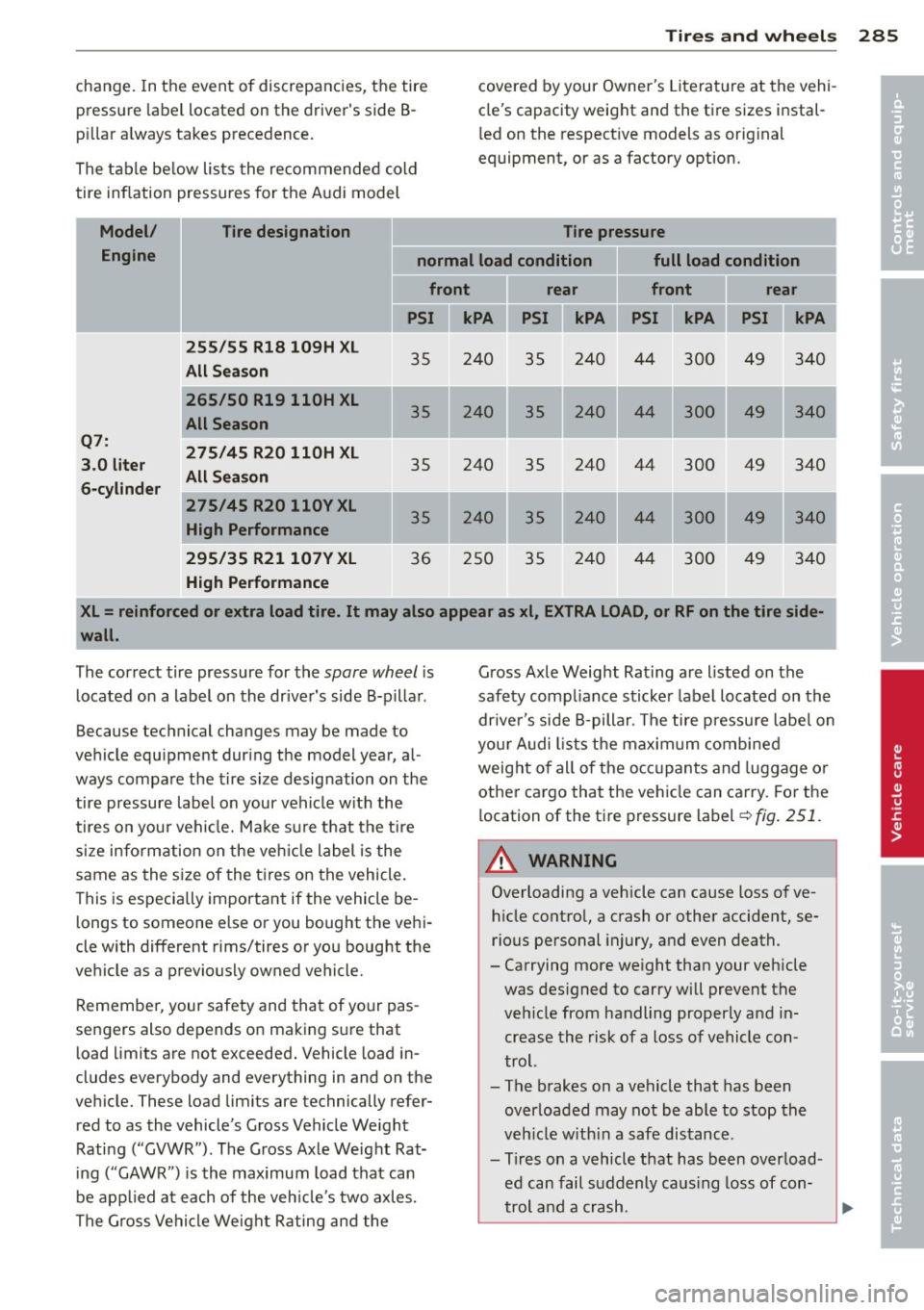
The table be low lists the recommended cold
tire inf lation pressures for the A udi model
I Model / Tire designation
covered by your Owner's Literature at the vehi
cle's capacity weight and the tire sizes instal
l ed on the respect ive models as orig inal
equipment, or as a factory option.
Tire pressure
Engine normal load condition full load condition
front rear front rear
I
PSI II kPA PSI kPA PSI j[ kPA PSI kPA
Q7:
3.0 liter
6-cy linder 2
55/5 5 Rl8 109H XL
All Sea son
265 /50 Rl9 ll0H XL
All Sea son
2 75/45 R20 ll0H XL
All S ea so n
275 /45 R20 110V XL
High Performance
295 /35 R21 10 7V XL
High Performance
35 240 35
35 240 35
35 240 35
35 240 35
36 250 35 240
44
300 49 340
240 44 300 49 340
240 44 300 49 340
•
240 44 300 49 340
I
240 44 300 49 340
XL= reinforced or extra load tire. It may als o appear as xl, EXTRA LOAD, or RF on the tire side
wall.
The correct tire pressure for the spare wheel i s
l ocated on a label on the driver's side 8-pilla r.
Because technical changes may be made to
vehicle equ ipment during the model year, al
ways compare the tire size designation on the
tire pressure label on your vehicle w ith the
tires on your vehicle. Ma ke sure that the tire
size information on the veh icle label is the
same as the s ize of the t ires on the vehicle.
This is especially important if the vehicle be l ongs to someone else or you bought the vehi
cle with different rims/tires or you bought the
vehicle as a previously owned vehicle.
Remember, your safety and that of your pas
sengers also depends on making sure that
l oad limits are not exceeded. Vehicle load in
cludes everybody and everything in and on the
vehicle. These load limits are technically refer red to as the vehicle's Gross Vehicle We ight
Rating ("GVWR") . The Gross Axle Weight Rat
i ng ("GAWR") is the maximum load that can
be appl ied at each of the veh icle's two axles.
The G ross Vehicle Weight Rating and the Gross Axle Weig
ht Rating are listed on the
safety compl iance sticker label located on the
drive r's side 8-pillar . The tire pressure labe l on
your A udi lists the maxim um combined
weight of all of the occ upants and luggage or
other cargo that t he vehicle can carry. Fo r the
location of the tire pressure label ¢
fig. 251.
A WARNING
Overloading a vehicle can cause loss of ve
h icle control, a crash or other accident, se
rious personal injury, and even death.
- Carrying more we ight than your veh icle
was des igned to carry will prevent the
veh icle from handling properly and in
crease the risk of a loss of vehicle con
trol.
- The brakes on a vehicle that has been overloaded may not be able to stop the
veh icle w ith in a safe distance.
- T ires on a vehicle that has been overload
ed can fail suddenly caus ing loss of con-
trol and a crash. ..,.
•
•
Page 290 of 348
288 Tires and wheels
Tires and vehicle load limits
There are limits to the amount of load or
weight that any veh icle and any t ire can carry.
A vehicle that is overloaded wi ll not handle
well and is more difficult to stop. Overload ing
can not on ly lead to loss of vehicle control
,
but can a lso damage important parts of the
vehicle and can lead to sudden tire failure in-
,
eluding a blowout and sudden deflation that
can cause the vehicle to crash .
Your safety and that of your passengers a lso
depends on making sure that load limits are
not exceeded. Vehicle load includes everybody
and everyth ing in and on the vehicle . These
load limits are tech nically referred to as the
vehicle's
Gross Vehicle Weight Rating
("GVWR").
The "GVWR" includes the we ight of the basic
vehicle, all factory installed accessories , a full
tank of fuel , oi l, coo lant and other fluids plus
maximum load. The maxim um load includes
the number of passengers that the vehicle is intended to carry ("seating capacity") with an
assumed weight of 150 lbs (68 kg) for each
passenger at a designated seating position
and the tota l weight of any l uggage in the ve
hicle. If you tow a trailer, the weight of the
trailer hitch and the tongue weight of the
loaded trailer must be included as part of the
veh icle load .
The
Gross Axle Weight Rating ("GAWR") is
the maximum load that can be applied at each
of the vehicle's two axles .
The Gross Vehicle Weight Rating and the
Gross Axle Weight Rating are listed on the
safety compliance st icker label located on the
driver's side B -pillar. Your Audi has 5 seating
positions, 2 in the front and 3 in the rear for
total seating capacity of 5. On vehicles w ith
six seats*, your veh icle has two front seats,
two seats in the second row seating and two
seats in the third row seating. On vehicles
with seven seats*, your vehicle has two front
seats, three seats in the second row seating
and two seats in the third row seating . Each seating
position has a seat belt
q page 175,
Safety belts .
The fact that there is an upper limit to your
vehicle's Gross Vehicle Weight Rating means
that the total weight of whatever is being car
ried in the vehicle (including the weight of a
trailer hitch and the tongue weight of the
loaded trailer) is lim ited. The more passen
gers in the vehicle or passengers who are
heavier than the standard we ights assumed
mean that less weight can be carr ied as lug
gage .
The tire pressure label on your Audi also lists
the maximum combined weight of all of the
occupants and luggage or other cargo that
the vehicle can carry . For the location of the
label
q page 284, fig. 251.
_& WARNING
Overloading a vehicle can cause loss of ve
h icl e control, a crash or other accident, se
rious personal injury, and even death.
- Carrying more weight than your vehicle
was designed to carry will prevent the
vehicle from handling properly and in
crease the risk of the loss of vehicle con
trol.
- The brakes on a vehicle that has been
overloaded may not be able to stop the
veh icle w ith in a safe distance.
- Tires on a vehicle that has been over load
ed can fail suddenly, including a blowout
and sudden deflation, causing loss of
control and a crash .
- Always make sure that the total load be
ing transported -including the weight of
a trailer hitch and the tongue we ight of a
loaded trailer -does not make the vehi
cle heavier than the vehicle's Gross Vehi
cle Weight Rating.
Determining correct load limit
Use the example below to cal
culate the total weight of the
passengers and luggage or
Page 296 of 348
29 4 T ire s and wheel s
-All four wheels must be fitted with radia l
t ires of the same type, size (roll ing c ir
cumference) and the same tread pattern.
Driv ing with different tires reduces veh i
cle handling and can lead to a loss of
control.
- If the spare tire is not the same as the
t ir es that are mounted on the veh icle -
for example with wi nter tires - on ly use
the spare tire for a short period of time
and dr ive with extra care. Refit the no r
ma l road whee l as soon as safely possi
ble.
- Never drive faster than the maxim um
speed for which the tires on your vehicle
are rated because tires that are drive n
faster than their rated speed can fail
sudden ly.
- Overloading ti res cause heat build- up,
sudden tire failure, including a blowout
and sudden deflation and loss of control.
- Temperature grades app ly to tires that
are properly inflated and not over or un
derinflated.
- For technical reasons it is not a lways
poss ible to use wheels from other
vehicles -in some cases not even wheels
from the same vehicle model.
- If you install wheel tr im discs on the ve
hicle whee ls, make sure that the air flow
to the brakes is not blocked . Reduced air
flow to the brakes can them to overheat,
increasing stopping d istances and caus
ing a collision.
- Run flat t ires may on ly be used on
vehicles that we re eq uipped w it h them
at the f acto ry. The vehicle must have a
chassis des igned for r un flat t ires . Incor
rect use of run flat tires can lead to vehi
cle damage or acc idents . Check with an
authorized Audi dealer or t ire specia list
to see if your vehicle can be equipped
with run flat t ires. If run flat tires are
used, they must be installed o n all four
wheels. Mix ing tire types is not permit
ted. (D Note
- For technical reasons, it is not generally
poss ible to use the wheel rims from oth
er veh icles. T his can hold tr ue for wheels
of the same vehicle type.
- If the spare tire is diffe rent from the
tires that you have mounted on your ve
hicle (for example winter tires or wide
profi le tires), then use the spare tire for a
short period of time only and drive w ith
extra care. Replace the flat tire w it h the
ti re mat ching the othe rs on your vehicle
as soon as possi ble.
- Never d rive without the valve stem cap.
T he v alves co uld get damaged.
@ For the sake of the environment
Dispose of o ld tires in accordance w ith the
l ocal requirements.
Uniform tire quality grading
- Tread wear
- Tra ction AA A B (
- Temperature ABC
Quality grades can be found where applicab le
on the tire s ide wall between tread shoulder
and maximum section width
c> page 291,
fig . 255 .
For example: Tread wear 200 , Traction AA ,
Temperature A .
All passenger car ti res must conform to Feder
al Safety Requirements in add ition to these
grades .
Tread wear
The tread wear g rade is a comparative rating
based on the wear rate of the tire when tested
u nder contro lled conditions o n a specified
government test course.
F o r example, a tire graded 150 wo uld wear
one and one ha lf (11/2) times as well on the
government course as a ti re graded 100.
Page 334 of 348
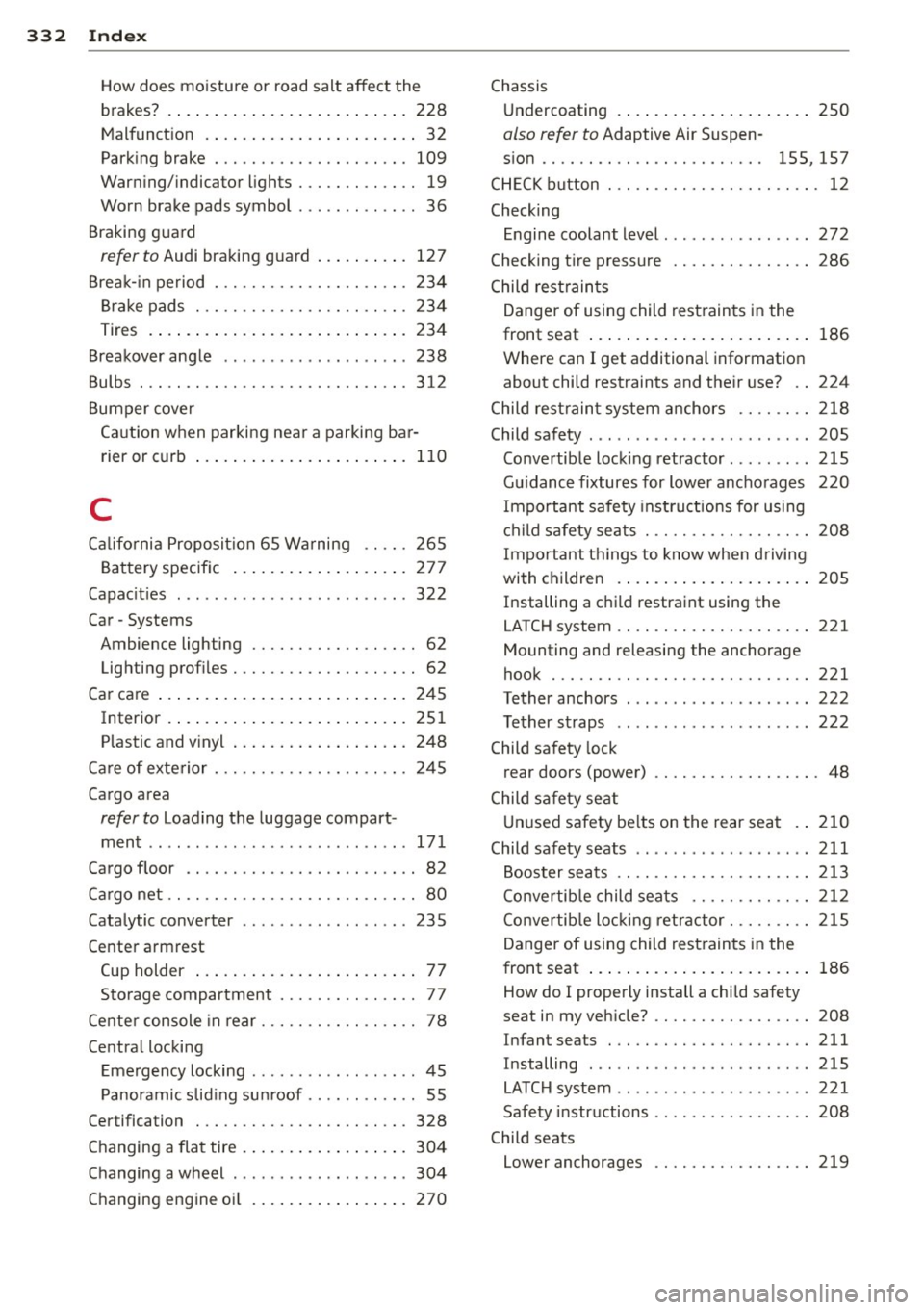
332 Index
How does moisture or road salt affect the
brakes? .................... ..... . 228
Malfunction .............. ... .... .. 32
Parking brake ............ .. .. .... . 109
Warning/indicator lights ... .. .. .... .. 19
Worn brake pads symbol ....... .. .... 36
Braking guard
refer to Audi braking guard .......... 127
Break-in period ............ .. .. .... . 234
Brake pads ............ .. .... .. .. . 234
Tires .... .. ................ ..... . 234
Breakover angle .. .. ........ ... .. .. . 238
Bulbs ... .. .. ..................... . 312
Bumper cover Caution when parking near a parking bar-rier or curb ............... ... .... . 110
C
California Proposition 65 Warning .. .. . 265
Battery specific .............. .... . 277
Capacities ... ... .... ...... .. .. .. .. . 322
Car -Systems
Ambience lighting . . . . . . . . . . . . . . . . . . 62
Lighting profiles ............ .. .... .. 62
Car care ..... ................ ..... . 245
Interior . . . . . . . . . . . . . . . . . . . . . . . . . . 251
Plastic and vinyl ................ .. . 248
Care of exterior ............ .. .. .. .. . 245
Cargo area
refer to Loading the luggage compart-
ment .. .. .. ... .... ...... .. .. .. .. . 171
Cargo floor .. ............. .. .. .. .. .. 82
Cargo net .... ... .......... .. .. .. .. .. 80
Catalytic converter ... ...... .. .. .. .. . 235
Center armrest Cup holder . . . . . . . . . . . . . . . . . . . . . . . . 77
Storage compartment . . . . . . . . . . . . . . . 77
Center console in rear ..... .. .. .. .. .. . . 78
Central locking Emergency locking .. ...... .. .. .. .. . . 45
Panoramic slid ing sunroof .. .. .. .. .. . . 55
Certification .............. .. .. .. .. . 328
Changing a flat tire .......... ... .... . 304
Changing a wheel .............. .. ... 304
Changing engine oil ......... .... ... . 270 Chassis
Undercoating
also refer to Adaptive Air Suspen- 250
sion . . . . . . . . . . . . . . . . . . . . . . . . 155, 157
CHECK button ..... ................. . 12
Checking Engine coolant level . ............ ... 272
Checking tire pressure ........... .... 286
Child restraints
Danger of using child restraints in the
front seat . . . . . . . . . . . . . . . . . . . . . . . . 186
Where can I get additional information
about child restraints and their use? .. 224
Child restraint system anchors .... .. .. 218
Child safety ..... .. .......... ... .. .. 205
Convertible locking retractor ... .. .. .. 215
Guidance fixtures for lower anchorages 220
Important safety instructions for using
child safety seats . ............. .. .. 208
Important things to know when driving
with children .... ................ . 205
Installing a child restraint using the
LATCH system .. .. ............. .. .. 221
Mounting and releasing the anchorage
hook . .... .... ................... 221
Tether anchors . .. .......... ... .. .. 222
Tether straps . ... ....... ...... .. .. 222
Child safety lock
rear doors (power) .. ........... .... . 48
Child safety seat Unused safety belts on the rear seat . . 210
Child safety seats .. ..... ..... ... .. .. 211
Booster seats ................. .... 213
Convertib le child seats ............. 212
Convertible locking retractor ......... 215
Danger of using child restraints in the
front seat ..... .. ................ . 186
How do I properly install a child safety
seat in my vehicle? ............... .. 208
Infant seats .................. .... 211
Installing ... .. .. ....... ...... .. .. 215
LATCH system .. .. ... ......... ... .. 221
Safety instructions ... .. ..... ... .. .. 208
Child seats Lower anchorages ............. .... 219