media AUDI Q7 2013 Owner´s Manual
[x] Cancel search | Manufacturer: AUDI, Model Year: 2013, Model line: Q7, Model: AUDI Q7 2013Pages: 348, PDF Size: 87.72 MB
Page 212 of 348
210 Child Safety
as possible before installing the child
restra int.
-A lways make sure that nothing pre
vents the front passenger's seat from being moved to the rearmost position
in its fore and aft adjustment range.
- Always make sure that the backrest is
in the upright position.
- Always buck le the child safety seat firmly
in place even if a child is not sitting in it.
A loose child safety seat can fly around
dur ing a sudden stop or in a coll is ion.
- Always read and heed all WARNINGS
whenever using a child restrained in ave
hicle is being used
c::> page 175, Safety
belts,
c::> page 184, Airbag system and
c::> page 205, Child Safety.
A WARNING
To reduce the risk of serious injury, make
sure that the
PASSENGER AIR BAG OFF
light comes on and stays on whenever a
child restraint is installed on the front pas
senger seat and the ignition is switched
on.
- Take the child restraint off the front pas
senger seat and install it properly at one
of the rear seat positions if the
PASSEN
GER AIR BAG OFF
light does not stay on.
- Have the airbag system inspected by
your authorized Audi dealer immediate
ly.
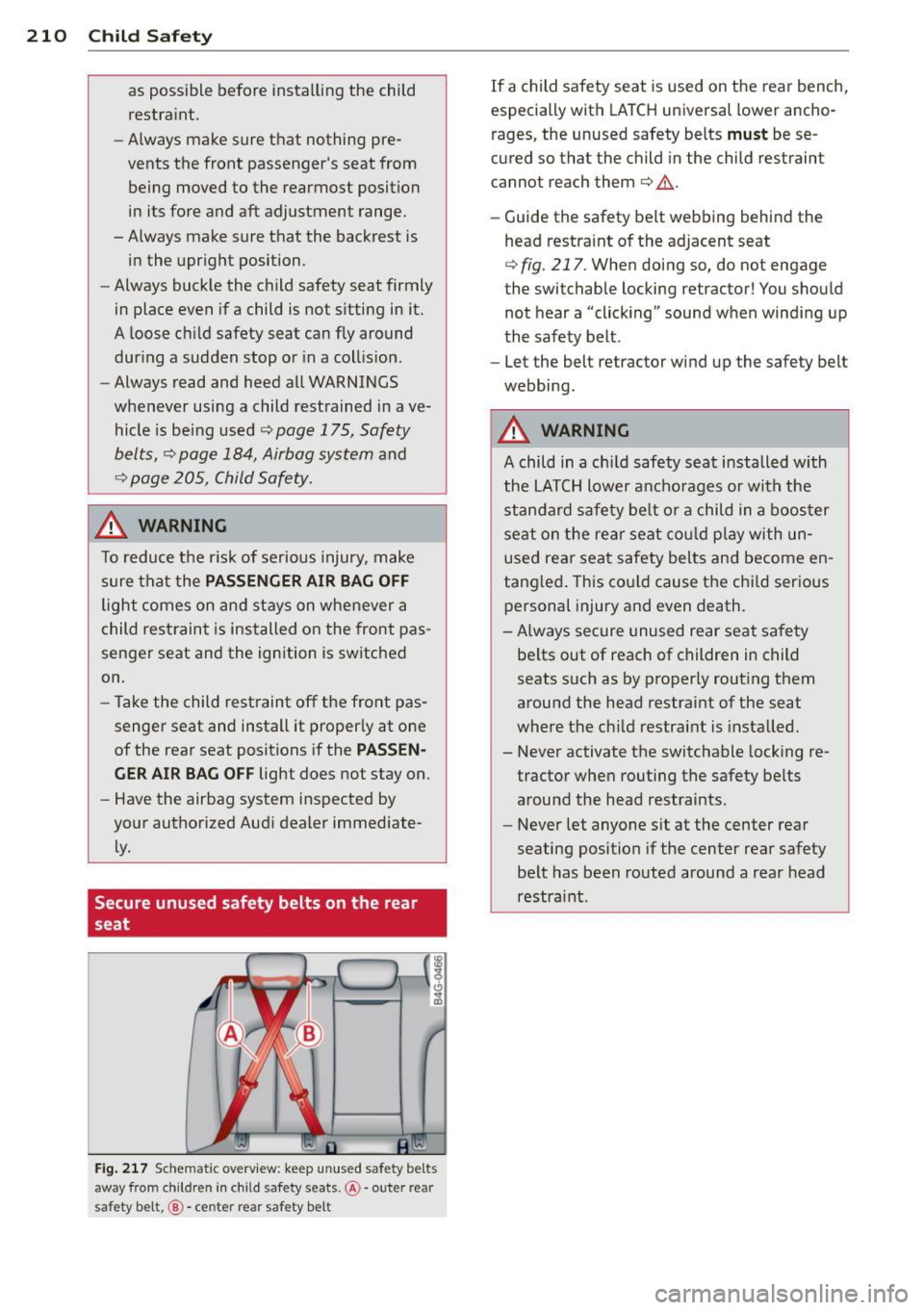
Secure unused safety belts on the rear
seat
Fig. 217 Schematic overview: keep unused safety belts
away from ch ildren in child sa fety seats. @· oute r rear
safety belt,@· center rear safety belt
If a child safety seat is used on the rear bench,
especially with LATCH universal lower ancho
rages, the unused safety belts
must be se
cured so that the child in the child restraint
cannot reach them
c::> & .
-Guide the safety belt webbing behind the
head restraint of the adjacent seat
c::>fig. 217. When doing so, do not engage
the switchable locking retractor! You should not hear a "clicking" sound when wind ing up
the safety belt.
- Let the belt retractor wind up the safety belt
webbing.
A WARNING ,-
A child in a chi ld safety seat installed with
the LATCH lower a nchorages or with the
standard safety belt or a child in a booster
seat on the rear seat could play with un
used rear seat safety belts and become en
tang led . This could cause the chi ld ser ious
personal injury and even death.
-Always secure unused rear seat sa fety
be lts out of reach of children in child
seats such as by properly routing them
around the head restraint of the seat
where the ch ild restraint is installed.
- Never activate the switchable locking re
tractor when routing the safety belts
around the head restraints.
- Never let anyone sit at the center rear
seating position if the center rear safety
be lt has been routed around a rear head
restraint.
Page 213 of 348
Child safety seats
Infant seats
Babies and infants up to about one year old
and 20 lbs. or 9 kg need special rearward -fac
ing child restraints that support the back,
neck and head in a crash.
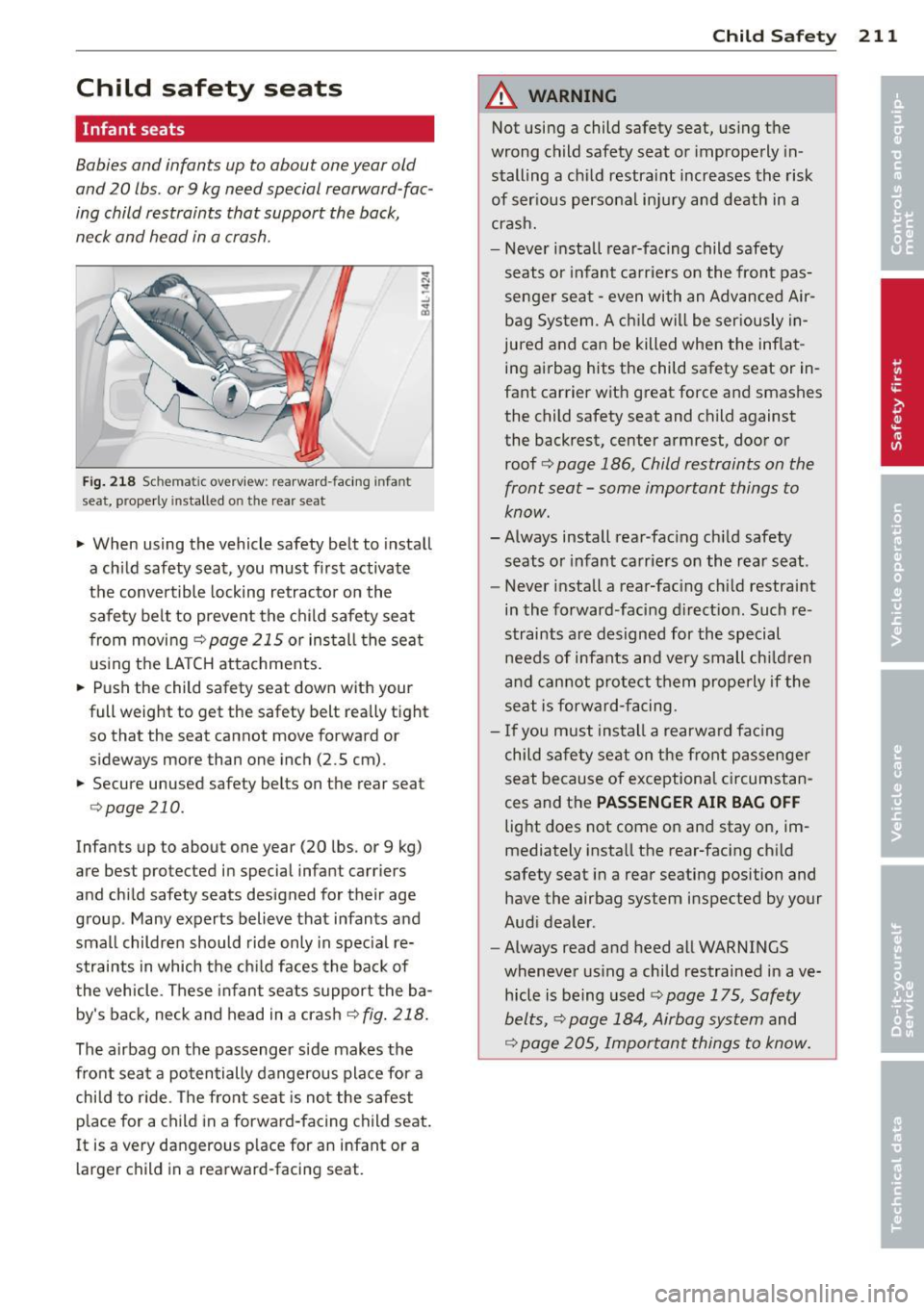
Fig . 218 Sche matic overv iew: rearward-fac ing infant
seat, properly installed o n the rear seat
.,. When using the vehicle safety belt to install
a ch ild safety seat, you must first activate
the convertible locking retracto r on the
safety be lt to prevent the child safety seat
from moving
¢ page 215 or install the seat
using the LA T CH attachments.
.,. Push the child safety seat down with your
full weight to get the safety belt rea lly tight
so that the seat cannot move forward or
sideways more than one inch (2.5 cm).
.,. Secure unused safety belts on the rear seat
¢page 210.
Infants up to about one year (20 lbs. or 9 kg)
are best protected in special infan t carriers
and child safety seats designed for their age
group . Many experts believe that infants and
small children should ride only in spec ial re
straints in which the ch ild faces the back of
the vehicle. These infant seats support the ba
by's back, neck and head in a crash
¢fig . 218.
The airbag on the passenger side makes the
front seat a po tentially dangerous place for a
child to r ide . The front seat is not the safest
p lace for a child in a forward -facing child seat.
It is a very dangerous p lace for an infant or a
l arger ch ild in a rearward-facing seat.
Child Safety 211
A WARNING
Not using a child safety seat, using t he
wrong child safety seat or improperly in
stall ing a ch ild restraint increases the risk
of ser ious personal injury and death in a
crash.
- Never install rear-facing child safety
seats or infant ca rr ie rs on the front pas
senger seat -even with an Advanced Air
bag Sys tem. A ch ild will be ser iously in
jured and ca n be killed when the inflat
ing airbag hits the child safety seat or in
fant carrier with great force and smashes the child safety seat and child against
the backrest, center armrest, door or
roof ¢
page 186, Child restraints on the
front seat- some important things to
know .
-Always install rear-fac ing ch ild safety
seats or infant carriers on the rear seat .
- Never install a rear-fac ing ch ild restraint
in the forward-fac ing d irect ion. Such re
straints are designed for the special needs of infants and very small ch ild ren
and cannot prote ct them properly if the
seat is forward- facing.
- If you mus t insta ll a rearward fac ing
child sa fety seat on the fro nt passenger
seat because of exceptiona l circumstan
ces and t he
PASSENGER AIR BAG OFF
light does not come on and stay on, im
mediately insta ll the rear -fac ing ch ild
safety seat in a rear seating position and
have the airbag system inspected by your
Aud i dea ler .
- Always read and heed all WARNINGS
wheneve r us ing a child restrained in ave
hicle is being used¢
page 175 , Safety
belts,
¢ page 184, Airbag system and
¢ page 205, Important things to know.
Page 214 of 348
212 Child Safety
Convertible child safety seats
Properly used convertible child safety seats
can help protect toddlers and children over
age one who weigh between
20 and 40 lbs. (9
and 18 kg) in a crash.
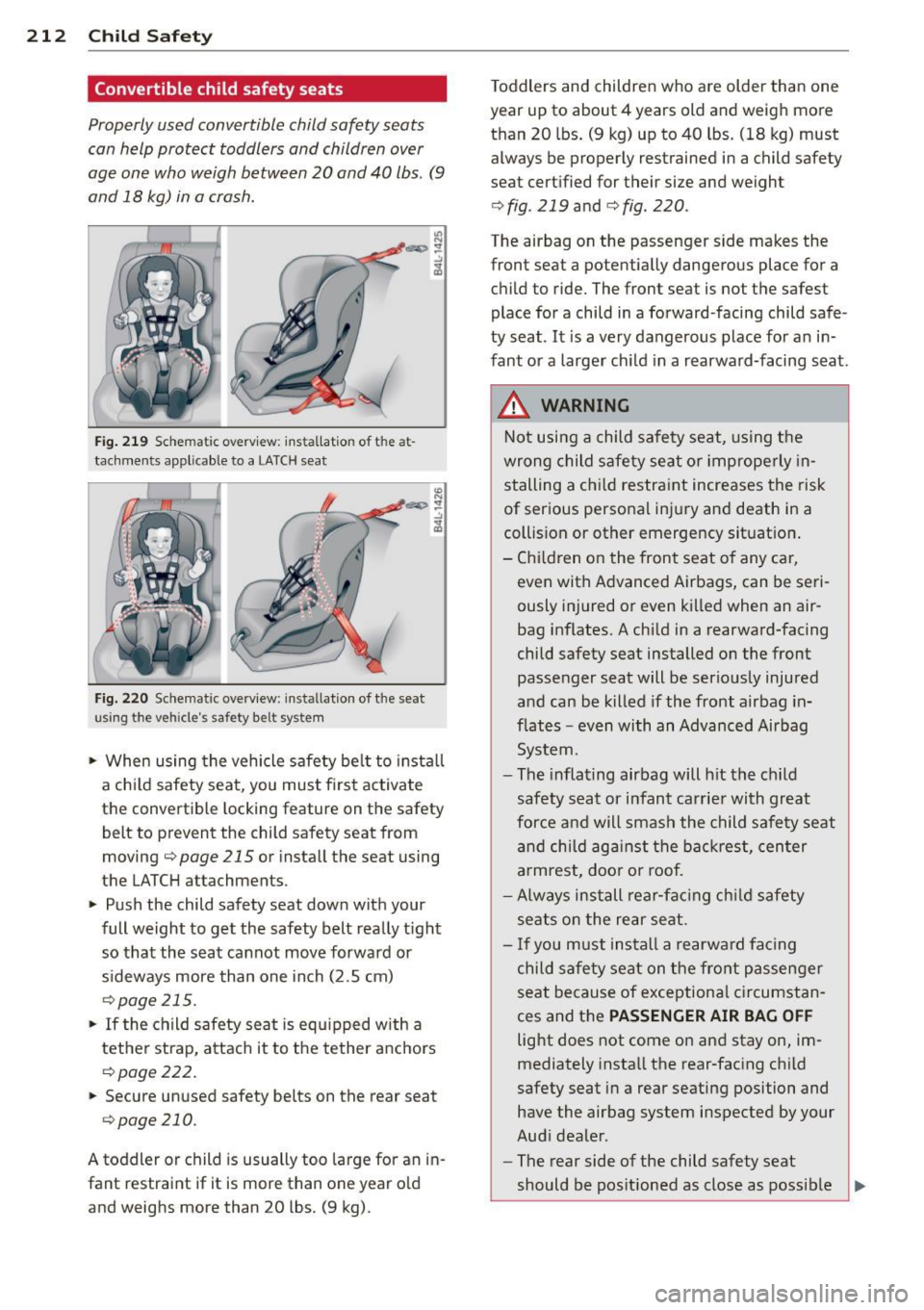
Fig. 219 Schematic overv iew : ins tallat ion of t he at
ta chments applicable to a LATCH seat
Fig. 220 Sche matic overview: insta llation of th e sea t
us ing t he veh icle's safety be lt system
.. When using the vehicle safety belt to install
a chi ld safety seat, you must f irst activate
the convertible locking feature on the safety
belt to prevent the child safety seat from
moving ¢
page 215 or install the seat using
the LATCH attachments .
.. Push the child safety seat down with your
full weight to get the safety belt really t ight
so that the seat cannot move forward or sideways more than one inch (2.5 cm)
¢page 215.
.. If the child safety seat is equ ipped with a
tether strap, attach it to the tether anchors
¢page 222.
.. Secure unused safety belts on the rear seat
¢page 210.
A toddler or child is usually too large for an in
fant restra int if it is more than one year o ld
and weighs more than 20 lbs. (9 kg). T
oddlers and children who are older than one
year up to about 4 years old and weigh more
than 20 lbs. (9 kg) up to 40 lbs. (18 kg) must
always be properly restrained in a child safety
seat certified for their size and weight
¢ fig . 219 and ¢ fig. 220 .
The airbag on the passenger side makes the
front seat a potentia lly dangerous place for a
child to ride. The front seat is not the safest
place for a child in a forward-facing child safe
ty seat . It is a very dangerous place for an in
fant or a larger child in a rearward-facing seat.
_&. WARNING
Not using a child safety seat, using the
wrong child safety seat or improp erly in
stalling a chi ld restraint increases the risk
of serious personal injury and death in a
collision or other emergency situation .
- Children on the front seat of any car,
-
even with Advanced Airbags, can be seri
ously injured or even killed when an air bag inflates . A chi ld in a rearward-facing
child safety seat installed on the front passenger seat will be serious ly injured
and can be killed if the front airbag in
f la tes -even with an Advanced Airbag
System .
- The inflating airbag will hit the child
safety seat or infant carrier with great
force and will smash the child safety seat
and child against the backrest, center
armrest, door or roof.
- Always install rear-facing child safety
seats on the rear seat .
- If you must install a rearward facing
child safety seat on the front passenger
seat because of exceptiona l circumstan
ces and the
PASSENGER AIR BAG OFF
light does not come on and stay on, im
mediately insta ll the rear-facing child
safety seat in a rear seating position and
have the airbag system inspected by your
Aud i dealer.
- The rear side of the child safety seat
should be pos itioned as close as possible ..,.
Page 216 of 348
214 Child Saf ety
• Secure unused safety be lts on the rear seat
9 page 210.
Ch ildren up to at least 8 years old (over 40
l bs. or 18 kg) are best protected in chi ld safe
ty seats designed for their age and weight. Ex perts say that the ske leta l structure, particu
larly the pelvis, of these chi ldren is not fully
developed, and they must not use the vehicle
safety belts w ithout a su itable child restraint .
It is us ually best to put these children in ap
propriate booster seats. Be sure the booster
seat meets all applicab le safety standards.
Booster seats raise the seating position of the
child and reposition both the lap and shoulder
parts of the safety belt so that they pass
across the child's body in the right places. The
routing of the belt over the child's body is very
important for the ch ild's protection, whether
or not a booster seat is used . Children age 12
and under must always ride in the rear seat.
Ch ildren who are at least 4
ft . 9 in. (57 in
ches/1.4S meters) tall can generally use the
vehicle's three po int lap and shoulder belts .
Neve r use the lap belt portion of the veh icle's
safety belt a lone to restrain any child, regard
l ess of how b ig the child is. Always remembe r
that c hildren do not have the pronounced pe l
vic structure required for the proper function
of lap belt portion of the vehicle's three point
lap and shoulder be lts. The child's safety ab
solutely requires that a lap be lt portion of the
safety belt be fastened snugly and as low as
possible around the pelvis . Never let the lap
be lt portion of the safety belt pass over the
chi ld's stomach or abdomen.
In a crash, airbags must inflate within a blink
of an eye and with cons iderable force . In order
to do its job, the airbag needs room to inflate
so that it will be there to protect the occupant
as the occupant moves forward into the air bag.
A vehicle occupant who is out of position and
too close to the airbag gets in the way of an
i n flat ing airb ag. When an occupant is too
close, he or she wi ll be struck violen tly and will
receive serious or possib ly even fatal in
jury .
In orde r fo r the ai rbag to offer protect ion, i t is
i mportant that a ll vehicle occupants, espe cial
ly any children, who m ust be in the front seat
because of exceptiona l circumstances , be
proper ly restrained and as far away from the
airbag as possible . By keeping room between
the child's body and the front of the passen
ger compartment, the airbag can inflate com
pletely and prov ide supplemental protection
in certain frontal collisions .
.&, WARNING
Not using a booste r seat, using the boos
ter seat improperly, inco rrectly installing a
booster seat or using the vehicle sa fety
belt improperly increases the risk of seri
ous persona l injury and death in a collision
or other emergency situat ion. To he lp re
duce the risk of serious personal injury
and/or death:
- The shou lder belt must lie as close to the
center of the ch ild's collar bone as possi
b le and must lie flat and snug on the up
per body . It must neve r lie across the
throat or neck. The lap belt must lie
across the pe lvis and neve r ac ross t he
stomach o r abdomen. Make sure the belt
liesflat andsnug.Pullon thebelt to
tighten if necessary.
- Failure to p roperly ro ute s afe ty belts
over a child's body wi ll ca use seve re inj u
ries in an accident o r other emergency
situation
¢ page 175 .
- The rear side o f the child sa fety seat
should be pos itioned as close as possib le
to the backrest on the vehicle seat. Ad
just or remove the rear seat head re straint if it is difficu lt to install the ch ild
seat with the head restraint in p lace
c::> page 77 . Install the head restraint
aga in immediately once the ch ild seat is
removed. D riving without head restraints
or w ith head restra ints that a re not prop
erly ad justed increases the risk of serious
.
or fatal neck in jury dramatically . ""
Page 226 of 348
224 Child Saf ety
Re leas ing th e te th er str ap
.. Loosen the tension following the child re
stra int manufacturer's instructions.
.. Depress the spring catch on the hook and
release it from the anchorage .
.. Fo r t he seco nd ro w of se ats: Push the floor
ing forward into place again.
.. For the th ird r ow of seats :* Replace the
plast ic cover cap .
(D Note
If you leave the child restraint with the
tether strap firmly installed for several
days, this could leave a mark on the up
holstery on the seat cushion and backrest
in the area whe re the tether strap was in
stalled. The uphols tery would a lso be per
manently stretched around the tether
strap . This applies especially to leather
seats .
Using tether straps on rearward-facing
child restraints
Currently , few rear -facing child restraint sys
tems come with a tether . P lease read and
heed the child restraint system manufactur
e r's instructions caref ully to determine how to
p roperly insta ll the tethe r.
& WARNING
A child in a rearward -facing child safety
seat insta lled on the front passenger seat
w ill be seriously injured and can be ki lled if
the front a irbag inflates - even with an Ad
vanced Airbag System.
- The inflating airbag will hit the child safety seat or infant carrier with great
force and w ill smash the ch ild safety seat
and child against the backrest, center
armrest, or door .
- A tight tether or other strap on a rear
ward-facing child restra int attached to
the front passenger seat can put too much pressure on the weight-mat in the
seat and register a heavier weigh t in the
Advanced Airbag System. The heav ier weight registered can make the system
work as though an adult were on the seat
and deploy the Advanced Airbag when it must be suppressed causing ser ious or
even fatal injury to the ch ild.
- If you must install a rearward fac ing
child safety seat on the front passenger
seat because of exceptional c ircumstan
ces and the
PASSENGER AIR BAG OFF
light does not come on and stay on, im
mediately insta ll the rear-fac ing ch ild
safety seat in a rear seating position and have the airbag system inspected by your
Audi dea ler.
Additional Information
Sources of information about child
restraints and their use
T here are a number of sou rces of add itiona l
information about child restraint se lection, in
sta llation and use:
N HT SA advises that the best chi ld safety seat
is the one that fits your ch ild and fits in you r
vehicle, and that yo u will use correct ly and
consistently.
T ry before yo u buy!
U. S Nat ional Highw ay Traffi c Safety Admin
i s trat ion
Tel.: 1-888-327-4 236 (TIY: 1-800-424-9153)
http://www.nhtsa.gov
N ati onal SAFE KID S Camp aign
Tel.: (202) 662-0600
http://www.safekids .o rg
S af ety Belt Saf e U. S.A
T el.: (800) 7 45 -SAFE (Eng Lish)
Tel.: (800) 747-SANO (Span ish)
http://www.ca rseat.org
T ranspo rt Ca nad a Info rmation Centre
Tel.: 1-800 -333-0371 or call
1-613-998-8616 if you are in the Ottawa area
http://www.tc.gc.ca/eng/ roadsafety/
menu.htm
Aud i Cu stom er R elation s
Tel.: (800) 822-2834
Page 233 of 348
@ Tips
- When the engine is running, never hold
the steer ing whee l turned a ll the way to
the right or t o the left f or longer than 15
seconds. The power steering pump w ill
overheat the hydraulic f lu id if you keep
hol ding the steer ing wheel turned all the
way. This is likely to damage the power
steering system.
- If the power steer ing system should fail
ent irely, or if the engine is not running
(fo r example, while being towed), you
will still be ab le to steer the vehicle.
However,
considerably more effort will
be required to do so.
- If the power s teer ing system should
have a leak, or is not functioning proper
l y, contact yo ur authorized Audi dealer
immediately.
- The power stee ring system requires a
spec ially formulated hydraulic fluid. The
power steering reservo ir is the one locat
ed farthest to the rear on the left side of
the engine compartment
c> page 266.
The co rrect flu id level in the reservoir is
i mportant for proper functioning of the
power steer ing .
Driving with your
quattro ®
With all-wheel drive, oil four wheels ore driv
en.
Gener al information
W ith all -whee l dr ive , power is distributed to
a ll fo ur wheels. This happens automatica lly
depending on yo ur driving sty le and the road
conditions at the time . See also
¢ page 227,
Electronic differential lock (EDL) .
Winter tires
When driving in the w inter, your ve hicl e w it h
all -wheel drive has an advan tage, even with
regu lar tires . In winter road conditions it may
be advisable to mount winter tires (or all -sea
son t ires) for improved driveability and brak-
Int ellig ent technolog y 231
ing: these tires must be mounted on all four
wheel s. See also ¢
page 295, Winter tires .
Tire chains
Where tire chains are mandatory o n certain
roads, this no rma lly also app lies to veh icles
with all-wheel drive¢
page 296, Snow
chains.
Replacing wheels /tires
Vehicles with all-wheel drive must always have ti res of t he same s ize. A lso avo id tires
with different t read depths. For det ails see
page
c!;> page 291, New tires and replacing
tires and wheels .
_& WARNING
A lways adj ust yo ur driv ing to road and traf
f ic conditions. Do not let the extra safety
afforded by all-wheel drive tempt you into
taking extra risks.
-Altho ugh the all-wheel drive is very ef
fective, always remember that braking
capacity is lim ited by tire traction. You
should therefore not drive at excessive
speeds on icy or slippe ry road surfaces .
- On wet road surfaces, be careful not to drive too fast because the front wheels
could begin to slide o n top of the water
(aquaplaning). If th is should occur, yo u
will have no warning from a s udden in
crease in engine speed as w ith a front
wheel drive vehicle. Always drive at
speeds which are suited to the road con
ditions -risk of crash.
Energy management
Starting ability is optimized
Energy management controls the distribution
of electrical energy and thus optimizes the
availability of electrical energy for starting the engine.
If a vehicle with a conventiona l energy system
is not driven for a long per iod of t ime, the bat
te ry is discharged by idling cur rent consume rs
(e.g. immobi liz e r). In certa in circumstan ces it ..,_
•
•
Page 242 of 348
240 Driving off road
If the vehicle threatens to tip over when
driving across a slope , you must immediate
ly steer downhill in the di rection of the
slope.
D o not par k your veh icle on steep slopes or
g rades .
T o reduce t he risk of tippi ng over, dr ive o n
slopes in the d irection o f the downwa rd slope
(fa ll line) -
not cros swise .
A WARNING
After drivin g through wate r, m ud, slush ,
etc ., the brakes may be slow to take effect
because of wet b rake roto rs and pads. Dry
the brakes f irst by braking carefully to re
store the full braking effect.
-
(D Note
Vehicle components s uch as the engine,
transmiss io n, suspension or elect rical sys
tem can be severely damaged by drivi ng
through wat er.
(1) Tips
- Check the depth of the wate r before dr iv
i ng th rough it.
- Do not stop the veh icle, dr ive in reverse
or switc h the engine off whe n driving
t hr ough water .
- Keep in mind that oncoming vehicles may create waves that raise t he water
l eve l and make it t oo deep fo r yo ur vehi
cle to dr ive th rough safely.
- Avoid dr iving thro ugh salt water because
i t can ca use corrosion.
Page 245 of 348
chains, make sure they will not drag on the
road when you are driving.
The cha ins shou ld cross under the trai le r
tongue to prevent it from dropping in case of
separation from the hitch.
(D Note
If you are going to tow a trailer, you must
activate the trailer operation mode
¢page 159, Towing a trailer.
Driving instructions
Driving with a trailer always requires extra
core and consideration.
To obtain the best poss ible handling of vehicle
and traile r, p lease note the following:
.,. Do not tow a loaded tra iler whe n your car it
self is not loaded.
.,. Be especially careful when passing other
vehicles .
.. Observe speed limits.
.. Do not d rive at the maximum permissible
speed.
.. Always apply brakes early.
.. Monitor the temperature gauge.
Weight distribution
Tow ing a loaded trai ler with an empty ca r re
sults in a high ly unstable distribution of
weight. If this cannot be avoided, drive at very
l ow speeds only to avoid the risk of losing
steering control.
A "balanced" rig is easier to operate and con
trol. This means that the tow vehicle should
be loaded to the extent possible and permiss i
ble, while keeping the trailer as light as possi
ble under the circumstances. Whenever possi
ble, transfer some cargo to the luggage com
partment of the tow vehicle wh ile observing
tongue load requirements and vehicle loading
considerations .
Speed
The higher the speed, the more difficult it be
comes for the driver to control the rig . Do not
drive at the maximum permissible speed. Re-
Trailer towing 243
duce your speed even more if load, weather or
wind conditions are unfavorable - particularly
when going downhill.
Red uce veh icle speed
immediately if the trail
er shows the slightest sign of sway ing.
Do not
try to stop the swaying by accelerating.
Observe speed limits. In some areas, speeds
f or vehicles towing trailers are lower than for
regular vehicles.
Always apply brakes early. When driving
downh ill, shift into a lowe r gear to use the en
gine braking effect to slow the vehicle. Use of
the brakes alone can cause them to overheat
and fail.
Coolant temperature
The coolant temperature gauge¢ page 10
must be observed carefully. If the need le
moves close to the upper end of the scale, re
duce speed immediately and/or turn off the
air conditioner.
If the coolant temperature warning light in
the instrument cluster starts flashing ., pull
off the road, stop and let the engine
idle for
about two minutes to prevent heat build -up .
A WARNING
Anyone not properly restrained in a mov
ing vehicle is at a much greater risk in an
accident. Never let anyone ride in your car
who is not properly wearing the restraints
prov ided by Audi .
Trailer towing tips
Important to know
-
Your vehicle handles differently when towing
a trai ler because of the additional weight and
different weight distr ibution. Safety, perform
ance and economy will great ly depend on how
carefully you load your trailer and operate
your rig.
Before you actua lly tow your tra iler, practice
turning, stopping and backing up in an area
away from traffic. Keep practicing until you
•
•
Page 251 of 348
Chrome care products and alkaline cleaners
will attack aluminum surfaces and can dam
age them over time.
A WARNING
Always read and heed all WARNINGS and other information ¢
page 245.
Touch-up paint
Minor paint damages should be touched up
immediately.
.. Use either a touch-up paint st ick or spray
paint to cover minor scratches and nicks.
Your authorized Audi dealer has touch-up paint for minor sc ratches and stone chips.
Scratches should be touched up soon after
they occur to prevent corrosion .
I f a spot starts to rust, however , a simple
touch -up job wi ll not be enough . The affected
surface must be sanded smooth and coated
with an anti-r ust primer before the painted
finish can be restored.
The number for the origina l vehicle paint can
be found on the vehicle identification labe l
¢page 320.
A WARNING
Always read and heed a ll WARNINGS and
other information ¢
page 245.
Windows
Clear vision to all sides .
Clea n all windows reg ularly to remove road
fi lm and carwash wax bui ldup.
.,. Remove snow from windows using a brush.
.. Use a plast ic ice scraper to remove ice from
windows and mirro rs.
.. Remove other residue on the windows with
a spray-on glass cleaner.
.. Wipe th e windows dry with a clean piece of
cloth or kitchen paper towel.
Cleaning and protec tion 249
The best way to remove snow from windows
and mirrors is to use a brush . Use a non-abra
s ive
pl astic ice scrape r -better sti ll, a spray
deicer -to remove
ice from w indows and mir
rors.
The windows must not be cleaned with insect remover or wax since these can interfere w ith
the function of the windshie ld w iper blades
(chatter) .
Oil, grease, or s ilicone residue can be removed
with
gla ss cle ane r or s ilicone remo ve r. How
ever, wax re sidue requires the use of a spec ial
ly formulated solvent. Please contact your au
thorized Audi dea ler for advice on safe prod
ucts for wax removal.
Windows should also be cleaned on the inside
at regu lar in tervals .
Never dry windows w ith the same chamois
that you use to dry painted surfaces. Wax resi due on the chamois can impair v is ion through
the windows .
A WARNING
-Always read and heed all WARNINGS a nd
other information ¢
page 245.
-The windsh ield must not be treated w ith
water -repellent materials . They can in
crease glare unde r poor v is ibility condi
tions such as wetness, da rkness, or when
the sun is low on the hor izon. In addi
tion, they can ca use the w indshield w ip
ers to chatter.
(D Note
- Never use warm o r hot wate r to remove
s now and ice from windows and mirro rs.
T his could cause the glass to crack .
- To prevent damage to t he w ires of the
rear defogger, do not place any adhesive
st ic kers on the ins ide of the rear w indow
over the wires.
- To help prevent d irt from scra tching the
w indow, always scrape in a forward di
rection -pushing the sc ra per away from
you -never back and forth .
•
•
Page 260 of 348
258 Fuel supply and filling your fuel tank
Winter operation
At temperatures below 20° F (-7° C), Diesel
fuel No.
2 loses its fluidity due to wax separa
tion, which may clog the fuel filter or tank fil
ter and keep the engine from running .
To help the filter from being clogged by wax,
the fue l filter in your vehicle is automatically
preheated. Preheating the fuel filter makes
operation of your vehicle possible with Diesel
fuel No. 2 down to -10° F (-24° C).
If you expect temperatures below
5° F
(-15° C)
ask your fuel dealer whether their
Diese l fuel No.
2 is sufficiently winterized for
the prevailing and expected temperatures.
If not winterized or insufficiently winterized
Diesel fuel has already thickened to the extent
that the engine will not start, warm the vehi
cle up by leaving it in a heated garage.
It is normal that the engine noise leve l (die
seling) is louder during the warm-up period in
winter. It is also norma l when whitish-blue
smoke comes out of the tailpipe after starting
and during warm-up . The amount of smoke
depends on the outs ide temperature.
Do not let your Diese l engine idle unnecessari
ly after a cold start. Driving off slowly will
shorten the warm-up period.
A WARNING
- Never use "starting assist fluids." They
may be potent ially explosive or cause a
"run-away" engine condition. This could
result in ser ious engine damage and per
sonal injur y.
- Never use fuel line anti-freeze offered for
gasoline engines.
(D Note
- Your Diesel engine has been specifically designed to operate only on Ultra Low
Sulfur Diesel fuel. Therefore, never use
home heating oil or regular gasoline. The
properties of these fuels may cause seri
ous damage to the fuel injection system
and to the engine. Using these fuels can
-
cause expensive engine repairs and will
also adversely affect your New Vehicle
Limited Warranty.
- If Diesel fuel sho uld get on any rubber
hose, it must be wiped off immediately.
Then wash the contaminated hose por
tion with soap and warm water. Do not allow D iesel fuel to remain on connect
ing hoses . They may develop leaks and
cause serious damage.
Fuel tank
Fuel filler neck
The fuel filler neck is located on the right rear
side panel behind the fuel filler flap.
If the power locking system shou ld fail, you
can still open the flap manua lly -for detailed
instructions see ¢
page 261.
You can find the fuel tank capacity of your ve
hicle in
Technical Data ¢page 322 .
The label on the inside of the fuel filler flap
te lls you the correct fuel for your vehicle. For
more information about fuel specifications,
see ¢
page 256.
Your vehicle fuel tank has an on-board refuel
ling vapo r recovery system. This feature helps
to prevent fue l vapors from escaping from the
tank and polluting the environment while you refuel your vehicle. In order to fi ll the tank
proper ly while protecting the environment,
please fo llow this refueling procedure careful
ly.
A WARNING
-Under normal operating conditions, never
carry addit ional fuel conta iners in your car .
Gas canisters and other conta iners used to
transport fuel can be dangerous. Such con
tainers, full or empty, may leak and could
cause a fire in a collision.
If you must
transport fuel to use for your lawn mower,
snow blower, etc., be very careful and al
ways observe loca l and state laws regard
ing the use, transportation and storage of
such fuel containers. Make certain the ..,.