light AUDI Q7 2013 Owner´s Manual
[x] Cancel search | Manufacturer: AUDI, Model Year: 2013, Model line: Q7, Model: AUDI Q7 2013Pages: 348, PDF Size: 87.72 MB
Page 163 of 348
Homelink®
Universal remote
control
General information
Appl ies to vehicles: with Horne Link® universal rem ote
control
The Homelink ® feature can learn up to three
radio frequency codes for most current trans
mitters used for operating garage doors, es
tate gates, home or outdoor lighting sys·
tems, and other devices.
You must first program the Homelink ® trans·
mitter before you can use the system
¢ page 162, Programming the HomeLink®
transmitter.
In order to program the Homelink® transmit·
ter for devices utilizing rolling code , a second
person on a ladder who can safe ly reach the
garage door opener motor is recommended.
It is also necessary to locate the "learn" but
ton on your garage door opener motor . Refer
to the operat ing instruct ions for the opener,
as the location and color of this button may
vary by manufacturer.
You can still use the origina l remote control
for the device at any time.
A WARNING
-
- Never use the Homelink® transmitter
with any garage door opener that does
have not the safety stop and reverse fea
ture as requ ired by federal safety stand
ards . Th is includes any garage door open·
er model manufactured before April 1,
1982.
- A garage door opener which cannot de·
tect an object, signaling the door to stop
and reverse does not meet current feder
al safety standards. Using a garage door
opener without these features increases
risk of serious injury or death.
- For safety reasons never release the
parking brake or start the engine while
anyone is stand ing in front of the vehicle .
Homelink® 161
-A garage door or an estate gate may
sometimes be set in motion when the
Homelink ® remote control is being pro·
grammed . If the device is repeatedly ac·
tivated, th is can overstrain motor and
damage its electrical components -an
overheated motor is a fire hazard!
- To avoid possible injuries or property
damage, please always make abso lutely
certain that no persons or objects are lo·
cated in the range of motion of any
equ ipment being ope rated.
(D Tips
- If you would like more information on
Homelink ®, where to purchase the
Homel ink ® compatible products, or
would like to purchase the Homelink ®
Home Lighting Package, please call toll
free: 1-800-355-3515 .
- For Declaration of Compliance to United
States FCC and Industry Canada regu la
tions ¢
page 328 .
Page 164 of 348
162 Homelink®
Programming the Homelink ®
transmitter
Applies to vehicles: with Homelink® unive rsal remote
control
The transmitter is programmed in two phas
es. For rolling code transmitters, a third
phase is also necessary .
-
Fig. 192 Overhead co nsole ; Homelink ® keypad
Fig. 193 Front bumper, d rive r side: loca tion of trans ·
m itterun it
Pha se 1:
programming the o verhead k eypad
1. Make sure your vehicle is w ithin operat ing
range of the remote controlled garage
door ope ner .
2 . Set the parking brake~,&.
in General in
formation on page 161.
3 . Turn the ignition on. Do not start the en
g ine!
4 . Press and hold the two outside Home
Link ® buttons
CD and @for approxi
mately 20 seconds until indicator light ®
c::> fig. 192 begins to flash. Then release
both buttons . Do not hold the buttons for
l onger than 30 seconds .
.,. This procedure only needs to be performed
on ce . It erases the factory-set defau lt codes
and does not have to be repeated to pro
gram addit ional remote contro ls. 5
. Press and ho ld the Homelink ® button
(D ,
@ or @ until the indicator light®
starts flashing
slowly . Release the b utton.
.,. The system will remain in programming
mode for 5 minutes. Co to the front of the
vehicle and proceed with phase 2 .
Phase 2:
programming the bum per mounted trans
mitte r
6. Hold the original remote control at a dis
tance between
0 -6 in. (0 -15 cm) from the
bumper below the appropr iate headlight
f or yo ur vehicle
~ fig. 193 (u se the short
est distance possible) .
7 . Aim the remote control just below the
dri ver s ide headlight.
8. Press and hold the act ivat ion button on
the remote control.
.,. May be different in Canada . If so, press and
re-press (cycle) the activation button on your
remote cont ro l every two seconds .
9. The emerge ncy flashers will flash
thre e
tim es
(after about 15-60 seconds) when
t h e programming is successful. Re lease
the b utton o n the remote control.
.,. To program more devices, repeat steps 4 to
9.
10. Press and hold the trained Homelink ®
button and observe the indicator light ®
¢fig . 192 .
.,. If the ind icator light is solid/co nti nuous,
programm ing is comp lete and your device
should a ctivate w hen you press and release
t he t rained Homelink ® button.
.,. If the ind icator light blinks rapidly fo r 2 sec
onds and is then a solid/continuous light,
proceed w ith phase 3 to program a rolling
code device.
Phase 3 : rolling code programming
.,. A second person on a ladder who ca n safe ly
reach the garage door opener motor is rec
ommended .
11. Locate the "learn" button on the garage
door opener motor (refer to the operating instructions for the opener, as the loca
t ion of t his button may vary by manufac-
turer) .
~
Page 165 of 348
12. Press and release the learn button on the
garage door opener motor.
.. Note : once the button is pressed, there are
30 seconds in which to initiate the next
step .
13. On the Homel ink® keypad inside the vehi
cle, firmly press and hold the Homelink ®
button previously programmed in phases
1 and 2 for two seconds and release. Re
peat this sequence
twice .
.. Some vehicles may requ ire the press/hold/
release sequence up to three times to com
plete the training process .
.. Homelink ® should now activate your rolling
code equipped device.
If the 5 minute time limit is exceeded, the
emergency flashers will flash one time to in
d icate that the process has been terminated.
In this case, repeat steps 4 through 9 .
If the emergency flashers do not flash
three
times (after about 15-60 seconds), program
ming was not successful. In this case, repeat
steps 4 through 9.
Remote control units for garage door openers
in Canada are set to stop transmitting radio
frequency s ignals after two seconds. This time
may not be sufficient for the Homelink ® sys
tem to learn the radio frequency s ignal. Per
form all other steps as described above .
Operating the Homelink ® transmitter
Applies to vehicles: with Home link® universa l remote
control
The Homelink ® transmitter works in the
some manner as the original hondheld re
mote control that come with the system.
mm
-
Fi g. 194 Overhead co nsole: Home link ® keypad
Homelink ® 163
.. Press the appropriate programmed button
Q), @) or @ to activate the desired remote
contro l function
~ A in General informa
tion on page 161 .
Reprogramming a single button
Applies to vehicles: with Homelink® universal remote
control
A HomeLink ® button can be reprogrammed
individually without affecting the other but
ton allocations.
Programming the overhead keypad
.. Press the appropr iate Homelink ® button
until the ind icator light begins flashing
slowly .
Programming the bumper mounted trans
mitter
1. Hold the original remote control at a dis
t anc e between
0-6 in. (0 -15 cm) from the
bumper below the appropriate headlight
for your vehicle (use the shortest distance
possible).
2. Aim the remote control just below the
driver side headlight.
3. Press and hold the act ivation button on
the remote control.
4. The emergency flashers will flash
three
times
(after about 15 -60 seconds) when
the programming is successful. Now re
lease the button on the remote control.
.. If the device utilizes a rolling code, please
follow phase 3 of¢
page 162, Program
ming the Homelink ® transmitter
for rolling
code programming.
This procedure will cause the existing pro
gramming on the Homelink ® button to be
erased!
Page 167 of 348
Driving Safely
General notes
Safe driving habits
Please remember -safety first!
This chapter contains important information,
tips, instructions and warnings that you need
to read and observe for your own safety, the
safety of your passengers and others . We have
summarized here what you need to know
about safety belts, airbags, ch ild restra ints as
well as child safety. You r safety is for us
priori
ty number 1.
Always observe t he information
a nd warn ings in th is se ct ion - for yo ur own
safety as well as that of your passengers .
The information in this se ction applies to all
model ve rsion s of your veh icle . Some of the
feat ures descr ibed in th is sec tions may be
standa rd equipment on some models, or may
be optional equipment on others . If you are
not sure, ask yo ur authorized Aud i dea ler.
A WARNING
- Always make sure that you follow the in
st ruct ions and heed the WARNINGS i n
this manual. It is in your interest and in
the inte rest of you r passengers.
- Always keep all of the Owner's Literature
man uals in your Audi when you lend o r
sell your vehicle so that this im po rtant
information will a lways be availab le to
the driver and passengers.
- Always keep the Owner's Literature han
dy so that you can find it easily if yo u
have ques tion s.
Safety equipment
The safety features are part of the occupant
restraint syst em and work togeth er to help
redu ce the risk of injury in a wide variety of
accident situations .
Your safety and the safety of your passenge rs
should not be left to chance. Advances in
t echnology have made a var iety o f fea tures
avai lable to he lp red uce the risk of i njury in an
Dr iving Safel y 165
accident . The following is a list of just a few of
the safety features in yo ur Audi :
- sophis ticated s afety be lts fo r drive r and a ll
passenger sea ting posit ions,
- be lt tens ione rs fo r the fro nt seats and the
outer sea ting pos it ions in the second row
seating,
- be lt h eight adjustment fo r th e front seats
a nd the o ute r seat ing positions in the sec
ond row sea ting,
- he ad restra ints for e ach sea ting pos it ion,
- front airbags,
- side airbags in the fro nt seats a nd the outer
seating posit ions i n the second row seat
ing*,
- side curta in airbags,
- special LATCH anchorages for child re-
straints,
- adjustab le steeri ng column.
T hese individual safety features, can work to
gether as a system to he lp protect you and
your passengers in a wide range of accide nts.
These features cannot work as a system if
they are not always correctly adjusted and cor
rect ly used .
Safety is everybody's responsibil ity!
Important things to do before driving
Safety is everybody 's job! Vehicle and occu
pant safety always depends on the informed
and careful driver.
Fo r yo ur safety and the safety of your passen
gers,
before driving always:
.. Make s ure that all lights and signals are op
erating correctly .
.. Ma ke s ure that the tire pressu re is co rrect .
.. Make s ure that all windows are clean and
afford good v is ibility to the o utside.
.. Secure a ll luggage a nd other items carefu lly
¢ page 87.
.. Make s ure th at noth ing can inte rfe re with
the peda ls.
.. Adjust fron t seat, head re straint and mi r
rors co rrec tly for you r heigh t.
•
•
Page 168 of 348
166 Driving Safel y
• Instruct passengers to adjust the head re
straints according to their height.
• Make sure to use the right child restra int
correct ly to protect children<=>
page 205,
Child Safe ty .
• Sit properly in your seat and make sure that
you r passenge rs do the same<=>
page 71 ,
General recomm endations .
• Fasten your safety bel t an d wear it properly.
Also ins truc t you r passengers to f aste n t heir
sa fety belts properly
<=> page 175.
What impairs driving safety?
Safe driving i s directly rela ted to the condi
t ion of the vehicle , the driver as well as the
driver 's abili ty to concentrate on the road
without being distracted .
The driver is responsib le fo r the s afety of the
ve hicl e an d all of i ts occupants . If you r ability
to d rive is impai red, safety r is k s for everybody
i n the vehicle increase and yo u also become a
hazard to everyone else on the road <=>
&_.
Therefore:
• Do no t let yo urself be dist racted by passen
gers or by using a cellular telephone.
• NEV ER drive when yo ur dr iv ing ability is im
paired (by medicat ions, alcohol , drugs, etc.).
• Observe all traffic laws , rules of the road
and speed limits and plain common sense .
• ALWAYS adjust you r speed to road , traff ic
and weathe r con dit ions .
• Take frequent b reaks on long t rips. Do not
dr ive for more than two hours a t a str etch .
• Do NOT drive whe n you are t ired , under
pressure or when you are stressed .
A WARNING
Impaired driving safety increases the risk
of serious personal injury and death when
ever a veh icle is being used.
Proper occupant
seating positions
Proper seating position for the driver
The proper driver seating position is impor
t ant for safe, relaxed driving.
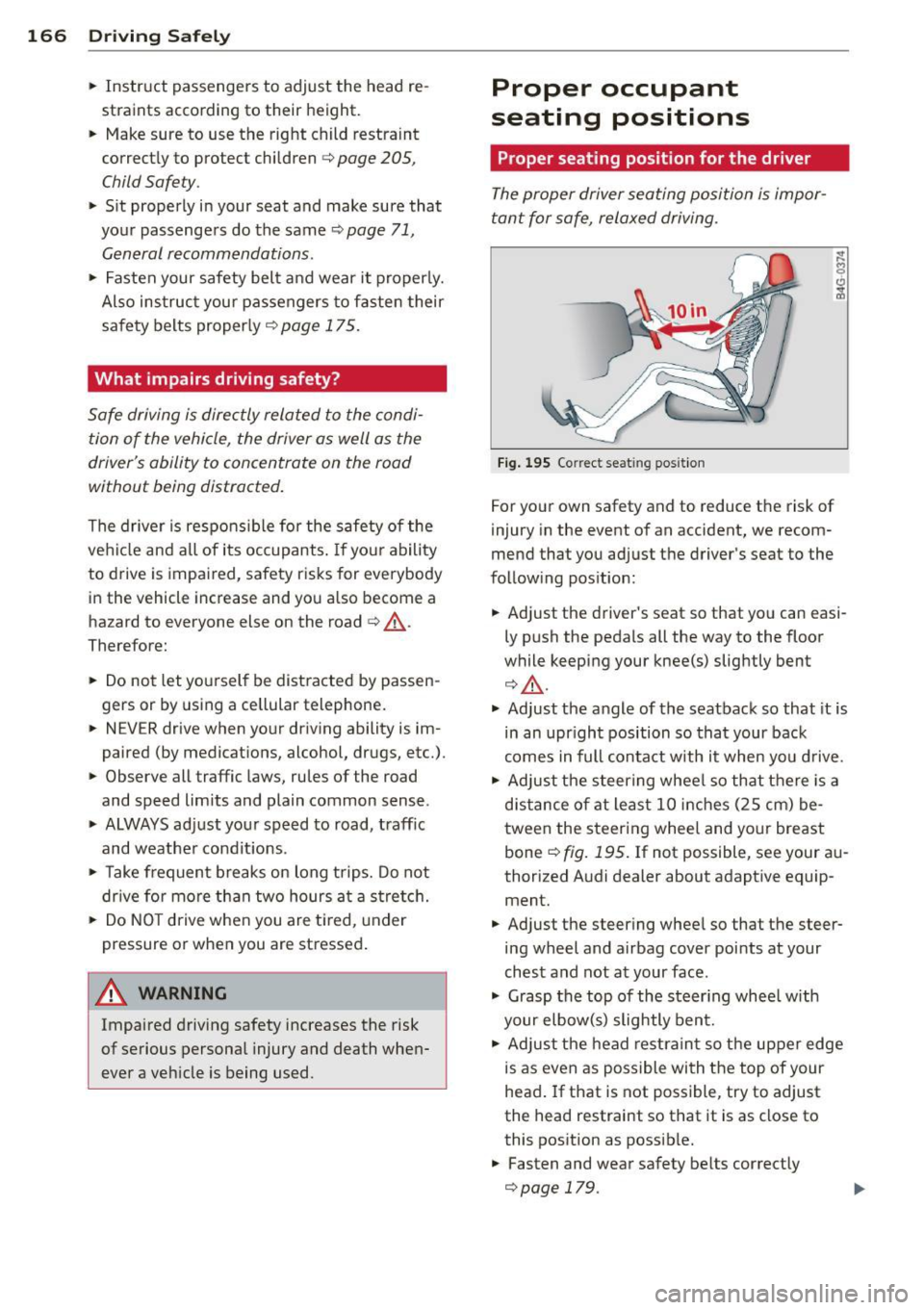
Fi g. 1 95 Correc t seat ing posit ion
For yo ur own safety and to reduce the risk of
injury in the event of an accident, we recom
mend that you adjust t he driver's seat to the
fo llow ing pos ition:
• Ad just the driver's seat so that you can easi
ly push the pedals all the way to the floor
while keepi ng your knee(s) slightly bent
¢ &_ .
• Adjust the a ngle of the seatback so that it is
in an upr ight position so that your back
comes in full conta ct w ith it when you d rive.
• Adjust t he steer ing whee l so that there is a
d is tance of at least 1 0 inches (2 5 cm) be
t ween the steer ing whee l and yo ur breast
bone ~
fig. 195. If not possible, see your a u
thorized A udi dealer about adaptive equip
ment.
• Adjust the steer ing whee l so that t he steer
ing wheel and airbag cover poi nts at your
ch est and not at your face .
• Grasp the top of the s teer ing wh ee l with
your elb ow(s) slightly ben t.
• Adjust t he head rest rain t so th e up per edge
is as even as possible wi th th e top of y our
head . If that is not poss ible, try to adjust
the head restraint so that it is as close to
this pos ition as possib le .
.,. Fasten and wear safety belts correctly
<=>page 179.
Page 177 of 348
Safety belts
General notes
Always wear safety belts!
Wearing safety belts correctly saves lives!
This chapter explains why safety belts are nec
essary, how they work and how to adjust and
wear them correctly.
... Read all the information that follows and
heed all of the instructions and WARNINGS.
A WARNING
Not wearing safety belts or wearing them
improperly increases the risk of serious
personal injury and death .
- Safety belts are the single most effective
means available to reduce the risk of se
rious injury and death in automobile acci
dents . For your protection and that of
your passengers, always correctly wear
safety belts when the vehicle is moving.
- Pregnant women, injured, or physically
impaired persons must also use safety
belts. Like all vehicle occupants, they are
more like ly to be seriously injured if they
do not wear safety be lts . The best way to
protect a fetus is to protect the mother -
throughout the entire pregnancy.
Number of seats
Vehicles with five seats: Your vehicle has two
front seats and three rear seats. Each seating
position has a safety belt.
Vehicles with six seats:* Your vehicle has two
front seats, two seats in the second row and two seats in the third row. Each seating posi
tion has a safety belt .
Vehicles with seven seats:* Your vehicles has
two front seats, three seats in the second row and two seats in the third row. Each seating
position has a safety belt.
Safety belts 175
A WARNING
Not wearing safety belts or wearing them
improperly increases the risk of serious
personal injury and death.
- Never strap more than one person, in
cluding small children, into any belt. It is
especially dangerous to place a safety
be lt over a child sitting on your lap.
- Never let more people ride in the vehicle
than there are safety belts available .
- Be sure everyone riding in the vehicle is
properly restrained with a separate safe
ty belt or child restraint.
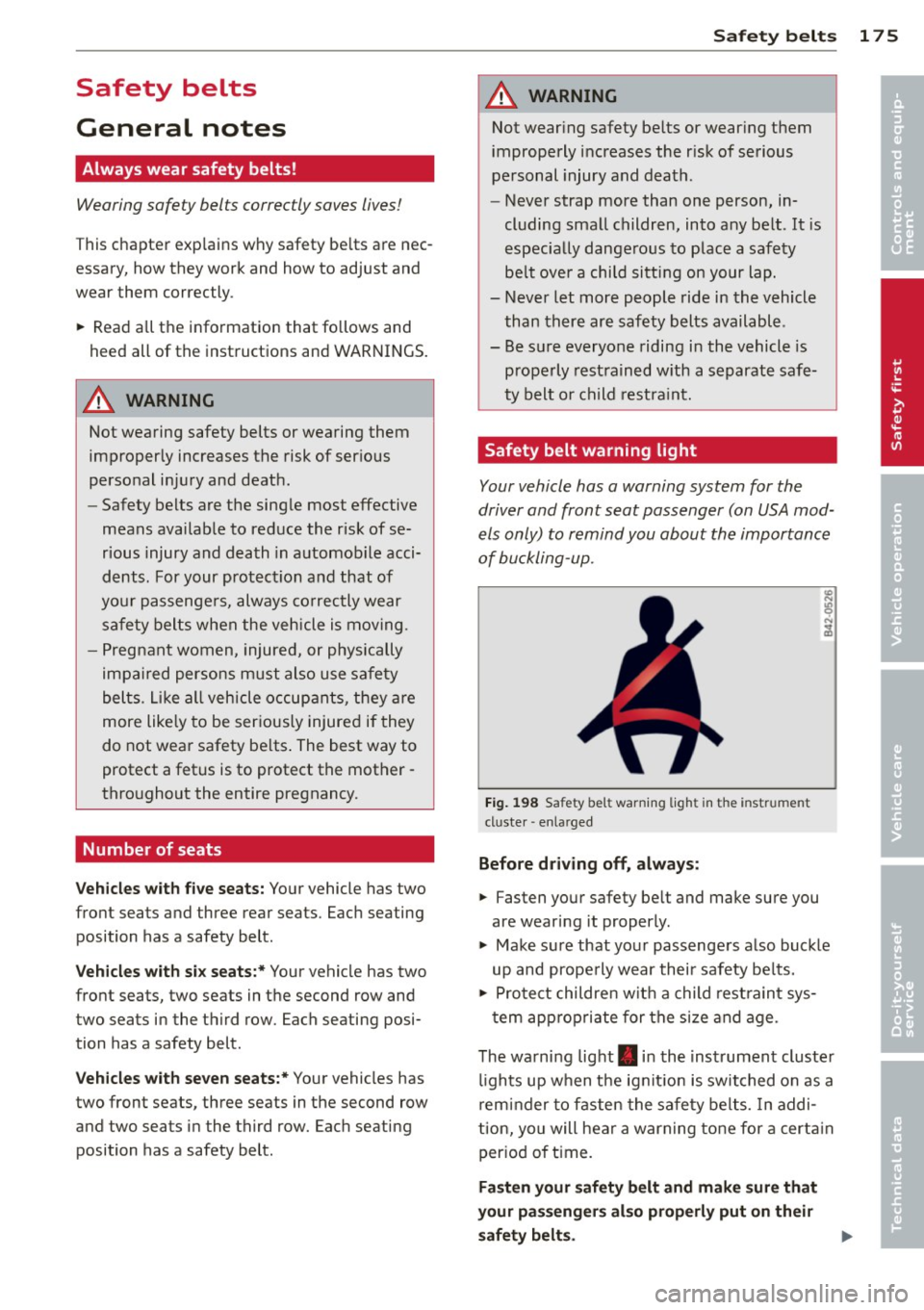
Safety belt warning light
Your vehicle has a warning system for the
driver and front seat passenger (on USA mod
els only) to remind you about the importance
of buckling-up.
Fig. 198 Safety bel t warn ing ligh t in the instru ment
cl uster -enla rged
Before driving off, always:
... Fasten your safety belt and make sure you
are wearing it properly .
"' Make sure that your passengers also buckle
up and properly wear their safety belts.
"' Protect children with a child restraint sys-
tem appropriate for the s ize and age.
The warning light . in the instrument cluster
lights up when the ignit ion is switched on as a
reminder to fasten the safety belts. In addi
tion, you will hear a warning tone for a certain
period of time.
Fasten your safety belt and make sure that
your passengers also properly put on their
safety belts.
•
•
Page 178 of 348
17 6 S afet y belt s
_&. WARNING
-Sa fety belts are the sing le most effective
means available to reduce the risk of se
rious injury and death in a utomob ile acci
dents. For your protection and that of
your passengers, always correctly wear
safety belts when the vehicle is moving.
- Failure to pay attention to the warning
light that come on, could lead to person
al injury .
Why safety belts?
Frontal collisions and the law of physics
Frontal crashes create very strong forces for
people riding in vehicles.
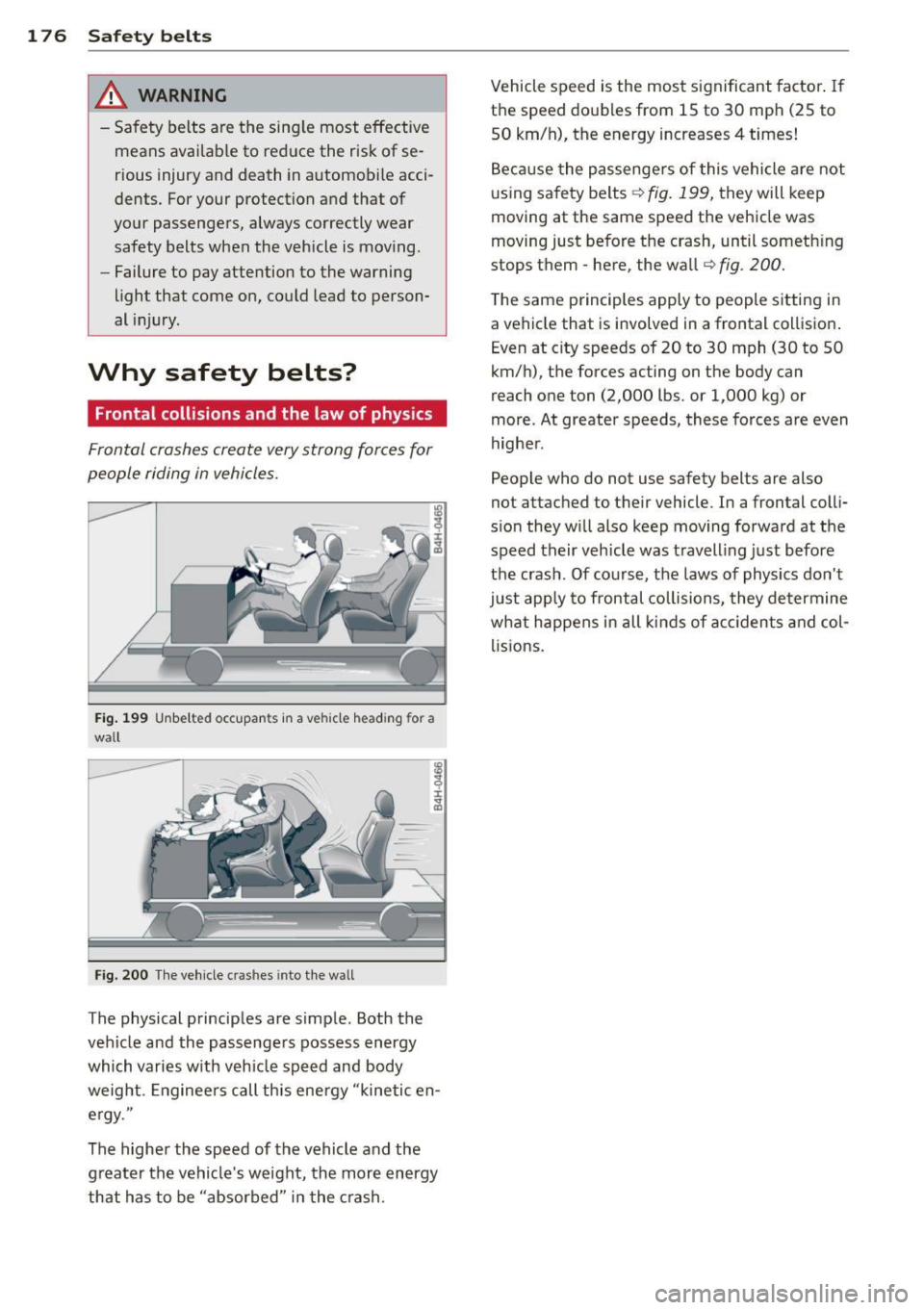
Fig. 199 Unbe lted occupants in a ve hicle h ead ing for a
wall
Fig. 2 00 Th e ve hicle c ras hes into the w all
The physical principles are simple . Both the
vehicle and the passengers possess energy
which varies with veh icle speed and body
weight . Engineers call this energy "kinetic en
ergy.''
The higher the speed of the vehicle and the g reater the vehicle's weight, the more energy
that has to be "absorbed" i n the crash. Vehicle speed is the most significant factor
. If
the speed doubles from 15 to 30 mph (25 to
50 km/h), the energy increases 4 times!
Because the passengers of this vehicle a re not
us ing sa fety belts ~
fig. 199, they will keep
moving at the same speed the vehicle was
moving just before the crash, until someth ing
stops them -here , the wa ll
Q fig. 200.
The same principles apply to people sitting in
a vehicle that is involved in a frontal collision .
Even at city speeds of 20 to 30 mph (30 to 50
km/h), the forces acting on the body can
reach one ton (2,000 lbs. o r 1,000 kg) or
more. At greater speeds, these forces are even
higher .
Peop le who do not use safety belts are also
not attached to their vehicle . In a frontal colli
s ion they will also keep moving forward at the
speed their veh icle was t ravell ing just before
the crash . Of course, the laws of physics don't
just app ly to frontal collisions, they determine
what happens in all kinds of acc idents and col
lis ions .
Page 181 of 348
damaged, have belts replaced by an au
thorized Audi dealer or qualified
workshop.
- Safety belts that have been worn and
loaded in an accident must be replaced
with the correct replacement safety belt
by an authorized Audi dealer. Replace
ment may be necessary even if damage
cannot be clearly seen. Anchorages that
were loaded must also be inspected.
- Never remove, modify, disassemble, or
try to repair the safety be lts yourself.
- Always keep the belts clean. Dirty belts
may not work properly and can impair
the funct ion of the inertia reel
¢ page 254, Safety belts .
Safety belts
Fastening safety belts
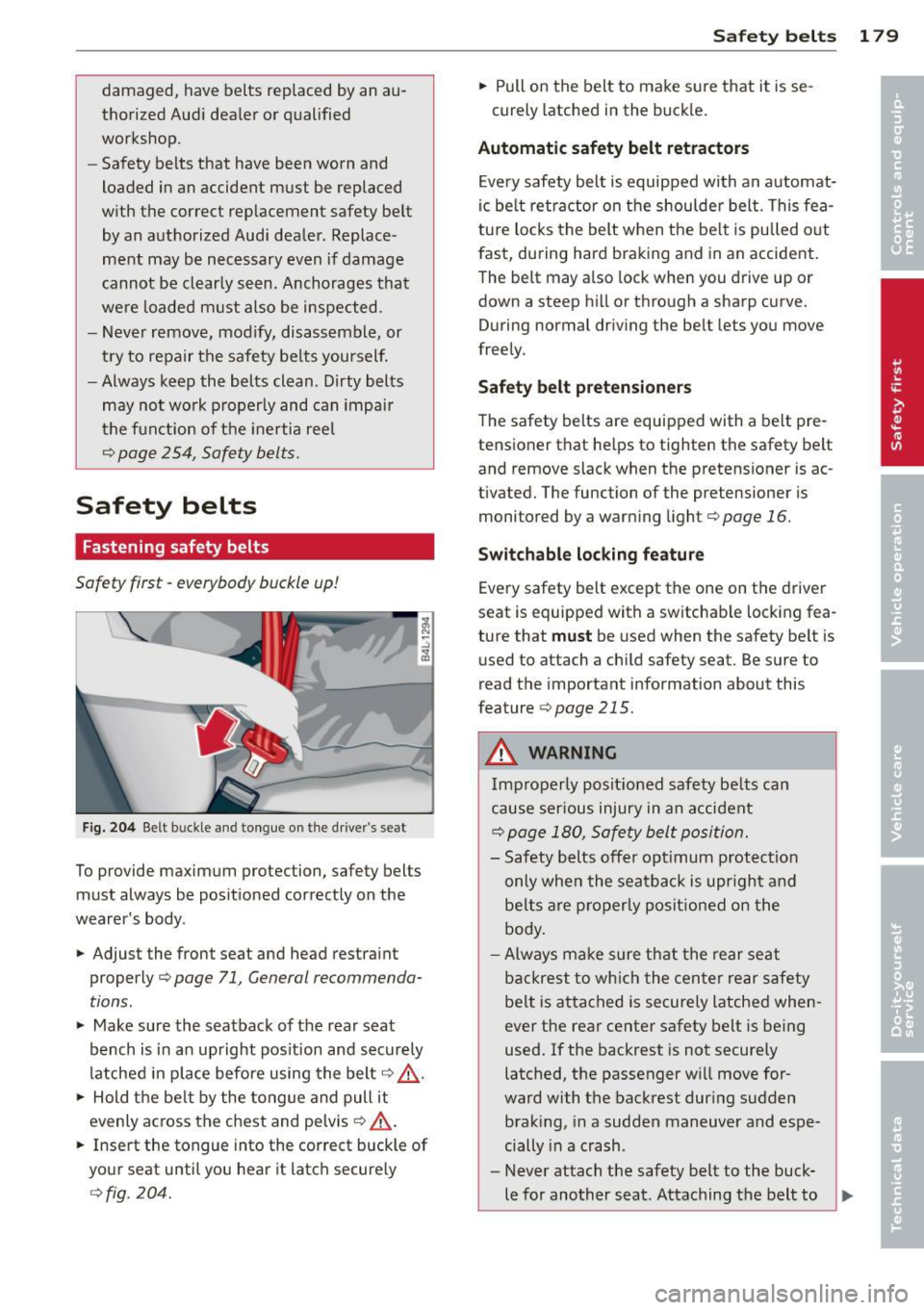
Safety first -everybody buckle up!
Fig. 204 Belt buckle and tongue on the driver's seat
To provide maximum protection, safety belts
must always be positioned correctly on the
wearer's body .
.. Adjust the front seat and head restraint
properly¢
page 71, General recommenda
tions .
.. Make sure the seatback of the rear seat
bench is in an upright position and securely
latched in place before using the belt ¢&, .
.. Hold the belt by the tongue and pull it
evenly across the chest and pelvis
¢ ,&. .
.. Insert the tongue into the correct buckle of
your seat until you hear it latch securely
<=> fig . 204.
Safety belts 179
.. Pull on the belt to make sure that it is se-
curely latched in the buckle .
Automatic safety belt retractors
Every safety belt is equipped with an automat
ic be lt retractor on the shoulder belt. This fea
ture locks the belt when the belt is pulled out
fast, during hard braking and in an accident.
The belt may also lock when you drive up or
down a steep hill or through a sharp curve. During normal driving the belt lets you move
freely.
Safety belt pretensioners
The safety belts are equipped with a belt pre
tensioner that helps to tighten the safety belt and remove slack when the pretensioner is ac
tivated. The function of the pretensioner is
monitored by a warning light¢
page 16.
Switchable locking feature
Every safety belt except the one on the driver
seat is equipped with a switchable locking fea
ture that
must be used when the safety be lt is
used to attach a child safety seat. Be sure to
read the important information about this
feature
<=> page 215.
A WARNING
Improperly positioned safety belts can
cause ser ious injury in an accident
c>page 180, Safety belt position.
- Safety belts offer optimum protection
only when the seatback is upr ight and
belts are properly positioned on the
body .
- Always make sure that the rear seat
backrest to wh ich the center rear safety
belt is attached is securely latched when
ever the rear center safety belt is being
used. If the backrest is not securely
latched, the passenger will move for
ward with the backrest during sudden
braking, in a sudden maneuver and espe
cially in a crash .
- Never attach the safety belt to the buck-
le for another seat. Attaching the belt to
~
Page 188 of 348
186 Airbag sys tem
Child restraints on the front seat - some
important things to know
• Be sure to read the impo rtant in forma tion
and heed the WARNINGS for important de
ta ils about ch ildren and Advanced Airbags
Q page 205.
Even though yo ur vehicle is equipped with an
Advanced Airbag System, make certain that
all children, especially those 12 years and
younger, a lways ride in the back seat properly
restra ined for their age and size. The airbag
on the passenger side makes the front seat a potentially dangerous place for a child to r ide .
The front seat is not the safest place fo r a
ch ild in a fo rward-faci ng ch ild safety seat. It
can be a very da ngerous place for a n infan t or
a child in a rearward -facing seat.
The Advanced Airbag System i n your veh icle
has been cer tified to comply with the require
men ts of Uni ted States Federa l Mo to r Veh icle
Safety Standard 208 as applicable at the time
your ve hicle was manufact ured.
The Standa rd requires the fron t air bag on t he
passenger side to be turned off ("sup
p ressed") if a c hild up to about one yea r of
age restrained in one of the rear-facing or for
ward-facing infant restra ints listed in Federal
Motor Vehicle Safety Standard 208 with which
the Advanced A irbag System in your vehicle
was certified has been installed on the front passenger seat . For a listing of the child re
straints that we re used to certi fy complia nce
with the US Safety Sta ndard
Q page 207.
The PASSENGER AIR BAG OFF light in the in
strument panel te lls you when the front Ad
vanced A irbag on t he passenger side has been
turned off by t he e lectronic control unit.
Each t ime you tur n on the ignition, the
PAS
SENGER AIR BAG OFF
li ght w ill come on for a
few seconds a nd:
- will stay on if the front passenger seat is not
occupied
- will stay on if there is a small child or child
rest raint on the front passenger seat -
w ill go off i f the front passenge r seat is oc
cupied by an adult as registere d by the
weight -sensing mat
r::!) page 195, Monitor
ing the Advanced Airbag System.
T he PASSENGER AIR BAG OFF light comes on
whe n the contro l unit detects a tota l weight
on the front passenger seat that req uires the
front a irbag to be turned off.
If the total weight on the front passenge r
seat is more than that of a typica l 1 year -old
c hi ld b ut less than the we ight of a small
adult, the front airbag on the passenger side
can deploy (the
PASSENGER AIR BAG OFF
li ght does not come on). If the PASSENGER
AIR BAG OFF
light does not come on , the
front a irbag on the passenger side has not
bee n tur ned off by the elec tronic con trol unit
and can deploy if the control uni t se nses an
impact that meets the con ditions stored i n its
memo ry .
For exampl e, the airbag may deploy if:
- a small ch ild that is heav ie r th an a typical 1
year-old ch ild is on the front passenger seat
( r egard less of whethe r the child is in one of
t he child safety seats listed
<:!) page 207), or
- a child who has outgrown ch ild restraints is
on t he front passenge r seat.
If the front passenger airbag is turned off, the
PASSENGER AIR BAG OFF light comes on in
the instr ume nt cluster and stays on.
The front airbag on the passenger side may
not deploy (the PASSENGER AIR BAG OFF
li gh t does not illum inate and stay lit) even if a
small ad ult o r teenager, or a passenger who is
not sitt ing up rig ht w ith their back against a
non- re cli ned ba ck res t w it h thei r feet on the
vehicle f loor in front of the sea t is on the front
passenge r seat
c::> page 1 66, Proper sea ting
position for the driver.
If t he fron t passenger a irbag dep loys, the
F ede ral Standard req uires the airbag to meet
t h e "low risk" dep loyment criteria to red uce
the risk of injury t hro ugh interactio n wit h the
airbag. "Low risk" dep loyment occ urs in those
crashes that take place at lower dece lerat ions ..,_
Page 189 of 348
as defined in the electronic control unit
¢ page 195, PASSENGER AIR BAG OFF light .
Always remember, a chi ld safety seat or infant
carrier installed on the front seat may be
struck and knocked out of position by the rap
id ly inflating passenger's airbag in a frontal
coll is ion . The airbag cou ld greatly reduce the
effectiveness of the child restraint and even
seriously injure the child during inflat ion.
F or this reason, and because the back seat is
the safest p lace for children -when properly
restra ined accord ing to their age and si ze - we
strongly recommend that children always sit in the back seat¢
page 205, Child Safety.
A WARNING
A child in a rearward-facing child safety
seat insta lled on the front passenger seat
w ill be seriously injured and can be k illed if
t he fron t airbag inf lates - even with an Ad
vanced Airbag System .
- The inflating a irbag w ill hit the child
sa fety seat or infant carrier w it h great
f orce and w ill smash the ch ild safety seat
and child against the backrest, center
armrest, door or roof.
- Always install rear -facing child sa fety
seats on the rear seat.
- If you mus t install a rearward facing
child safety seat on the front passenger
seat because of exceptional circ umstan
ces and the
PASSENGER AIR BAG O FF
light does not come on and stay on, im
med iately install the rear-facing child
safety seat in a rear seating posit ion and
have the a irbag system inspected by you r
authori zed Aud i dealer.
- Forward-fac ing ch ild safety seats instal
led on the front passenger's seat may in
terfere with the deployment of the air
b ag and cause serious person al injury to
the ch ild .
WARNING
If, in exceptional c ir c umstances, you mus t
install a forwa rd -facing child restra int on
the front passenger's seat:
A irbag system 187
-Always ma ke sure the forward-facing
seat has been designed and certified by its manufacturer for use on a front seat
with a passenger front and s ide a irbag.
- Never put the forward-facing child re
straint up against or very near the instru ment panel.
- Always move the passenger seat into its
rearmost position in t he seat's fore and
aft adj ustment range, as fa r away from
the airbag as possible before installing
the forward-fa cing ch ild restra int. The
backrest mu st be a dju ste d to an upright
posi tion.
- Ma ke sure that the
PASSENGER AIR BAG
OFF
li ght comes on and stays on all the
time wheneve r the ignit ion is swi tched
on.
A WARNING
To reduce the risk of serious injury, make
sure that the
PASSENGER AIR BAG OFF
light wi ll be displayed whenever a child re
straint is installed on the front passenger
seat and the ignition is sw itched on.
- If the
PASSENGER AIR BAG OFF light
does not stay on, perform the checks de
scribed ¢
page 195, Monitoring the Ad
vanced Airbag System .
-Take t he chi ld restraint off the front pas
senger seat and install it properly at one
of the rear seat positions if the
PASSEN
GER AIR BAG OFF
li g ht does not stay on.
- Have the airbag system inspected by
your author ized Audi dealer immed iate
ly.
- Always carefully follow instr uctions from
child r estraint manufa cture rs when in
s tall ing c hild restra ints.
A WARNING
If, in exce ptiona l circumstan ces, you must
ins tall a forward or rearw ard-facing c hild
restra int on the front passenger's seat:
- Imp roper ins tal lation o f ch ild restraints
can reduce their effec tiveness or even
•
•