ABS AUDI Q7 2014 Owner´s Manual
[x] Cancel search | Manufacturer: AUDI, Model Year: 2014, Model line: Q7, Model: AUDI Q7 2014Pages: 340, PDF Size: 85.02 MB
Page 177 of 340
,&_ WARNING
-Sa fety belts are the sing le most effective
means availab le to reduce the risk of se
rious injury and death in automobile acci
dents. For your protection and that of
your passengers, always correctly wear safety belts when the vehicle is mov ing .
- Failure to pay attention to the warning
light that come on, could lead to person
al injury.
Why safety belts?
Frontal collisions and the law of physics
Frontal crashes create very strong forces for
people riding in vehicles.
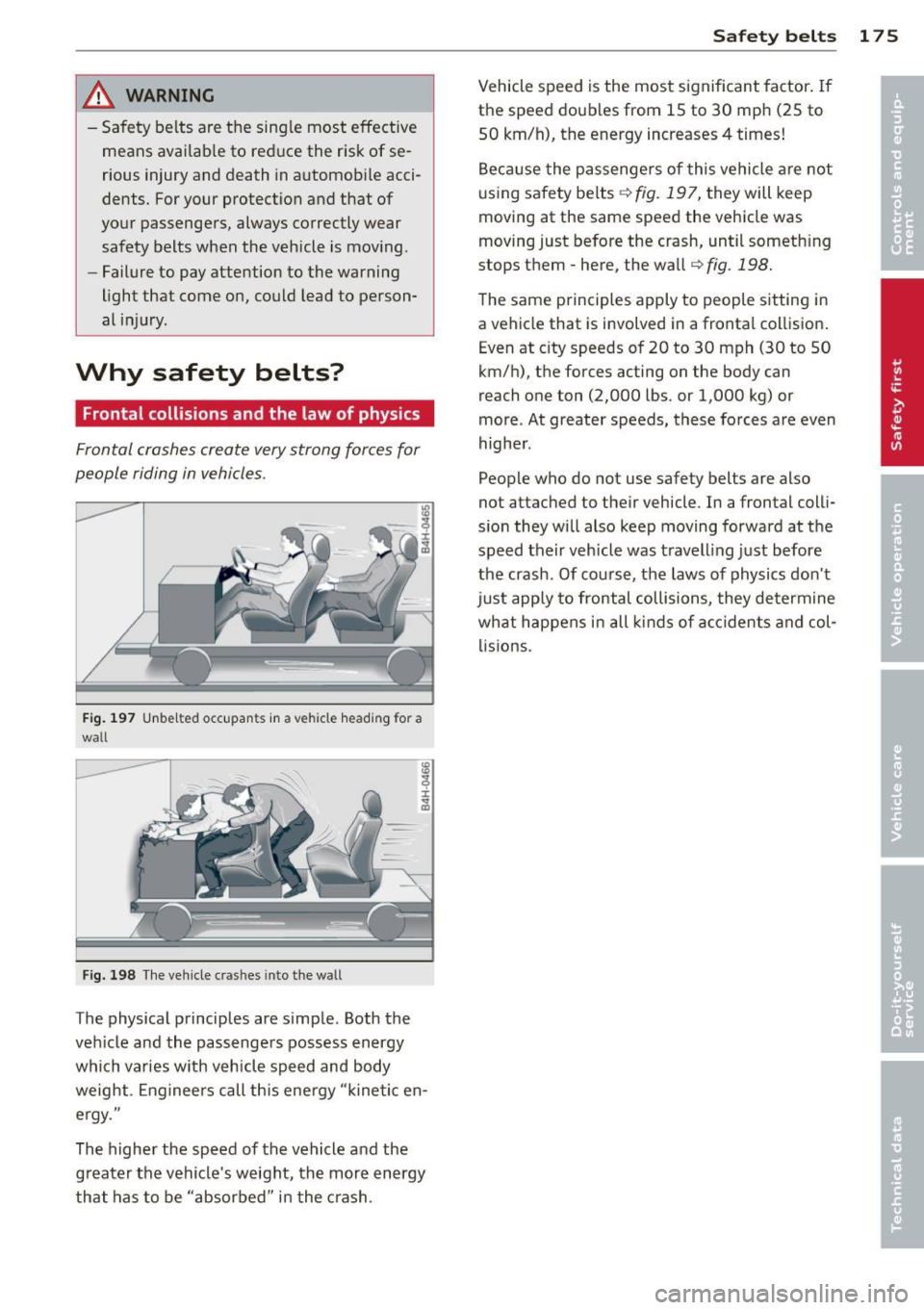
F ig . 197 Unbe lted occupants in a ve hicle heading for a
wall
Fig. 198 The vehicle cras hes into the wall
The physical principles are simple. Both the
veh icle and the passengers possess energy
which varies with vehicle speed and body weight . Engineers call this energy "kinetic en
e rgy."
The higher the speed of the vehicle and the
g reate r the vehicle's weight, the more energy
that has to be "absorbed" in the crash.
Safety belts 175
Vehicle speed is the most significant factor . If
the speed doub les from 15 to 30 mph (25 to
50 km/h), the energy increases 4 times!
Beca use the passenge rs of this vehicle are not
using safety belts¢
fig. 197, they will keep
moving at the same speed the vehicle was
moving just before the crash, until someth ing
stops them -here, the wall¢
fig. 198.
The same principles apply to people sitting in
a vehicle that is involved in a frontal collision.
Even at c ity speeds of 20 to 30 mph (30 to 50
km/h), the forces acting on the body can
reach one ton (2,000 lbs. or 1,000 kg) or
more . At greater speeds, these fo rces are even
higher.
Peop le who do not use safety belts are also
not attached to their vehicle . In a frontal colli
s ion they will also keep moving forward at the
speed their vehicle was travelling just before
the crash . Of co urse, the laws of physics don't
just app ly to frontal collisions, they determine
what happens in all kinds of acc idents and col
lisions.
Page 178 of 340
176 Safety belts
What happens to occupants not wearing
safety belts?
In crashes unbelted occupants cannot stop themselves from flying forward and being in
jured or killed. Always wear your safety belts!
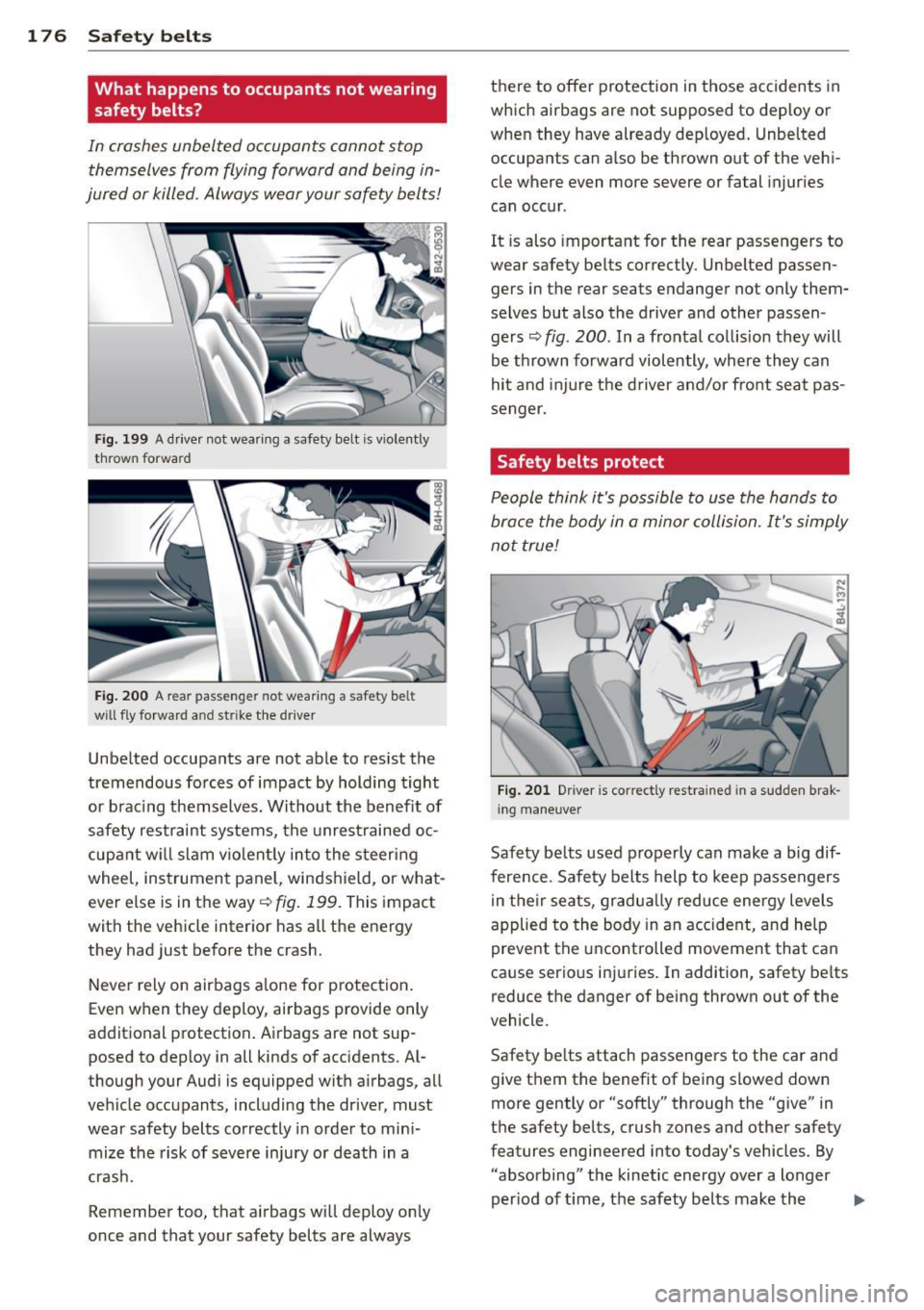
Fig. 199 A driver not wearing a safety belt is violently
thrown forward
Fig. 200 A rear passenger not wearing a safety belt
will fly forward and strike the drive r
Unbelted occupants are not able to resist the
tremendous forces of impact by holding tight
or bracing themselves. Without the benefit of
safety restraint systems, the unrestrained oc
cupant will slam violently into the steering
wheel, instrument panel, windshield, or what
ever else is in the way
q fig. 199. This impact
with the vehicle interior has all the energy
they had just before the crash.
Never rely on airbags alone for protection.
Even when they deploy, airbags provide only
additional protection. Airbags are not sup posed to deploy in all kinds of accidents. Al
though your Audi is equipped with airbags, all
vehicle occupants, including the driver, must
wear safety belts correctly in order to mini
mize the risk of severe injury or death in a
crash.
Remember too, that airbags will deploy only
once and that your safety belts are always there to offer protection in those accidents
in
which airbags are not supposed to deploy or
when they have already deployed. Unbelted occupants can also be thrown out of the vehi
cle where even more severe or fatal injuries
can occur .
It is also important for the rear passengers to
wear safety belts correctly. Unbelted passen
gers in the rear seats endanger not only them
selves but also the driver and other passen gers¢
fig. 200. In a frontal collision they will
be thrown forward violently, where they can
hit and injure the driver and/or front seat pas
senger.
Safety belts protect
People think it's possible to use the hands to
brace the body in a minor collision. It's simply
not true!
Fig. 201 Driver is correctly restrained in a sudden brak
ing maneuver
Safety belts used properly can make a big dif
ference. Safety belts help to keep passengers
in their seats, gradually reduce energy levels
applied to the body in an accident, and help
prevent the uncontrolled movement that can
cause serious injuries. In addition, safety belts
reduce the danger of being thrown out of the
vehicle.
Safety belts attach passengers to the car and
give them the benefit of being slowed down
more gently or "softly" through the "give" in
the safety belts, crush zones and other safety
features engineered into today's vehicles. By
"absorbing" the kinetic energy over a longer
period of ti me, the safety belts make the
lilJJ,
Page 189 of 340
prevent them from providing any
protection.
- An improperly installed child restraint
can interfere with the airbag as it de
ploys and seriously injure or even kill the
child -even with an Advanced Airbag
System.
- Always carefully follow the manufactur
er's instructions provided with the child
safety seat or carrier.
- Never place additional items on the seat
that can increase the total weight regis
tered by the weight-sensing mat and can cause injury in a crash.
Front airbags
Description of front airbags
The airbag system can provide supplemental
protection to properly restrained front seat
occupants.
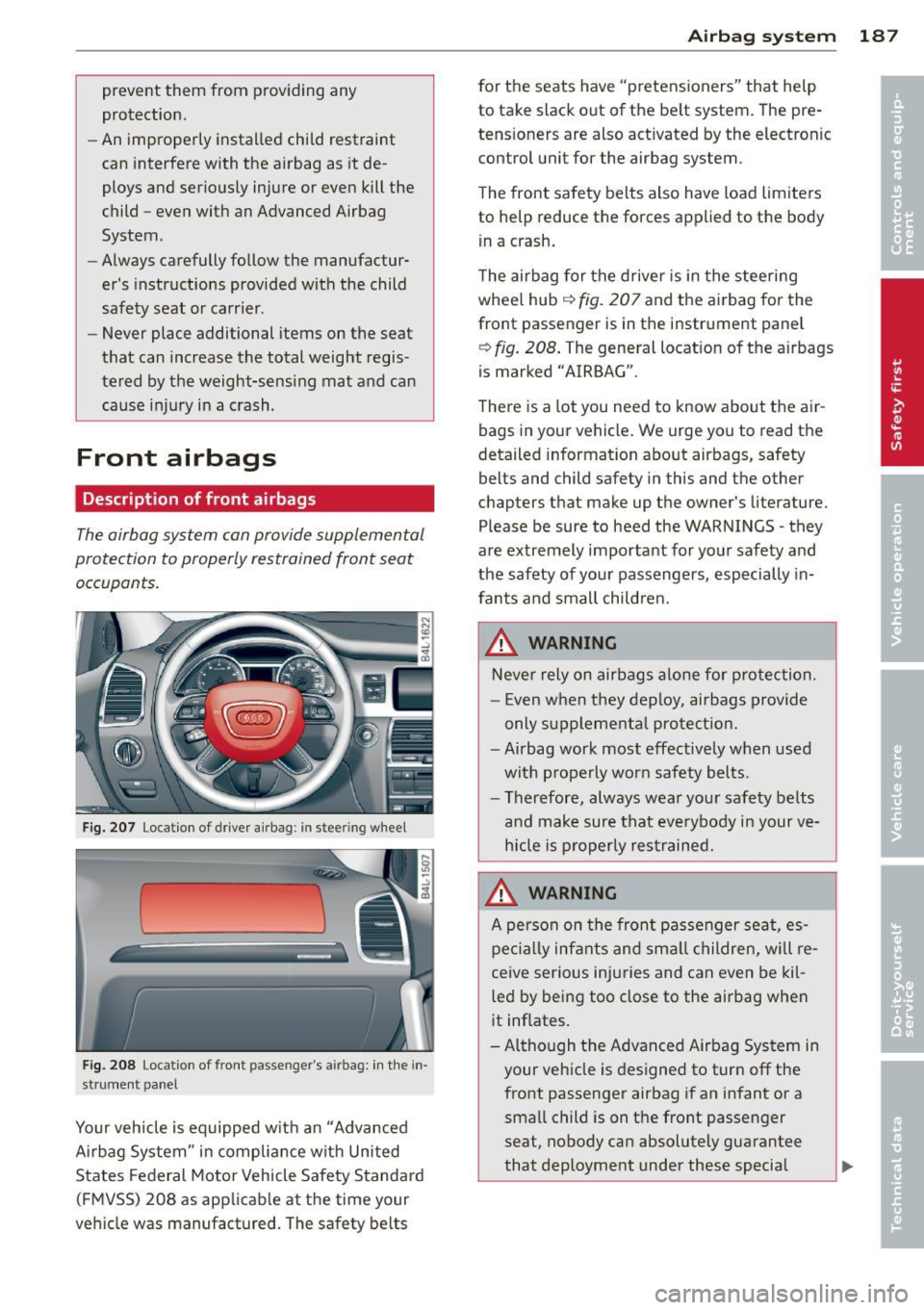
Fig. 207 Location of driver ai rb ag : in stee ring whee l
Fig. 208 Location of front passenger 's a irbag: in the in
strume nt panel
Your vehicle is equipped with an "Advanced
Airbag System " in compliance with United
States Federal Motor Vehicle Safety Standard
(FMVSS) 208 as applicable at the time your
ve hicle was manufactured. The safety belts
Airbag system 187
for the seats have "pret ens ioners " that help
to take slack out of the belt system. The pre
tensioners are also activated by the electronic
control unit for the airbag system.
Th e front safety belts also have load limiters
to help reduce the forces applied to the body
in a crash .
Th e airbag for the driver is in the steering
wheel hub
q fig. 207 and the airbag for the
front passenger is in the instrument panel
~ fig. 208. The general location of the airbags
is marked "AIRBAG" .
There is a lot you need to know about the air
bags in your vehicle. We urge you to read the
detailed information about airbags, safety
belts and child safety in this and the other
chapters that make up the owner's literature.
Please be sure to heed the WARNINGS -they
are extremely important for your safety and
the safety of your passengers, especially in
fants and small children.
_&. WARNING
Never rely on airbags alone for protection.
- Even when they deploy, airbags provide
only supplemental protection.
-Airbag work most effectively when used
with properly worn safety belts.
- Therefore, always wear your safety belts
and make sure that everybody in your ve
hicle is properly restrained.
_&. WARNING
A person on the front passenger seat, es
pecially infants and small children, will re
ceive serious injuries and can even be kil
led by being too close to the airbag when
it inflates.
- Although the Advanced Airbag System in
your vehicle is designed to turn off the
front passenger airbag if an infant or a
small child is on the front passenger
seat, nobody can absolutely guarantee
that deployment under these special
11>-
Page 191 of 340
If the total weight on the front passenger
seat is more than that of a typical 1 year -old,
but less than the weight of a small adult, the
front airbag on the passenger side may deploy (the
P ASS ENGER AIR B AG OFF light does not
come on).
For example, th e airbag may depl oy if:
-a small child that is heavier than a typical 1
year-o ld child is on the front passenger seat
(regardless of whether the child is in one of
the chi ld safety seats listed
<=) page 206),
-a chi ld who has outgrown child restraints is
on the front passenger seat.
I f the front passenger airbag is turned
off, the
PA SSENGER AIR B AG OFF light in the center
of the instrument panel wi ll come on and stay
on.
The front a irbag on the passenger side may
not deploy (the PA SSENG ER AIR BAG O FF
light does not ill uminate and stay lit) if:
- a small adu lt or teenager is on the front pas
senger seat
- a passenger who is not sitt ing upright w ith
their back against a non-reclined backrest
with their feet on the vehicle floo r in front
of the seat is on the front passenge r seat .
If the front passenger airbag deploys, the
Federal Standard requires the a irbag to meet
the " low risk" deployment cr iteria to help re
duce the risk of inju ry through interaction
with the airbag. "Low risk" deployment occurs in those crashes that take place at lower de
celerations as defined in the electronic control
un it.
<=) page 194
Al ways rememb er: Even tho ugh your vehicle
is equipped with Advanced Airbags, the safest
p lace for children is properly restrained on the
back seat. Please be sure to read the impor
tant information in the sect ions that follow
and be sure to heed all of the WARNINGS.
A WARNING
To reduce the risk of injury when an airbag inflates, a lways wear safety belts prope rly.
A irbag system 189
-If you are unrestrained, leaning forward,
sitt ing s ideways or out of pos ition in any
way, your risk of injury is much higher.
- You will a lso receive serious injuries and
could even be killed if you are up aga inst
the airbag or too close to it when it in
flates -even w ith an Advanced A irbag
<=)page 183 .
A WARNING
-
A child in a rearward-fac ing ch ild safety
seat installed on the front passenger seat
will be ser ious ly injured and can be killed if
the front airbag inflates -even with an Ad
vanced A irbag System.
- Al tho ugh the Advanced Airbag System in
your veh icle is designed to turn
off the
front airbag when a rearward -facing
child restraint has been insta lled on the
front passenger seat, nobody can abso
lutely guarantee that dep loyment is im
possible in all conceivable s ituations that
may happen dur ing the usefu l life of your
veh icle.
- The inflating airbag will h it the ch ild
safety seat or infant carrier with great
force and will smash the child safety seat
and child against the bac krest, center
armrest, doo r, or roof.
- Always install rearward-facing chi ld re
straints on the rear seat.
- If you must install a rearwa rd fac ing
child safety seat on the fro nt passenger
seat because of exceptiona l circumstan
ces and the
PASSENGER AIR BAG OFF
light does not come on and s tay on, im
mediately insta ll the rear-facing ch ild
safety seat in a rear seating position and
have the airbag system inspected by your
author ized Audi dealer.
A WARNING
If, in except iona l circumstances, you must
install a forward-facing child restraint on
the front passenger's seat:
~
•
•
Page 200 of 340
198 Airbag system
@ For the sake of the environment
Undep loyed airbag modu les and preten
sioners might be classified as Perchlorate Material -special handling may app ly, see
www.dtsc.ca.gov/haza rdouswaste/per chlorate. When the vehicle or parts of the
restraint system including airbag modules
and safety belts w ith pretens ioners are
scrapped, all applicable laws and regula
tions must be observed. Your authori zed
Audi dea ler is familiar with these requ ire
ments and we recommend that you have
your dea ler perform this service for you.
Other things that can affect Advanced
Airbag performance
Changing the vehicle's suspension system can
change the way that the Advanced Airbag Sys
tem performs in a crash. For example, using
tire-r im combinations not approved by Aud i,
l owering the vehicle, changing the stiffness o f
the suspension, including the springs, s uspen
sion struts, shock absorbers etc. can change
the forces that are measured by the airbag
sensors and sent to the electronic control
un it. Some suspension changes can, for exam
ple, increase the force levels measured by the
sensors and make the airbag system deploy in
crashes in wh ich it would not deploy if the
changes had not been made. Other kinds of
changes may reduce the force levels meas
u red by the sensors and prevent the airbag
from deploying when it should .
The sensors in the safety belt buckle for the
driver and front passenger sea t tell the elec
tronic control module if the safety belt is
latched or not. If the safety belt is being used,
the front airbag will deploy at a slightly high
er rate of vehicle deceleration than if the safe
ty belt is not being used. Therefore, in a par
ticular collision, it is possible that an airbag
will not deploy at a seating position where the safety belt is being used but will inflate at the
position where the safety belt is not being
used.
It is important that nothing interfere
with the safety belt buckles so that the sen- sors can send the correct info
rmation about
safety belt use to the electronic control unit.
.&_ WARNING
-
Changing the vehicle's suspension includ- ing use of unapproved tire-rim combina
tions can change Advanced Airbag per
formance and increase the risk of serious
personal injury in a crash.
- Never install suspension components
that do not have the same performance
characteristics as the components origi
nally installed on your vehicle.
- Never use tire-rim combinations that
have not been approved by Audi.
&_ WARNING
--
Items stored between the safety be lt
buckle and the center console can cause
the sensors in the buckle to send the
wrong information to the e lectronic con
trol module and prevent the Advanced Air
bag System from working properly.
- Always make sure that nothing can inter
fere with the safety belt buckles and that
they are not obstructed.
Side airbags
Description of side airbag s
The airbag system can provide supplemental
protection to properly restrained occupants.
Fig. 211 Side airbag location in th e drive r's seat
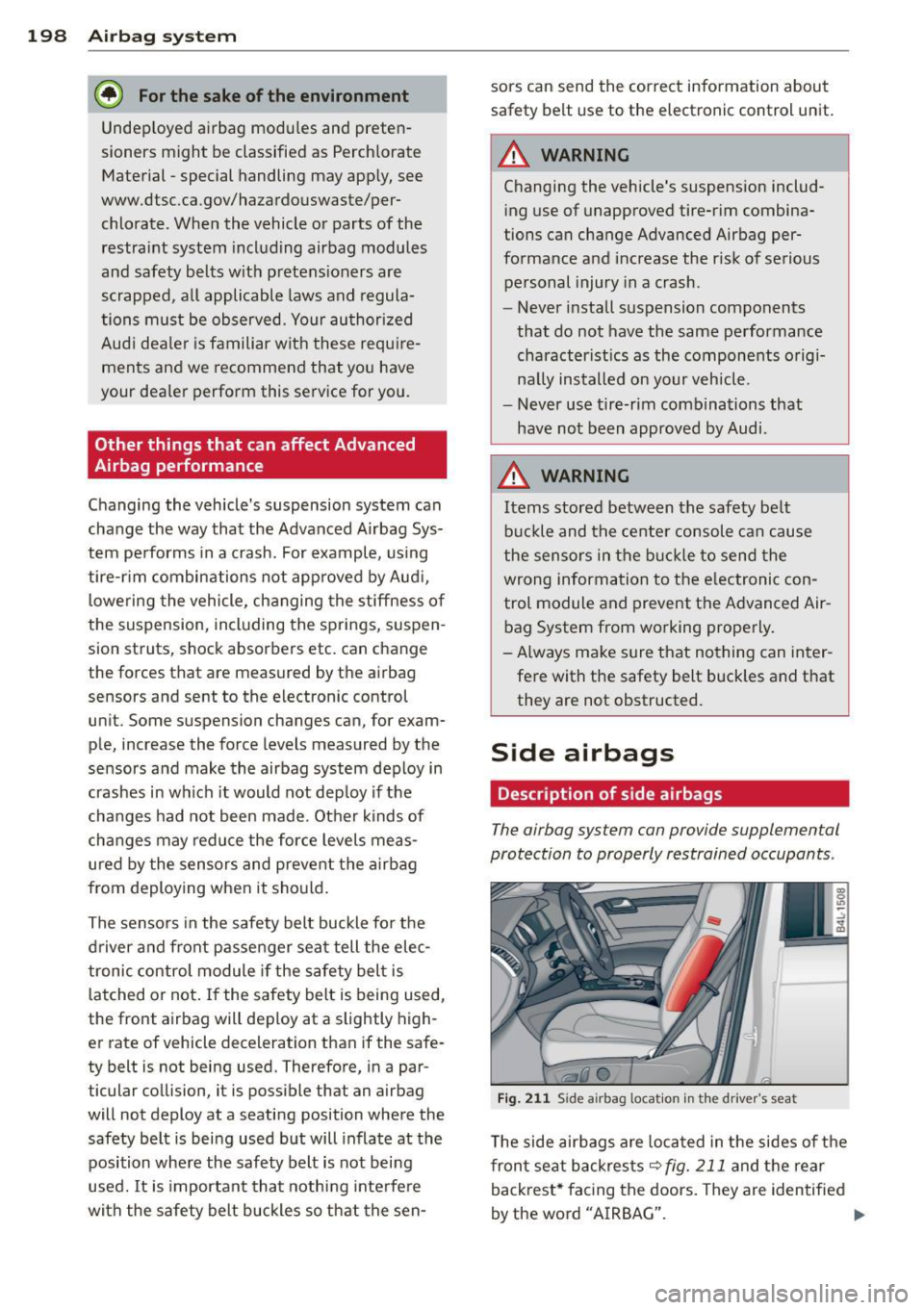
The side airbags are located in the sides of the
front seat backrests
~fig. 211 and the rear
backrest* facing the doors. They are identified
by the word "AIRBAG". ....
Page 226 of 340
224 Intelligent technology
Intelligent technology
Notice about data
recorded by vehicle
control modules
Your vehicle is not equipped with an Event Da
ta Recorder (EDR), installed by some manu
facturers fo r the express purpose of capturing
data for retrieval after an accident or crash
event . EDRs are sometimes ca lled "crash re
corders".
Some state laws restrict the retr ieval or down
loading of data stored by EDRs that were in
stalled in a vehicle for the express purpose of
retrieving data after an accident or crash
event without the owner's consent.
A lthough your vehicle is not equipped with an
EDR, it is equipped with a number of electron
ic control modules for various vehicle systems
such as, for examp le, engine function, emis
sion control, as well as for the airbags and
safety belts .
These electronic contro l modules also record
vehicle-related data during normal vehicle op
eration for diagnostic and repair purposes.
The recording capacity of the electronic con
trol modules is limited to data (no sound is re
corded) and only a small amount of data is ac
tually recorded over a very limited period of
time and stored when a system fault or other
condition is sensed by a control unit. Some of
the data then stored may relate to vehicle
speed, direction, braking as we ll as restraint
system use and performance in the event of a
crash or other condition. Stored data can only
be read and downloaded with special equip
ment.
Electronic Stabilization
Control (ESC)
Description
The Electronic Stabilization Control (ESC) rein
forces driver safety. It reduces the risk of slip
p ing and improves driving stability. ESC de
tects cr itical s ituations such as the vehicle oversteering and
understeering or the wheels
spinning . The vehicle is stabilized by applying
the brakes or reducing engine torque . Once
the ESC is active, the indicator light
G1 blinks
in the instrument cluster.
ESC includes the anti-lock brake system (ABS),
brake assist system, anti-slip regulation
(ASR), electronic differential lock (EDL) and
hill descent control.
Anti-lock brake system (ABS)
ABS prevents the whee ls from locking up
when braking. The vehicle can still be steered
even during hard braking. App ly steady pres
sure to the brake pedal. Do not pump the ped al. A pulsing in the brake pedal indicates that
the system is helping you to brake the vehicle .
Brake assist system
The brake assist system can decrease braking
distance. It increases braking power when the
driver presses the brake pedal quickly in emer
gency situations. You must press and hold the
brake pedal until the situation is over . In
vehicles with adaptive cruise control*, the
brake assist system is more sensitive if the
distance detected to the vehicle ahead is too
small.
Anti-slip regulation (ASR)
ASR reduces engine power when the drive
wheels begin to spin and adapts the force to
the road conditions. This makes it easier to
sta rt, accelerate and drive up hills.
Electronic differential lock (EDL)
The EDL brakes wheels that are spinning and
transfers the drive power to the other wheels .
This function is available up to about 60 mph
(100 km/h) .
In extreme cases, EDL automatically switches
off to help keep the brake on the braked wheel
from overheat ing. EDL will switch on again au
tomat ically when conditions have returned to
normal.
Page 227 of 340
A WARNING 1-=
-ESC, ABS, ASR and EDL cannot overcome
the laws of physics. This is espec ially im
portant on slippery or wet roads. If the
systems begin act ing to stab ilize your ve
hicle, you should immediately change
your speed to match the road and traffic conditions. Do not let the increased sa fe
ty provided by these systems tempt you
to take r isks. Doing so will increase the
risk of a loss of vehicle control, collision
and ser ious persona l injuries.
- Always adapt your speed to road, traffic
and weather conditions. The risk of los
ing control of the vehicle increases when
dr iv ing too fast, especially through
curves and on slippery or wet roads, and
w hen driving too close to vehicles up
ahead. ESC, ABS, the b rake assist sys
tem, ASR and EDL cannot prevent co lli
sions.
Switching on/off --- -
Intellig ent technolog y 225
-Always accelerate with special care on
even, smooth surfaces such as those that
are wet or covered with ice and snow.
The drive wheels can spin even with
these assistance systems that cannot al
ways he lp to reduce the risk of loss of ve
hicle control.
@ Tips
- ABS and ASR only work correctly when
all four wheels are equipped with identi
cal tires. D iffe rent tire sizes can lead to a
reduction in engine powe r.
- Yo u may hear noises when the systems
descr ibed are working.
- If the ind icator light
DJ or ~ (USA
mode ls)/ ii] (Canada models) appears,
there may be a malfunction~
page 16,
¢page 18.
•
•
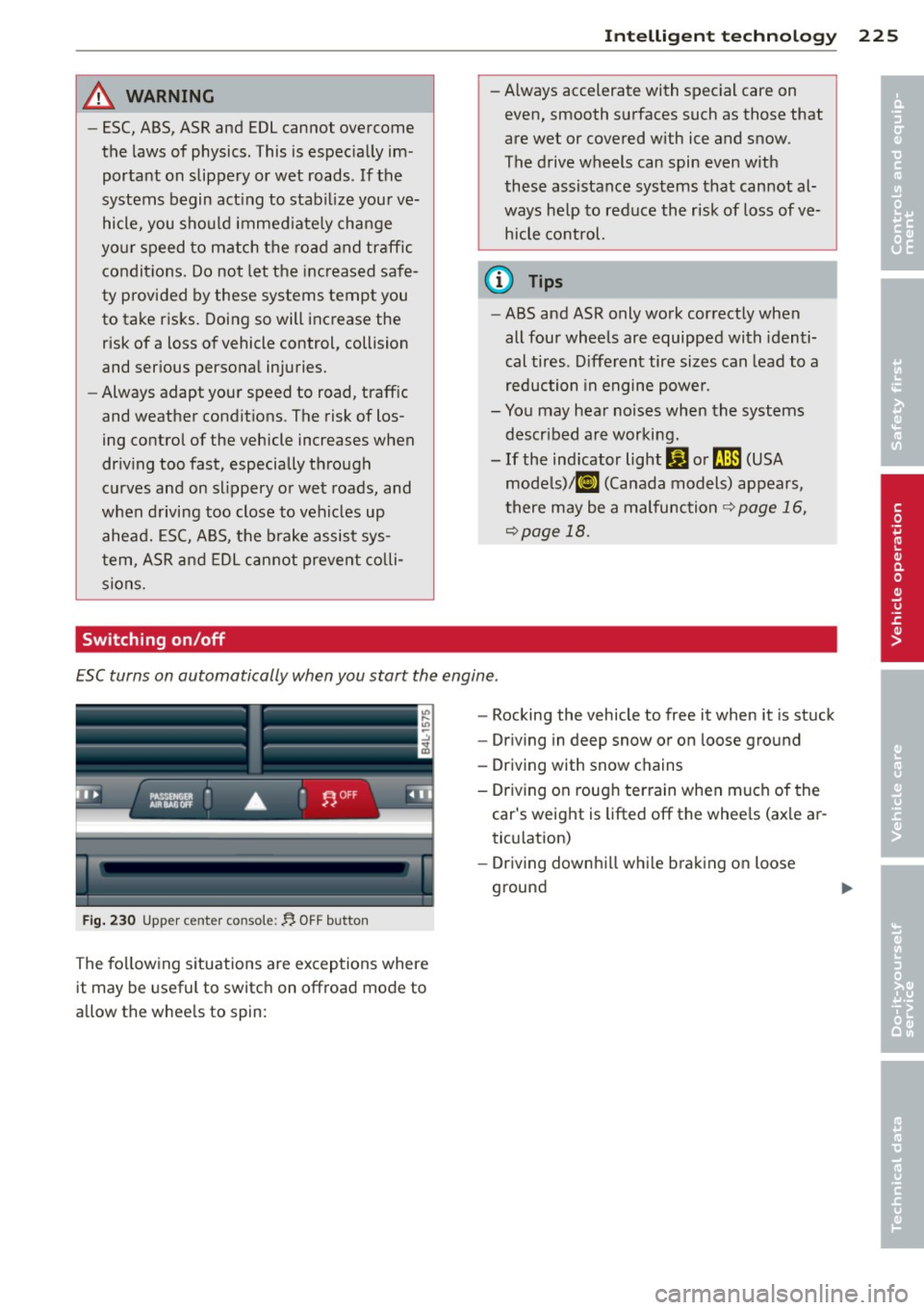
ESC turns on automatically when you start the engine .
. ...---------.,
--------------
Fig. 230 Upper center conso le : ~ O FF button
The fo llow ing situations are exceptions where
it may be useful to switch on offroad mode to
allow the whee ls to spin: -
Rocking the vehicle to free it when it is stuck
- Dr iving in deep snow or on loose ground
- Driving with snow chains
- Dr iving on roug h terrain when much of the
car's weight is lifted off the whee ls (ax le ar
ticu lation)
- Dr iving downhi ll wh ile braking on loose
ground
Page 242 of 340
240 Trailer towing
Trailer towing
Driving with a trailer
General information
Your Audi was designed primarily for passen
ger transportation .
If you plan to tow a trailer, p lease remember
that the additional load will affect durability,
economy and performance .
Trailer towing not on ly places more stress on
the vehicle, it also calls for more concentra
tion from the driver.
For this reason, always fo llow the operating
and driving instructions provided and use
common sense.
@ Note
If you are going to tow a trai ler, you must
activate the trailer operation mode
c:::> page 159, Towing a trailer.
Technical requirements
Trailer hitch
Use a weight-carrying hitch conforming to the
gross trailer weight. The hitch must be suita ble for your vehicle and trailer and must be
mounted securely on the veh icle's chassis at a
technically sound location . Use only a trailer
hitch with a removable ball mount. Always
check with the trailer hitch manufacturer to
make sure that you are using the cor rect
hitch.
Do not use a bumper hitch.
The hitch must be installed in such a way that
it does not interfere with the impact-absorb
ing bumper system. No modifications should
be made to the vehicle exhaust and brake sys
tems. From time to time, check that all hitch
mounting bolts remain securely fastened.
When you are not towing a trailer, remove the
trai ler hitch ball mount. This prevents the
hitch from causing damage should your vehi
cle be struck from behind
c:::> A.
Trailer brakes
If your trailer is equipped with a brakin g sys
tem, check to be sure that it conforms to all
regulations.
T he trailer hydraulic brake system must not be
directly connected to the vehicle's hydraulic
brake system
c:::> A .
Safety chains
Always use safety chains between your veh icle
and the tra iler.
Trailer lights
Trailer lights must meet all regulations. Be
sure to check with your authorized Audi dealer
for correct wiring, sw itches, and relays.
Mirrors
If you are unable to see the traffic behind you
using the regular outside mirrors, then you
must install extended mirrors.
It is important
that you always have clear v is ion to the rear .
A WARNING ,-
- If a trailer has electrical brakes please
note that these brakes are not activated
by the factory-fitted control unit -risk of
accident!
- Afte r removing the trailer hitch, do not
store it in yo ur vehicle. In case of sudden
braking, the hitch could fly forward and
injure you or your passengers.
- Never install a "weight distributing" or
"load equalizing" trailer hitch on your ve
hicle. The vehicle was not designed for
these kinds of trailer hitches. The hitch
attachment can fail, causing the trailer
to tear loose from the vehicle.
- The Gross Vehicle Weight Rating for your
veh icle, found on the safety compliance
label on the driver's side B-pillar, must
never be exceeded under any c ircumstan
ces. Exceeding the Gross Vehicle Weight
Rating of your vehicle is likely to damage
your vehicle, and such damage will not
be covered by your Limited New Vehicle
-
Warranty. Exceeding the Gross Vehicle ~
Page 245 of 340
have become completely familiar with the way
your vehicle-trailer combination behaves and responds.
Backing up is difficu lt and requires practice.
Backing up with a trai ler genera lly requires
steering action opposite to that when backing up your vehicle without a trailer .
Maintain a greater distance between your ve
hicle and the one in front of you. You will need
more room to stop . To compensate for the
trai ler, you will need a larger than norma l
turning radius.
When passing, remember that you cannot ac
celerate as fast as you normally would be
cause of the added load . Make sure you have
enough room to pass. After passing, allow plenty of room for your tra iler before chang
ing lanes again .
Avoid jerky starts, sharp turns or rapid lane
changes.
@ Tips
- Do not tow a traile r during the break-in
period of your vehicle.
- If you tow a trailer, your A udi may re
quire more frequent maintenance due to
the extra load
<=> page 316.
Parking on a slope
Do not park on a slope with a trailer. If it can
not be avoided, do so only after doing the fol
lowing:
When parking:
.. Apply the foot brake .
.. Have someone place chocks under both the
vehicle and the trai ler wheels .
.. With chocks in place, slowly re lease the
brakes until the wheel chocks absorb the
load .
.. Turn the wheels towards the curb .
.. Apply the parking brake .
.. Move the selector lever to P.
When restarting after parking:
.. Apply the foot brake.
Trailer towing 243
.. Start the engine.
.. Move the selector lever to D.
.. Release the parking brake and s low ly pull
out and away from the wheel chocks.
.. Stop and have someone retr ieve the wheel
chocks.
(D Tips
If you move the selector lever of the auto
matic transmission to P before applying
the parking brake and before blocking the
whee ls, you may have to use more force
l ater to move the lever out of the
P posi
tion.
•
•
Page 249 of 340
Vehicle care and cleaning 247
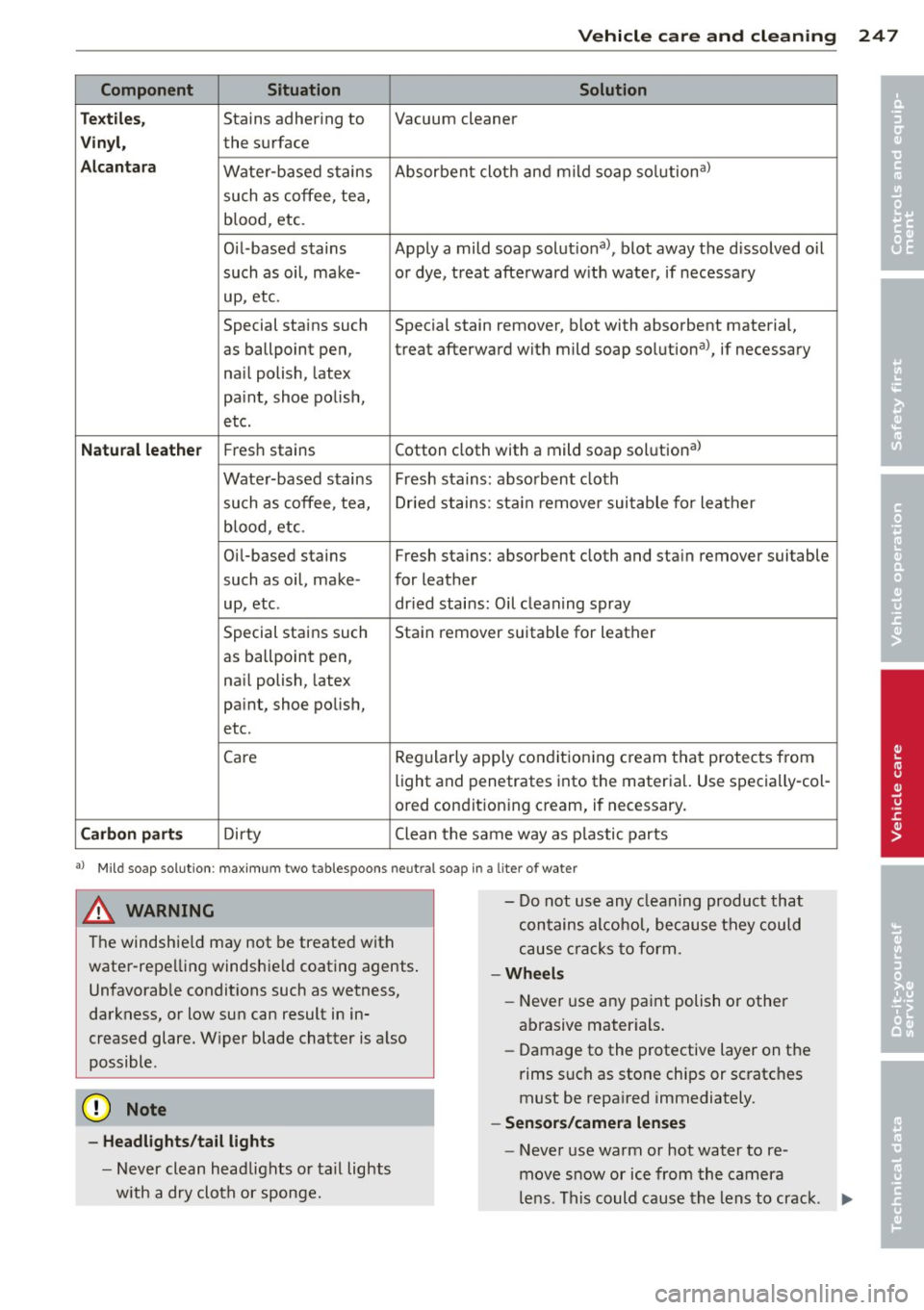
Component Situation Solution
Te xtile s,
Stains adhering to Vacuum cleaner
Vinyl, the surface
Alcantara Water-based stains Absorbent cloth and mild soap
solutional
such as coffee, tea, blood, etc.
Oil-based stains Apply a mild soap solutiona l, blot away the d issolved oil
such as oil, make- or dye, treat afterward w ith water, if necessary
up, etc.
Special stains such Special stain remover, b lot with absorbent material,
as ballpoint pen, treat afterward with mild soap solutiona l, if necessary
na il polish, latex
pa int, shoe polish,
etc.
Natural leather Fresh stains Cotton cloth with a mild soap solutiona l
Water-based stains Fresh sta ins: absorbent cloth
such as coffee, tea, Dried stains: stain remover suitable for leather
blood , etc .
Oil-based stains Fresh stains: absorbent cloth and stain remover suitable
such as oil, make- for leather
up , etc . dried sta ins: Oil cleaning spray
Special stains such Sta in remover suitable for leather
as ballpo int pen,
nai l polish, latex
paint, shoe polish,
etc.
Care Regularly apply conditioning cream that protects from
light and penetrates
into the material. Use specially-col-
ored conditioning cream, if necessary.
Carbon parts Dirty Clean the same way as plastic parts
al Mil d soap so lution: m axim um two ta bles poo ns neu tral soa p in a lite r of water
& WARNING
The windshie ld may not be treated with
water-repelling windshie ld coating agents .
Unfavorab le conditions such as wetness,
darkness, or low sun can result in in
creased glare. W iper blade chatter is also
possible.
- Headlights/tail lights
- Never clean headlights or tail lights
w ith a dry cloth or sponge. -
Do not use any cleaning product that
contains alcohol, because they could
cause cracks to form.
-Wheels
-Never use any paint polish or other
abrasive mater ials.
- Damage to the protective layer on the
rims such as stone chips or scratches
must be repaired immediately .
-Sensors/camera lenses
- Never use warm or hot water to re-
move snow or ice from the camera
len s. This could cause the lens to crack .
IJII>
•
•