ABS AUDI Q7 2014 Owner´s Manual
[x] Cancel search | Manufacturer: AUDI, Model Year: 2014, Model line: Q7, Model: AUDI Q7 2014Pages: 340, PDF Size: 85.02 MB
Page 270 of 340
268 Check ing and filling
If the brake fluid level falls considerably be
low the "MIN" mark, the brake warning/indi
cator light (U .S . mode ls:
1111 , Canadian
models: .) will come on
<::> page 19 and
<::> page 32. Do not continue to operate the ve
h icle . The complete brake system should be
thoroughly checked by an authorized Aud i
dea ler or qualified workshop and the cause
corrected. If the brake fluid level is too low,
the brake warning/indicator light will illum i
nate . Contact an authorized Aud i dealer
im
m ediatel y.
@ Tips
The brake fluid rese rvoir is located unde r
neath the cove r.
Changing brake fluid
Hove the broke fluid changed by on experi
enced technician.
Brake fluid absorbs moisture from the a ir . If
the water content in the brake fluid is too
h igh , corrosion in the brake system may result
after a per iod of t ime. The bo iling po int of the
brake fluid wi ll also decrease considerably and
decrease braking performance.
Therefore, the brake flu id must be changed
e ver y tw o year s. Always use new b rake fluid
which conforms to Federal Motor Vehicle
Standard "FMVSS 1 16 DO T 4".
The brake flu id reservo ir can be difficult to
reach, therefore, we recommend that yo u
have the brake f luid changed by you r author
ized
Audi dea ler. Your dea ler has the correct
too ls, the right brake fluid and the know -how
to do this for you.
A WARNING
- Brake fluid is poisonous . It must be stor
ed only i n the closed orig inal container
o ut of the reach of children!
- Brake fa ilure can result from old or inap
propriate b rake fluid. Observe these pre
caut ions: -
Use only brake fluid that meets SAE
specification
J 1703 and conforms to
Federa l Motor Vehicle Standard 116.
Always check with your authorized Audi
dealer to make sure you are using the
correct brake fluid . The correct type of
brake f lu id is also ind icated on the
brake flu id reservoir.
- T he brake fluid must be new. Heavy use
of the bra kes ca n cau se a vapo r lock if
the b rake fluid is left in the system too
l ong . This can seriously affect the effi
c iency of the brakes as well as your
safety. This co uld resu lt in an accident.
(D Note
Bra ke fluid will damage the paint of you r
vehicle .
(® For the sake of the environment
Because of the p rob lem of p roper disposal
of b ra ke fluid as well as the spec ial too ls
r equired and the necessary expertise, we
re commend that yo u have the brake fluid
changed by yo ur authorized Aud i dea ler.
Battery
General information
U nder normal ope rat ing cond itions, the bat
tery in yo ur Audi does not need any ma inte
nance. With
high o utside tempe ra tur es or
l ong dai ly drives we recommend that you have
the e lectrolyte level checked by an authorized
Audi dealer or qualif ied workshop. The elec
trolyte level should also be checked each time
the battery is charged
<::> page 2 70.
Have the battery checked when yo u take your
vehicle in for service. You are well advised to replace a battery that is o lder than 5 years .
With certain types of airbag deployment, the batte ry is disconnected from the veh icle elec
trical system for safety reasons¢.&
in Re
pair , core and disposal of the airbags on
page 197.
~
Page 271 of 340
Disconne cting the batt ery t erminals
Some vehicle functions (power w indow regu
l ators, for example) are lost if the battery ter
minals are disconnected . These functions have
to be re learned after the battery terminals are
connected again. To prevent this, the battery
should only be disconnected from the vehicle
electrical system when absolutely necessary
for repairs .
Vehicle s not driven fo r lo ng period s
If you do not drive your vehicle over a period
of several days or weeks, electrical compo
nents are gradually cut back or switched off .
This reduces energy consumption and main
tains starting capab ility over a longer per iod
¢ page 229 .
Take into consideration that when you unlock
your vehicle, some convenience functions,
such as the inter ior lights or the power seat
adjustment, may not be available . The con
ve nience funct ions w ill be available again
when yo u turn on the ignition and start the
engine.
Winter op eration
During the winter months, battery capacity
tends to decrease as tempe ratures d rop . This
i s because more powe r is also consumed while
start ing, and the headl ights, rea r window de
fogger, etc., are used more often.
Avo id unnecessary power consumption, par
ticularly in c ity t raffic or when t rave ling on ly
short d istances. Let you r autho rized Aud i
dealer check the capacity of the vehicle bat
tery before winter sets in ¢
page 270. A we ll
charged battery wi ll not only prevent starting
prob lems when the weather is cold, but will
also last longer .
If your vehicle is left standing for severa l
weeks at extremely low temperat ures, the
veh icle battery should be removed and
stored where it will not freeze. This will
prevent it from bei ng damaged and hav ing
to be replaced.
Checkin g and fillin g 269
Working on the battery
Be especially careful when working on or near
the battery.
The battery is located under the driver 's seat.
Before you check anyth ing under the dr iver's
seat,
read and h eed all WARNINGS G &_ .
Always heed the safety warnings , when work
ing on the vehicle battery or the vehicle e lec
trical system to prevent injury .
The following WARNINGS are ver y
important when working on the batter y:
Alway s heed the following WARN IN G SY M-
BOLS a nd safety p re caution s when working
on the battery .
®
Alway s wear e ye prote ction.
&
Bat te ry acid contains s ulfuric acid. Al-
ways w ear glov es and ey e prot ect ion .
@
No
-spar ks
- flames
- smo kin g.
A
When a batt ery i s charged , it produ ce s
hydro gen g as whi ch i s explo sive and
c o uld cau se pe rsonal injur y.
®
Alw ays k eep th e batt ery w ell out of
reac h of chi ldr en .
.8, WARNING
Whenever working on the battery or on
the electrical system, there is the risk of
injury, accident and even fire . Read and
heed the following WARNINGS:
- Always wear eye protection. Do not let
battery ac id or any lead particles get on
your skin or clothing . Shield you r eyes .
Exp losive gases can cause blindness or
other injury.
- Battery acid contains sulfuric acid. Sulfu
ric acid can cause blindness and severe
burns.
- Always wear g loves and eye protection.
-
Do no t tilt the ba ttery because acid .,. •
•
Page 294 of 340

292 Tires and wheels
TPMS malfunction indicato r is combined with
the low tire pressure telltale . When the sys
tem detects a malfunct ion, the te lltale will
flash for approximately one minute and then
remain continuously illuminated. This se
quence will continue upon subsequent vehicle
start-ups as long as the malfunction exists.
When the malfunction indicator is illuminat
ed, the system may not be able to detect or
signal low t ire pressure as intended. TPMS
malfunctions may occur for a variety of rea
sons, includ ing the installat ion of replace
ment or alt ernate tires or wheels on the vehi
cle that prevent the TPMS from functioning
properly. Always check the TPMS malfunct ion
tellta le after replacing one or more tires or
wheels on your vehicle to ensure that the re p lacement or a lternate tires and wheels allow
the TPMS to continue to function properly.
Tire pressure indicator appears
The tire pressure indicator in the instrument
cluster informs you if the tire pressure is too
low or if there is a system malfunction.
Fig. 254 D isplay: underinflat ion wa rning
Using the ABS sensors, the tire pressure moni
toring system compares the tire tread circum
ference and vibration characteristics of the in
dividual tires. If the pressure decreases in one
or more tires, this is indicated in the instr u
ment cluster with a
[D] warning symbol and a
message ¢
fig. 254. The driver message in the
display goes out after S seconds. The driver
message can be displayed again by pressing
the
! CHECK I button . If only one tire is affect
ed, the display will indicate its position . The tire pressure
monitoring must be reset via
MMI each time the pressures are adjusted (e.
g. when switching between partial and full
load pressure) or after changing or replacing a
tire on your vehicle¢
page 293. The TPMS in
dicator on ly monitors the tire pressure that
you have prev iously stored . You can find the
re commended t ire pressures for your vehicle
on the label on driver's s ide B-pillar
¢page 277.
Tire tread circumference and vibration charac
teristics can change and cause a tire pressure
warning if:
- the t ire pressure in one or more tires is too
low,
- the t ire has structural damage,
- the t ire pressure was changed, wheels rotat-
ed or replaced but the TPMS was not reset
¢page 293.
Warning symbols
[D] Loss of pressure in at least one tire¢.&. .
Check the tire or tires and replace or repa ir if
necessary. The
[I] indicator light in the instru
ment cluster also illuminates
¢page 14.
Check/correct the pressures of all four tires
and reset TPMS via MMI.
@m (T ire Pressure Mon itor ing System) Tire
pressure: System malfunction!.
If ffiim appears afte r switching the ignition on
or whi le dr iving and the
[D] indicator light in
the instrument cluster blinks for approx i
mately one minute and then stays on, there is
a system malfunct ion .
Attempt to store the correct tire pressure
¢
page 293. If the indicator light does not
turn off or if it turns on shortly thereafter, im
med iate ly drive your vehicle to a n author ized
Audi dealer or authorized repair facility to
have the malfunction corrected.
.&_ WARNING
- If the tire pressure indicato r appears in
th e ins trum ent cluster display, one or
more of your tires is significantly under
inflated . Reduce your speed immediately ..,_
Page 295 of 340
and avoid any hard steering or braking
maneuvers. Stop as soon as possible and
check the tires and their pressures. In·
flate the tire pressure to the proper pres
sure as indicated on the vehicle's tire
pressure label ¢
page 2 77. Driving on a
significantly under-inflated tire causes
the tire to overheat and can lead to tire
failure. Under-inflation also is likely to
impair the vehicle's handling and stop
ping ability.
- The driver is responsible for maintaining
the correct tire pressures. You must
check the tire pressures regularly.
- Under certain conditions (such as a spor
ty driving style, winter conditions or un
paved roads), the pressure monitor indi
cator may be delayed.
- Ask your authorized Audi dealer if run
flat tires may be used on your vehicle.
Your vehicle registration becomes invalid
if you use these tires when not permit
ted. Damage to your vehicle or accidents could also result.
@ Tips
- The tire pressure monitoring system
stops working when there is an ESC/ABS
malfunction.
- Using snow chains may result in a system
malfunction.
- The tire pressure monitoring system on
your Audi was developed using tires with
the "AO" or "RO" identification on the
tire sidewall¢
page 284. We recom
mend using these tires.
Reset tire pressure monitoring system
If the tire pressure is adjusted, wheels are ro tated or changed, the TPMS must be reset via
MMI.
.,. Before resetting the TPMS, the current pres
sures of all four tires must correspond to
the specified values. Adjust the tire pressure and reset the pressure in the tire pressure
Tires and wheels 293
monitoring system according to the load
you are carrying
¢ page 277.
.,. Turn on the ignition.
.,. Select:
!CAR I function button > Systems*
control button > Tire pressure monitoring >
Store now. Or
.,. Select:
!CAR I function button> Car systems*
control button > Servicing & checks > Tire
pressure monitoring
> Store tire pressures .
@ Tips
Do not store the tire pressure if there are
snow chains on the tire.
•
•
Page 296 of 340
2 94 What do I do now ?
What do I do now?
Jack, tools and
inflatable spare tire
Tools
The tool kit is located in the luggage com
partment under the cargo floor cover.
Fig. 255 Luggage compart men t: vehicle too l kit
The onboard tool kit includes:
- Hook for removing wheel covers*
- Plast ic hook to remove wheel bolt covers*
- Wheel bolt wrench
- Alignment pin for changing wheels
- Screwdriver with reversible blade
- 10 x 13 open ended wrench
- Towing eye
(D Tips
Some of the onboard items listed above
are provided on certa in models only or are
optional ext ras .
Jack and folding chocks
The jack and the folding chocks are located in
the luggage compartment under the cargo
floor cover.
Fig . 256 Luggage compartment veh icle jack and fo ld
i ng chocks
-----........ -
Fig. 257 Open ing fold ing chocks
Veh icle jack
The jack is located under the tool kit
<=> fig . 256. Before storing the jack, make sure
it is wound back down as far as it will go.
Folding chock s
Two unassembled folding chocks are attached
to the foam section at the front with the jack
<=>fig. 256.
Release the two hook-and-loop fasteners, and
remove the two chocks. To use the chocks, you
first have to raise the support plate
<=> fig. 257 (!) and then insert the locking plate
with the two "tabs" into the elongated holes
in the base plate@<=>&. .
A WARNING
--The chock cannot fulfill its function and
may lose its stability if the "tabs" on the
suppo rt p late are not inse rted correctly
into the elongated holes in the base
Page 297 of 340
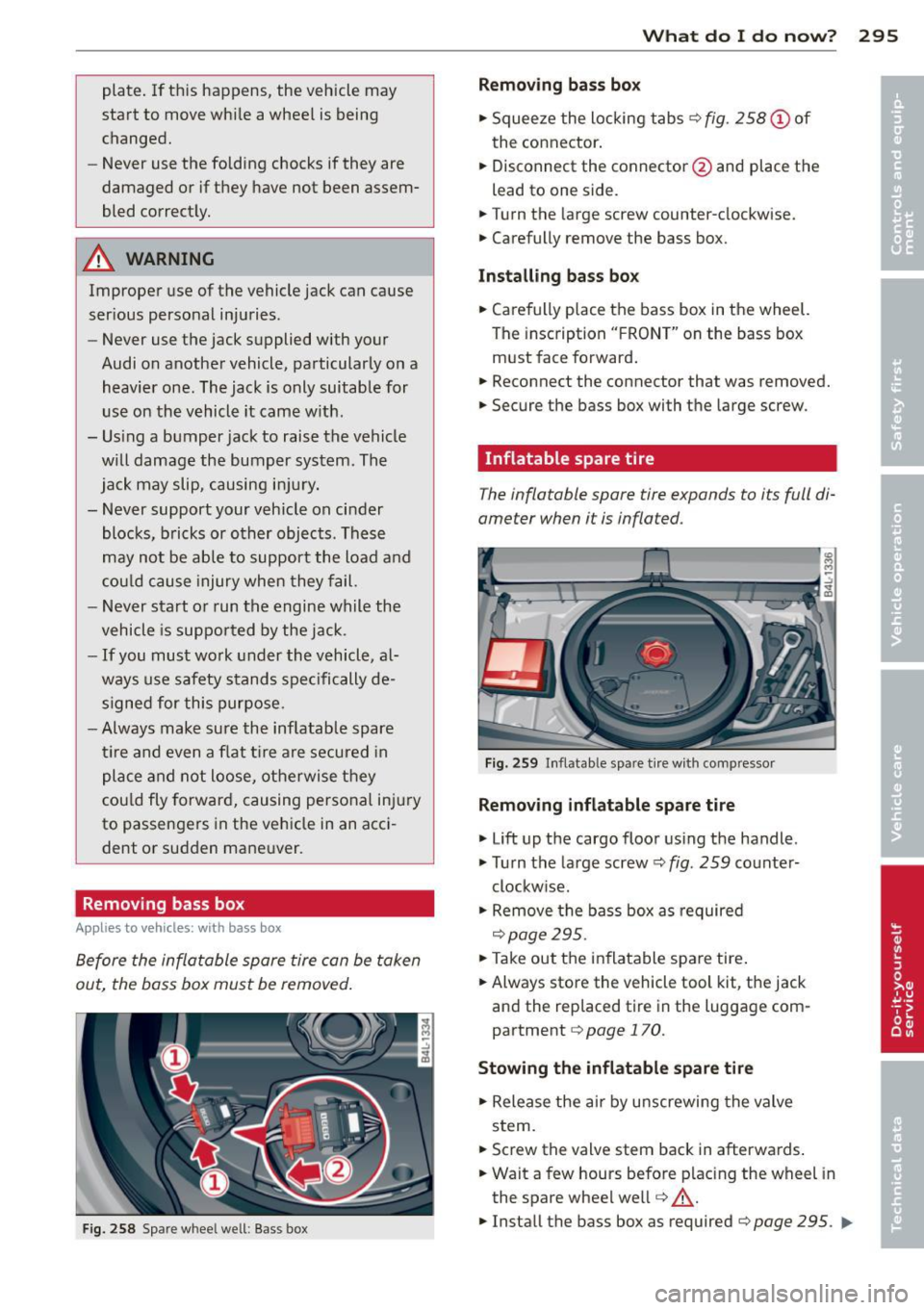
plate. If this hap pens , the vehicle may
start to m ove whi le a whee l is being
changed.
- Never use the folding chocks if they are
damaged or i f they have not been assem
bled correct ly.
A WARNING
Improper use of the vehicle jack can cause
ser ious personal injuries.
- Never use the jack supplied with your
Audi on another vehicle, particularly on a heavier one. The jack is only suitable for
use on the vehicle it came w ith .
- Us ing a bumper jack to raise the vehicle
will damage the bumper system. The
jack may slip, causing i njury.
- Never support your vehicle on cinder bloc ks, b ricks or other objects. Th ese
may not be able to support the load and
cou ld cause injury when they fail.
- Never start or run t he engine while the
vehicle is suppor ted by the jack.
- If you must wo rk under the vehicle, al
ways use safety stand s spe cifically de
signed for this purpose.
- Always make sure the inflatable spare
tir e a nd even a f lat t ire are se cured in
place and not loose, ot herwise they
cou ld fly forward, causing personal inj ury
to passengers in the veh icle in an acc i
dent or sudden mane uver.
Removing bass box
Applies to vehicles: with bass box
Before the inflatable spare tire can be taken
out, the bass box must be removed .
Fig . 2 58 Spare wheel well: Sass box
What do I do now ? 295
Removing bass box
.,. Squee ze the locking tabs ~ fig . 258 (D of
the conne ctor .
.,. Disconnect the connector @and place the
lead to one side.
.,. Turn the large screw counter-clockwise .
.,. Carefully remove the bass box.
Installing bass bo x
.,. Carefully p lace the bass box in the wheel.
The inscription "F RO NT" on the bass box
must face forward .
.,. Reconnect the connector that was removed.
.,. Secure the bass box with the large screw .
Inflatable spare tire
The inflatable spare tire expands to its full di
ameter when it is inflated.
Fig. 25 9 In flatable spare tir e w ith compressor
Removing inflatable spare tire
.,. Lift up the cargo floo r us ing the handle .
"' Turn the large screw
9 fig . 259 co unte r-
clockw ise.
"' Remove the bass box as required
¢ page 295 .
.,. Take out the in flatable spare tire .
.,. Always store the vehicle tool kit, the jack
and the replaced tire in the luggage com
partment
9 page 170.
Stowing the inflatable spare t ire
"' Release the ai r by u nscrewing the valve
stem .
.,. Screw the valve stem back in afterwards .
.,. Wait a few hours before p lac ing the wheel in
the spare wheel we ll¢ ,& .
"' Install the bass box as required ¢
page 295 . ..,_
Page 336 of 340
334 Index
Tread Wear Indicator (TWI) . ... .. .... . 283
Trip computer Fuel consumption . . . . . . . . . . . . . . . . . . 24
M ileage .... ............. .. .. .. .. .. 24
Sing le -tr ip memory ....... .. .. .... .. 25
Total -t rip memo ry . . . . . . . . . . . . . . . . . . 25
Trip odometer .............. ... .. ... . 12
What does it mean whe n dEF appears in
the t rip odomete r d isplay? . .. .. .... .. 12
Trunk
refer to Rear lid . . . . . . . . . . . . . . . . 45, 46
T u rn ing rear air conditioning on/off
Four -z one automatic comfort a ir condi-
tioning ...... ........... .. .. .... .. 99
T u rn signa ls . ... . .. ..... ... .. .. .... .. 60
Warning/indicator lights ... .. .. .... . . 16
u
Unfasten ing sa fe ty be lts
Unid irect iona l tires .......... ... .. .. .
Uniform ti re quality g rading ... .... .. .
Un lo ck ing 180
273
287
P owe r locking sw itch .... .. .. .. .. .. . . 44
Rear lid/trunk l id ......... .... .... .. 45
Remote control key . . . . . . . . . . . . . . . . . 4 3
Using the key . . . . . . . . . . . . . . . . . . . . . . 43
V
Va let key function
Activa ting and deactivating ... ... ... .. 41
Vanity m irror . . . . . . . . . . . . . . . . . . . . . . . . 62
Vehicle Care/clean ing ............ .. .. .... . 244
Vehicle ident ificat ion labe l ... .. .. .. .. . 3 13
Vehicle Identification N umber (VIN) ... . 313
Vehicle jack . . . . . . . . . . . . . . . . . . . 294, 299
Vehi cle liter ature . . . . . . . . . . . . . . . . . . . . . 5
Vehicle shut-down .......... ... .. .. . 234
Vent ilation
Climate controls . . . . . . . . . . . . . . . . . . . . 92
V in yl
C le a ning ... ... .......... .. .. .. .. . 247
w
Warning/ind ica tor lights . ..... .... . .. . 10
Adaptive Air Suspension . . . . . . . . . . . . . 17
Adaptive cruise control . ..... ... .. .. 121
Airbag system .................... . 16
Anti- lock brake system (ABS) . . . . . . . . . 18
Brake system ...... .... .... ... .. .. . 19
Cruise contro l . . . . . . . . . . . . . . . . . . . . . . 18
E lectronic power cont rol ... ...... ... . 15
El ectronic Stab ilization Contro l (ESC) .. . 16
G low p lug sys tem ............. .... . 15
Hig h beam .. .. .. ... .......... .. .. . 18
Malfunction Ind icator Lamp (M IL) .. .. . 17
Pa rking brake .... .. .... .... ... .. .. . 19
Safety be lt . . . . . . . . . . . . . . . . . . . . . . . . 18
Tire pressure monitoring system . . . . . . 18
Trail er turn s ignal assembly ... .. .... . 17
Turn signals ... .. ... .. .. ... ..... .. . 16
Warning lights . . . . . . . . . . . . . . . . . . . . . . 14
Wa rranty coverages .... ... ...... .. .. 316
Washer reservo ir .... ........... .. .. 272
Wea r indica to r .. .. .. .... .... ... .. .. 28 3
We ights ....... ... ................ . 313
What happens if yo u wear your safety belt
too loose? .. .... .. ............. .... 179
Wh at happens to unbelted o ccupants? .. 176
What impai rs driving safety? ....... ... 16S
What shou ld I do after changing a
whee l? . .... .... .. ................. 280
Wh at shou ld I do afte r repla cing whee ls? 280
Wheel bolts Torque ....... ... ................ . 290
Wheels . ... .... .. ... .. ..... .... . .. 273
Checking t ire pressure .......... .. .. 279
Cleaning .. .... .. ... .......... .... 246
Co ld tire inflation pressure .. ... ... .. 277
General notes .. .. .......... ...... . 273
G lossary of tire and loading terminolo-
gy ... .. .. .. .. .. ............... .. 274
New t ires and whee ls ........... .... 28 4
T ires and veh icle loa d limits ..... .... 281
When must a safety be lt be replaced? .. 177
When m ust the airbag system be inspect -
ed? .... .... .... .. ................. 194
When should I adjus t the tire pressures? 280
When should I check the tire press ures? . 280