page 27 AUDI Q7 2014 Owner´s Manual
[x] Cancel search | Manufacturer: AUDI, Model Year: 2014, Model line: Q7, Model: AUDI Q7 2014Pages: 340, PDF Size: 85.02 MB
Page 75 of 340
Front passenger's seat
Always move the front passenger seat into the rearmost position .
To avoid contact with the airbag while it is de
ploying, do not sit any closer to the instru
ment panel than necessary and always wear
the three-point safety belt provided adjusted
correctly . We recommend that you adjust the
passenger's seat in the following manner:
.. Move the front passenger seat into the rear
most position of the fore and aft adjustment
range
~ .&. in Why is your seat adjustment
so important? on page
72.
• Bring the backrest up to an (almost) upright
position.
Do not ride with the seat reclined.
.. Adjust the head restraint so the upper edge
is as even as possible with the top of your
head . If that is not possible, try to adjust
the head restraint so that it is as close to
this position as possible ¢
page 77 .
.. Place your feet on the floor in front of the
passenger's seat .
Power front seat
adjustment
Seat adjustment controls
The operating logic for the switches corre
sponds to the cons truction and function of
the seat.
ui
"' ~ -" __.___,., 1,--~--,-,:,
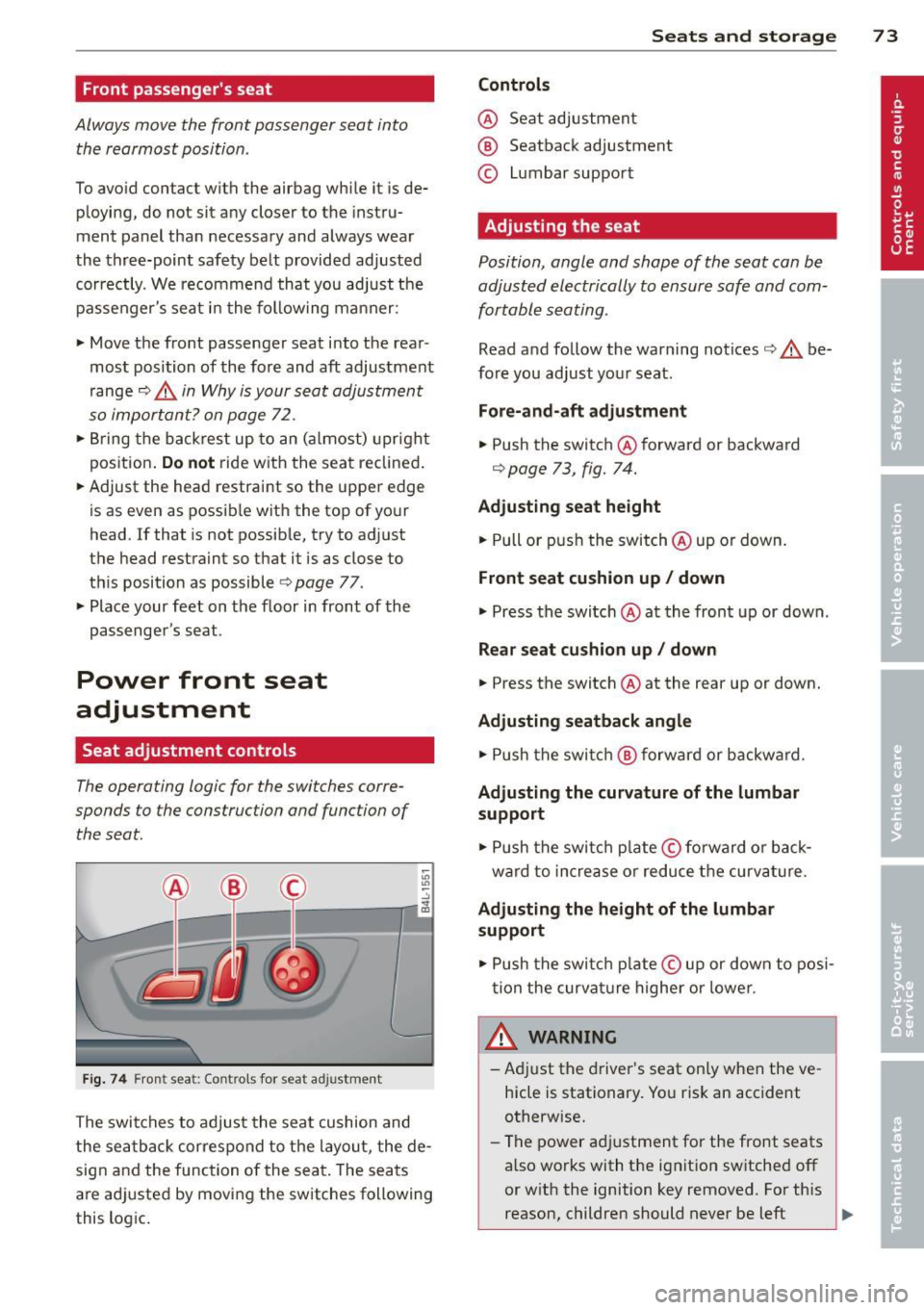
Fig. 74 Front seat: Co ntr ols for seat a djustment
The switches to adjust the seat cushion and
the seatback correspond to the layout, the de
sign and the function of the seat. The seats
are adjusted by moving the switches following
this logic.
Seats and storage 73
Controls
@ Seat adjustment
® Seatback adjustment
© Lumbar support
Adjusting the seat
Position, angle and shape of the seat can be
adjusted electrically to ensure safe and com
fortable seating .
Read and follow the warning notices¢.&. be
fore you adjust your seat .
Fore-and-aft adjustment
.. Push the switch @forward or backward
¢ page 73, fig. 74 .
Adjusting seat height
.. Pull or push the switch @up or down.
Front seat cushion up/ down
.. Press the switch @at the front up or down .
Rear seat cushion up/ down
.. Press the switch @at the rear up or down.
Adjusting seatback angle
.. Push the switch @ forward or backward.
Adjusting the curvature of the lumbar
support
.. Push the switch plate© forward or back
ward to increase or reduce the curvature.
Adjusting the height of the lumbar
support
.. Push the switch plat e© up or down to posi
tion the curvature higher or lower .
A WARNING
-Adjust the driver's seat only when the ve
hicle is stationary. You risk an accident
otherwise.
- The power adjustment for the front seats
also works with the ignition sw itched off
or with the ignition key removed. For this
reason, children should never be left
IJIJ>
Page 76 of 340
7 4 Seats and storage
unattended in the vehicle -they could be
injured!
- Exercise caution when adjusting the seat
height. Unsupervised or careless seat ad
justment can pinch fingers or hands causing injuries.
- While the vehicle is moving, the seat
backs of the front seats must not be in
clined too far to the rear because the ef
fectiveness of the safety belts and the
airbag system is severely compromised -
there is a risk of injury.
- To reduce the risk of injury in the case of
sudden braking or accident, front pas
sengers must never ride in a moving ve
hicle with the seatback reclined . Safety
belts and the airbag system only offer
maximum protection when the seatback
is upright and the safety belts are prop
erly positioned on the body. The more
the seatback is reclined, the greater the
risk of personal injury from an incorrect
seating position and improperly posi
tioned safety belts .
Seat memory
Driver's seat memory
Applies to vehicles: with seat memory
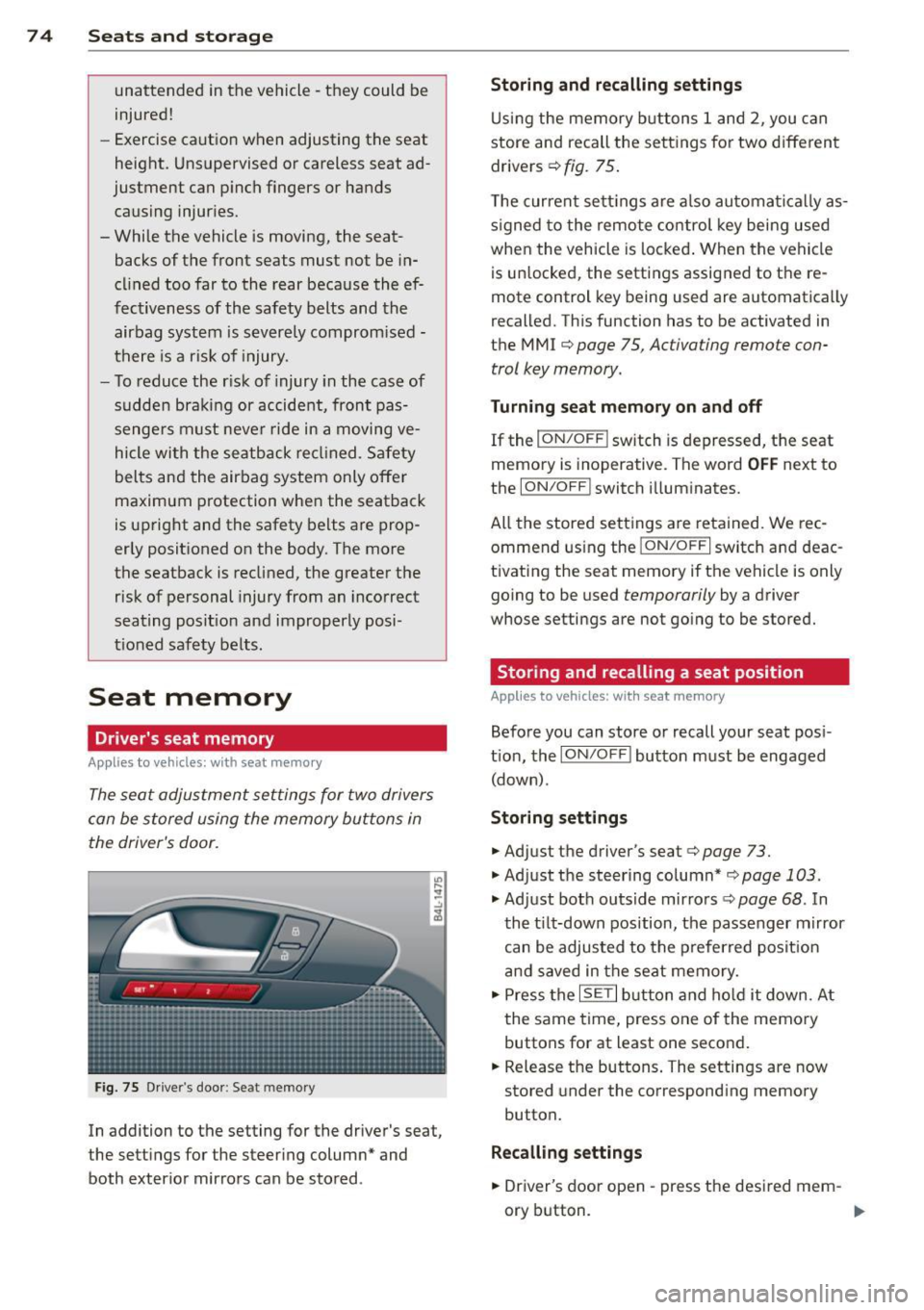
The seat adjustment settings for two drivers
can be stored using the memory buttons in
the driver's door.
Fig. 75 Drive r's door : Se at me mory
In addition to the setting for the driver 's seat,
the settings for the steering column* and both exterior mirrors can be stored .
Storing and recalling settings
Using the memory buttons 1 and 2, you can
store and recall the settings for two different
drivers ¢
fig. 75.
The current settings are also automatically as
s igned to the remote control key being used
when the vehicle is locked. When the vehicle
is unlocked, the settings assigned to the re
mote control k ey b eing used are automatically
recalled. This function has to be activated in
the MMI ¢
page 75 , Ac tiva ting remo te con
trol key memory.
Turning seat m emory on and off
If the I ON/OFF I switch is depressed, the seat
memory is inoperative. The word
OFF next to
the
ION/O FF! switch illuminates.
All the stored settings are retained. We rec
ommend using the
I ON/O FF I switch and deac
tivating the seat memory if the vehicle is only
going to be used
temporarily by a driver
whose se tting s are not going to be stored.
Storing and recalling a seat position
Applies to vehicles: with seat memory
Before you can store or recall your seat posi
tion, the
ION/OFF I button must be engaged
(down) .
Storing settings
.,. Adjust the driver 's seat ¢ page 73 .
.,. Adjust the steering column*¢ page 103 .
.,. Adjust both outside mirrors¢ page 68. In
the tilt-down position, the passenger mirror
can be adjusted to the preferred position
and saved in the seat memory .
.,. Press the
ISETI button and hold it down. At
the same time, press one of the memory
buttons for at least one second .
.,. Release the buttons. The settings are now
stored under the corresponding memory
button.
Recalling settings
.,. Driver's door open -press the desired mem-
ory button . _..
Page 77 of 340
~ Driver's door closed -press the correspond
ing memory button until the stored position
is reached.
Successful storage is conf irmed audibly and
by the light in the
!SE T! button illuminating.
When the vehicle is
locked, the current set
tings are stored and ass igned to the remote
control key. But the settings stored on memo
ry buttons
1 and 2 are not deleted. They can
be recalled at any time. When the vehicle is
unlocked, the settings assigned to the remote
control key are restored.
I f your vehicle is driven by other persons using
your remote control key , you should save your
individual seat position on one of the memory
buttons. You can recall your settings again
simply and conven iently by pressing the corre
spond ing memory button . When the vehicle is
locked, these settings are automatically re-as
signed to the remote control key and stored.
A WARNING
-For safety reasons, the seat setting can
only be recalled when the vehicle is sta
tionary -othe rwise you risk having an ac
cident.
- In an emergency, the recall operation
can be stopped by pressing the
!ON/O FF I
button or by briefly pressing any given
memory button.
Activating remote control key memory
Applies to vehicles: with seat memo ry
To assign the driver's seat settings to the re
mote control key when locking the vehicle, the
function must be activated in the MMI.
~ Select: I CARI function button > Systems*
control button > Seat adjustment > Driver 's
seat> Key mem. profile
> On. Or
~ Select : I CARI function button > Car systems*
control button > Vehicle settings > Seats >
Driver's seat> Remote control key> On.
Seats and storage 75
(D Tips
If you do not want another driver's set
tings to be assigned to the remote control key, switch off the memory function using
the MMI or the
I ON/OF F! button
¢ page 74.
Rear seats
General information
Safe transportation of passengers on the rear
seats requires proper safety precautions .
All passengers on the rear seats must be seat
ed in compliance with the safety guide lines
exp lain ed in
¢page 174 and ¢page 183.
The correct seating position is criti ca l for the
sa fety of front
and rear seat passengers alike
¢page 167.
A WARNING
-Occupants in the front and rear seats
must always be properly restrained.
- Do not let anyone ride in the vehicle
without the head restraints provided.
Head restraints help to reduce injuries.
- Loose items inside the passenger com
partment, can fly forward in a crash or
sudden maneuver and injure occupants.
Always store articles in the luggage com
partment and use the fastening eyes, es
pecially when the rear seatbacks have
been fo lded down .
- Read and heed all WARNINGS
¢ page 167, Proper seating positions
for passengers in rear seats .
Page 79 of 340
Folding seatback up and down (third
row seating)
Applies to vehicles: with third row seatin g
The third row seating is suitable for persons
up to 1.6 meters (5 ft 3 in) in height .
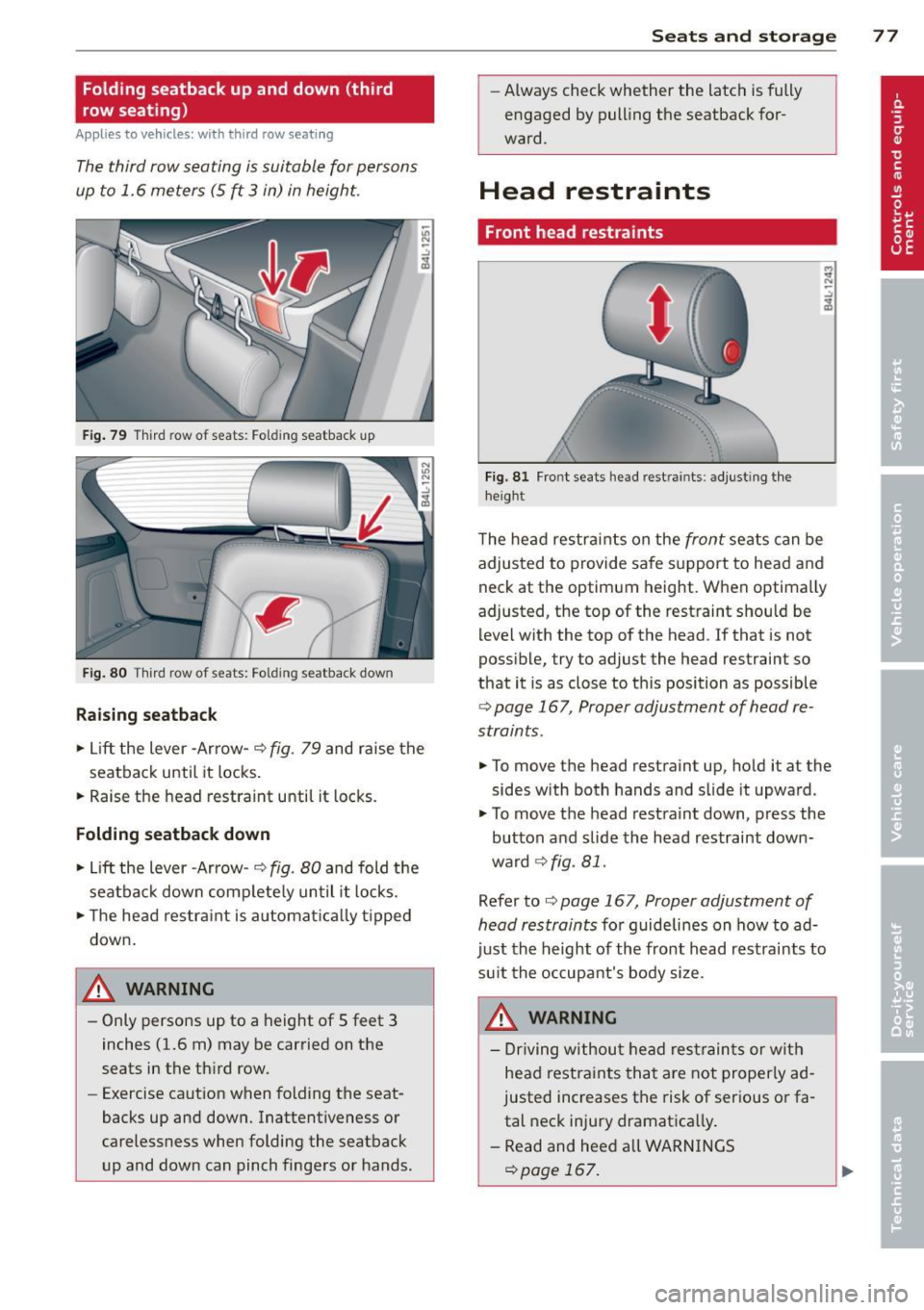
Fig. 79 Third row o f seats : Fo ld ing seatback up
Fig. 80 Third row o f seats: Fo ld in g seatback dow n
Raising seatback
~ Lift the lever -Arrow- ¢ fig. 79 and raise the
seatback until it locks.
~ Raise the head restraint until it locks.
Folding seatback down
~ Lift the lever -Arrow- ¢ fig. 80 and fold the
seatback down complete ly until it locks.
~ The head restraint is automat ically t ipped
down.
A WARNING
- Only persons up to a height of 5 feet 3
inches (1.6 m) may be carried on the
seats in the third row.
- Exercise caution when folding the seat
backs up and down. Inattentiveness or
carelessness when folding the seatback
up and down can pinch fingers or hands.
-
Seats and storage 77
-Always check whether the latch is fully
engaged by pull ing the seatback for
ward.
Head restraints
Front head restraints
Fig. 81 Fro nt seats head rest ra in ts: adjust ing the
height
The head restraints on the front seats can be
adjusted to provide safe support to head and
neck at the optimum height. When optimally
adjusted, the top of the restraint should be level with the top of the head . If that is not
possible, try to adjust the head restraint so
that it is as close to this position as possible
¢ page 167 , Proper adjustment of head re
straints .
~ To move the head restraint up, hold it at the
sides with both hands and slide it upward.
~ To move the head restraint down, press the
button and slide the head restraint down
ward ¢
fig. 81.
Refer to¢ page 167, Proper adjustment of
head restraints
for guidelines on how to ad
just the height of the front head restraints to
su it the occupant's body size.
A WARNING
- Driving without head restraints or with
head restraints that are not properly ad
justed increases the risk of serious or fa
tal neck injury dramatica lly.
- Read and heed all WARNINGS
c::>page 167.
Page 80 of 340
78 Seats and storage
@ Tips
Correctly adjusted head restraints and
safety belts are an extremely effective
combinat ion of safety features.
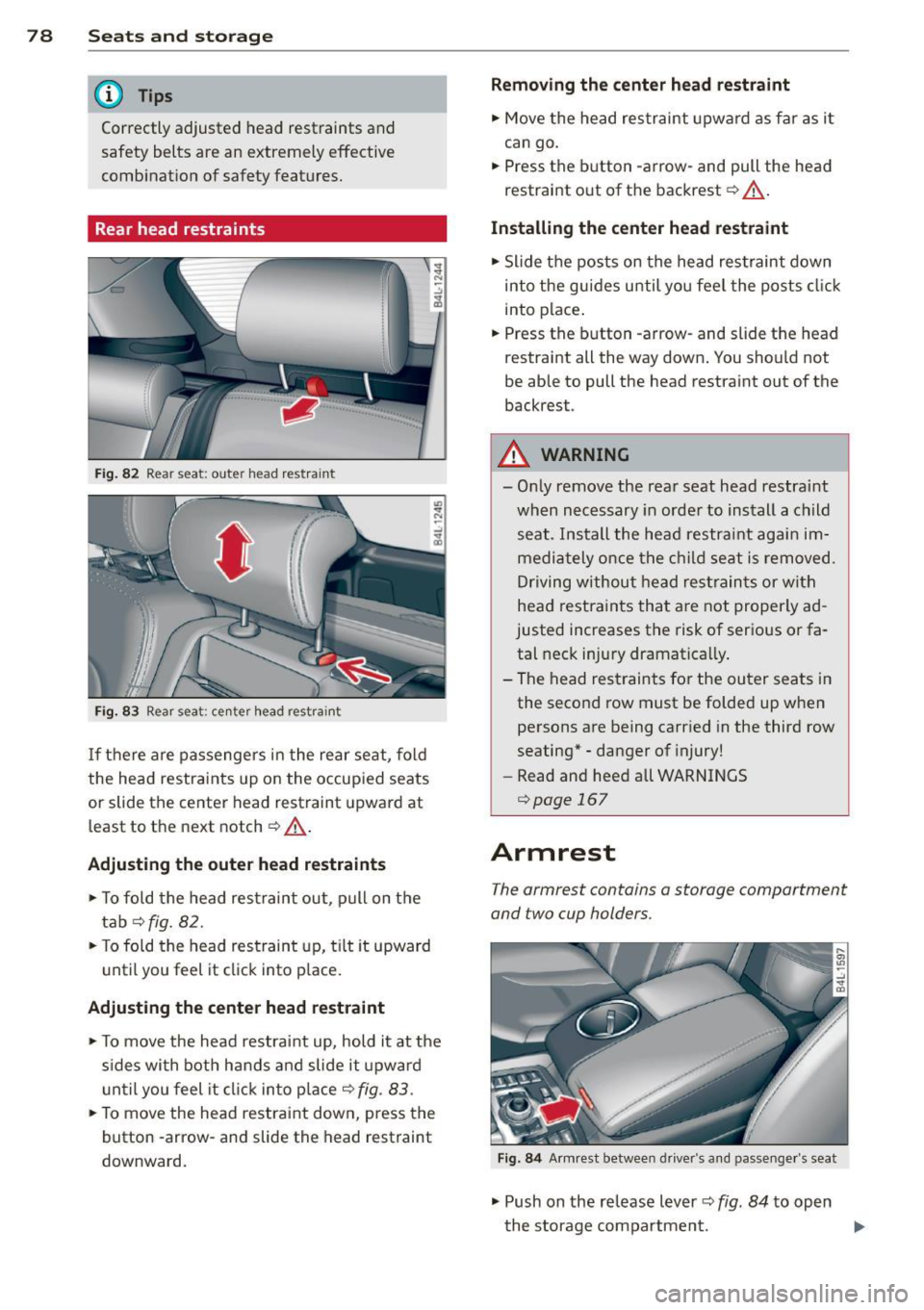
Rear head restraints
F ig. 82 Rear seat: ou ter hea d rest raint
Fi g. 83 Rear se at: ce nte r h ead restra int
I f the re are passengers in the rear seat, fold
the head restraints up on the occupied seats
or slide the cente r head restraint upward at
least to the next notch
~ .,& .
Adjusting the outer head restraints
.,. To fold the head restraint out, pull on the
tab ¢
fig. 82 .
.. To fo ld the head rest raint up, ti lt it upward
until you feel it c lick into p lace.
Adjusting the center h ead restraint
.,. To move the head restra int up , hold it at the
s ides wi th both hands and slide it upwa rd
u ntil you feel it cl ick into p lace
"* fig . 83 .
.. To move the head restraint down, press the
button -arrow -and slide the head restraint
downward.
Remo ving the center head re straint
.,. Move the head res traint upw ard as f ar as i t
can go.
.. Press the b utton -arrow -and pull the head
restraint o ut of the backrest "*.,& .
Installing the center head restraint
.. Slide the posts on the head restraint down
into the guides u ntil you feel the posts click
into place .
.. Press the b utton -arrow- and slide the head
r estraint all th e way down . You should not
be able to pull the head restraint out of the
backrest .
A WARNING
=
-On ly remove the rea r seat head restra int
when necessary in orde r to install a child
seat . Install the hea d restraint aga in im
mediately once the child se at is removed.
Driving without head res train ts or with
head restraints that are not properly ad
justed increases the r isk of serious or fa
tal neck injury dramatica lly.
- The head restraints for the outer seats in
the second row must be folded up when
persons are being carr ied in the third row
seating* - danger of injury!
- Read and heed all WARNINGS
¢page 167
Armrest
The arm rest contains a storage comportment
and two cup holders .
Fig . 8 4 Arm rest betwee n driver's a nd pass enge r's seat
.,. Push on the release lever ¢ fig. 84 to open
the storage compartmen t.
Page 82 of 340
80 Seats and storage
Luggage compartment
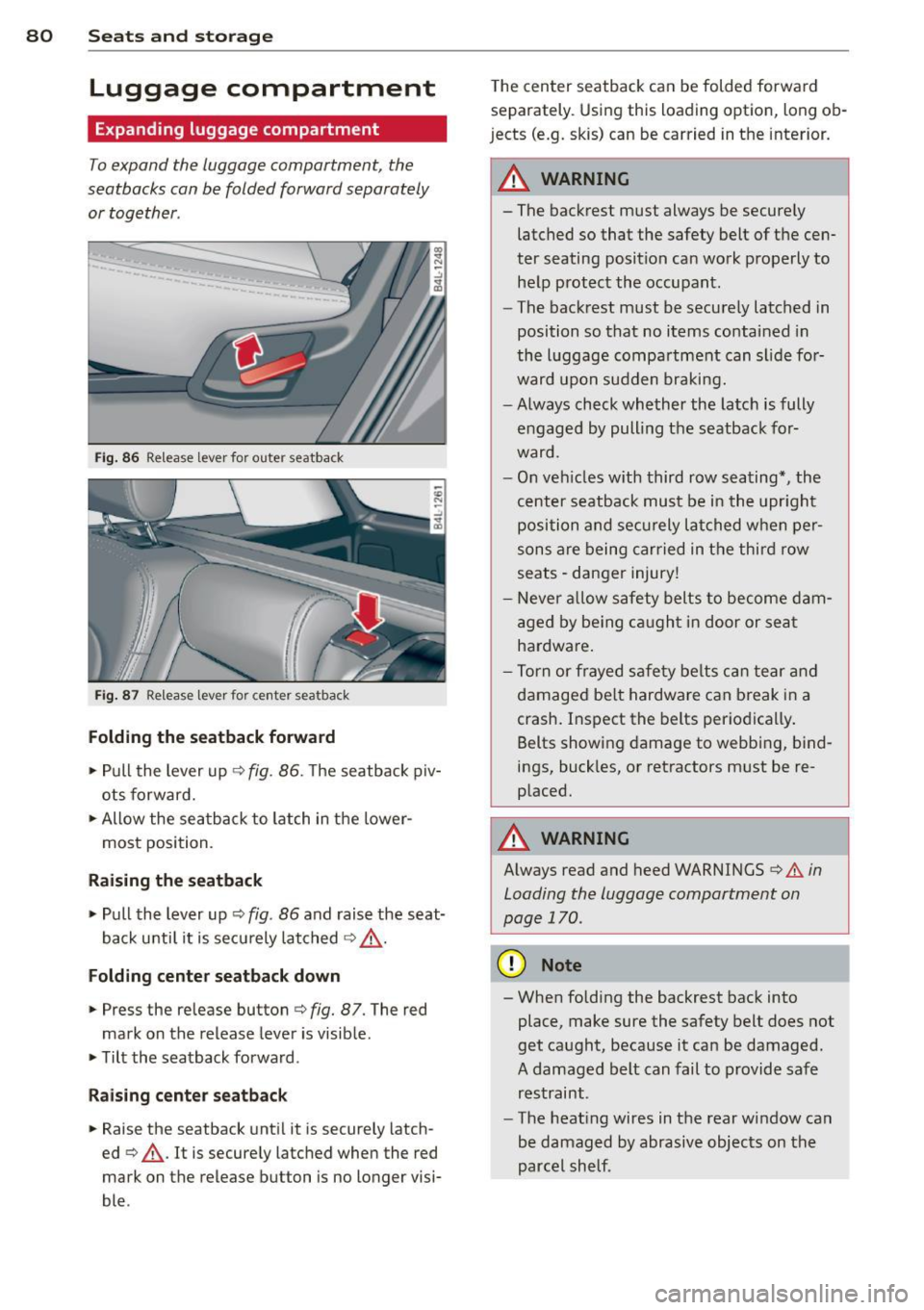
Expanding luggage compartment
To expand the luggage compartment, the
seatbacks can be folded forward separately or together .
Fig. 86 Release lever fo r outer seatback
Fig. 87 Release leve r for cente r seatback
Folding the s eatback forward
,. Pull the lever up c:> fig . 86. T he seatback piv
ots forward.
,. Allow the sea tback to latch in the lower·
most position.
Raising the seatback
,. Pull the lever up c:> fig. 86 and raise the seat
back u ntil it is securely latched
c:> & -
Folding cente r seatback down
,. Press the release button c:> fig. 87. The red
mark on the release lever is visible.
,. Tilt the seatback forward .
Raising center seatba ck
,. Raise the seatback until it is securely latch ·
ed
c:> & . It is securely latched when the red
mark on the release button is no longer visi·
ble . T
he center seatback can be folded forwa rd
separately . Using this loading option, long ob·
j ects (e.g. skis) can be carried in the interior.
A WARNING
--
- The backrest must always be secure ly
latched so that the safety belt of the cen·
ter seating position can wo rk p roperly to
help protect the occupant.
- The backrest must be securely latched in
position so that no items contained in
the luggage compa rtment can s lide fo r·
ward upon sudden braking.
- Always check whether the latch is fully
engaged by pulling the seatback for
ward.
- On veh icles w ith third row seating*, the
ce nter seatback must be in the upr ight
po sition and secu rely lat ched when per
son s are being carried in t he thir d row
seats -danger injury!
- Never allow safety belts to become dam·
age d by be ing ca ugh t in door or seat
hardwa re .
- Torn or frayed safety be lts ca n tear and
damaged be lt hardware can break in a
crash. Inspect the belts periodica lly .
Belts showing damage to webbing, bind
ings, buck les, or retractors m ust be re·
p laced.
A WARNING
-
A lways read and heed WARNINGS c:> .&. in
Loading the luggage compartment on
page
170 .
(D Note
-When folding the backrest back into
place , make sure the safety belt does not
get caught, because it can be damaged.
A damaged belt can fail to provide safe
restraint .
- The heat ing wires in the rear window can
be damaged by abrasive objects on the
parcel shelf .
Page 83 of 340
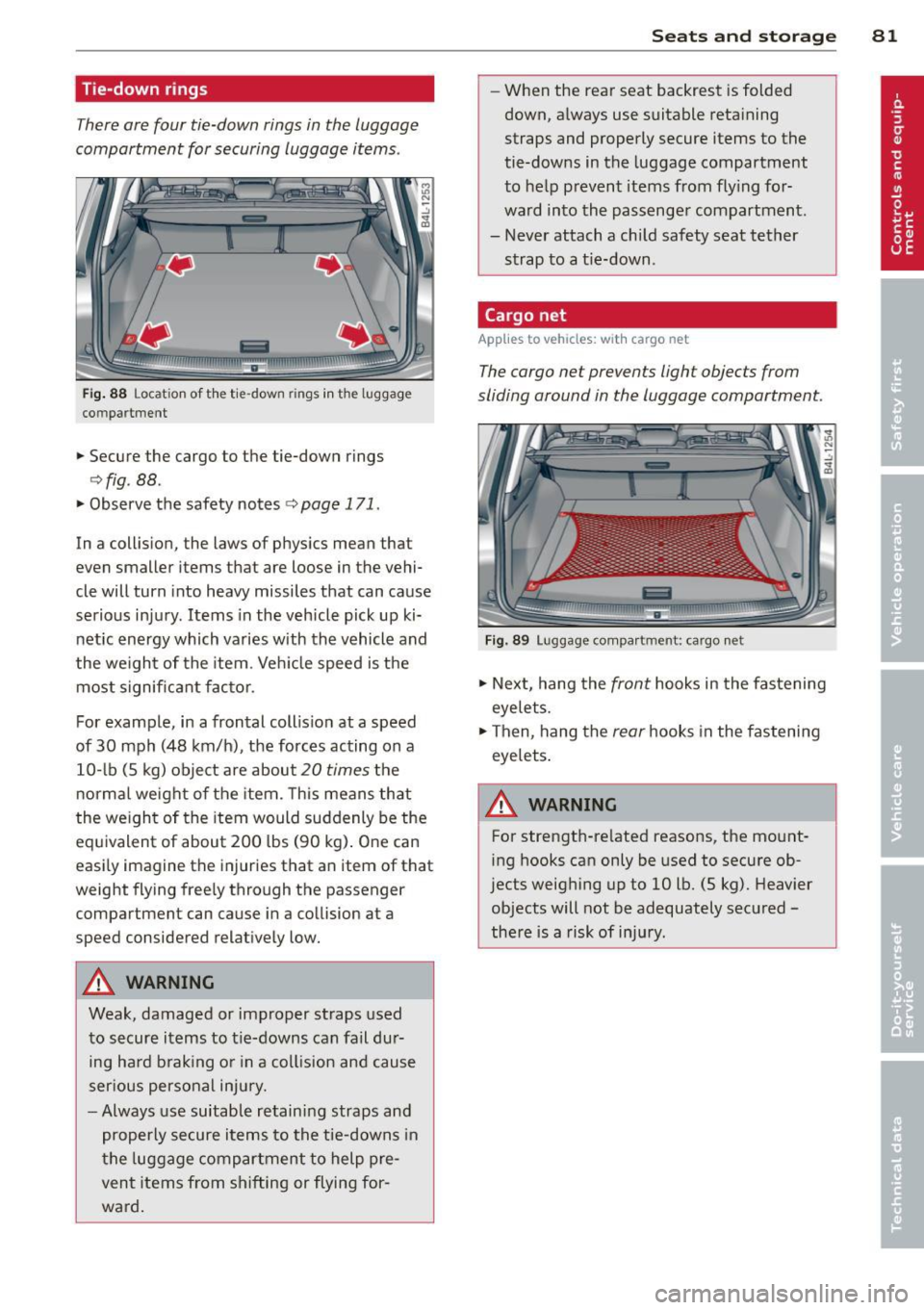
Tie-down rings
There are four tie-down rings in the luggage
compartment for securing luggage items .
liiiil
Fig. 88 Locat ion of t he tie -down rings in the luggage
co mpar tment
.,. Secure the cargo to the tie-down rings
i=> fig . 88 .
.,. Observe the safety notes c:> page 171 .
In a collision, the laws of physics mean that
even smaller items that are loose in the vehi
cle will turn into heavy missiles that can cause
serious injury . Items in the vehicle pick up ki
netic energy which varies with the vehicle and
the weight of the item . Veh icle speed is the
most significant factor.
For example, in a frontal coll ision at a speed
of 30 mph (48 km/h), the forces acting on a 10- lb (5 kg) object are about
20 times the
normal weight of the item. This means that
the we ight of the item would suddenly be the
equivalent of about 200 lbs (90 kg). One can
easi ly imagine the injuries that an item of that
weight flying freely through the passenger
compartment can cause in a collision at a
speed considered relatively low.
A WARNING
Weak, damaged or improper straps used
to secure items to t ie-downs can fail dur
ing hard brak ing or in a col lision and cause
ser ious personal injury.
- Always use suitable retaining straps and
properly secure items to the tie-downs in
the luggage compartment to help pre
vent items from shifting or flying for
ward.
.
S ea ts a nd s to rage 81
- When the rear seat backrest is folded
down, always use suitable reta ining
straps and properly secure items to the
tie-downs in the luggage compartment
to help prevent items from fly ing for
ward into the passenger compartment.
- Never attach a child safety seat tether
strap to a t ie-down .
Cargo net
Applies to vehicles: wit h cargo net
The cargo net prevents light objects from
sliding around in the luggage compartment.
Fig. 89 Luggage compar tment : cargo ne t
.,. Next, hang the front hooks in the fastening
eyelets.
.,. Then , hang the
rear hooks in the fastening
eyelets .
A WARNING
--
For strength-related reasons, the mount
ing hooks can only be used to secure ob·
jects weighing up to 10 lb. (5 kg). Heavier
objects will not be adequately secured -
there is a risk of injury.
Page 86 of 340
84 Seats and storage
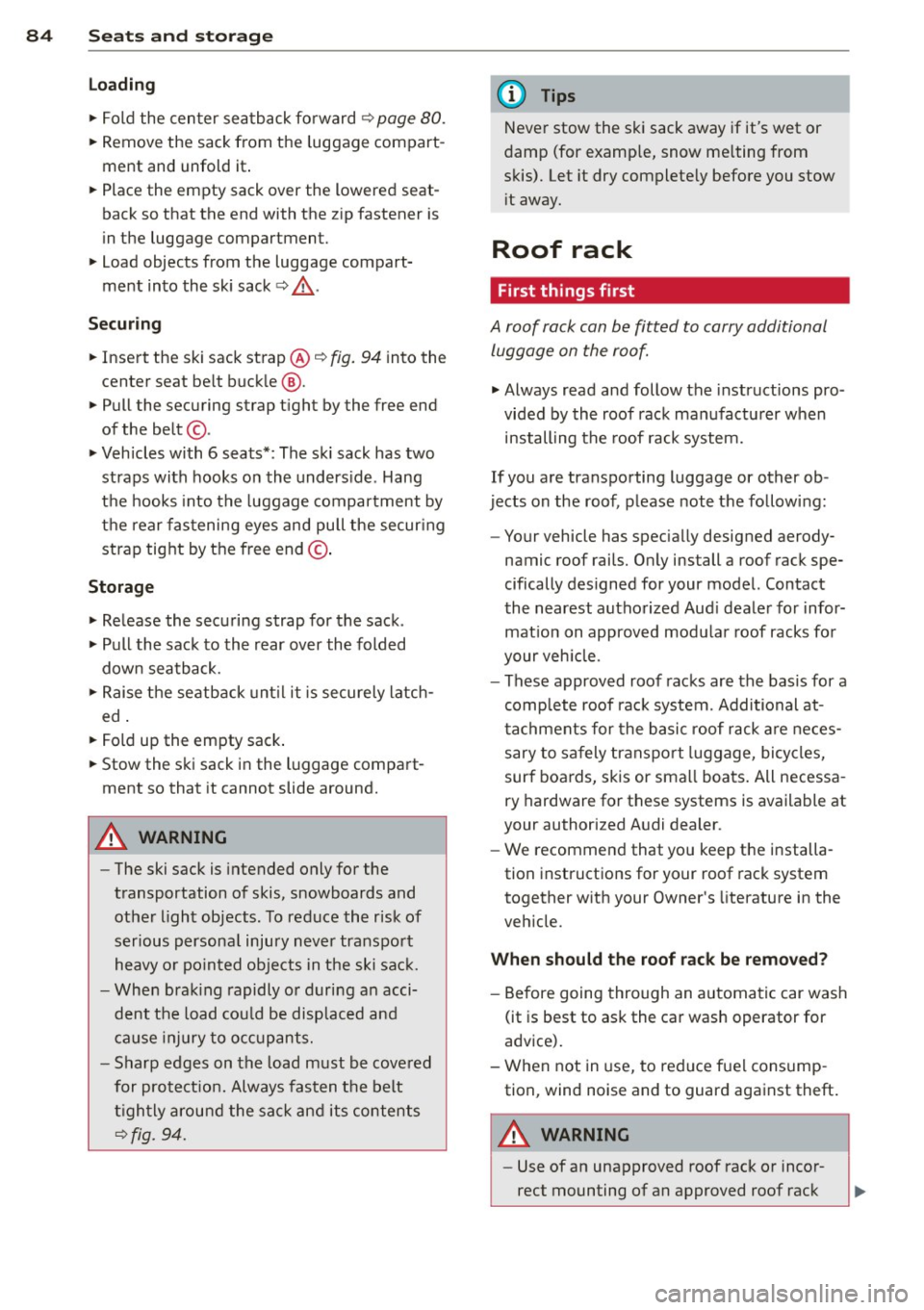
Loading
.. Fold the center seatback fo rward ¢ page 80 .
.. Remove the sack from the luggage compart-
ment and unfold it .
.. Place the empty sack over the lowered seat
back so that the end with the zip fastener is
in the luggage compartment.
.. Load objects from the luggage compart
ment into the sk i sack ¢
&-
Securing
.. Insert the ski sack strap@¢ fig. 94 into the
center seat be lt buck le
@ .
.. Pull the securing strap tight by the free end
of the belt ©-
.. Vehicles with 6 seats*: The ski sack has two
straps with hooks on the underside . Hang
the hooks into the luggage compartment by
the rear fastening eyes and pull the secur ing
strap tight by the free end ©-
Storage
.. Release the securing strap for the sack .
.. Pull the sack to the rear over the folded
down seatback.
.. Raise the seatback unt il it is securely latch
ed .
.. Fold up the empty sack .
.. Stow the ski sack in the luggage compart
ment so that it cannot slide around.
A WARNING
-
-The ski sack is intended only for the
transportation of skis, snowboards and
other light objects. To reduce the risk of
serious persona l injury never transport
heavy or pointed objects in the ski sack.
- When brak ing rapidly or during an acci
dent the load could be displaced and
cause injury to occupants.
- Sharp edges on the load must be covered
for protect ion. Always fasten the belt
tightly around the sack and its contents
¢fig. 94.
(D Tips
Never stow the ski sack away if it's wet or
damp (for examp le, snow me lting from
skis). Let it dry complete ly before you stow
i t away.
Roof rack
First things first
A roof rack can be fitted to carry additional
luggage on the roof.
.. Always read and follow the instructions pro
vided by the roof rack manufacturer when
installing the roof rack system .
If you are transporting luggage or other ob
jects on the roof, please note the following :
- Your vehicle has spec ially designed aerody-
namic roof rails. Only install a roof rack spe
cifically designed for your model. Contact
the nearest authorized Aud i dealer for infor
mat ion on approved modula r roof racks for
your veh icle.
- These approved roof racks are the basis for a
complete roof rack system. Additional at
tachments for the basic roof rack are neces
sary to safely transport luggage, bicycles,
surf boards, skis or small boats. All necessa
ry hardware for these systems is available at
your authorized Audi dealer.
- We recommend that you keep the installa
tion instructions for your roof rack system
together with your Owner's literature in the
veh icle.
When should the roof rack be removed?
-Before going through an automatic car wash
(it is best to ask the car wash operator for
advice).
- When not in use, to reduce fuel consump
tion, wind noise and to guard against theft.
A WARNING
-
- Use of an unapproved roof rack or incor-
rect mounting of an approved roof rack
Page 87 of 340
can cause the roof rack or the items at
tached to it to fall off the roof onto the
road.
- Objects falling from the roof of a vehicle
can cause a crash and personal injury.
- Only mount the system between the
markings shown in<=>
page 85, fig. 95.
-The roof rack system must be installed
exactly according to the instructions pro
vided.
(D Note
- Your vehicle warranty does not cover any damages to the vehicle caused by using
roof racks or mounting structures not
approved by Audi for your vehicle. The
same applies to damage resulting from i ncorrect roof rack installation.
- Always check the roof rack mountings
and hardware before each trip and dur
ing a tr ip to make sure everything is se
curely tightened. If necessary, retighten
the mount ings and check the entire sys
tem from time to time.
- After mounting a roof rack system, or
when you transport objects on the roof
of your veh icle, the height of the vehicle
i s natura lly increased. Be careful when
driving under low bridges or in parking
garages for example. This could cause
damage to the load and even the vehicle
itself.
Roof rack mounting locations
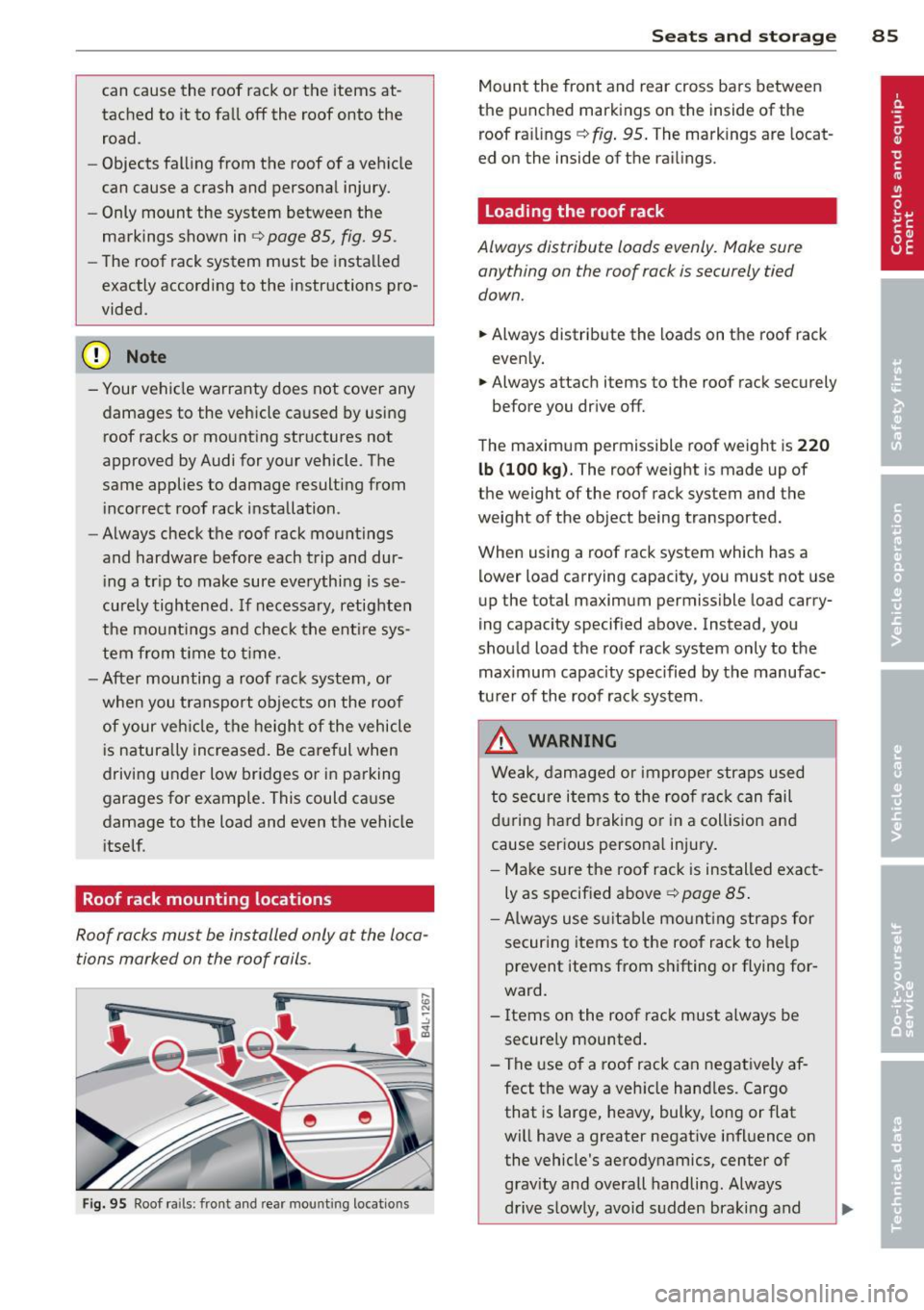
Roof racks must be installed only at the loca tions marked on the roof rails.
i
-
Fig. 95 Roof ra ils: front and rear mounting locat ions
Seats and storage 85
Mount the front and rear cross bars between
the punched markings on the inside of the
roof ra ilings
¢ fig . 95. The markings are locat
ed on the inside of the railings.
Loading the roof rack
Always distribute loads evenly. Make sure
anything on the roof rack is securely tied
down.
.,. Always distribute the loads on the roof rack
even ly .
.,. Always attach items to the roof rack securely
before you drive off.
The maximum permissible roof weight is
220
lb (100 kg).
The roof weight is made up of
the weight of the roof rack system and the
weight of the object being transported.
When using a roof rack system which has a
lower load carrying capacity, you must not use
up the total maximum permissible load carry
ing capacity specified above. Instead, you
should load the roof rack system only to the maximum capacity specified by the manufac
turer of the roof rack system .
& WARNING
Weak, damaged or imprope r straps used
to secure items to the roof rack can fail
during hard braking or in a collision and
cause serious personal injury.
- Make sure the roof rack is installed exact
ly as specified above¢
page 85 .
-Always use suitable mount ing straps for
securing items to the roof rack to help
prevent items from shifting or flying for
ward.
- Items on the roof rack must a lways be
securely mounted.
- The use of a roof rack can negatively af
fect the way a veh icle hand les. Cargo
that is large, heavy, bulky, long or flat
will have a greater negative influence on
the vehicle's aerodynamics, center of grav ity and overall handling. Always
drive slowly, avoid sudden braki ng and .,.
Page 88 of 340
86 Seats and storage
maneuvers when transporting cargo on
the roof of your vehicle.
- Never exceed the maximum permissible
load carrying capacity of the roof o f your
vehicle, the perm issib le axle weights and
the permiss ible total weight of your veh i
cle
c:> page 313, Weights.
CD Note
Make sure that the opened rear lid does
not come in contact with the cargo on the
roof.
@) For the sake of the environment
As a resu lt of the increased wind resist
ance created by a roof rack, your vehicle is
using fuel unnecessarily. So remove the
roof rack after using it .
Cupholder
Front cupholders
The cupholders ore located in the center arm
rest.
Fig . 96 Ce nter a rmrest: Be verage holder
• Open the cover at the recess on the side
c:> fig . 96 .
A maxim um of two beverages can be accom
modated in the cent er armrest . T he second
beverage holder is located under a cove r.
A WARNING
Spilled hot liquid can cause an accident
and personal injury .
-
-Never carry any beverage containers with
hot liquids, such as hot coffee or hot tea, in the vehicle while it is moving
. In case
of an acc ident, sudden braking or other
veh icle movement, hot liquid could spill,
causing scalding burns . Spilled hot liquid
can also cause an accident and personal
in ju ry .
- Use o nly soft cups in the cupholder . Hard
cups and glasses can cause injury in an
accident.
CD Note
Only drink conta iners with lids should be
carried in the cupholder. Liquid could spill
out and damage you r vehicle's electron ic
equipment or stain the upholstery, etc.
(upholder in the rear center armrest
The cupholder is located in the center con
sole .
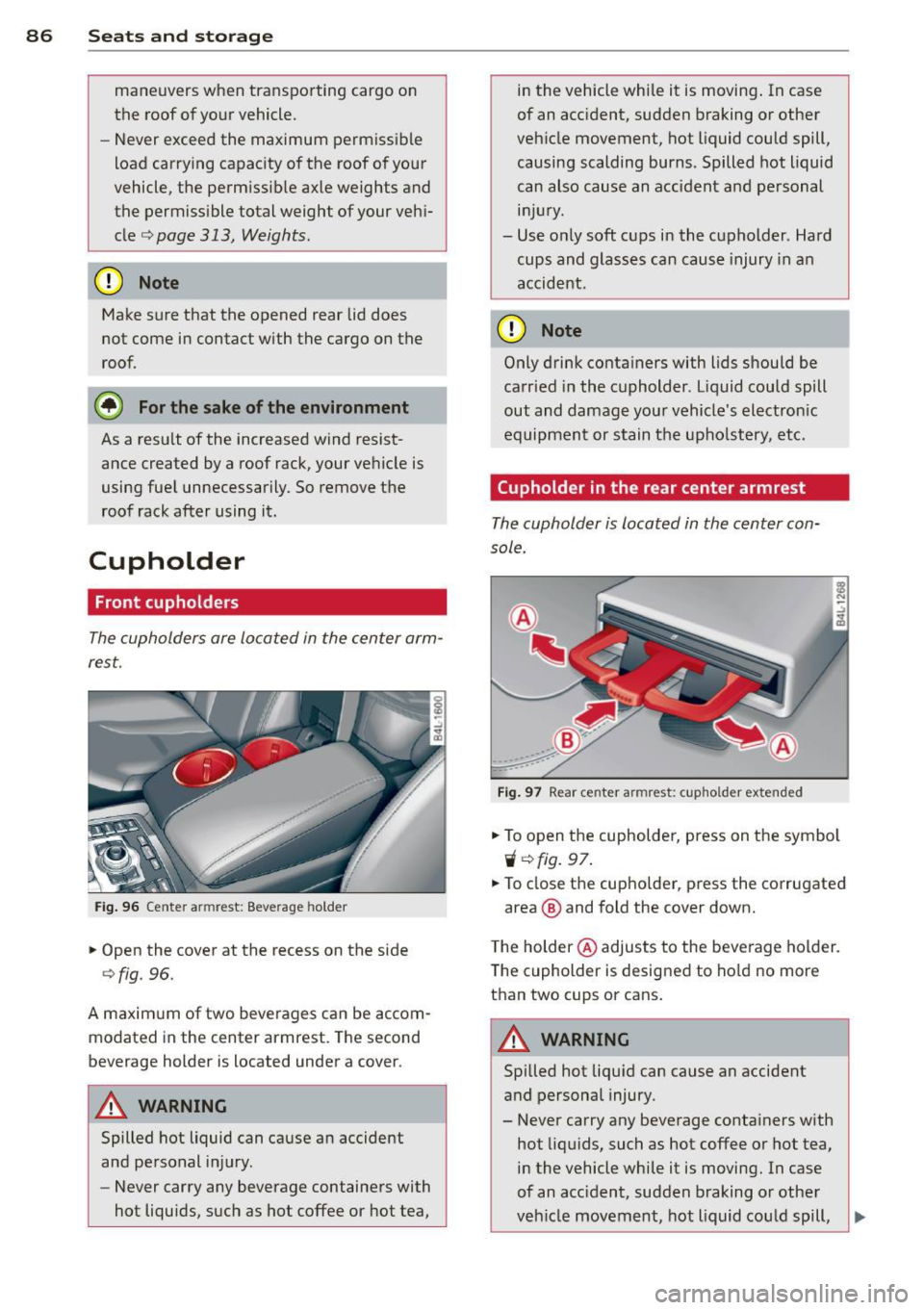
Fig. 97 R ea r cen te r a rmre st: c upho ld er ext ended
• To open the cupholder, press on the symbo l
'i c:>fig . 97 .
• To close the cupho lder, press the corrugated
area @ and fold the cover down.
The holder @adjusts to the beve rage holder .
The cupholder is designed to ho ld no more
than two cups or cans.
A WARNING
-
Spilled hot liqu id can cause an accident
and personal injury .
-
-Never carry any beverage conta iners with
hot liquids, such as hot coffee or hot tea,
in the vehicle while it is moving. In case
of an acc ident, sudden braking or other
veh icle movement, hot liquid could spill,