warning light AUDI Q7 2014 Owner´s Manual
[x] Cancel search | Manufacturer: AUDI, Model Year: 2014, Model line: Q7, Model: AUDI Q7 2014Pages: 340, PDF Size: 85.02 MB
Page 158 of 340
156 Adapti ve Air Susp en sion
possible to raise the suspension to a h igh level
above certain speeds .
When a speed of about 75 mph (120 km/h) is
exceeded for more than 30 seconds, the vehi
cle is automatically lowered to
low level when
in comfort and automatic mode. Ground
clearance is about 0.6 inch (15 mm) less,
compared to the
normal level.
When a speed of about 100 mph (160 km/h)
is exceeded for more than 20 seconds, the ve
h icle is automat ica lly lowered to
highway lev
el
when in automatic and dynamic mode.
Ground clearance is about 1.4 inches (35 mm)
less, compared to the
normal level. Road
hold ing is optimized as a result of the lower
center of gravity, and fuel consumption is re
duced as a result of reduced wind resistance.
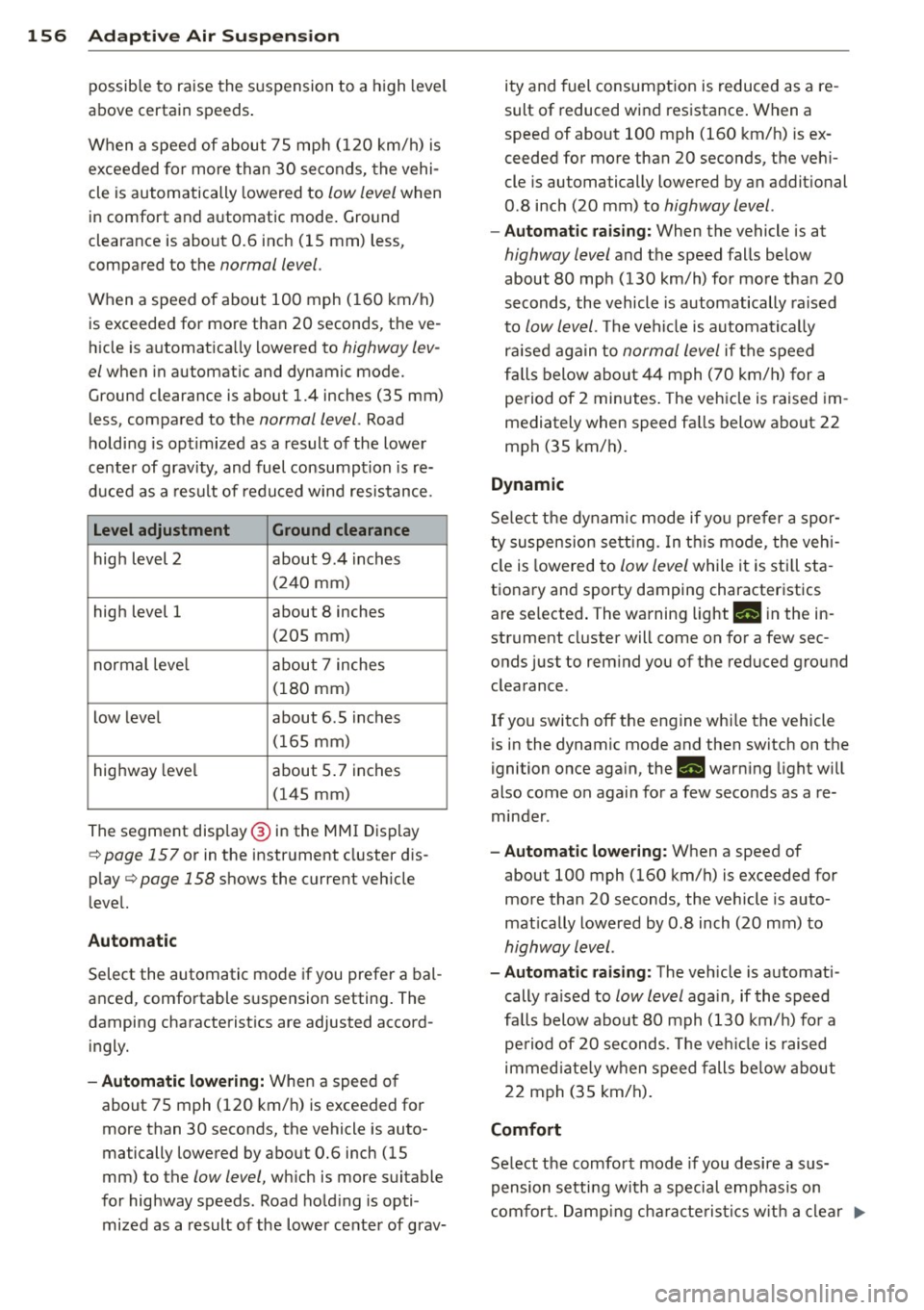
Level adjustment Ground clearance
high level 2 about 9.4 inches
(2 40 mm)
high level 1 about 8 inches
(205 mm)
normal leve l about 7 inches
(180 mm)
low level about 6.5 inches
(165 mm)
highway level about 5 .7 inches
(145 mm)
The segment disp lay @ in the MMI Display
c:::> page 157 or in the instr ument cluster dis
p lay
c:::> page 158 shows the current veh icle
level.
Automatic
Select the automatic mode if you prefer a bal
anced, comfortable suspension setting . The
damping characteristics are adjusted accord ingly.
- Autom atic lowe rin g: When a speed of
about 75 mph (120 km/h) is exceeded for
more than 30 seconds, the vehicle is auto
matically lowered by about 0.6 inch (15
mm) to the
low level, wh ich is more suitable
for highway speeds. Road hold ing is opti
mized as a result of the lower ce nter of grav- ity and fuel consumption is reduced as a re
sult of reduced wind resistance . When a
speed of about 100 mph (160 km/h) is ex
ceeded for more than 20 seconds, the veh i
cle is automatically lowered by an addit ional
0.8 inch (20 mm) to
highway level .
-Automat ic raising: When the vehicle is at
highway level and the speed falls below
about 80 mph (130 km/h) for more than 20
seconds, the vehicle is automatically raised
to
low level. Th e vehicle is automatically
raised aga in to
normal level if the speed
fa lls below about 44 mph (70 km/h) for a
pe riod of 2 minutes . The vehicle is raised im
mediately when speed fa lls below about 22
mph (35 km/h).
Dynamic
Se lect the dynam ic mode if yo u pre fer a spor
ty suspension se tti ng. In t his mode, the veh i
cle is lowered to
low level while it is still sta
t ionary and sporty damping characteristics
are selected . The warning light
Ill in the in
strument cluster will come on for a few sec
onds just to rem ind you of the reduced ground
clearance.
If you switch off the engine whi le the vehicle
is in the dynamic mode and then switch on the
ignition once aga in, the
Ill warn ing light will
also come on again for a few seconds as a re minder .
-Automat ic lowe ring: When a speed of
about 100 mph (160 km/h) is exceeded for
more than 20 seconds, the veh icle is auto
mat ically lowered by 0.8 inch (20 mm) to
highway level .
-Automa tic raising: The vehicle is automati
cally ra ised to
low level again, if the speed
fa lls below about 80 mph (130 km/h) for a
pe riod of 20 seconds. The ve hicle i s raised
immed iate ly when speed falls be low about
22 mph (35 km/h).
Comfort
Select the comfort mode if you desire a s us
pension setti ng w ith a special emp hasis on
comfort. Damp ing cha racte ris tics w ith a clear .,.
Page 163 of 340

Homelink
Universal remote
control
Description
Applies to vehicles: with Home link
The HomeLink universal remote control can
be programmed with the remote control for
devices that are already present.
With Home Link, you can control devices such
as the garage door, security systems, house
lights , etc. comfortably from the inside of you
vehicle.
Homelink makes it possible for you to rep lace
three different remote controls from devices
in your home with one universal remote. This
feature works for most garage door and exte
rior door motor signals. Programming the in
dividual remote control for your remote con
trol takes place on the left side of the front bumper. There is a control module attached at
this location .
A one-time programming of the sensor must be performed before you are able to use sys
tems with Homelink. If the system does not activate after performing the one-time pro
gramming, check whether the system uses a rolling code
¢ page 163 .
A WARNING
-Never use the Homelink transmitter
with any garage door opener that does
have not the safety stop and reverse fea
ture as required by federa l safety stand
ards. This includes any garage door open
er model manufactured before April 1,
1982.
- A garage door opener which cannot de
tect an object, signaling the door to stop
and reverse does not meet current feder
al safety standards . Using a garage door
opener without these features increases
risk of serious injury or death.
Homelink 161
- For safety reasons never release the
parking brake or start the engine while
anyone is standing in front of the vehicle .
- A garage door or an estate gate may
sometimes be set in motion when the
Homelink remote control is being pro
grammed. If the device is repeatedly ac
tivated, th is can overstrain motor and
damage its electrical components - an
overheated mo to r i s a fire hazard!
- To avoid possib le injuries or property
damage, please always make abso lutely
certa in that no persons or objects are lo
cated in the range of motion of any
equipment being operated.
(0 Tips
- If you would like more information on
Homelink, where to purchase the Home
Link compat ible products, or would like
to purchase the Home Link Home Light
ing Package, please call toll-free :
1-800-355-3515.
- For Declaration of Compliance to United
States FCC and Industry Canada regula
tions
¢page 319.
-For security reasons, we recommend that
you clear the programmed buttons be
fore selling the vehicle.
Operation
App lies to vehicles : with Homeli nk
111111 111111
-
Fig. 191 Headl iner: controls
Req uirement: The buttons must be program
med
<:!)page 162.
Page 166 of 340
164 Driving Safel y
Driving Safely
General notes
Safe driving habits
Please remember -safety first!
This chapter contains important information,
tips, instructions and warnings that you need
to read and observe for your own safety, the
safety of your passengers and others . We have
summarized here what you need to know
about safety belts, a irbags, ch ild restra ints as
well as child safety. Your safety is for us
priori
ty number 1.
Always observe the info rmat ion
and warn ings in th is sect ion -fo r yo ur own
safety as well as that of your passengers .
The information in this se ction app lies to all
model ve rsions of your veh icle . Some of the
feat ures desc ribed in this sec tions may be
standard equipment on some models, or may
be optional equipment on others . If you are
not sure, ask your authorized Aud i dealer.
A WARNING
- Always make sure that you follow the in
struct ions and heed the WARNINGS in
this manual. It is in your interest and in
the inte rest of you r passengers.
- Always keep all of the Owner's Literature
man uals in your Audi when you lend or
sell your veh icle so that this impo rtant
information will a lways be availab le to
the drive r and pas sengers.
- Always keep the Owner's Literature han
dy so tha t you can find it easily if yo u
have ques tions.
Safety equipment
The safety features are part of the occupant
restraint system and work together to help
redu ce the risk of injury in a wide variety of
accident situations.
Your safety and the safety of you r passenge rs
should not be left to chance. Advances in
technology have made a varie ty o f fea tures
avai la bl e to he lp re duce the risk of inj ury in an accident
. The following is a list of just a few of
the safety features in your Audi:
- sophis tic ated s afety be lts for d rive r and a ll
passenger sea ting pos it ions,
- be lt te nsione rs fo r th e fro nt sea ts a nd the
ou ter sea ting posit ions in the second row
seating,
- be lt h eight adjustment fo r th e front sea ts
an d the o ute r seat ing pos itions in the sec
ond row seating,
- he ad restra ints for e ach sea ting pos ition,
- fro nt airbags,
- side airbags in the fro nt seats and the outer
seating positions in the second row seat ing*,
- side curta in ai rbags,
- specia l LATCH anchorages for child re-
st raints,
- ad justab le steering colum n.
These individual safety features, can work to gether as a system to he lp protect you and
your passengers in a wide range of accidents .
These features cannot work as a system if
they are not always correctly adjusted and cor rectly used .
Safety is everybody's responsibil ity!
Important things to do before driving
Safety is everybody 's job! Vehicle and occu
pant safety always depends on the informed
and careful driver.
Fo r yo ur safety and the safety of your passen
gers,
before driving always:
.. Ma ke s ure t hat all lights and sign als are op
erati ng correctly .
.. Make s ure t hat the tire pressure is correct.
.. Make s ure that all windows are clean and af
ford good vis ibility to the outs ide.
.. Secure all luggage and other items carefu lly
¢ page 88.
.. Make s ure that nothing can inte rfere with
the peda ls.
.. Adj ust fron t seat, head restraint and m irrors
correc tly fo r you r height . .,.
Page 167 of 340
.. Instruct passengers to adjust the head re
straints according to their height.
.. Make sure to use the right child restraint
correctly to protect children
c:> page 204,
Child Safety .
.. Sit properly in your seat and make sure that
your passengers do the same
c:> page 72,
General recommendations .
.,. Fasten your safety belt and wear it properly.
Also ins truc t your passengers to fasten their
safety belts properly
c:> page 17 4.
What impairs driving safety?
Safe driving is directly related to the condi
tion of the vehicle, the driver as well as the
driver's ability to concentrate on the road
without being distracted.
The driver is respons ible for the safety of the
vehicle and a ll of its occupants . If your ability
to drive is impaired, safety risks for everybody
in the vehicle increase and you also become a
hazard to everyone else on the road
c:> .&,..
Therefore:
.. Do not let yoursel f be distracted by passen
gers or by using a cellular telephone .
.. NEVER drive when your driving ability is im
paired (by medications, alcohol, drugs, etc.).
.. Observe all traffic laws, rules of the road
and speed limits and plain common sense .
.,. ALWAYS adjust your speed to road, traff ic
and weather cond it ions .
.. Take frequent breaks on long t rips. Do not
drive for more than two hours at a stretc h.
.. Do NOT drive when you are t ired , under
pressure or when you are stressed .
A WARNING
Impaired driving safety increases the risk
of serious personal injury and death when
ever a veh icle is being used.
Driving Safely 165
Proper occupant
seating positions
Proper seating position for the driver
The proper driver seating position is impor
tant for safe, relaxed driving.
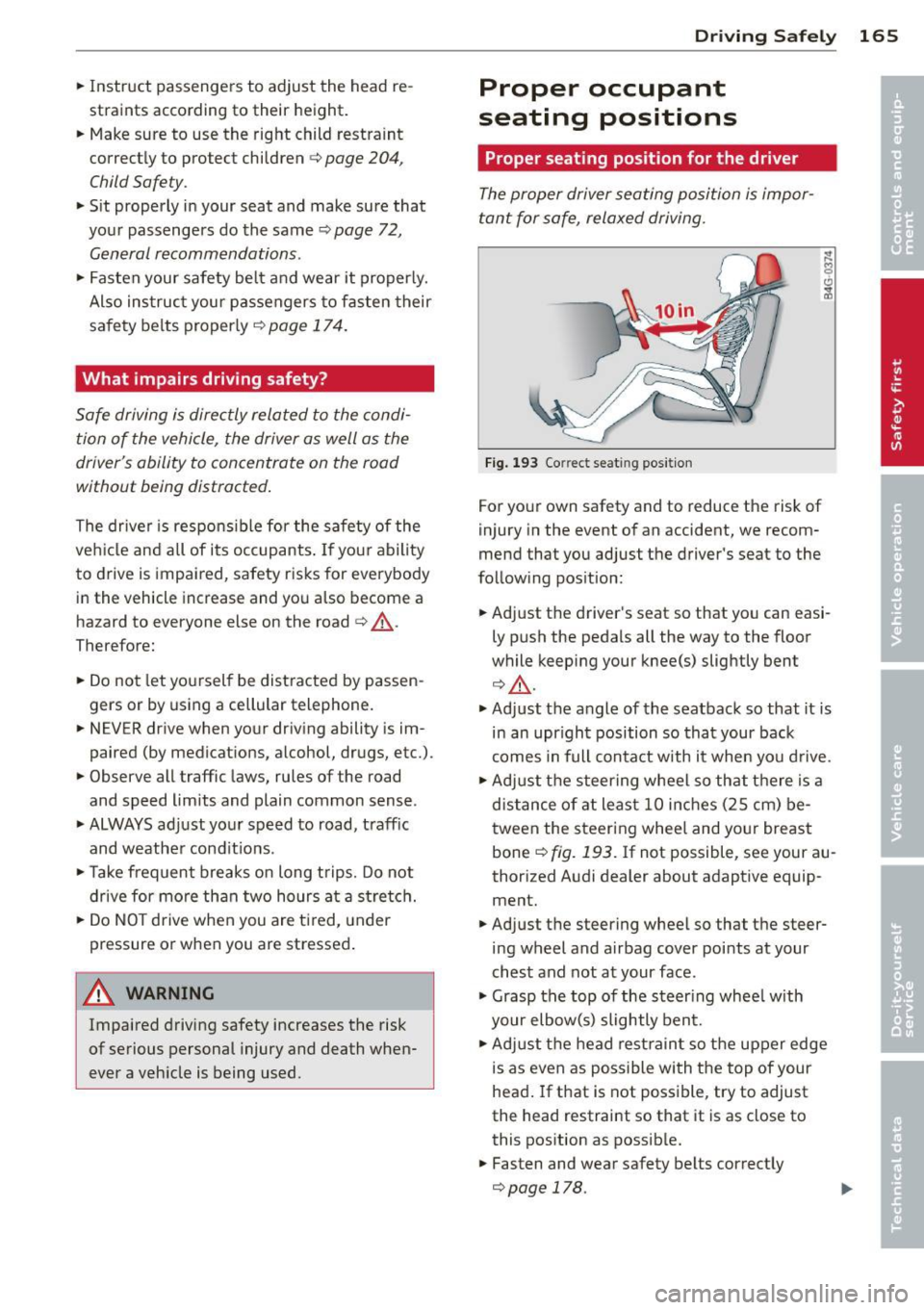
Fig. 193 Correct seat ing pos it ion
For your own safety and to reduce the risk of
injury in the event of an accident, we recom
mend that you adjust the driver's seat to the
follow ing pos ition:
.. Adjust the driver's seat so that you can easi
ly push the pedals all the way to the floor
wh ile keeping your knee(s) slightly bent
c:> .&,. .
.. Adjust the angle of the seatback so that it is
in an upr ight position so that your back
comes in full contact with it when you drive .
.. Adjust the steering wheel so that th ere is a
distance of at least 10 inches (25 cm) be
tween the steering wheel and yo ur breast
bone ~
fig. 193. If not possible, see your au
thorized Audi dealer about adaptive equip
ment .
.. Adjust the steering wheel so that the steer
ing wheel and airbag cover points at your
chest and not at your face.
.,. Grasp the top of the steer ing whee l with
your elbow(s) slightly bent.
.. Adjust the head rest raint so the upper edge
is as even as possible with the top of your
head. If that is not poss ible, try to adjust
the head restraint so that it is as close to
this position as possible .
.. Fasten and wear safety belts correctly
c:> page 178 .
Page 176 of 340
174 Safety belts
Safety belts
General notes
Always wear safety belts!
Wearing safety belts correctly saves lives!
This chapter exp lains why safety be lts are nec
essary, how they work and how to adjust and
wear them correctly .
.. Read a ll the information that fo llows and
heed all of the instructions and WARNINGS.
A WARNING
Not wearing safety belts or wearing them
improperly increases the risk of ser ious
personal injury and death .
- Safety belts are the sing le most effective
means available to reduce the risk of se
rious injury and death in automob ile acci
dents . For your protection and that of
your passenge rs, always co rrectly wear
safety belts when the vehicle is moving .
- Pregnant women, injured, or physically
impaired persons must also use safety
belts. Like all veh icle occupants, they are
more like ly to be seriously injured if they
do not wear safety be lts . The best way to
protect a fetus is to protect the mother -
throughout the entire pregnancy.
Number of seats
V eh icles with fi ve seats: Your vehicle has two
front seats and three rear seats. Each seating
position has a safety belt .
Vehicle s with six seats:* Your vehicle has two
front seats, two seats in the second row and
two seats in the third row. Each seating posi
tion has a safety belt.
Ve hicle s with sev en se ats:* Your vehicles has
two front seats, three seats in the second row
and two seats in the third row. Each seating position has a safety belt .
A WARNING
Not wearing safety belts or wear ing them
i mproperly increases the r isk of serious
personal injury and death.
- Never strap more than one person, in
cluding small children, into any belt . It is
espec ially dangerous to p lace a safety
belt ove r a ch ild sitt ing on your lap.
- Never let more people ride in the vehicle
than there are safety belts available .
- Be sure everyone riding in the vehicle is
properly restrained w ith a separate safe
ty belt or child restra int.
Safety belt warning light
Your vehicle has a warning system for the
driver and front seat passenger (on USA mod
els only) to remind you about the importance
of buckling-up.
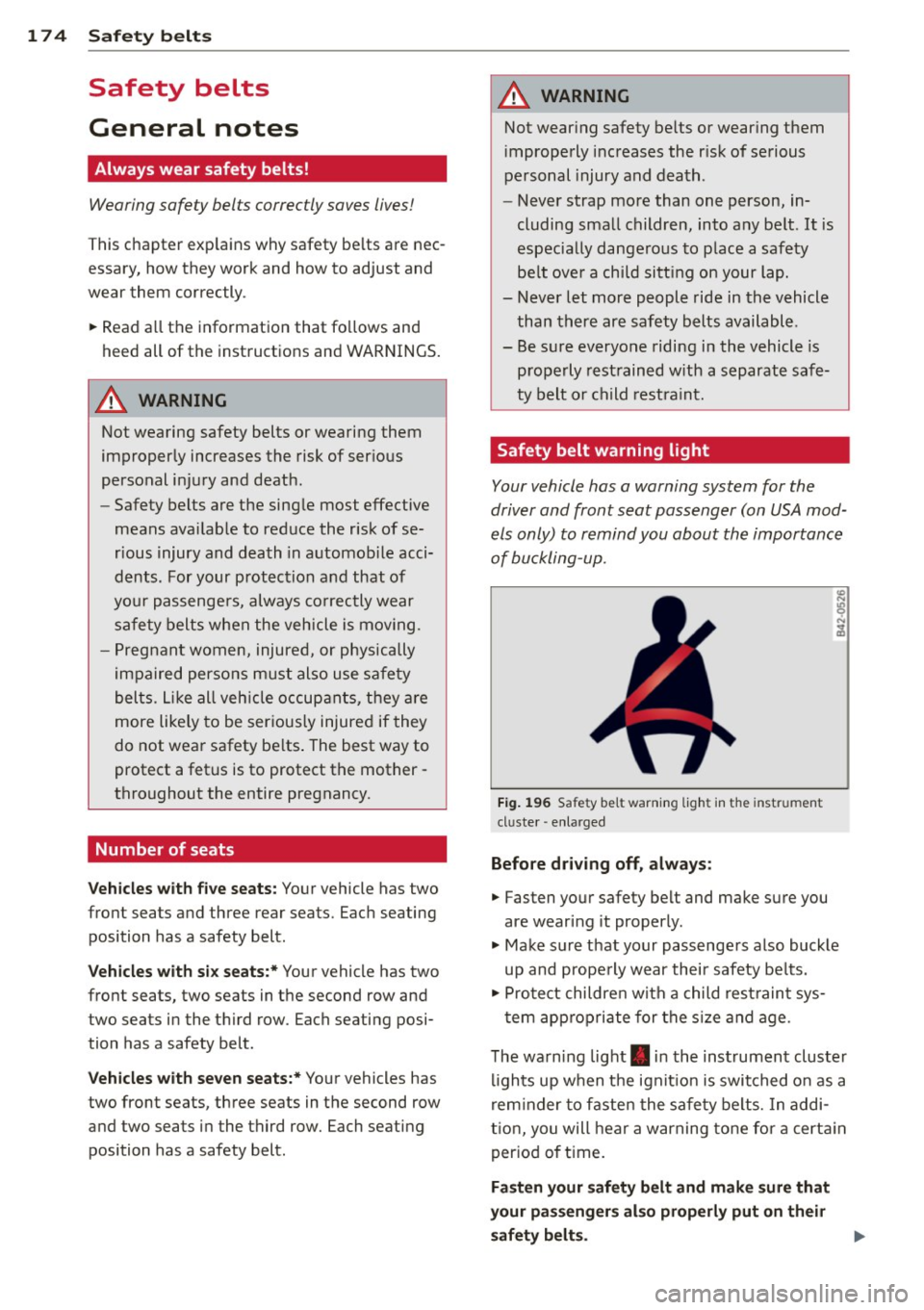
F ig . 1 96 Safety bel t warning ligh t in the instr ument
cl uste r -e nlarged
Before dri ving off , alw ays:
.. Fasten your safety belt and make sure you
are wearing it properly .
.. Make sure that your passengers also buckle
up and properly wear their safety be lts.
.. Protect childre n w ith a child rest raint sys-
tem app ropriate for the s ize and age .
The warn ing light . in the instrument cluste r
li ghts up when the ignit ion is switched on as a
rem inder to fasten the safety belts. In addi
t ion, you will hear a warning tone for a certa in
per iod of t ime.
Fa ste n yo ur safet y be lt and mak e sure that
yo ur pa ssengers a lso properly put on th eir
sa fe ty b elt s.
Page 177 of 340
,&_ WARNING
-Sa fety belts are the sing le most effective
means availab le to reduce the risk of se
rious injury and death in automobile acci
dents. For your protection and that of
your passengers, always correctly wear safety belts when the vehicle is mov ing .
- Failure to pay attention to the warning
light that come on, could lead to person
al injury.
Why safety belts?
Frontal collisions and the law of physics
Frontal crashes create very strong forces for
people riding in vehicles.
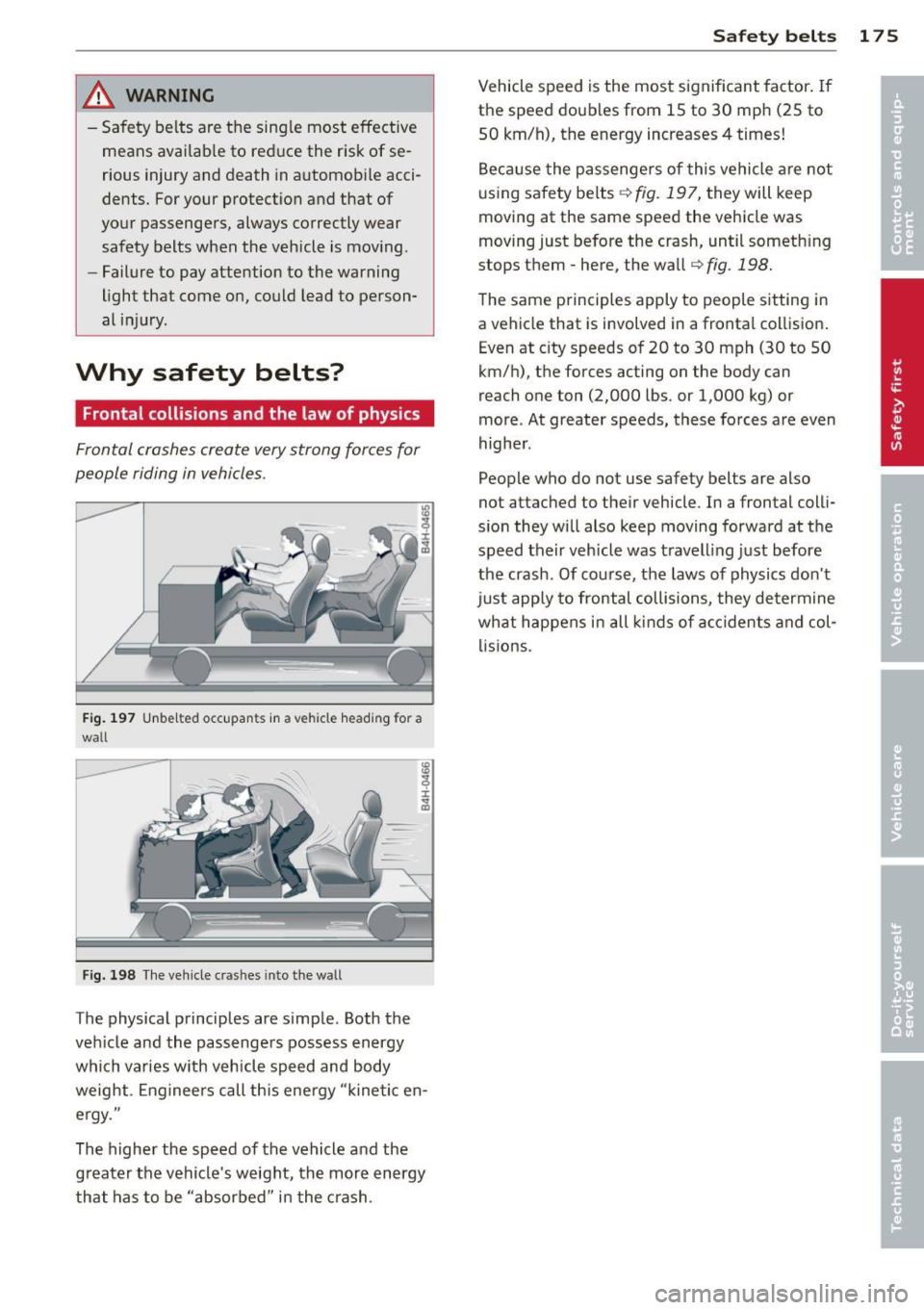
F ig . 197 Unbe lted occupants in a ve hicle heading for a
wall
Fig. 198 The vehicle cras hes into the wall
The physical principles are simple. Both the
veh icle and the passengers possess energy
which varies with vehicle speed and body weight . Engineers call this energy "kinetic en
e rgy."
The higher the speed of the vehicle and the
g reate r the vehicle's weight, the more energy
that has to be "absorbed" in the crash.
Safety belts 175
Vehicle speed is the most significant factor . If
the speed doub les from 15 to 30 mph (25 to
50 km/h), the energy increases 4 times!
Beca use the passenge rs of this vehicle are not
using safety belts¢
fig. 197, they will keep
moving at the same speed the vehicle was
moving just before the crash, until someth ing
stops them -here, the wall¢
fig. 198.
The same principles apply to people sitting in
a vehicle that is involved in a frontal collision.
Even at c ity speeds of 20 to 30 mph (30 to 50
km/h), the forces acting on the body can
reach one ton (2,000 lbs. or 1,000 kg) or
more . At greater speeds, these fo rces are even
higher.
Peop le who do not use safety belts are also
not attached to their vehicle . In a frontal colli
s ion they will also keep moving forward at the
speed their vehicle was travelling just before
the crash . Of co urse, the laws of physics don't
just app ly to frontal collisions, they determine
what happens in all kinds of acc idents and col
lisions.
Page 180 of 340
178 S afet y belt s
damaged, have belts replaced by an au
thorized Aud i dealer or qualified
workshop.
- Safety belts that have been worn and
loaded in an accident must be replaced
with the correct rep lacement safety be lt
by an authorized Audi dea le r. Replace
ment may be necessary even if damage
c anno t be clear ly seen. Anchorages that
we re loaded m ust also be inspected.
- Never remove, modify, disass emble, or
t ry to repa ir t he safety be lts yourself.
- Always keep the belts clean . Dirty belts
may not wo rk p roperly and can impa ir
the funct io n of t he in ertia reel¢
ta
ble Cleaning in terior on page 246.
Safety belts
Fastening safety belts
Safety first -everybody buckle up!
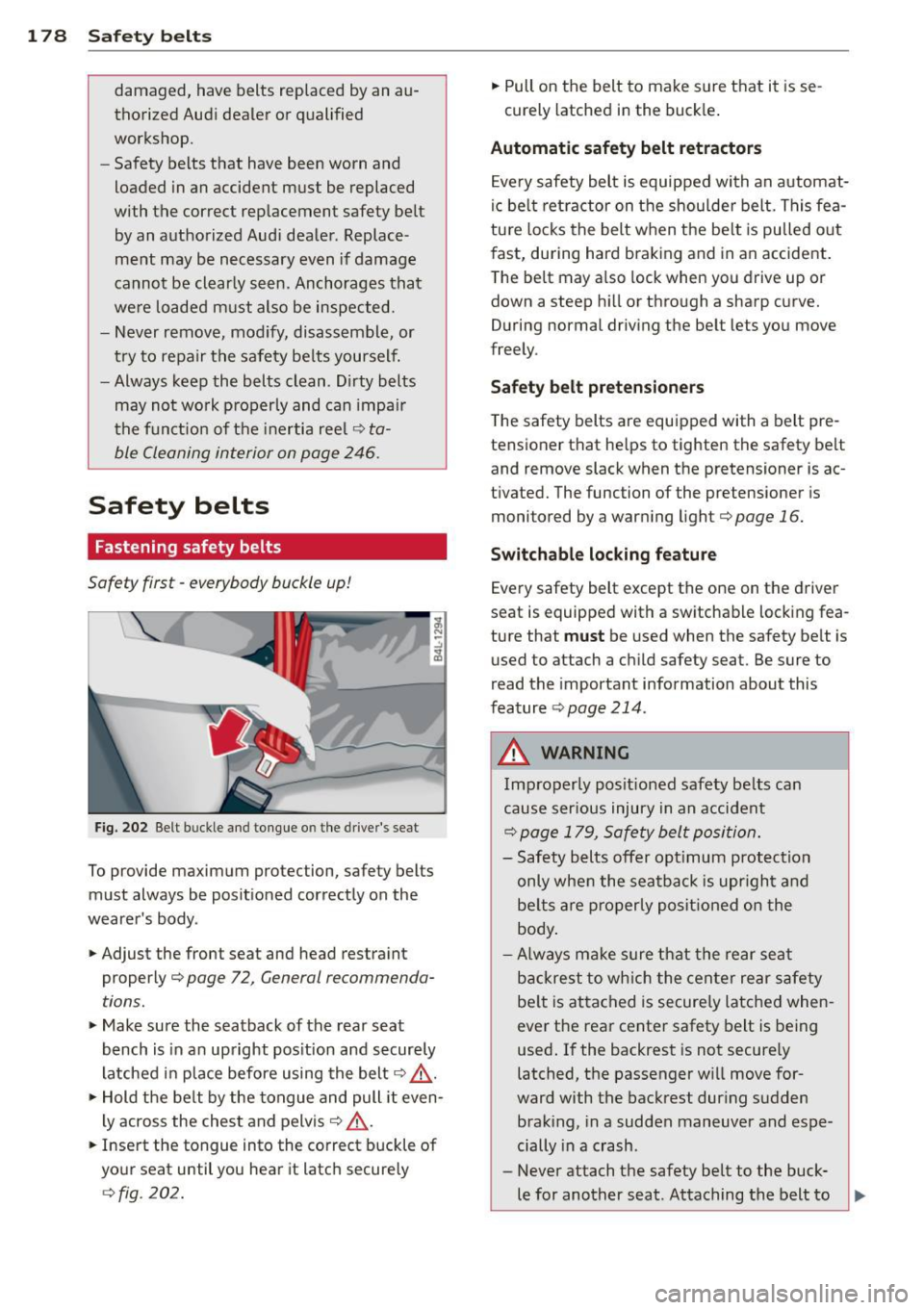
Fig. 2 02 Belt buckle and tongue o n th e dr iver 's seat
To provide maximum protection, safety belts
must always be posit ioned correctly on the
wearer 's body .
.. Adjust the front seat and head restra int
properly¢
page 72, General recommenda
tions .
.. Make sure the seatback of the rear seat
bench is in a n upright pos ition and securely
l atched in place before using the belt ¢&_ .
.. Hold the belt by the to ngue and pull it even
l y across the chest and pelvis
c:::> &, .
.. Inse rt the tongue into the correct buckle of
your seat until you hea r it latc h securely
¢ fig . 202.
.. Pull on the belt to ma ke sure t hat it is se -
curely latched in the buck le .
Automatic safety belt retractors
Eve ry safety belt is equipped with an automat
ic be lt r etractor on t he shou lde r belt. This fea
tu re locks the belt when the be lt is pulled out
fast, during hard braking and in an accident .
The be lt may a lso lock when you drive up or
down a steep hi ll or thro ugh a sharp curve.
D uring normal driving the belt lets you move
freely .
Safety belt pretensioners
The safety belts are equipped with a belt pre
tensioner that he lps to tighten the safety belt
and remove slack when the pretensioner is ac
t ivated. The function of the pretensioner is
monitored by a war ning light¢
page 16.
Switchable locking feature
Every safety belt except the one on the d river
seat is equipped with a sw itchab le locking fea
ture that
must be used when the safety be lt is
used to attach a c hild safety seat. Be sure to
read the important information about this
feature
c:::> page 214.
A WARNING
Imp roperly posit ioned safety be lts can
cause ser ious injury in an accide nt
c:::> page 179, Safe ty belt posi tion.
-
- Safety b elts offer opt imum protect ion
only whe n the sea tbac k is u prigh t an d
be lts a re pr operly posit ioned on the
body .
- Always m ake sure that the rear sea t
b a ckrest to wh ich the center rear s afety
be lt is at tached is secure ly latched when
ever the rear center safety belt is being
used . If the backrest is not secure ly
latched, the passenger w ill move for
ward with the backrest dur ing sudden
brak ing, in a sudden maneuver and espe
cially in a c rash.
- Never attach the safety belt to the buck-
le for another seat . Attaching the belt to .,_
Page 187 of 340
Child restraints on the front seat - some
important things to know
.. Be sure to read the important informat ion
and heed the WARNINGS for important de
tai ls about chi ldren and Advanced Airbags
c> page 204.
Even though your vehicle is equipped with an
Advanced Airbag System, make certain that
a ll chi ldren, especially those 12 years and
younger, a lways ride in the back seat properly
restra ined for their age and size. The airbag
on the passenger side makes the front seat a potentially dangerous place for a child to r ide .
The front seat is not the safest place fo r a
chi ld in a fo rward-facing chi ld safety seat. It
can be a very dangerous place for an infan t or
a child in a rea rward -facing seat.
The Advanced Airbag System i n your veh icle
h as been cert ified to comp ly with the require
men ts of Uni ted States Federa l Mo to r Veh icle
Safety Standard 208 as applicable at the time
your ve hicle was manufactured.
The Standard requires the fron t air bag on the
passenger side to be turne d off ("sup
p ressed") if a chi ld up to about one year of
age restrained in one of the rear -facing or for
ward -facing infant restraints listed i n Federal
Motor Vehicle Safety Standard 208 with wh ich
the Advanced Airbag System in your vehicle
was certified has been installed o n the front
passenger seat. For a listing of the child re
straints that we re used to certify compliance
with the US Safety Sta ndard
c> page 206.
The PASS ENGER AIR BAG OFF light in the in
strument panel te lls you when the front Ad
vanced A irbag on the passenger side has been
turned off by the e lectronic control u nit.
Each t ime you tur n on the ignition, the
PAS
SENGER AIR BAG OFF
l ight w ill come on for a
few seconds a nd:
- will stay on if the front passenger seat is not
occup ied
- will stay on if there is a small child or child
restraint on the front passenger seat
A irbag sys tem 185
- will go off if the front passenger seat is oc
cupied by an adult as registered by the
weight -sensing mat
c> page 194, Monitor
ing the Advanced Airbag System.
T he PASSENGER AIR BAG OFF light comes on
whe n the contro l unit detects a tota l weight
on the front passenger seat that req uires the
front a irbag to be turned off.
If the total weight on the front passenge r
seat is more than that of a typical 1 year-o ld
c h ild but less than the weight of a small
adult, the front airbag on the passenger side
can deploy (the
PASSENGER AIR BAG OFF
li ght does not come on). If the PASSENGER
AIR BAG OFF
light does not come on, the
front a irbag on t he passeng er side has not
been turned off by the elec troni c con trol unit
and can deploy if the control unit senses an
impact that meets the cond it ions stored i n its
memory .
For example, th e airb ag may deploy if :
-a small ch ild that is heav ie r than a typical 1
year-old ch ild is o n the front passenger seat
(regard less of whether the child is in one of
the ch ild safety seats listed
c> page 206), or
- a child who has outgrown chi ld restraints is
on the front passenge r seat.
If the front passenger airbag is turned off, the
PASSENGER AIR BAG OFF light comes on in
the instr ument cluster and stays on .
The front airbag on the passenger side may
not deploy (the PASSENGER AIR BAG OFF
l ight does not illum inate and stay lit) even if a
small ad ult o r teenager, or a passenger who is
not sitti ng uprig ht w ith their back against a
non -recli ned back rest w it h thei r feet on t he
vehicle floor i n front of the sea t is on t he front
passenger seat
c> page 165, Proper seating
position for the driver.
If the fron t passenger ai rbag dep loy s, the
Feder al Standard req uires the airbag to meet
the "low risk" dep loyment criteria to reduce
the ris k of injury t hro ugh interact ion w ith the
airbag. "Low risk" dep loyment occ urs in those
crashes that take place at lower dece lerat ions ..,_ •
•
Page 188 of 340
186 Airbag sys tem
as def ined in the electronic control unit
Q page 194, PASSENGER AIR BAG OFF light.
A lways remember, a ch ild safety seat or infant
carrier insta lled on the front sea t may be
struck and knocked o ut o f position by the rap
id ly inflating passeng er's airbag in a frontal
coll is ion . T he airbag cou ld greatly reduce the
effec tiveness of the child restraint and even
serious ly injure the child during inflat ion.
F or this reason, and because the back seat is
the safest p lace for children - when properly
restra ined acco rd ing to their age and si ze - we
s trongly recommend that children always sit
in the back seat
Q page 204, Child Safety .
A WARNING
A child in a rearward-facing child safety
s e at insta lled on the front passenger seat
w ill be seriously injured and can be k illed if
t he fr ont a irbag inflates - even with an Ad
vanced Airbag System.
- T he i nflating a irbag will hit the child
safety seat or infant carrier wit h great
f orce and w ill smash the ch ild safety sea t
and child against the backrest , center
armrest, door or roof.
- Always insta ll rear -facing child sa fety
seats on the rear seat.
- If you mus t install a rearward facing
child safety seat on the front passenger
seat because of exceptional circ umstan
ces and the
PASSENG ER AIR BAG OFF
light does not come on and stay on , im
med iately install the rea r-facing child
safety seat in a rear seating position and
hav e the a irbag system inspected by you r
authori zed Aud i dealer.
- Forward-fac ing ch ild safety seats instal
led on the front passenger's seat may i n
terfere wi th the deployment of the air
b ag and cau se serious person al injury to
the ch ild .
A WARNING
If, in exceptional c ircumstances, you must
install a forward-facing child restra int on
the front passenger's seat: -
Always make sure the forward-facing
seat has been designed and certified by
its manufacturer for use on a front seat
with a passenger front and s ide a irbag .
- Never put the forward-facing child re
straint up against or very near the instru ment panel.
- Always move the passenger seat into its
rearmost pos ition in the seat's fore a nd
aft ad justment range, as fa r away from
the airbag as possible b efore installing
the forwa rd-fa cing ch ild restra int. The
b ackrest mus t be a djusted to a n up right
position.
- Make s ure that the
PASSENGER AIR BAG
OFF
li ght comes on and stays o n all the
t ime wheneve r the ignition is switched
on.
A WARNING -ra----
To reduce the risk of serious injury, make
sure that the
PASSENGER AIR BAG OFF
light will be displayed whenever a child re
straint is installed on the front passenger
seat and the ignition is sw itched on.
- If the
PASSENGER AIR BAG OFF light
does not stay on, perform the checks de
scribed
Q page 194, Monitoring the Ad
vanced Airbag System .
-Take t he chi ld restraint off the front pas
senger seat and install it prope rly at one
of the rear seat positions if t he
PASSEN
GER AIR BAG OFF
li ght does not stay on.
- Have the airbag system inspected by
your author ized Audi deal er immed iate
ly .
- Always carefu lly follow instr uctions from
chi ld restraint manufacture rs when in
st all ing c hild restra ints .
A WARNING
If, in exce ptiona l circumstances, you m ust
i nsta ll a forward or rearw ard-fa cing child
r estra int on the front passenger's seat :
- Imp roper ins tallation o f child restra ints
can reduce their effec tiveness or even
Page 191 of 340
If the total weight on the front passenger
seat is more than that of a typical 1 year -old,
but less than the weight of a small adult, the
front airbag on the passenger side may deploy (the
P ASS ENGER AIR B AG OFF light does not
come on).
For example, th e airbag may depl oy if:
-a small child that is heavier than a typical 1
year-o ld child is on the front passenger seat
(regardless of whether the child is in one of
the chi ld safety seats listed
<=) page 206),
-a chi ld who has outgrown child restraints is
on the front passenger seat.
I f the front passenger airbag is turned
off, the
PA SSENGER AIR B AG OFF light in the center
of the instrument panel wi ll come on and stay
on.
The front a irbag on the passenger side may
not deploy (the PA SSENG ER AIR BAG O FF
light does not ill uminate and stay lit) if:
- a small adu lt or teenager is on the front pas
senger seat
- a passenger who is not sitt ing upright w ith
their back against a non-reclined backrest
with their feet on the vehicle floo r in front
of the seat is on the front passenge r seat .
If the front passenger airbag deploys, the
Federal Standard requires the a irbag to meet
the " low risk" deployment cr iteria to help re
duce the risk of inju ry through interaction
with the airbag. "Low risk" deployment occurs in those crashes that take place at lower de
celerations as defined in the electronic control
un it.
<=) page 194
Al ways rememb er: Even tho ugh your vehicle
is equipped with Advanced Airbags, the safest
p lace for children is properly restrained on the
back seat. Please be sure to read the impor
tant information in the sect ions that follow
and be sure to heed all of the WARNINGS.
A WARNING
To reduce the risk of injury when an airbag inflates, a lways wear safety belts prope rly.
A irbag system 189
-If you are unrestrained, leaning forward,
sitt ing s ideways or out of pos ition in any
way, your risk of injury is much higher.
- You will a lso receive serious injuries and
could even be killed if you are up aga inst
the airbag or too close to it when it in
flates -even w ith an Advanced A irbag
<=)page 183 .
A WARNING
-
A child in a rearward-fac ing ch ild safety
seat installed on the front passenger seat
will be ser ious ly injured and can be killed if
the front airbag inflates -even with an Ad
vanced A irbag System.
- Al tho ugh the Advanced Airbag System in
your veh icle is designed to turn
off the
front airbag when a rearward -facing
child restraint has been insta lled on the
front passenger seat, nobody can abso
lutely guarantee that dep loyment is im
possible in all conceivable s ituations that
may happen dur ing the usefu l life of your
veh icle.
- The inflating airbag will h it the ch ild
safety seat or infant carrier with great
force and will smash the child safety seat
and child against the bac krest, center
armrest, doo r, or roof.
- Always install rearward-facing chi ld re
straints on the rear seat.
- If you must install a rearwa rd fac ing
child safety seat on the fro nt passenger
seat because of exceptiona l circumstan
ces and the
PASSENGER AIR BAG OFF
light does not come on and s tay on, im
mediately insta ll the rear-facing ch ild
safety seat in a rear seating position and
have the airbag system inspected by your
author ized Audi dealer.
A WARNING
If, in except iona l circumstances, you must
install a forward-facing child restraint on
the front passenger's seat:
~
•
•