lock AUDI Q7 2014 Owner´s Manual
[x] Cancel search | Manufacturer: AUDI, Model Year: 2014, Model line: Q7, Model: AUDI Q7 2014Pages: 340, PDF Size: 85.02 MB
Page 216 of 340
214 Child Saf ety
- Childre n on the front seat of any car,
even with Advanced A irba gs, can be seri
ous ly injured or even killed when an a ir
bag inflates .
- Never let a child stand or knee l on any
seat, for exam ple the front seat.
- Never let a child ride in the cargo area of your vehicle .
- Always remember that a chi ld leaning
forward, sitt ing s ideways or out of posi
t ion in any way during an acc ident can be
struck by a deploying airbag . This will re
sult in serious personal injury or death .
- If you must install a booster seat on the
front passenger seat because of excep
t ional circumstances the
PASSENGER
AIR BAG OFF
light must come on and
stay on, whenever the ignition is sw itch
ed on.
- If the
PASSENGER AIR BAG OFF light
does not come on and stay on, perform
the checks described¢
page 194, Moni
toring the Advanced Airbag System.
- T ake the child restrain t off the front pas
senger seat and install it properly at one
of the rear seat positions if the
PASSEN
GER AIR BAG O FF
light does not stay on
whenever the ignition is switched on.
- Always read and heed all WARNINGS
whenever using a child restrained in ave
hicle is being used
¢page 174, Safety
belts,
c:::;, page 183, Airbag system and
c:::;, page 204, Important things to know.
Installing a child safety
seat
Securing a child safety seat using a
safety belt
Safety belts for the rear seats and the front
passenger can be locked with the convertible locking retractor to properly secure child
safety seats .
The safety belts emergency locking retractors
for the rear seats safety belts and for the
front passenger's seat safety belt have a con
ve rtible locking retracto r fo r child restra ints . T
he safety belt m ust be locked so that be lt
webbing cannot unree l. The retractor can be
activated to lock the safety belt and prevent
the safety belt webbing from loosening up
during norma l dr iving. A child safety seat can
o n ly be properly insta lled when the safety belt
i s loc ked so that the child and child safety
sea t w ill stay in place .
Always remember: Even tho ugh your vehicle is
equipped with an Advanced Airbag system, all
c h ildren, especially those 12 years and young
er, shou ld always r ide in the back seat prope r
l y restra ined fo r the ir age and size.
_& WARNING
Imp ro perly ins talled ch ild safety sea ts in
crease the risk of serious pe rsonal injury
and death in a co llision.
- Always make s ure that the safe ty belt re
trac to r i s loc ked when insta lling a child
safety seat . An un locked safety belt re
tracto r cannot hold the child safety seat
in place dur ing norma l driving or in a
crash.
- Always buckle the child sa fety seat firmly
in place even if a ch ild is not sitt ing in it.
A loose child safety seat can fly around du ring a sudden stop or in a collision.
- Always make sure that the rear seat
backrest to wh ich the center rear safety
be lt is attached is securely latched when
eve r the rea r center safety belt is being
used to secure a c hild restra int.
- If the backrest is not securely la tched,
the child and the child restraint will be
thrown forward togethe r with t he back
rest and will strike part s of the vehicle
interior. The child can be seriously in
jured or killed.
- Never inst all rear-facing child s afety
seats or in fant ca rrie rs on the front pas
senger seat . A child will be serious ly in
jured and can be killed when the passen ger airbag in flates.
- The inflating air bag will h it the ch ild
safety seat or infant carrier with great
force and will smash the child safety seat ..,.
Page 218 of 340
216 Child Safety
-A tight tether strap on a rearward-facing
child restraint attached to the front pas
senger seat can put too much pressure on the weight-mat in the seat and regis
ter a heavier weight in the Advanced Air
bag System. The heavier weight regis
tered can make the system work as
though an adult were on the seat and de
ploy the Advanced Airbag when it must
be suppressed causing serious or even
fatal injury to the child.
- Make sure that the
PASSENGER AIR BAG
OFF
light comes on and stays on all the
time whenever the ignition is switched
on.
- If the
PASSENGER AIR BAG OFF light
does not come on and stay on, immedi
ately install the rear-facing child safety
seat in a rear seating position and have
the airbag system inspected by your Audi dealer.
Activating the convertible locking
retractor
Use the convertible locking retractor to se
cure a child restraint.
Always heed the child safety seat manufactur
er's instructions when installing a child re
straint in your vehicle. To activate the conver
tible locking retractor:
• Place the child restraint on a seat, prefera
bly on the rear seat.
• Slowly pull the belt
all the way out.
• Route it around or through the child re
straint belt path¢,&.
• Push the child safety seat down with your
full weight to get the safety belt really tight.
• Insert the belt tongue into the buckle for
that seating position.
• Guide the safety belt back into the retractor
until the belt lies flat and snug on the child
safety seat.
• You should hear a "clicking" noise as the
belt winds back into the inertia reel. Test the
convertible locking retractor by pulling on
the belt . You should no longer be able to pull the belt out of the retractor.
The con
vertible locking retractor is now activated.
• Make sure that the red release button is fac
ing away from the child restraint so that it
can be unbuckled quickly.
• Pull on the belt to make sure the safety belt
is properly tight and fastened so that the
seat cannot move forward or sideways more
than one inch (2 .5 cm).
_&. WARNING
-
Using the wrong child restraint or an im
properly installed child restraint can cause
serious personal injury or death in a crash.
- Always make sure that the safety belt re-
tractor is locked when installing a child
safety seat. An unlocked safety belt re
tractor cannot hold the child safety seat
in place during normal driving or in a
crash.
- Always buckle the child safety seat firmly
in place even if a child is not sitting in it.
A loose child safety seat can fly around
during a sudden stop or in a crash.
- Always make sure the seat backrest to
which the child restraint is installed is in
an upright position and securely latched
into place and cannot fold forward . Oth
erwise, the seatback with the child safety
seat attached to it could fly forward in
the event of an accident or other emer
gency situation.
- Always read and heed all WARNINGS
whenever using a child restrained in ave
hicle is being used~
page 204. Special
precautions apply when installing a child
safety seat on the front passenger seat
¢ page 185, Child restraints on the front
seat -some important things to know .
Page 219 of 340
Deactivating the convertible locking
retractor
The convertible locking retractor for child re
straints will be deactivated automatically when the belt is wound all the way back into the retractor.
" Press the red button on the safe ty belt buck
le. The belt tongue w ill pop out of the buck
le.
" Guide the safety be lt all the way back into
its stowed position .
A lways let the safety belt retrac t complete ly
into its stowed position . The sa fety belt can
now be used as an ordinary safety belt with
out the convertib le locking retractor for child
restra ints.
If the convertible locking retractor shou ld be
activated inadvertently, the safety belt must
be unfastened and guided comp letely back in
to its stowed position to deactivate th is fea
ture. If the convertib le locking retractor is not
deactivated, the safety belt will gradually be
come tighter and uncomfortable to wear.
A WARNING
Improperly insta lled child safety seats in
crease the risk of ser ious personal inju ry
and death in a collision.
- Never unfasten the safety belt to deacti
vate the convertible locki ng ret ractor for
child restraints while the veh icle is mov
ing. You would not be rest rained and
cou ld be seriously injured in an accident.
- Always read and heed all WARN INGS
whenever using a child restrained in ave
hicle is being used¢
page 204. Special
precautions apply when installing a chi ld
safety seat on the front passenger seat
¢ page 185, Child restraints on the front
seat -some important things to know.
Child Sa fet y 21 7
LATCH Lower
anchorages and tethers
for children
Child Restraint System anchors and how
are they related to child safety
To prov ide a simpler and more practicable way
to attach the child restra int on the vehicle
seat, Federal regulat ions requ ire spec ial lower
anchorages in vehicles and devices on new
child restraints to attach to the vehicle ancho
rages.
T he combination of the tether anchorages and
the lower anchorages is now generally ca lled
the
LATCH system for " Lower Anchorages and
T ethers for Chil dren."
Forward-facing chi ld restraints manufactured
after September 1, 1999, are required by U.S .
federal regulations to comply with new child
head movement performance requirements .
These new performance requirements make a
tether necessary on most new child seats.
Installing a child restraint that requires a top
tether without one can seriously impair the performance of the chi ld restra int and its abil
ity to protect the child in a collision. Insta lling
a child restraint that requires a top tether
without the top tether may be a violation of
state law.
Child restraint manufacturers offer LATCH
lower anchorages on their child seats with
hook-on or push-on connectors attached to
adjustable straps.
In addition to the LATCH lower anchorages,
these child restraint systems usually require
the use of tether straps to help keep the child
restraint firmly in place .
A WARNING
Improper installation of child restraints
will increase the r isk of inj ury and death in
a crash.
-
•
•
Page 222 of 340
220 Child Safe ty
& WARNING
Improper use of tether anchorages or low
er anchorages can cause serious personal
injury in a crash.
- Always carefully follow the ch ild re
straint manufacturer's instructions for proper installation and use of child re
st raint systems .
- Never use the
LATCH or tethe r anchorag
es to attach safety belts or other kinds of
occupant restraints.
- Child restraint tether attachments and
lower attachments are only des igned to
se cu re a child res traint that has been
equipped to use these anchorages.
- T ether anchorages and lower an chorages
are designed to withstand only those loads imposed by correct ly fitted ch ild
res traints . Under no circumstances can
they be used safe ly for adu lt or chi ld
safety belts or harnesses.
- Never mount more than one chi ld re
st raint to a sing le tether or to a lower an
chorage point. Attac hing two chi ld re
straints to a sing le anchorage poi nt can
cause the anchorage to fail and cause se
rious personal injury in a crash.
(D Note
- Remove the guidance f ixtures before
fo ld ing the rear seatback to prevent
damaging the seat cushion.
- If you leave the guidance fixtures instal
l ed for several days, they could leave a
mark on the upho lstery on the seat cush
i o n and backrest in the area that the
guidance fixtures were insta lled. The up
ho lstery would also be permanently
stretched around the guid ance fixt ures.
This applies especially to leather seats.
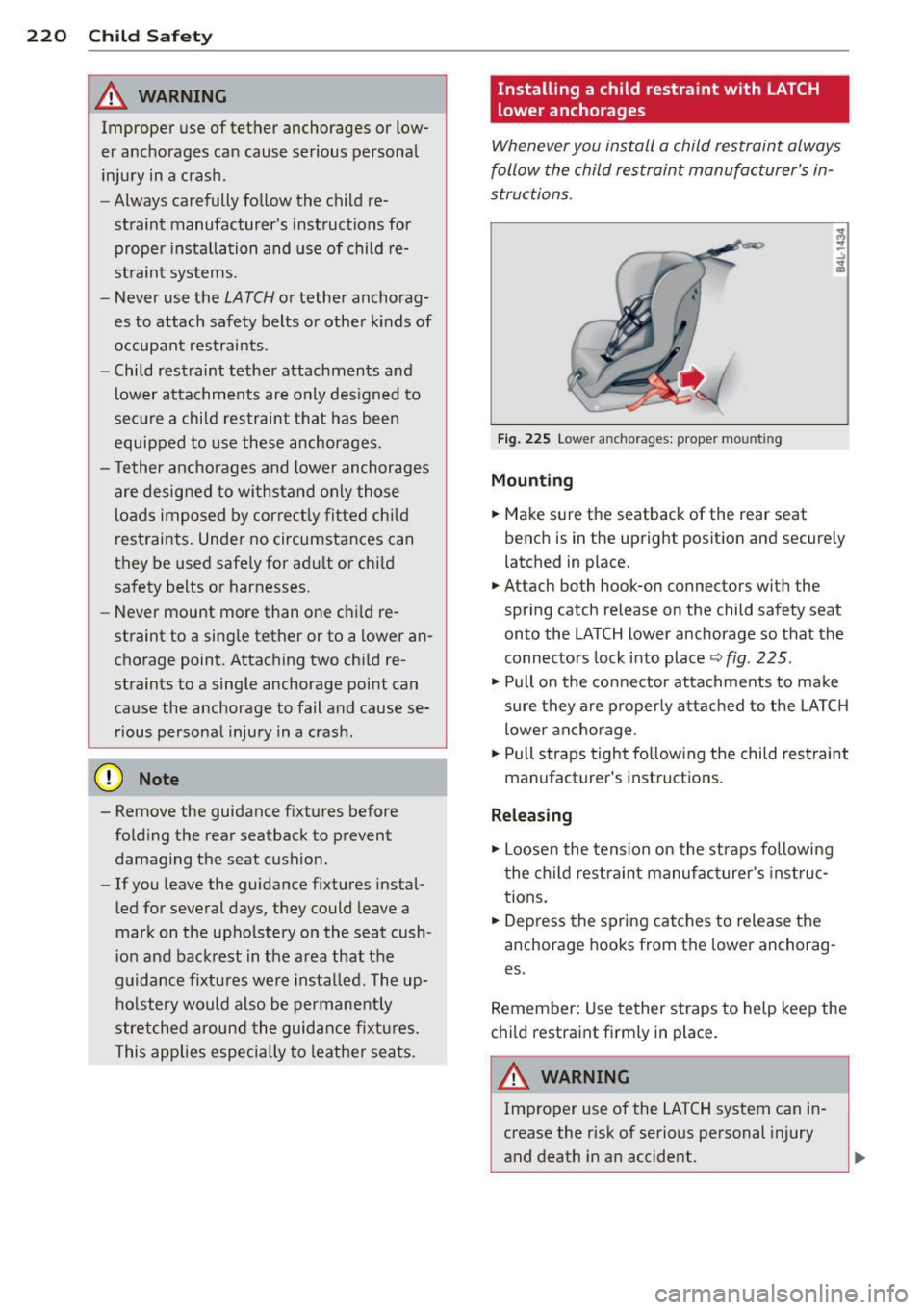
Installing a child restraint with LATCH
lower anchorages
Whenever you install a child restraint always
follow the child restraint manufacturer's in
structions.
F ig . 225 Lower a ncho rages: proper mount ing
Mo unting
.,. Make s ure the seatback of the rear seat
benc h is in the upright position and securely
latched in place.
.,. Attach both hook-on connectors with the
spring catch release on the child safety seat
onto the LATCH lower anchorage so that the
connectors lock into place ~
fig. 225 .
.,. Pull on the connector attachments to ma ke
sure they are properly attac hed to the LATC H
lower ancho rage .
.,. Pull straps tight fo llow ing the child res traint
manufacturer's instruct ions.
Releasing
.,. Loose n the tension on the straps fo llowing
t he child restra int manufac turer's inst ruc
tions .
.. Depress the spring catches to release the
anchorage hooks from t he lower anchorag
es.
Remember: Use tether straps to help keep the
c h ild restraint firmly in place .
A WARNING
'-
Improper use of the LATCH system can in-
crease the risk of serious personal in jury
and death in an accident.
Page 226 of 340
224 Intelligent technology
Intelligent technology
Notice about data
recorded by vehicle
control modules
Your vehicle is not equipped with an Event Da
ta Recorder (EDR), installed by some manu
facturers fo r the express purpose of capturing
data for retrieval after an accident or crash
event . EDRs are sometimes ca lled "crash re
corders".
Some state laws restrict the retr ieval or down
loading of data stored by EDRs that were in
stalled in a vehicle for the express purpose of
retrieving data after an accident or crash
event without the owner's consent.
A lthough your vehicle is not equipped with an
EDR, it is equipped with a number of electron
ic control modules for various vehicle systems
such as, for examp le, engine function, emis
sion control, as well as for the airbags and
safety belts .
These electronic contro l modules also record
vehicle-related data during normal vehicle op
eration for diagnostic and repair purposes.
The recording capacity of the electronic con
trol modules is limited to data (no sound is re
corded) and only a small amount of data is ac
tually recorded over a very limited period of
time and stored when a system fault or other
condition is sensed by a control unit. Some of
the data then stored may relate to vehicle
speed, direction, braking as we ll as restraint
system use and performance in the event of a
crash or other condition. Stored data can only
be read and downloaded with special equip
ment.
Electronic Stabilization
Control (ESC)
Description
The Electronic Stabilization Control (ESC) rein
forces driver safety. It reduces the risk of slip
p ing and improves driving stability. ESC de
tects cr itical s ituations such as the vehicle oversteering and
understeering or the wheels
spinning . The vehicle is stabilized by applying
the brakes or reducing engine torque . Once
the ESC is active, the indicator light
G1 blinks
in the instrument cluster.
ESC includes the anti-lock brake system (ABS),
brake assist system, anti-slip regulation
(ASR), electronic differential lock (EDL) and
hill descent control.
Anti-lock brake system (ABS)
ABS prevents the whee ls from locking up
when braking. The vehicle can still be steered
even during hard braking. App ly steady pres
sure to the brake pedal. Do not pump the ped al. A pulsing in the brake pedal indicates that
the system is helping you to brake the vehicle .
Brake assist system
The brake assist system can decrease braking
distance. It increases braking power when the
driver presses the brake pedal quickly in emer
gency situations. You must press and hold the
brake pedal until the situation is over . In
vehicles with adaptive cruise control*, the
brake assist system is more sensitive if the
distance detected to the vehicle ahead is too
small.
Anti-slip regulation (ASR)
ASR reduces engine power when the drive
wheels begin to spin and adapts the force to
the road conditions. This makes it easier to
sta rt, accelerate and drive up hills.
Electronic differential lock (EDL)
The EDL brakes wheels that are spinning and
transfers the drive power to the other wheels .
This function is available up to about 60 mph
(100 km/h) .
In extreme cases, EDL automatically switches
off to help keep the brake on the braked wheel
from overheat ing. EDL will switch on again au
tomat ically when conditions have returned to
normal.
Page 232 of 340
230 Intellig ent technol ogy
What you should know
The highest priority is given to maintaining
starting capability.
The battery is severely taxed in short-distance
driving, in city traffic and during the cold time
of year. Abundant electr ical energy is re
qu ired, but only a little is generated. It is also
cr itical if the e ngine is not running and elect ri
cal components a re turned on. In th is in
stance energy is being consumed but none is being generated .
I t is in precisely these situations that you w ill
notice energy management actively regulat
ing the distrib ution of energy.
Vehicle stand s for an ext ende d period
If you do not drive your vehicle over a period
of several days or weeks, electrical compo
nents are gradually cut back o r switched off .
This reduces energy cons umption and main
tains starting capab ility
over a longer period.
Take into consideration that when you un lock
your ve hicle, some convenience functions,
such as the interior ligh ts or the power seat
ad justmen t, may not be available. The con
venience functions will be available again
when you turn on the ignition and start the
engine.
With the engine turned off
I f you listen to the radio, for example, with
the eng ine turned off or use other MM I func
tions, the battery is being discharged .
I f sta rting capability is jeopa rdized due to en
e rgy consumpt ion, the follow ing warning ap
pears in the MMI disp lay:
Ple ase s tart engin e, otherwi se system will
s wit ch off in 3 minute s.
The warning ind icates that the system will be
turned off automatically after 3 m inutes .
If
you wish to cont inue us ing the functions, you
have to start the engine.
With the eng in e runnin g
Although e lectrical energy is gene rated when
the vehicle is being driven, the battery can be
come discharged. This happens mostly when
little energy is being generated and a great
deal consumed and the battery's state of
charge is not optimal.
To bring the energy balance back into equili brium, consumers which req uire especially
large amounts of energy are temporar ily cut
back or sw itched off. Heat ing systems in par
t icular require a great deal of energy. If you
notice, for example, that the heated seats* or
the heated rear window are not heating, they
have been tempora rily cut back or switched
off . These systems w ill be available again as
soon as t he energy balance has been restored.
You w ill also notice that engine id le speed has
been increased slightly . T h is is normal and not
a cause for con cern. By inc reas ing engine id le
speed the additional energy required is gener
ated and the battery is charged.
Driver notification in the instrument
cluster display
If battery power drops into the range where it
can limit the ability of the engine to start, this
is shown in the instrument cluster display
with the fo llow ing driver message:
(•) low batte ry charge: bat tery w ill be
ch arg ed whil e dri ving
This notificat ion reminds you that the starting
capability of the engine may be lim ited. As
soon as you start dr iv ing again, the battery
will be recharged and the not ificat io n will go
out .
Driver notific ation app ear s a nd goe s out
again
If this driver notification appears after the ig
nition is turned on or wh ile driving and it goes
out again after a while, the battery has been
adequately recharged. .,.
Page 239 of 340

Driving off road
Driving in difficult road
conditions and offroad
General information
The operation of the E lectronic Stabilization
Control (ESC) is expanded fo r operation away
from paved roads. In situations where slip or a
differential lock ing funct ion is required, the
offroad mode can be activated
c:::> page 224.
Hill descent control is a lso ava ilable in the off
road mode, which automat ically brakes the
ve hicl e and thereby keeps speed consta nt
when differe nt w heel speeds a re detected
when descending a hill
c:::> page 226. Your A ud i
a lso has permanent a ll-wheel drive in addi
tion.
H oweve r, your Aud i is not a pure off road ve hi
cle . It was not built for d riving unde r extreme
conditions, e.g. for trips that are in the nat ure
of an expedition .
Drive only on road s and offro ad sections
which match the de sign of y our vehicl e and
you r abilitie s as a dri ver. Ne ver t ake ri sks!
Before driving offroad
- Check the eng ine oi l level, t ire pressu re ,
coolant level , and the fluid level in the w ind
shield washe r reservo ir.
- Stow luggage items a nd other objects in the
l uggage compartment, and sec ure t hem
against s lid ing aro und .
After driving offroad
- After trips off road, remove any twigs and
othe r foreign objects from the grill , the un
derbody and the wheels. Pay spec ia l atten
t ion to fore ign ob jects (stones) which have
become lodged in t he tire tre ad.
- Clean t he body and the vehicle unders ide,
and inspect the veh icle for possible damage.
- Clean dirty w indows , headlamp lenses, rear
li gh ts, and license plates .
- Perfo rm a brake check (particularly after
t ravell ing throug h water) .
Driving off road 237
A WARNING
-Drive especially attentively and plan
ahead in diff icu lt road conditions and
when off road. Excessive speed o r inco r
rect maneuve rs can cause injuries and
damage to the vehicle.
-
- Always adapt your speed and driving
style to road, offroad, t raff ic, and weath
e r condition s. D rive e spe cially slowly off
road when yo ur view is restricted.
- Please be aware that in offroad mode,
pa rti cularly on a smoo th and s lippery
road, the whee ls may have an increased
tendency to spin and the vehicle may
break away -danger of skidding!
- Stability is limited in the offroad mode .
@ For the sake of the environment
Avoid damage to the environment and re
spect na ture .
@ Tips
Only d rive where it is permitted and stay
on marked roads and paths.
Explanation of some technical terms
T he following data refer to ideal cond itions .
Depend ing on ve hicle load and gro und condi
tions and the environment, the numbers may
vary .
It is the driver's responsibility to decide
whether a veh icle can overcome a specific sit
uat ion
c:::> &, .
Gradient angle
The number o f meters in altitude ga ined over
a distance of 109.4 ya rds or 100 meters
(grade) are given as a percentage o r degrees.
Information about the gradient the vehicle
can climb under its own power (depends in
part on the road surface and engine power).
Max imum perm itted grade : 31
°
Lat eral angle (slo pe of veh icle )
Indicates the angle up to which the vehicle
can be driven diagona lly or across the fall line
on a slope without the vehicle tipp ing over
IJll,
•
•
Page 245 of 340
have become completely familiar with the way
your vehicle-trailer combination behaves and responds.
Backing up is difficu lt and requires practice.
Backing up with a trai ler genera lly requires
steering action opposite to that when backing up your vehicle without a trailer .
Maintain a greater distance between your ve
hicle and the one in front of you. You will need
more room to stop . To compensate for the
trai ler, you will need a larger than norma l
turning radius.
When passing, remember that you cannot ac
celerate as fast as you normally would be
cause of the added load . Make sure you have
enough room to pass. After passing, allow plenty of room for your tra iler before chang
ing lanes again .
Avoid jerky starts, sharp turns or rapid lane
changes.
@ Tips
- Do not tow a traile r during the break-in
period of your vehicle.
- If you tow a trailer, your A udi may re
quire more frequent maintenance due to
the extra load
<=> page 316.
Parking on a slope
Do not park on a slope with a trailer. If it can
not be avoided, do so only after doing the fol
lowing:
When parking:
.. Apply the foot brake .
.. Have someone place chocks under both the
vehicle and the trai ler wheels .
.. With chocks in place, slowly re lease the
brakes until the wheel chocks absorb the
load .
.. Turn the wheels towards the curb .
.. Apply the parking brake .
.. Move the selector lever to P.
When restarting after parking:
.. Apply the foot brake.
Trailer towing 243
.. Start the engine.
.. Move the selector lever to D.
.. Release the parking brake and s low ly pull
out and away from the wheel chocks.
.. Stop and have someone retr ieve the wheel
chocks.
(D Tips
If you move the selector lever of the auto
matic transmission to P before applying
the parking brake and before blocking the
whee ls, you may have to use more force
l ater to move the lever out of the
P posi
tion.
•
•
Page 253 of 340
Winter operation
At temperatures below 20° F (-7° C), Diesel
fuel No.
2 loses its fluidity due to wax separa
tion, which may clog the fuel filter or tank fil
ter and keep the engine from running .
To help the filter from being clogged by wax,
the fuel filter in your vehicle is automatically
preheated. Preheating the fuel filter makes
operation of your vehicle possible with Diesel
fuel No . 2 down to -10° F (-24° C).
If you expect temperatures below 5° F
(-15° C) ask your fuel dealer whether their
Diese l fuel No. 2 is sufficiently winterized for
the prevailing and expected temperatures.
If not winterized or insufficiently winterized
Diesel fuel has already thickened to the extent
that the engine will not start, warm the vehi
cle up by leaving it in a heated garage.
It is normal that the engine noise leve l (die
seling) is louder during the warm-up period in
winter.
It is also norma l when whitish-blue
smoke comes out of the tailpipe after start ing
and during warm-up . The amount of smoke
depends on the outs ide temperature.
Do not let your Diese l engine id le unnecessari
ly after a cold start. Driving off slowly will
shorten the warm-up period .
A WARNING
-Never use "starting assist fluids." They
may be potent ially explosive or cause a
"run-away" engine condition. This could
result in serious engine damage and per
sonal injury.
- Never use fuel line anti-freeze offered for
gasoline engines .
0 Note
- Refueling with gasoline when your vehi
cle has a diesel engine can cause very se
rious and expens ive engine and fuel sys
tem damage that is not covered by any
A udi Limited Warranty.
- If you put any amou nt of incorrect fuel in
the fuel tank, do not start the engine un-
-
Fuel supply and filling your fuel tank 251
der any circumstances. Immediately con
tact the nearest authorized Audi dea ler
or authorized Audi Service Fac ility for as
sistance. These fuels contain substances
that can severely damage the fuel sys
tem and the engine if the engine is start
ed .
- Veh icles with diesel engines must never
be refueled or driven with gasoline, kero
sene, heating oil, or other non-specified
fuels that have not been expressly ap proved for use with the diesel engine.
Other kinds of fuel can cause serious
damage to the fuel system and the en
gine that is not covered by any Audi Lim
ited Warranty.
- If Diesel fuel should get on any rubber
hose, it must be wiped off immediately.
Then wash the contaminated hose por
tion with soap and warm water. Do not
allow D iesel fuel to remain on connect
ing hoses . They may develop leaks and
cause serious damage.
Fuel tank
Fuel filler neck
The fuel filler neck is located on the right rear
side panel behind the fuel filler flap.
If the power locking system shou ld fai l, you
can still open the flap manually -for detailed
instructions see¢
page 254.
You can find the fuel tank capacity of your ve
hicle inc::>
page 315.
The label on the inside of the fuel filler flap
tells you the correct fuel for your veh icle. For
more information abo ut fuel specifications,
see c::>
page 249.
Your vehicle fuel tank has an on-board refuel
ling vapor recovery system. This feature helps
to prevent fue l vapors from escaping from the
tank and pollut ing the environment while you
refuel yo ur vehicle. In order to fill the tank
properly while protecting the environment,
please follow this refueling procedure careful-
~-~
•
•
Page 254 of 340

252 Fuel supply and filling your fuel tank
_&. WARNING
Under normal operating conditions, never
carry additional fuel containers in your car .
Gas canisters and other containers used to
transport fuel can be dangerous. Such con
tainers, full or empty, may leak and could
cause afire in a collision. If you must
transport fuel to use for your lawn mower,
snow blower, etc., be very careful and al
ways observe local and state laws regard
ing the use, transportat ion and storage of
such fuel containers. Make certain the con
tainer meets industry standards (ANSI/
ASTM F8S2 -86).
(D Note
Never drive your vehicle until the fuel tank
is completely empty. The irregular supp ly
of fuel can cause misfiring . Gasoline could
enter the exhaust system and damage the
catalyt ic converter.
Refuelling
Fig . 232 Right rear vehicle side : Open ing t he fue l filler
fl ap
Fig. 233 Fu el cap hooked on the opened fue l filler fl ap
When adding fuel, the ignition and any cellu
lar phones in the vehicle must be switched
off . When activating the central locking, the fuel
filler flap is automatically unlocked or
locked. Refuel the vehicle with the ignition
turned
off.
Taking the fuel cap off
.,. To open the fue l filler f lap, press on the left
side of the flap¢
fig. 232 -arrow-.
.,. Unscrew fue l filler cap counter-clockwise
and hang it on the fuel filler flap ¢
fig. 233.
.,. Check the label on the inside of the fuel fill
er flap to determine if the vehicle must be
fueled with gasoline or diesel fuel.
Refuelling procedure
.,. Insert the fuel nozzle from the gasoline
pump into the fuel filler neck as far as it wi ll
go .
.,. Select a medium refuelling rate so that the
nozzle switches off automatically when the
tank is fu ll.
Putting the fuel cap back on
.,. After filling your tank, twist the fuel filler
cap clockwise as far as it wi ll go.
.,. Close the fuel filler flap.
T o avoid fuel spilling or evaporating from the
fuel tank always close fuel filler cap proper ly
and completely. An improperly closed fuel fill
er cap may also cause the MIL lamp¢
page 27
to come on (only vehicles with gasoline en
gine) .
_&. WARNING
Improper refueling or handling of fuel can
cause fire, explosion and severe burns.
- Fuel is highly flammable and can cause
severe bu rns and other injuries.
- Failure to shut the engine off while refu
eling and/or to insert the pump nozzle
fu lly into the fuel filler neck could cause
fuel to spray out of filler neck or to over
f low . Fu el spray and overflowing fue l can
cause a fire.
- Never use a cellular telephone while re
fue ling. The electromagnetic radiat ion
can cause sparks that can ignite fuel va
pors and cause a fire .