change wheel AUDI Q7 2015 Owner´s Manual
[x] Cancel search | Manufacturer: AUDI, Model Year: 2015, Model line: Q7, Model: AUDI Q7 2015Pages: 350, PDF Size: 86 MB
Page 243 of 350
M N
0 ...J
'SI: ,...., \!) 1.1'1 ,...., 1.1'1 ,....,
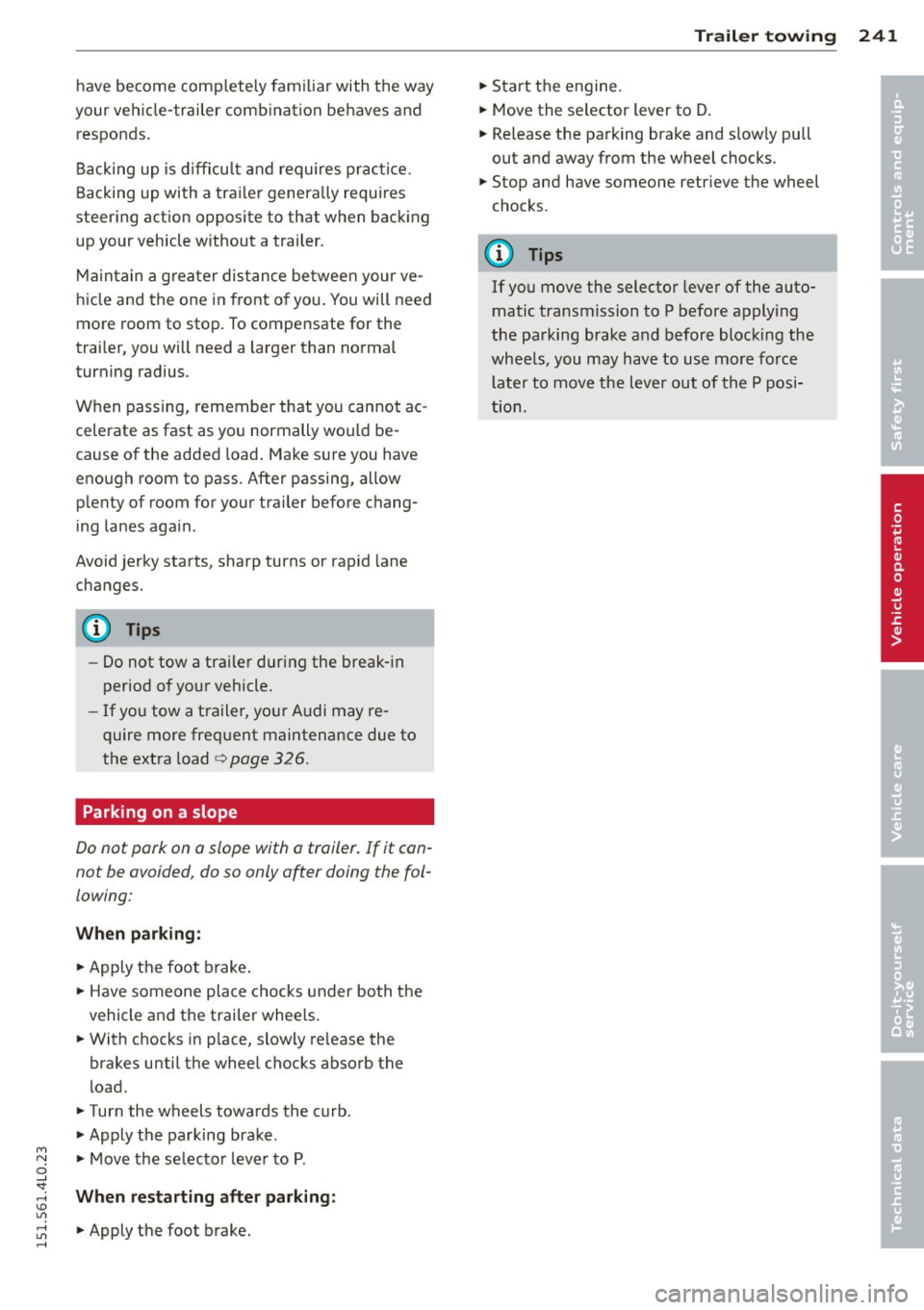
have become completely familiar with the way
your vehicle-trailer combination behaves and responds.
Backing up is difficu lt and requires practice.
Backing up with a trai ler genera lly requires
steering action opposite to that when backing up your vehicle without a trailer .
Maintain a greater distance between your ve
hicle and the one in front of you. You will need
more room to stop . To compensate for the
trai ler, you will need a larger than norma l
turning radius.
When passing, remember that you cannot ac
celerate as fast as you normally would be
cause of the added load . Make sure you have
enough room to pass. After passing, allow plenty of room for your tra iler before chang
ing lanes again .
Avoid jerky starts, sharp turns or rapid lane
changes.
@ Tips
- Do not tow a traile r during the break-in
period of your vehicle.
- If you tow a trailer, your A udi may re
quire more frequent maintenance due to
the extra load
¢ page 326.
Parking on a slope
Do not park on a slope with a trailer. If it can
not be avoided, do so only after doing the fol
lowing:
When parking:
.. Apply the foot brake .
.. Have someone place chocks under both the
vehicle and the trai ler wheels .
.. With chocks in place, slowly re lease the
brakes until the wheel chocks absorb the
load .
.. Turn the wheels towards the curb .
.. Apply the parking brake.
.. Move the selector lever to P.
When restarting after parking:
.. Apply the foot brake.
Trailer towing 241
.. Start the engine.
.. Move the selector lever to D.
.. Release the parking brake and s low ly pull
out and away from the wheel chocks.
.. Stop and have someone retr ieve the wheel
chocks.
(D Tips
If you move the selector lever of the auto
matic transmission to P before applying
the parking brake and before blocking the
whee ls, you may have to use more force
l ater to move the lever out of the
P posi
tion.
•
•
Page 278 of 350

276 Tires a nd whee ls
Recommended inflation Sidewall
pressure
means that portion of a tire be -
see
c:::> page 2 7 4, Cold tire infla-tween the tread and bead.
tion pressure.
Speed rating (letter code )
Reinforced tire
means the speed at which a tire
means a tire design to operate is designed to be driven for ex-
at higher loads and at higher tended periods of time. The rat-
inflation pressures than the ings range from 93 mph (150
corresponding standard tire .
km/h) to 186 mph (298 km/h)
Reinforced tires may be identi -
c:::> page 294. You may not find
fied as "XL", "xl", "EXTRA
this information on all tires be-
LOAD", or "RF" on the sidewall.
cause it is not required by law.
Rim The speed rating letter code,
means a metal support for a where applicable, is molded on
tire or a tire and tube assembly the tire sidewall and indicates
upon which the tire beads are the maximum permissible
road
seated . speeds
c:::> A in Winter tires on
Rim d
iameter
page 298.
means nominal diameter of the
T ir e pressure mon itoring
system
bead seat. If you change your means a system that detects
wheel size, you will have to pur-
chase new tires to match the when one or more of a vehicle's
new rim diameter . tires are underinflated and illu-
Rim
size de signation
m inates a low tire pressure
warning telltale.
means rim diameter and width.
Tread
R im width
means that portion of a tire
means nominal distance be- that comes into contact with
tween rim flanges. the road.
...
Page 282 of 350
280 Tires and wheels
If you wish to improve comfort See the illustration ¢ fig. 250
when operating the vehicle at for the location of the label on
normal load (up to 3 occu-driver's side B-pillar (color of
pants), you can adjust tire the actual label and exact loca-
pressures to those specified tion on the vehicle will vary
for normal vehicle load. Before slightly).
operating the vehicle at maxi-Note that the following table is
mum load, you must increase accurate at the time of going to
the tire pressures to those press and is subject to change .
specified for maximum vehicle In the event of discrepancies,
load¢&. the tire pressure label located
Bear in mind that the tire pres- on the driver's side B-pillar al-
sure monitoring system can on- ways takes precedence.
ly monitor the tire pressures
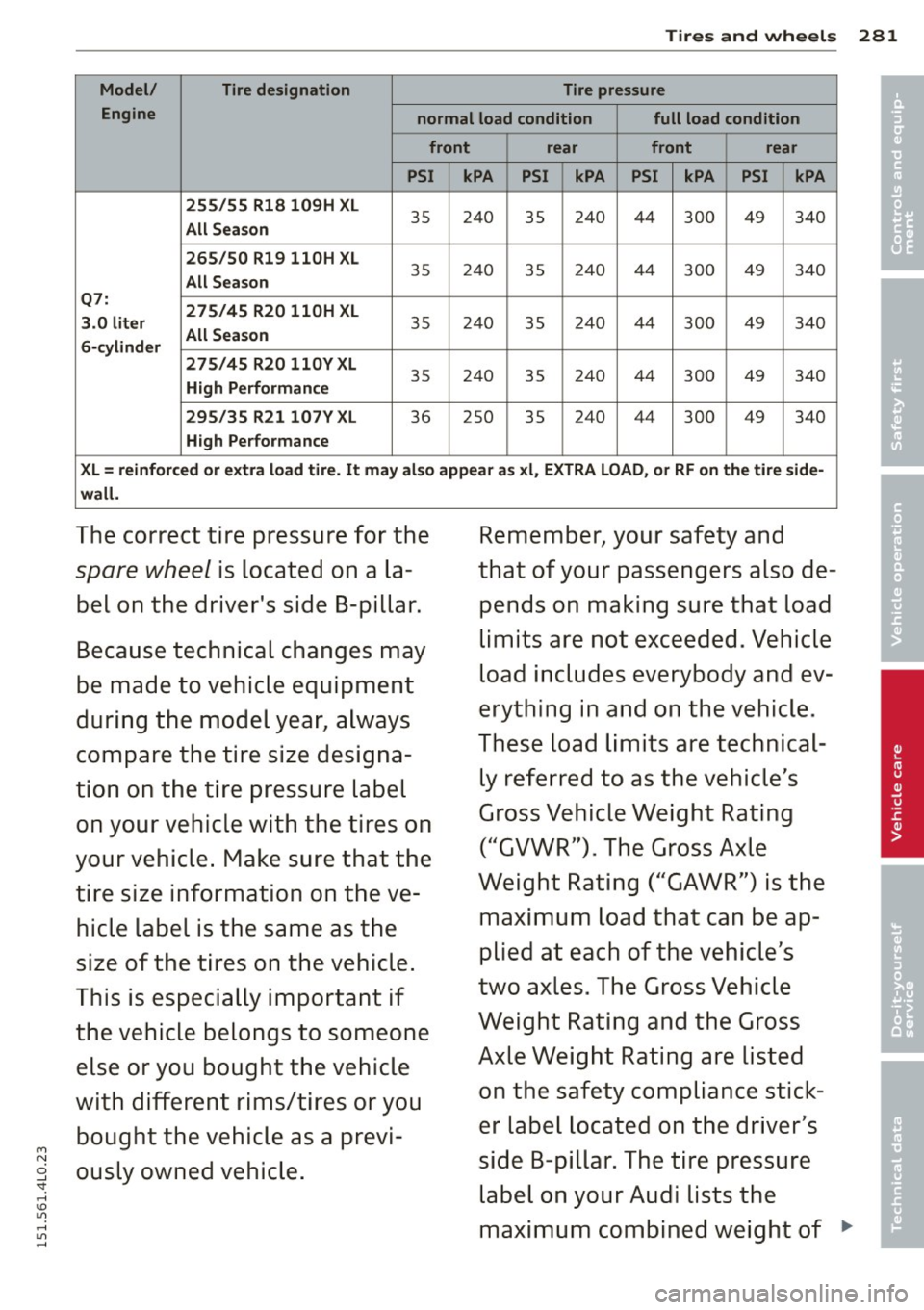
The table below lists the rec-
you have stored . The system
ommended cold tire inflation
does not recognize the load
pressures for the Audi model
condition of your vehicle. covered by your Owner's Litera-
The effectiveness of the tire ture at the vehicle's capacity
pressure monitoring system weight and the tire sizes instal-
will be impaired if you store led on the respective models as
normal load pressures but then original equipment, or as a fac-
operate the vehicle at its maxi-tory option.
...
mum load¢&.
Page 283 of 350
M N
0 ...J 'SI" ,...., \!) 1.1'1 ,...., 1.1'1 ,....,
Tires and wheels 281
Model/ Tire designation Tire pressure
Engine normal load condition full load condition
front rear front rear
PSI kPA PSI kPA PSI kPA PSI
kPA
255/55 R18 109H XL
All Season
35 240
35 240 44
300 49 340
265/50 Rl9 llOH XL
All Season
35 240
35 240 44
300 49 340
Q7:
3.0 liter 275/45 R20 110H XL
All Season
35 240
35 240
44 300 49 340
6-cylinder
275/4S R20 llOY XL
High Performance
35 240 35 240 44 300 49 340
295/35 R21 107V XL 36 250 35 240
44
300 49 340
High Performance
XL~ reinforced or extra load tire. It may also appear as xl, EXTRA LOAD, or RF on the tire side-
wa .
The correct tire pressure for the
spare wheel is located on a la
bel on the driver's side B-pillar.
Because technical changes may
be made to vehicle equipment
during the model year, always
compare the tire size designa
tion on the tire pressure label on your vehicle with the tires on
your vehicle. Make sure that the tire size information on the ve
hicle label is the same as the
size of the tires on the vehicle.
This is especially important if
the vehicle belongs to someone
else or you bought the vehicle
with different rims/tires or you
bought the vehicle as a previ
ously owned vehicle. Remember, your safety and
that of your passengers also de pends on making sure that load
limits are not exceeded. Vehicle
load includes everybody and ev
erything in and on the vehicle.
These load limits are technical- ly referred to as the vehicle's
Gross Vehicle Weight Rating ("GVWR"). The Gross Axle
Weight Rating ("GAWR") is the maximum load that can be ap
plied at each of the vehicle's
two axles. The Gross Vehicle
Weight Rating and the Gross
Axle Weight Rating are listed on the safety compliance stick-
er label located on the driver's
side B-pillar. The tire pressure label on your Audi lists the
maximum combined weight of ""
•
•
'
Page 288 of 350
286 Tires and wheels
build-up, sudden tire failure
and loss of control.
-If the tire pressure is too low or too high, the tires
will wear prematurely and
the vehicle will not handle
well.
-If the tire is not flat and you
do not have to change a
wheel immediately, drive at reduced speed to the near
est service station to check
the tire pressure and add air
as required.
(D Note
Driving without valve stem
caps can cause damage to
the tire valves. To prevent
this, always make sure that
factory installed valve stem caps on all wheels are secure
ly mounted on the valve .
@ For the sake of the environment
Underinflated tires will also
increase the fuel consump
tion .
Tires and vehicle load limits
There are limits to the amount
of load or weight that any vehi
cle and any tire can carry. Ave
hicle that is overloaded will not handle well and is more diffi
cult to stop. Overloading can not only lead to loss of vehicle
control, but can also damage important parts of the vehicle
and can lead to sudden tire fail
ure, including a blowout and
sudden deflation that can cause
the vehicle to crash .
Your safety and that of your passengers also depends on
making sure that load limits are
not exceeded. Vehicle load in
cludes everybody and every
thing in and on the vehicle.
These load limits are technical
ly referred to as the vehicle's
Gross Vehicle Weight Rating
("GVWR") .
The "GVWR " includes the
weight of the basic vehicle, all
factory installed accessories, a
full tank of fuel, oil, coolant
and other fluids plus maximum load. The maximum load in
cludes the number of passen
gers that the vehicle is intend
ed to carry ("seating capacity")
with an assumed weight of 150 lbs (68 kg) for each pas
senger at a designated seating
position and the total weight of
any luggage in the vehicle. If ""
Page 305 of 350
M N
0 ..J
'SI: ,...., \!) ..,.,
,...., ..,., ,....,
@ Tips
-The tire pressure m onitoring system may
stop working when there is an ESC mal
funct ion.
- Using snow chains may result in a system
malfunction.
- The tire pressure monitoring system on
your A udi was developed using t ires with
the "AO" or "RO" identification on the
tire sidewall
c:> page 291. We recom
mend using these t ires.
Reset tire pressure monitoring system
If the tire pressure is adjusted, wheels are ro
tated or changed, the TPMS must be reset via
MMI.
.. Before stor ing the new tire pressures, check
t h at the current pressures on all four t ires
correspond to the specified values and
adapt the p ress ures to the current load
c:> page 278 .
.. Swi tch on the igni tion .
.. Se lect:
ICARI f u nct ion but to n > Sy stem s*
control b utton > Tire pre ssure monitoring >
Store now. Or
.. Se lect:
ICARI f u nction button> Car sy stems*
control button > Se rvicing & checks > Tire
pressure monito ring > Store tire pressures
> Yes , store now .
(D Tips
Do not store the t ire p ress ure i f there a re
snow chains on the tire. Otherwise, a sys
tem ma lf u nction may occu r.
Tire s an d wheel s 303
•
•
Page 307 of 350
M
"' 0 _,
"". rl I.O
"' rl
"' rl
plate. If this hap pens , the vehicle may
start to m ove whi le a whee l is being
changed.
- Never use the folding chocks if they are
damaged or i f they have not been assem
bled correct ly.
A WARNING
Improper use of the vehicle jack can cause
ser ious personal injuries.
- Never use the jack supplied with your
Audi on another vehicle, particularly on a heavier one. The jack is only suitable for
use on the vehicle it came w ith .
- Us ing a bumper jack to raise the vehicle
will damage the bumper system. The
jack may slip, causing i njury.
- Never support your vehicle on cinder bloc ks, b ricks or other objects. Th ese
may not be able to support the load and
cou ld cause injury when they fail.
- Never start or run t he engine while the
vehicle is suppor ted by the jack.
- If you must wo rk under the vehicle, al
ways use safety stand s spe cifically de
signed for this purpose.
- Always make sure the inflatable spare
tir e a nd even a f lat t ire are se cured in
place and not loose, ot herwise they
cou ld fly forward, causing personal inj ury
to passengers in the veh icle in an acc i
dent or sudden mane uver.
Removing bass box
Applies to vehicles: with bass box
Before the inflatable spare tire can be taken
out, the bass box must be removed .
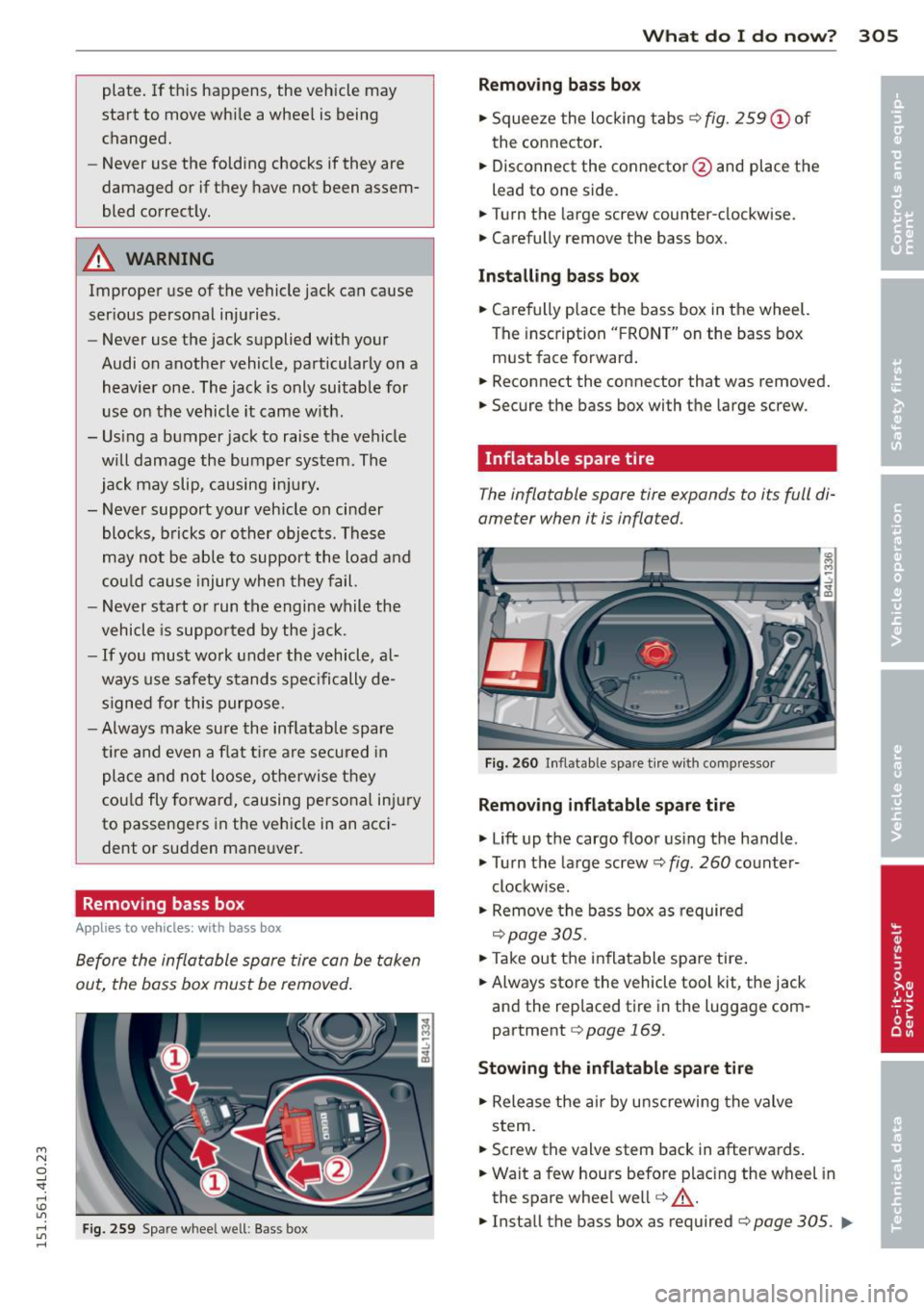
Fig . 259 Spare wheel well: Bass box
What do I do now ? 305
Removing bass box
.,. Squee ze the locking tabs ~ fig . 259 (D of
the conne ctor .
.,. Disconnect the connector @and place the
lead to one side.
.,. Turn the large screw counter-clockwise .
.,. Carefully remove the bass box.
Installing bass bo x
.,. Carefully p lace the bass box in the wheel.
The inscription "F RO NT" on the bass box
must face forward .
.,. Reconnect the connector that was removed.
.,. Secure the bass box with the large screw .
Inflatable spare tire
The inflatable spare tire expands to its full di
ameter when it is inflated.
Fig. 2 60 In flatable spare tir e w ith compressor
Removing inflatable spare tire
.,. Lift up the cargo floo r us ing the handle .
"' Turn the large screw
9 fig . 260 counte r-
clockw ise.
"' Remove the bass box as required
¢ page 305 .
.,. Take out the in flatable spare tire .
.,. Always store the vehicle tool kit, the jack
and the replaced tire in the luggage com
partment
9 page 169.
Stowing the inflatable spare t ire
"' Release the ai r by u nscrewing the valve
stem .
.,. Screw the valve stem back in afterwards .
.,. Wait a few hours before p lac ing the wheel in
the spare wheel we ll¢ ,& .
"' Install the bass box as required ¢
page 305 . ..,_
Page 308 of 350
306 What do I do now?
• Secure the wheel with the large screw.
• Fold the cargo floor back down .
After using th e inflat able spare wheel
The inflatable spare t ire can be re-used as
l ong as it is not damaged and is not worn
down to the tread wear ind icators
c::> A .
When you let the air out of the inflatable
spa re tire, it does not assume its folded shape
again for several ho urs. Until then, it cannot
be p laced back in the spare wheel well and
stowed securely.
A WARNING
- Never use the spare tire if it is damaged
or if it is worn down to the tread wear in
dicators.
- If the inflatable spare tire is more than 6
years old, use it on ly in an emergency
and w ith extreme caut ion and careful
dr iv ing .
- The inflatable spare tire is intended only
for temporary and short-term use .
It
should be replaced as soon as possible
with the no rmal wheel and tire .
- The tire pressure value for the inflatable
spare t ire is located on the driver's side
B-p illar
c::> page 278, fig . 251 .
-Maximum perm iss ible speed is SO mph
(80 km/h).
- Avoid full-throttle acce le rat ion, heavy
braking, and fast corner ing .
- When the air is let out of the inflatable
spare wheel, it does not assume its fold
ed shape for several hours . Until then, it
cannot be placed back in the spare wheel
we ll and stowed secu rely.
- Never drive with more than one inflata
ble spare ti re.
- For technical reasons, the use of ti re
chains on the inf latable spare tire is not
permitted.
If i t is necessary to drive w ith
t ir e cha ins, the infla table spare whee l
must be moun ted on the front axle in the
event of a flat in a rear tire . The newly
available front whee l must the n be in
sta lled in place of the rear wheel with the flat tire
. Insta lling the t ire cha in be
fore mounting the wheel and tire is rec
ommended.
- Loose items in the passenger compart
ment can cause serious personal injury
during hard brak ing or in a n accident.
Never store the inflatable spare tire or
jack and tools in the passenge r compart
ment.
(D Note
- The inflatable spare tire has been deve l
oped specifically for t his veh icle mode l.
It must not be exchanged or used for
other vehicle models. Sim ila rly, inflata
ble t ires from other vehi cle models m ust
no t be used.
- Norma l summer or w inte r ti res m ust not
be ins talled on the infla table t ire rim.
Inflating inflatable spare tire
• Remove the compressor from the luggage
compa rtment
c::> page 305 , fig. 260.
• Unscrew the valve stem from the spare tire.
• Screw the tire f iller hose from the compres
sor firmly onto the
va lve of the spare tire.
• Insert the plug from the compressor into an
outlet of the ve hicle
c::> page 90 .
• Switch the comp resso r on .
• Let the compressor run unti l the va lue speci
fied on the ti re p ressu re label is reached
c::> page 278, fig. 251 . Switc h the compres
sor off after running for 12 m inutes at the
most -danger of overheating!
A WARNING
-The compressor and the tire f iller hose can
become extremely hot while t hey are run
n ing -danger of burns!
([) Note
Switch the compressor off after ru nning
for 12 min utes at the most -danger of
overheating! Allow the compressor to cool
down for a few m inutes before you use it
again .
Page 309 of 350
M N
0 ..J
'SI: ,...., \!) ..,.,
,...., ..,., ,....,
Changing a wheel
Before changing a wheel
Observe the following precautions for your
own and your passenger's safety when chang
ing a wheel .
.,. After you experience a tire fa ilure, pull the
car well away from moving traffic and try to
reach
level gro und before you stop¢.&_ .
.. All passengers should
leav e the car and
move to a safe location (fo r instan ce, be hind
the guardra il)¢ .&_.
.,. Engage the
parkin g brake to prevent your
vehicle from ro lling unintentionally¢ .&_.
.. Move
selecto r le ver to p osition P ¢ .&_ .
1> Ifyou are towing a trai ler: unhitch the trail
er from your veh icle.
.,. Block the diagonally opposite wheel with
the folding chocks or other objects.
.. Take the
jack and the inflatab le spare tire
out of the luggage compartment
¢page 304.
& WARNING
You or your passengers cou ld be injured
while changing a whee l if yo u do not fol
low these safety precautions:
- If you have a flat t ire, move a safe dis
tance off the road . Turn off the eng ine,
t ur n the emergency flashers o n and use
other warning devices to alert other mo
torists.
- Make sure that passengers wait in a safe
place away from the vehicle and well
away from the road and traffic.
- To he lp prevent the veh icle from mov ing
sudden ly and possibly slipping off the
jack, always fully set the parking b rake
and block the whee l diagonally opposite
the wheel being cha nged with the fo ld
ing chocks or othe r objects. When one
front whee l is lifted off the g ro und, plac
ing the A utomat ic Transm iss ion in P
(Park) wi ll
not prevent the vehicle from
moving .
-
What do I do now? 307
-Before you change a whee l, be sure the
ground is level and firm. If necessary,
use a sturdy board under the jack.
- Always store the vehicle tool kit, the jack
and the replaced tire in the luggage com
partment
<=:>page 169 .
Changing a wheel
When you change a wheel, follow these
quence described below step-by-step and in
exactly that order.
1. Activate the vehicle jack mode (only
vehicles with Adaptive Air S uspension)
¢ page 161 .
2. Remove the decorati ve wheel co ver* . For
more details see also <=:>
page 308, Deco
rative wheel covers
or <=:> page 308,
Wheels with wheel bolt caps.
3. Loosen the wh eel bolt s¢ page 308 .
4. Loca te the p roper mounting point for the
jack and align the jack be low that point
¢ page 309.
5. Lift the car with the jack Q page 309 .
6. Remove the wheel with the flat ti re and
then install the
inflatable spare tire
¢ page 310.
7. Tig hte n all wheel bolts lightly.
8.
L owe r the vehicle with the jack .
9. Use the wheel bolt w rench and
firmly
t ighten all wheel bolts¢ page 308.
10. Replace the decora tive whe el co ver* .
11. Deactivate the vehicle jack mode (on ly
vehicles with Adaptive Air S uspension)
¢ page 161 .
A WARNING
Always read and follow all WARNINGS and
informat ion<=:>
& in Raising the vehicle on
page 310
and <=:> page 311.
•
•
Page 310 of 350

308 What do I do now?
After changing a wheel
A wheel change is no t complete without do
ing the following .
"'Always store the vehicle tool kit, the jack
and the replaced tire in the luggage com
partment
¢ page 169.
"'As soon as possible, have the tightening
torques
on all wheel bolts checked with a
torque wrench. The correct tightening tor
que is 120
ft lb (160 Nm) .
"' Have the flat tire
replaced as soon as possi
ble.
@ Tips
- If you notice that the wheel bolts are
corroded and difficult to turn while
changing a tire, they should be replaced
before you check the tighten ing torque.
- Drive at reduced speed until you have the
tightening torques checked.
Decorative wheel covers
App lies to vehicles: with decorative wheel covers
The decorative wheel covers must be removed
first to access the wheel bolts.
Fig . 261 C han ging a w hee l: Removing the whee l cove r
Removing
"'Insert the hook provided with the vehicle
tool kit in the hole in the hub.
"' Pull off the
decorative wheel cover
<=> fig . 261 .
' Wheels with wheel bolt caps
Applies to vehicles: with wheel bolts with caps
The caps must be removed first from the
wheel bolts before the bolts can be un
screwed .
Fig. 262 Changing a wh eel: re mo vin g th e wh eel b o lt
caps
Removing
"' Push the plastic clip provided with the vehi
cle tool kit over the wheel bolt cap until it
engages .
"' Pull on the
plastic clip to remove the cap
<=)fig. 262 .
Refitting
"' Place the caps over the wheel bolts and
push them back on.
The caps are to protect and keep the wh eel
bolts clean.
Loosening and tightening the wheel
bolts
The wheel bolts mus t be loosened before rais
ing the vehicle .
Fig. 263 Cha ng ing a w heel : loosening th e w hee l bo lts II--