warning AUDI Q7 2015 Owner´s Manual
[x] Cancel search | Manufacturer: AUDI, Model Year: 2015, Model line: Q7, Model: AUDI Q7 2015Pages: 350, PDF Size: 86 MB
Page 313 of 350

M N
0 ...J
'SI: ,...., \!) ..,.,
,...., ..,., ,....,
(D Note
When removing or installing the wheel,
the rim could hit the bra ke rotor and dam
age the rotor . Wor k carefully and have a
second person help you.
- W hen mounting tires with
unidirectional
tread design
ma ke s ure the tread pat
tern is pointed the r ight way
<=> page 311.
-The wheel bolts should be clea n and easy
to tu rn. Check for d irt and corrosio n on
t h e mat ing su rfaces of both the whee l
and the hub. Remove a ll dirt from these
su rfaces before remo untin g t he wheel.
Tires with unidirectional tread design
Tires with unidirectional tread design must be
mounted with their tr ead pattern point ed in
the right dire ction.
Using a spare tire with a tread pattern
intended for use in a specific direction
W hen using a spa re tire w ith a t read patte rn
in te nded fo r use in a specific direction, p lease
n ot e t he followi ng:
- The direction of rotation is marked by an ar
row on the side of the tire.
- If the spare tire has to be installed in the in
correct di rection, use the spa re tire only
tem porarily si nce th e tir e will not be able to
a ch ieve i ts op timum pe rfo rm ance chara cter
is tics with reg ard to aq uaplani ng, noise and
wea r.
- W e recommend that you p ay pa rticular at
tent io n t o this fact du ring wet weathe r and
t h at you adjus t your spee d to matc h roa d
con dit ions.
- Re place the fla t tire w ith a new one and
have it installed on your vehicle as soon as
poss ible to restore the hand ling advantages
of a unid irect iona l tire.
What do I do now?
Notes on wheel changing
P lease read t he i nfo rmat ion c:> page 291, New
t ires and replacing tires and wheels
if y ou a r e
go ing to use a sp are tire w hich is different
from the ti res on yo ur vehicle.
After yo u cha nge a tire:
- Check the tire pressure on the spare imme
diately after installation .
- Have the wheel bolt tightening torque
checked with a torque wrench as soon as
possible by your authorized Audi dealer or
a qualified workshop.
- With steel and alloy wheel rims, the wheel
bolts are correctly tightened at a torque of 120 ft lb (160 Nm) .
- If you notice that the wheel bolts are cor
roded and difficult to turn while changing
a tire, they should be replaced before you
check the tightening torque.
- Repla ce the flat tire with a new one and
have it installed on your vehicle as s oon as
possible. Remount the wheel cover.
Until then, drive with extra care and at re
duced speeds .
&_ WARNING
-
- If yo u are goi ng to e quip yo u r ve hicl e
wit h tires o r rims whi ch di ffer from those
which were fac to ry installed, t hen be
sure to rea d the information
c:> page 2 91,
New tires and replacing tires and
wheels.
- Always make s ure the damaged wheel o r
even a flat tire and the jack and t ool kit
are prope rly secured in the luggage com
pa rtme nt and are not loose in the pas
senge r compartment .
- In an accident or sudden maneuver they
could fly forwa rd, inj uri ng a nyo ne in the
veh icle.
- Always sto re damaged wheel , jack a nd
too ls sec urely in the luggage compa rt
men t. Othe rwise, in a n accide nt o r sud
de n m aneuver they could fly forwa rd,
c a u sing i nju ry to passenger s in th e ve hi
cle.
311
•
•
Page 314 of 350
312 Fuses and bulbs
Fuses and bulbs
Electrical fuses
Replacing fuses
Fuses that have blown will have metal strips
that have burned through .
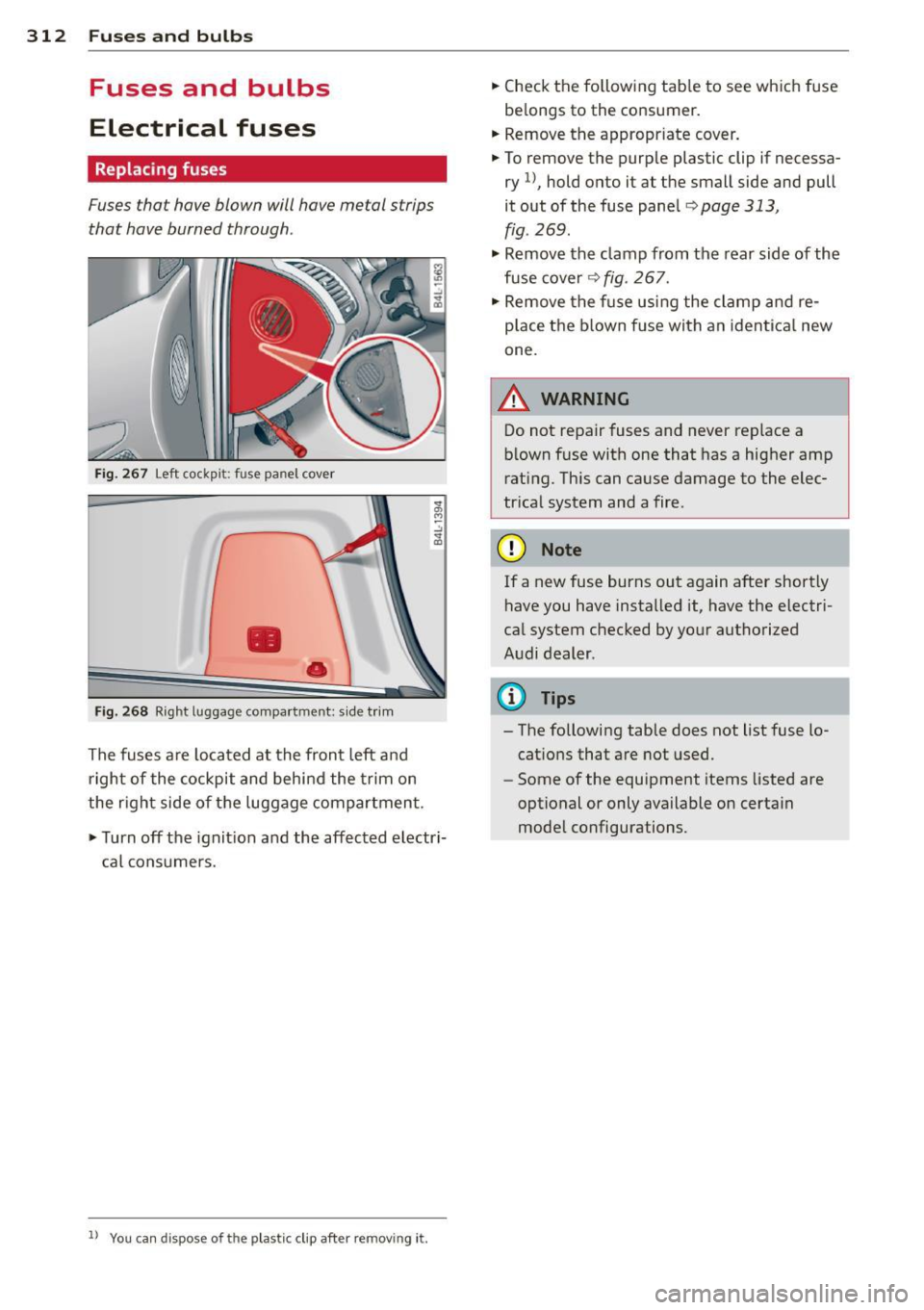
Fig. 267 Left cockpit: fuse pa nel cover
•
•
Fig. 268 Right luggage compart men t: sid e trim
The fuses are located at the front left and
right of the cockpit and behind the trim on
the right side of the luggage compartment.
.,. Turn off the ignition and the affected electri
cal consumers.
ll You can dispose of t he pla stic clip aft er re m ov ing it.
.,. Check the following table to see which fuse
belongs to the consumer.
... Remove the appropriate cover .
... To remove the purp le plastic clip if necessa
ry
1) , hold onto it at the small side and pull
it out of the fuse panel
c:> page 313,
fig .
269 .
... Remove the clamp from the rear side of the
fuse cover
c:> fig. 267 .
... Remove the fuse using the clamp and re
place the blown fuse with an identical new
one.
A WARNING
--
Do not repair fuses and never replace a
blown fuse with one that has a higher amp
rating. This can cause damage to the elec
trical system and a fire .
(D Note
If a new fuse burns out again after shortly
have you have installed it, have the electri
cal system checked by your authorized
Audi dealer .
{!) Tips
-The following table does not list fuse lo
cations that are not used.
- Some of the equipment items listed are
optional or only available on certain
model configurations .
Page 318 of 350

316 Fuses and bulbs
must be co rrectly taken apart and then prop
erly put back together to help prevent break
age of parts and long term damage from wa
te r that can enter housings that have not been
properly resealed.
F or your safety, we recommend that you have
your author ized Audi deale r replace any bulbs
for you, since your dealer has the proper tools,
the correct bulbs and the expertise.
Gas discharge lamps (Xenon lights)*:
Due to the high electrical vo ltage, have the
bu lbs rep laced by a qualified technician.
Headlights with Xenon light can be identified
by the high voltage sticker.
A WARNING
Contact with high-voltage components of
the electrical system and improper re placement of gas discharge (Xenon) head
light bulbs can cause serious personal in
jury and death .
- Xenon bulbs are pressurized and can ex
plode when be ing changed .
-Chang ing Xenon lamps requires the spe
cial train ing, instructions and equip
ment .
- Only an authorized Audi dealer or other
qualified workshop should change the
bulbs in gas d ischarge lamps.
A WARNING
There are parts with sharp edges on the
openings and on the bulb holders that can
cause serious cuts.
- If you are uncertain about what to do,
have the work performed by an author
ized Audi dea le r or other qualified work
shop. Serious personal injury may result
from improperly performed work .
(j) Tips
-If you must replace the light bu lbs your
se lf, always remembe r that the engine
compartment of any vehicle is a hazard
ous area to work in . Always read and
heed all WARNINGS
c::> page 256 c::> _& .
-
- It is best to ask your authorized Audi
dealer whenever you need to change a
bulb .
Page 319 of 350
M N
0 ...J
'SI: ,...., \!) ..,.,
,...., ..,., ,....,
Emergency situations
General
This chapter is intended for trained emer
gency crews and working personnel who have the necessary tools and equipment to
perform these operations.
Starting by pushing or
towing
(D Note
Your v ehicl e is e quipped w ith an automatic
tra nsm iss io n. Cons eque ntly, the e ngine
cann ot be started by pus hing o r tow ing.
Starting with jumper
cables
If necessary, the engine can be started by
connecting it to the battery of another vehi
cle.
If th e engine shou ld fail to start because of a
d ischarged o r weak battery, the battery can be
connected to the battery of
another veh icle,
usi ng a
pair of jumper cables to start the en
gine .
Jumper c ables
Use only jumper cab les of sufficiently large
cross section to carry the starter cur rent safe
l y. Refer to the man ufacturer's specifications.
Use only jumper cables with
insulated te rm i
na l clamps w hich are d istinctly mar ked:
plus(+ ) cable in mos t ca ses co lore d red
minus(-) cable
i n most cases colored black .
A WARNING
Batteries con tai n elec trici ty, a cid, and gas.
Any o f these c an caus e ve ry ser ious or f atal
injury . Foll ow the instruc tions below fo r
safe han dling of your veh icle's battery .
- Alw ays s hield y our eyes and a void le an
ing over the batte ry w henever possib le .
Emergency situations 31 7
- A discharged battery can freeze at tem
pe rat ures just below 32 °F (0 °C). Before
connecting a jumpe r cable, you must
thaw the frozen battery c omp lete ly, ot h
e rwise it could explode.
- Do not allow battery acid to co ntact eyes
or skin . Fl ush any con tacted area wi th
wat er immediately .
- Imp roper use of a booster battery to
s tart a vehicle may cause an ex plosion.
- Vehicle batter ies generate expl osive gas
es. Keep sparks, flame and lighted c iga
rettes away from ba tte ries.
- Do not t ry to jump start a ny ve hicle w it h
a low ac id leve l in the battery.
- The voltage of the booste r batte ry m ust
also have a 12-Vo lt rat ing. T he capac ity
(Ah) of the booste r batt ery sho uld not b e
lowe r than that of th e discharged bat
t ery. Use o f batt eries of d iffe ren t vol tage
or su bstan tia lly differen t "Ah" rat ing
may cause an exp losion and pers onal in
jury .
- N ever ch arge a fr ozen batt ery. Gas t ra p
pe d i n the ice may c ause an ex plosion .
- N ev e r ch arge o r use a batt ery th at h as
been fro zen . Th e batte ry case may have
be weake ned.
- U se o f batter ies of di ffere nt vol tage or
substantially differen t ca pa city (Ah) rat
i ng may cause an exp losion and injury .
T he ca pa c ity (Ah) of the booster battery
should not be lower than that of the dis
charged battery.
- Before you check anything in the engine
compa rtment, always read an d heed a ll
WARNINGS¢
page 256.
(D Note
- App lyi ng a hi gher vo ltage booste r ba t
t ery wi ll cause expens ive damage to sen
sit ive e lectronic components, such as
cont ro l units, relays, rad io , etc.
- There must be no electrical c ontact be
tween the vehicles as otherw ise current
co uld already start to f low as soon as t he
posi tive(+) terminals a re con nect ed. ..,. •
•
Page 320 of 350
318 Emergency situations
@ Tips
- The discharged battery must be properly
connected to the vehicle's electrical sys
tem. When jump starting or charging the
battery, never connect the negative
ground cable to the battery negative
post because the battery manager sys
tem must be able to detect the battery's
state of charge . Always connect the neg
ative ground cable to the negative
ground post of the battery manager con
trol unit.
Use of jumper cables
Make sure to connect the jumper coble
clomps in exactly the order described below!
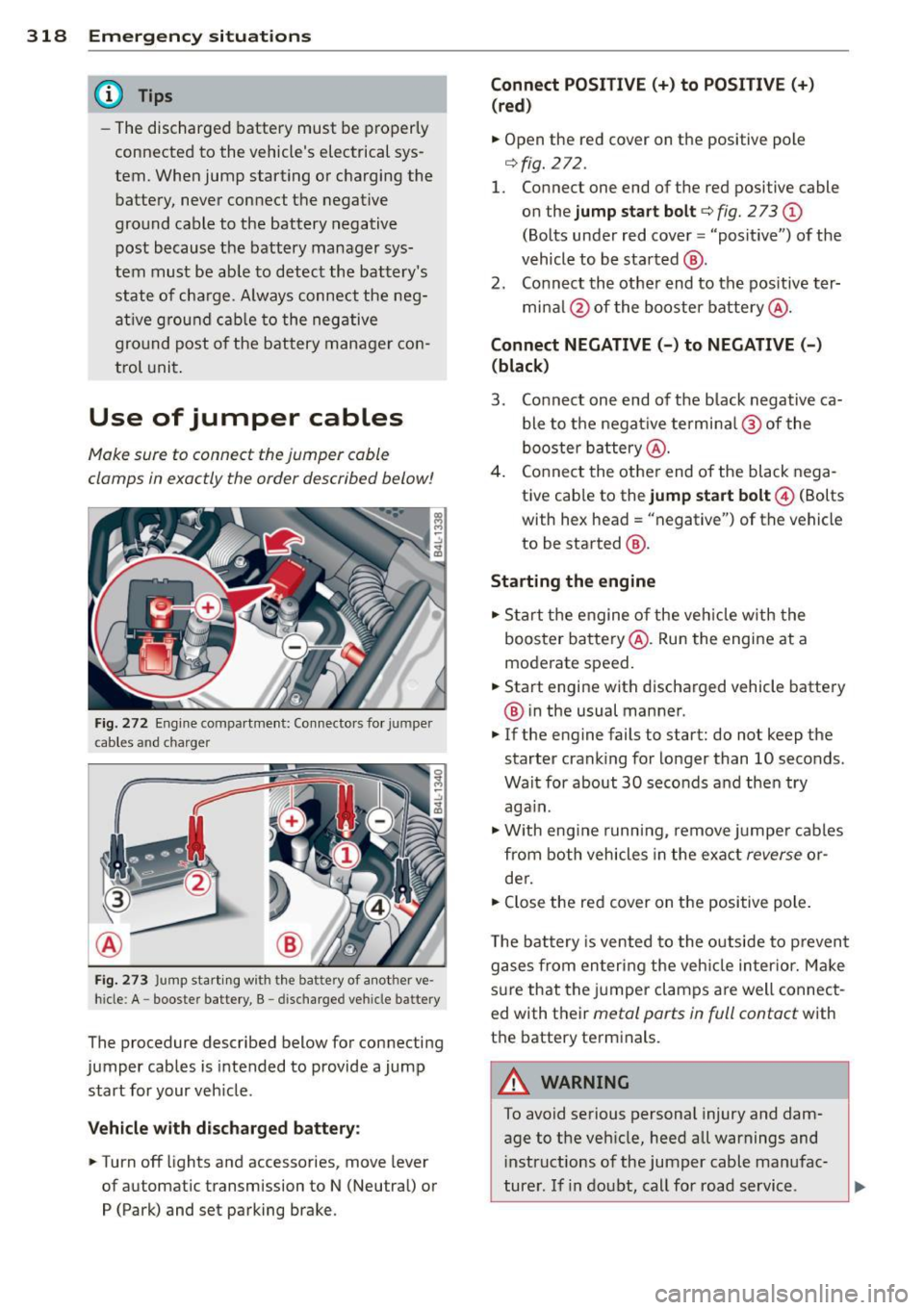
Fig . 272 Engine co mpartment: Conne cto rs fo r jum per
c ables a nd charger
®
Fig. 273 Ju m p sta rt in g w it h the bat te ry of anot her ve
h icle : A - b ooster battery, B - discharge d ve hicl e batte ry
The procedure described below for connecting
jumper cables is intended to provide a jump
start for your veh icle .
Vehicle with discharged battery:
.. Turn
off lights and accessories, move lever
of automatic transmission to N (Neutral) or
P (Park) and set parking brake. Connect
POSITIVE(+) to POSITIVE(+)
(red)
.. Open the red cover on the pos itive pole
¢ fig. 272 .
1. Connect one end of the red positive cable
on the jump start bolt
c::;, fig. 2 73@
(Bolts under red cover = "positive") of the
vehicle to be started @.
2. Connect the other end to the positive ter-
mina l@ of the booster battery@.
Connect NEGATIVE (-) to NEGATIVE (-)
(black)
3. Connect one end of the black negative ca
ble to the negat ive terminal @ of the
booster battery @.
4. Connect the other end of the black nega
tive cable to the jump start bolt@ (Bolts
with hex head= "negative") of the vehicle
to be started @.
Starting the engine
.. Start the engine of the vehicle w ith the
booster battery@. Run the engine at a
moderate speed .
.. Start engine with discharged vehicle battery
@ in the usual manner.
.. If the engine fails to start: do not keep the
starter crank ing for longer than 10 seconds .
Wait for about 30 seconds and then try
again .
""W ith engine running, remove jumper cables
from both vehicles in the exact
reverse or·
de r .
.. Close the red cover on the positive pole.
T he battery is vented to the outside to prevent
gases from entering the veh icle interior. Make
sure that the jumper clamps are well connect
ed with their
metal ports in full contact with
the battery terminals.
A WARNING
-
To avoid serious persona l injury and dam-
age to the vehicle, heed all warnings and i nstructions of the jumper cable manufac-
turer . If in doubt, call for road service . ,..
Page 321 of 350
M N
0 ...J
'SI: ,...., \!) 1.1'1 ,...., 1.1'1 ,....,
-Jumper cables must be long enough so
that the vehicles do not t ouch.
- W hen connecting jumper ca bles, make
sure that they cannot get caught in any
moving parts in the eng ine compart
ment.
- Before you check anything in the engine
compartment, always read and heed all
WARNINGS
Q page 256.
(D Note
Improper hook-up of jumper cables can ru
in the generator.
- Always connect POSITIVE( +) to POSI
TIVE(+), and NEGATIVE(-) to NEGATIVE
( - ) ground post of the battery manager
control unit.
- Check that all screw plugs on the battery
cells are screwed in firmly. If not, tighten plugs prior to connecting clamp on nega
tive battery terminal.
- Please note that the procedure for con
nect ing a jumper cable as described
above applies spec ifically to the case of
your vehicle be ing jump started . When
you are giving a jump start to another ve
hi cle, do
not connec t the negat ive (-) ca
ble to the negat ive( -) term inal on the
discharged battery ©¢
fig. 2 73. In
stead, securely connect the negative( -)
cable to e ither a solid metal component
that is firmly bolted to the engine block
or to the engine block itse lf. If the bat
tery that is being charged does not vent
to the outside, escaping battery gas
could ignite and exp lode!
Em erg en cy si tuation s 319
Emergency towing
with commercial tow
truck
General hints
Your Audi requires special handling for tow
ing.
T he following information is to be used by
commercial tow t ruck operators who know
how to operate their equipment safely.
- Never tow your Audi , towing will cause
damage to the engine a nd transmi ssion.
- Never wrap th e safet y chain s or winch c a
ble s around th e brak e lin es.
- To prevent unne ce ss ary dam age, your Aud i
mu st be t ransp orted with a flat bed truck .
- To load th e vehi cle on to the fl at bed, us e
the t owing loop found in the vehicle t ool s
and atta ch to the front or rear anch o rage
¢ page 320 and Qpage 320 .
A WARNING
A vehicle being towed is not safe for pas
sengers. Never allow anyone to ride in a
vehicle be ing towed, for any reason.
-
•
•
Page 322 of 350
320 Emergency situations
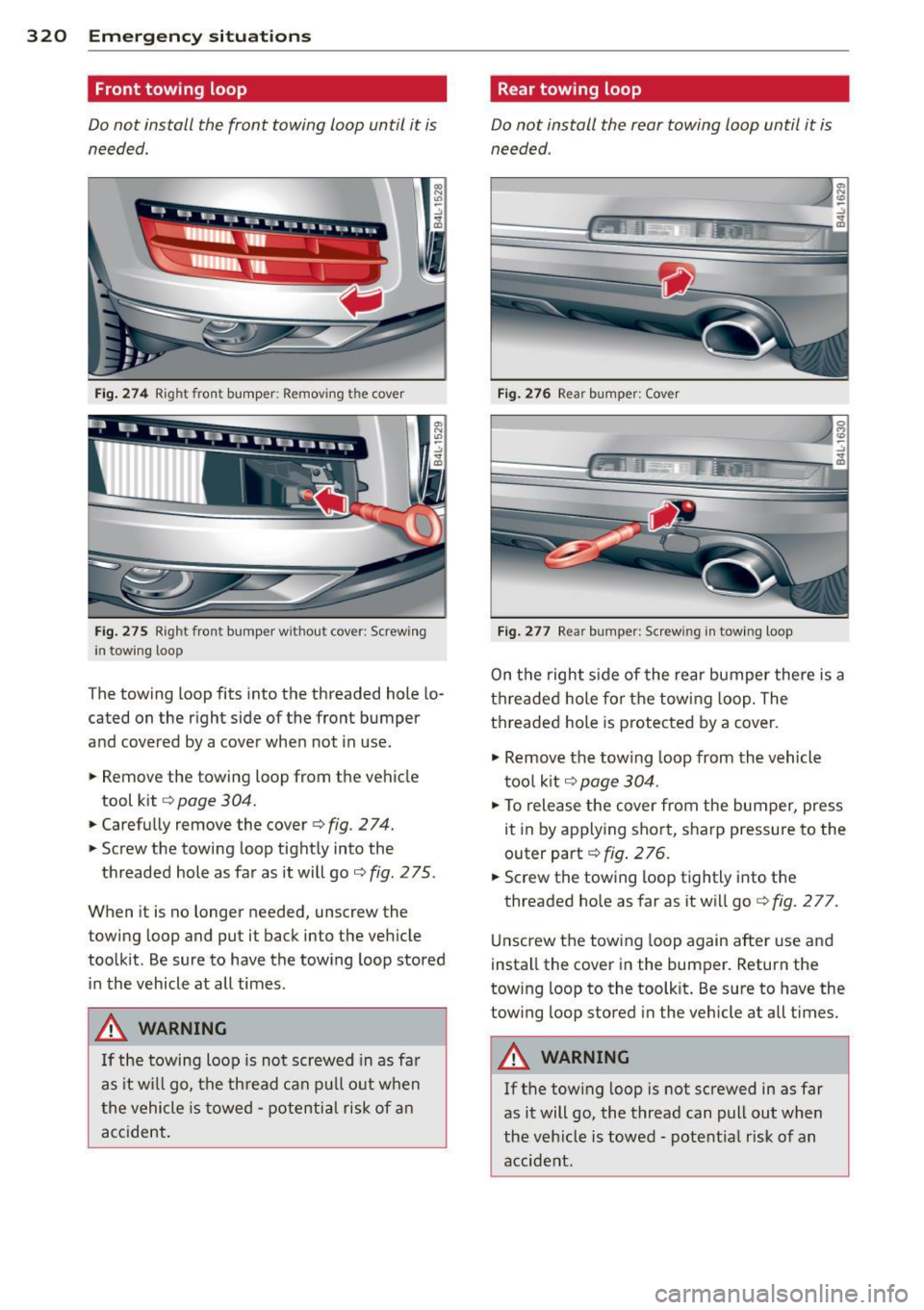
Front towing loop
Do not install the front towing loop until it is
needed.
Fig. 274 Right fron t bumper: Removing t he cover
Fig. 275 Righ t fron t bumper wit hout cove r: Screwing
i n towing loop
The towing loop fits into the threaded hole lo
cated on the right side of the front bumper
and covered by a cover when not in use.
• Remove the towing loop from the vehicle
tool kit
c> page 304.
• Carefully remove the cover c> fig. 274.
• Screw the towing loop tightly into the
threaded hole as far as it will go
c> fig . 2 75 .
When it is no longer needed, unscrew the
towing loop and put it back into the vehicle
toolkit. Be sure to have the towing loop stored
in the vehicle at all times .
A WARNING
If the towing loop is not screwed in as far
as it will go, the thread can pull out when
the vehicle is towed -potential risk of an
accident.
Rear towing loop
Do not install the rear towing loop until it is
needed .
Fig. 276 Rear bumper: Cover
Fig. 277 Rea r bumper: Screw ing in tow ing loop
On the right sid e of the rear bumper there is a
threaded hole for the towing loop. The
threaded hole is protected by a cover.
• Remove the towing loop from the vehicle
tool kit
c> page 304 .
• To release the cover from the bumper, press
it in by applying short, sharp pressure to the
outer part
c> fig . 2 76.
• Screw the towing loop tightly into the
threaded hole as far as it will go
c> fig. 2 77.
Unscrew the towing loop again afte r use and
install the cover in the bumper. Return the
towing loop to the toolkit . Be sure to have the
towing loop stored in the vehicle at a ll times.
A WARNING
If the towing loop is not screwed in as far
as it will go, the thread can pull out when
the veh icle is towed - potential risk of an
accident.
Page 323 of 350

M
"' 0 ..J
"". rl I.O
"' rl
"' rl
Loading the vehicle onto a flat bed truck
Fig. 278 Ve hicle on fla t bed tr uck
Front hook up
.. Align the vehicle with the centerline of the
car carr ier ramp.
.. Attach the winch hook to the front towline
eye previously installed .
Rear hook up
.. Align the vehicle w ith the centerline of the
car carrier ramp.
.. Attach the winch hook to the rear towline
eye previously installed.
(D} Tips
Check carefully to make sure the hook- up
is secure before moving the car up the flat
bed truck ramp .
Lifting vehicle
Lifting with workshop hoist and with
floor jack
The vehicle may only be li~ed at the lifting
points illustrated .
Fig. 279 Fro nt l ift ing po int
Emergenc y situ ation s 321
Fig. 280 Rea r liftin g po int
.,. Read and heed WARNING c::> .&, .
.,. Locate lifting points c::> fig. 2 79 and
¢ fig. 280 .
.,. Adju st lifting arms of wo rkshop ho ist o r
floor jack to ma tch veh icle lifting points.
.. Insert a rubbe r pad be tween the floor jack/
workshop hoist and the lift ing points.
If y ou mu st lift your veh icl e with a fl oor jack
to w ork und erneath , be sure the vehicle is
safel y supported on stand s intended for thi s
purpo se .
Front lifting point
T he lifti ng point is loca ted o n the floo r pan re
i nforcemen t abo ut a t the same level as the
jack mounting point
c::> fig. 279. Do not lift
the vehicle at the vertic al sill reinforcement.
Rear lifting point
T he lifting point is located o n the vert ica l rein
f o rcement of the lower s ill for the on board
jack
c::> fig. 280 .
Lifting with vehicle jack
Refer to c:;, page 309.
A WARNING
-To reduce the risk of ser ious injury and
veh icle damage.
- Always lift the vehicle only at the spe
cia l workshop hoist and floor jack lift
points illustrated
c:;, fig. 279 and
c:;, fig. 280.
- Fail ure to lift the veh icle at these
-
po ints could cause the vehicle to tilt or ..,.
Page 325 of 350

Technical Data
Vehicle identification
F ig. 281 Veh ide Identificat ion Number (VlN) plate: lo ·
c ation on d river 's s ide das h pane l
XXXXX XX · X -XXXX XXX
~ fAllftlli. -llllll · NR. ~ W!ru -llllll -NO.
xx
XXXX XXXX XX X XXXXXXXX
XXX XXX
IYP /TYPE
XX XXXXXXX XX X X XX
XXX KW XXX
®i ~W.::·f :l~~ XXXX XXX XXX
©+ ::rw= xxxx I xxxx XXX I xx
M. · AUSSt I IJ'IIDIIS
~--
EOA 7D 5 4UB 6XM SSG SRW
2E H JDZ 1LB lA S 18A
3FC SMU 7X l
FD A 9G3 OG7 OYH OJF
TL6 3 KA 8EH UlA X98 027
lXW 803 908 824 D2D
7T6 CV7 7KO 4X3 2K2
3L4 4KC 3YO 413 502
1S A 7GB 01A 4GO
XX. X XX X XX X XXXX
Fig. 282
Vehicle identificat io n label: inside the lug
ga ge compar tmen t
Vehicle Identification Number (VlN)
The Veh icle Iden tifica tion Number is located
in different p laces :
- under the windshield on the driver's side
¢fig. 281.
-in the MMI: Select: !CAR ! function button>
Systems* contro l bu tton > Vehicle ID num
ber (VIN)
or select: I CAR I function button >
Car systems* control button > Servicing &
~ checks > VIN number .
:3 -on the vehicle identification label. ""'. rl I.O
"' rl
"' rl
Technical Data 323
Vehicle identification label
The vehicle identification label is located in
the luggage compartment under the cargo
floor cover.
T he label¢
fig. 282 shows the following vehi
cle data :
(D Vehicle Ident ificat ion Number (VIN)
@ Vehicle type, engine o utput, transmission
® Engine and transmission code
© Paint number and interior
® Optional equipment numbers
The information of the vehicle identification
label can also be found in your Warranty
&
Maintenance booklet.
Safety compliance sticker
The safety compliance sticker is your assur
ance that your new veh icle complies with all
applicable Federal Motor Vehicle Safety
Standards which were in effect at the time the
vehicle was manufactured . You can find this
sticker on the door jamb on the driver's side.
It shows the month and year of production
and the vehicle ident ificat ion number of your
vehicle (perforation) a s well as the Gross Veh i
cle Weight Rating (GVWR) and the Gross Axle
Weight Rating (GAWR) .
High voltage warning label
The high voltage warning label is located in
the engine compartment next to the engine hood re lease. The spark ign ition system com
plies with the Ca nadian standard ICES-002 .
Weights
Gross Vehicle Weight Rating
The Gross Vehicle Weight Rating (GVWR), and
the Gross Axle Weight Rating (GAWR) for
front and rear are listed on a sticke r on the
door jamb on the driver's side .
The Gross Vehicle Weight Rating includes the
weight of the bas ic vehicle plus full fuel tank,
o il and coolant, plus maximum load, which in
cludes passenger we ight (150 lbs/68 kg per
II>--
Page 326 of 350
324 Technical Dat a
designated seating position) and luggage
weight¢ .&,.
Gross Axle W eight Rating
The Gross Axle Weight Rating is the maximum
l oad that can be applied at each axle of the
vehicle ¢Lr!, .
Vehicle capacit y weight
The vehicle capac ity we ight (max. load) is list
ed on the driver's side B-p illar.
A WARNING
- T he Gross Vehicle Weight Rat ing for your
vehicle, fo und on the safety compliance
label on the driver's side B -pillar, must
never be exceeded under any circumstan
ces. Exceeding the Gross Vehicle We ight
Rating of your vehicle is likely to damage
your vehicle, and such damage will not
be covered by your Lim ited New Vehicle
Warranty. Exceeding the Gross Vehicle
We ight Rating will also change the per
formance and handling cha racte rist ics of
yo ur vehicle, which cou ld cause a crash
result ing in se rious in jury or death.
- T he Gross Veh icle Weight Rat ing fo r yo ur
vehicle would be exceeded if yo ur vehicle
is simultaneo us ly equipped with Panor
amic sliding sunroo f; th ird-row seating;
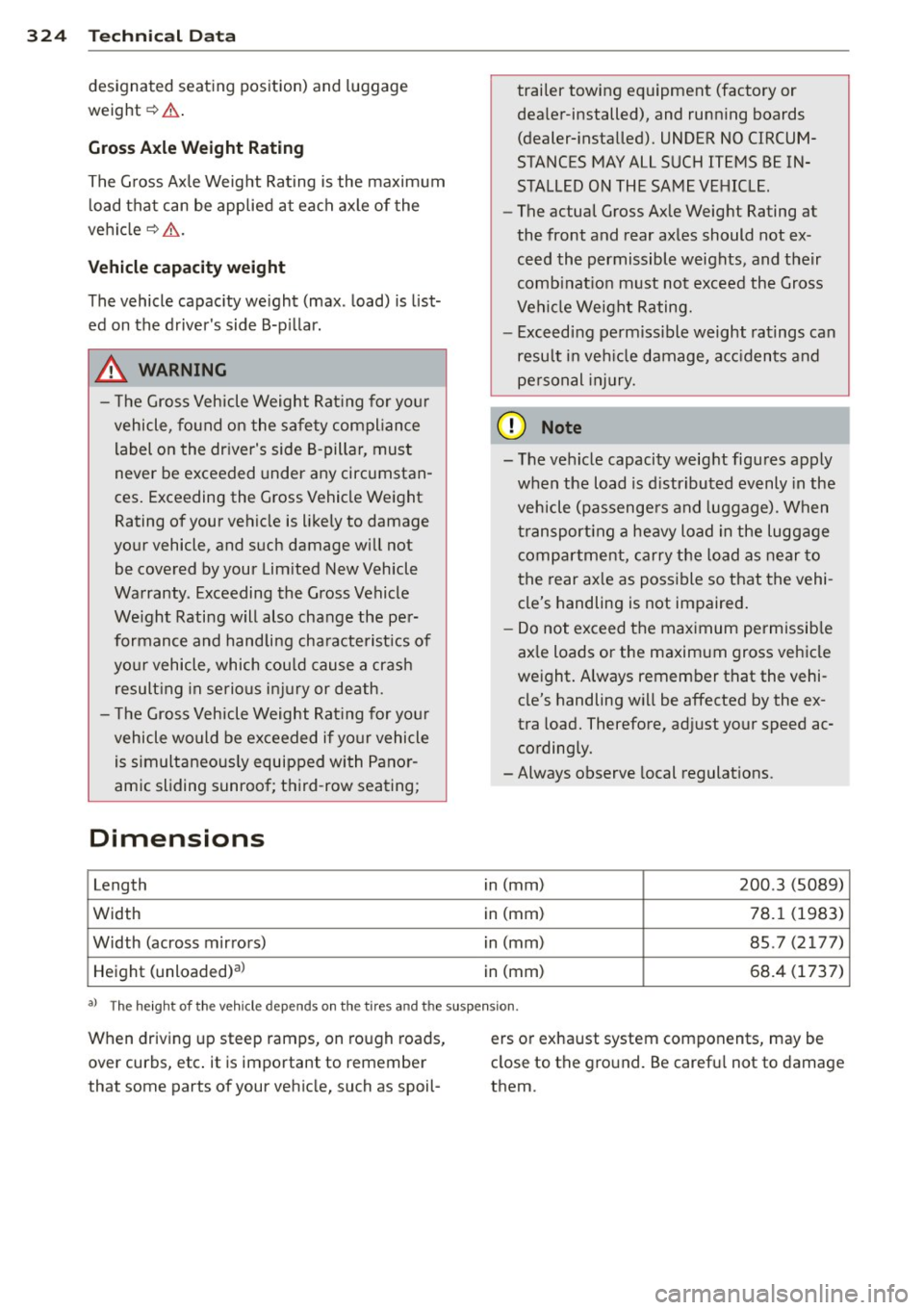
Dimensions
Length
Width
Width (across mirrors) Height (unloaded) al trailer towing
equipment (factory or
dea le r-installed), and running boards
(dealer-installed). UNDER NO CIRCUM
STANCES MAY ALL SUCH ITEMS BE IN
STA LLED ON THE SAME VE HICLE .
- The actual Gross Ax le Weig ht Rating at
the front and rear ax les should not ex
ceed the permissible weights, and the ir
comb inat io n must not exceed the Gross
Vehi cle Weight Rating.
- Exceeding permiss ible weight ratings can
result i n ve hicl e damage, a ccidents and
personal inj ury.
....--
CD Note
- The vehicle capacity weight figu res apply
when the load is d istr ibuted evenly in the
vehicle (passenge rs and luggage). When
t ransport ing a heavy load in the lugg age
compar tment, carry the load as near to
t he rear ax le as possible so that the vehi
cle's handling is not impaired.
- Do not exceed the maximum permissib le
ax le loads or the maximum gross vehicle
we ight . A lways remember that the vehi
cle's handling w ill be affected by the ex
tra load. Therefore, ad just your speed ac
cordingly.
- Always observe local regulat ions.
in (mm)
200 .3 (5089)
in (mm) 78.1 (1983)
in (mm) 85 .7 (2 177)
in (mm) 68.4 (1737)
al The he ight of the veh icle depen ds on the tires and th e su spension.
When driv ing up steep ramps, on rough roads,
over curbs, etc . it is important to remember
that some parts of your vehicle, such as spoil-ers
or exha ust system components, may be
close to the ground. Be carefu l not to damage
them.
1