service AUDI Q7 2015 Owner´s Manual
[x] Cancel search | Manufacturer: AUDI, Model Year: 2015, Model line: Q7, Model: AUDI Q7 2015Pages: 350, PDF Size: 86 MB
Page 260 of 350

258 Checking and filling Engine compartment
These are the most important items that you can check .
Fig. 242 Typical layo ut for containers, engine oil di pstick and engin e oil fille r cap
(D W indshield/head light washer
t . (
;R ) con ainer ,.... .............. .
@ Coolant expansion tank (-L) .. .
@ Engin e oi l filler cap ('t".:r.) . .. .. .
©
®
®
(j)
Eng ine oil dipstick .......... .
Brake fluid reservoir
((0)) ..... .
Power steering reservoir ... .. .
Jump start connector( +) under 270
263
261
260
265
226
a cover,( ·) with hex head screw 268,317
The position of the engine o il fi lling hole and
the engine oil dipstick
r=;, fig. 242 (position ®
and @) can vary according to the type of en
gine .
_&. WARNING
Before you check anything in the engine
compartment, always read and heed all
WARNINGS ¢.&.
in Working in the engine
c ompartment on page 256.
-
Engine oil
Engine oil specifications
The engine oil used must conform to exact
specifications .
The service interva l disp lay in t he instrument
cluster of your vehicle will inform you when it
is time for an oil change . We recommend that
you have your oil changed by an authorized Audi Service Advisor.
If you have to top
off the oil between oil
changes, use the Audi o il quality standard
spec ified in the table.
Audi oil quality standard
Gasoline
VW 502 00 or
engine vw 504 00
Diesel vw 507 00
engine
Page 261 of 350
M N
0 ...J
'SI: ,...., \!) 1.1'1 ,...., 1.1'1 ,....,
Using the proper engine oil is important for
the functionality and service life of the en
g ine. Your engine was factory -filled with a
h igh-quality oil which can usually be used
t h roughout the entire year.
Your Limited New Vehicle Warranty does not cover damage or ma lf u nctions due to
fa ilure to follow recommended mainte
nance and use requirements as set forth in
the Audi Owner's Manual and Warranty
&
Ma intenance booklet .
- Use only a high quality eng ine oil that ex
pressly complies w ith the Audi o il quality
sta ndard specified for your veh icle's e n
gine . U sing any other oil can cause seri
ous eng ine dam age.
- Do not m ix any l ubrica nts o r othe r addi
tives into the eng ine oi l. Doing so can
ca use eng ine damage.
I f you need to add oil and there is no ne
availab le tha t mee ts the Audi o il qua lity
s t andard your engine requires, yo u may
add a tota l of no more than 0 .5 quart/ liter
of a high -quality "synthetic"oil t hat meets
the following specifications.
- Vehicles with gaso line engine: ACEA A3
or API S M with a viscosity grade of
SAE OW-30, SAE SW-30 or SA E SW-40.
- Vehicles with diesel engine: ACEA C3 o r
API CF with a v iscosity grade of
SAE OW-30 or SAE SW-30.
- Fo r more information abo ut engine oi l
that has been approved for your vehicle, p lease contact either your a uthori zed
Audi dealer or Audi Customer Relations
at 1 (800) 822 -2834 or visit our web site
at www.a udiusa.com or
www.aud ica nada .ca.
Eng ine oil consumption
To provide effect ive lub rication and cooling for
internal engine pa rts, all inte rnal combust ion
engines use some oil. Oil consumption varies
Checkin g and fillin g 259
from engine to engine and may change ove r
the life of the engine. Engines tend to use
more o il during the break-in period than they
do afterward, when o il cons umption has sta
bili zed. Depending on the way the vehicle is
driven and the operati ng conditions, oil con
sumption can be up to 1 quart per 1,200
mil es(! lite r per 2,000 km) . Consumption
may be higher wi thin the fi rs t 3,000 m iles
(5,000 km) .
Un der normal cond itions, the rate of oil con
sumption depends on o il quality as well as v is
cosity, engine speed (rpm), outs ide tempera
ture, road condi tions, the amount of oil d il u
t ion caused by condensed water or fue l resi
due, and oxidation of the oi l. Oi l consump tion
may inc rease with engine wear over time, un
ti l replacement of worn engine parts may be
come necessary.
Beca use of all these variables, there is no
standard or "norma l" rate of o il cons umption .
We urge you to check the engine oil le vel at
regular intervals, p referably e very time you
fill the fuel tank, and always before a long
trip .
The oil p ressure wa rning light. is not an
indicato r of low engine oil le vel. If the wa rn
ing light does not go out after starting, or
flash es while dri ving (above 1500 rpm ), a
buzzer will sound . It indicates that the oil
pres sure is too low. Stop the engine immedi
ately, che ck the engine oil level and add oil if
n ec ess ary. If the engine oil level i s normal,
but the light continues to flash , do not keep
driving or let the engine idle, as dam age may
occur .
If you believe yo ur engine uses too much o il,
we recommend that you consul t your author
ized Audi dea ler so that the ca use of yo ur con
cern can be proper ly diagnosed . Keep in mind
that acc urate measurement of oil consump
tion req uires great care and may take some
time . Your Audi dealer h as ins truc tions for
how to measure oil consumption accurately .
I),
•
•
Page 264 of 350
26 2 Ch eck ing and filling
8_ WARNING
Stop! Before working in the engine com
partment, always read and heed all WARN
INGS
~ .&. in Working in the engine com
partment on page
256 . The engine com
partment of any motor veh icle is a poten
tially dangerous area and can cause ser i
ous personal injury.
8_ WARNING ,,,__
If you must change the engine oil in your
vehicle:
- Always wea r eye protection .
- T o reduce the ris k of burns from hot en-
gine oil let the engine cool down to the
touch.
- Whe n removing the oil drain plug with
yo ur fingers, stay as far away as poss ible.
Always keep your forearm paralle l to the
ground to he lp prevent hot oil from run
ning down your arm.
- Drain the oi l into a container designed
for this pu rpose, one large enough to
hold at least the total amount of oil in
your engine.
- To reduce the risk of poisoning, never use
empty food or beverage containers that
might m islead someone into dr ink ing
from them.
- Engine oil is poisonous. Keep it well out
of the reach of children.
- Cont inuous contact with used engine oil
is harmful to your skin. Always protect
your sk in by washing thoroughly with
soap and water .
(D Note
Never mix oil additives with your engine
oil. These additives can damage your en
gine and adverse ly affect your Audi Limit
ed New Vehicle Warranty.
@i For the sake of the environment
- Before changing the oil, first make sure
you know where you can properly dispose of the old oil.
-
.
- Always dispose of used oil p roperly. Nev
er dump it on garden soil, in wooded
areas, into st reams or down sewage
dra ins.
- Recycle used oi l by taking it to a used en
gine oil collection facility in your area, or
contact a service station.
- We strongly recommend that yo u have
your oil changed by an authorized Audi
dealer or a qualified workshop with the
special tools and expert ise required, and
proper means of disposal.
Engine cooling system
Coolant
The engine coolant performs two functions: it
keeps the engine from overheating and it pro
tects the engine from freezing in the winter.
T he cooling sys tem is sealed and genera lly re
quires little attention.
The cooling system has been fi lled at the fac
tory with a permanent coolant which does not need to be changed. The coo lant cons ists of a
mixtu re of specially conditioned water and the
manufacturer's g lycol -basedcoo la nt add
i-
tive G l3 antifreeze with anticorrosion addi
tives (SO% for USA mode ls; 60% for Canadian
models). This mixture both assures the neces
sary frost protection and protects metal com
ponents in the eng ine's cooling system from
corros ion and scaling.
It also ra ises the bo il
i ng po int of the coolant .
Do not reduce the concentration of the cool
ant in the summer by adding p lain wate r. Th e
proportion of coo lant additiv e mu st be at
l e as t 50 °/4 but not m ore than 60°/4
to main
ta in ant ifreeze protect io n and cooling eff ic ien
c y.
If the coo lant fros t protection is too low,
the coolant could freeze and damage the vehi
cle heating and engine cooling system.
For year- round driving, antifreeze is added at
t h e factory fo r temperatures down to:
- -31°F(-35°C)USA
- - 40 °F ( - 40 °C) Canada.
Page 268 of 350
26 6 Ch eck ing and filling
If the brake fluid level falls considerably be
low the "MIN" mark, the brake warning/indi
cator light (U .S . mode ls:
11111 , Canadian
models: .) will come on
<=> page 19 and
<=> page 32. Do not continue to operate the ve
h icle . The complete brake system should be
thoroughly checked by an authorized Aud i
dea ler or qualified workshop and the cause
corrected. If the brake fluid level is too low,
the brake warning/indicator light will illum i
nate . Contact an authorized Aud i dealer
im
m ediatel y.
@ Tips
The brake fluid rese rvoir is located unde r
neath the cove r.
Changing brake fluid
Hove the broke fluid changed by on experi
enced technician.
Brake fluid absorbs moisture from the a ir . If
the water content in the brake fluid is too
h igh , corrosion in the brake system may result
after a per iod of t ime. The bo iling po int of the
brake fluid wi ll also decrease considerably and
decrease braking performance.
Therefore, the brake flu id must be changed
e ver y tw o year s. Always use new b rake fluid
which conforms to Federal Motor Vehicle
Standard "FMVSS 1 16 DO T 4".
The brake flu id reservo ir can be difficult to
reach, therefore, we recommend that you
have the brake f luid changed by you r author
ized
Audi dea ler. Your dea ler has the correct
too ls, the right brake fluid and the know -how
to do this for you.
A WARNING
- Brake fluid is poisonous . It must be stor
ed only i n the closed orig inal container
o ut of the reach of children!
- Brake fa ilure can result from old or inap
propriate b rake fluid. Observe these pre
caut ions: -
Use only brake fluid that meets SAE
specification
J 1703 and conforms to
Federa l Motor Vehicle Standard 116.
Always check with your authorized Audi
dealer to make sure you are using the
correct brake fluid . The correct type of
brake f lu id is also ind icated on the
brake flu id reservoir.
- T he brake fluid must be new. Heavy use
of the bra kes ca n cause a vapo r lock if
the b rake fluid is left in the system too
l ong . This can seriously affect the effi
c iency of the brakes as well as your
safety. This co uld resu lt in an accident.
(D Note
Bra ke fluid will damage the paint of you r
vehicle .
(® For the sake of the environment
Because of the p rob lem of p roper disposal
of b ra ke fluid as well as the spec ial too ls
r equired and the necessary expertise, we
re commend that yo u have the brake fluid
changed by yo ur authorized Aud i dea ler.
Battery
General information
U nder normal ope rat ing cond itions , the bat
tery in yo ur Audi does not need any ma inte
nance. With
high o utside tempe ra tur es or
l ong dai ly drives we recommend that you have
the e lectrolyte level checked by an authorized
Audi dealer or qualif ied workshop. The elec
trolyte level should also be checked each time
the battery is charged
<=> page 268.
Have the battery checked when yo u take your
vehicle in for service. You are well advised to replace a battery that is o lder than 5 years .
With certain types of airbag deployment, the battery is disconnected from the veh icle elec
trical system for safety reasons<=>.&
in Re
pair , core and disposal of the airbags on
page 196.
~
Page 288 of 350
286 Tires and wheels
build-up, sudden tire failure
and loss of control.
-If the tire pressure is too low or too high, the tires
will wear prematurely and
the vehicle will not handle
well.
-If the tire is not flat and you
do not have to change a
wheel immediately, drive at reduced speed to the near
est service station to check
the tire pressure and add air
as required.
(D Note
Driving without valve stem
caps can cause damage to
the tire valves. To prevent
this, always make sure that
factory installed valve stem caps on all wheels are secure
ly mounted on the valve .
@ For the sake of the environment
Underinflated tires will also
increase the fuel consump
tion .
Tires and vehicle load limits
There are limits to the amount
of load or weight that any vehi
cle and any tire can carry. Ave
hicle that is overloaded will not handle well and is more diffi
cult to stop. Overloading can not only lead to loss of vehicle
control, but can also damage important parts of the vehicle
and can lead to sudden tire fail
ure, including a blowout and
sudden deflation that can cause
the vehicle to crash .
Your safety and that of your passengers also depends on
making sure that load limits are
not exceeded. Vehicle load in
cludes everybody and every
thing in and on the vehicle.
These load limits are technical
ly referred to as the vehicle's
Gross Vehicle Weight Rating
("GVWR") .
The "GVWR " includes the
weight of the basic vehicle, all
factory installed accessories, a
full tank of fuel, oil, coolant
and other fluids plus maximum load. The maximum load in
cludes the number of passen
gers that the vehicle is intend
ed to carry ("seating capacity")
with an assumed weight of 150 lbs (68 kg) for each pas
senger at a designated seating
position and the total weight of
any luggage in the vehicle. If ""
Page 291 of 350
M
"' 0 ..J
""'. rl I.O
"' rl
"' rl
being loaded on the vehicle.
That weight may not safely
exceed the available cargo and luggage load capacity
calculated in Step 4.
6. If your vehicle will be towing
a trailer, load from your trail
er will be transferred to your
vehicle. Consult this manual
to determine how this re
duces the available cargo
and luggage load capacity of
your vehicle.
.,.Check the tire sidewall
(¢ page 291, fig. 254) to de
termine the designated load rating for a specific tire.
Tire service life
The service life of tires depends
on a lot of different things in
cluding proper installation and
balancing, correct tire pressure and driving style .
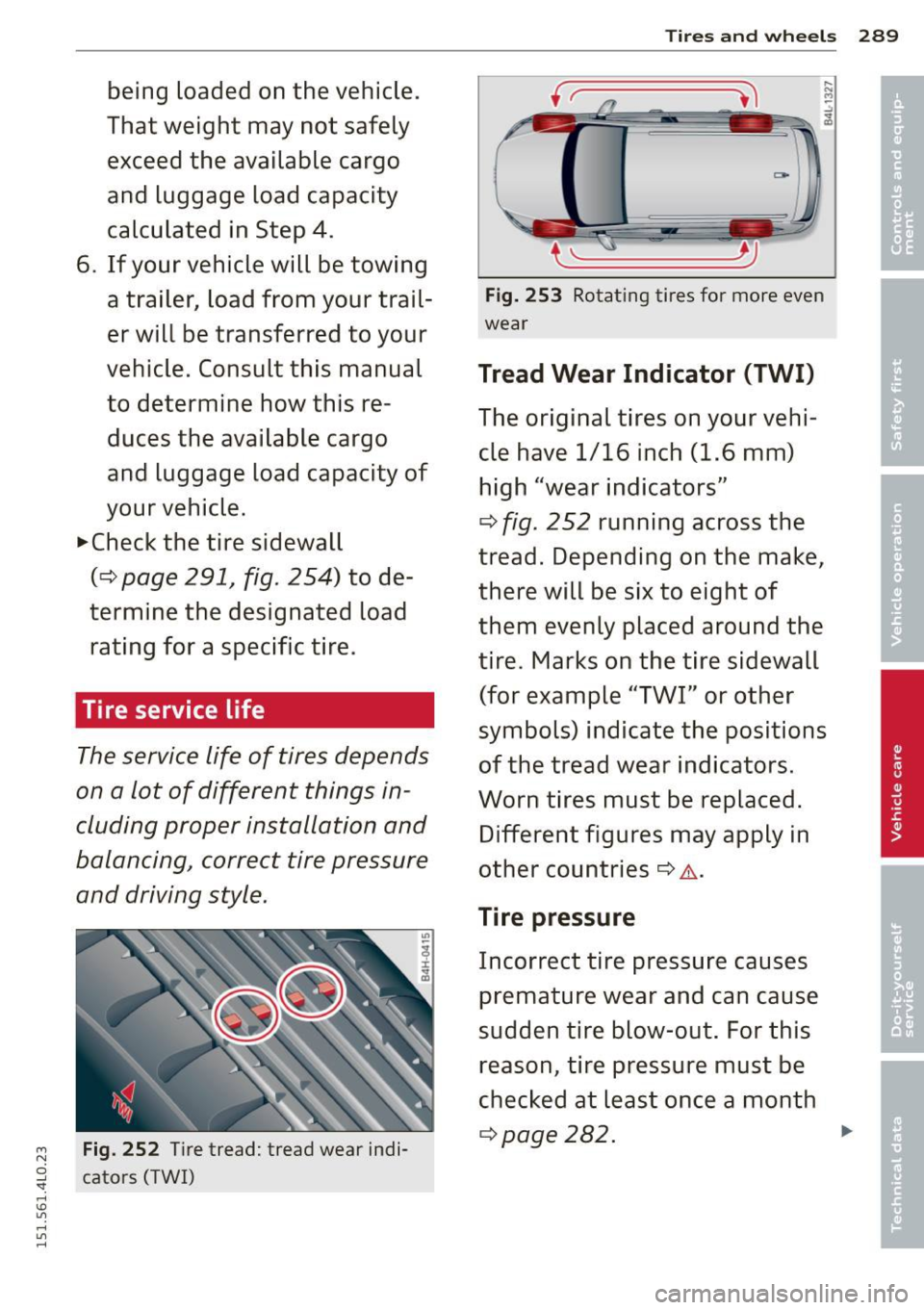
Fig. 252 Tire tread: tread wear indi
cators (TWI)
Tires and wheels 289
.... N M ::;;
;g
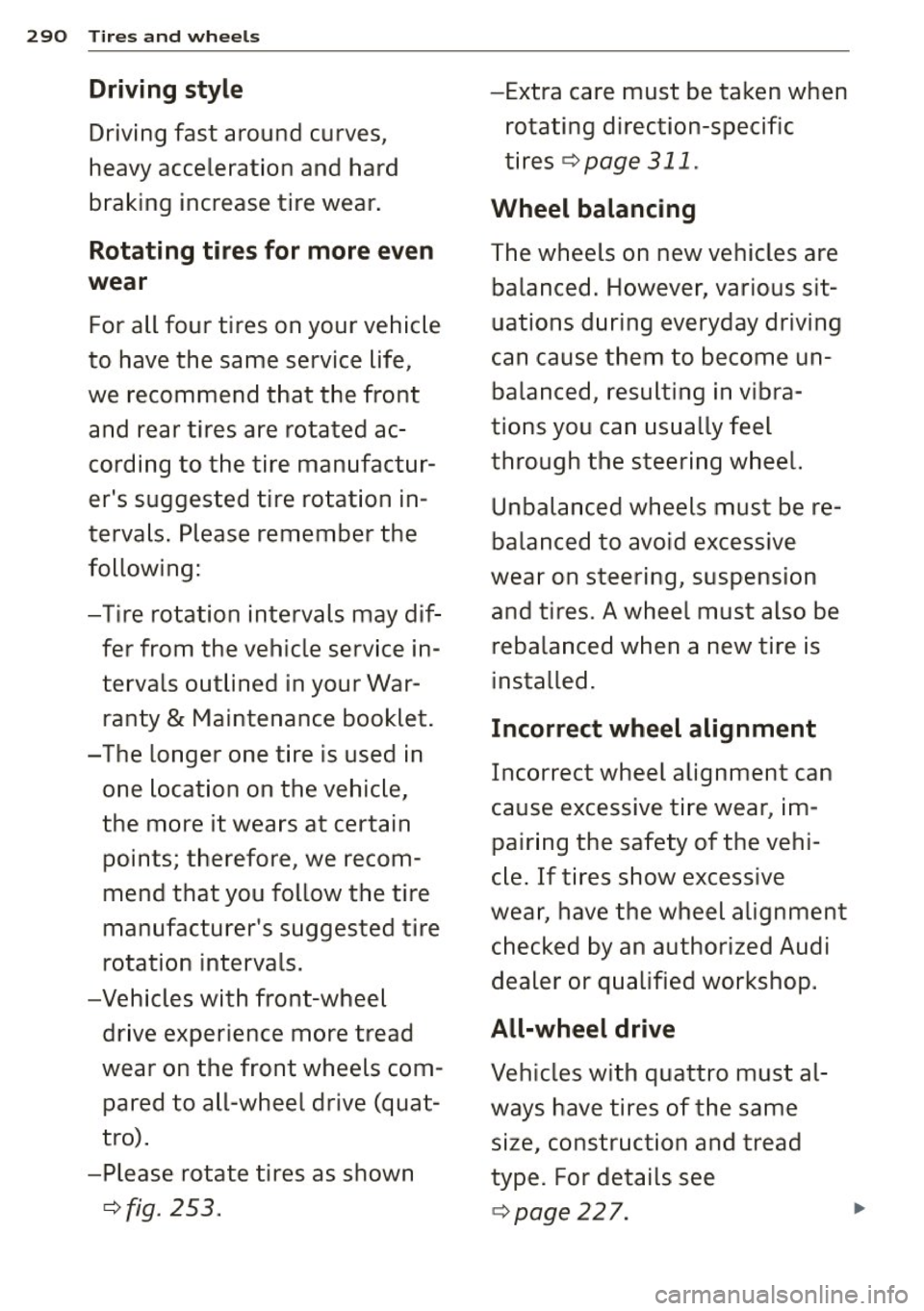
Fig. 253 Rotating tires for more even
wear
Tread Wear Indicator (TWI)
The original tires on your vehi
cle have
1/16 inch (1.6 mm)
high "wear indicators"
¢ fig. 252 running across the
tread. Depending on the make,
there will be six to eight of
them evenly placed around the
tire. Marks on the tire sidewall (for example "TWI" or other
symbols) indicate the positions
of the tread wear indicators.
Worn tires must be replaced.
Different figures may apply in
other countries
¢ & .
Tire pressure
Incorrect tire pressure causes
premature wear and can cause
sudden tire blow-out. For this
reason, tire pressure must be
checked at least once a month
¢ page 282.
Page 292 of 350
290 Tires and whee ls
Driving style - Extra care must be taken when
Driving fast around curves, rotating direction-specific
heavy acceleration and hard tires
¢
page 311.
braking increase tire wear. Wheel balancing
Rotating tires for more even
The wheels on new vehicles are
wear ba lanced. However, various sit-
For all four tires on your vehicle uations during everyday driving
to have the same service life, can cause them to become un-
we recommend that the front balanced, resulting in vibra-
and rear tires are rotated ac -tions you can usually feel
cording to the tire manufactur- through the steering wheel.
er's s uggested tire rotation in-
Unbalanced wheels must be re-
tervals . Please remember the
balanced to avoid excessive
following: wear on steering, suspension
-T ire rotation intervals may dif -and tires. A wheel must also be
fer from the vehicle service in· rebalanced when a new tire is
tervals outlined in your War -insta
lled .
ranty
& Maintenance booklet . Incorrect wheel alignment
-The longer one tire is used in
Incorrect wheel alignment can
one location on the vehic le,
cause excessive ti re wear, im-
the more it wears at certain
pairi ng the safety of the vehi-
points; t herefore, we recom-
cle . If t ires show excessive
mend that you fo llow the tire
wear, have the wheel alignment
manufacturer's suggested tire
checked by an authorized Audi
rotation interva ls.
dealer or qualified wo rkshop.
-Vehicles with front-wheel
dr ive experience more t read
All-wheel drive
wear on the front wheels com-
Vehicles with quattro must al -
pared to all-wheel drive (quat- ways have tires of the same
tro) .
size, construction and tread
-Please rotate tires as shown type. For details see
¢ fig. 253.
¢page 227. ...
Page 320 of 350
318 Emergency situations
@ Tips
- The discharged battery must be properly
connected to the vehicle's electrical sys
tem. When jump starting or charging the
battery, never connect the negative
ground cable to the battery negative
post because the battery manager sys
tem must be able to detect the battery's
state of charge . Always connect the neg
ative ground cable to the negative
ground post of the battery manager con
trol unit.
Use of jumper cables
Make sure to connect the jumper coble
clomps in exactly the order described below!
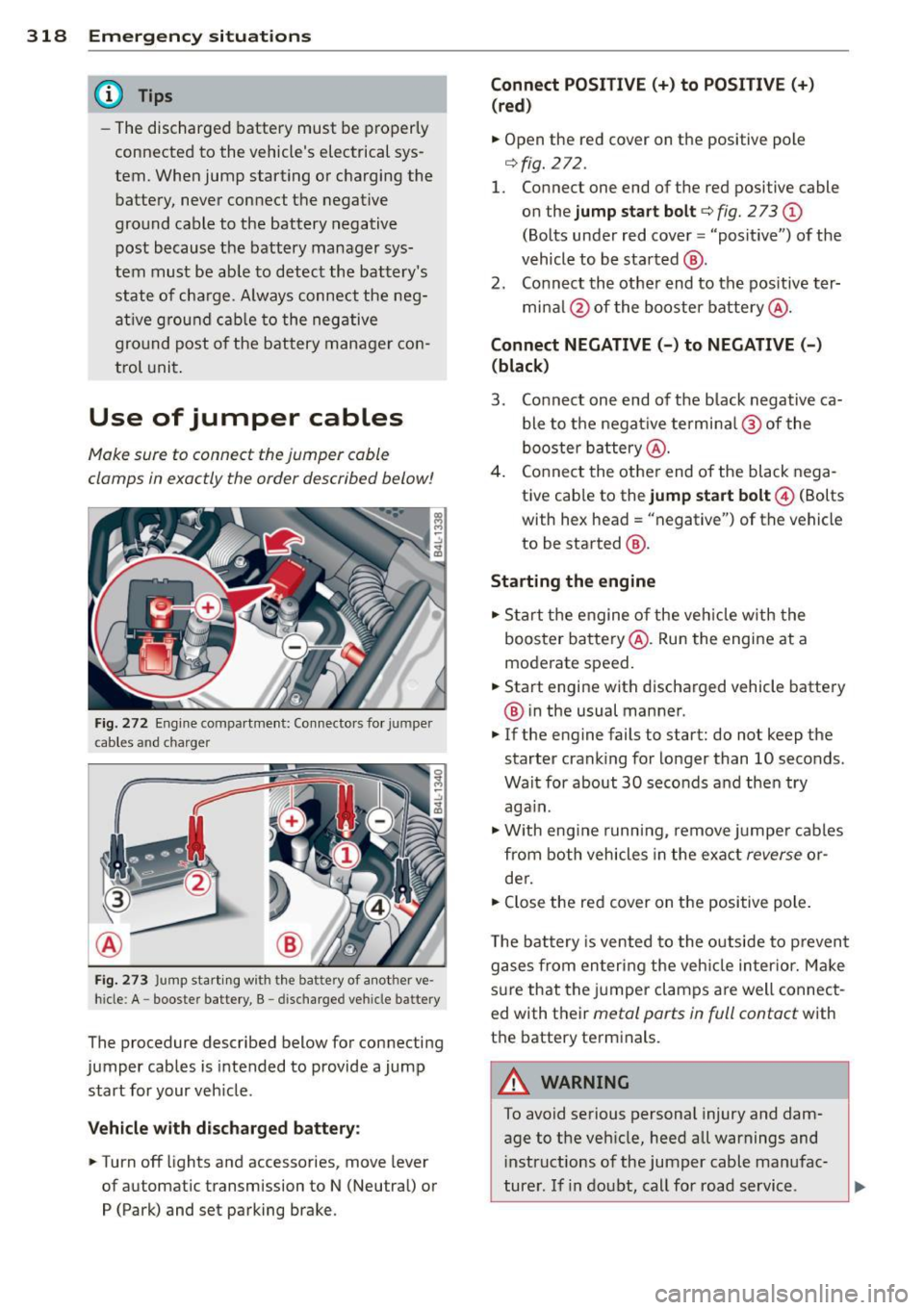
Fig . 272 Engine co mpartment: Conne cto rs fo r jum per
c ables a nd charger
®
Fig. 273 Ju m p sta rt in g w it h the bat te ry of anot her ve
h icle : A - b ooster battery, B - discharge d ve hicl e batte ry
The procedure described below for connecting
jumper cables is intended to provide a jump
start for your veh icle .
Vehicle with discharged battery:
.. Turn
off lights and accessories, move lever
of automatic transmission to N (Neutral) or
P (Park) and set parking brake. Connect
POSITIVE(+) to POSITIVE(+)
(red)
.. Open the red cover on the pos itive pole
¢ fig. 272 .
1. Connect one end of the red positive cable
on the jump start bolt
c::;, fig. 2 73@
(Bolts under red cover = "positive") of the
vehicle to be started @.
2. Connect the other end to the positive ter-
mina l@ of the booster battery@.
Connect NEGATIVE (-) to NEGATIVE (-)
(black)
3. Connect one end of the black negative ca
ble to the negat ive terminal @ of the
booster battery @.
4. Connect the other end of the black nega
tive cable to the jump start bolt@ (Bolts
with hex head= "negative") of the vehicle
to be started @.
Starting the engine
.. Start the engine of the vehicle w ith the
booster battery@. Run the engine at a
moderate speed .
.. Start engine with discharged vehicle battery
@ in the usual manner.
.. If the engine fails to start: do not keep the
starter crank ing for longer than 10 seconds .
Wait for about 30 seconds and then try
again .
""W ith engine running, remove jumper cables
from both vehicles in the exact
reverse or·
de r .
.. Close the red cover on the positive pole.
T he battery is vented to the outside to prevent
gases from entering the veh icle interior. Make
sure that the jumper clamps are well connect
ed with their
metal ports in full contact with
the battery terminals.
A WARNING
-
To avoid serious persona l injury and dam-
age to the vehicle, heed all warnings and i nstructions of the jumper cable manufac-
turer . If in doubt, call for road service . ,..
Page 328 of 350

326 Consumer Information
Consumer Information
Warranty coverages
You r Audi i s covered by the following war
ranties:
- New Vehicle Limited Warranty
- Limited Warranty Against Corrosion Perfo-
ration
- Emissions Control System Warranty
- Emissions Performance Warranty
- California Emissions Control Warranty (USA
vehicles only)
- California Emissions Performance Warranty
(USA vehicles only)
Detailed information regarding your warran
ties can be found in your
Warranty & Mainte
nance booklet .
Operating your vehicle
outside the U.S.A. or
Canada
Government regu lations in the United States
and Canada require that automobiles meet
specific emission regulations and safety
standards. Therefore, veh icles built for the
U.S.A . and Canada differ from vehicles sold in
other countries .
If you p lan to take your vehicle outside the
continental limits of the United States or Can
ada, there is the possibility that:
- unleaded fuels for vehicles with cata lytic
converter may not be available;
- fuel may have a considerably lowe r octane
rating. Improper fuel may cause engine
damage ;
- service may be inadequate due to lack of
proper service facilities, tools or testing
equipment ;
- replacement pa rts may not be readily availa
ble.
- Navigation systems for vehicles built for the
U.S.A. and Canada will not necessar ily work
in Europe, and may not work in other coun
tries outside North America .
(D Note
Audi cannot be responsible for mechanical
damage that could result from inadequate
fuel, service or parts availability.
Audi Service Repair Manuals and Literature
Audi Official Factory Service Manuals and Lit
erature are published as soon as possible after
model introduction. Service Manuals and liter
ature are available to order from the Audi
T echnical Literature Ordering Center at:
www.audi.techliterature.com
Maintenance
General
Your vehicle has been designed to help keep
maintenance requirements to a minimum.
However, a certain amount of regular mainte
nance is still necessary to assure your vehicle's
s afety, economy and rel iability. For detailed
vehicle maintenance consult your Warranty &
Maintenance booklet.
Under difficult operating conditions, for ex
ample at extremely low outside temperatures,
i n very dusty regions , when towing a trailer
very frequently, etc., some service work
should be performed between the intervals
specified. This applies particularly to:
- oil changes, and
- cleaning or replacing the air filter .
(® For the sake of the environment
By regularly maintaining your vehicle, you
help make sure that emission standards
are maintained, thus minimizing adverse
effects on the environment.
Important considerations for you and
your vehicle
The increasing use of electronics, sophisticat
ed fuel injection and emission contro l sys-
tems, and the genera lly increasing technical
liJJ,
Page 334 of 350
332 Index
Alcantara
C leaning 245
A ll-w heel drive . ........... .... .... . 227
Winter tir es
A lternator 298
Malfunction . . . . . . . . . . . . . . . . . . . . . . . 31
Ambience lighting Lighting profiles .......... .... .... .. 65
Anti -freeze
refer to Engine coo lant system ...... . 262
Anti-lock brake system ..... ... .. .. .. . 223
Warn ing/ indicator lights . . . . . . . . . 16, 18
Anti-slip regulation ........ .. .. .... . 223
Warn ing/ indicator lights ... .. .. .. .. .. 16
Anti-theft systems Anti-theft alarm system . . . . . . . . . . . . . 50
Electronic immobilizer ... .. .. .. .... . . 40
Approach/departure angle . .. .. .. .. .. . 235
Ashtray . .. ... ............ .. .. .. .. .. 89
Asterisk What does it mean when something is
marked with an asterisk? . . . . . . . . . . . . . . 6
Aud i b rak ing guard ....... .. .. .. .. .. . 129
Error messages .... ....... ... .... . 130
Settings . . . . . . . . . . . . . . . . . . . . . . . . . 130
Status messages . . . . . . . . . . . . . . . . . . 130
Switching on and off ...... .. .. .. .. . 130
Aud i Service Repair Man uals and Litera-
ture .. .. .. .. ............. .. .. .... . 326
Auto -Check Control . . . . . . . . . . . . . . . . . . 30
Automatic belt retractor ... ... .. .. ... 177
Automatic mode
F our-zone automatic comfort air condi-
tioning .... ... .. ..... ... .. .. .... . 101
Automatic Shift Lock (ASL) . . . . . . . . . . . 140
Automatic transmission ..... .. .. .... . 139
Automatic Shift Lock (ASL) . .. .. .. .. . 140
Driving .. ................. .. .... . 141
Emergency mode . . . . . . . . . . . . . . . . . . 143
Emergency release ......... ... .. .. . 143
H ill descent contro l ........ ... .. ... 142
I gn ition key safety lock .... .. .. .. .. . 107
Kick-down . . . . . . . . . . . . . . . . . . . . . . . . 143
M anual s hift program ......... .. .. . 1 42
Selector lever ........... ... .. .... . 139
Shift paddles . . . . . . . . . . . . . . . . . . . . . 142 AUTO mode
A/C climate controls ... ..... ... .. .. . 97
Auto Safety Hot line ............. .... 170
Average speed . . . . . . . . . . . . . . . . . . . . . . . 24
Avoid damaging the vehicle .... ... .. .. 232
B
Bass box
Battery .... .. .. .. .. ........... ... .
Battery location .. ................ .
Charg ing ... ... .. .. ... ........... .
Impo rtant warnings when working on
the battery .... .. ............. ... . 30S
266
267
268
267
Jump start ing .. .. ... .......... .. .. 317
Low .. .. .. .... .. ... .. ..... ... .. .. 228
Replacing the battery ... .... ... .. .. 270
State of charge ... .. ... ......... ... 228
Voltage ... .... ................... . 35
Winter operation . ............. .... 266
Working on the battery .. .... ... .. .. 267
Before driving ..... ... .. ..... .... . .. 163
B lended gasoline .. ................ . 248
Booster seats . . . . . . . . . . . . . . . . . . . . . . 211
Brake fluid
Changing the brake fluid ..... ... .. .. 266
Checking the brake fluid level . ... .. .. 265
Reservoir ... .. .. .. .... .... .... ... 265
What is the correct brake fluid level? .. 265
What shou ld I do if the brake fluid warn-
ing light comes on? .... .. ... ... .. .. 265
Brake light Defective . . . . . . . . . . . . . . . . . . . . . . . . . 23
Brake system .... ... .............. .. 265
Anti- lock brake system . . . . . . . . . . . . . . 18
Brake assist system ..... .... ... .. .. 223
Brake booster .... ... .. ..... .... . .. 225
Brake fluid . ..... ... .. ..... ... .. .. 265
Brake fluid specifications for refill and re-
placement .... .. ............. .... 266
Brake pads .. .. .. ..... ........... . 230
General information .............. . 225
How does moisture or road sa lt affect the
brakes? . .. .. .. .. ............. .. .. 225
Malfunction . . . . . . . . . . . . . . . . . . . . . . . 32
Parking brake .. .. ... .......... .. .. 111
Warning/indicator lights ..... ... .. .. . 19
Worn brake pads symbo l . . . . . . . . . . . . . 36