fuel AUDI Q7 2015 Owner´s Manual
[x] Cancel search | Manufacturer: AUDI, Model Year: 2015, Model line: Q7, Model: AUDI Q7 2015Pages: 350, PDF Size: 86 MB
Page 253 of 350
M N
0 ...J
'SI: ,...., \!) 1.1'1 ,...., 1.1'1 ,....,
~ Check the label on the inside of the fuel fi ll
er flap to determine if the vehicle must be
fueled with gasoline or diesel fuel.
Refuelling procedure
~ Insert the fuel nozzle from the gasol ine
pump into the fue l filler neck as far as it will
go.
~ Se lect a medium refuelling rate so that the
no zzle switches off automatica lly when the
tank is full.
Putting the fuel cap back on
~ After filling your tank, twist the fuel fi ller
cap clockwise as far as it will go.
~ Close the fuel filler flap.
To avoid fuel spi lling or evaporating from the
fuel tank always close fuel fi ller cap properly
and comp lete ly. An improperly closed fuel fill
er cap may also cause the M IL lamp
r=) page 2 7
to come on (only vehicles with gasoline en
gine) .
A WARNING
Improper refueling or handling of fuel can
cause fire, explosion and severe burns.
- Fuel is highly flammable and can cause
severe burns and other injuries .
- Failure to shut the engine off while refu
eling and/or to insert the pump nozzle
fully into the fuel filler neck could cause
fuel to spray out of f iller neck or to over
flow. Fuel spray and ove rflow ing fuel can
cause a fire.
- Never use a cellular telephone wh ile re
fueling. The electromagnetic radiation
can cause sparks that can ignite fue l va
pors and cause a fire.
- Never get back into you r vehicle while re
fueling. If in exceptiona l circumstances
you must get back in your vehicle whi le
refueling, make certain that yo u close
the door and touch metal to discharge
static electricity before touching the fill
er nozzle again. Static electricity can
cause sparks that can ignite fuel vapors
released during refueling.
Fuel supply and filling your fuel tank 251
-Never smoke or have an open flame any
where in or near your vehicle when refu
eling or filling a portable fuel conta iner .
- For your safety, we strongly recommend
that you do not travel with a portable
fuel container in your vehicle . The con
tainer, full or empty may leak and could
cause a fire, especially in a crash.
- If, under exceptional circumstances, you
must transport a portable fuel container,
please observe the following:
- Never fill a portable fuel container
while it is anywhere in or on the vehicle
(for example, in the luggage compart
ment, or on the trunk). Stat ic electrici
ty can build up while filling and can ig
nite fuel vapors causing a fire .
- Always place a portable fuel conta iner
on the ground before filling.
- Always keep the filler no zzle complete
ly inside the portable container before
and dur ing filling .
- If filling a portable container made of
metal, the f iller nozzle must always be
in contact with the conta iner . This will
help prevent static electric ity from d is
charging and cause a fire .
- Never spill fue l inside the vehicle or
luggage compartment. Fuel vapors are
highly flammable .
- Always observe local and state/provin
cia l laws regarding the use, storage
and transportation of fuel containers.
- Make certain the fuel container meets
in dustry standa rds (ANSI/ AS TM
F852-86).
(D Note
If any fuel has spilled onto the car, it
shou ld be removed immediately to prevent
damage to the paint.
@ For the sake of the environment
As soon as the correctly operated nozzle
switches off automat ica lly for the first
time, the tank is full. Do not try to add
more fuel because fuel may spill out. In •
•
Page 254 of 350
252 Fuel supply and filling your fuel tank
addition, the expans ion space in the fuel
tank will be filled -causing the fuel to
overflow when it becomes warm and pol
lute the environment.
@ Tips
- Running your engine while refuelling
may cause vapors to escape or even
cause fue l to spill out of the tank. This
would then shut off the fuel nozzle be
fore the tank is full.
- Do not refuel your vehicle w ith the igni
tion turned on. The fuel gauge may oth
erwise not ind icate the correct fuel level
after refuell ing.
- Diesel veh icles* are equipped with a die
sel misfueling protector. It allows the
vehicle to be fueled only w ith a diesel
fuel pump nozzle. A worn or damaged
nozzle or a nozzle that is too small may
not be able to open the diesel misfueling
protector. If this is the case, try turning
the nozz le before inserting it in the fue l
filler neck, use a different fuel pump or
see your authorized Audi dealer or au
thorized repair facility for assistance.
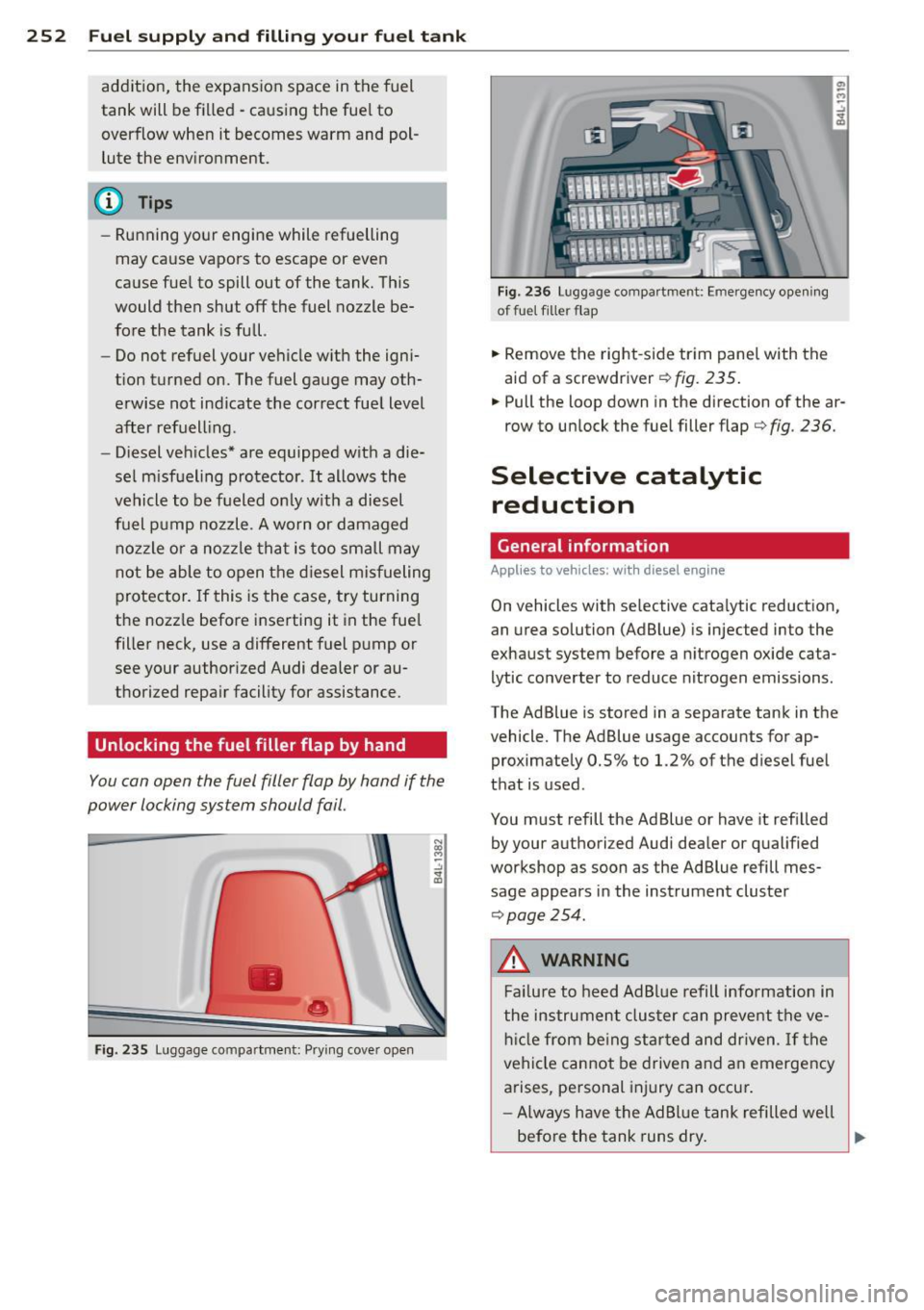
Unlocking the fuel filler flap by hand
You con open the fuel filler flop by hand if the
power locking system should foil.
• e
Fig. 235 Luggage compartment: Prying cover open
Fig. 236 Lu ggage compa rtment: Emergency opening
of fue l fille r flap
.. Remove the right-side trim panel with the
aid of a screwdriver
¢ fig . 235.
.. Pull the loop down in the direction of the ar
row to unlock the fuel filler flap¢
fig. 236.
Selective catalytic
reduction
General information
Applies to vehicles: with diesel engine
On vehicles with selective catalytic reduction,
an urea solution (AdBlue) is injected into the
exhaust system before a nitrogen oxide cata
lytic converter to reduce nitrogen emissions.
The Ad Blue is stored in a separate tank in the
vehicle. The Ad Blue usage accounts for ap proximately 0.5% to 1.2% of the diesel fuel
that is used .
You must refill the Ad Blue or have it ref illed
by your authorized Audi dealer or qualified
workshop as soon as the Ad Blue refill mes
sage appears in the instrument cluster
¢page 254.
&_ WARNING ~
Failure to heed AdBlue refill information in
the instrument cluster can prevent the ve
hicle from being started and dr iven.
If the
vehicle cannot be driven and an emergency
arises, personal injury can occur.
- Always have the AdBlue tank refilled we ll
before the tank runs dry. .,.
Page 255 of 350
M
"' 0 ..J
"". rl I.O
"' rl
"' rl
@ Tips
-The instrument cluster display indicates
the distance remaining that can be driv
en
c::.> page 253. If the AdBlue tank is
completely empty, the engine will not
start again after the ignition is sw itched
off .
- Ad Blue is required by law to operate this
vehicle .
Indicator in the instrument cluster
display
Applies to vehicles: with diesel engine
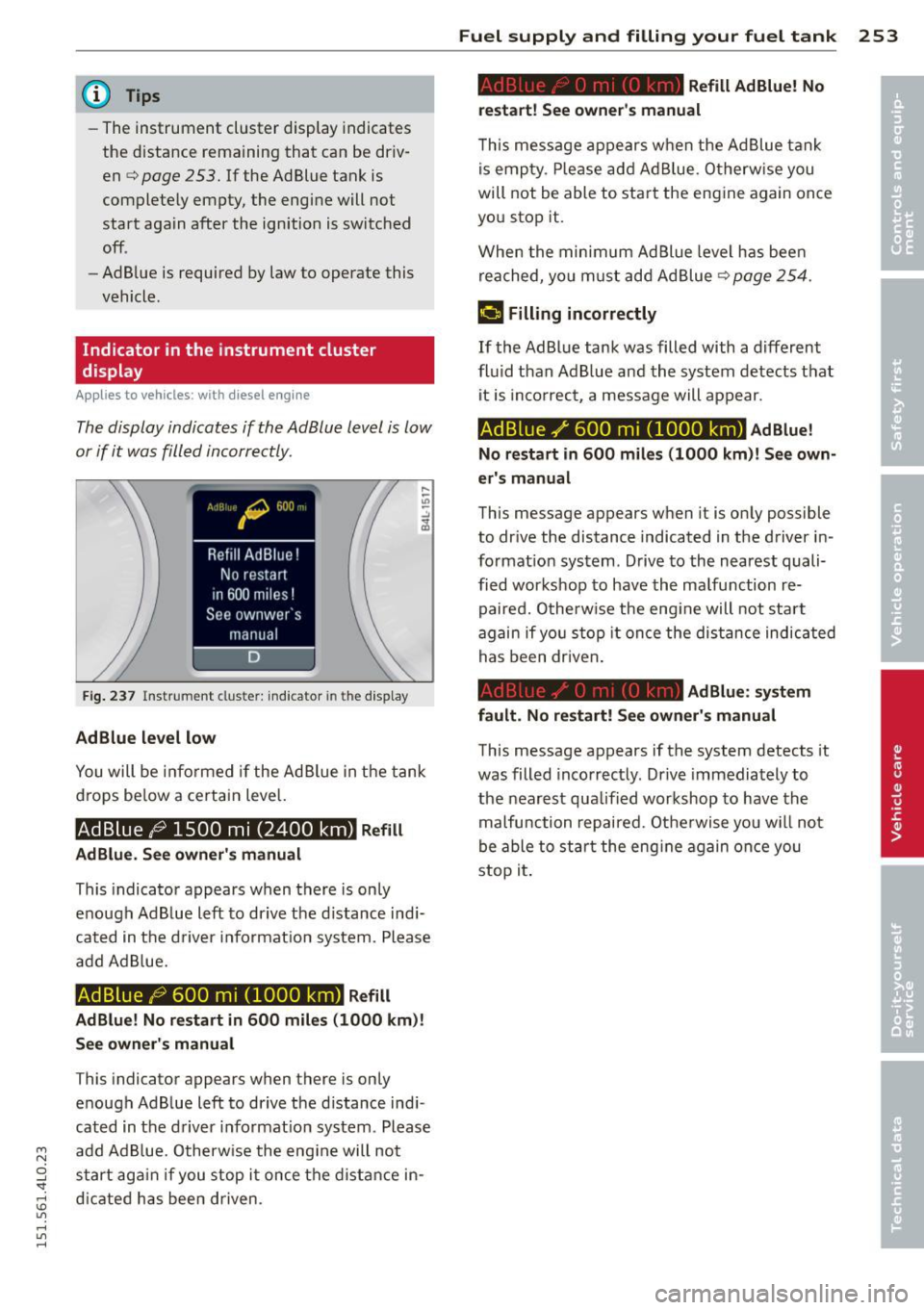
The display indicates if the Ad Blue level is low
or if it was filled incorrectly .
Fig. 23 7 Instr ume nt cluster : ind ic a tor in the d isp lay
AdBlue level low
You will be info rmed if the AdBlue in t he tank
drops be low a certain leve l.
AdBlue /9 1500 mi (2400 km) Refill
Ad Blu e. S ee owner 's manual
This indicator appears when there is only
enough Ad B lue left to dr ive the d istance ind i
cated in the d river i nformat ion system . Please
add Ad Blue.
AdBlue /9 600 mi ( 1000 km) Refill
Ad Blue! No r estart in 600 miles (1000 km )!
See owner's manual
T his ind ica tor appe ars when there is only
e nough Ad B lue left to dr ive the d istance ind i
cated in the d river informat ion system . Please
ad d Ad Blue. Otherw ise the eng ine will not
s tart aga in if you stop i t once the dist an ce in
d ic a ted h as been driven .
Fuel suppl y and filli ng your fuel t ank 253
Refill Ad Blue ! No
r e sta rt ! See owne r's manual
This message appears when the Ad Blue tank
is emp ty . Ple a se add Ad B lue . O therw ise you
will not be able to start the engin e aga in once
you stop it .
When the min imum Ad Blue leve l ha s bee n
reached, yo u m ust add Ad Blue
c::.> page 254.
¢,fj Filling incorrectly
If the AdBlue tank was filled with a different
fl ui d than Ad B lue and the system detects t hat
it i s inco rrect, a message will appear.
AdBl ue ,/' 600 m i (1000 km) AdBlue!
No restart in 600 mile s (1000 km)! See own
er's manual
This message appears w hen it is on ly possible
to dr ive the distance indicated in the d river in
fo rmat ion system . Drive to the nearest quali
fied wor kshop to have th e malfunction re
paired. Othe rw ise the eng ine will not sta rt
again if yo u stop it once the distance indicated
has been driven .
AdBlue: system
fault . No restart! See owner' s manual
This message appears if the system detects it
was filled inco rrectly . Drive immediate ly to
the nearest qualified wor kshop to have the
malfu nction repaired. Ot he rwise you w ill not
be able to star t the eng ine again on ce you
stop i t.
Page 256 of 350
254 Fuel supply and filling your fuel tank Filling AdBlue
Applies to vehicles: with diesel engine
A special refill bottle must be used to fill the
AdBlue .
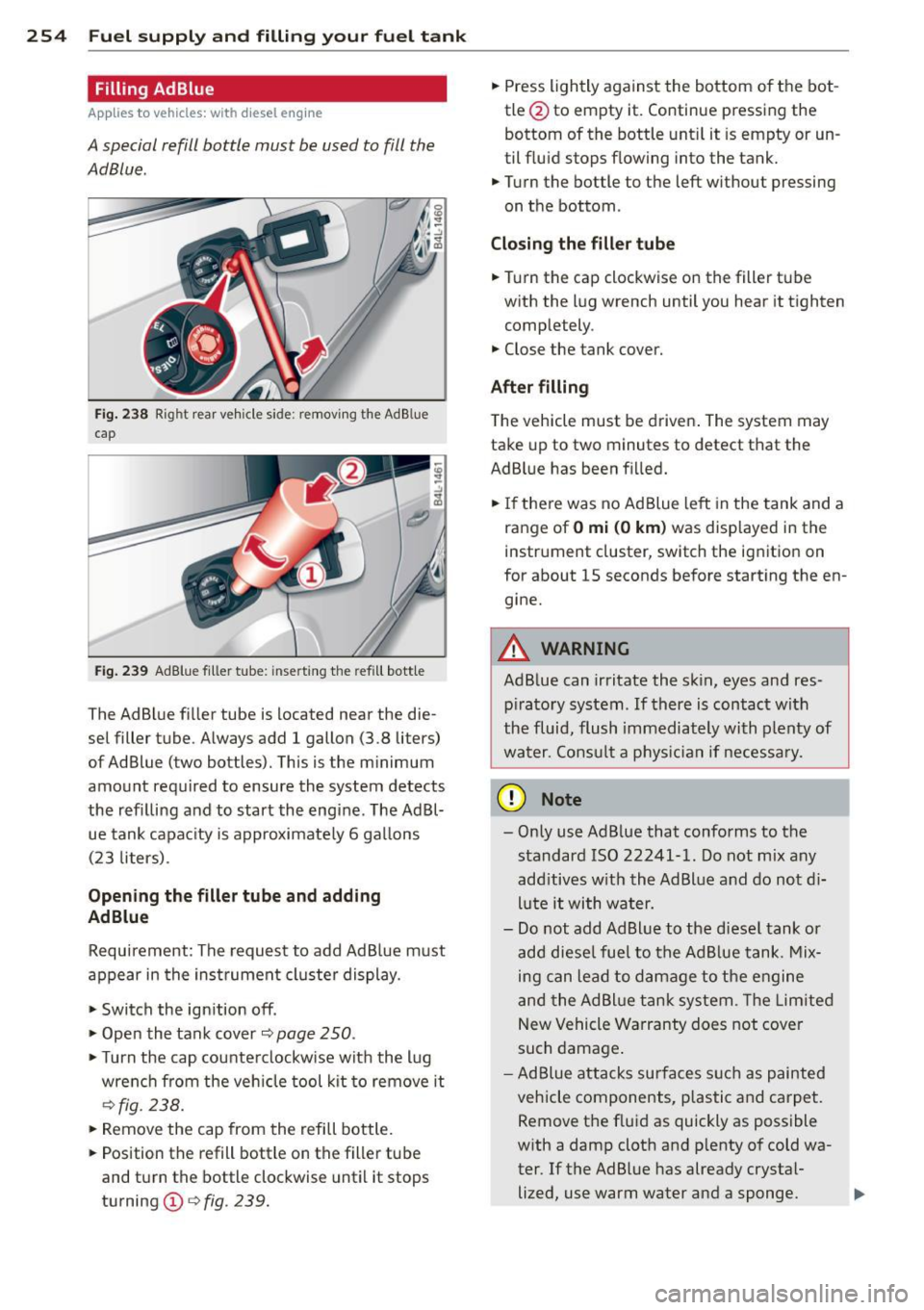
Fig . 238 Rig ht rea r ve hicle side: re mov ing the Ad B lu e
ca p
Fig. 2 39 Ad Blue filler t ube: inse rt in g the ref ill bott le
The AdBlue fi ller tube is located near the die
sel filler tube . A lways add 1 gallon (3 .8 liters)
of AdBlue (two bottles). This is the m inimum
amount requ ired to ensure the system detects
the ref illing a nd to start the engine . The Ad Bl
ue tank capac ity is approximate ly 6 ga llons
(2 3 liters) .
Opening the filler tube and adding
AdBlue
Requirement : The requ est to add Ad B lue must
appear in the ins trumen t cl uste r display.
• Switch the ign ition off .
• Ope n th e tank cover ¢
page 250.
• Turn the cap counte rclockw ise wit h the lug
wrenc h fro m the veh icle tool kit to remove it
¢fig. 238.
• Remove the cap from the refill bottle.
• Pos ition the refill bott le on the filler tube
and tu rn the bottle clockwise until it stops
turning
(D ¢ fig . 239.
• Press ligh tly against the bottom of t he bot
tle @to empty it. Continue pressing the
bottom of the bottle unt il it is empty or un
til f lu id stops flow ing into the tank.
• Turn the bottle to t he left w ithout pressing
on the bottom .
Closing the filler tube
• Turn the cap clockwise on the filler tu be
w ith the l ug wrench until you hear it t ighten
completely .
• Close the tank cover.
After filling
The vehicle must be driven . The system may
take up to two minutes to detect that the
AdB lue has been f illed.
• If the re was no Ad Blue left in the tank and a
range of
O mi (0 km ) was displayed in the
instrument cluster, switch the ig nition on
for about 15 seconds before start ing the en
gine.
A WARNING >=
Ad B lue can irritate the s kin, eyes and res-
p ira to ry system . If there is contac t wit h
the fluid, flush immediat ely with plenty of
w at er. Co nsult a phys icia n if necessa ry.
(D Note
- Only use Ad B lue that conforms to the
standard ISO 22241-1. Do not mix any
add itives w ith th e AdBl ue and do no t di
l ut e it with water.
- Do not add Ad Bl ue to the d iese l tank or
ad d diese l fue l to t he Ad B lue tank . M ix
ing can lead to d amage to t he e ngine
a nd the AdBl ue ta nk system. The Lim ite d
N ew Vehicle Warranty does not cove r
such damage .
- Ad Blue attacks surfaces s uch as p ain ted
vehicle components, p lastic a nd carpet.
Remove t he f lu id as quickly as possible
w ith a damp clot h and p lenty o f cold wa
ter. If the AdB lue has already crystal-
lized, use warm water and a sponge. .,..
Page 257 of 350
M N
0 ...J
'SI: ,...., \!) 1.1'1 ,...., 1.1'1 ,....,
AdBlue residue that is not removed will
crystallize and can damage the affected
surface.
- Do not store the refill bott le in the vehi
cle.
If it leaks, the escaping Ad Blue could
damage the vehicle interior.
- Do not allow AdBlue to come into con
tact with clothing. If there is contact
with the fluid, flush immediately with plenty of water.
(D Tips
- You can obtain refill bott les from any au
thorized Audi dealer or other qualified
workshop.
- Follow the AdBlue manufacturer's in
structions for usage and storage.
Fuel supply and filling your fuel tank 255
•
•
Page 259 of 350
M N
0 ...J
'SI: ,...., \!) 1.1'1 ,...., 1.1'1 ,....,
-Apply the parking brake.
- Move selector lever to P (Park).
- Always let the engine cool down. Hot
components will burn skin on contact.
- To reduce the risk of being burned, never
open the hood if you see or hear steam
or coolant escaping from the engine
compartment. Wait until no steam or
coolant can be seen or heard before care
fully opening the hood.
- Keep children away from the engine com
partment .
- Never spill fluids on hot engine compo
nents. They can cause a fire.
- Never touch the radiator fan. The auxili
ary electric fan is temperature controlled
and can switch on suddenly.
- Never open the coolant reservoir cap
when the engine is still warm. The cool
ant system is pressurized and hot cool
ant could spray out .
- Protect your face, hands and arm from
steam or hot engine coolant by placing a
thick rag over the cap when you open the
coolant reservoir .
- Do not remove the engine cover under
any circumstances . This increases the
risk of burns.
- If work on the fuel system or the electri
cal system is necessary:
- Always disconnect the battery .
- Never smoke or work near heaters or
open flames. Fluids in the engine com
partment could start a fire.
- Keep an approved fire extinguisher im
mediately available.
- To avoid electrical shock and personal in
jury while the engine is running or being
started, never touch:
- Ignition cables
- Other components of the high voltage
electronic ignition system.
- If you must perform a check or repair
with the engine running:
Checking and filling 257
- First, fully apply the parking brake,
move selector lever to P (Park).
- Always use extreme caution to prevent
clothing, jewelry, or long hair from get
ting caught in the radiator fan, V-belts
or other moving parts, or from contact
ing hot parts . Tie back hair before
starting, and do not wear clothing that
will hang or droop into the engine.
- Minimize exposure to emission and
chemical hazards~&. .
A WARNING
California Proposition 65 Warning:
- Engine exhaust, some of its constituents,
and certain vehicle components contain
or emit chemicals known to the State of
California to cause cancer and birth de
fects and reproductive harm. In addition,
certain fluids contained in vehicles and
certain products of component wear con
tain or emit chemicals known to the State of California to cause cancer and
birth defects or other reproductive harm.
- Battery posts, terminals and related ac
cessories contain lead and lead com
pounds, chemicals known to the State of
California to cause cancer and reproduc
tive harms. Wash hands after handling.
Q) Note
When adding fluids, always make sure that
they are poured into the proper container
or filler opening, otherwise serious dam
age to vehicle systems will occur .
@ For the sake of the environment
To detect leaks in time, inspect the vehicle
floor pan from underneath regularly . If
you see spots from oil or other vehicle flu ids, have your vehicle inspected by an au
thorized Audi dealer. •
•
Page 261 of 350
M N
0 ...J
'SI: ,...., \!) 1.1'1 ,...., 1.1'1 ,....,
Using the proper engine oil is important for
the functionality and service life of the en
g ine. Your engine was factory -filled with a
h igh-quality oil which can usually be used
t h roughout the entire year.
Your Limited New Vehicle Warranty does not cover damage or ma lf u nctions due to
fa ilure to follow recommended mainte
nance and use requirements as set forth in
the Audi Owner's Manual and Warranty
&
Ma intenance booklet .
- Use only a high quality eng ine oil that ex
pressly complies w ith the Audi o il quality
sta ndard specified for your veh icle's e n
gine . U sing any other oil can cause seri
ous eng ine dam age.
- Do not m ix any l ubrica nts o r othe r addi
tives into the eng ine oi l. Doing so can
ca use eng ine damage.
I f you need to add oil and there is no ne
availab le tha t mee ts the Audi o il qua lity
s t andard your engine requires, yo u may
add a tota l of no more than 0 .5 quart/ liter
of a high -quality "synthetic"oil t hat meets
the following specifications.
- Vehicles with gaso line engine: ACEA A3
or API S M with a viscosity grade of
SAE OW-30, SAE SW-30 or SA E SW-40.
- Vehicles with diesel engine: ACEA C3 o r
API CF with a v iscosity grade of
SAE OW-30 or SAE SW-30.
- Fo r more information abo ut engine oi l
that has been approved for your vehicle, p lease contact either your a uthori zed
Audi dealer or Audi Customer Relations
at 1 (800) 822 -2834 or visit our web site
at www.a udiusa.com or
www.aud ica nada .ca.
Eng ine oil consumption
To provide effect ive lub rication and cooling for
internal engine pa rts, all inte rnal combust ion
engines use some oil. Oil consumption varies
Checkin g and fillin g 259
from engine to engine and may change ove r
the life of the engine. Engines tend to use
more o il during the break-in period than they
do afterward, when o il cons umption has sta
bili zed. Depending on the way the vehicle is
driven and the operati ng conditions, oil con
sumption can be up to 1 quart per 1,200
mil es(! lite r per 2,000 km) . Consumption
may be higher wi thin the fi rs t 3,000 m iles
(5,000 km) .
Un der normal cond itions, the rate of oil con
sumption depends on o il quality as well as v is
cosity, engine speed (rpm), outs ide tempera
ture, road condi tions, the amount of oil d il u
t ion caused by condensed water or fue l resi
due, and oxidation of the oi l. Oi l consump tion
may inc rease with engine wear over time, un
ti l replacement of worn engine parts may be
come necessary.
Beca use of all these variables, there is no
standard or "norma l" rate of o il cons umption .
We urge you to check the engine oil le vel at
regular intervals, p referably e very time you
fill the fuel tank, and always before a long
trip .
The oil p ressure wa rning light. is not an
indicato r of low engine oil le vel. If the wa rn
ing light does not go out after starting, or
flash es while dri ving (above 1500 rpm ), a
buzzer will sound . It indicates that the oil
pres sure is too low. Stop the engine immedi
ately, che ck the engine oil level and add oil if
n ec ess ary. If the engine oil level i s normal,
but the light continues to flash , do not keep
driving or let the engine idle, as dam age may
occur .
If you believe yo ur engine uses too much o il,
we recommend that you consul t your author
ized Audi dea ler so that the ca use of yo ur con
cern can be proper ly diagnosed . Keep in mind
that acc urate measurement of oil consump
tion req uires great care and may take some
time . Your Audi dealer h as ins truc tions for
how to measure oil consumption accurately .
I),
•
•
Page 262 of 350
260 Checking and filling
& WARNING
Stop! Before working in the engine com
partment, always read and heed all WARN
INGS
~ A in Working in the engine com
partment on page
256 . The engine com
pa rtment of any motor ve hicle is a poten
tially d angerous area and can c ause ser i
ous personal injury.
- The eng ine depends on o il to lubr icate
and cool a ll of its moving pa rts. The en
gine o il m ust be che cked reg ularly and
k ept at the required leve l.
- Make it a habi t to have the eng ine oi l lev
el checked every time you fill the fue l
tank .
- Too litt le engi ne oil may cause seve re e n
gine damage.
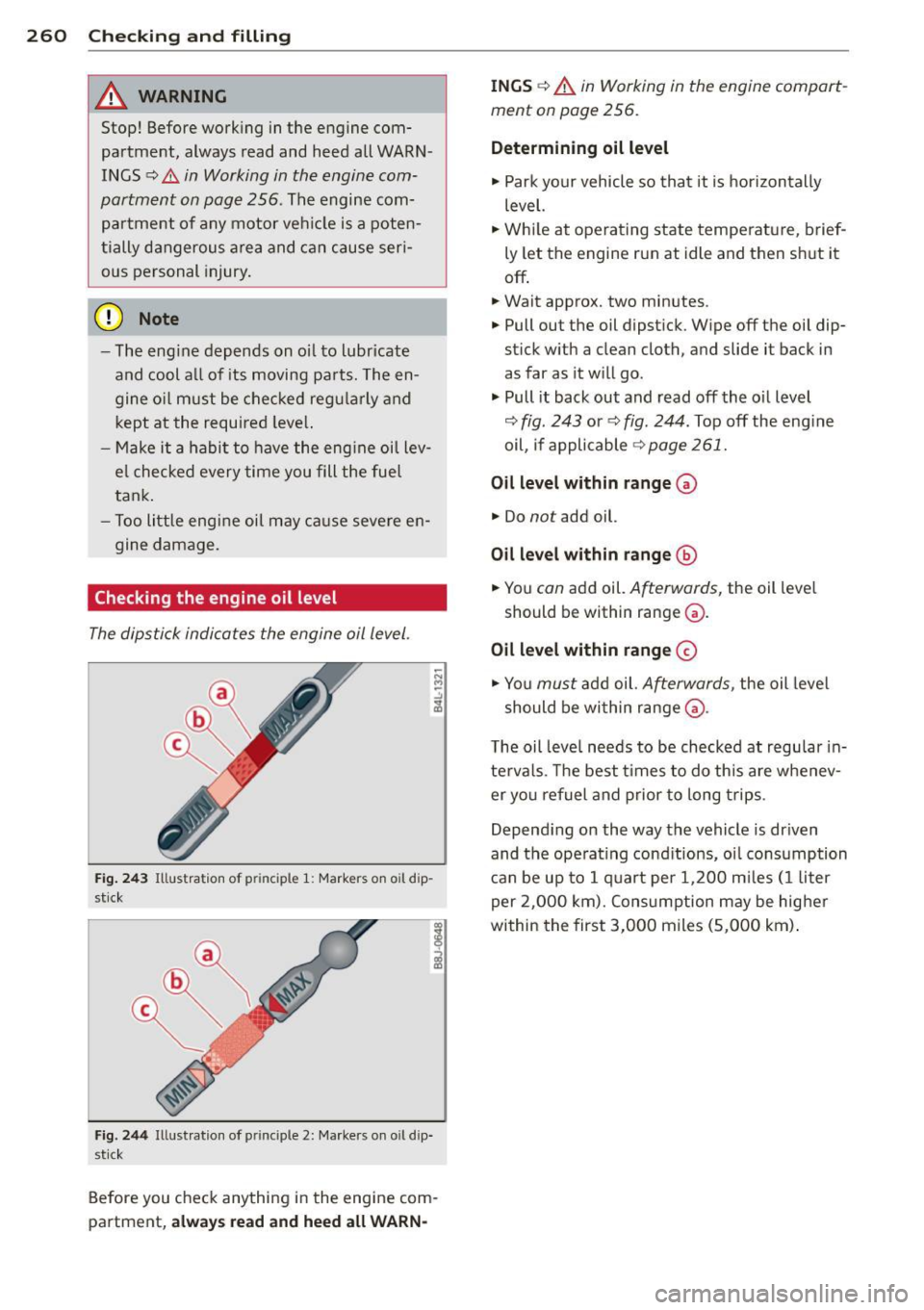
Checking the engine oil level
The dipstick indicates the engine oil level .
Fig. 2 4 3 Illustrat ion of principle 1: Markers on oil dip
st ick
Fig. 2 44 Illustrat ion of p rinciple 2: Ma rkers on o il dip
st ick
Before you chec k anythin g in the eng ine com
partment,
a lw ays read and heed all WARN-
INGS ~.&. in Working in the engine compart
ment on page
256.
Determin ing oil level
• Park yo ur vehicle so that it is horizontally
level.
• W hile at operat ing state tempe rature, brief
ly let the engine run at idle and then s hut it
off .
.. Wait approx. two minutes .
.. Pull out the oil dipstick. Wipe off the oil dip
stick w ith a clean cloth, and slide it back in
as far as it w ill go.
• Pull it back out and read off the o il level
~ fig. 243 o r ~ fig. 244. Top off the eng ine
oil, if applicable ~
page 261.
Oil level within range 0
• Do not add oil.
Oil le ve l within range@
• Yo u can add oil. Afterwards, the oil leve l
should be within range
G).
Oil level within range 0
• You must add oil. Afterwards , the oil leve l
should be wi thin range
G) .
The oil leve l needs to be checked at regular in
te rva ls. The best times to do th is are whenev
er you refuel and prior to long trips .
Depend ing on the way the vehicle is dr iven
and the ope rat ing cond itions, oi l consumption
can be up to
1 quart pe r 1,200 miles (I liter
per
2,000 k m). Consumption m ay be higher
within the first
3,000 miles (5,000 km) .
Page 276 of 350
274 Tir es a nd whee ls
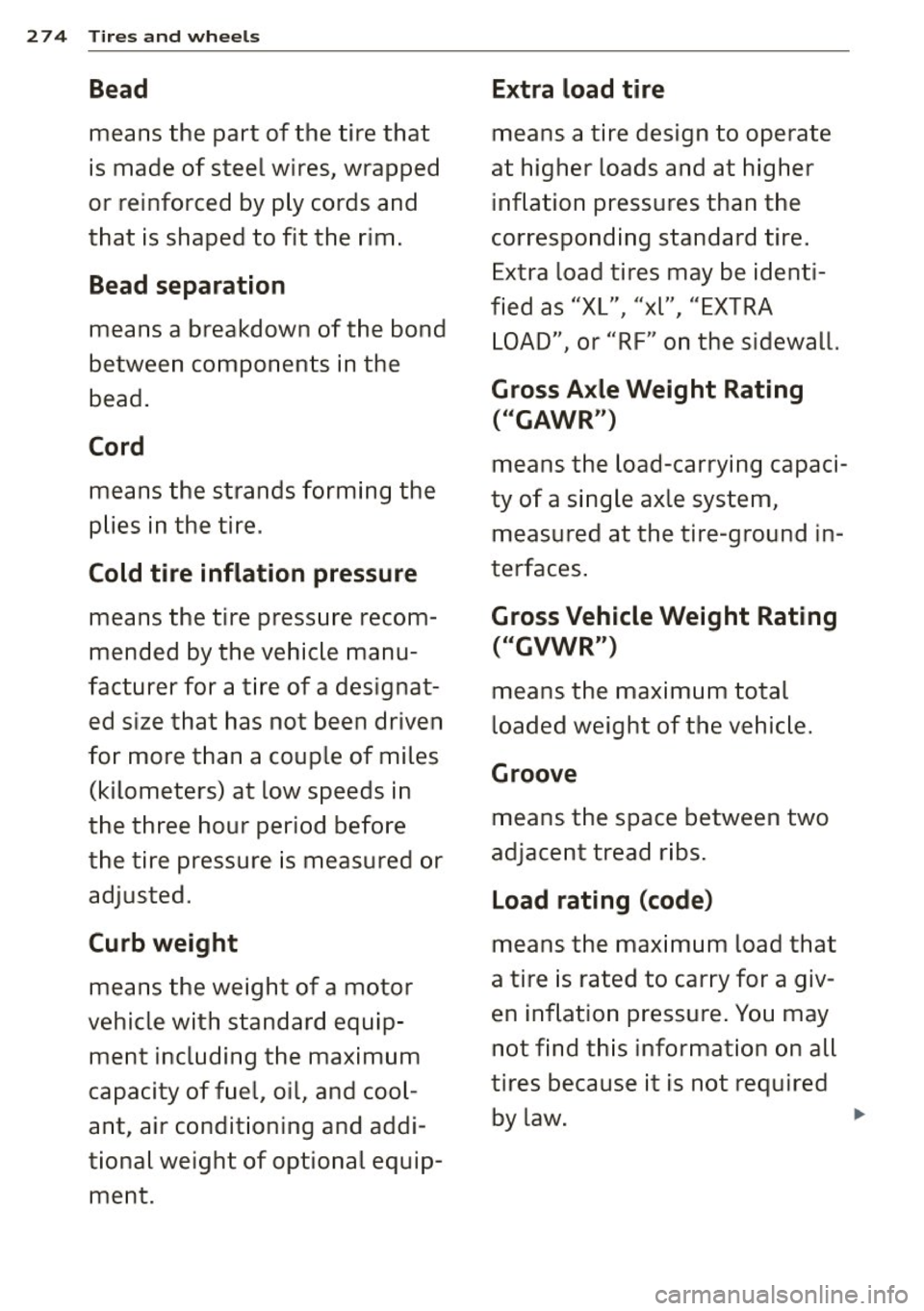
Bead Extra load tire
means the part of the tire that means a tire design to operate
is made of steel wires, wrapped at higher loads and at higher
or reinforced by p ly cords and inflation pressures than the
that is shaped to fit the rim . corresponding standard tire .
Bead separation Extra load tires may be identi-
fied as "XL", "xl", " EXTRA
means a breakdown of the bond LOAD", or "RF" on the sidewall.
between components in the
bead .
Gross A xle Weight Rating
(" GAWR ")
Cord
means the load-carrying capaci-
means the strands forming the ty of a single axle system,
p lies in the tire .
measured at the tire-ground in-
Cold tire inflation pressure terfaces.
means the tire pressure recom-
Gross Vehicle Weight Rating
mended by the vehicle manu-( "GVWR ")
facturer for a t ire of a designat-
means the maximum total
ed size that has not been driven loaded weight of the vehicle.
for more than a couple of miles
Groove
(kilometers) at low speeds in
the three hour period before means the space between two
the tire pressure is measured or adjacent tread ribs.
adjusted.
Load rating (code )
Curb weight
means the max imum load that
means the weight of a motor a tire
is rated to carry for a giv-
vehicle with standard equip -en inflation pressure
. You may
ment including the maximum not find th
is information on all
capacity of fuel, oil, and cool- tires because it is not required
ant, air condit ioning and addi- by law.
...
tional weight of optional equip-
ment.
Page 288 of 350
286 Tires and wheels
build-up, sudden tire failure
and loss of control.
-If the tire pressure is too low or too high, the tires
will wear prematurely and
the vehicle will not handle
well.
-If the tire is not flat and you
do not have to change a
wheel immediately, drive at reduced speed to the near
est service station to check
the tire pressure and add air
as required.
(D Note
Driving without valve stem
caps can cause damage to
the tire valves. To prevent
this, always make sure that
factory installed valve stem caps on all wheels are secure
ly mounted on the valve .
@ For the sake of the environment
Underinflated tires will also
increase the fuel consump
tion .
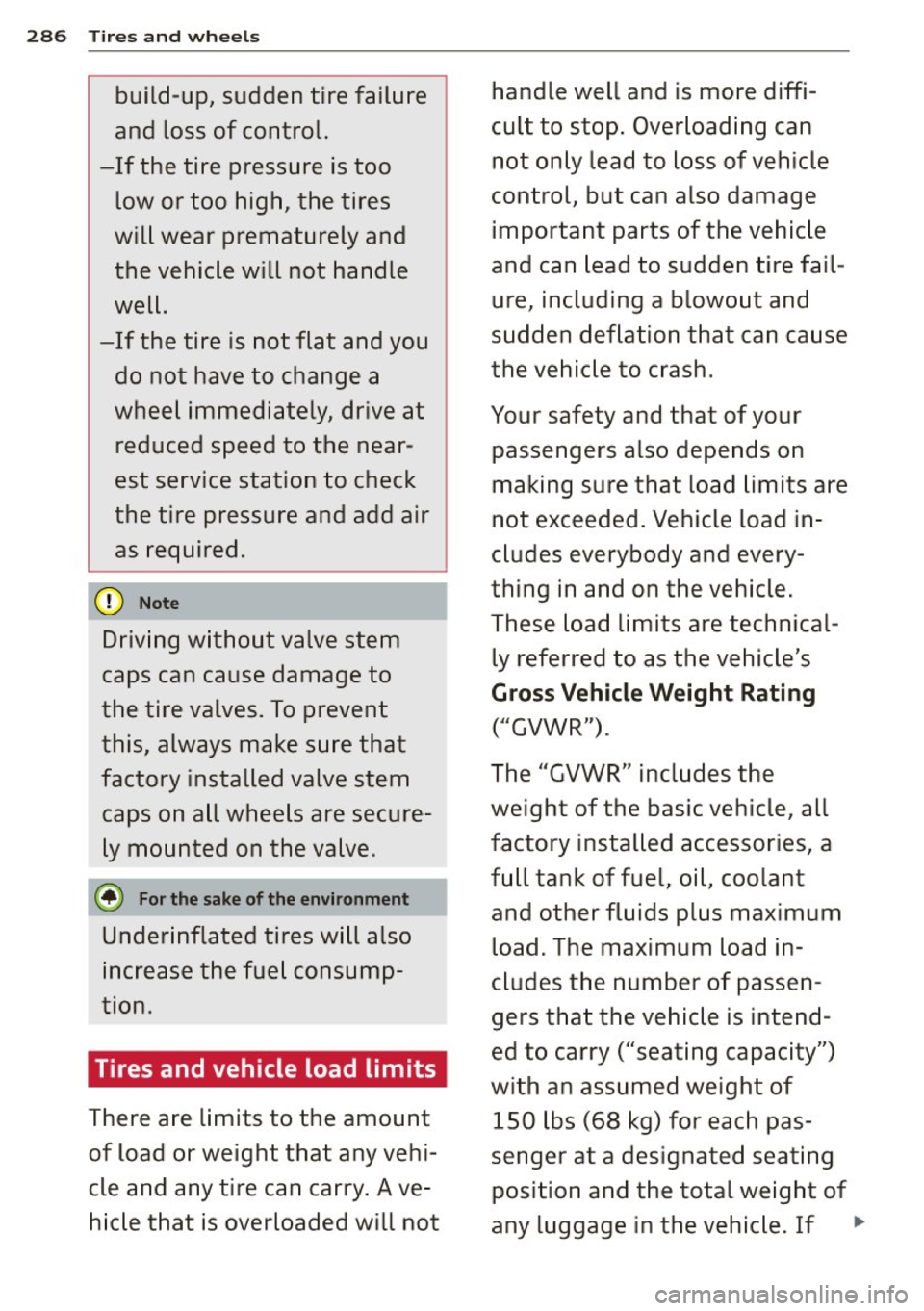
Tires and vehicle load limits
There are limits to the amount
of load or weight that any vehi
cle and any tire can carry. Ave
hicle that is overloaded will not handle well and is more diffi
cult to stop. Overloading can not only lead to loss of vehicle
control, but can also damage important parts of the vehicle
and can lead to sudden tire fail
ure, including a blowout and
sudden deflation that can cause
the vehicle to crash .
Your safety and that of your passengers also depends on
making sure that load limits are
not exceeded. Vehicle load in
cludes everybody and every
thing in and on the vehicle.
These load limits are technical
ly referred to as the vehicle's
Gross Vehicle Weight Rating
("GVWR") .
The "GVWR " includes the
weight of the basic vehicle, all
factory installed accessories, a
full tank of fuel, oil, coolant
and other fluids plus maximum load. The maximum load in
cludes the number of passen
gers that the vehicle is intend
ed to carry ("seating capacity")
with an assumed weight of 150 lbs (68 kg) for each pas
senger at a designated seating
position and the total weight of
any luggage in the vehicle. If ""