brake AUDI Q7 2017 Owner´s Manual
[x] Cancel search | Manufacturer: AUDI, Model Year: 2017, Model line: Q7, Model: AUDI Q7 2017Pages: 402, PDF Size: 100.39 MB
Page 150 of 402
Intelligent Technology
Intelligent Technology
Electronic stabilization
control (ESC)
Description
Elect ronic stabilization control (ESC) supports
driver safety.
It red uces the risk of slipping and
improves driving stability. ESC detects crit ica l sit
uations such as when the vehicle is oversteering
and understeering or the wheels are spinning.
The vehicle is stabilized by applying the brakes or reducing eng ine torq ue. When the ESC engages,
the
DJ ind icator light blinks in the instrument
cluste r.
The fo llow ing systems are integrated in the ESC:
Ant i-loc k bra king system (ABS)
ABS prevents the whee ls from locking when brak
ing. The vehicle can sti ll be steered even during
hard brak ing. Apply steady pressure to the brake
pedal. Do not pump the pedal. A puls ing in the
brake pedal indicates that the system is acting to
stabilize the vehicle .
Brake assist system
The brake assist system can decrease brak ing dis
tance . It increases braking power when the driver
presses the brake pedal quick ly in emergency sit
uations . You must press and hold the b rake pedal
until the dangerous situat io n is over . In veh icles
with adapt ive cr uise control*, the bra ke assist
sys tem is more sensitive if the d ista nce detec ted
t o the vehicle dr iv ing ahead is too small.
O n ve hicles w ith act ivated and funct io ni ng night
vision assist*, the brake ass ist system ca n re
spond more sens it ively if there is a warning.
Anti-Slip Regulation (ASR )
ASR reduces eng ine power when the drive wheels
begin spinning a nd adap ts the force to the road
conditions . This makes it easie r to start, acceler
ate and dr ive up h ills.
Electron ic differential lock (EDL )
EDL applies the brakes to a wheel that starts
spinning and transfers the drive power to the
148
other driving whee ls. This function is not avai la
ble at higher speeds.
In extreme cases , ED L automat ica lly swi tches off
to keep t he b rake on the braked wheel from over
heating. The veh icle is still working correct ly. ED L
will switch on again automatically when condi
tions have returned to normal.
Steering recommendat ion
The ESC he lps to stabilize the vehicle by chang ing
t h e s teer ing torque.
Select ive wheel torque control
Se lective wheel to rque cont rol is used when d riv
i ng on curves. Braking is targeted toward the
whee ls on the inside of the curve as needed . T his
a ll ows mo re precise dr iving in cu rves .
Automatic post -collision braking system
The "automat ic post -collis io n braking system"
can help to reduce the risk of sliding and of addi
tiona l co llisions after an acc ident. If the a irbag
contro l modu le detects a collision, the veh icle is
braked by the ESC.
The veh icle does not brake automatically if:
- the driver presses the accelerator pedal, or
- the ESC, the brake system or the veh icle elect ri-
cal system are not functioning.
A WARNING
- The ESC and its integrated systems cannot
overcome the lim its imposed by natura l
phys ical laws . This is espec ially important
on s lippery or wet roads . If the systems be
gi n ac ting to stabilize yo ur vehicle, you
should immediately a lter your speed to
match the road and traffic conditions. Do
not let the inc reased safety provided tempt
you into taking risks. This could increase
your r isk of a coll is ion.
- Please note the risk of a collision increases
when driving fast, especially through curves
and on slippery or wet roads, and when dr iv
ing too close to objects ahead. The ESC and
its integrated systems cannot always pre
vent co llisions -there is st ill a risk of acci
dents!
Page 152 of 402
Intelligent Technology
_&. WARNING
You should only switch offroad mode on or
switch ESC/ ASR off if your driving abilities
and the traff ic conditions perm it. There is a
r isk of slid ing.
- The stabilization function is limited when
offroad mode is switched on. The driving
wheels co uld spin and the vehicle could
swerve , especially on slick or slippery road
surfaces.
- T here is no vehicle stab ilizat ion when ESC/
ASR are switched off .
Hill descent assist
Hill descent assist makes it possible to drive
down a hill at a constant speed.
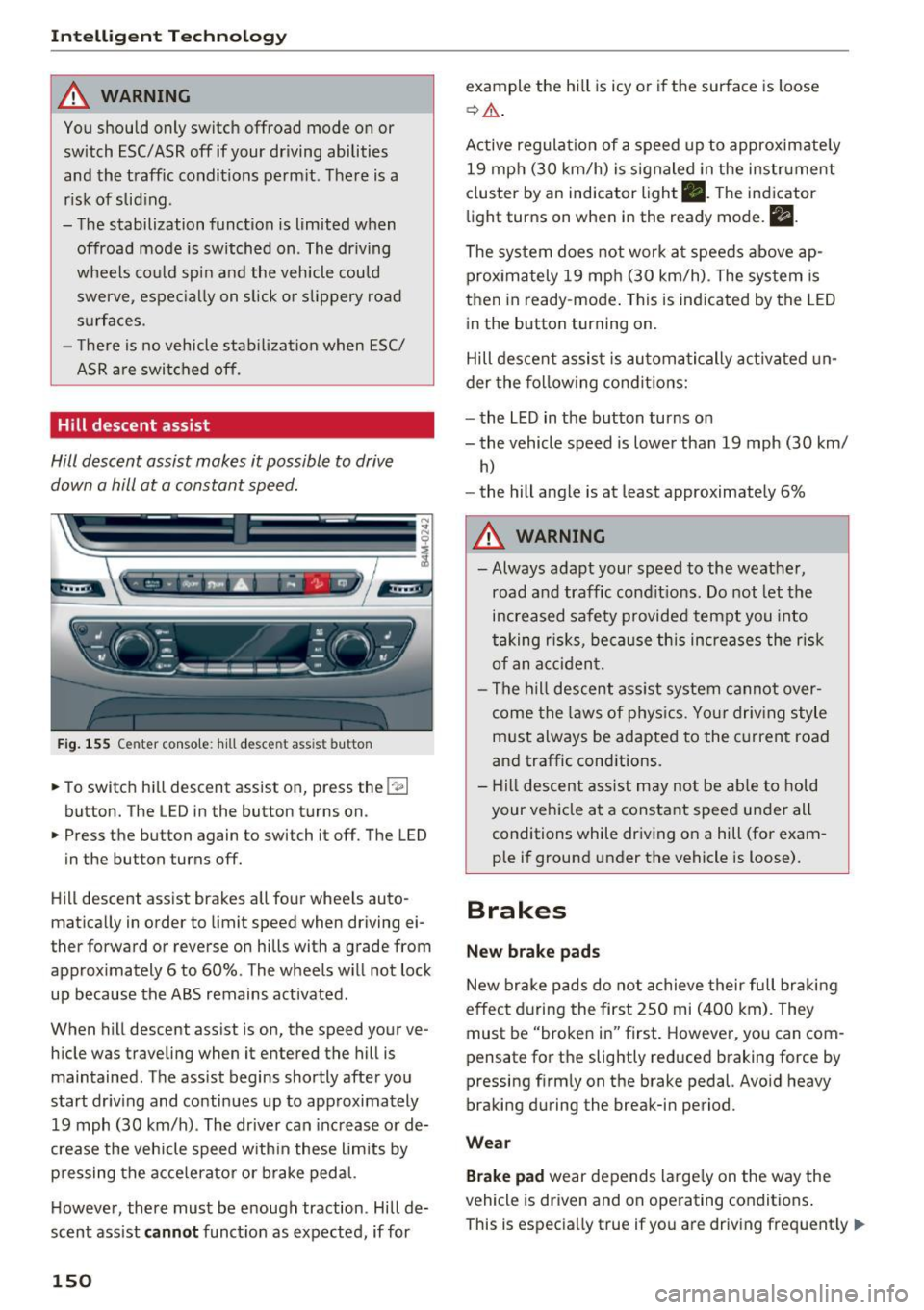
Fig. 155 Center console: hill descent ass ist button
.. To switch hill descent assist on, press the 1-
.. Press the button again to switch it off. The LED
in the button turns off.
Hill descent assist brakes all four wheels auto
matically in order to limit speed when driving ei
ther forward or reverse on hills with a grade from approximately 6 to 60%. The wheels w ill not lock
up because the ABS remains activated.
When hill descent assist is on, the speed your ve
hicle was traveling when it entered the hill is maintained. The assist begins shortly after you
start driv ing and continues up to approximately
19 mph (30 km/h). The driver can increase or de
crease the vehicle speed w ith in these limits by
pressing the accelerato r or brake pedal.
H owever, there must be enough traction. Hill de
scent assist
cannot function as expected, if for
150
example the hill is icy or if the surface is loose
~ & .
Active regulat ion of a speed up to approximately
19 mph (30 km/h) is signaled in the instrument
cluster by an indicator light •. T he indicator
light turns on when in the ready mode.
II.
The system does not work at speeds above ap
proximately 19 mph (30 km/h). The system is
then in ready-mode . This is indicated by the LED
in the button turning on.
Hill descent assist is automatically activated un
der the following conditions:
- the LED in the button turns on
- the vehicle speed is lower than 19 mph (30 km/
h)
-the hill angle is at least approximately 6%
_&. WARNING
-
- Always adapt your speed to the weather,
road and traffic conditions. Do not let the
increased safety provided tempt you into
taking risks, because this increases the risk
of an accident.
- The hill descent assist system cannot over
come the laws of phys ics. Your driving style
must always be adapted to the current road
and traffic cond itions .
- Hill descent assist may not be able to hold
your vehicle at a constant speed under all
conditions while driving on a hill (for exam
ple if ground under the vehicle is loose).
Brakes
New brake pads
New brake pads do not achieve their full braking
effect during the first 250 mi (400 km). They
must be "broken in" first. However, you can com
pensate for the slightly reduced braking force by
pressing f irmly on the brake pedal. Avo id heavy
braking during the break-in period.
Wear
Brake pad wear depends largely on the way the
vehicle is driven and on operating conditions .
This is especially true if you are driv ing frequent ly
IJ,,
Page 153 of 402
u co ...... N r-... N ...... 0
0
:E: '
style.
Operating noise
Noises may occur when bra king depend ing o n the
speed, b raking force and ou ts ide cond itions su ch
as tempe rature and humidity.
W et conditions or road salt
In ce rtain s ituat ions, for example after dr iving
through water, in heavy ra in or afte r washing
your car, the bra king effect may be reduced due
to moisture or ice on t he b rake ro to rs and br ake
pads . The br akes mus t be "dried" f irs t with a few
careful brake applications .
At highe r speeds and with the windsh ie ld w ipers
turned o n, the br ake p ads press against the br ake
r otors for a short amoun t of time . This action,
which is not felt by the driver, happens at regular intervals and ens ures a better reaction time for
the brakes in wet weather.
The braking effe ct can also be reduced if you are
d riving on salted roads and you do not apply t he
brakes for long periods of time . The layer of salt
on the bra ke rotors and pads must be worn off
f irst when the brakes are app lied.
Cor rosion
L eaving the vehicle par ked for long pe riods of
time, low mi leage and avoiding heavy braking
can cont ribute to corrosion on the brake rotors
and to dirty brake pads.
If you usually avo id heavy b raking or if there is
corrosion present, occasional heavy braking at h igh speeds is recommended to clean the brake
rotors and pads¢
A.
Brake system malfunct ion
If yo u no tic e th at the brake peda l travel has sud
denly
increased, then a brake c ircuit in the dual
circuit brake system may have malfunctioned. Drive to an aut ho rized Aud i dea le r or a uth orized
Aud i Service Facility immediately to have the
problem corrected. On the way there, drive with
reduced speed and keep in mi nd that you w ill
need a longer dista nce to stop and you w ill need
to p ress the b rake pedal harde r.
Intellig ent Technology
Low brake fluid level
When the br ake fluid level is low, malfu nctions in
the brake system may occur . The brake fluid level
is electronically monitored .
Brake booster
The brake booster ampl ifies t he p ress ure you ap
ply to the brake pedal.
A WARNING
- Onl y ap ply the bra kes for the purpose o f
cleaning the brake sys tem when road and
traffic conditions permit. You must not en
danger other roa d users . This increases the
risk of an accident.
-
- Never let the ve hicle roll while the engine is
stopped because this increases the risk of an
accident.
(D Note
- Never let the brakes "rub" by pressing the
peda l lightly when braking is not actually
necessary. This causes the b rakes to over
heat and increases braking distance and
causes wear.
- Before driving downhill a long distance on a
steep hill, decrease your speed and select a
lower gear . This makes use of the engi ne
bra king effec t and relieves the brakes. If
you need to bra ke ad ditio na lly, bra ke in in
t erva ls and not continuously.
(D Tips
- If the brake boos ter is not work ing , you
must press t he b rake peda l w ith much more
force than normal.
- If you retrofit your vehicle with a front s po il
er, wheel covers or sim ila r i tems, make su re
t ha t the air flow to the fro nt wheels is n ot
i nt errup ted. Otherwise t he b rake system
c an become too hot .
151
Page 263 of 402
u (0 ,....,
N r--. N ,....,
0
0
:E
Pedals
The pedals must always be free to move and
must never be interfered with by a floor mat or
any other object.
Make sure that all pedals move freely without in
terference and that noth ing prevents them from
returning to their original positions .
Only use floor mats that leave the pedal area free
and can be secured with floor mat fasteners.
If a brake circuit fails, increased brake pedal trav
e l is required to bring the vehicle to a full stop.
A WARNING
Pedals that cannot move freely can cause loss
of vehicle control and increase the risk of seri
ous injury.
- Never place any objects in the driver's foot
well. An object could get into the pedal area and interfere w ith pedal function. In case of
sudden braking or an accident, you would not be ab le to brake or accelerate!
-Always make sure that nothing can fall or move into the dr iver's footwe ll.
Floor mats on the driver side
Always use floor mats that can be securely at
tached to the floor mat fasteners and do not interfere with the free movement of the pedals .
... Make sure that the floor mats are properly se
cured and cannot move and interfere with the
pedals
Q .&_ .
Use only floor mats that leave the pedal area un
obstructed and that are firmly secured so that
they cannot slip out of pos it ion . You can obtain
suitable floor mats from your authorized Audi
dealer.
Floor mat fasteners are installed in your Audi .
Fl oor mats used in your vehicle must be attached
to these fasteners. Properly securing the floor mats will prevent them from sliding into posi-
Driving safety
tions that could interfere with the pedals or im
pair safe operation of your vehicle in other ways.
A WARNING
-
Pedals that cannot move freely can res ult in a
l oss of vehicle control and increase the risk of
serious personal injury.
-Always make sure that floor mats are prop
erly secured.
- Never p lace or install floor mats or other
f loor coverings in the vehicle that cannot be
proper ly secured in place to prevent them
from slipping and interfer ing with the ped
als o r the ab ility to control the vehicle.
- Never p lace or install floor mats or other
f loor cove rings on top of already installed
floor mats . Additional floor mats and other
cover ings will reduce t he si ze of the pedal
a rea and in terfere with the pedals.
- Always p roperly re insta ll and secure floor
mats that have been take n out fo r clean ing .
- Always make sure that objects cannot fall
into the d river footwell whi le the vehicle is
mov ing. Objec ts can become trapped under
the brake pedal and accelerator pedal caus
ing a loss of vehicle control.
Storing cargo correctly
Loading the luggage compartment
All luggage and other objects must be properly stowed and secured in the luggage compart
ment.
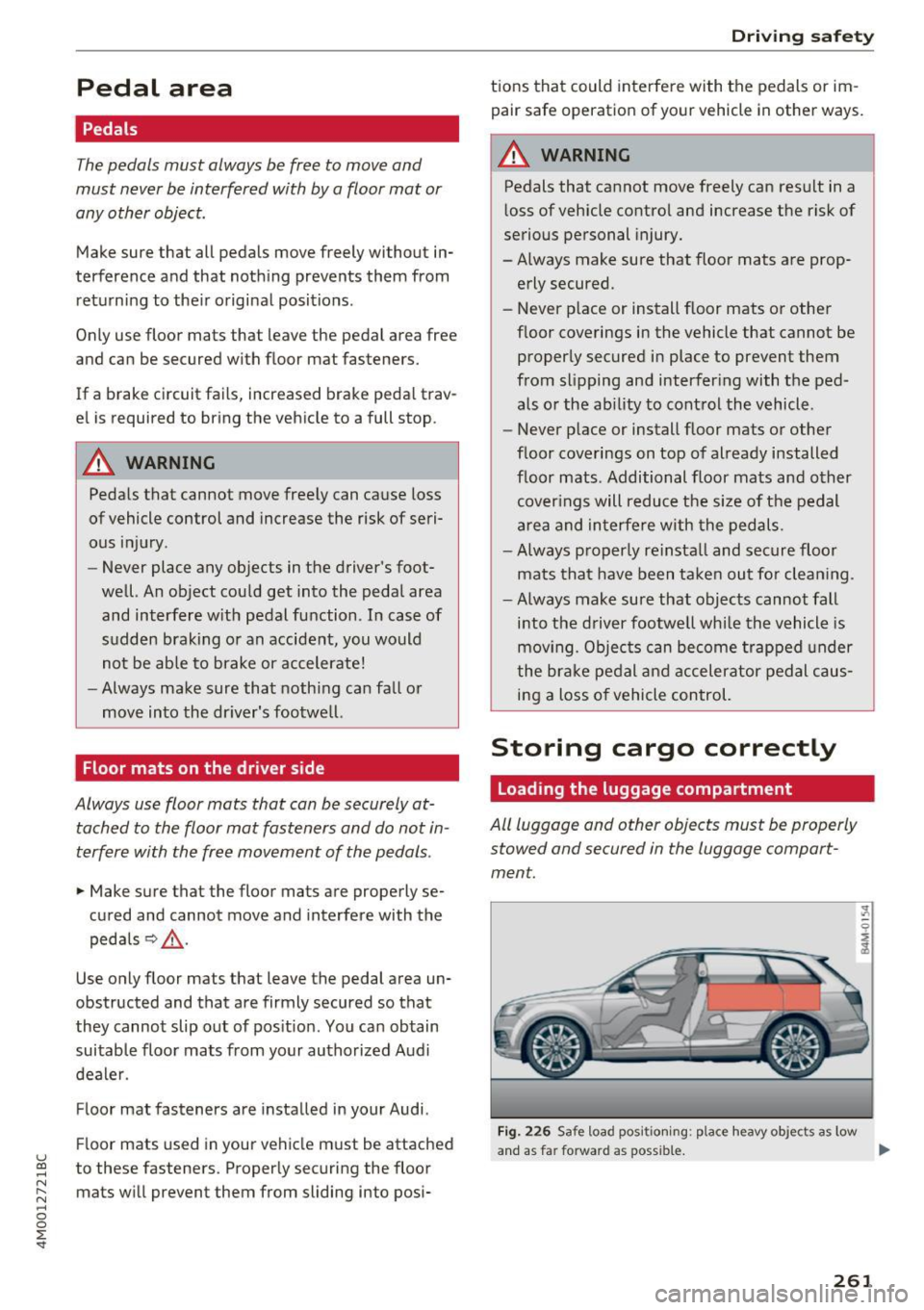
F ig. 226 Safe load positio ning: place heavy objects as low
a n d as far forward as poss ible.
IJI,-
261
Page 324 of 402
Check ing and F illing
Engine compartment
Working in the engine compartment
Special care is required if you are working in the
engine compartment
Fo r wo rk in th e engine compa rtmen t, s uch as
c h ec kin g and filli ng flu id s, th ere is a risk of in
j u ry, sc aldin g, ac cide nts, a nd b urn s. For this
rea son, foll ow all the warning s and gener al
s a fe ty p recaution s pr ov ided in the f ollow ing in·
f o rm ation . Th e en gine c omp artmen t is a dan
ger ous are a.
¢ ,&.
_& WARNING
- T urn the engine off.
- Switch the ign ition off .
- Set the parking brake .
- Select the P selector lever pos ition .
- let the engine cool down.
- Never open the hood when there is steam or coolant escaping from the engine compart
ment, because there is a risk that you could
be burned . Wait until no steam or coolant is
escaping .
- Keep ch ildren away from the engine com
partment .
- Never spill flu ids on a hot engine. These flu
ids (such as the anti -freezing agent con
ta ined in the coolant) can ignite .
- Avoid short circu its in the electrical system .
- When working in the engine compartment,
remember that the rad iator fan can sw itch
on even if the ignition is switched off, which
increases the risk of in jury .
- Never open the cap on the coolant expan
sion tank when the eng ine is warm . The
cooling system is under pressure.
- To protect your face, hands, and arms from hot steam or coolant, cove r the cap with a
large cloth when opening.
- Do not remove the engine cover under any circumstances . This increases the risk of
burns.
- If tests need to be performed w ith the en
gine running, there is additional danger d ue
to moving components (such as the ribbed
322
be lt, alternator and radiator fan) and from
the high-voltage ignition system.
- Do not under any circumstances activate the
throttle inadvertently (for example, by hand
from the engine compartment) if the veh i
cle is stat ionary but the eng ine is running
and a gear is engaged . Otherwise, the veh i
cle will start to move immediately and this
could result in an acc ident .
- Pay attent ion to the following warnings
when work on the fue l system is required:
- Do not smoke .
- Never work near open flames .
- Always have a working fire extinguisher
nearby
- All work on the battery or elect rical system
in your vehicle can result in injuries, chemi
cal b urns, acc idents or burns . Because of
this, all work must be performed
onl y by an
authorized Audi dealer or authorized Audi
Service Facility.
- To reduce the risk o f electric shock and in
jury, never touch the following components
when the engine is running or is being start•
ed:
- Ign ition cable
- Other components in the electronic high -
vo ltage ign ition system
- If you must check or perform work on the
engine while it is running:
- Set the parking brake firs t and then se lect
the P selector lever position.
- Always proceed w ith extreme caution so
that clothing, jewelry or long hair do not become caught in the radiator fan, fan
belt or other moving components or do
not come into contact with hot compo
nents. Tie back long hair before beginn ing
work and do not wear clothing that can hang down into the engine .
- Lim it your exposure to exhaust and chemi
cals to as short a time as possible
¢ .&. .
A WARNING
California Proposition 65 Warning:
Page 326 of 402
Checking and Filling
-If the hood is not latched completely, it
could fly up while you are driving and ob
struct your vision.
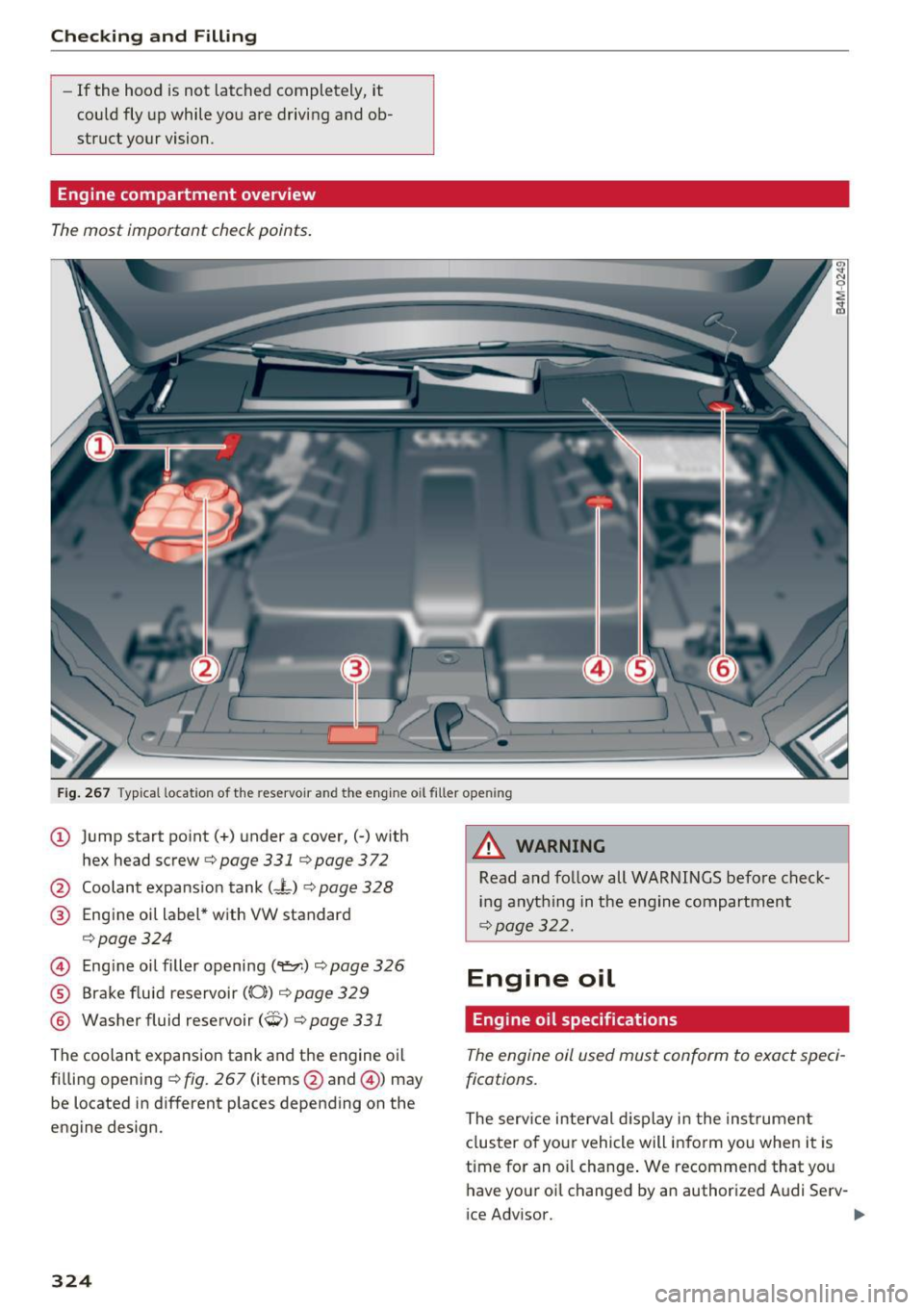
Engine compartment overview
The most important check points.
Fig. 267 Typ ical location of the reservoir and the engine oil filler opening
@ Jump start point(+) under a cover,(-) with
hex head screw
c;, page 331 qpage 372
@ Coolant expansion tank (-L) ~ page 328
@ Engine oil label * with VW standard
,=;, page 324
© Engine oil filler opening (9:::r.) c;, page 326
® Brake fluid reservoir ((0)) c;, page 329
® Washer fluid reservoir (W) c;, page 331
The coolant expansion tank and the engine o il
filling opening
c;, fig . 267 (items @and @) may
be located in different places depending on the
engine design.
324
8,_ WARNING
Read and follow all WARNINGS befo re check
ing anything in the engine compartment
c;, page 322.
Engine oil
Engine oil specifications
The engine oil used must conform to exact speci
fications.
The serv ice interval d isplay i n the instrumen t
clus ter of your vehicle will inform you when it is
time for an o il change . We recommend that you
have your oi l changed by an author ized Audi Serv-
ice Advisor. ..,_
Page 331 of 402
u (0 ...... N r--. N ...... 0
0
:E
ly unscrew the cap to the left until you feel re
sistance ¢,&. .
.. Push the release button again and remove the
cap completely .
.. Add coolant mixed in the correct ratio
¢page 328 up to the MAX marking .
.. Make sure that the fluid level remains stable .
Add more coolant if necessary .
.,. Turn the cap to the right to secure it until yo u
feel resistance a second time.
Coolant loss usually indicates there is a leak . Im
mediately drive your vehicle to an authorized
Audi dealer or authorized Aud i Service Facility
and have the cooling system inspected. If the
cooling system is not leaking, a loss can come
from the coolant boiling through overheating
and being pushed out of the cooling system.
A WARNING
-The cooling system is under pressure. Do
not open the coolant expansion tank cap
when the eng ine is hot. This increases the
risk of burns .
- The coolant additive and the coolant can be
dangerous to your health. For this reason,
keep the coolant in the original container
and away from children. There is a risk of
poisoning.
- When working in the engine compartment,
remember that the radiator fan can switch
on even if the ign ition is switched off, which
increases the risk of injury.
CD Note
Do not add coolant if the expansion tank is
empty. There may be air in the cooling sys
tem, which increases the risk of engine dam
age . If this is the case, do not continue driv
ing . See an authorized Audi dealer or author
ized Audi Service Facility for assistance.
Checking and Filling
Brake fluid
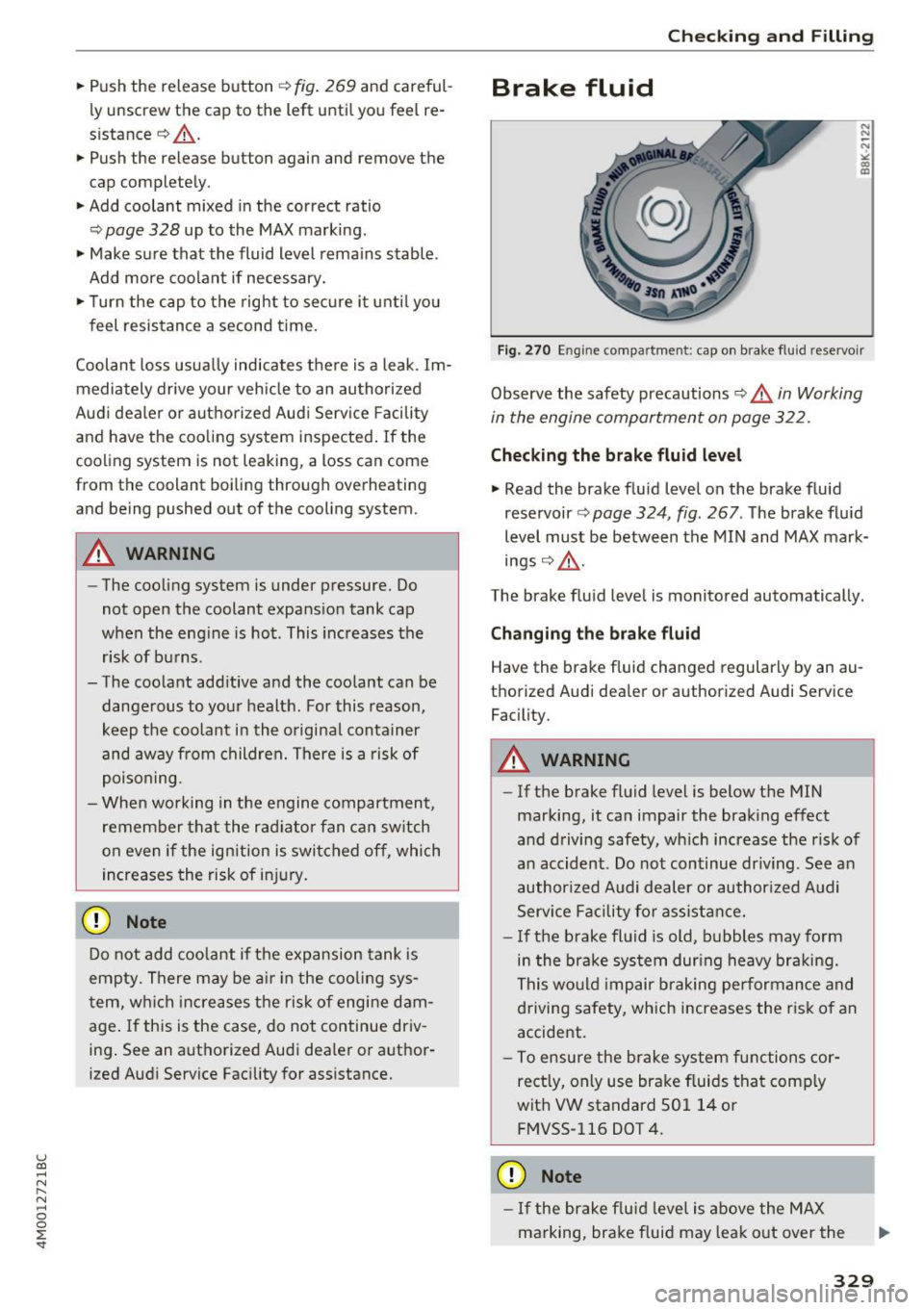
Fig. 270 Engine compartment: cap on brake fluid reservo ir
Observe the safety precautions¢ A in Working
in the engine compartment on page 322 .
Checking the brake fluid level
.. Read the brake fluid level on the brake fluid
reservoir ¢
page 324, fig . 267. The brake fluid
level must be between the MIN and MAX mark
ings ¢,& .
The brake fluid level is monitored automatically.
Changing the brake fluid
Have the brake fluid changed regularly by an au
thorized Audi dealer or authorized Audi Service Facility.
A WARNING
- If the brake flu id level is below the MIN
marking, it can impair the braking effect
and driving safety, wh ich increase the risk of
an accident. Do not continue dr iving. See an
authorized Audi dealer or authorized Audi
Serv ice Facility for assistance.
- If the brake fluid is old, bubbles may form
in the brake system dur ing heavy braking.
This would impair braking performance and
driving safety, which increases the risk of an
accident.
- To ensure the brake system functions cor
rectly, only use brake fluids that comp ly
with VW standard 501 14 or FMVSS-116 DOT 4.
CD Note
-If the brake flu id l eve l is above the MAX
marking, brake fluid may leak out over the
329
Page 337 of 402
u
"' .... N
" N .... 0
0
l'. ...
® Mud and snow capability
"M/5" or "M+S" indicates the tire
has properties making it suitable
to drive in mud or snow.~ indi
cates a winter tire .
@ Composition of the tire cord
and materials
The number of plies indicates the
number of rubber ized fabric lay
ers in the t ire. In general : the
more layers, the more weight a
tire can carry . Tire manufacturers
must also specify the materials
used in the ti re . These incl ude
stee l, nylon, polyester and other
materials .
@Maximum permitted load
This number indicates the maxi
mum load in kilograms and
pounds that the tire can carry .
@ Uniform tire quality grade
standards for treadwear,
traction and temperature resistance
T readwear , traction and tempera
ture ranges¢
page 350.
@ Running direction
The arrows indicate the running
direction of un idirectional t ires .
You must always follow the speci- fied running direction
¢
page 365.
€3) Maximum permitted
inflation pressure
Wheels
T his number ind icates the max i
mum pressure to which a tire can
be inflated unde r normal operat
ing conditions.
Glossary of tire and loading
terminology
Accessory weight
means the combined we igh t (in
excess of those standard items
wh ich may be replaced) of auto
matic transmission, power steer
ing, power brakes, power win
dows, power seats, radio, and
heater, to the extent that these
items are availab le as factory-in
stalled equipment (whether in
stalled or not).
Aspect ratio
means the ratio of the height to
the w idth of the tire in percent .
Numbers of 55 or lower indicate a
low s idewall for improved steer
ing response and better overall
handling on dry pavement .
335
Page 339 of 402
u
(a) Curb weight
(b) Accessory weight
(c) Vehicle capacity weight, and
(d) Production options we ight
Ma ximum (permissible)
inflation pressure
means the maximum cold infla
tion pressure to which a t ire may
be inflated. Also called "maxi
mum inflation pressure."
Normal occupant weight
means 150 lbs. (68 kilograms)
times the number of occupants
seated in the veh icle up to the to
tal seating capacity of your vehi c le.
Occupant distribution
means distribution of occupants
in a vehicle.
Outer diameter
means the overall diameter of an
inflated new tire.
Overall width
means the linear distance be
tween the exteriors of the side
walls of an inflated tire, including
elevations due to labeling, deco
rations, or protective bands or
~ ribs . N
" N .... 0
0
l'. ...
Wheels
Ply
means a layer of rubber-coated
parallel cords .
Production options weight
means the combined weight of
those installed regular production
options weighing over 5 lbs. (2.3 kg) in excess of those standard
items which they replace, not pre
viously considered in curb weight
or accessory weight, including
heavy duty brakes, ride levelers,
roof rack, heavy duty battery, and
special trim .
Radial ply tire
means a pneumatic tire in which
the ply cords that extend to the beads are laid at substantially 90
degrees to the centerline of the
tread.
Recommended inflation
pressure
see ~ page 336, Cold tire infla
tion pressure .
Reinforced tire
means a tire designed to operate
at higher loads and at higher in
flation pressures than the corre sponding standard tire. Rein
forced tires may be identified as .,.
337
Page 343 of 402
u a,
-N
" N .... 0
0
l: ..
different tire speeds. For this reason, in case of emergency, only
use a spare tire that has the same
circumference as the regular
tires.
&,_ WARNING
-Do not use steel rims that are 17 inches or larger. Other
wise, damage to the vehicle
and an accident could result.
-For technical reasons, it is not
possible to use tires from oth
er vehicles -in some cases,
you cannot even use tires from
the same vehicle model.
-Make sure that the tires you
select have enough clearance
to the vehicle. Replacement
tires should not be chosen
simply based on the nominal
size, because tires with a dif
ferent construction can differ greatly even if they are the
same size. If there is not
enough clearance, the tires or
the vehicle can be damaged
and this can reduce driving
safety and increase the risk of
an accident.
-Only use tires that are more
than six years old when abso-
Wheels
lutely necessary and drive
carefully when doing so.
-Run-flat tires* may only be used on vehicles that were
equipped with them at the
factory
¢ page 3 52.
-If you install wheel covers on
the vehicle, make sure they al low enough air circulation to
cool the brake system. If they
do not, this could increase the
risk of an accident.
Tire wear/damage
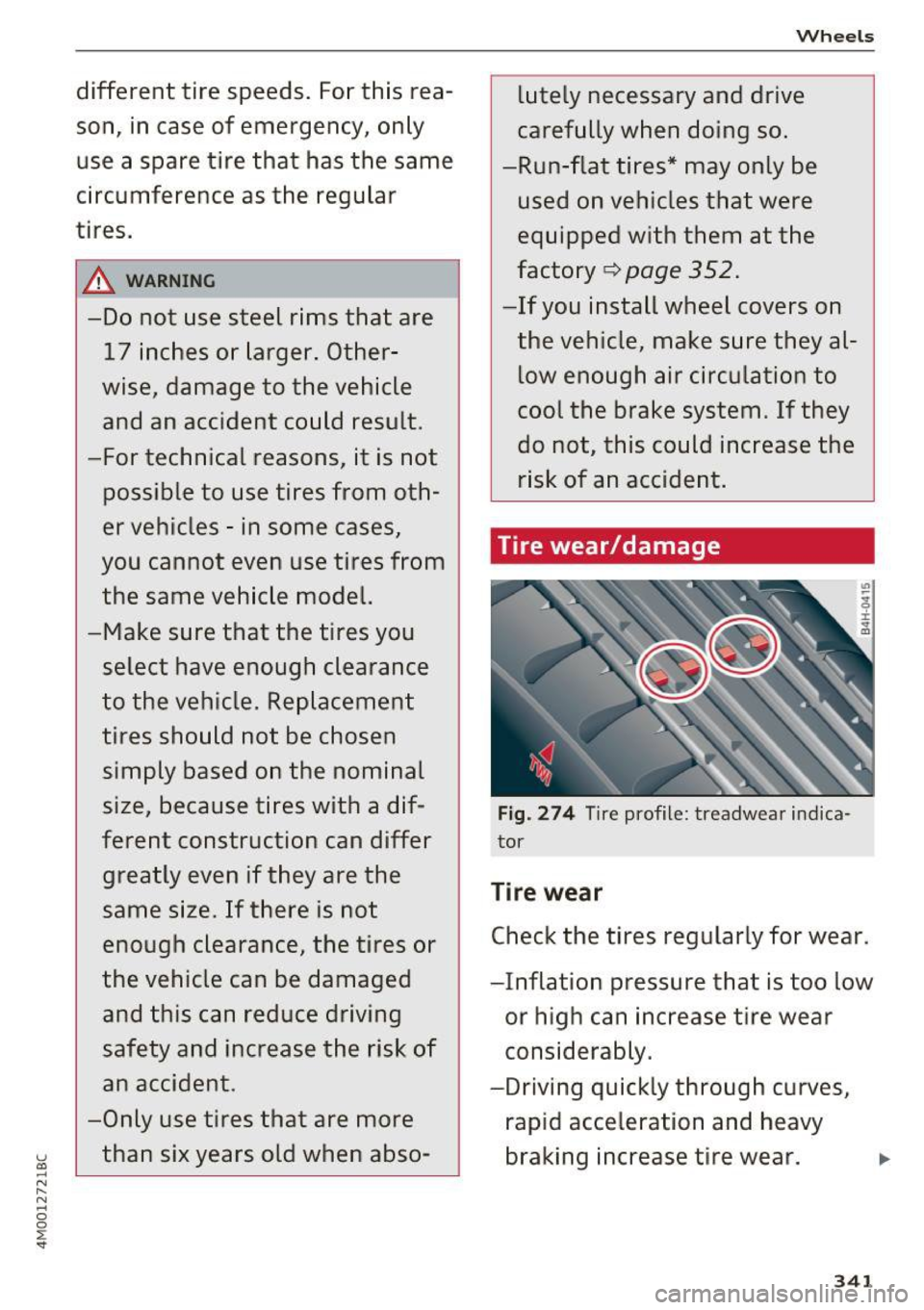
Fig. 274 T ire profile: treadwear indica
tor
Tire wear
Check the tires regularly for wear.
-Inflation pressure that is too low
or high can increase tire wear
considerably.
-Driving quickly through curves, rapid acceleration and heavy
braking increase tire wear.
341