door lock AUDI Q7 2018 Owner´s Manual
[x] Cancel search | Manufacturer: AUDI, Model Year: 2018, Model line: Q7, Model: AUDI Q7 2018Pages: 398, PDF Size: 185.58 MB
Page 276 of 398
Airbag syste m
-Never hold the steering whee l at the 12
o'clock pos it ion or w ith your han ds any
where inside the steering wheel or on the steering wheel hub. Holding t he steering
wheel the wrong way increases the risk of severe injury to the arms, hands, and head if
the d river a irbag deploys.
A WARNING
Objects between you and the a irbag w il l in
crease the risk of inj ury in a crash by interfer
ing w ith the way the airbag unfo lds and/or by
being pushed into you as the airbag inflates .
- Always make sure nothing is in the front air-
bag deployment zone that could be str uck
by the airbag when it inflates.
-
- Objects in the zone of a deploying airbag
can become projectiles when the airbag de
ploys and cause serious persona l injury .
- Never hold th ings in your hands or on your
lap when the vehicle is in use.
- Never place accessor ies or other objec ts
(s uch as c up ho lders, telephone brackets,
note pads, navigation systems, or things
that are large, heavy, o r bulky) on the doors;
never attach then to the doors or the wind
shield; never place them over or near or at
tach them to the area marked ,,AIRBAG" on
the steering wheel, instrument panel or the seat backrests; never p lace them between
these a reas and yo u or any other person in
the vehicle.
- Never attach objects to the w indshield
above the passenger front airbag, s uch as
accessory GPS navigation uni ts or mus ic
players . S uch objects could ca use serio us in
jury in a collision, especially when the air bags inflate.
- Never recline the front passenger seat to transport objects . Items can also move into
the deployment area of the side a irbags or
the front a irbag during breaking o r in a sud
den maneuver. Objects near the airbags can
fly dangerous ly through the passenger com
partment and cause injury, particularly
when the seat is reclined and the airbags in
flate.
274
A WARNING
A person on the front passenger seat, espe
cially infants and small ch ildren, wi ll receive
serious in juries and can even be k illed by be
ing too close to the airbag when it inflates .
- Although the Advanced Airbag System in your veh icle is designed to turn off the front
passenger airbag if an infant o r a small child
is on the fron t passenger sea t, nobody can
absolu tely guarantee tha t deployment un
de r these specia l condi tions is impossible in
all conceivable situations that may happen
during the useful life of yo ur vehicle.
- The Advanced Airbag System can dep loy in
accordance with the ,.low risk" option for 3-
and 6-year-old children under the U.S. Fed
eral Standard if a child w ith electrical capac
itance greater than the combined capac i
tance of a typical one-year o ld infant re
strained in one of the forward facing or rea r
ward-facing chi ld seats with which yo ur ve
hicle was certified is on the front passenger
seat and the o ther conditions for airbag de-
ployment are me t.
- Accident s tatisti cs have shown th at children
are generally safer in the rear seat are a than
in the front seat ing pos ition.
- For their own s afety, all ch ildren, especi ally
12 years and younger, should alw ays ride in
the back proper ly restrained for their age
and size .
Advanced front airbag system
Your vehicle is equipped with a front Advanced
Airbag System in compliance with United States
Federal Motor Vehicle Safety Standard (FMVSS)
208, as well as Canada Motor Vehicle Safety
Standard (CMVSS) 208 as applicable at the t ime
you r vehicle was manufactured .
-
The front Advanced Airbag System supplements
the safety belts to provide add itiona l protect ion
for the driver 's and front passenger's heads and
upper bod ies in fronta l crashes. The a irbags in
flate only in frontal impacts when the vehicle de-
ce le ra tion is high e no ugh.
II>-
Page 301 of 398
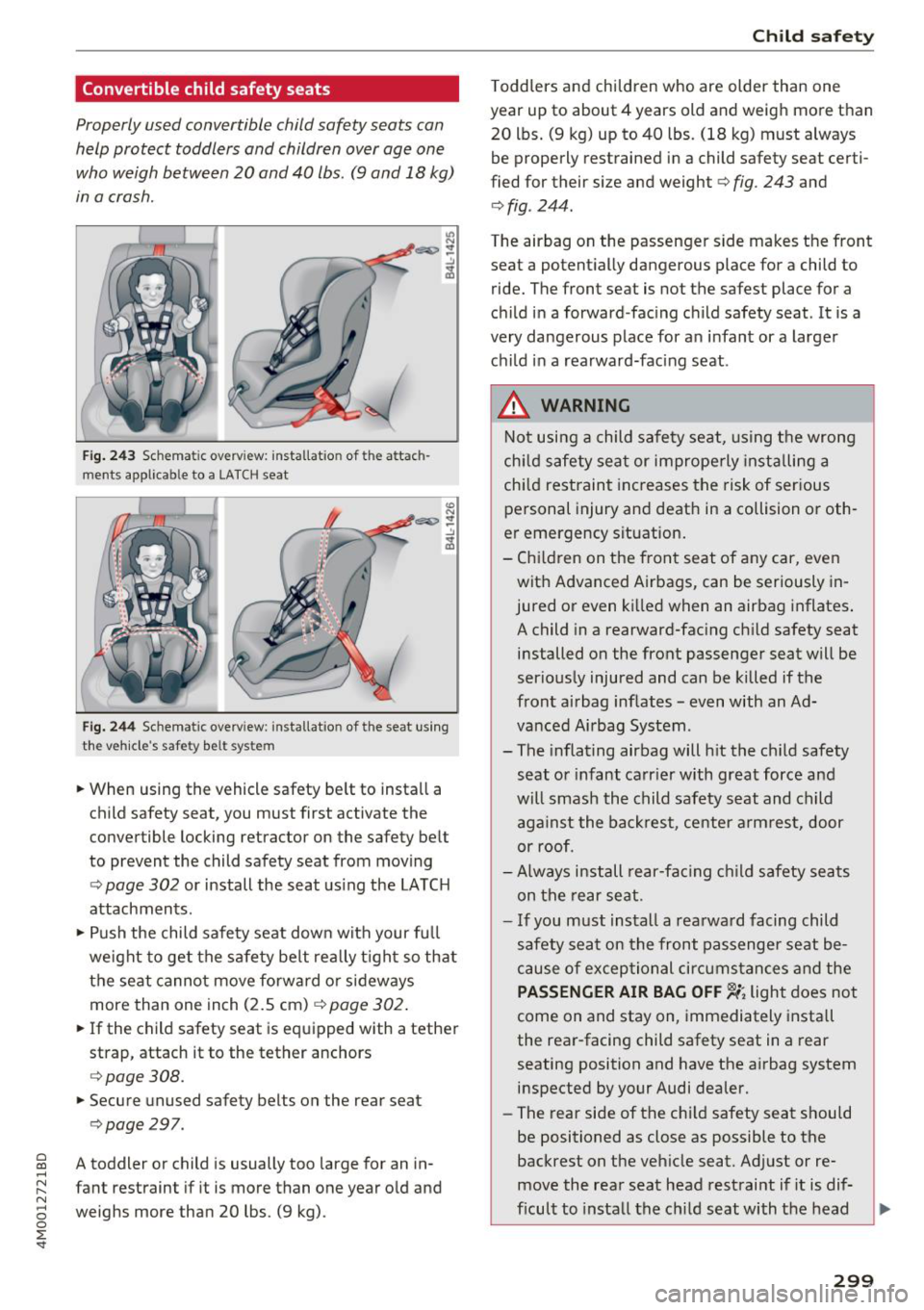
Convertible child safety seats
Properly used convertible child safety seats can
help protect toddlers and children over age one
who weigh between
20 and 40 lbs. (9 and 18 kg)
in a crash.
f ig . 243 Sche matic overview: installatio n of the attach
ments applica ble to
a LA TCH seat
Fig. 2 44 Schematic overview: installat ion of the seat using
the vehicle's safety belt system
~ When using the vehicle safety belt to install a
child safety seat, you must first activate the
convertible locking retractor on the safety belt
to prevent the child safety seat from moving
¢page 302 or install the seat us ing the LA TC H
attachments .
~ Push the child safety seat down with your fu ll
weight to get the safety be lt rea lly t ight so that
the seat cannot move forward o r sideways
more than one inch (2.5 cm)¢
page 302 .
~ If the child safety seat is equipped with a tether
strap, attach it to the tether anchors
¢page 308.
~ Secure unused safety belts on the rear seat
¢page 297.
~ A toddler or child is usually too large for an in-
~ fant restraint if it is more than one year old and
8 weighs more than 20 lbs. (9 kg). 0 :E '
Todd lers and children who are older than one
year up to about 4 years old and weigh more than
20 lbs. (9 kg) up to 40 lbs . (18 kg) must always
be properly restrained in a child safety seat certi
fied for their size and weight ¢
fig. 243 and
¢ fig. 244.
The airbag on the passenger side makes the front
seat a potent ially dangerous place for a child to
ride. The front seat is not the safest place for a
child in a forward -fac ing child safety seat . It is a
very dangerous place for a n in fant or a larger
child in a rearward-facing seat .
_&. WARNING
Not using a child safety seat, using t he wrong
chi ld safety seat or imprope rly insta lling a
chi ld restraint increases the risk of ser ious
personal injury and death in a collision or oth
er emergency situation.
- Ch ildren on the front seat of any car, eve n
wit h Advanced Airbags, can be seriously in
jured or even killed when an airbag inflates .
A child in a rearward-fac ing ch ild safety seat
installed on the front passenger seat will be
serious ly injured and can be killed if the
front airbag inflates -even with an Ad
va nced Ai rbag System .
- The inflat ing airbag will h it the ch ild safety
seat or infant carr ier with great force and
will smash the child safety seat and child aga inst the backrest, ce nter a rmrest, door
or roof.
- Always ins tall rear-fa cing c hild safety seats
on the rear seat .
- If you m ust instal l a rea rwa rd facing child
safety seat on the front passenger seat be
cause of exceptional circ ums tan ces and the
PASSENGER AIR BAG OFF "1; light does not
come on and stay on, immediately insta ll
the rea r-facing child safety seat in a rear
seating position and have the a irbag system
inspected by your Audi dealer.
- The rear side of the ch ild safety seat shou ld
be positioned as close as possible to the
backrest on the veh icle seat. Adjust or re
move the rear seat head restraint if it is dif-
f icult to instal l the ch ild seat with the head ._.
299
Page 305 of 398
Cl a:, ...... N
" N ...... 0
0
::r '
-
Improperly installed child safety seats in
crease the risk of serious personal injury and
death in a collision.
- Always make sure that the safety belt re
tractor is locked when installing a child
safety seat. An unlocked safety belt retrac
tor cannot hold the child safety seat in place dur ing normal driving or in a crash.
- Always buckle the child safety seat firmly in
place even if a child is not sitting in it. A
loose child safety seat can fly around during
a sudden stop or in a collision.
- Always make sure that the rear seat back
rest to wh ich the center rear safety belt* is
attached is secure ly latched whenever the
rea r cente r safety belt is being used to se
cur e a ch ild rest raint.
- If the backrest is not securely latched, the
child and the child restraint will be thrown
forwar d toge ther w it h the backrest and will
st rike parts of the vehicle interior. The ch ild
can be se riously in jured or killed .
- Never ins tall rear-f acing chi ld safety sea ts
or infant carriers on the front passen ger
seat . A child will be serious ly inju red and
can be killed when the passenger airbag in
flates.
- The inflating airbag will hit the child safety
seat or infant carrier with great force and
will smash the ch ild safety seat and chi ld
against the backrest, center armrest, door
or roof .
- Always install rear-facing child safety seats
o r infant carriers on the rear seat.
- Forward-fac ing ch ild safety seats or infant
carriers installed on the front passenger's
seat may interfere with the deployment of
the a irbag and cause serious injury to the
child .
- It is safe r to install a forward-fac ing ch ild
safety seat on the rear seat .
- Always read and heed all WARNINGS when
ever using a child res trained in a veh icle is
being used~
page 291 . Specia l precaut ions
apply when installing a child safety seat on
t h e fron t passenger sea t~
page 2 70, Child
Ch ild saf ety
restraints on the front seat -some impor
tant things to know.
A WARNING
--
A lways take special precautions if you must
i nstall a forward or rearward-facing child re
stra int on the front passenger's seat in excep
tional s ituations:
- Whenever a forward or rearward-fac ing
child restraint is installed on the front pas
senger sea t, the
PASSENGER AIR BAG OFF
~; lig ht must come on and stay on whenev
er the ign ition is swi tched on.
- I f the
PASSENGER AIR BAG OFF~; light
does not come on and stay on, perform the
checks desc ribe d
~ page 281, Monito ring
t he Advanced Airbag System.
- T ake the child res tra int off the front passen
ge r seat and inst all it prope rly at one of the
rear sea t positions i f the
PASSENGER AIR
BAG OFF~;
light does not stay on whenever
the ignition is switched on .
- Imp roper installat ion of child restra ints can
reduce the ir effectiveness or even prevent
them from providing any protect ion .
- An imprope rly installed child restra int can
interfere with the airbag as it deploys and
serio usly injure or even kill the chi ld.
- Always carefully follow the manufacturer's
instr uctions provided with the child sa fety
seat or ca rr ie r.
- After checking to make su re that the child
rest raint is proper ly installed, make ce rtain
that the child restraint is co rrectly recog
n ized by the capacitive passenger detection
system in the front passenger seat and that
the
PASSENGER AIR BAG OFF~; light sig
na ls the correct front passenger fronta l air
b ag sta tus.
A WARNING
F orw ard-facing child restra int s:
- Always make sure the forward-facing sea t
has been des igned and certified by its man
ufa cturer for use on a fron t sea t with a pa s
senger front and side air bag.
303
Page 306 of 398
Child sa fety
- Never put the forward -facing child restraint
up, against or very near the instrument pan
el.
- Always move the front passenger seat to
the h ighest position in the up and down ad
justment range and move it back to the
rearmost position in the seat's fore and aft
adjustment range, as far away from the air
bag as possib le, before insta lli ng the for
wa rd-facing child restra int.
- Always make sure that the safety belt upper
anchorage is beh ind the child restra int and
not next to or in front of t he ch ild restraint
so tha t the safety belt w ill be properly pos i
tioned.
- Make s ure tha t the
PASSENGER AIR BAG
OFF ~;
light comes on and stays on a ll the
time whenever the ignition is switched on.
A WARNING
Rearward-facing child restraints:
- A ch ild in a rea rw ar d-facing child safety seat
insta lled on the front passenger seat wi ll be
seriously injured and can be killed if the
front airbag inflates -even with an Ad
vanced Airbag System.
- The inflating airbag wi ll hit the child safety
seat or infant carrier with great force and
will smash the chi ld safety seat and child
against the backrest , center armrest, door
or roof.
- Always be especially careful if you must in
sta ll a rearward facing child safety seat on
the front passenger seat in exceptional c ir
c u mstances.
- Make sure that the
PAS SENGER AIR BAG
OFF ~;
light comes on and stays on all the
t ime whenever the ignition is switched on.
- If the PASSENGER AIR BAG OFF~; light
does not come o n and stay o n, immed iate ly
install the rea r-fa cing child safety seat in a
re ar seat ing pos ition and have the airbag
system inspe cte d by your Aud i de aler.
304
Activating the convertible locking retractor
Use the convertible locking retractor to secure a
child restraint.
Always heed the child safety seat manufacturer's
i nstruct ions when installing a child restra int in
your vehicle. To activate the convertible locking r etractor:
.,. Place the child restraint on a seat, preferably
on the rear seat .
.,. Slowly pull the belt
all th e w ay out .
.,. Route it around or through the child restra int
be lt path~ .,&..
.,. Push the ch ild safety sea t down with yo ur full
weigh t to ge t the safety belt rea lly tigh t.
.,. Insert t he be lt tong ue into the b uck le for that
seating position .
.,. Guide the safety be lt back into the retractor un
til the belt lies flat and snug on the ch ild safety
seat.
.,. You shou ld hear a "cl icking" noise as the belt
w inds back into the inertia reel. Test the con
vert ib le lock ing retractor by pull ing on the belt.
You s hou ld no lo nge r be able to pull the belt
out of the retracto r. T he convertib le lock ing re
tracto r is now activa ted .
.,. Make sure that the red release button is facing
away from the chi ld restraint so that it can be
unb uc kled quickly .
.,. Pull on the belt to make sure the safety belt is
properly t ight and fastened so that the seat
cannot move forward or s ideways more than
one inch (2 .5 cm) .
A WARNING
Using the wrong ch ild rest raint or an improp
e rly insta lled child restra int can ca use se rio us
pe rsonal injury or death in a crash.
- Always make sure that the safety be lt re
tr actor is locked whe n in stalling a c hild
safety seat . An un lo cked sa fety be lt retr ac
tor cannot hold the chi ld safety seat in p lace
during normal driving or in a crash.
- Always buckle t he chi ld safety seat fi rm ly in
p lace even if a chi ld is not sitting in it. A
loose chi ld safety seat can fly a round during
a sudden stop or in a crash.
Page 314 of 398
Checking and Filling
Refueling
Fueling procedure
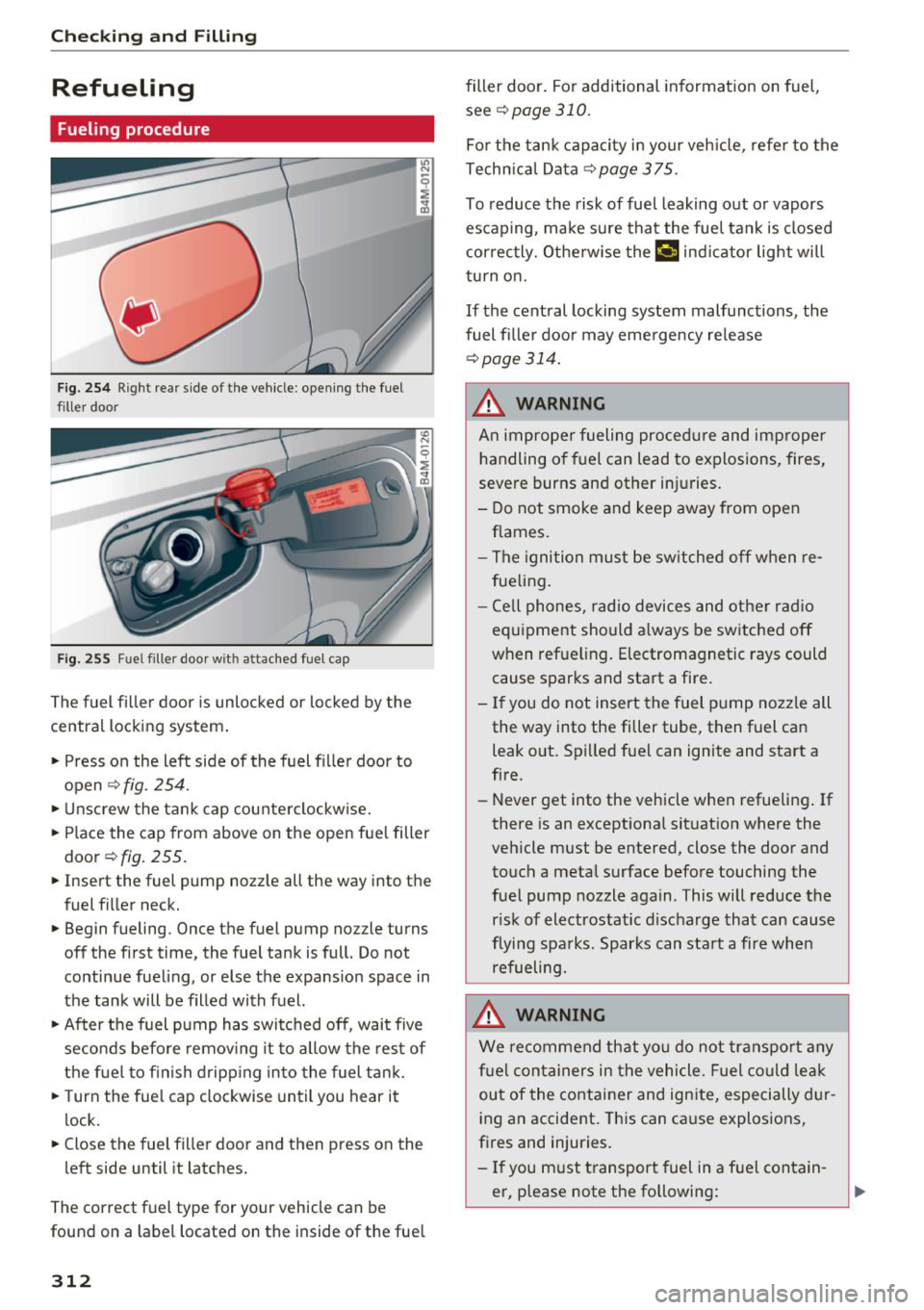
Fig. 254 Right re ar side of the vehicle : opening the fue l
filler door
Fig. 255 Fu el fi lle r door w it h atta ched fuel cap
The fuel f ille r door is unlocked or locked by the
central locking system .
• Press on the left side of the fuel filler door to
open
c:!;> fig. 254.
• Unscrew the tank cap counterclockw ise.
• Place the cap from above on the open fue l filler
door c:!;>fig. 255.
• Insert the fu el pump no zz le all the way into th e
fuel filler neck.
• Begin fueling . Once the fuel pump noz zle turns
off the first time, the fuel tank is full. Do not continue fueling , or else the expans ion space in
the tank will be filled with fuel.
• After the fuel pump has switched off , wait five
seconds before remov ing it to allow the rest of
the fuel to f inish dripp ing into the fuel tank.
• Turn the fue l cap clockwise until you hear it
lock.
• Close the fuel filler door and then pr ess on th e
left side until it latches.
The correct fu el type for your vehicle can be
found on a lab el located on the inside of the fue l
312
filler door. For additional information on fuel,
se e
c:!;> page 310.
For the tank capacity in your veh icle, refer to the
Technica l Data
c:!;> page 3 75 .
To reduce the risk of fuel leaking out or vapors
escaping, make sure that the fuel tank is closed
correctly. Otherw ise the
¢'4 ind icator light wi ll
turn on.
If the cent ral locking system malfunctions , the
fuel filler doo r may emergency re lease
c:!;> page 314.
& WARNING
An improper fueling procedure and improper
handling of fuel can lead to explosions, fires,
severe burns and other in juries.
- Do not smoke and keep away from open
flames.
- The ignition must be sw itched off when re
fueling.
- Cell phones, radio devices and other rad io
equipment should a lways be switched off
when refueling. E lectromagnetic rays could
cause sparks and start a fire.
- If you do not insert the fuel pump nozzle all
the way into the filler tube, then fuel can
leak out. Spilled fuel can ignite and start a
fire .
- Never get into the vehicle when refueling . If
there is an exceptional situation where the
vehicle must be entered, close the door and
touch a metal surface before touching the
fuel pump nozzle again . This will reduce the
r isk of electrostatic discharge that can cause
f lying sparks. Sparks can start a fire when
refueling.
& WARNING
We recommend that you do not transpo rt any
f u el containers in the vehicle . Fuel could leak
out of the container and ignite, especially dur
ing an accident. This can cause explosions,
fires and injuries.
- If you must transport fuel in a fuel contain er, p lease note the following :
Page 315 of 398
Cl a:, ...... N
" N ...... 0
0
-Always p lace a fuel container on the
ground before f illing. Never f ill the fuel
container with fuel while it is in or on the
ve hicle . Electrostatic charge can occur
while refuel ing and the fuel vapors could
ign ite .
- For fuel containers made of metal, the fuel pump nozzle must always ma intain
contact w ith the conta ine r to reduce the
r isk of static c harge.
- I nsert the fuel pump nozzle as fa r as pos
sib le into the filler ope ning whi le ref uel
ing.
- Follow legal requirements w hen using ,
sto ring a nd transpo rting fue l co nta ine rs .
- Make sure that the fuel container meets
the industry standa rds , fo r example ANSI
or AS TM F852-86 .
0 Note
- Remove fuel that has overflowed onto any
vehicle compo nents immed iate ly to reduce
t h e ris k of da mage to t he ve hicle.
-Never dr ive until the fuel tank is comp letely
empty . The irregu lar supply of fuel t hat re
s ul ts from that ca n cause engine misfires.
Un comb usted f uel w ill en ter the ex ha ust
system an d increase the risk of damage to
t h e catalytic converter .
- Applies to: vehicles with a diesel engine: if
the fue l tank runs complete ly empty, the ig
nition m ust remain switched on for at least
30 seconds after refueling before starting
the engine . It may take longer than usual
fo r the engine to start, even up to a m inute.
This is because the air m ust first bleed o ut
of the fuel system when starting the engine .
@ For the sake of the environment
Do not overfill the fuel tan k, otherw ise fue l
can leak out when the vehicle is warm ing up .
~ ll Mark et-specific
Ch eck ing and F illing
(D Tips
The fuel filler door on your ve hicle does not
l ock if you lock t he ve hicle from t he ins ide us
i ng the central locking switch.
(D Tips
Applies to: vehicles with a diesel engine: die
se l vehicles are equipped with a misfueling
guard
ll _ It a llows the vehicle to be fueled on
l y w ith a diesel fuel pump nozzle.
- A worn or damaged nozz le or a nozzle that
is too small may not be able to open the
diese l misfue ling guard. If this is the case,
try turni ng the nozzle before inserting it in
the fuel f ille r neck, use a d ifferent fuel
pump, or see an autho rized Aud i dealer o r
au thor ized A udi Se rvice Fac ility for assis
t an ce.
- Th e misfueling gua rd does not open when
add ing f uel from a f uel containe r. You can
bypass i t by add ing t he d iese l fue l slowly .
313
Page 316 of 398

Checking and Filling
Fuel filler door emergency release
If the central locking system is faulty, the fuel
filler door can be unlocked manually.
•
Fig . 256 Lu ggage compartment: removing the light cover
•
Fig . 257 Luggage compartment: fuel fi ller door emergency
r ele ase
The emergency release mec hanism is located be
h ind the r ight light cover in the luggage compart
ment .
.. Use a screwdriver to remove the light cover
.:>fig . 256 .
.. Loosen the loop from the retainer and then pull
on the loop carefully
c> fig. 257 i=> @. The filler
doo r is released .
.. Press on the left side of the fuel fille r door to
open it
c> page 312, fig . 254.
@ Note
O nl y pull on the loop until you feel resistance .
You will not hear it release. Otherwise yo u
co uld damage the emergency re lease mecha
nism .
314
Selective catalytic
reduction (AdBlue/DEF)
General information
App lies to: vehicles with selective catalytic reduct ion
In vehicles with selective catalytic reduction, a
urea solution (AdBlue/DEF) is injected into the
exhaust system in front of a nitrogen oxide cata l ytic converter to reduce nitrogen em issions. The
urea solution is known as Ad Blue or DEF (Diesel
Exhaust Fluid) . The informat ion that follows w ill
u se the name Ad B lue .
The Ad Blue is carried in a separate tank in the ve
hicle. The AdBlue consumption depends on the
dr iv ing behavior and veh icle operat ing cond i
tions .
It is within a range of 1.0 L -3.0L every 600
miles (1,000 km). In some cases, the consump
tion may a lso differ from this range depending
o n the dr iving behavior and vehicle operat ing
cond it ions.
When a message about refi lling the AdBlue ap
pears in the instrument cl uster display, you must
refi ll the Ad B lue yourse lf or have it refilled by an
authorized Aud i dea le r o r a utho rized Audi Service
Facility
c> page 315.
(D Tips
- T he d isp lay ind icates the dista nce rema ining
that can be dr iven
c> page 314 . If the Ad Bl
ue tank is completely empty, the engine will
not start again after the ignition is switched
off .
- Ad Blue is required by law to operate this ve
hicle .
Messages in the instrument cluster display
App lies to: vehicles with selective cata lyt ic reduct ion
The display indicates if the Ad Blue level is low or
if there is a system malfunction.
AdBlue level low
You w il l be informed in the instrument cl uster
display if the Ad Blue in the tank drops below a
ce rtain level. Ad d at a minim um the amount of
AdBlue shown in the message: .,..
Page 318 of 398
Check ing and F illing
risk of damaging the fuel tank system and
the engine. See an authorized Audi dealer or
a uthorized Audi Serv ice Facility for ass is
tance.
- AdB lue attacks surfaces such as painted ve
hicle components, plast ic and carpet. Re
move the fluid as quickly as poss ible with a
damp cloth and plenty of cold water. If the
Ad Blue has already crysta llized, use warm
water and a sponge . AdBl ue residue that is
not removed will crysta llize a nd can damage
the affe cted surface.
- Do not sto re refi ll bott les o r caniste rs per
mane ntly in the ve hicle. If the con ta iner
l e ak s, the escap ing Ad B lue could damage
the ve hicle in ter io r.
- Do not allow Ad Blue to come into co ntact
wi th clothing. If the re is contac t w ith the
f lui d, flus h immed iate ly w ith plenty o f wa
te r.
(D Tips
Follow t he Ad Blue m anufact urer's ins truc
t ions for use and s torage .
Refilling AdBlue using a pump
Applies to: vehicles with selective catalytic reduction
... Open the tank fi ller door ¢ page 312 , fig . 254.
... Turn the tank filler neck cap to the left to re
move
r=:> page 315, fig . 258 .
... Refill Ad B lue until the pump nozzle switches
off for the first time
r=:> 0 .
.,. Close the filler tube¢ page 317, Completing
AdBlue refill
(Qj) Note
- The pump nozzle handle must be pointing downwa rd w hen fill ing . Ot herwise the
p ump noz zle w ill not sw itch off a utomat i
ca lly¢ @)
in Preparation on page 315.
-Do not cont inue fill ing once the pump no z
zl e automatically switc hes off for the first
time. The AdBl ue tan k system could be
ove rfilled and leak A d Blue ¢(@ in
Prepara
tion on page 315 .
316
Refilling AdBlue using a canister
Applies to: vehicles with selective catalytic reduction
®
+®
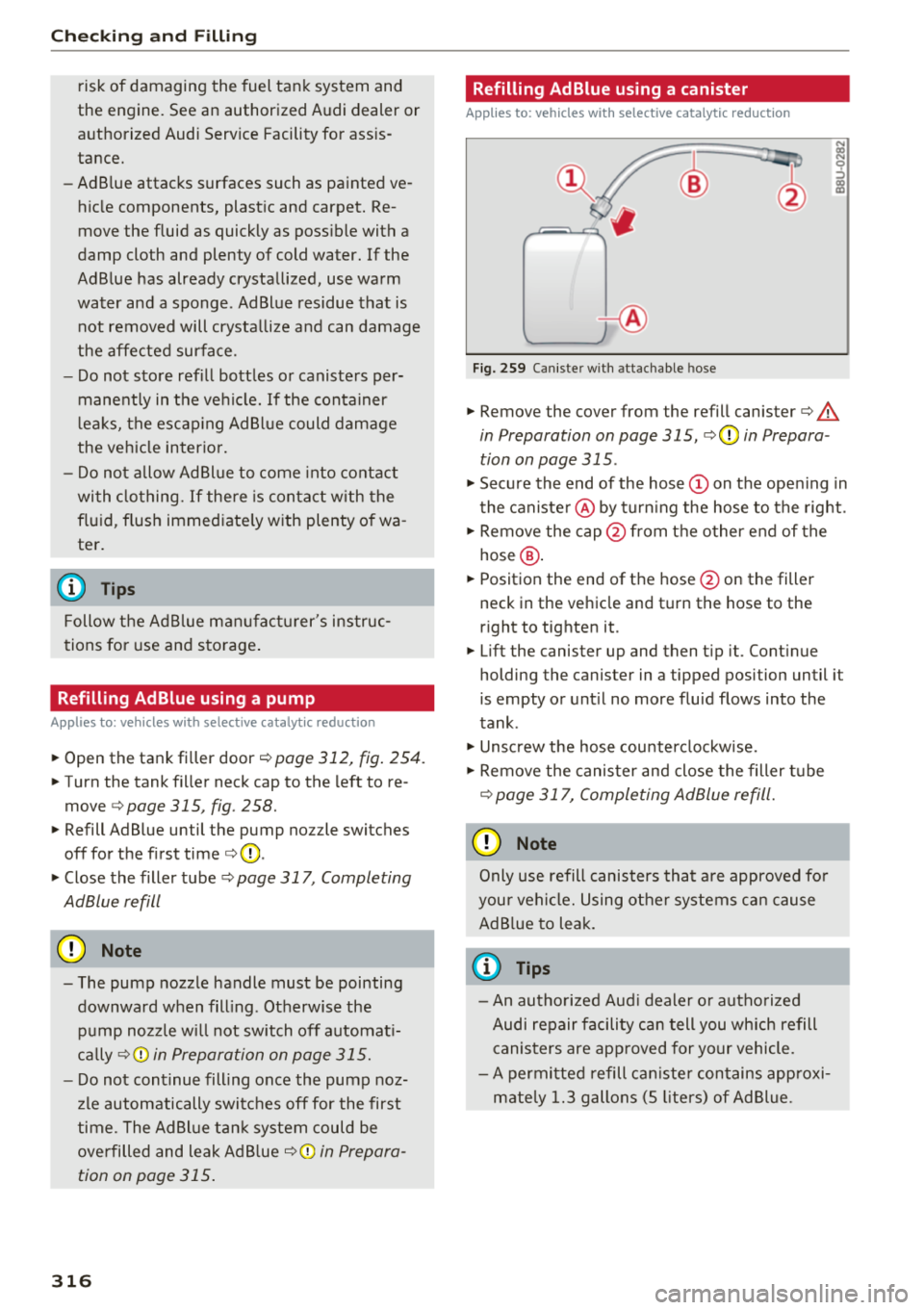
Fig. 2 59 Caniste r w ith attac hable hose
... Remove the cover from the refill canister¢.&.
in Preparation on page 315, r=:>0 in Prepara
tion on page 315 .
... Secu re the end of the hose (Don the ope ning in
the caniste r@ by tu rn ing the hose to the right .
.,. Remove the cap @from the other end of the
hose @ .
... Position the end of the hose @on the filler
neck in the ve hicle and turn the hose to the
r ight to tighten it .
... Lift the canister up and then tip it. Cont inue
holding the canister in a tipped position until it
is empty or unt il no more fluid flows into the
tank .
.,. Unsc rew the hose cou nterclockw ise .
.,. Remove the canister and close the filler t ube
r=:> page 317, Completing AdBlue refill.
{[» Note
Only use refill canisters that a re approved fo r
you r veh icle. Using o ther s ystems ca n cause
AdB lue to lea k.
© Tips
- An autho riz ed Aud i dea le r or aut ho rized
Audi repair f acili ty c an t ell you wh ich refill
c anis ters are app roved for yo ur vehicle .
- A per mitted refill ca niste r contains app roxi
m ate ly 1. 3 g allons (S lite rs) of Ad Blu e.
Page 319 of 398

Cl a:, ...... N
" N ...... 0
0
::r '
Applies to: vehicles with selective catalytic reduction
.,. Remove the cap from the refill bottle ¢&, in
Preparation on page 315,
¢ @ in Preparation
on page 315.
.,. Position the bottle on the filler tube and turn
the bottle clockwise unti l it stops turning .
.,. Press lightly against the bottom of the bottle
to empty it. Continue pressing the bottom of
the bottle until it is empty or until fluid stops
flowing into the tank .
.,. Turn the bottle to the left without press ing on
the bottom .
.,. Remove the bottle and seal the filler neck
¢ page 317, Completing AdBlue refill .
({D Note
Onl y use refi ll bottles t hat are approved for
your veh icle. Using othe r systems can ca use
Ad Blue to leak.
(j) Tips
- You can obta in refi ll bottles from an autho r
iz ed Audi dealer or author ized Audi Se rvice
Fac ility.
- A pe rm itted refill bott le conta ins approx i
ma tely O.S gallons ( 1.9 lite rs) of Ad B lue.
Completing AdBlue refill
Applies to: vehicles with selective catalytic reduction
Closing th e fill er n eck
.,. Turn the Ad Blue cap to t he r igh t on the filler
tube unti l the cap clic ks into p lace ¢
A in
Preparation on page 315,
¢ @ in Pr eparation
on page 315 .
.,. Close the fuel filler door and then press on the
left side until it lat ches.
After filling
The vehicle must be driven so that the system
r e cognizes that the Ad Blue was refilled. This can
take sev era l minutes .
.,. If there was no Ad Blue left in the t ank and a
range of O mi (0 km) was shown in the display,
switch the ignition on for about 30 seconds be
fore starting the engine .
Check ing and F illing
(D Tips
Ad B lue in the tank can freeze at very low tem
peratures . If thi s happens, the system will
not detect that the Ad Blue was refilled and it
will continue to inform you of the low Ad B lue
l evel. The message turns off as soon as the
ta nk thaws out aga in .
Emissions control
systems
Catalytic converter
Applies to: vehicles with gasoline engines
T he veh icle may only be d riven w ith un leaded
gasol ine , otherwise the cata lyti c converte r will be
dest royed.
Never dr ive u ntil the ta nk is completely empty .
T he ir regu lar supply of fuel that resu lts from that
can cause eng ine misfires. Uncomb usted fue l will
en ter the exha ust system , which can cause over
heating and damage to the cata lytic converter.
Di esel particulate filt er
Applies to: vehicles with diesel particulate filter
T he diesel part iculate filte r filte rs nearly all of
the soot pa rt icles out of the exhaus t. The filter
cleans itself a utomat ica lly unde r no rma l dr iving
cond it io ns. If the fi lter canno t be cleaned auto
matically, for examp le if only s ho rt distances are
u su a lly driven, t he fi lter will become clogged
with soot.
Indicator light (diesel particulate filter )
Applies to: vehicles with diesel particulate filter
II Particulate filter: cl ean by driving . See own
er 's manual
The diesel part icu late filter requ ires regenera
t ion. To support the filter's self-cleaning func
t ion:
Drive for approximately 15 minutes at 37 mph
(60 km/h) or above in the "S" selecto r leve r pos i
t ion. Keep the engine speed at a minim um of
2,000 RPM . The temperat ure increase that will
r esul t from this ca n bu rn off the soot in the filter.
T he ind icator light will turn off when the cleaning
has completed successfully . .,.
317
Page 322 of 398
Checking and Filling
- Engine exhaust, some of its constituents,
and certain vehicle components contain or
emit chemicals known to the State of Cali
forn ia to cause cancer and birth defects and
reproduct ive harm . In addition, certain flu
ids contained in veh icles and certain prod
ucts of compo nent wear contain or emit
chemicals known to the State of California
to cause cancer and birth defects or other reproductive harm .
- Battery posts, termina ls and related acces
sories contain lead and lead compounds, chemicals known to the State of California
to cause cancer and reproductive harms.
Wash hands after handling .
(D Note
When filling flu ids, be sure not to mix the flu
ids up . Otherwise severe ma lfunctions and en
gine damage w ill occur .
@ For the sake of the environment
You shou ld regularly check the ground under
your vehicle in order to detect leaks quickly. If
there are visible spots from oil or other fluids,
bring your vehicle to an authorized Audi deal
er or author ized Audi Service Facility to be
checked .
Opening/closing the hood
The hood is released from inside the vehicle.
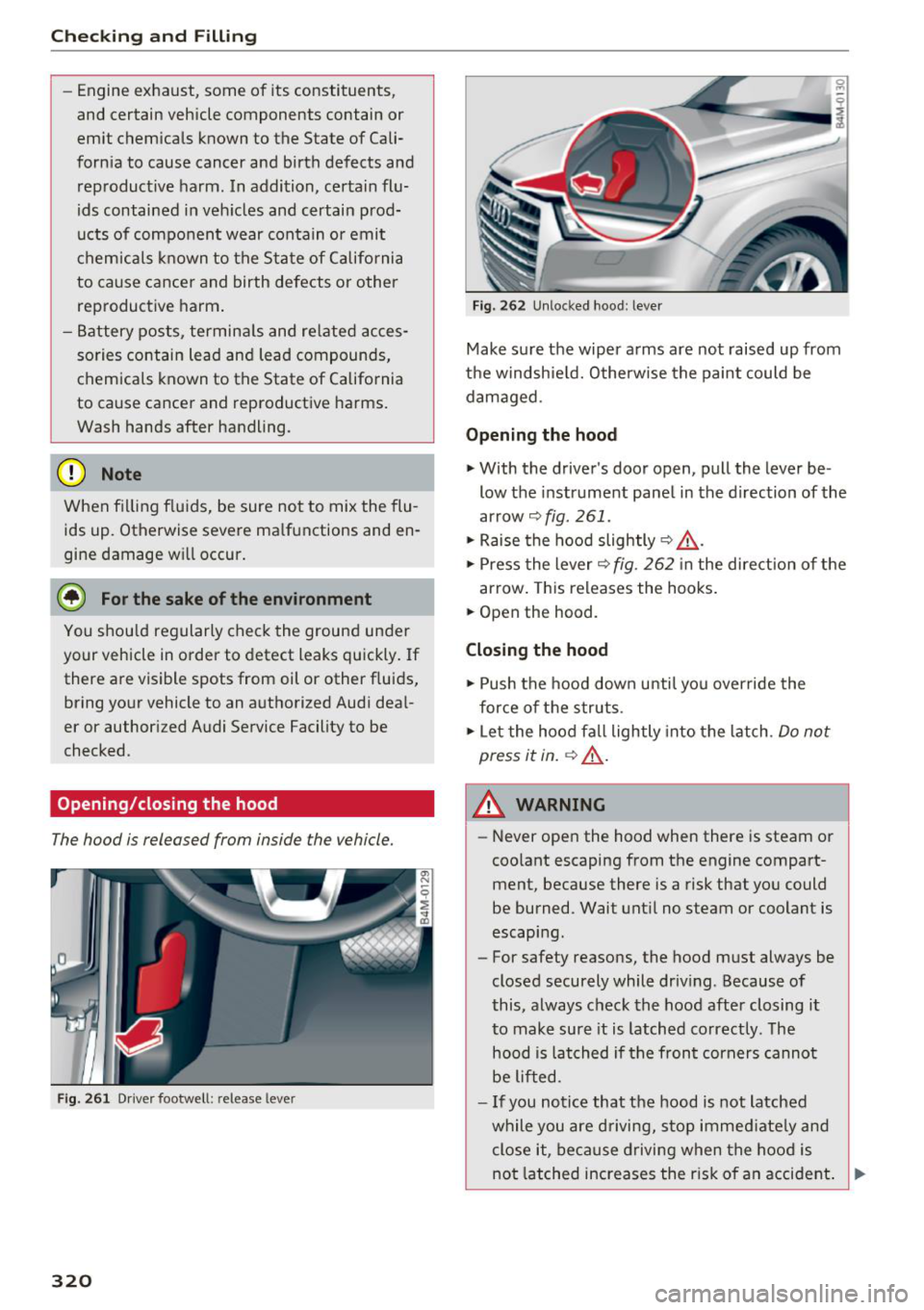
Fig . 261 D river footwell : release leve r
320
Fig. 262 Unlocked hood : lev er
Make sure the wiper arms are not raised up from
the windshie ld. Otherw ise the paint could be
damaged .
Opening the hood
"'With the driver's door open, pull the lever be
low the instrument panel in the direction of the
arrow ~
fig. 261 .
"' Raise the hood slightly~ &-
"' Press the lever~ fig. 262 in the direction of the
arrow. This releases the hooks .
"' Open the hood.
Closing the hood
"' Push the hood down until you over ride the
force of the struts .
"' Let the hood fall lightly into the latch .
Do not
press it in.
~ .&_ .
A WARNING
-Never open the hood when there is steam or
coo lant escaping from the engine compart
ment, because there is a risk that you could
be burned. Wait until no steam or coolant is
escaping.
- For safety reasons, the hood must always be
closed securely while driving . Because of
this, always check the hood after closing it
to make sure it is latched correctly . The
hood is latched if the front corners canno t
be lifted .
- If you notice that the hood is not latched
while you are driving, stop immed iate ly and
close it, because driving when the hood is
not latched increases the r isk of an accident . ..,.