rear AUDI Q7 2018 Owner´s Manual
[x] Cancel search | Manufacturer: AUDI, Model Year: 2018, Model line: Q7, Model: AUDI Q7 2018Pages: 398, PDF Size: 185.58 MB
Page 252 of 398
System settin gs
& WARNING
To reduce the risk of an accident, adjust the
volume of the aud io system so that aud ible
signals from outside the vehicle, such as po
lice and fire sirens, can be heard easily at all
times .
(D Tips
Volumes that are too h igh or too low are a u
tomatically adjusted to a set leve l w hen the
MMI is switched on .
Adjusting the system volume
.,. Se lect : I MENU I button> Sound > left contro l
button.
Telephone
App lies to: veh icles with telephone
.
Mute telephone : messages and ringtones are set
to mute .
Ringtone : see c:> page 185, Ringtone and volum e
s etting s.
Rington e volume :
you can adjust the volume of
the selected ringtone by turning the cont ro l
knob .
Messag e v olume: you ca n ad just the volume of
the notification for an incoming text m essage by
turning the control knob.
Microphone input level : you can adjust the call
volume during a phone ca ll by turning the contro l
knob.
Navigation
Applies to: vehicles with navigation system
Voice guidance : see c:>page 212.
Voice guidance dur ing phon e call : see
c:> page 212 .
Voice guidance volume : you can ad just the vo ice
gu idance volume by tur ning the control knob.
O r:
you can adjust the vo ice guidance volume during
active route guidance by turning the On/Off knob.
250
Entert ainme nt fader : the volume o f audio p lay
back can be temporarily lowered when the park
i ng system or voice guidance is active .
Voice recognition sy stem
Applies to: vehicles with voice recognition system
Command di splay : see c:> page 245.
Short dia log : see c:> page 245.
Volume : see c:>page 245.
Indi vidual speech t ra inin g: see ¢ page 245.
Parking aid*
You can adjust the vol ume of the signal tone by
turning the contro l knob .
-Adjusting the Front volum e: select and con
firm
High , Medium or Low .
- Adjus ting
the Rear volume : select and confirm
H igh , Medium or Low .
MMI touch*
Turn the control knob to adjust the volume of the
spoken prompts from the MM I touch*.
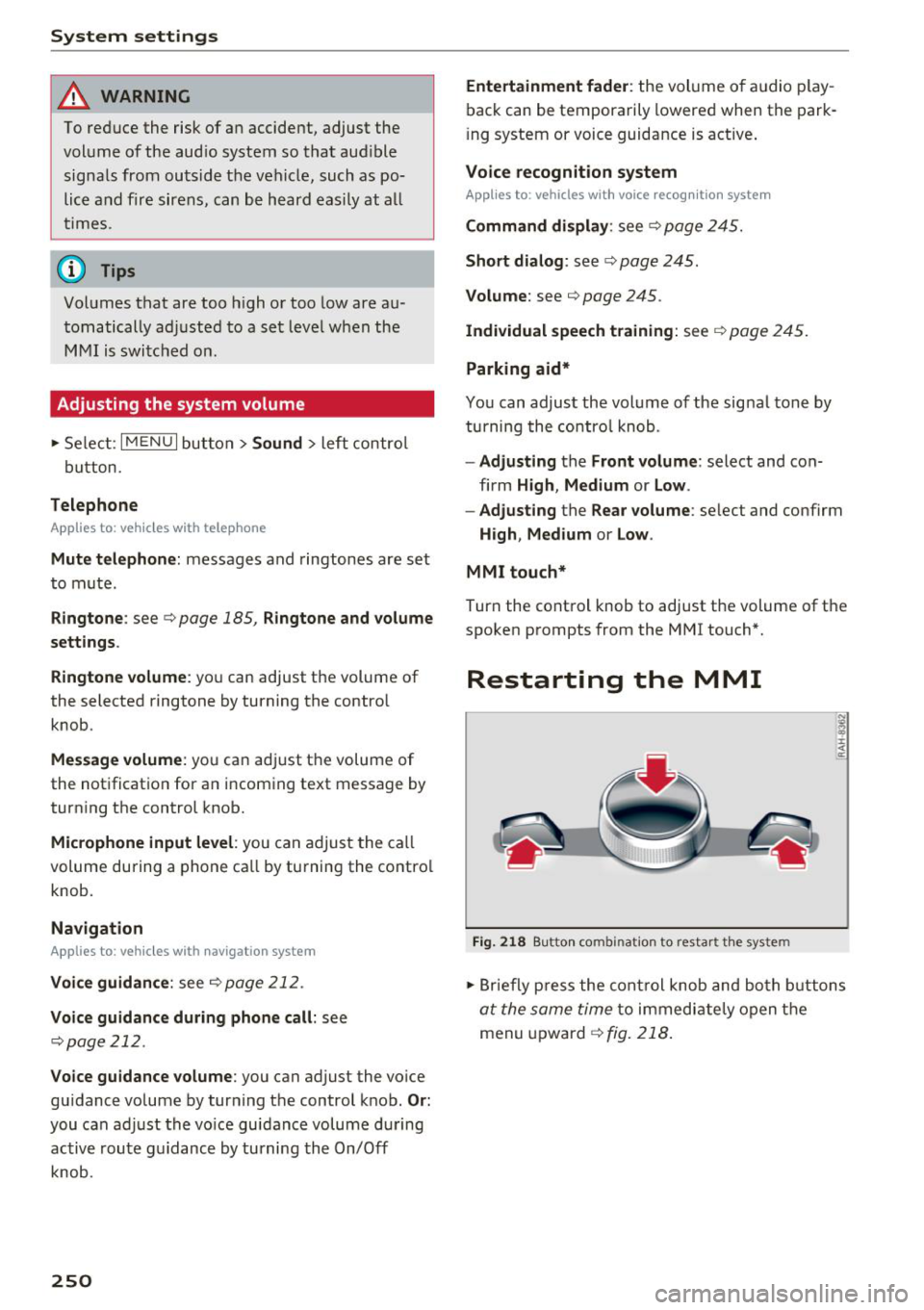
Restarting the MMI
Fig. 218 Bu tton co m bin at ion to re sta rt t he s yst em
.,. Briefly p ress the cont rol knob and both b uttons
at the same time to immediate ly open the
menu upward
¢ fig. 218 .
Page 256 of 398
Driving safety
-Before driving, always adjust the front seats
and head restraints properly and make sure
that all passengers are properly restrained.
- Never adjust the seats while the vehicle is
moving. Your seat may move unexpectedly
and you could lose control of the vehicle.
- Never drive with the backrest reclined or tilted far back! The farther the backrests are
tilted back, the greater the risk of injury due
to incorrect positioning of the safety belt and improper seating position .
- Children must always ride in child safety seats¢
page 291 . Special precautions ap
ply when installing a child safety seat on the
front passenger seat
c:> page 269.
Proper seating position for the front
passenger
The proper front passenger seating position is
important for safe, relaxed driving.
For your own safety and to reduce the risk of in
jury in the event of an accident, we recommend
that you adjust the seat for the front passenger
to the following position:
.,. Adjust the angle of the seatback so that it is in
an upright position and your back comes in full
contact with it whenever the vehicle is moving .
... Adjust the head restraint so the upper edge is
as even as possible with the top of your head. If
that is not possible, try to adjust the head re straint so that it is as close to this position as
possible¢
page 58.
... Keep both feet flat on the floor in front of the
front passenger seat .
.,. Fasten and wear safety belts correct
ly¢
page 264.
For detailed information on how to adjust the
front passenger's seat, see ¢
page 54.
A WARNING
Front seat passengers who are unbelted, out
of position or too close to the airbag can be
seriously injured or killed by the airbag as it
unfolds. To help reduce the risk of serious
personal injury:
254
- Passengers must always sit in an upright po
sition and never lean against or place any
part of their body too close to the area
where the airbags are located.
- Passengers who are unbelted, out of posi
tion or too close to the airbag can be seri
ously injured by an airbag as it unfolds with
great force in the blink of an eye.
- Always make sure that there are at least
10 inches (25 cm) between the front pas
senger's breastbone and the instrument
panel.
- Each passenger must always sit on a seat of
their own and properly fasten and wear the
safety belt belonging to that seat.
- Before driving, always adjust the front pas
senger seat and head restraint properly.
- Always keep your feet on the floor in front
of the seat. Never rest them on the seat, in
strument panel, out of the window, etc. The
airbag system and safety belt will not be
able to protect you properly and can even in
crease the risk of injury in a crash.
- Never drive with the backrest reclined or
tilted far back! The farther the backrests are
tilted back, the greater the risk of injury due
to incorrect positioning of the safety belt
and improper seating position.
- Children must always ride in child safety
seats ¢
page 291. Special precautions ap
ply when installing a child safety seat on the
front passenger seat
c::> page 269.
Proper seating positions for passengers in
rear seats
Rear seat passengers must sit upright with both
feet on the floor consistent with their physical
size and be properly restrained whenever the ve
hicle is in use.
To reduce the risk of injury caused by an incorrect
seating position in the event of a sudden braking
maneuver or an accident, your passengers on the
rear bench seat must always observe the follow
ing :
... If there are passengers on the outer rear seats,
adjust the head restraints so the upper edge is .,.
Page 257 of 398
a co ...... N r--. N ...... 0
0
:E '
that is not possible, try to adjust the head re
straint so that it is as close to this position as
possible. If there is a passenger in the center
rear seat, slide the head restraint upward
c:>page 58.
• Make sure that the seatback is securely latched
in the upright pos ition
r:::;, page 63 .
• Keep both feet flat in the footwell in front of
the rear seat .
• Fasten and wear safety be lts properly
,:;;;,page 264.
• Make sure that children are always properly re
strained in a child restraint that is appropriate
for their size and ager:::;,
page 291.
A WARNING
Passengers who are improperly seated on the
rear seat can be seriously injured in a crash.
- Each passenger must always sit on a seat of
their own and properly fasten and wear the
safety belt belonging to that seat .
- Safety belts only offer max imum p rotection
when the seatback is securely latched in the
upr ight position and the safety be lts are
prope rly pos itioned on the body. By not sit
t ing upright, a rea r seat passenger increases
the risk of personal in jury from improperly
posit ioned safety belts !
- Always adjust the head rest raint properly so
that it can g ive maximum protection.
Dri ving safety
Proper adjustment of head restraints
Correctly adjusted head restraints are an impor
tant part of your vehicle's occupant restraint sys
tem and can help to reduce the risk of injuries in
accident situations.
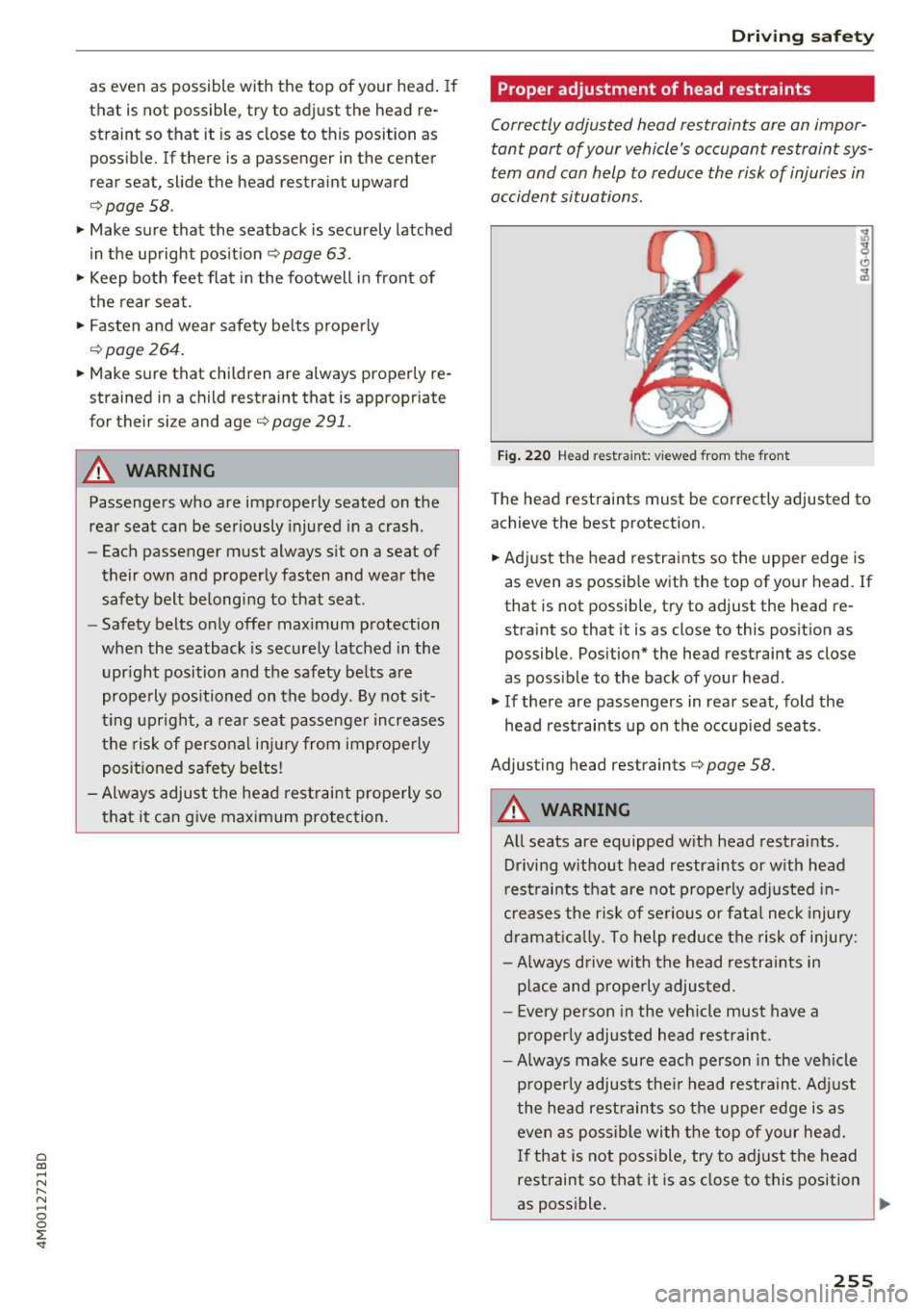
F ig . 2 2 0 Head restraint: v iewed from t he front
The head restraints must be correctly adjusted to
achieve the best protection.
• Adjust the head restraints so the upper edge is
as even as possib le with the top of your head. If
that is not possible, try to adjust the head re
straint so that it is as close to this position as
possible . Position* the head restraint as close
as possible to the back of your head.
• If there are passengers in rear seat, fold the
head restraints up on the occupied seats .
Adjusting head restraints
r:::;, page 58.
A WARNING
All seats are equipped with head restraints .
Driving w ithout head restraints or w ith head
r est raints that are not properly adjusted in
creases the r is k of se rious or fata l neck injury
dramat ic al ly. To help reduce the risk of inju ry:
- Always d rive with the head restra ints in
p lace and properly adjusted.
- Every pe rson in the veh icle must have a
p roperly adjusted head restraint.
- Always make sure each person in the veh icle
p roperly adjusts the ir head restraint. Adj ust
the head restraints so the upper edge is as
even as possible wi th the top of your head.
I f that is not poss ible, try to ad just the head
rest raint so that it is as close to this position
as poss ible.
Ill>
255
Page 259 of 398
a co ...... N r--. N ...... 0
0
:E '
Always use floor mats that can be securely at
tached to the floor mat fasteners and do not in
terfere with the free movement of the pedals.
.,. Make sure that the floor mats are properly se
cured and cannot
move and interfere with the
pedals ¢&_ .
Use only floor mats that leave the pedal area un
obstructed and that are firmly secured so that
they cannot slip out of pos it ion . You can obtain
suitab le floor mats from your authorized Audi
deale r.
F loor mat fasteners are installed in your Audi.
Floor mats used in your vehicle must be attached
to these fasteners. Proper ly securing the floor
mats will prevent them from sliding into posi
tions that could interfere with the pedals or im
pa ir safe operation of your vehicle in other ways.
A WARNING
Peda ls that cannot move free ly can result in a
loss of vehicle control and increase the risk of
ser ious personal in jury.
- Always make sure tha t floor mats are p rop
erly sec ured.
- Never place o r install floor mats or other
floo r coverings in the ve hicle that cannot be
prope rly secured in place to prevent them
from slipp ing and interfering with the ped
als or the ability to control t he vehicle .
- Never place o r inst all floo r m ats or o ther
floor coverings on top of already insta lled
floo r mats. Additional floor mats and other
cove rings wi ll reduce the size of the peda l
area and interfere with the pedals.
- Always properly reinstall and secure floor
mats that have been taken o ut for cleaning.
- Always make sure that objects cannot fa ll
into the dr iver footwell while the veh icle is
moving. Objects can become trapped under
the brake peda l and accelerator peda l caus
ing a loss of veh icle control.
Dri ving sa fety
Storing cargo correctly
Loading the luggage compartment
All luggage and other objects must be properly
stowed and secured in the luggage compart
ment .
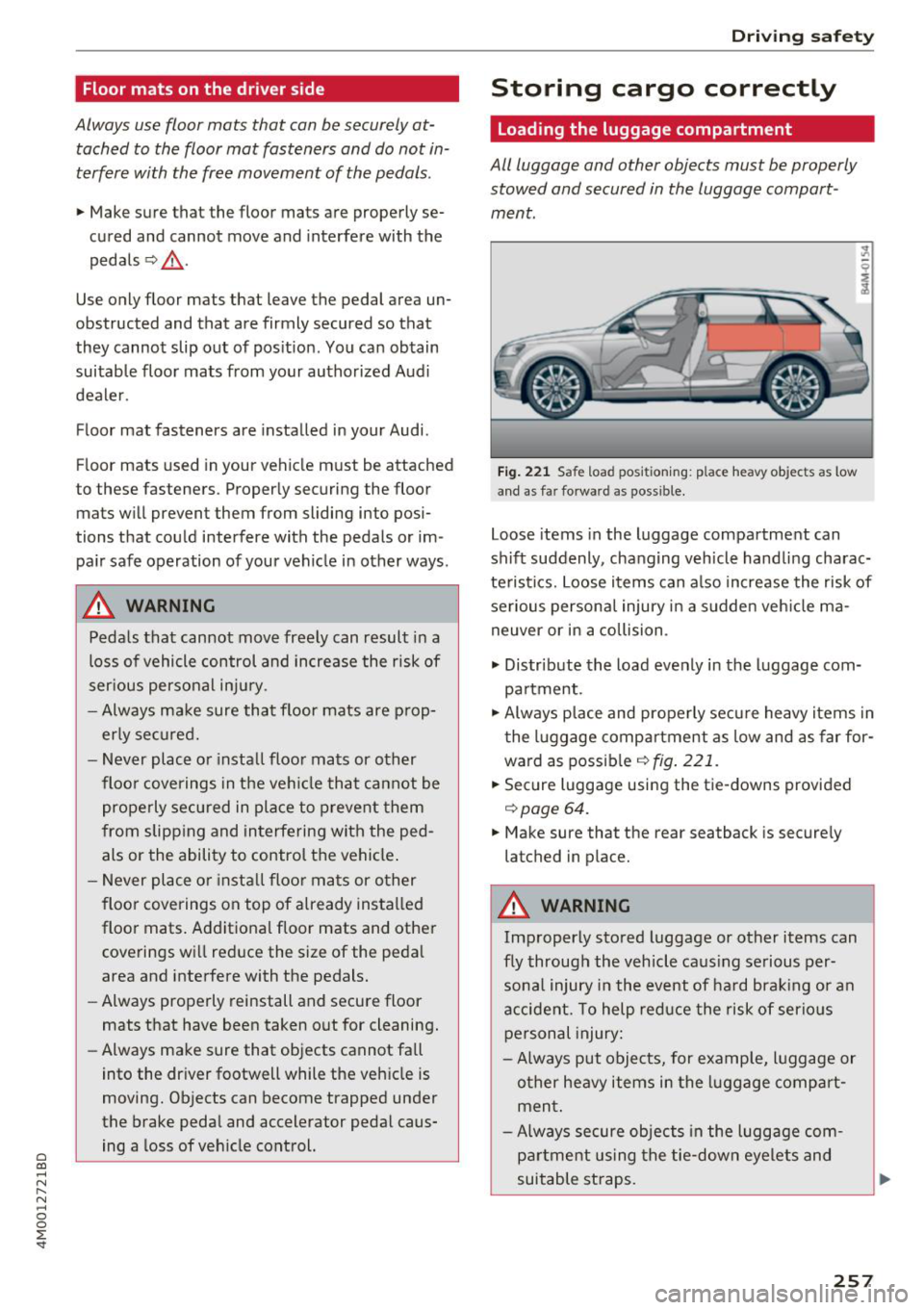
Fig . 221 Safe load pos ition ing: place heavy objects as low
a n d as far forward as possible.
Loose items in the luggage compartment can
sh ift suddenly, changing vehicle hand lin g charac
te ristics. Loo se i tems can a lso increase the risk of
se rious persona l injury in a sudden veh icle ma
neuver or in a collision .
.,. Distr ibute the load evenly in the luggage com
pa rtment .
.,. Always p lace and properly secu re heavy items in
t he l uggage compartment as low and as far for
wa rd as possib le
¢ fig . 221.
.,. Secure luggage usi ng the tie -downs provided
¢ page 64.
.,. Make sure that the rear seatback is secure ly
latched in place.
A WARNING
-
Improperly stored luggage or other items can
f ly through the vehicle ca us ing se rious per
sona l injury i n the event of ha rd bra king or an
accident. To help reduce the risk of serio us
personal injury:
- Always put obje cts, for examp le, l uggage or
o ther heavy item s in the luggage compa rt
men t.
- Always secure objects in the luggage com
p art ment us ing the tie-down eyelets and
suitable straps .
257
Page 260 of 398
Driving safety
A WARNING
Heavy loads will influence the way your vehi
cle handles . To help reduce the risk of a loss
of control leading to serious personal injury:
- Always keep in mind when transporting
heavy objects, that a change in the center of
gravity can also cause changes in vehicle
handling:
- Always distribute the load as evenly as
possible.
- Place heavy objects as far forward in the
luggage compartment as possible.
- Never exceed the Gross Axle Weight Rating
or the Gross Vehicle Weight Rating specified
on the safety compliance sticker on th e driv
er's side B-pillar. Exceeding permissible
weight standards can cause the vehicle to
slide and handle differently .
- Please observe information on safe driving
<=) page 252.
A WARNING
To help prevent poisonous exhaust gas from
being drawn into the vehicle, always keep the
rear lid closed while driving .
- Never transport objects larger than those
fitting completely into the luggage area be cause the rear lid cannot be fully closed .
- If you absolutely must drive with the rear lid
open, observe the following notes to reduce
the risk of poisoning:
- Close all windows,
- Close the sunroof*,
- Open all air outlets in the instrument pan-
el,
- Switch off the air recirculation,
- Set the fresh air fan to the highest speed .
A WARNING
Always make sure that the doors, all win
dows, the sunroof* and the rear lid are se
curely closed and locked to reduce the risk of
injury when the vehicle is not being used .
- After closing the rear lid , always make sure
that it is properly closed and locked.
258
-Never leave your vehicle unattended espe
cially with the rear lid left open. A child
could crawl into the vehicle through the lug
gage compartment and close the rear lid be
coming trapped and unable to get out . Be
ing trapped in a vehicle can lead to serious
personal injury.
- Never let children play in or around the vehi
cle .
- Never let passengers ride in the luggage
compartment . Vehicle occupants must al
ways be properly restrained in one of the
ve
hicle 's seating positions.
@ Note
If you are transporting large items with the
backrest folded down*, you should remove
the Rear Seat Entertainment (RSE)* and its
holder* to avoid damage.
© Tips
-Air circulation helps to reduce window fog
ging. Stale air escapes to the outside
through vents in the trim panel. Be sure to
keep these slots free and open .
- The tire pressure must correspond to the
load. The tire pressure label lists the recom
mended cold tire inflation pressures for the
vehicle at its maximum capacity weight and
the tires that were on your vehicle at the
time it was manufactured. For recommend ed tire pressures for normal load condi
tions, please see chapter
Q page 341 .
Tie-downs
The luggage compartmen t is equipped with four
t ie-downs to secure luggage and o ther i tems.
Use the tie-downs to secure your cargo properly
Qpage 257, L oading the luggage compartment.
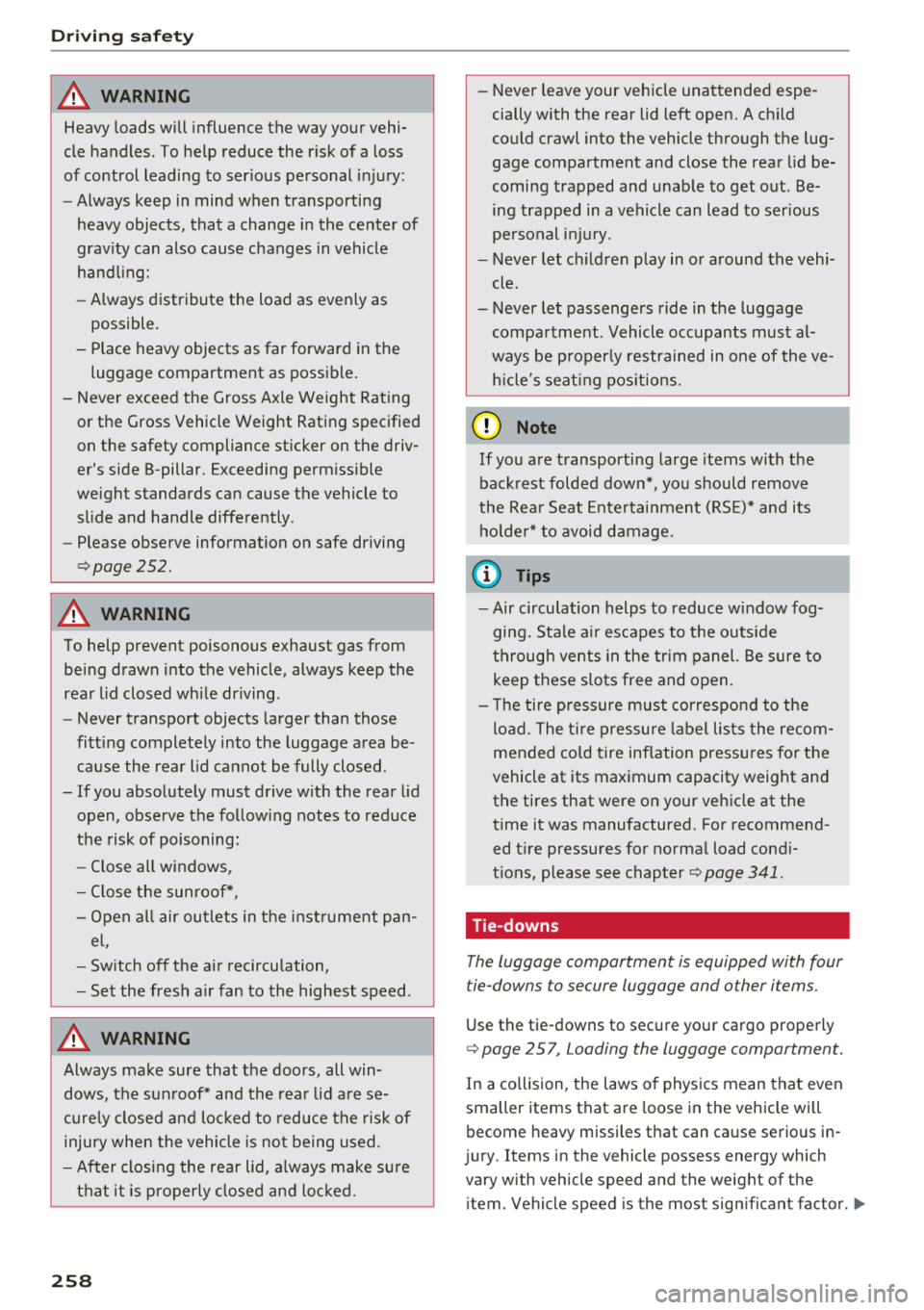
In a collision , the laws of physics mean that even
smaller items that are loose in the vehicle will
become heavy missiles that can cause serious in
jury. Items in the vehicle possess ene rgy which
vary with vehicle speed and the weight of the
item . Vehicle speed is the mos t significant fac tor . ..,.
Page 263 of 398
Cl a:, ...... N
" N ...... 0
0
::r '
General information
Always wear safety belts!
Wearing safety belts correctly saves lives!
This chapter explains why safety be lts are neces
sary, how they work and how to adjust and wear
them correctly.
~ Read all the information that follows and heed
all of the instructions and WARNINGS.
A WARNING
Not wearing safety belts or wearing them im
properly increases the risk of serious personal
injury and death.
- Safety belts are the s ingle most effective
means ava ilable to reduce the risk of serious
injury and death in automobi le accidents.
For your protection and that of your passen
gers, always co rrect ly wea r safety be lts
w hen the veh icle is mov ing.
- Pregnant wome n, in ju red, o r physically im
paired persons mus t also use safety be lts.
Lik e al l vehicle oc cupan ts, they are mo re
li kely to be serio usly injured i f th ey do no t
wear safety be lts . The best way to protect a
fetus is to protect the mothe r - thro ughout
the ent ire pregnancy.
Number of seats
App lies to: Ve hicles w ith five seats: Your vehicle
has two front seats and three rear seats. Each
seating position has a safety belt .
App lies to: Ve hicles w ith seven seats: Your
ve hicles has two front seats, three seats in the
second row and two seats in the third row. Each
seating position has a safety belt .
A WARNING
Not wea ring safety bel ts or wear ing them im
properly increases the risk of ser io us pe rsonal
inju ry and death.
- Never st rap more tha n one person, i nclud
ing small c hildre n, into any be lt.
It is espe-
Safet y be lts
cially dangero us to p lace a safety be lt over a
child sitting on yo ur lap.
- Never let more peop le ride in the vehicle
than there are safety be lts available.
- Be s ure everyone riding in the vehicle is
proper ly restrained with a separate safety
be lt o r ch ild rest raint.
Safety belt warning light
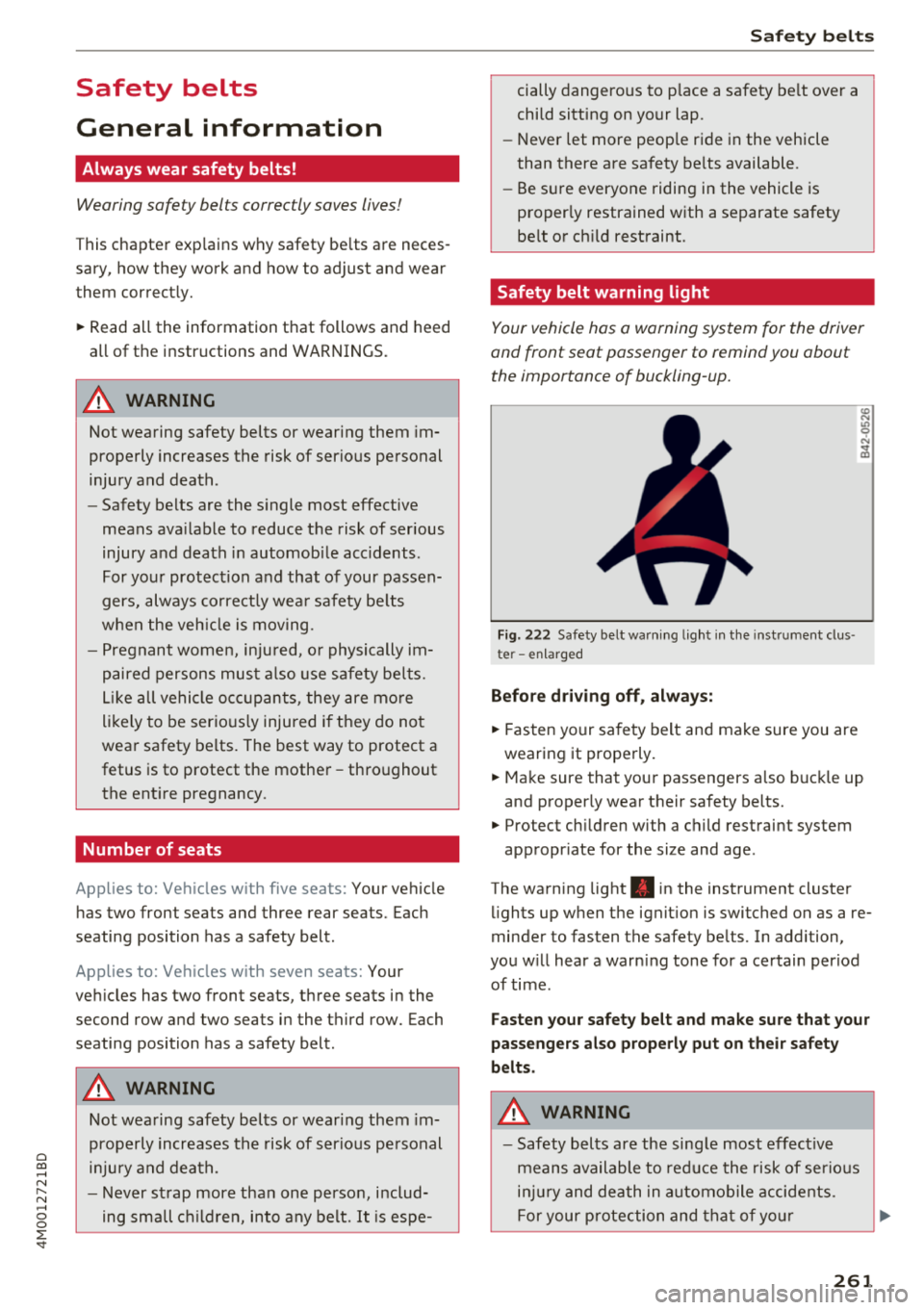
Your vehicle has a warning system for the driver
and front seat passenger to remind you about the importance of buckling-up.
F ig . 222 Safety belt wa rning lig ht in t he inst rume nt clus
ter - en larged
Before dr iving off , always :
~ Fasten your safety belt and ma ke sure you are
wearing it properly.
;?;
~ Make sure that you r passengers also b uckl e up
and properly wear their safety belts.
~ Protect children with a c hild restraint system
appropr iate for the size and age .
The warning lig ht . in the instrument cluster
lights up when t he ignit ion is switched on as a re
minder to fasten the safety be lts. In addition,
you w ill hear a warn ing tone for a certain period
of time.
Fasten your safet y belt and make sure that your
passengers also properly put on their safety
b e lts .
A WARNING
-
-Safety belts are the sing le m ost effect ive
means available to red uce the risk of se riou s
i njur y and death in a utomo bile acci dents.
F or your p rotection and tha t of yo ur
261
Page 264 of 398
Safe ty belts
passenge rs, a lways correct ly wear safety
belts when the vehicle is moving.
- Failure to pay attention to the warning light
that comes on could lead to personal injury.
Why use safety belts?
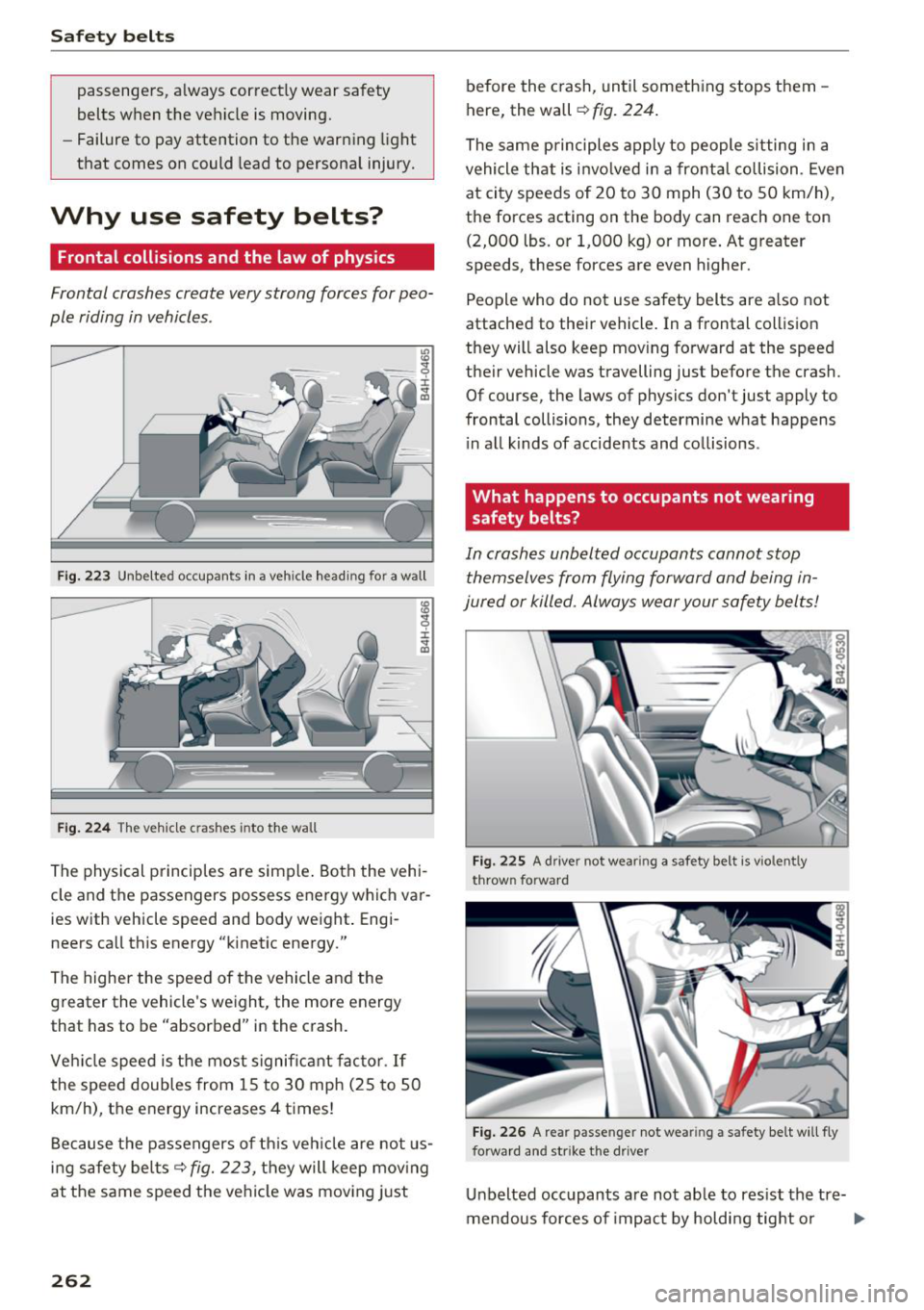
Frontal collisions and the law of physics
Frontal crashes create very strong forces for peo
ple riding in vehicles .
Fig. 223 Unbe lted occupants in a vehicle heading for a wall
Fig. 22 4 The vehicle crashes into the wall
The physical princip les are simple . Both the vehi
cle and the passengers possess energy which var
ies with vehicle speed and body we ight . Engi
neers call this energy "kinet ic energy."
The higher the speed of the vehicle and the
greater the vehicle's weight, the more energy
that has to be "absorbed" in the crash.
Veh icle speed is the most signific ant fac tor .
If
the speed doubles from 15 to 30 mph (25 to 50
km/h), the energy increases 4 times!
Because the passengers of th is veh icle are not us
i n g safety bel ts
¢fig. 223, they will keep mov ing
at the same speed the ve hicle was moving j ust
262
before the crash, until something stops them -
here, the wall ¢
fig. 224.
The same principles apply to people s itting in a
vehicle that is invo lved in a fronta l collision . Even
at city speeds of 20 to 30 mph (30 to 50 km/h),
the forces acting on the body can reach one ton
(2,000 lbs . or 1,000 kg) o r more . At g reater
speeds, these forces are even higher.
People who do not use safety belts are a lso not
attached to their vehicle . In a frontal collision
they will also keep mov ing forward at the speed
their vehicle was travelling just before the crash.
Of course, the laws of physics don't just apply to
frontal collisions, they determine what happens
i n a ll kinds of accide nts and co llisions .
What happens to occupants not wearing
safety belts?
In crashes unbelted occupants cannot stop
themselves from flying forward and being in
jured or killed. Always wear your safety belts!
Fig. 225 A drive r not wearing a safety belt is violently
thrown forward
F ig . 22 6 A rear passe nger not wea ring a safety belt w ill fly
forwa rd and strike the driver
Unbelted occ upants a re not ab le to res ist the tre-
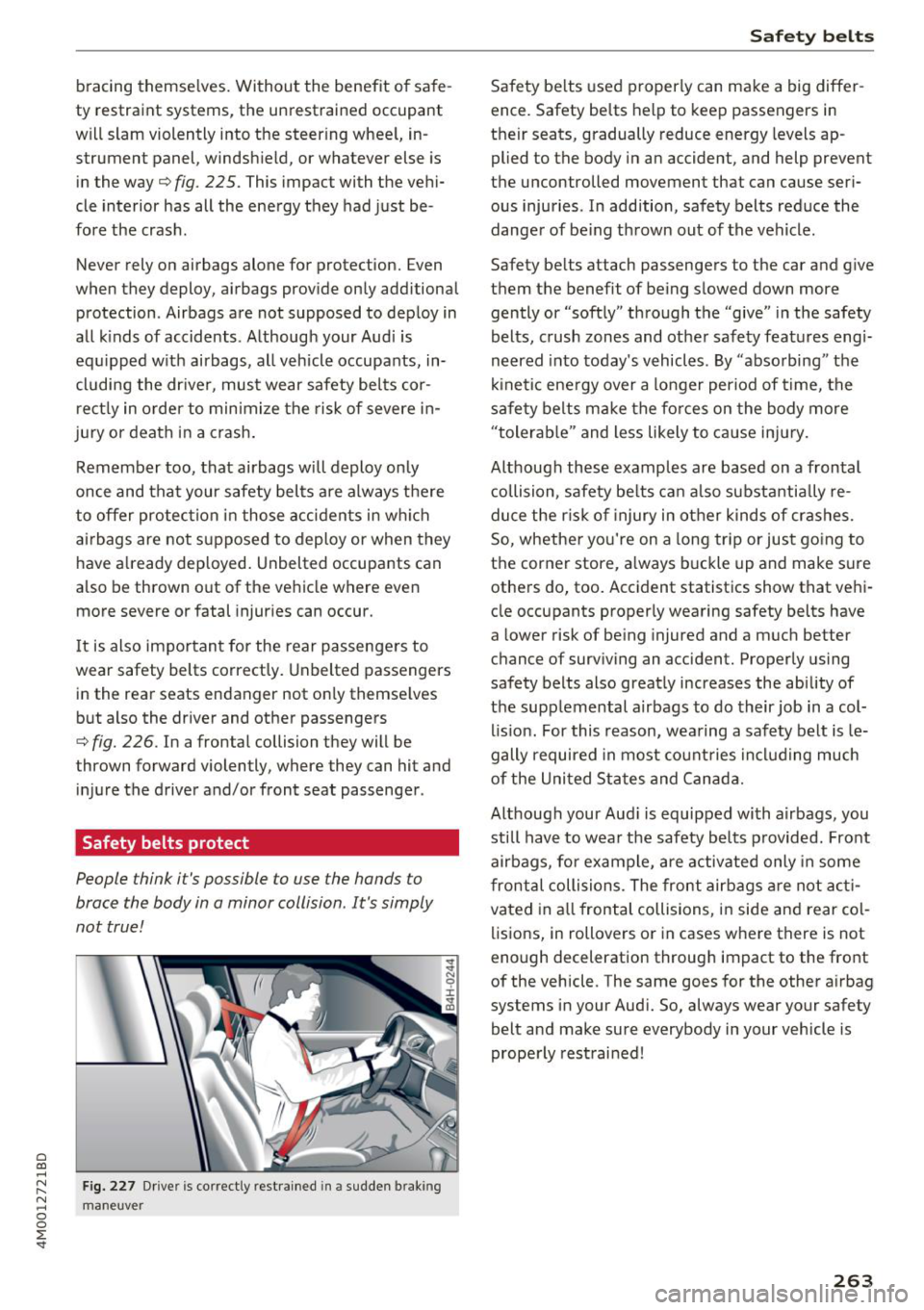
mendous forces of impac t by holdi ng tight o r
llll-
Page 265 of 398
a co ...... N r--. N ...... 0
0
:E '
ty restraint systems , the unr estrained occupant
will slam violently into the steering wheel, in
strument panel, windshield , or whatever else is
in the way
c:;, fig. 225 . This impact with the vehi
cle interior has all the energy they had just be
fore the crash.
Never rely on airbags alone for protection. Even
when they deploy , airbags provide only additional
protection . Airbags are not supposed to deploy in
all kinds of accidents. Although your Audi is
equipped with airbags, all vehicle occupants, in
cluding the driver, must wear safety belts cor
rectly in order to minimize the risk of severe in
jury or death in a crash.
Remember too, that airbags will deploy only
once and that your safety belts are always there
to offer protection in those accidents in which
airbags are not supposed to deploy or when they
have already deployed. Unbelted occupants can
also be thrown out of the vehicle where even more severe or fatal injuries can occur.
It is also important for the rear passengers to
wear safety belts correctly. Unbelted passengers in the rear seats endanger not only themselves
but also the driver and other passengers
c:;, fig. 226 . In a frontal collision they will be
thrown forward violently, where they can hit and injure the driver and/or front seat passenger .
Safety belts protect
People think it's possible to use the hands to
brace the body in a minor collision . It's simply
not true!
Fig. 227 Drive r is co rr ectly restrained in a sudden b rak ing
maneuver
Safety belts
Safety belts used properly can make a big differ
ence. Safety belts help to keep passengers in
their seats, gradually reduce energy levels ap plied to the body in an accident , and help prevent
the uncontrolled movement that can cause seri ous injuries. In addition, safety belts reduce the
danger of be ing thrown out of the vehicle .
Safety belts attach passengers to the car and give
them the benefit of being slowed down more gently or "softly" through the "give" in the safety
belts, crush zones and other safety features engi
neered into today's vehicles . By "absorbing" the
kinetic energy over a longer period of time, the
safety belts make the forces on the body more
"tolerable" and less likely to cause injury .
Although these examples are based on a frontal collision, safety belts can also substantia lly re
duce the risk of injury in other kinds of crashes.
So, whether you're on a long trip or just going to
the corner store, always buckle up and make sure
others do, too. Accident statistics show that vehi
cle occupants properly wearing safety belts have
a lower risk of being injured and a much better
chance of surviving an accident. Properly using
safety belts also greatly increases the ability of
the supplemental a irbags to do their job in a col
lision. For this reason, wearing a safety belt is le
gally required in most countries including much
of the United States and Canada.
Although your Aud i is equipped with airbags, you
still have to wear the safety belts provided. Front
airbags, for example, are activated only in some
frontal collisions. The front airbags are not acti
vated in all frontal collisions, in side and rear col
lisions, in rollovers or in cases where there is not
enough deceleration through impact to the front
of the vehicle . The same goes for the other airbag
systems in your Audi. So, always wear your safety
belt and make sure everybody in your vehicle is
properly restrained!
263
Page 267 of 398
a co ...... N r--. N ...... 0
0
:E '
is in an upright position and secure ly latched in
place before using the belt¢.&_ .
• Pull the safety belt evenly across the chest and
pelvis ¢
fig. 228, ¢ .&_ .
• Insert the tongue into the correct buckle of
your seat until you hear it latch securely.
• Pullon the belt to make sure that it is securely
latched in the buck le.
Automatic safety belt retractors
Every safety belt is equ ipped with an automatic
belt retractor on the shoulder belt. Th is feature
locks the belt when the belt is pu lled out fast,
during hard braking and in an accident . T he belt
may a lso lock when you drive up or down a steep
hill or thr ough a s harp curve. Dur ing normal dr iv
ing the bel t lets you move freely.
Safet y belt pretensioners
Safety belts wit h pretensioners he lp to tighte n
the safety belt and remove s lack when the pre
tensione rs a re activate d¢
page 267 . T he fu nc
t ion of the pretensioner is moni to red by a warn
ing light
q page 25.
Convertible locking retractor
E very safety belt except the one on the driver
seat is eq uipped w ith a co nvertible locking ret rac
tor that
must be used when the safety bel t is
used to attach a child safe ty seat. Be sure to read
the impo rtant i nfo rmat ion about this feature
¢ page 302.
.&._ WARNING
Improperly posit ioned safety be lts can cause
ser ious injury in an accident
q page 265,
Safety belt position .
- Safety belts offer optimum protection only
when the seatback is upright and belts are
properly positioned on the body.
-Always ma ke sure that the rear seat bac k
rest to wh ich the center rear safety be lt is
attached is secure ly latched whenever the
rear cente r safety belt is being used .
If the
backrest is not securely latched, the passen
ger will move forward with the backrest dur-
Safet y bel ts
ing sudden braking, in a s udden ma neuver
and espec ia lly in a crash.
- Never attach the safety belt to the buckle
for another seat. Attach ing the be lt to the
wrong buckle will reduce safety be lt effec
tiveness and can cause serio us personal i n
jury .
- A passenger who is not properly rest rai ned
can be seriously injured by the safety belt it
self when it moves from the st ronge r parts
of the body into c ritical areas like the abdo
men .
- Always loc k the convertible locking retractor
when yo u are s ecu ring a c hild safety seat in
the vehicle
q page 304.
Safety belt position
Correct belt position is the key to getting maxi
mum protection from safety belts .
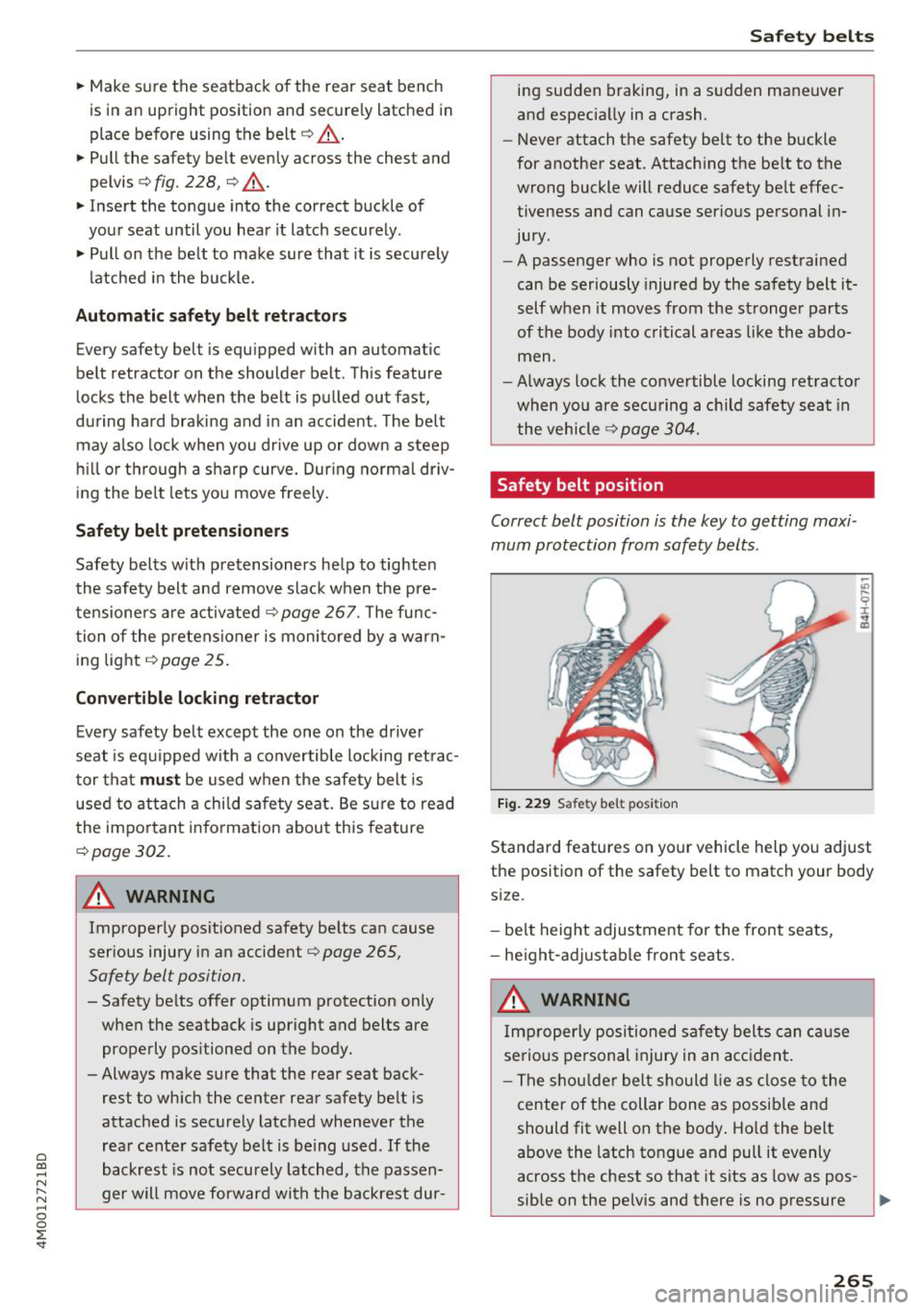
Fig. 22 9 Safet y belt pos it ion
Standard features on your vehicle help you adjust
the position of the safety belt to matc h your body
s ize .
- be lt height adjus tment for the front seats,
- he igh t-a djust able fro nt seat s.
.&_ WARNING
Im properly posi tioned sa fe ty belts can ca use
se rious pe rsonal injury in an acc ident .
- Th e shou lde r belt should lie as close to the
center of t he collar bone as possib le and
should fit well on the body . Ho ld the belt
above the latch tongue and pull it evenly
across the chest so that it sits as low as pos-
sible on the pe lvis and there is no pressure ..,.
265
Page 268 of 398
Safety belts
on the abdomen. The belt should always fit
snugly
~ fig. 229. Pull on the belt to tighten
if necessary.
- The lap belt portion of the safety belt must
be positioned as low as possible across pel
vis and never over the abdomen. Make sure
the belt lies flat and snug
c> fig . 229. Pull on
the belt to tighten if necessary.
- A loose-fitting safety belt can cause serious
injuries by shifting its pos ition on your body
from the strong bones to more vulnerable,
soft tissue and cause serious injury.
- Always read and heed all WARNINGS and
other important information
Q page 264.
Pregnant women must also be correctly
restrained
The best way to protect the fetus is to make sure
that expectant mothers always wear safety belts
correctly -throughout the pregnancy.
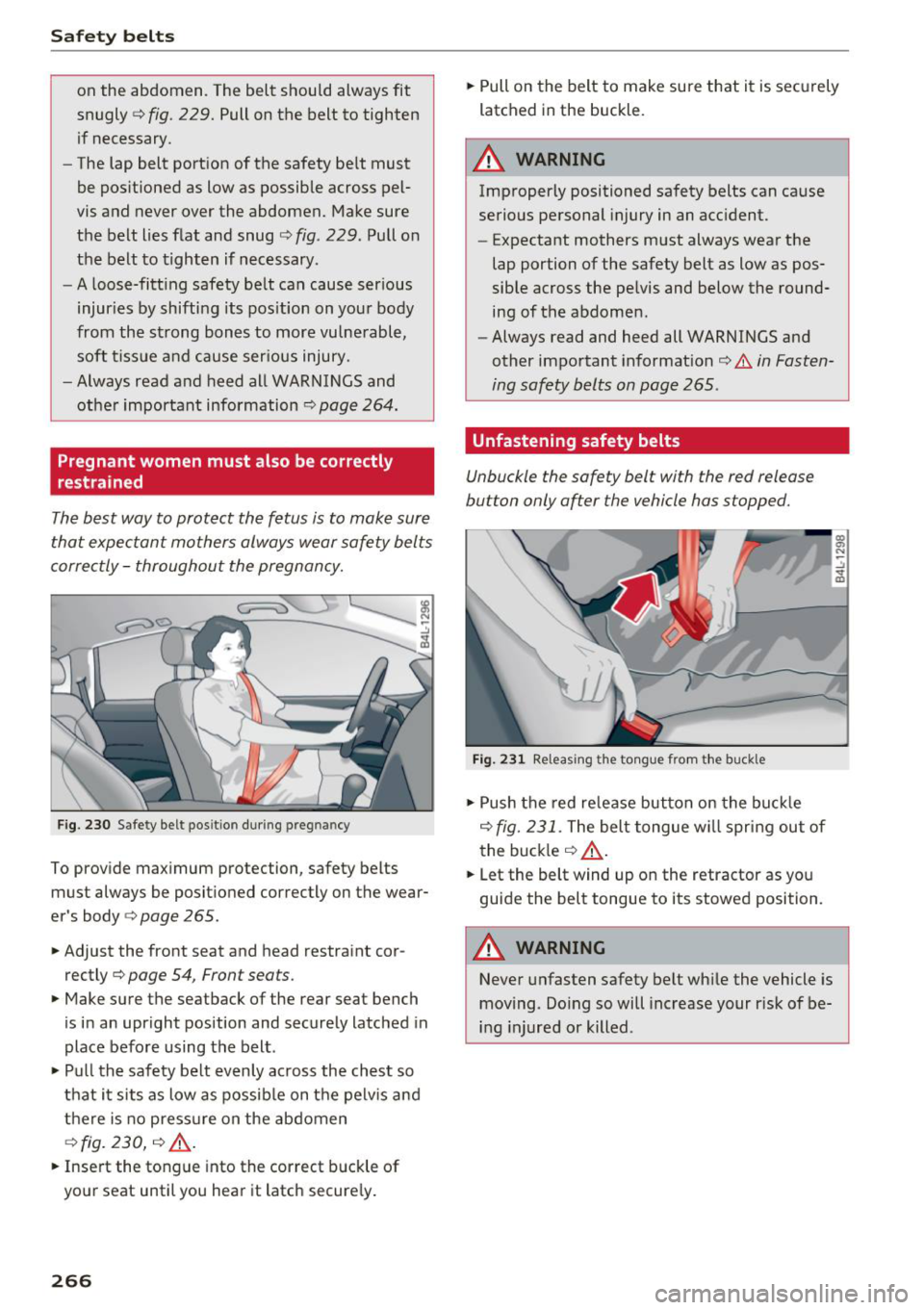
Fig. 230 Safety belt pos ition during preg nan cy
To provide maximum protection, safety belts
must always be positioned correctly on the wear
er's body
i=> page 265.
.,. Adjust the front seat and head restraint cor
rectly
c> page 54, Front seats .
.,. Make sure the seatback of the rear seat bench
is in an upright position and securely latched in
place before using the belt .
.,. Pull the safety belt evenly across the chest so
that it sits as low as possible on the pelvis and
there is no pressure on the abdomen
Q fig. 230, QA .
.,. Insert the tongue into the correct buckle of
your seat until you hear it latch securely.
266
.,. Pull on the belt to make sure that it is securely
latched in the buckle.
A WARNING
Improperly positioned safety belts can cause
serious personal injury in an accident.
- Expectant mothers must always wear the
lap portion of the safety belt as low as pos
sible across the pelvis and below the round
ing of the abdomen.
- Always read and heed all WARNINGS and
other important information
c> .& in Fasten
ing safety belts on page
265 .
Unfastening safety belts
Unbuckle the safety belt with the red release
button only after the vehicle has stopped.
Fig. 231 Releasing the tongue from the buckle
.,. Push the red release button on the buckle
Q fig. 231. The belt tongue will spring out of
the buckle
Q .&, .
.,. Let the belt wind up on the retractor as you
guide the belt tongue to its stowed position.
A WARNING
Never unfasten safety belt while the vehicle is
moving . Doing so will increase your risk of be
ing injured or killed.