cooling AUDI R8 2007 User Guide
[x] Cancel search | Manufacturer: AUDI, Model Year: 2007, Model line: R8, Model: AUDI R8 2007Pages: 210, PDF Size: 8.1 MB
Page 82 of 210

Heating and cooling 80
For the sake of the environmentSwitch off the heated rear window manually as soon as the rear
window is clear. By saving electrical power you can also save fuel.Applies to vehicles: with seat heatingSeat heating The seat cushions and backrests of the front seats can be
heated electrically.– Press the button for seat heating ⇒page 75, fig. 69
to set the desired seat temperature.Possible settings range from 1 to 3. The selected seat heating
setting is indicated by LEDs above the button.
Caution
To avoid damaging the heating elements of the seat heating, please
do not kneel on the seat or apply sharp pressure at a single point.
- +
- +
document_0900452a816e6cc9.book Seite 80 Mittwoch, 21. Februar 2007 1:32 13
Page 141 of 210
Your vehicle and the environment139
Controls
Safety
Driving tips
General maintenance
Self-help
Technical data
Sporty drivingLetting the engine warm up and cool downYou can reduce the amount of wear and tear on your vehicle during
a sporty driving session simply by adopting a more restrained
driving style while the engine is warming up and cooling down.
You should allow the engine to warm up by keeping the engine
speed below 7000 rpm until the engine oil reaches at least 90 °C. In
addition, the tyres will not develop their full grip potential until they
have had a chance to warm up on the road.
Even though the engine continues to be cooled after you switch it
off, it is particularly important to give it time to cool down before
parking. The engine, brakes, exhaust system and gearbox will all
reach very high temperatures when you adopt a sporty driving style.
Before you park the vehicle, allow it to cool down to normal temper-
ature by driving at moderate rpm speeds for several miles.Driving on a racing circuitBefore you take your car out on a racing circuit, please ensure that
it is in perfect condition. You should check the tyre tread and brake
pads for wear. It's also a good idea to increase the tyre pressure by
0.3 bar.
The oil consumption may be slightly higher than “normal” when
driving on a racing circuit ⇒page 157.
You should always check your vehicle after driving hard. Are the
brake pads ok? Do you notice any problems with the tyres (e.g. tread
worn, blistering, etc.)? Are the air intakes free of leaves and
deposits? Is the oil level ok?
Your Audi R8 dealer will be glad to carry out an inspection before
and after you use the car on a racing circuit.
Note
•
Some racing circuits (e.g. with banked curves) can affect the
behaviour of the ESP.
•
Driving the car on a racing circuit places a heavy load on all parts
of the vehicle. This can result in increased wear and tear.
Environmental compatibilityEnvironmental protection is a top priority in the design, choice of
materials and production of your new Audi. Particular importance
has been attached to the following aspects:
Design measures for economical recycling•
Joints and connections designed for ease of dismantling
•
Modular construction to facilitate dismantling
•
Increased use of single-grade materials
•
Plastic parts and elastomers are labelled in accordance with ISO
1043, ISO 11469 and ISO 1629
Choice of materials
•
Nearly all materials used can be recycled
•
Similar types of plastics grouped together for easy recycling
•
Recycled materials used in manufacture
•
Reduced vapour emissions from plastics
•
CFC-free refrigerant in air conditioner
Compliance with the laws prohibiting the use of:
•
Cadmium
•
Asbestos
•
Lead
•
Mercury
•
Chrome VI
document_0900452a816e6cc9.book Seite 139 Mittwoch, 21. Februar 2007 1:32 13
Page 157 of 210
Checking and topping up fluids155
Controls
Safety
Driving tips
General maintenance
Self-help
Technical data
Checking and topping up fluidsEngine lidOpening the engine lid
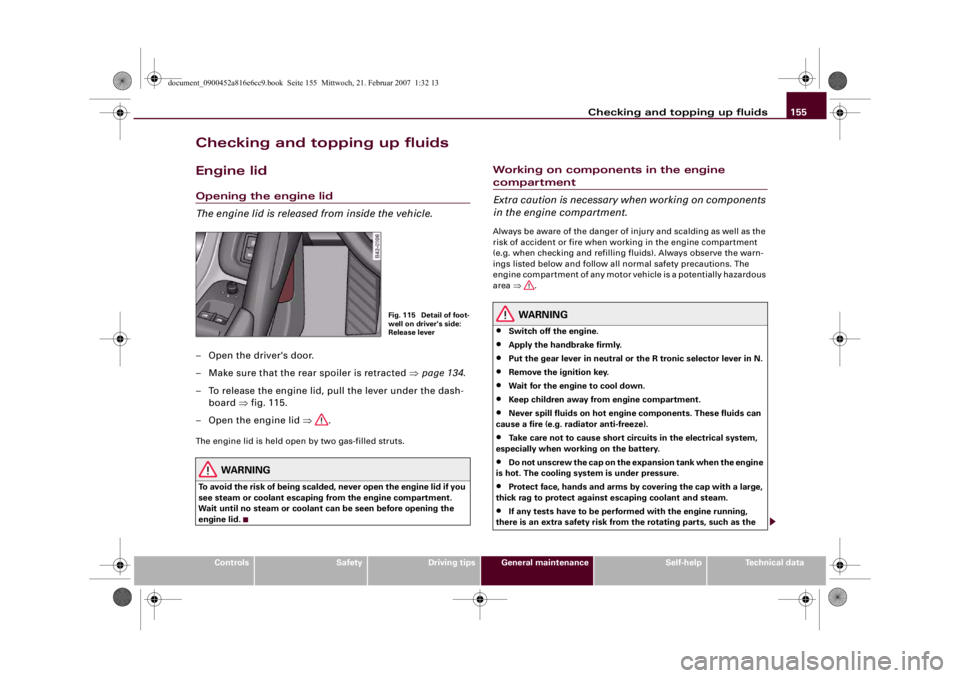
The engine lid is released from inside the vehicle.– Open the driver's door.
– Make sure that the rear spoiler is retracted ⇒page 134.
– To release the engine lid, pull the lever under the dash-
board ⇒fig. 115.
– Open the engine lid ⇒.The engine lid is held open by two gas-filled struts.
WARNING
To avoid the risk of being scalded, never open the engine lid if you
see steam or coolant escaping from the engine compartment.
Wait until no steam or coolant can be seen before opening the
engine lid.
Working on components in the engine compartment
Extra caution is necessary when working on components
in the engine compartment.Always be aware of the danger of injury and scalding as well as the
risk of accident or fire when working in the engine compartment
(e.g. when checking and refilling fluids). Always observe the warn-
ings listed below and follow all normal safety precautions. The
engine compartment of any motor vehicle is a potentially hazardous
area ⇒.
WARNING
•
Switch off the engine.
•
Apply the handbrake firmly.
•
Put the gear lever in neutral or the R tronic selector lever in N.
•
Remove the ignition key.
•
Wait for the engine to cool down.
•
Keep children away from engine compartment.
•
Never spill fluids on hot engine components. These fluids can
cause a fire (e.g. radiator anti-freeze).
•
Take care not to cause short circuits in the electrical system,
especially when working on the battery.
•
Do not unscrew the cap on the expansion tank when the engine
is hot. The cooling system is under pressure.
•
Protect face, hands and arms by covering the cap with a large,
thick rag to protect against escaping coolant and steam.
•
If any tests have to be performed with the engine running,
there is an extra safety risk from the rotating parts, such as the
Fig. 115 Detail of foot-
well on driver's side:
Release lever
document_0900452a816e6cc9.book Seite 155 Mittwoch, 21. Februar 2007 1:32 13
Page 161 of 210

Checking and topping up fluids159
Controls
Safety
Driving tips
General maintenance
Self-help
Technical data
•
No additives should be used with engine oil. Any damage caused
by the use of such additives would not be covered by the factory
warranty.For the sake of the environment
•
Never pour oil down drains or into the ground.
•
Always observe statutory requirements when disposing of
empty oil canisters.
Cooling systemCoolant
The purpose of the coolant is to carry heat away from the
engine. The correct amount of anti-freeze is important to
prevent the cooling system from freezing in winter.The cooling system is filled for life at the factory, so the coolant does
not need to be changed. The coolant consists of a mixture of water
and anti-freeze additive G12++. This is a glycol-based anti-freeze
with anti-corrosion additives.
Anti-freeze additive
The amount of anti-freeze additive required depends on the temper-
atures to be expected in the winter season. If the anti-freeze concen-
tration is too low the coolant can freeze, resulting in failure of the
cooling system and heater.
The cooling system is filled at the factory with the correct amount of
anti-freeze for the country concerned.
In most cases the mixture consists of 60% water and 40% additive.
This mixture gives the required anti-freeze protection at tempera-
tures down to – 25 °C and protects the alloy parts of the cooling
system against corrosion. It also prevents scaling and raises the
boiling point of the coolant.Countries with warm climate
The coolant concentration must not be reduced by adding plain
water, even in the summer or in warm climates. The concentration
of the anti-freeze additive must always be at least 40%.
Countries with cold climate
If greater anti-freeze protection is required in very cold climates, the
proportion of the anti-freeze additive G12++ can be increased. A
concentration of 60% offers protection down to about -40 °C. The
concentration of the anti-freeze additive must not be more than
60%, otherwise this would reduce the anti-freeze protection. In addi-
tion, the cooling effect will be adversely affected.
Vehicles for export to countries with a cold climate (such as Sweden,
Norway and Finland) are supplied with antifreeze protection down
to about -35 °C. The concentration of the antifreeze additive for
these countries should always be at least 50%.
Caution
•
It is advisable to have the cooling system checked before the
winter season to make sure that the anti-freeze concentration is
adequate for the conditions to be expected. This applies particularly
if you intend to take the car into a colder climate zone. If necessary,
have the anti-freeze concentration increased to 50 - 60% as required.
•
Use only antifreeze additive G12++, an additive meeting the
specification “TL-VW 774G”. Other additives may give considerably
inferior corrosion protection. The resulting corrosion in the cooling
system can lead to a loss of coolant, causing serious damage to the
engine.
•
The coolant additive G12++ must not be mixed with any other
additives.
document_0900452a816e6cc9.book Seite 159 Mittwoch, 21. Februar 2007 1:32 13
Page 162 of 210
Checking and topping up fluids 160Checking coolant level
Be careful when checking the coolant.– Switch off the ignition.
– Cover the cap on the expansion tank with a cloth, and
carefully unscrew the cap anti-clockwise ⇒.
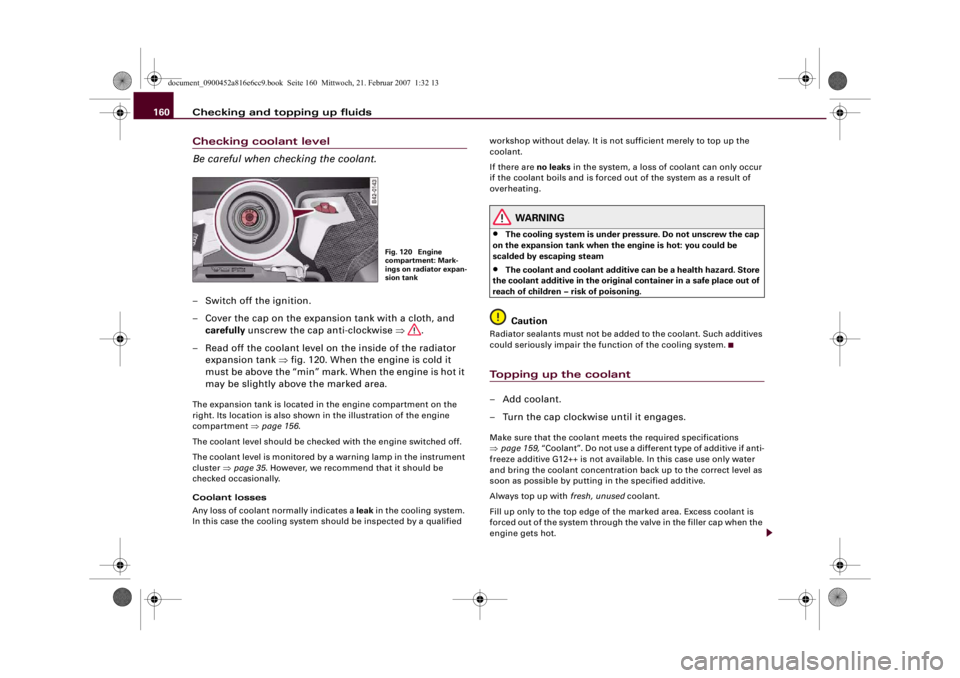
– Read off the coolant level on the inside of the radiator
expansion tank ⇒fig. 120. When the engine is cold it
must be above the “min” mark. When the engine is hot it
may be slightly above the marked area.The expansion tank is located in the engine compartment on the
right. Its location is also shown in the illustration of the engine
compartment ⇒page 156.
The coolant level should be checked with the engine switched off.
The coolant level is monitored by a warning lamp in the instrument
cluster ⇒page 35. However, we recommend that it should be
checked occasionally.
Coolant losses
Any loss of coolant normally indicates a leak in the cooling system.
In this case the cooling system should be inspected by a qualified workshop without delay. It is not sufficient merely to top up the
coolant.
If there are no leaks in the system, a loss of coolant can only occur
if the coolant boils and is forced out of the system as a result of
overheating.
WARNING
•
The cooling system is under pressure. Do not unscrew the cap
on the expansion tank when the engine is hot: you could be
scalded by escaping steam
•
The coolant and coolant additive can be a health hazard. Store
the coolant additive in the original container in a safe place out of
reach of children – risk of poisoning.Caution
Radiator sealants must not be added to the coolant. Such additives
could seriously impair the function of the cooling system.Topping up the coolant– Add coolant.
– Turn the cap clockwise until it engages.Make sure that the coolant meets the required specifications
⇒page 159, “Coolant”. Do not use a different type of additive if anti-
freeze additive G12++ is not available. In this case use only water
and bring the coolant concentration back up to the correct level as
soon as possible by putting in the specified additive.
Always top up with fresh, unused coolant.
Fill up only to the top edge of the marked area. Excess coolant is
forced out of the system through the valve in the filler cap when the
engine gets hot.
Fig. 120 Engine
compartment: Mark-
ings on radiator expan-
sion tank
document_0900452a816e6cc9.book Seite 160 Mittwoch, 21. Februar 2007 1:32 13
Page 172 of 210

Wheels and tyres 170•
If wheel trims are fitted after the car is purchased, ensure that
there is an adequate flow of air for cooling the brakes.For the sake of the environment
Old tyres must be disposed of according to the laws in the country
concerned.
Note
•
Tyres with the “R0” mark are specially matched to your Audi. We
recommend that you use these tyres only. Your Audi R8 dealer or
specialist retailer will gladly provide you with further information.
•
Never mount used tyres if you are not sure of their previous
history.
•
For technical reasons it is not normally possible to use wheel
rims from other vehicles. In some cases this also applies to rims
from other vehicles of the same model.
Wheel bolts
The wheel bolts are designed to suit the rims on your car.The wheel bolts are matched to the rims. When installing different
wheels (for instance alloy wheels or wheels with winter tyres) it is
important to use the correct wheel bolts with the right length and
correctly shaped bolt heads. This is essential for the secure fit of the
wheels and for the proper function of the brake system.
Audi R8 dealers have full information on the technical requirements
when installing or changing tyres, rims or wheel trims.
The wheel bolts should be clean and turn easily.
A special adapter is required to turn the anti-theft wheel bolts*
⇒page 182.
Winter tyres
Winter tyres will significantly improve the car's handling
in winter road conditions.–Use only radial ply winter tyres.
– Winter tyres must be fitted on all four wheels.
– Only use winter tyres of the correct type approved for
your vehicle.
– Please note that the maximum permissible speed for
winter tyres may be lower than for summer tyres.
– Also note that winter tyres are no longer effective when
the tread is worn down.
– After fitting the wheels you must always check the tyre
pressures. The correct tyre pressures are listed on the
sticker on the driver's door pillar ⇒page 167.In winter road conditions winter tyres will considerably improve the
car's handling. Due to their type of construction (width, rubber
compound, tread pattern), summer tyres give less grip on ice and
snow. This applies particularly to vehicles equipped with wide
section tyres or high speed tyres (code letters H, V or Y on the side-
wall).
Only use winter tyres of the correct type approved for your vehicle.
The sizes of the winter tyres approved for your vehicle are listed in
the vehicle's documents (e.g. EC Certificate of Conformity or COC
document
3)). The vehicle documents vary depending on the
country of residence. Also refer to ⇒page 168.
Winter tyres are no longer fully effective when the tread is worn
down to a depth of 4 mm.
WARNING (continued)
3)COC = Certificate of conformity
document_0900452a816e6cc9.book Seite 170 Mittwoch, 21. Februar 2007 1:32 13
Page 205 of 210

Index203
Controls
Safety
Driving tips
General maintenance
Self-help
Technical data Car keys . . . . . . . . . . . . . . . . . . . . . . . . . . . . 40
Carbon parts
Exterior . . . . . . . . . . . . . . . . . . . . . . . . . 146
Interior . . . . . . . . . . . . . . . . . . . . . . . . . 147
Care of vehicle . . . . . . . . . . . . . . . . . . . . . . 144
Catalytic converter . . . . . . . . . . . . . . . . . . 138
Central locking system . . . . . . . . . . . . . . . . 42
Deadlock mechanism . . . . . . . . . . . . . . 44
Locking . . . . . . . . . . . . . . . . . . . . . . . . . . 44
Locking and unlocking the vehicle from
inside . . . . . . . . . . . . . . . . . . . . . . . . . . 45
Locking doors manually . . . . . . . . . . . . 46
Luggage lid . . . . . . . . . . . . . . . . . . . . . . . 47
Opening and closing windows . . . . . . . 43
Security central locking . . . . . . . . . . . . 46
Switches . . . . . . . . . . . . . . . . . . . . . . . . . 45
Unlocking . . . . . . . . . . . . . . . . . . . . . . . . 44
Ceramic brake discs
Changing a wheel . . . . . . . . . . . . . . . . 184
Changing a wheel . . . . . . . . . . . . . . . . . . . 182
Changing bulbs . . . . . . . . . . . . . . . . . . . . . 193
Chassis number . . . . . . . . . . . . . . . . . . . . . 196
Child safety . . . . . . . . . . . . . . . . . . . . . . . . 122
Child safety seat . . . . . . . . . . . . . . . . . . . . 123
Child seat categories . . . . . . . . . . . . . . 123
Fitting . . . . . . . . . . . . . . . . . . . . . . . . . . 126
ISOFIX system . . . . . . . . . . . . . . . . . . . 128
Safety notes . . . . . . . . . . . . . . . . . . . . . 122
Cigarette lighter . . . . . . . . . . . . . . . . . . . . . 72
Cleaning . . . . . . . . . . . . . . . . . . . . . . . . . . . 144
Cleaning Alcantara . . . . . . . . . . . . . . . . . . 150Cleaning seat covers
Alcantara . . . . . . . . . . . . . . . . . . . . . . . . 150
Natural leather . . . . . . . . . . . . . . . . . . . 149
Textile covers . . . . . . . . . . . . . . . . . . . . 147
Cleaning textile covers and trim parts . . 147
Closing
Engine lid . . . . . . . . . . . . . . . . . . . . . . . 156
Clutch overheating . . . . . . . . . . . . . . . . . . . 38
Colour code . . . . . . . . . . . . . . . . . . . . . . . . 196
Coming home function . . . . . . . . . . . . . . . . 54
Compartment for (sun)glasses . . . . . . . . . 73
Compass in mirror . . . . . . . . . . . . . . . . . . . 65
Conformity certification . . . . . . . . . . . . . . . 98
Controls and displays
Overview . . . . . . . . . . . . . . . . . . . . . . . . . . 9
Convenience close . . . . . . . . . . . . . . . . . . . 43
Convenience open . . . . . . . . . . . . . . . . . . . . 43
Cooling system
Anti-freeze additive . . . . . . . . . . . . . . . 159
Checking coolant level . . . . . . . . . . . . 160
Coolant . . . . . . . . . . . . . . . . . . . . . . . . . 159
Coolant temperature gauge . . . . . . . . . 12
Malfunction . . . . . . . . . . . . . . . . . . . . . . 35
Radiator fan . . . . . . . . . . . . . . . . . . . . . 161
Topping up coolant . . . . . . . . . . . . . . . 160
Cruise control system . . . . . . . . . . . . . . . . . 86
Adjusting stored speed . . . . . . . . . . . . . 87
Indicator lamp . . . . . . . . . . . . . . . . . . . . 17
Setting speed . . . . . . . . . . . . . . . . . . . . . 87
Switching off . . . . . . . . . . . . . . . . . . . . . 88
Switching off temporarily . . . . . . . . . . . 88
Cup holders . . . . . . . . . . . . . . . . . . . . . . . . . 72
Current fuel consumption . . . . . . . . . . . . . 22
DDashboard lighting
SeeInstrument lighting . . . . . . . . . . . . . 55
Date display . . . . . . . . . . . . . . . . . . . . . . . . . 12
Daytime running lights . . . . . . . . . . . . . . . . 52
Deactivating front passenger's airbag . . 120
Deadlock mechanism . . . . . . . . . . . . . . . . . 44
Defrosting windows . . . . . . . . . . . . . . . . . . 78
Deluxe automatic air conditioner
Economical operation . . . . . . . . . . . . . . 79
Description of R tronic . . . . . . . . . . . . . . . . 90
Digital clock . . . . . . . . . . . . . . . . . . . . . . . . . 12
Digital compass . . . . . . . . . . . . . . . . . . . . . . 65
Dimensions . . . . . . . . . . . . . . . . . . . . . . . . 198
Dipped headlights . . . . . . . . . . . . . . . . . . . . 52
Defective . . . . . . . . . . . . . . . . . . . . . . . . . 37
Distance covered . . . . . . . . . . . . . . . . . . . . . 23
Door catches, engine lid and front lid
warning . . . . . . . . . . . . . . . . . . . . . . . . 20
Doors
Locking doors manually . . . . . . . . . . . . 46
Driver
SeeSitting position . . . . . . . . . . . . . . . 104
Driver information system
CD and radio display . . . . . . . . . . . . . . . 20
Door catches, engine lid and front lid
warning . . . . . . . . . . . . . . . . . . . . . . . . 20
Help . . . . . . . . . . . . . . . . . . . . . . . . . . . . . 25
Menu button . . . . . . . . . . . . . . . . . . . . . . 25
Menu display . . . . . . . . . . . . . . . . . . . . . 24
On-board computer . . . . . . . . . . . . . . . . 22
Outside temperature display . . . . . . . . 20
document_0900452a816e6cc9.book Seite 203 Mittwoch, 21. Februar 2007 1:32 13
Page 210 of 210

Index 208Tyre pressure . . . . . . . . . . . . . . . . . . 167, 172
Tyre pressure monitoring system . . . . . 172
Warning lamp . . . . . . . . . . . . . . . . . 16, 36
Tyre repair kit . . . . . . . . . . . . . . . . . . . . . . 178
Tyres
Inflation pressures . . . . . . . . . . . 167, 172
Tread wear indicators . . . . . . . . . . . . . 168
Tyre pressure monitoring system . . . 172
Tyre service life . . . . . . . . . . . . . . . . . . 167UUniversal transmitter . . . . . . . . . . . . . . . . . 95
Unleaded fuel . . . . . . . . . . . . . . . . . . . . . . 152
Unlocking . . . . . . . . . . . . . . . . . . . . . . . . . . 43
Central locking system . . . . . . . . . . . . . 44VVehicle battery
SeeBattery . . . . . . . . . . . . . . . . . . . . . . 162
Vehicle data sticker . . . . . . . . . . . . . . . . . 196
Vehicle identification data . . . . . . . . . . . . 196
Vehicle identification number . . . . . . . . . 196
Vehicles with automatic gearshift
SeeR tronic . . . . . . . . . . . . . . . . . . . . . . 90
Ventilation . . . . . . . . . . . . . . . . . . . . . . . . . . 75
Voltmeter display . . . . . . . . . . . . . . . . . . . . 14
WWarning lamps . . . . . . . . . . . . . . . . . . . . . . 15
Airbag . . . . . . . . . . . . . . . . . . . . . . . . . . . 17
Alternator . . . . . . . . . . . . . . . . . . . . . . . . 18
Anti-lock brake system . . . . . . . . . . . . . 19
Audi magnetic ride . . . . . . . . . . . . . . . . 16
Brake system . . . . . . . . . . . . . . . . . . . . . 18
Clutch overheating . . . . . . . . . . . . . . . . 38
Electronic differential lock . . . . . . . . . . 19
Electronic stabilisation program . . . . . 16
Emission control system . . . . . . . . . . . 17
Engine management (EPC) . . . . . . . . . . 16
No R gear . . . . . . . . . . . . . . . . . . . . . . . . 38
Rear spoiler . . . . . . . . . . . . . . . . . . . . . . 17
Red symbols in central display . . . . . . 33
Seat belt . . . . . . . . . . . . . . . . . . . . . . . . . 18
Selector lever defective . . . . . . . . . . . . 38
Tyre pressure monitoring system . 16, 36
Yellow symbols in central display . . . . 33
Warning triangle . . . . . . . . . . . . . . . . . . . . 178
Washer fluid level low . . . . . . . . . . . . . . . . 37
Washing . . . . . . . . . . . . . . . . . . . . . . . . . . . 144
Waxing . . . . . . . . . . . . . . . . . . . . . . . . . . . . 144
Weights
SeePerformance, weights and
dimensions . . . . . . . . . . . . . . . . . . . . 198
Wheel bolts . . . . . . . . . . . . . . . . . . . . . . . . 170
Wheel imbalance . . . . . . . . . . . . . . . . . . . 167
Wheels . . . . . . . . . . . . . . . . . . . . . . . . 147, 166
Rims . . . . . . . . . . . . . . . . . . . . . . . . . . . 166Windows
Cleaning . . . . . . . . . . . . . . . . . . . . . . . . 146
Defrosting . . . . . . . . . . . . . . . . . . . . . . . 78
De-icing . . . . . . . . . . . . . . . . . . . . . . . . 146
Windows (electric)
SeeElectric windows . . . . . . . . . . . . . . 50
Windscreen washer fluid . . . . . . . . . . . . . 164
Windscreen wipers . . . . . . . . . . . . . . . . . . . 59
Changing blades . . . . . . . . . . . . . . . . . . 62
Service position . . . . . . . . . . . . . . . . . . . 61
Winter conditions
Battery . . . . . . . . . . . . . . . . . . . . . . . . . 162
Care of vehicle . . . . . . . . . . . . . . . . . . . 144
Cooling system . . . . . . . . . . . . . . . . . . 159
Defrost function . . . . . . . . . . . . . . . . . . 78
De-icing windows . . . . . . . . . . . . . . . . 146
Snow chains . . . . . . . . . . . . . . . . . . . . . 171
Tyres . . . . . . . . . . . . . . . . . . . . . . . . . . . 170
Windscreen washer . . . . . . . . . . . . . . . 164
Winter operation
Seat heating (air conditioner) . . . . . . . 80
Winter tyres . . . . . . . . . . . . . . . . . . . . . . . . 170
Wiper and washer system . . . . . . . . . . . . . 59
Wiper blades
SeeWindscreen wipers . . . . . . . . . . . . . 62
document_0900452a816e6cc9.book Seite 208 Mittwoch, 21. Februar 2007 1:32 13