ignition AUDI R8 2007 Workshop Manual
[x] Cancel search | Manufacturer: AUDI, Model Year: 2007, Model line: R8, Model: AUDI R8 2007Pages: 210, PDF Size: 8.1 MB
Page 99 of 210
HomeLink97
Controls
Safety
Driving tips
General maintenance
Self-help
Technical data
Applies to vehicles: with HomeLinkRolling code programming
Some devices require rolling code programming of the
HomeLink universal transmitter.Identifying a rolling code
– Press the already programmed HomeLink button again
and hold it down.
–Watch HomeLink diode ⇒page 95, fig. 80. If the diode
starts flashing rapidly and turns into a constant light
after about 2 seconds, this indicates that the device you
wish to operate (e.g. a garage door opener) is equipped
with a rolling code.
– Program the rolling code as follows:
Activating the garage door opener drive unit
– Locate the programming button on the garage door
drive. The exact location and colour of the button may
vary depending on the type of garage door opener.
– Press the programming button on the door drive unit
(this will normally cause a “programming mode indicator
lamp” on the unit to light up). You now have about 30
seconds to start and complete programming of the
HomeLink control button on the operating unit.
Programming of the operating unit above the
interior mirror
– Press and release the already programmed HomeLink
button.
– Press the HomeLink button again to complete rolling
code programming.
After programming at the operating unit, the garage door opener
should recognise the HomeLink signal and respond when the
HomeLink button is pressed. Now the other control buttons can be
programmed as required.
Note
•
Having a second person assist you makes programming of the
rolling code easier and faster. For some makes of garage door
openers the HomeLink button may have to be pressed a third time
to complete the training sequence.
•
If you encounter problems programming the rolling code you
may find helpful information in the operating instructions of the
garage door opener or other device you wish to operate.
Applies to vehicles: with HomeLinkOperating HomeLink
The programmed devices are activated by means of the
HomeLink control buttons above the interior mirror.– Switch on the ignition (do not start the engine).
– Press the programmed HomeLink button ⇒page 95,
fig. 80. The device assigned to that button (e.g. garage
door) will be activated.The HomeLink indicator diode ⇒page 95, fig. 80 will light up when
you press the button.Applies to vehicles: with HomeLinkErasing the HomeLink® button programming
You can erase the complete HomeLink programming by
pressing the two outer buttons.– Switch on the ignition (do not start the engine).
AA
document_0900452a816e6cc9.book Seite 97 Mittwoch, 21. Februar 2007 1:32 13
Page 117 of 210
Airbag system115
Controls
Safety
Driving tips
General maintenance
Self-help
Technical data
Airbag systemDescription of airbag systemGeneral notes on airbag system
The airbag is an integral part of the car's passive safety
system.In conjunction with the three-point seat belts, the airbag system
gives the front occupants additional protection for the head and
chest in the event of a severe frontal collision.
In a side collision the side airbags reduce the risk of injury to the
areas of the body facing the impact ⇒.
In addition to their normal function of protecting the occupants in a
collision, the seat belts also hold them in a position where the
airbags can inflate properly and provide maximum protection.
The airbag system will only work with the ignition on. The airbag
system is monitored electronically; the airbag warning lamp indi-
cates whether the system is functioning properly.
The main parts of the airbag system are:•
the electronic monitoring system (control unit and sensors),
•
the two front airbags,
•
The two side airbags,
•
The airbag warning lamp in the instrument cluster.
There is a fault in the airbag system if the warning
lamp
•
does not come on when the ignition is switched on,
•
does not go out about 3 seconds after the ignition is switched
on,
•
goes out and then comes on again after the ignition is switched
on,
•
comes on or flickers while the car is moving.
WARNING
•
The airbags are not a substitute for the seat belts; they are an
integral part of the car's overall passive safety system. The airbags
can only offer effective protection if the occupants are wearing
their seat belts. For this reason it is very important to wear the
seat belts at all times ⇒page 109, “Why is it so important to use
seat belts?”.
•
The seat belts and airbags can only provide maximum protec-
tion if the occupants are seated correctly ⇒page 67, “Seats and
storage”.
•
If you do not wear a seat belt, if you lean forward, or are not
seated correctly while the vehicle is in motion, you are at greater
risk of injury should the airbag system be triggered in an accident.
•
Components of the airbag system are located in various parts
of the vehicle. If repairs to other vehicle components make it
necessary to perform work on the airbag system or to remove or
install parts of the airbag system, this may cause damage to the
airbag system. As a result, the airbags may not inflate correctly or
may not be triggered at all in an accident situation.
•
If a fault should occur in the airbag system, have the system
checked immediately by a qualified workshop. Otherwise the
system may fail to trigger in an accident.
•
Do not attempt to modify components of the airbag system in
any way.
•
Never make any alterations to the front bumper or the body.
•
The airbag system can only be activated once; if the airbag has
been triggered, the system must be replaced. Should the airbag
system or airbag modules have to be replaced, the qualified work-
shop carrying out the replacement will document all details in the
appropriate section of the Service Schedule.
document_0900452a816e6cc9.book Seite 115 Mittwoch, 21. Februar 2007 1:32 13
Page 122 of 210
Airbag system 120•
Any damage to the original seat upholstery or around the
seams of the side airbag units must be repaired immediately by a
qualified workshop.
•
Any work involving the side airbag system or removal and
installation of the airbag components for other repairs (such as
repairs to the seats) should always be performed by a qualified
workshop. Otherwise the airbag system may fail to work
properly.
Deactivating the airbagsDeactivating airbags
If airbags have been deactivated, they should be reacti-
vated as soon as possible so that they can continue to
give the required protection.There are two ways of deactivating the airbags: you can deactivate
the front passenger's airbag yourself by means of the key-operated
switch ⇒page 120. The other airbags can be deactivated by your
Audi R8 dealer.
Deactivating front passenger's airbag when a child
safety seat is in use
If you have no alternative but to install a rearward-facing child safety
seat on the front passenger's seat you must deactivate the front
passenger's airbag beforehand.
Monitoring of airbag system
The airbag warning lamp will light up for a few seconds every time
the ignition is switched on.
WARNING
•
Never install a rearward-facing child safety seat on the front
passenger's seat unless the front passenger's airbag has been
deactivated – this can result in potentially fatal injuries to the child
⇒page 123.
•
Make sure that the front passenger's airbag is reactivated by
means of the key-operated switch as soon as the child seat is no
longer needed on the front passenger's seat.
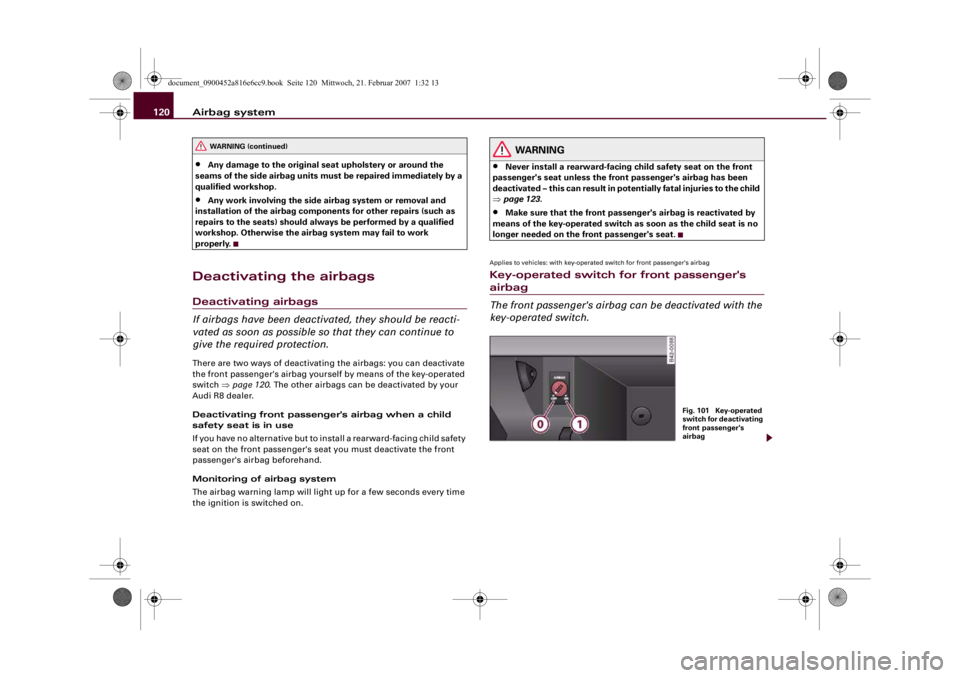
Applies to vehicles: with key-operated switch for front passenger's airbagKey-operated switch for front passenger's airbag
The front passenger's airbag can be deactivated with the
key-operated switch.
WARNING (continued)
Fig. 101 Key-operated
switch for deactivating
front passenger's
airbag
document_0900452a816e6cc9.book Seite 120 Mittwoch, 21. Februar 2007 1:32 13
Page 123 of 210
Airbag system121
Controls
Safety
Driving tips
General maintenance
Self-help
Technical data
The key-operated switch for deactivating the front
passenger's airbag is located in the glove box ⇒page 120,
fig. 101.
– To deactivate the front passenger's airbag, insert the
ignition key in the switch and turn it to position .
– The front passenger's airbag can be reactivated by
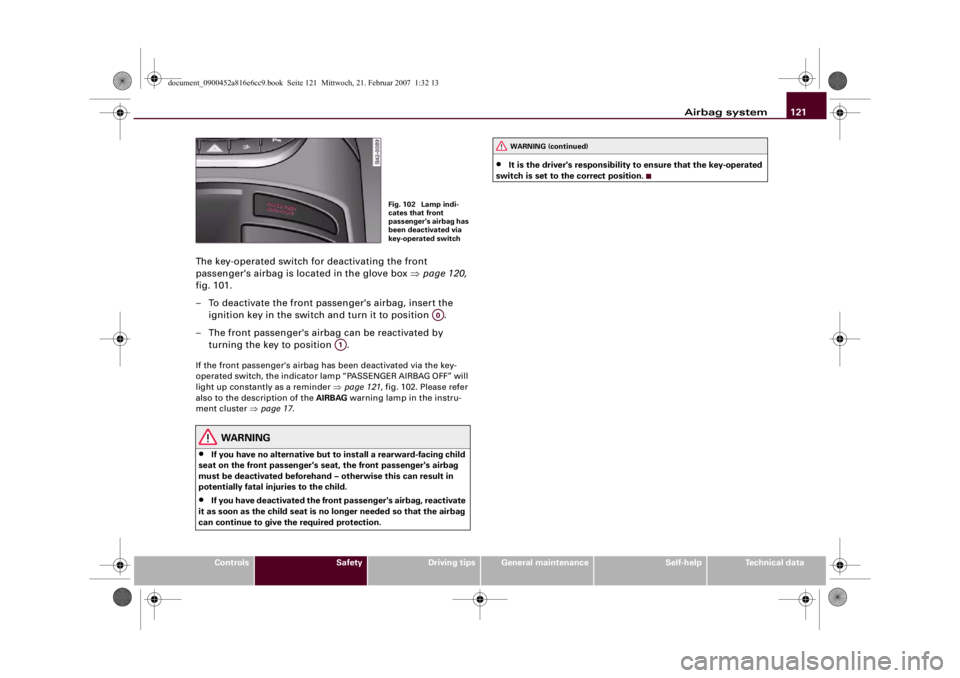
turning the key to position .If the front passenger's airbag has been deactivated via the key-
operated switch, the indicator lamp “PASSENGER AIRBAG OFF” will
light up constantly as a reminder ⇒page 121, fig. 102. Please refer
also to the description of the AIRBAG warning lamp in the instru-
ment cluster ⇒page 17.
WARNING
•
If you have no alternative but to install a rearward-facing child
seat on the front passenger's seat, the front passenger's airbag
must be deactivated beforehand – otherwise this can result in
potentially fatal injuries to the child.
•
If you have deactivated the front passenger's airbag, reactivate
it as soon as the child seat is no longer needed so that the airbag
can continue to give the required protection.
•
It is the driver's responsibility to ensure that the key-operated
switch is set to the correct position.
Fig. 102 Lamp indi-
cates that front
passenger's airbag has
been deactivated via
key-operated switch
A0
A1
WARNING (continued)
document_0900452a816e6cc9.book Seite 121 Mittwoch, 21. Februar 2007 1:32 13
Page 147 of 210
Care of vehicle and cleaning145
Controls
Safety
Driving tips
General maintenance
Self-help
Technical data
WARNING
•
Do not wash the vehicle with the ignition switched on – risk of
accident.
•
Do not clean the underside of the car or inside the wheel arches
without protecting your hands and arms. You may cut yourself on
sharp metal parts.
•
Take care when washing the car during the winter: moisture
and ice on the brakes may affect braking efficiency – this could
cause an accident.Caution
•
Compare the track width of your vehicle with the distance
between the guide rails for the wheels in the car wash. Otherwise
there may be a risk of damaging the wheel rims and tyres.
•
Compare the ground clearance of your vehicle with the height of
the guide rails for the wheels in the car wash to prevent any damage
to the underside.
•
Compare the width of your vehicle with the available width when
entering and driving through the car wash.
•
Retract the exterior mirrors to avoid damage. Electrically retract-
able exterior mirrors must NOT be folded in or out by hand. Always
use the electrical power control.
•
Do not wash the vehicle in direct sunlight – otherwise the paint
can be damaged.
•
Do not use insect sponges, or abrasive household sponges, etc.
– they can damage the surfaces.
•
The headlights should only be washed with water – do not wipe
them with a dry cloth or sponge. It is best to use soapy water.
•
Never wash tyres with a jet that sprays the water out in a direct
stream. This could damage the tyres – even if the spray is kept at a
distance and only used for a very short time.
For the sake of the environment
The car should only be washed in special wash bays. This prevents
oily water from getting into the public drains. In some districts,
washing vehicles anywhere else may be prohibited.Waxing and polishingWaxi ng
Waxing protects the paintwork. It is time to apply a good coat of wax
when water no longer forms droplets and rolls off the clean paint-
work.
Even if a wax solution is used regularly in the car wash, it is advis-
able to protect the paint with a coat of wax at least twice a year.
In the summer, you will find it is much easier to remove dead insects
(which accumulate on the bumper and front lid) if the car has been
waxed recently.
Polishing
Polishing is only necessary if the paint has lost its shine, and the
gloss cannot be brought back by putting on wax.
The car must be waxed after polishing if the polish used does not
contain wax compounds to seal the paint.
Caution
Matt painted and plastic parts must not be treated with wax or
polish.Ornamental trim and mouldingsThe metal brightwork on the body is made of aluminium rather than
chrome (for environmental reasons).
document_0900452a816e6cc9.book Seite 145 Mittwoch, 21. Februar 2007 1:32 13
Page 157 of 210
Checking and topping up fluids155
Controls
Safety
Driving tips
General maintenance
Self-help
Technical data
Checking and topping up fluidsEngine lidOpening the engine lid
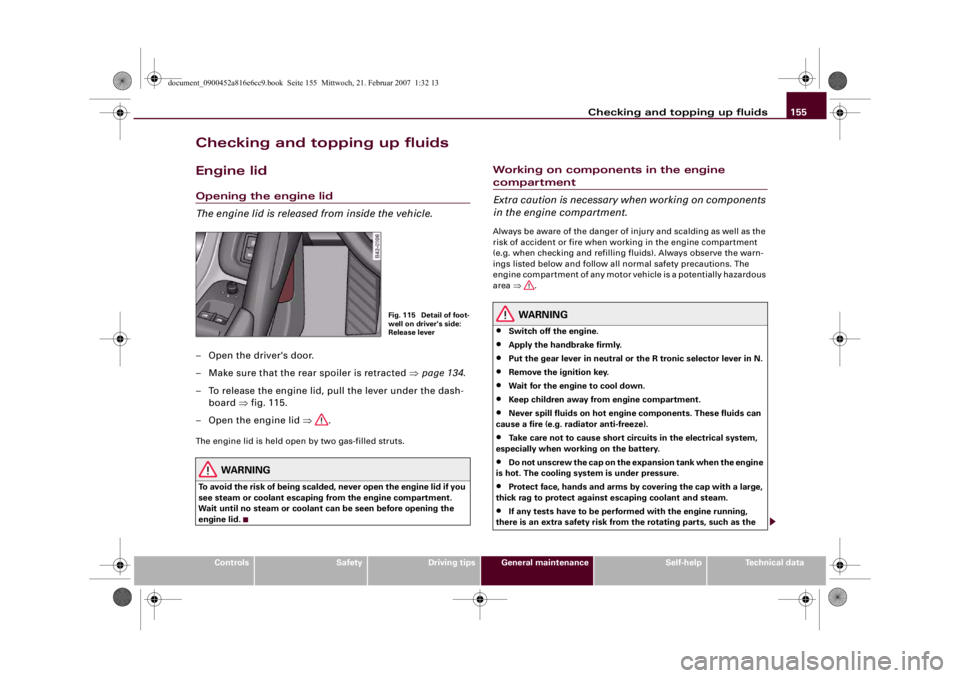
The engine lid is released from inside the vehicle.– Open the driver's door.
– Make sure that the rear spoiler is retracted ⇒page 134.
– To release the engine lid, pull the lever under the dash-
board ⇒fig. 115.
– Open the engine lid ⇒.The engine lid is held open by two gas-filled struts.
WARNING
To avoid the risk of being scalded, never open the engine lid if you
see steam or coolant escaping from the engine compartment.
Wait until no steam or coolant can be seen before opening the
engine lid.
Working on components in the engine compartment
Extra caution is necessary when working on components
in the engine compartment.Always be aware of the danger of injury and scalding as well as the
risk of accident or fire when working in the engine compartment
(e.g. when checking and refilling fluids). Always observe the warn-
ings listed below and follow all normal safety precautions. The
engine compartment of any motor vehicle is a potentially hazardous
area ⇒.
WARNING
•
Switch off the engine.
•
Apply the handbrake firmly.
•
Put the gear lever in neutral or the R tronic selector lever in N.
•
Remove the ignition key.
•
Wait for the engine to cool down.
•
Keep children away from engine compartment.
•
Never spill fluids on hot engine components. These fluids can
cause a fire (e.g. radiator anti-freeze).
•
Take care not to cause short circuits in the electrical system,
especially when working on the battery.
•
Do not unscrew the cap on the expansion tank when the engine
is hot. The cooling system is under pressure.
•
Protect face, hands and arms by covering the cap with a large,
thick rag to protect against escaping coolant and steam.
•
If any tests have to be performed with the engine running,
there is an extra safety risk from the rotating parts, such as the
Fig. 115 Detail of foot-
well on driver's side:
Release lever
document_0900452a816e6cc9.book Seite 155 Mittwoch, 21. Februar 2007 1:32 13
Page 158 of 210
Checking and topping up fluids 156drive belts and alternator, etc., and from the high-voltage ignition
system. •
Observe the following additional warnings if work on the fuel
system or the electrical system is necessary:
−Always disconnect the battery
−Do not smoke
−Never work near open flames
−Always keep an approved fire extinguisher immediately
available.Caution
When topping up fluids make sure the correct fluid is put into the
correct filler opening. This can otherwise cause serious malfunc-
tions or engine damage.
For the sake of the environment
Inspect the ground underneath your vehicle regularly so that any
leaks are detected at an early stage. If you find oil spots or other
fluids, have your vehicle inspected by a qualified workshop.
Note
On right-hand drive vehicles* some of the containers/ reservoirs
mentioned below are located on the other side of the engine
compartment.Closing the engine lid– Make sure that the rear spoiler is retracted ⇒page 134.
– To close the engine lid, pull it down to overcome the
spring pressure.– Then let it drop into the catches; do not press down ⇒.
WARNING
For safety reasons the engine lid must always be completely
closed when the vehicle is moving. After closing it always check
that it is properly secured. The engine lid must be flush with the
adjacent body panels.Engine compartment layout
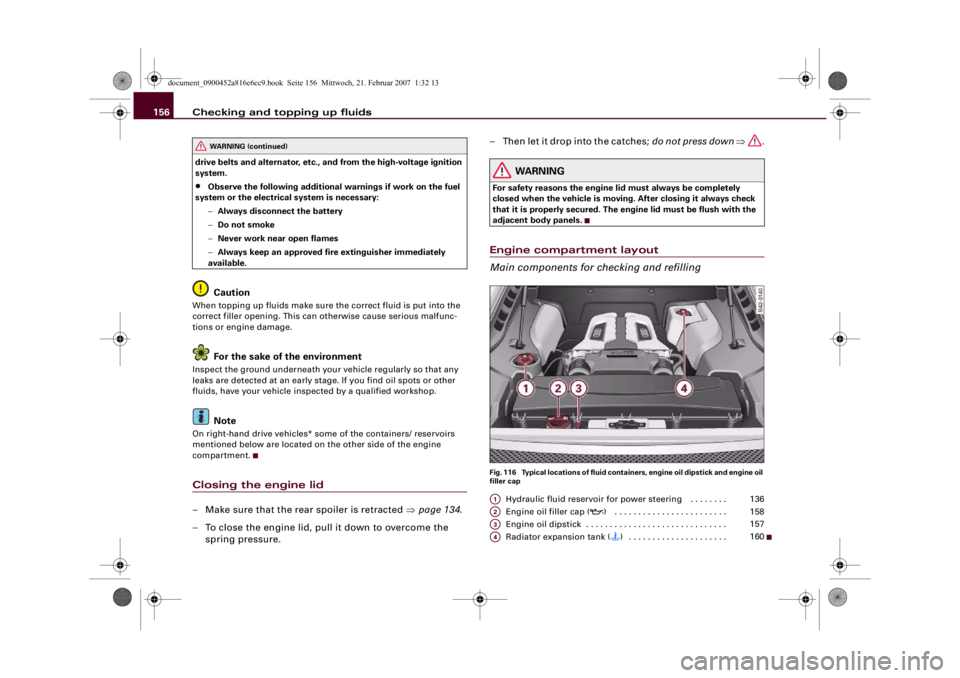
Main components for checking and refillingFig. 116 Typical locations of fluid containers, engine oil dipstick and engine oil
filler cap
Hydraulic fluid reservoir for power steering . . . . . . . .
Engine oil filler cap (
) . . . . . . . . . . . . . . . . . . . . . . . .
Engine oil dipstick . . . . . . . . . . . . . . . . . . . . . . . . . . . . . .
Radiator expansion tank () . . . . . . . . . . . . . . . . . . . . .
WARNING (continued)
A1
136
A2
158
A3
157
A4
160
document_0900452a816e6cc9.book Seite 156 Mittwoch, 21. Februar 2007 1:32 13
Page 162 of 210
Checking and topping up fluids 160Checking coolant level
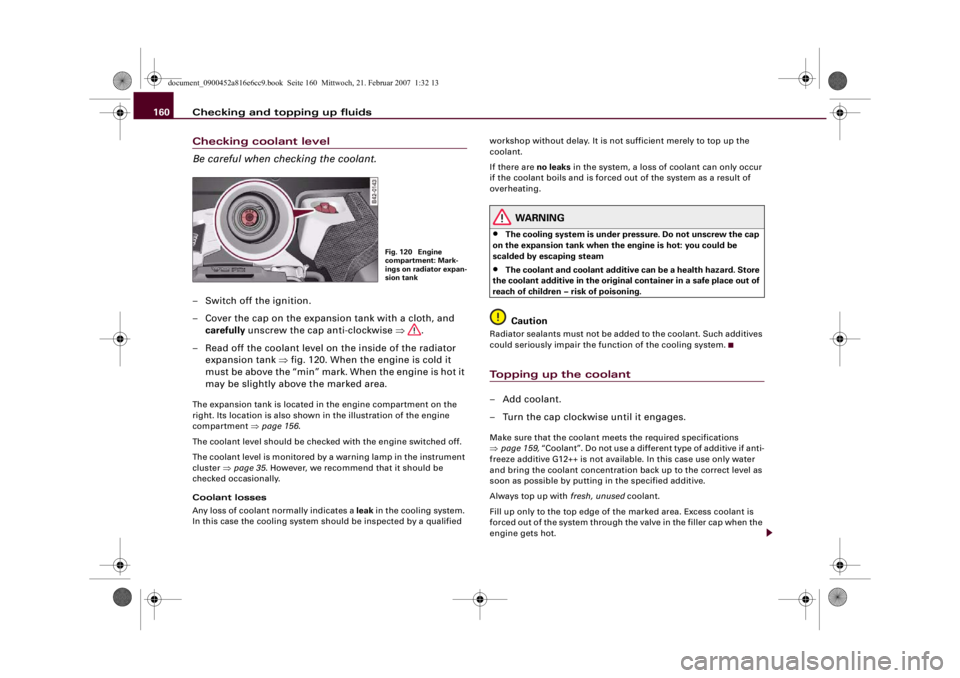
Be careful when checking the coolant.– Switch off the ignition.
– Cover the cap on the expansion tank with a cloth, and
carefully unscrew the cap anti-clockwise ⇒.
– Read off the coolant level on the inside of the radiator
expansion tank ⇒fig. 120. When the engine is cold it
must be above the “min” mark. When the engine is hot it
may be slightly above the marked area.The expansion tank is located in the engine compartment on the
right. Its location is also shown in the illustration of the engine
compartment ⇒page 156.
The coolant level should be checked with the engine switched off.
The coolant level is monitored by a warning lamp in the instrument
cluster ⇒page 35. However, we recommend that it should be
checked occasionally.
Coolant losses
Any loss of coolant normally indicates a leak in the cooling system.
In this case the cooling system should be inspected by a qualified workshop without delay. It is not sufficient merely to top up the
coolant.
If there are no leaks in the system, a loss of coolant can only occur
if the coolant boils and is forced out of the system as a result of
overheating.
WARNING
•
The cooling system is under pressure. Do not unscrew the cap
on the expansion tank when the engine is hot: you could be
scalded by escaping steam
•
The coolant and coolant additive can be a health hazard. Store
the coolant additive in the original container in a safe place out of
reach of children – risk of poisoning.Caution
Radiator sealants must not be added to the coolant. Such additives
could seriously impair the function of the cooling system.Topping up the coolant– Add coolant.
– Turn the cap clockwise until it engages.Make sure that the coolant meets the required specifications
⇒page 159, “Coolant”. Do not use a different type of additive if anti-
freeze additive G12++ is not available. In this case use only water
and bring the coolant concentration back up to the correct level as
soon as possible by putting in the specified additive.
Always top up with fresh, unused coolant.
Fill up only to the top edge of the marked area. Excess coolant is
forced out of the system through the valve in the filler cap when the
engine gets hot.
Fig. 120 Engine
compartment: Mark-
ings on radiator expan-
sion tank
document_0900452a816e6cc9.book Seite 160 Mittwoch, 21. Februar 2007 1:32 13
Page 163 of 210
Checking and topping up fluids161
Controls
Safety
Driving tips
General maintenance
Self-help
Technical data If a lot of coolant has been lost, wait for the engine to cool down
before putting in cold coolant. Failure to do so could result in
serious engine damage.
WARNING
The coolant and coolant additive can be a health hazard. Store the
coolant additive in the original container in a safe place out of
reach of children – risk of poisoning.
For the sake of the environment
Drained off coolant should not be used again. Drain off the used
coolant into a suitable container and dispose of it in the proper
manner (observe environmental regulations).Radiator fan
The radiator fan can start running spontaneously.The radiator fan is powered electrically. The speed of the fan is
varied according to the temperature registered by a thermostat.
The radiator fan or auxiliary fan can continue to run for as long as
10 minutes after stopping the engine – even after the ignition is
switched off. It may also start running suddenly after a while if•
residual heat raises the coolant temperature, or
•
the hot engine compartment is additionally heated up by the
sun.
Brake fluidNote
When required, the brake fluid should be changed by a
competent mechanic with the proper equipment.Brake fluid gradually absorbs moisture from the atmosphere. If the
water content in the brake fluid is too high, this may cause corrosion
in the brake system over time. In addition, the boiling point of the
brake fluid will be considerably reduced. This could adversely affect
the braking ability in certain circumstances.
For this reason the brake fluid must be changed periodically.
Your vehicle's Service Schedule will tell you when the brake fluid has
to be changed.
The brake fluid is replaced by your Audi R8 dealer as part of the
Inspection Service. They are familiar with the procedure and have
the necessary special tools and spare parts as well as the proper
facilities for disposing of the old fluid.
Use only the genuine brake fluid specified by the factory Qualified
workshops know that the brake fluid “DOT 4” is approved by Audi.
The brake fluid must be fresh and unused.
WARNING
Heavy use of the brakes may cause a vapour lock if the brake fluid
is left in the system for too long. This would seriously affect the
efficiency of the brakes and the safety of the car – risk of
accident.
document_0900452a816e6cc9.book Seite 161 Mittwoch, 21. Februar 2007 1:32 13
Page 164 of 210
Checking and topping up fluids 162BatteryGeneral notes
All work on batteries requires specialist knowledge.The battery is located behind the cover in the luggage compart-
ment. To remove the cover, slide it to the left and lift it out.
The battery is virtually maintenance-free and is checked in the
Inspection Services.
We recommend that you replace a battery once it is older than 5
years.
Disconnecting the battery
If the battery is disconnected, some of the vehicle's functions will
become inoperative (e.g. electric windows). These functions will
require resetting after the battery is reconnected. For this reason,
the battery should only be disconnected from the vehicle's electrical
system when absolutely necessary.
If the vehicle is not used for long periods
The battery will gradually lose its charge because certain electrical
equipment continues to draw current even when the ignition is off.
If you park the vehicle for long periods of time in winter you should
have your Audi R8 dealer take the battery out of the vehicle and keep
it in a frost-proof room. This ensures that it cannot “freeze up” and
be damaged. At warm outside temperatures it is sufficient to
disconnect the negative terminal of the battery. Even when the
battery is not connected you should charge it from time to time.
Winter conditions
The battery is drained more in cold weather, which means that the
starting power is reduced. For this reason, have the battery checked
and charged if necessary before the start of winter.Replacing the battery
A replacement battery must have the same capacity, voltage and
current rating. It must also have the same dimensions as the orig-
inal, factory-fitted battery and have sealed caps. The Audi batteries
which have been specially developed fulfil the maintenance,
performance and safety specifications for your vehicle.
We recommend to use only maintenance-free batteries or deep-
cycle resistant and leakproof batteries which comply with the
standards TL 825 06 (dated December 1997 or later) and VW 7 50 73
(August 2001 or later).
Since the battery is difficult to access, we recommend having it
replaced by an Audi R8 dealer or qualified workshop.
WARNING
•
All work on batteries requires specialist knowledge. For queries
regarding the vehicle battery please contact an Audi R8 dealership
or other qualified workshop (risk of chemical burns / risk of explo-
sion).
•
The battery must not be opened. Do not attempt to make any
changes to the electrolyte level of the battery. Otherwise, there is
a risk that a mixture of oxygen and hydrogen gas can accumulate
and cause an explosion.Caution
•
The battery holder and clamps must always be correctly secured.
•
Before starting any work on the battery, always observe the
warnings listed under ⇒ in “Important safety warnings for
handling a car battery” on page 163.For the sake of the environment
Batteries contain toxic substances including sulphuric acid and
lead. They must be disposed of appropriately and must not be put
together with ordinary household waste. Make sure the battery
document_0900452a816e6cc9.book Seite 162 Mittwoch, 21. Februar 2007 1:32 13