belt AUDI R8 COUPE 2020 Workshop Manual
[x] Cancel search | Manufacturer: AUDI, Model Year: 2020, Model line: R8 COUPE, Model: AUDI R8 COUPE 2020Pages: 308, PDF Size: 82.41 MB
Page 223 of 308
4S1012721BA
Child safety
ZA\ WARNING
Always take special precautions if you must
install a forward or rearward-facing child re-
straint on the front passenger's seat in excep-
tional situations:
— Whenever a forward or rearward-facing
child restraint is installed on the front pas-
senger seat, the PASSENGER AIR BAG OFF
#; light must come on and stay on whenever
the ignition is switched on.
— If the PASSENGER AIR BAG OFF %; light
does not come on and stay on, perform the
checks described > page 198, Monitoring
the Advanced Airbag System.
— If the PASSENGER AIR BAG OFF %; light
does not come on and stay on whenever the
ignition is switched on the inflating airbag
will hit the child safety seat or infant carrier
with great force and will smash the child
safety seat and child against the backrest,
center armrest, door or roof. Have the air-
bag system inspected immediately by your
Audi dealer.
— Improper installation of child restraints can
reduce their effectiveness or even prevent
them from providing any protection.
— An improperly installed child restraint can
interfere with the airbag as it deploys and
seriously
injure or even kill the child.
— Always carefully follow the manufacturer's
instructions provided with the child safety
seat or carrier.
— After checking to make sure that the child
restraint is properly installed, make certain
that the child restraint is correctly recog-
nized by the capacitive passenger detection
system in the front passenger seat and that
the PASSENGER AIR BAG OFF %; light sig-
nals the correct front passenger frontal air-
bag status.
ZA\ WARNING
Forward-facing child restraints:
— Always make sure the forward-facing seat
has been designed and certified by its manu-
facturer for use on a front seat with a pas-
senger front and side airbag.
— Never put the forward-facing child restraint
up, against or very near the instrument pan-
el
— Always move the passenger seat into its
rearmost position in the seat's fore and aft
adjustment range, as far away from the air-
bag as possible before installing the for-
ward-facing child restraint. The backrest
must be adjusted to an upright position.
— Make sure that the PASSENGER AIR BAG
OFF 3%; light comes on and stays on all the
time whenever the ignition is switched on.
ZA WARNING
Rearward-facing child restraints:
—A child in a rearward-facing child safety seat
installed on the front passenger seat will be
seriously injured and can be killed if the
front airbag inflates - even with an Ad-
vanced Airbag System.
— The inflating airbag will hit the child safety
seat or infant carrier with great force and
will smash the child safety seat and child
against the backrest, center armrest, door
or roof.
— Always be especially careful if you must in-
stall a rearward facing child safety seat on
the front passenger seat in exceptional cir-
cumstances.
— Make sure that the PASSENGER AIR BAG
OFF %; light comes on and stays on all the
time whenever the ignition is switched on.
— If the PASSENGER AIR BAG OFF #; light
does not come on and stay on, have the air-
bag system inspected by your Audi dealer.
Activating the convertible locking retractor
Use the convertible locking retractor to secure a
child restraint.
Always heed the child safety seat manufacturer's
instructions when installing a child restraint in
your vehicle. To activate the convertible locking
retractor:
> Place the child restraint on a seat.
> Slowly pull the belt all the way out.
221
Page 224 of 308
Child safety
> Route it around or through the child restraint
belt path > A\.
> Push the child safety seat down with your full
weight to get the safety belt really tight.
> Insert the belt tongue into the buckle for that
seating position.
> Guide the safety belt back into the retractor un-
til the belt lies flat and snug on the child safety
seat.
> You should hear a “clicking” noise as the belt
winds back into the inertia reel. Test the con-
vertible locking retractor by pulling on the belt.
You should no longer be able to pull the belt
out of the retractor. The convertible locking re-
tractor is now activated.
> Make sure that the red release button is facing
away from the child restraint so that it can be
unbuckled quickly.
> Pull on the belt to make sure the safety belt is
properly tight and fastened so that the seat
cannot move forward and sideways more than
lin (2.5 cm).
ZA WARNING
Using the wrong child restraint or an improp-
erly installed child restraint can cause serious
personal injury or death in a crash.
— Always make sure that the safety belt retrac-
tor is locked when installing a child safety
seat. An unlocked safety belt retractor can-
not hold the child safety seat in place during
normal driving or in a crash.
— Always buckle the child safety seat firmly in
place even if a child is not sitting in it. A
loose child safety seat can fly around during
a sudden stop or ina crash.
— Always make sure the seat backrest to which
the child restraint is installed is in an up-
right position. Otherwise, the seatback with
the child safety seat attached to it could fly
forward in the event of an accident or other
emergency situation.
— Always read and heed all WARNINGS when-
ever using a child restrained in a vehicle is
being used = page 211. Special precautions
apply when installing a child safety seat on
the front passenger seat > page 188, Child
222
restraints on the front seat - some impor-
tant things to know.
Deactivating the convertible locking
tela tel
The convertible locking retractor for child re-
straints will be deactivated automatically when
the belt is wound all the way back into the re-
tractor.
> Press the red button on the safety belt buckle.
The belt tongue will pop out of the buckle.
>» Guide the safety belt all the way back into its
stowed position.
Always let the safety belt retract completely into
its stowed position. The safety belt can now be
used as an ordinary safety belt without the con-
vertible locking retractor for child restraints.
If the convertible locking retractor should be ac-
tivated inadvertently, the safety belt must be un-
fastened and guided completely back into its
stowed position to deactivate this feature. If the
convertible locking retractor is not deactivated,
the safety belt will gradually become tighter and
uncomfortable to wear.
ZA\ WARNING
Improperly installed child safety seats in-
crease the risk of serious personal injury and
death in a collision.
— Never unfasten the safety belt to deactivate
the convertible locking retractor for child re-
straints while the vehicle is moving. You
would not be restrained and could be seri-
ously injured in an accident.
— Always read and heed all WARNINGS when-
ever using a child restrained in a vehicle is
being used > page 211. Special precautions
apply when installing a child safety seat on
the front passenger seat > page 188, Child
restraints on the front seat - some impor-
tant things to know.
Page 225 of 308
4S1012721BA
Child safety
Tether anchors and tether straps
Applies to: vehicles with Tether anchors and tether straps
a
9° db
+ a
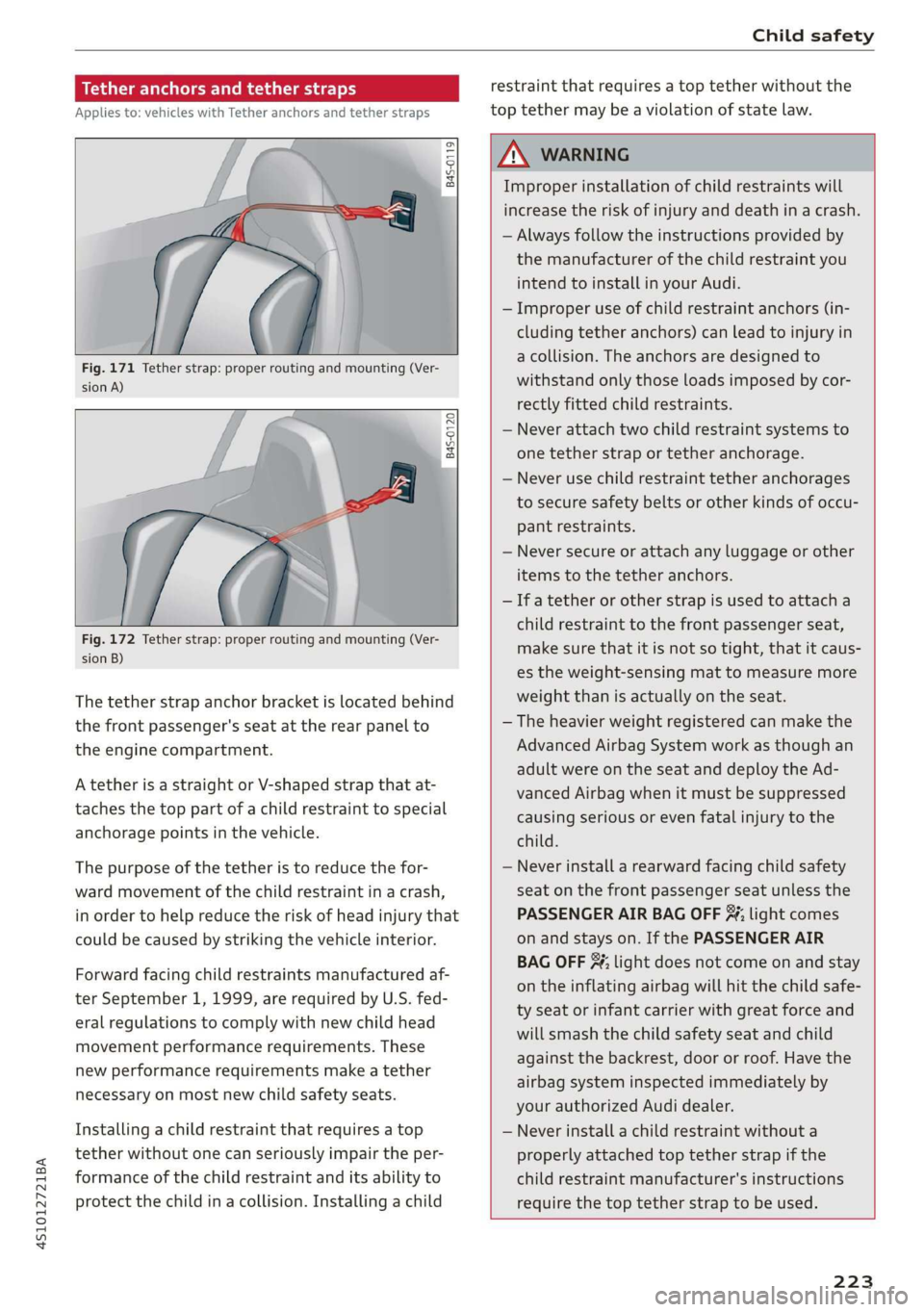
Fig. 171 Tether strap: proper routing and mounting (Ver-
sion A)
eS aS
9
db t a
Fig. 172 Tether strap: proper routing and mounting (Ver-
sion B)
The tether strap anchor bracket is located behind
the front passenger's seat at the rear panel to
the engine compartment.
A tether is a straight or V-shaped strap that at-
taches the top part of a child restraint to special
anchorage points in the vehicle.
The purpose of the tether is to reduce the for-
ward movement of the child restraint in a crash,
in order to help reduce the risk of head injury that
could be caused by striking the vehicle interior.
Forward facing child restraints manufactured af-
ter September 1, 1999, are required by U.S. fed-
eral regulations to comply with new child head
movement performance requirements. These
new performance requirements make a tether
necessary on most new child safety seats.
Installing a child restraint that requires a top
tether without one can seriously impair the per-
formance of the child restraint and its ability to
protect the child in a collision. Installing a child
restraint that requires a top tether without the
top tether may be a violation of state law.
Improper installation of child restraints will
increase the risk of injury and death in a crash.
— Always follow the instructions provided by
the manufacturer of the child restraint you
intend to install in your Audi.
— Improper use of child restraint anchors (in-
cluding tether anchors) can lead to injury in
a collision. The anchors are designed to
withstand only those loads imposed by cor-
rectly fitted child restraints.
— Never attach two child restraint systems to
one tether strap or tether anchorage.
— Never use child restraint tether anchorages
to secure safety belts or other kinds of occu-
pant restraints.
— Never secure or attach any luggage or other
items to the tether anchors.
— Ifa tether or other strap is used to attach a
child restraint to the front passenger seat,
make sure that it is not so tight, that it caus-
es the weight-sensing mat to measure more
weight than is actually on the seat.
— The heavier weight registered can make the
Advanced Airbag System work as though an
adult were on the seat and deploy the Ad-
vanced Airbag when it must be suppressed
causing serious or even fatal injury to the
child.
— Never install a rearward facing child safety
seat on the front passenger seat unless the
PASSENGER AIR BAG OFF %; light comes
on and stays on. If the PASSENGER AIR
BAG OFF 3%; light does not come on and stay
on the inflating airbag will hit the child safe-
ty seat or infant carrier with great force and
will smash the child safety seat and child
against the backrest, door or roof. Have the
airbag system inspected immediately by
your authorized Audi dealer.
— Never install a child restraint without a
properly attached top tether strap if the
child restraint manufacturer's instructions
require the top tether strap to be used.
223
Page 226 of 308
Child safety
Installing the tether strap on the
anchorage
Applies to: vehicles with Tether anchors and tether straps
Installing the tether strap
> Release or deploy the tether strap on the child
restraint according to the child restraint manu-
facturer's instructions.
> Guide the upper tether strap sideways (Version
A) > page 223, fig. 171 or under (Version B)
=> page 223, fig. 172 the head restraint.
> Remove the cover to expose the anchor bracket.
> Attach the tether strap anchorage hook into the
opening of the tether anchorage.
> Pull on the tether strap hook so that the spring
catch of the hook is engaged.
> Tighten the tether strap firmly following the
child restraint manufacturer's instructions.
Releasing the tether strap
> Loosen the tension following the child restraint
manufacturer’s instructions.
> Depress the spring catch on the hook and re-
lease it from the anchorage.
©) Note
If you leave the child restraint with the tether
strap firmly installed for several days, this
could leave a mark on the upholstery on the
seat cushion and backrest in the area where
the tether strap was installed. The upholstery
would also be permanently stretched around
the tether strap. This applies especially to
leather seats.
Using tether straps on rearward-facing
Riera)
Applies to: vehicles with Tether anchors and tether straps
Currently, few rear-facing child restraint systems
come with a tether. Please read and heed the
child restraint system manufacturer's instruc-
tions carefully to determine how to properly in-
stall the tether.
Z\ WARNING
A child in a rearward-facing child safety seat
installed on the front passenger seat will be
224
seriously injured and can be killed if the front
airbag inflates - even with an Advanced Airbag
System.
— The inflating airbag will hit the child safety
seat or infant carrier with great force and
will smash the child safety seat and child
against the backrest, center armrest or
door.
— Never install a rearward facing child safety
seat on the front passenger seat unless the
PASSENGER AIR BAG OFF 3; light comes
on and stays on. If the PASSENGER AIR
BAG OFF ¥; light does not come on and stay
on the inflating airbag will hit the child safe-
ty seat or infant carrier with great force and
will smash the child safety seat and child
against the backrest, door or roof. Have the
airbag system inspected immediately by
your authorized Audi dealer.
Additional information
Sources of information about child
restraints and their use
There are a number of sources of additional infor-
mation about child restraint selection, installa-
tion and use:
NHTSA advises that the best child safety seat is
the one that fits your child and fits in your vehi-
cle, and that you will use correctly and consis-
tently.
Try before you buy!
U.S.
National Highway Traffic Safety Adminis-
tration
Tel.: 1-888-327-4236 (TTY: 1-800-424-9153)
www.nhtsa.gov
National SAFE KIDS Campaign
Tel.: (202) 662-0600
www.safekids.org
Safety BeltSafe U.S.A.
Tel.: (800) 745-SAFE (English)
Tel.: (800) 747-SANO (Spanish)
www.carseat.org
Page 232 of 308

Checking and Filling
— Never open the cap on the coolant expan-
sion tank when the engine is warm. The
cooling system is under pressure.
— To protect your face, hands, and arms from
hot steam or coolant, cover the cap with a
thick cloth when opening.
— Do not remove the engine cover under any
circumstances. This increases the risk of
burns.
— Due to the risk of electric shock, never touch
the ignition cable or other components in
the electronic high-voltage ignition system
when the engine is running or is starting.
— If a gear is engaged while the vehicle is sta-
tionary and the engine is running, do not
press the accelerator pedal inadvertently.
Pressing the accelerator pedal will cause the
vehicle to move, and this could result in an
accident.
— If inspections or repairs must be performed
while the engine is running, moving compo-
nents (such as the ribbed belt, generator,
and radiator fan) pose an additional risk.
— Set the parking brake first and select the
“p” (Park) selector lever position.
— Always make sure that no parts of the
body, jewelry, ties, loose clothing, and
long hair can be caught in moving engine
components. Before any work, always re-
move any jewelry and/or ties, tie back long
hair, and make sure all clothing fits close
to the body to reduce the risk of anything
becoming caught in engine components.
— Pay attention to the following warnings list-
ed when work on the fuel system or on the
electrical equipment is required.
— Do not smoke.
— Never work near open flames.
— Always have a working fire extinguisher
nearby.
— All work on the battery or electrical system
in your vehicle can result in injuries, chemi-
cal burns, accidents, or burns. Because of
this, all work must be performed only by an
authorized Audi dealer or authorized Audi
Service Facility.
— Limit your exposure to exhaust and chemi-
cals to as short a time as possible.
ZA\ WARNING
California Proposition 65 Warning:
— Engine exhaust, some of its constituents,
and certain vehicle components contain or
emit chemicals known to the State of Cali-
fornia to cause cancer and birth defects and
reproductive harm. In addition, certain flu-
ids contained in vehicles and certain prod-
ucts of component wear contain or emit
chemicals known to the State of California
to cause cancer and birth defects or other
reproductive harm.
— Battery posts, terminals and related acces-
sories contain lead and lead compounds,
chemicals known to the State of California
to cause cancer and reproductive harms.
Wash hands after handling.
230
() Note
When filling fluids, be sure not to add any flu-
ids to the wrong reservoirs. Otherwise severe
malfunctions and engine damage will occur.
@) For the sake of the environment
You should regularly check the ground under
your vehicle in order to detect leaks quickly. If
there are visible spots from oil or other fluids,
bring your vehicle to an authorized Audi deal-
er or authorized Audi Service Facility to be
checked.
Page 270 of 308
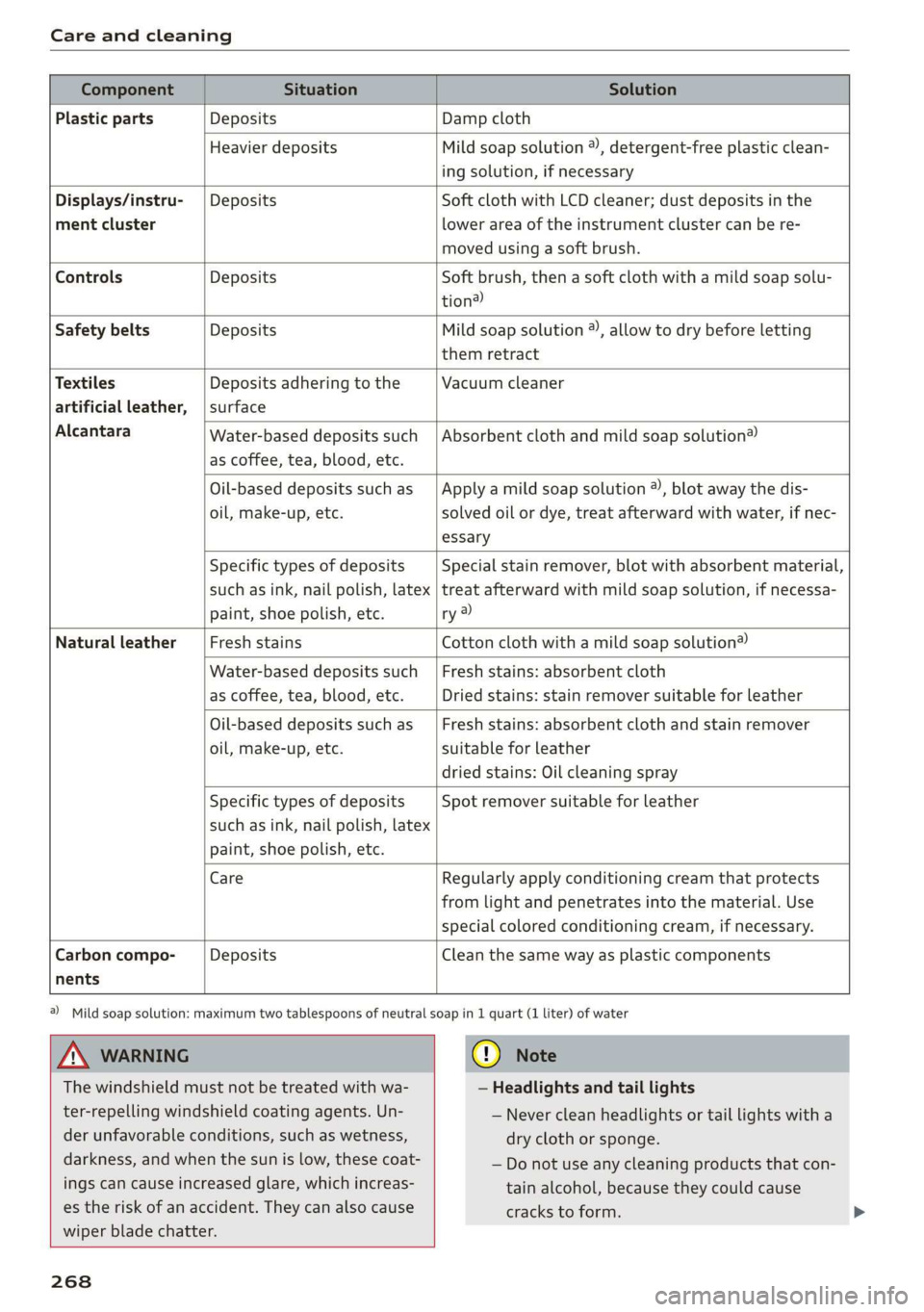
Care and cleaning
Component Situation Solution
Plastic parts Deposits Damp cloth
Heavier deposits Mild soap solution ®, detergent-free plastic clean-
ing solution, if necessary
Water-based deposits such
as coffee, tea, blood, etc.
Displays/instru- | Deposits Soft cloth with LCD cleaner; dust deposits in the
ment cluster lower area of the instrument cluster can be re-
moved using a soft brush.
Controls Deposits Soft brush, then a soft cloth with a mild soap solu-
tion?)
Safety belts Deposits Mild soap solution ®, allow to dry before letting
them retract
Textiles Deposits adhering to the Vacuum cleaner
artificial leather, | surface
Alcantara Absorbent cloth and mild soap solution®
Oil-based deposits such as
oil, make-up, etc.
Apply a mild soap solution ®), blot away the dis-
solved oil or dye, treat afterward with water, if nec-
essary
Specific types of deposits
such as ink, nail polish, latex
paint, shoe polish, etc.
Special stain remover, blot with absorbent material,
treat afterward with mild soap solution, if necessa-
ry a)
Natural leather Fresh stains Cotton cloth with a mild soap solution®
Water-based deposits such
as coffee, tea, blood, etc.
Fresh stains: absorbent cloth
Dried stains: stain remover suitable for leather
Oil-based deposits such as
oil, make-up, etc.
Fresh stains: absorbent cloth and stain remover
suitable for leather
dried stains: Oil cleaning spray
Specific types of deposits
such as ink, nail polish, latex
paint, shoe polish, etc.
Spot remover suitable for leather
nents
Care Regularly apply conditioning cream that protects
from light and penetrates into the material. Use
special
colored conditioning cream, if necessary.
Carbon compo- Deposits Clean the same way as plastic components
A WARNING
The windshield must not be treated with wa-
ter-repelling windshield coating agents. Un-
der
unfavorable conditions, such as wetness,
darkness, and when the sun is low, these coat-
ings can cause increased glare, which increas-
es the risk of an accident. They can also cause
wiper blade chatter.
268
@) Mild soap solution: maximum two tablespoons of neutral soap in 1 quart (1 liter) of water
@) Note
— Headlights and tail lights
— Never clean headlights or tail lights with a
dry cloth or sponge.
— Do not use any cleaning products that con-
tain alcohol, because they could cause
cracks to form.
Page 271 of 308
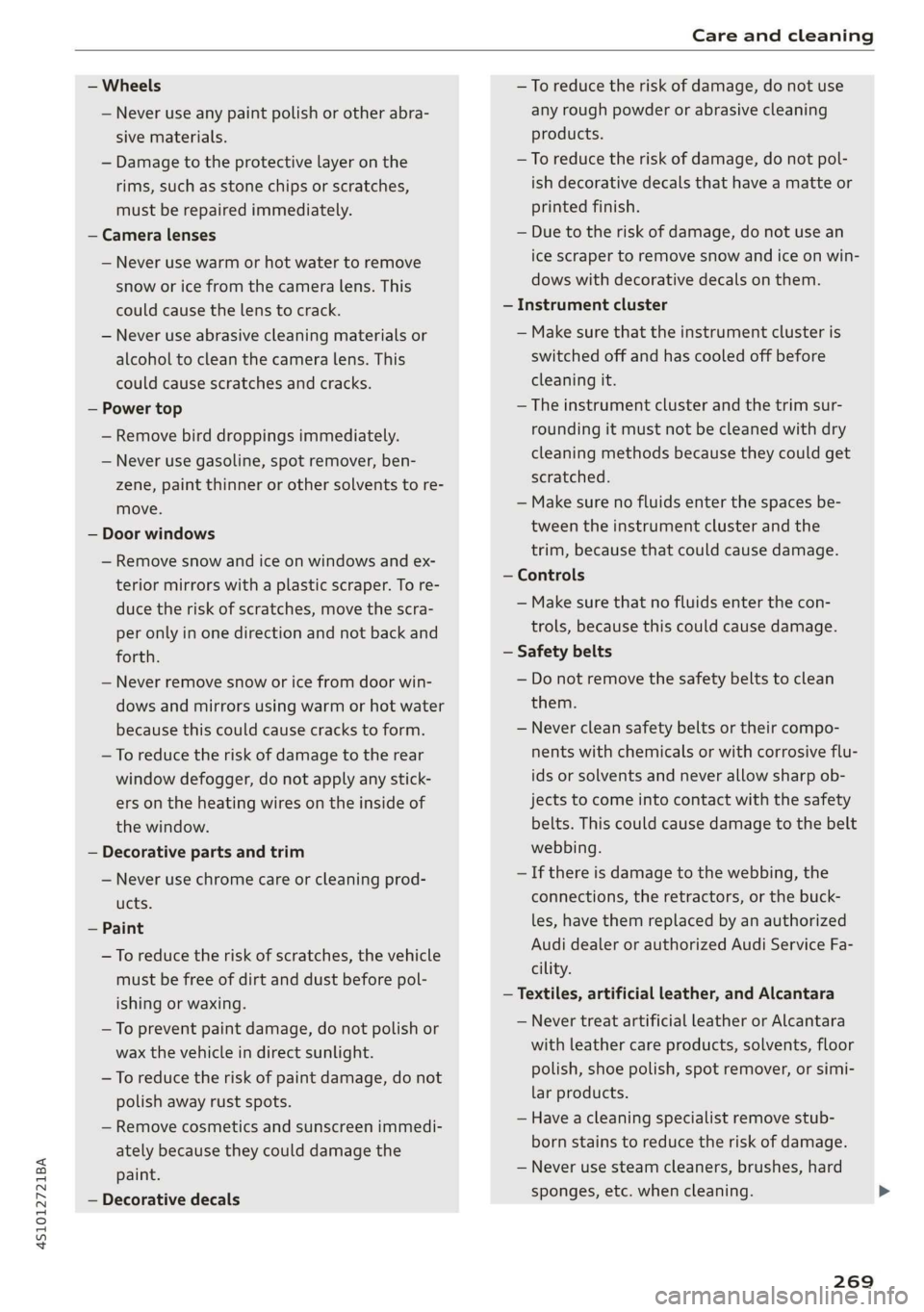
4S1012721BA
Care and cleaning
— Wheels
— Never use any paint polish or other abra-
sive materials.
— Damage to the protective layer on the
rims, such as stone chips or scratches,
must be repaired immediately.
— Camera lenses
— Never use warm or hot water to remove
snow or ice from the camera lens. This
could cause the lens to crack.
— Never use abrasive cleaning materials or
alcohol to clean the camera lens. This
could cause scratches and cracks.
— Power top
— Remove bird droppings immediately.
— Never use gasoline, spot remover, ben-
zene, paint thinner or other solvents to re-
move.
— Door windows
— Remove snow and ice on windows and ex-
terior mirrors with a plastic scraper. To re-
duce the risk of scratches, move the scra-
per only in one direction and not back and
forth.
— Never remove snow or ice from door win-
dows and mirrors using warm or hot water
because this could cause cracks to form.
—To reduce the risk of damage to the rear
window defogger, do not apply any stick-
ers on the heating wires on the inside of
the window.
— Decorative parts and trim
— Never use chrome care or cleaning prod-
ucts.
— Paint
—To reduce the risk of scratches, the vehicle
must be free of dirt and dust before pol-
ishing or waxing.
—To prevent paint damage, do not polish or
wax the vehicle in direct sunlight.
—To reduce the risk of paint damage, do not
polish away rust spots.
— Remove cosmetics and sunscreen immedi-
ately because they could damage the
paint.
— Decorative decals
—To reduce the risk of damage, do not use
any rough powder or abrasive cleaning
products.
— To reduce the risk of damage, do not pol-
ish decorative decals that have a matte or
printed finish.
— Due to the risk of damage, do not use an
ice scraper to remove snow and ice on win-
dows with decorative decals on them.
— Instrument cluster
— Make sure that the instrument cluster is
switched off and has cooled off before
cleaning it.
— The instrument cluster and the trim sur-
rounding it must not be cleaned with dry
cleaning methods because they could get
scratched.
— Make sure no fluids enter the spaces be-
tween the instrument cluster and the
trim, because that could cause damage.
— Controls
— Make sure that no fluids enter the con-
trols, because this could cause damage.
— Safety belts
— Do not remove the safety belts to clean
them.
— Never clean safety belts or their compo-
nents with chemicals or with corrosive flu-
ids or solvents and never allow sharp ob-
jects to come into contact with the safety
belts. This could cause damage to the belt
webbing.
— If there is damage to the webbing, the
connections, the retractors, or the buck-
les, have them replaced by an authorized
Audi dealer or authorized Audi Service Fa-
cility.
— Textiles, artificial leather, and Alcantara
— Never treat artificial leather or Alcantara
with leather care products, solvents, floor
polish, shoe polish, spot remover, or simi-
lar products.
— Have a cleaning specialist remove stub-
born stains to reduce the risk of damage.
— Never use steam cleaners, brushes, hard
sponges, etc. when cleaning.
269
Page 272 of 308
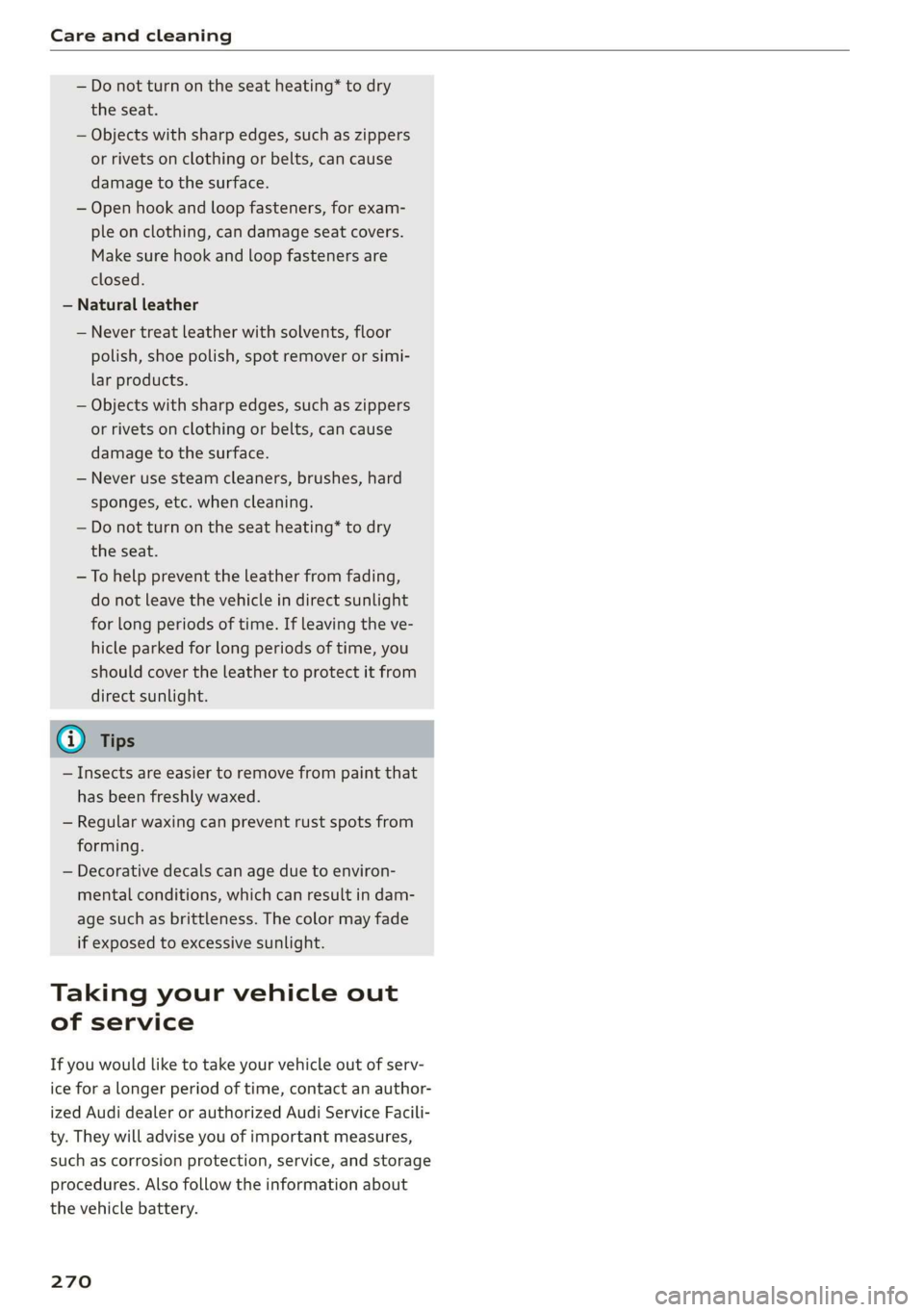
Care and cleaning
— Do not turn on the seat heating* to dry
the seat.
— Objects with sharp edges, such as zippers
or rivets on clothing or belts, can cause
damage to the surface.
— Open hook and loop fasteners, for exam-
ple on clothing, can damage seat covers.
Make sure hook and loop fasteners are
closed.
— Natural leather
— Never treat leather with solvents, floor
polish, shoe polish, spot remover or simi-
lar products.
— Objects with sharp edges, such as zippers
or rivets on clothing or belts, can cause
damage to the surface.
— Never use steam cleaners, brushes, hard
sponges, etc. when cleaning.
— Do not turn on the seat heating” to dry
the seat.
—To help prevent the leather from fading,
do not leave the vehicle in direct sunlight
for long periods of time. If leaving the ve-
hicle parked for long periods of time, you
should cover the leather to protect it from
direct sunlight.
@ Tips
— Insects are easier to remove from paint that
has been freshly waxed.
— Regular waxing can prevent rust spots from
forming.
— Decorative decals can age due to environ-
mental conditions, which can result in dam-
age such as brittleness. The color may fade
if exposed to excessive sunlight.
Taking your vehicle out
of service
If you would like to take your vehicle out of serv-
ice for a longer period of time, contact an author-
ized Audi dealer or authorized Audi Service Facili-
ty. They will advise you of important measures,
such as corrosion protection, service, and storage
procedures. Also follow the information about
the vehicle battery.
270
Page 284 of 308
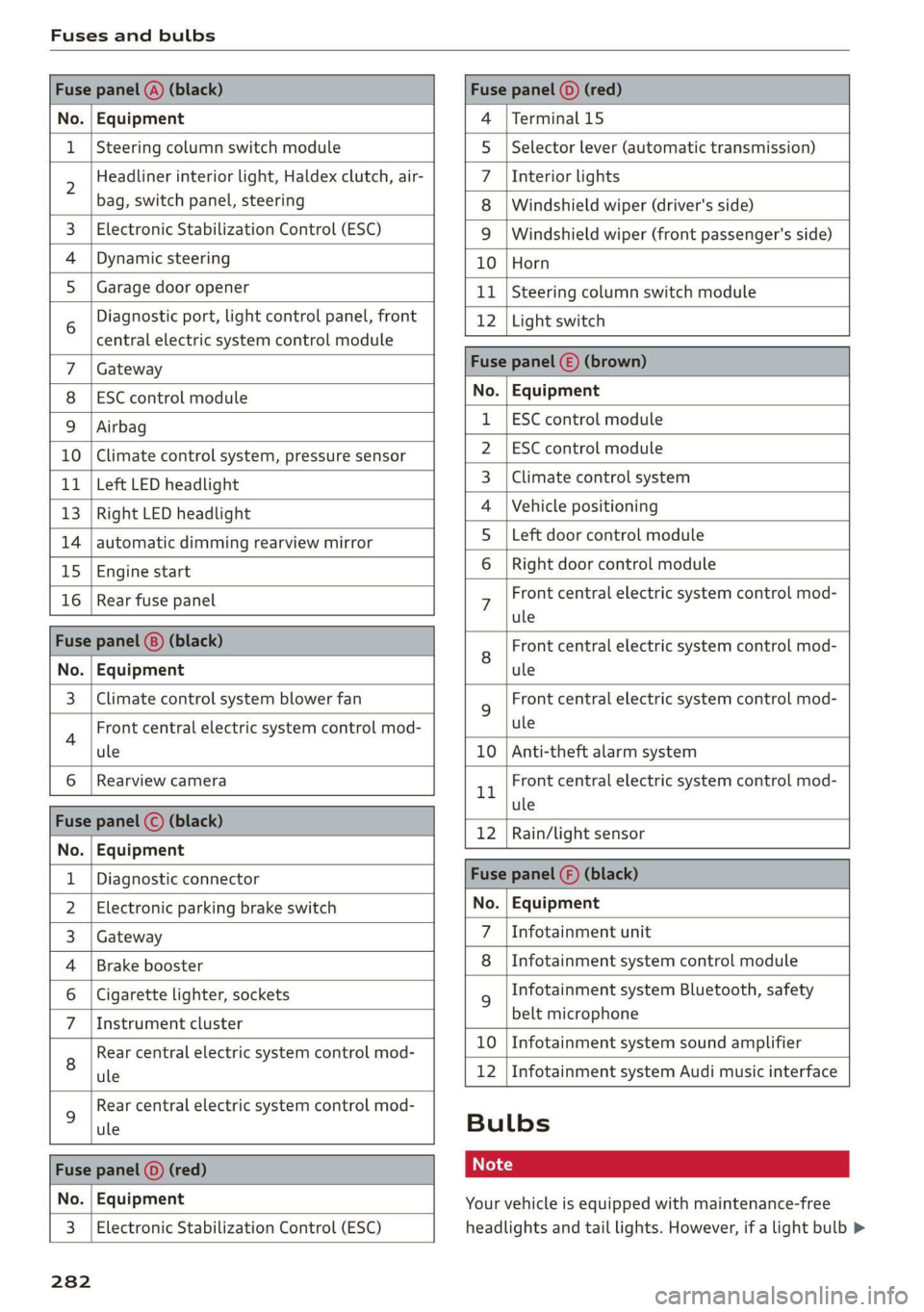
Fuses and bulbs
Fuse panel @) (black) Fuse panel © (red)
No. | Equipment 4 |Terminal 15
1 |Steering column switch module 5 |Selector lever (automatic transmission)
2 Headliner interior light, Haldex clutch, air- 7 |Interior lights
bag, switch panel, steering 8 | Windshield wiper (driver's side)
3. | Electronic Stabilization Control (ESC) 9 | Windshield wiper (front passenger's side)
4 |Dynamic steering 10 |Horn
5_| Garage door opener 11 | Steering column switch module
6 Diagnostic port, light control panel, front 12 | Light switch
central electric system control module —
Gateway Fuse panel () (brown)
ESC control module No. | Equipment
Airbag 1 |ESC control module
10 | Climate control system, pressure sensor 2_|ESC control module
11 | Left LED headlight 3 | Climate control system
13 |Right LED headlight 4 |Vehicle positioning
14 | automatic dimming rearview mirror 5_ Left door control module
15 |Engine start 6 |Right door control module
16 | Rear fuse panel 7 Front central electric system control mod-
ule
Fuse panel (@) (black) 8 Front central electric system control mod-
No. | Equipment ule
3 | Climate control system blower fan 9 Front central electric system control mod-
4 Front central electric system control mod- ule
ule 10 | Anti-theft alarm system
6 |Rearview camera 1 Front central electric system control mod-
- ule
nue pene) sBisch 12 |Rain/light sensor
No. | Equipment
1 | Diagnostic connector Fuse panel () (black)
2 | Electronic parking brake switch No. | Equipment
3 | Gateway 7 \Infotainment unit
4 |Brake booster 8 |Infotainment system control module
6 | Cigarette lighter, sockets 9 Infotainment system Bluetooth, safety
7 |Instrument cluster belt microphone
Rear central electric system control mod- £0 | Infotainment:system:sound amplifier
8 ule 12 | Infotainment system Audi music interface
9 Rear central electric system control mod-
ule Bulbs
Fs panel © ed ot
No. | Equipment Your vehicle is equipped with maintenance-free
3 | Electronic Stabilization Control (ESC) headlights and tail lights. However, if a light bulb >
282
Page 286 of 308
Accessories and technical changes
Accessories and
technical changes
Warranty
Your vehicle is covered by various warranties:
— New Vehicle Limited Warranty
— Limited Warranty Against Corrosion Perforation
— Emissions Control System Warranties: Federal
Emissions Control System Defect Warranty,
Federal Emissions Performance Warranty
— Applies to: USA models: Kansas Safety Belt
Limited Warranty
— Applies to: USA models: California Emissions
Control Warranties: Short-term Emissions De-
fects Warranty, Long-term Emissions Defects
Warranty, TZEV models Emissions Defects
Warranty, California Emissions Performance
Warranty
You can find detailed information in your Warran-
ty & Maintenance Booklet and in the California
Emissions Booklet*.
Audi Literature Shop
Service information is available as soon as possi-
ble after a model is introduced and can be or-
dered in the Audi Literature Shop: http://
literature.audiusa.com
Driving in other
countries
Government regulations in the United States and
Canada require motor vehicles to comply with
emissions regulations and safety standards.
Therefore, vehicles that were produced for the
U.S. and Canadian markets are different from ve-
hicles produced for other countries.
If you plan to use your vehicle outside of the
United States or Canada, it is possible that:
— Fuel may have a significantly lower octane rat-
ing. Unsuitable fuels can cause engine damage.
— Proper maintenance and repair work may not
be possible because special service equipment,
tools, or measuring devices needed for your ve-
hicle may not be available.
284
— Replacement parts may not always be availa-
ble.
— Navigation systems for vehicles built for the
U.S.A. and Canada will not necessarily work in
Europe, and may not work in other countries.
() Note
Audi is not liable for damage to the vehicle re-
sulting from these country-specific differen-
ces.
Maintenance, repairs,
and technical modifi-
cations
Note the safety precautions > page 229, General
information and > page 275, Raising the vehicle.
General information
Due to the increasing complexity of technology in
these vehicles, as well as the safety and environ-
mental standards that apply, you can only per-
form a very limited amount of repairs and modifi-
cations to the vehicle yourself.
Proof of maintenance work may be required to
submit a claim within the warranty period.
We recommend that you have your vehicle serv-
iced by an authorized Audi dealer or authorized
Audi Service Facility and that Audi Genuine Parts
and Audi Genuine Accessories are used. This
helps to ensure that your vehicle's functionality,
performance, and safety are not impaired.
Maintenance and repairs
Your vehicle was designed to help keep mainte-
nance requirements to a minimum. Some regular
maintenance is required to help ensure that your
vehicle runs in a safe, economical, and reliable
manner. Please refer to your Warranty & Mainte-
nance Booklet for more detailed information
about vehicle maintenance.
When operating the vehicle under more extreme
operating conditions, for example when outside
temperatures are very low or in very dusty envi-
ronments, certain maintenance should be per-
formed between the specified intervals.