warning AUDI R8 SPYDER 2011 Owners Manual
[x] Cancel search | Manufacturer: AUDI, Model Year: 2011, Model line: R8 SPYDER, Model: AUDI R8 SPYDER 2011Pages: 244, PDF Size: 59.74 MB
Page 181 of 244
The engine oil and oil filter must be changed
according to the mi leage (kilometers) and
time interva ls specified in your vehicle's War
ranty & Maintenance booklet. Do not exceed
these intervals -harmful deposits from old
engine o il can reduce engine performance and
can lead to expensive engine repairs.
Changing the o il at the recommended inter
vals is so very important because the lubricat
ing properties of oil decrease gradually during
normal vehicle use . If you are not sure when
you have your oi l changed, ask your author
i zed A udi Service Advisor.
Under some circumstances the engine o il
should even be changed more frequently.
Change o il more often if you drive mostly
short distances, ope ra te the vehicle in dusty
areas or mostly under s top-and-go traffic con
d itions, or when yo u use your vehicle whe re
temperatures stay below freezing point for
l ong periods.
D etergen t additives i n the o il w il l make fresh
oil look dark after the eng ine has been run
ning for a short time . This is norma l and is not
a reason to change the oi l more often than
recommended.
Damage or malfunction s due t o lack of
m aintenance
It is essen tial that you change your oil at the
r ecommended inte rva ls using only engine o il
that complies with A udi oil standard
VW 502 00. Yo ur Limited New Vehicle War
ranty does not cover damage or malfunctions
d ue to fai lure to fo llow recommended mainte
nance and use req uirements as set forth in
the Audi Owner's Manua l and Warranty&
Ma intenance book let . Your autho rized Aud i
deale r will have to deny warranty coverage un
l ess you present to the dealer p roof in the
fo rm of Se rvice o r Repair Orde rs t hat all
sched uled main tenance w as performed in a
time ly manner .
Checkin g and fillin g 179
Engine oil consumption
The engine in your vehicle depends on an ade
quate amount of oil to lubricate and cool all
of its moving parts .
In order to provide effective lubrication and
cooling of interna l eng ine components, all in
te rnal combust io n engines consume a certain
amount of oil. Oil consumpt io n va ries from
engine to e ngine and may change sig nifican tly
ove r the life of the engine. Typically, engines
with a spec ified break -in pe riod (see
c::> page 158) consume more oil d uri ng the
break-in pe riod than they consume afte r oi l
consumption has stabilized.
U nder normal cond itions, the rate of oi l con
s u mption depends on t he q uality and viscos ity
of the oil, the RP M (revolut ions per minute) at
which the engine is operated, the ambient
temperature and road conditions. Further fac
tors are the amount of oil dilut ion from water
condensa tion or fue l residue a nd the oxida
tion level of the oil. As any eng ine is subject to
wear as m ileage builds up, t he oil co nsump
t ion may increase over time until repla cement
of wo rn components may be come necessary.
Wi th a ll these va riab les coming into p lay, no
standard rate of oil consumpt io n can be es
t a bl is h ed o r spec ified . There is no alte rnative
to regular and frequent chec king of the o il lev
el, see
Note.
If the yellow engine o il level wa rning symbo l
i n the instrument cluster
1\11 lights up, yo u
sho uld check the oil leve l as soon as possib le
c::> page 180 . Top off the oil at your ear liest
convenience
c::> page 180 .
A WARNING
-Before you check anything in the engine
compartment, always read and heed a ll
WARNINGS
c::> & in Working in the engine
compartment on pag e 175.
(D Note
Driving w ith an insufficient o il level is like-
-
ly to cause severe damage to the engine. .,.
•
•
Page 183 of 244
A WARNING ,~
- While topping off, the oil must not come
in contact with hot engine pa rts -fire
hazard!
- The oil fil ler cap must be properly se
cured to prevent oil from being sprayed
on the hot engine and exhaust system
when the eng ine is running -fire hazard!
- If your skin has come in contact w ith the
engine oil, yo u must subsequently
cl eanse it tho roughly.
CD Note
- The oil level must not be above range G)
- danger of converter or eng ine damage!
Contact an authorized Audi dealer to
draw off oil, if ne cessa ry.
- Audi does not recommend the use of oil
additives. They may damage the engine
and adverse ly affect your New Vehicle
Warran ty.
@) For the sake of the environment
- Under no ci rcumstances ca n the oil come
i n conta ct wit h the sewage network o r
the soil.
- Observe and fo llow lega l regu lations
when d isposing of empty oil con taine rs.
Engine cooling system
Coolant
The coolant provides cooling for the engine.
The percentage of the coolant additive deter
mines the freeze protection of the coolant in the winter.
The cooling system has been filled at the fac
tory with a permanent coo lant which does not
need to be changed. The coolant consists of a
mixture of water and the manufacturer's gly
col-based coolant additive Gl2++ ant ifreeze
with ant icor rosion add itives (SO% fo r USA
models; 60% for Canad ian models).
Checkin g and fillin g 181
Coolant additive
The percentage of the coo lant add itive de
pends on the climatic cond itions in wh ich the
vehicle is operated . If the percentage of
freeze protection i n the coo lant is too low, the
coolant can freeze, leading to a failure o f the
cooling and heating circuit.
T he percentage of coolant addit ive has al
ready been adjusted at the factory for the ve
hicle's climatic conditions.
T he m ix rat io for USA models is SO% wa ter
and SO% coolant addit ive, for Canadia n mod
els 40% water and 60% coolant additive. This
mixture both ass ures the necessary frost pro
tection (-31 °F/-3S °C for USA models, -40 °F/-40 °C for Canada models) a nd protects
metal components i n the engine's cooling sys
tem from corrosion and scaling. It also ra ises
t h e boili ng poi nt of the coo la nt.
Summer time
Do not reduce the concentrat ion of the cool
ant in the summer by adding p la in water.
The
proportion of coolant additive must be at
least 50 % but not more than 60 %
to main
ta in an tifreeze pro te cti on and cooling eff ic ien
c y.
A WARNING
B efore you c hec k anything in the engi ne
compartment, a lways rea d and heed a ll
WAR NIN GS~ .&.
in Working in the engine
compartment on page 175.
CD Note
- Be fore winter sets in, have the coo lant
checke d to see if the coolan t additive in
your vehicle is sufficient to meet the cli mate conditions. This is especia lly impor
tant if you live in a region where t he win
ter is extreme ly cold. If necessary, in
crease the p ropo rtion of coo lant add itive
to 60% .
-
-Only Gl2+ +, an additive meeting specif i
cat io n "T L-VW 774G" may be used as a
coolant additive. Oth er coo lant add itives
IJJ,
•
•
Page 185 of 244
In a se ale d system, losses can occur only if
the boiling point of the coolant is exceeded as
a result of overheat ing.
A WARNING
- The cooling system is under press ure. Do
not open the cap of the coolant expan
sion tank when the eng ine is hot. You
risk being scalded .
- The coo lant add itive, and therefore the
coolant itse lf, is hazardous to health.
Keep the coolant additive in the origina l
co nta iner out of the reach of children.
It
is a poison hazard.
CD Note
Do not add any type of rad iator leak seal
ant to your vehicle's eng ine coolant. Add
ing radiator repair f luid may adve rsely af
fect the fu nction and performance of your
coo ling system and could res ult in damage
not covere d by your New Vehicle Limited
Warranty .
Adding coolant
Before you check anything in the engine com
partment,
always read and heed all WARN
INGS ¢ & in Working in the engine compart
ment on page 175 .
.. Add coolant .
.. Tw ist the cap on again
t ightly.
.. Tighte n the cap (D ¢ page 182, fig. 146
again .
Replacement engine coolant must conform to
exact specifications ¢
page 181, Coolant. If
the coolant additive Gl2++ is not available in
an emergency, you must not add any other ad
d itive . In th is case, use only water and restore
the co rrec t mix ratio wi th the specified cool
ant add itive as soon as possib le.
Always use
new engine coolant when ref illing .
Do not fill coolant above the " MAX" mark. Ex
cess coolant will be forced out through the p ressure relief valve i n the cap when the en
g ine becomes hot .
Checking and fillin g 183
With a major loss of coolant, you shou ld add
the coolant only when the engine has
cooled.
In this way you prevent engine damage.
A WARNING
- The cooling system is unde r pressure and
can get very hot. Reduce the risk of
scalding from hot coolant by followi ng
these steps .
- Turn off t he engine and allow it to coo l
down.
- Protect you r fa ce, hands and arms from
escaping fluid and steam by covering
the cap with a large, th ic k rag.
- Turn the cap s lowly and very carefully
in a counter -clockwise direction while
applying light, downward pressure on
the top
of the cap.
- To avoid being bu rned, do not spill an
tifreeze or coolant on the ex haust sys
tem or hot engine pa rts. Under certain
cond itions, the ethylene glycol in en
gine coolant can catch fire .
- Antifreeze is poisonous . Always store an
tifreeze in its origina l container and well
out of the reach of children .
- If you dra in the coo lant, it m ust be
caught and safely stored in a proper con
taine r clearly marked " poison" .
CD Note
- Coolant pollutes the environment and
cou ld cause an engine fire. Excess cool
ant will be forced out through the pres
sure relief valve in the cap w hen the en
gine becomes hot .
- If, in an eme rgency, o nly wate r can be
added, the co rrec t ratio between wa ter
and antifreez e
¢page 181 must be re
stored as soon as poss ible.
@) For the sake of the environment
D ra ined coola nt sho uld not be reused. Al
ways d ispose of used coolant while observ
i ng a ll environmental regula tions. •
•
Page 186 of 244
184 Checking and filling
Brake fluid
Notice
Have the brake fluid changed by an experi
enc ed technician .
Brake fluid abso rbs moisture from t he a ir. If
the water content in the brake fluid is t oo
high, corrosion in the brake system may result
after a per iod of t ime . The bo iling po int of the
brake fluid w ill also decrease considerably and
dec rease b rak ing performance.
Therefore, the brake flu id must be changed
e ver y two y ear s. Always use new brake fluid
which confo rms to Fede ral Motor Vehicle
Standa rd "FMVSS 1 16 DO T 4".
Brake fluid is rep laced according to the Audi
maintena nce service schedule . Your author
ized Audi dealer is equipped with the necessa
ry special tools and rep lacement parts , has
the necessary expe rtise, and c an d ispose of
the used fluid .
& WARNING
-Brake fluid is po isonous. It must be sto r
ed on ly in the closed orig inal container
o ut o f the reach of children!
- Brake fa ilure can result from old or inap
propriate b rake fluid . Observe these pre
caut ions:
- Use only bra ke fluid that meets SAE
specifi cation
J 1 703 and co nfo rms to
F ederal Motor Vehicle St andard 116 .
A lways check with you r a uthorized Aud i
dea ler to make s ure you are using the
correct brake fl uid. T he correct type of
brake fluid is a lso indicated on the
brake fluid reservoir.
- The brake fluid must be new. Heavy use
of the brakes can cause a vapor lock if
the brake fl uid is left in the system too
long . This can ser ious ly affect the effi
cie ncy of the bra kes as well as yo ur
safety. This could result in an acc ident .
(D Note
Brake fluid will damage the paint of you r
vehicle .
@ For the sake of the environment
Because o f the prob lem of p rope r disposal
of brake fluid as well as the spec ial too ls
r equired and the necessary expertise, we
recommend that yo u have the brake fl uid
changed by yo ur authorized Aud i dea le r.
Battery
General information
All work on the battery requires technical
knowledge.
The battery is located behind the cover i n the
l uggage compa rtme nt. Remove the cover by
pushing it to the left and lift ing it o ut.
The battery is practically maintenance-free
and is checked as pa rt of your ve hicle's main
tenance se rv ices .
You are we ll advised to replace a battery that
is older than S years .
Disconnecting the battery terminal s
Some vehicle functions (power window reg u
lators, for example) are lost if the battery te r
mina ls are disconnected . T hese functions have
to be relearned after the battery termina ls are
connected again . To prevent th is, the battery
shou ld only be disco nnected from the ve hicle
electrica l system when abso lutely necessary
f o r repai rs.
Vehicles not driven for long periods
The battery becomes d ischarged due to quies
cent current consume rs even when the vehicle
i s not used . With extended pe riods of non-use
i n the
cold season, you should have the ve hi
cl e battery removed by an autho rized Aud i
de aler or qu alified workshop and stored in an
frost -free place. This preven ts the battery
from "freezing" and thereby being dest royed.
D uring the
warmer seasons it is eno ugh to liJ>
Page 187 of 244
disconnect the battery negative terminal. Oc
casionally charge a disconnected battery.
Winter operation
The cold time of year places a special strain on
the battery, resulting in reduced starting pow
er. So before the cold weather starts, have the battery inspected and charged as necessary.
A WARNING
- All work on the battery requires technical
knowledge. Please contact an authorized
Audi dealer or another authorized facility
for questions about the battery - danger of acid burns and explosion hazard!
- The battery must not be opened! Do not
try to change the battery's liquid level,
otherwise detonating gas will escape
from the battery - explosion hazard!
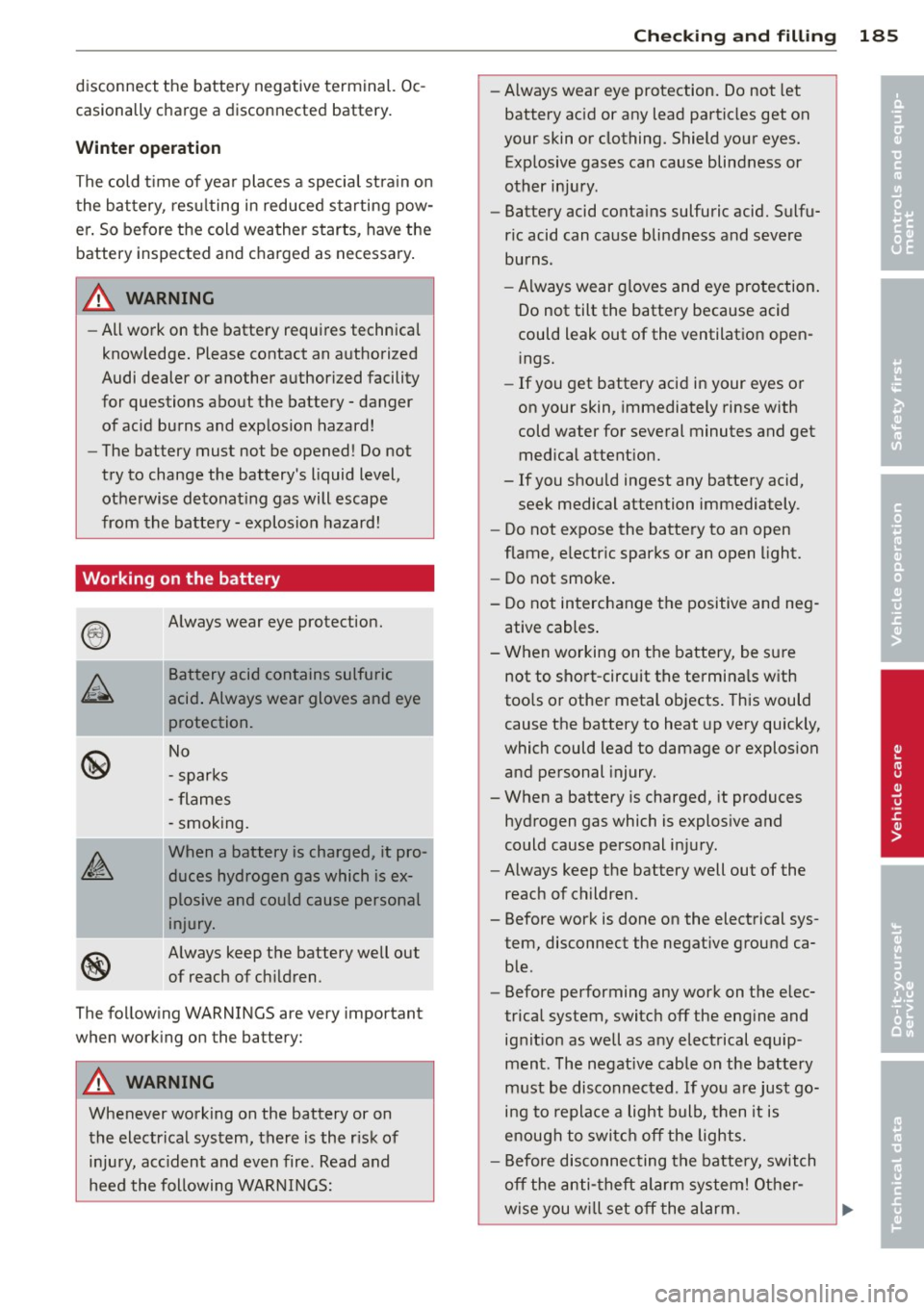
Working on the battery
Always wear eye protection.
Battery acid contains sulfuric
acid. Always wear gloves and eye
protection.
No
- sparks
- flames
- smoking.
When a battery is charged, it pro
duces hydrogen gas which is ex plosive and could cause personal
injury.
Always keep the battery well out
of reach of children.
The following WARNINGS are very important
when working on the battery:
A WARNING
Whenever working on the battery or on
the electrical system, there is the risk of
injury, accident and even fire. Read and
heed the following WARNINGS:
-
Checking and filling 185
- Always wear eye protection. Do not let
battery acid or any lead particles get on
your skin or clothing. Shield your eyes. Explosive gases can cause blindness or
other injury.
- Battery acid contains sulfuric acid. Sulfu
ric acid can cause blindness and severe
burns.
- Always wear gloves and eye protection.
Do not tilt the battery because acid
could leak out of the ventilation open
ings.
- If you get battery acid in your eyes or
on your skin, immediately rinse with
cold water for several minutes and get
medical attention.
- If you should ingest any battery acid,
seek medical attention immediately.
- Do not expose the battery to an open
flame, electric sparks or an open light.
- Do not smoke.
- Do not interchange the positive and neg- ative cables.
- When working on the battery, be sure
not to short-circuit the terminals with
tools or other metal objects. This would cause the battery to heat up very quickly,
which could lead to damage or explosion and personal injury.
- When a battery is charged, it produces
hydrogen gas which is explosive and
could cause personal injury.
- Always keep the battery well out of the
reach of children.
- Before work is done on the electrical sys
tem, disconnect the negative ground ca
ble.
- Before performing any work on the elec
trical system, switch off the engine and
ignition as well as any electrical equip
ment. The negative cable on the battery
must be disconnected.
If you are just go
ing to replace a light bulb, then it is
enough to switch off the lights.
- Before disconnecting the battery, switch
off the anti-theft alarm system! Other
wise you will set off the alarm. •
•
Page 188 of 244
186 Checking and filling
-When disconnecting the battery, first
disconnect the negative cable and then
the positive cable.
- Before reconnecting the battery, make
sure all electrical consumers are switch ed off. Reconnect the positive cable first
and then the negative cable. Never inter
change the cables -this could start a fire!
- Never charge a frozen or a thawed-out
battery. It could explode!
If a battery has
frozen, then it must be replaced. A dis
charged battery can freeze over at 32 °F
(0 °C).
-Make sure the vent hose is always attach
ed to the opening on the side of the bat
tery.
- Never use batteries which are damaged.
Danger of explosion! Always replace a
damaged battery .
.&, WARNING
California Proposition
65 Warning:
- Battery posts, terminals and related ac
cessories contain lead and lead com
pounds, chemicals known to the State of
California to cause cancer and reproduc
tive problems. Wash hands after han
dling.
(D Note
- Do not disconnect the vehicle battery
when the ignition is switched on or when
the engine is running, otherwise, you will
damage electronic components in the
electrical system.
- If your vehicle is going to stand for a
long period of time without being driven,
protect the battery from "freezing", oth
erwise it will be damaged and will then have to be replaced. Charging the battery
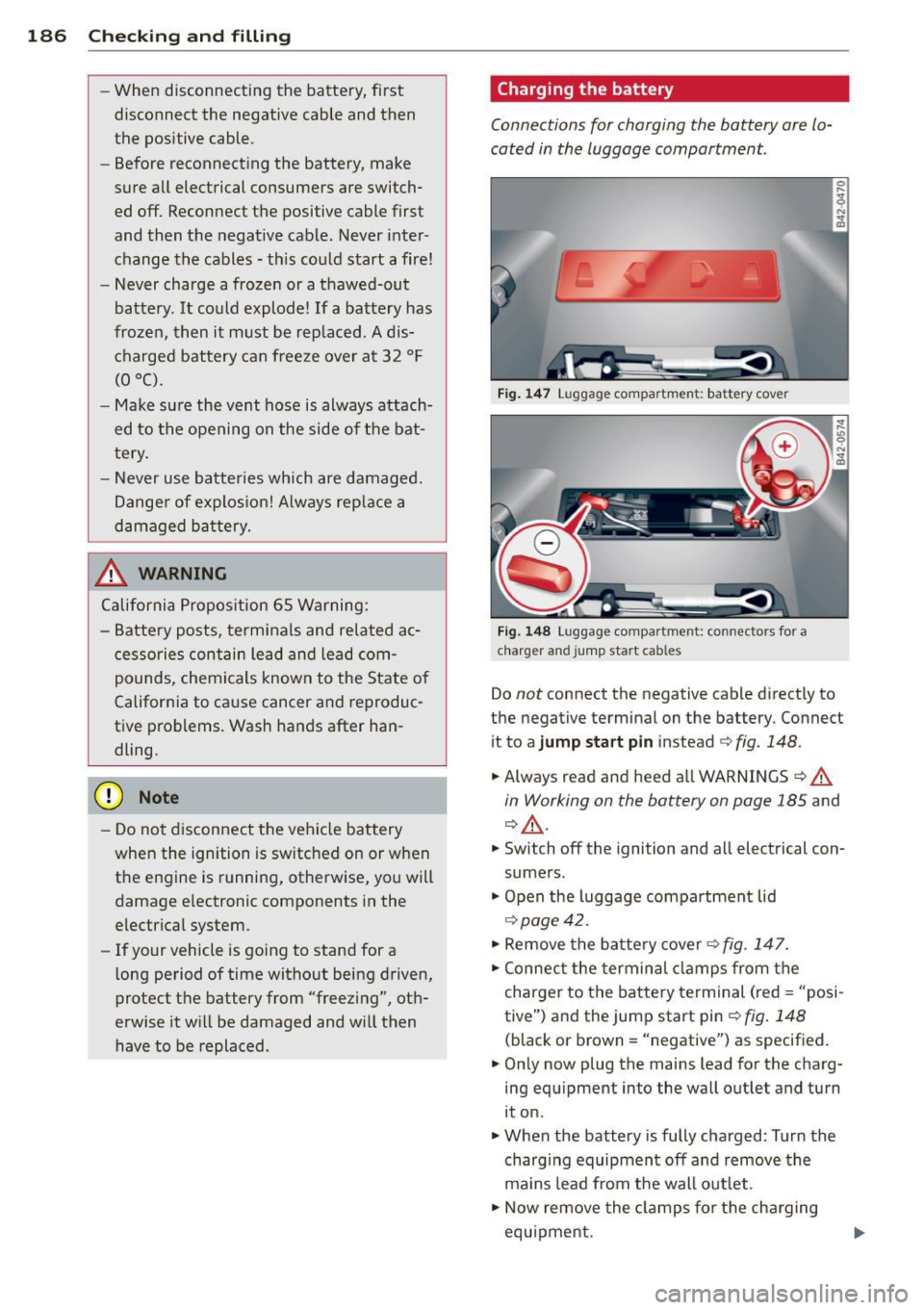
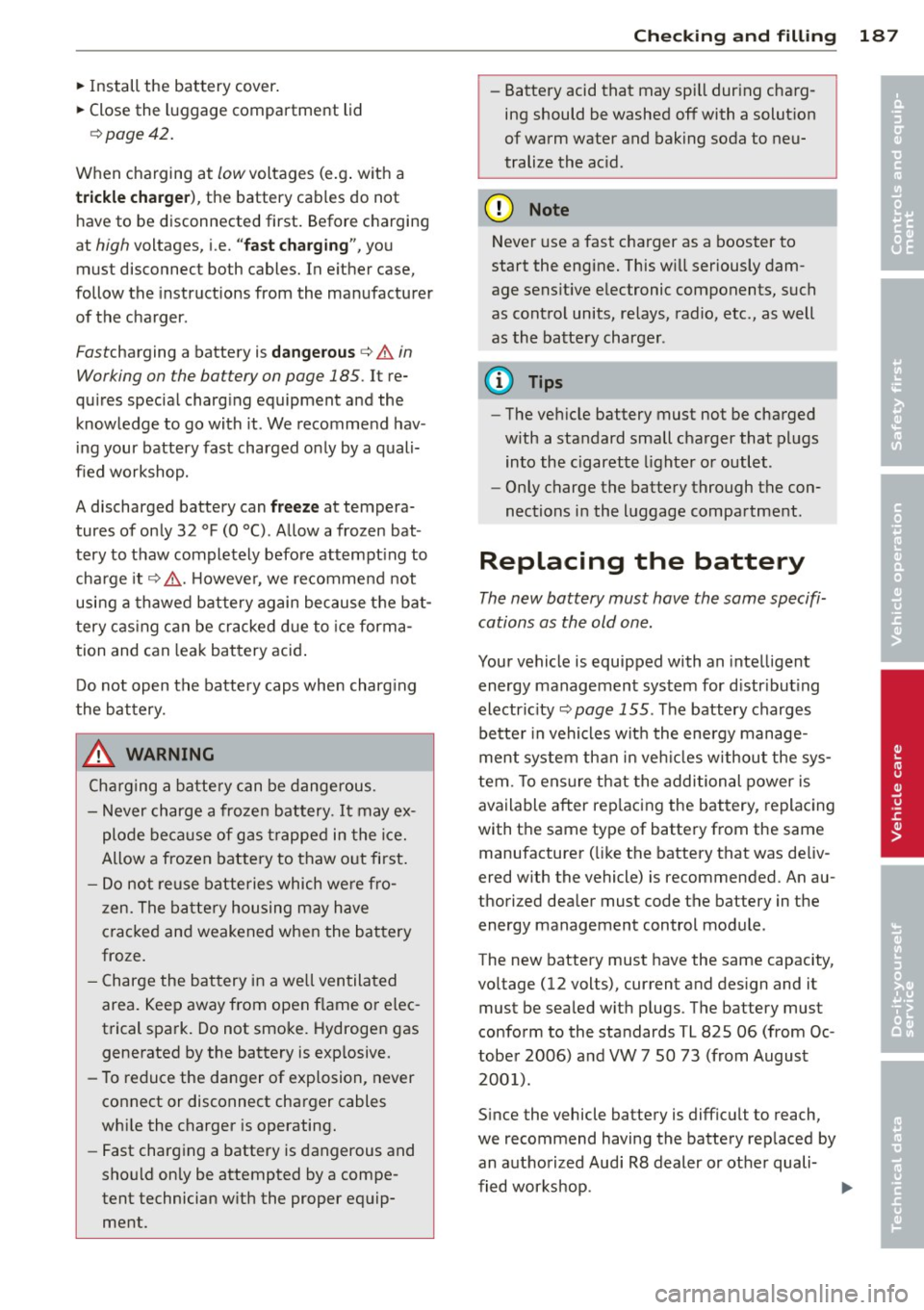
Connections for
charging the battery are lo
cated in the luggage compartment.
Fig. 147 L uggage compartment: battery cover
Fig. 148 Luggage compartment: connectors for a
charger and jump start cables
Do not connect the negative cable directly to
the negative terminal on the battery. Connect
it to a
jump start pin instead c:, fig. 148.
.,. Always read and heed all WARNINGS c:, A
in Working on the battery on page 185 and
¢ A -
... Switch off the ignition and all electrical con
sumers .
.,. Open the luggage compartment lid
c:>page42 .
.,. Remove the battery cover c:, fig. 147.
.,. Connect the terminal clamps from the
charger to the battery terminal (red= "posi
tive") and the jump start pin
c:, fig. 148
(black or brown= "negative") as specified.
.,. Only now plug the mains lead for the charg
ing equipment into the wall outlet and turn
it on .
.,. When the battery is fully charged: Turn the
charging equipment off and remove the
mains lead from the wall outlet .
.,. Now remove the clamps for the charging
equipment.
Page 189 of 244
~ Install the battery cover.
~ Close the luggage compartment lid
¢page 42.
When charging at low voltages (e.g. with a
trickle charger), the battery cables do not
have to be disconnected first. Before charging
at
high voltages, i.e. "fast charging", you
must disconnect both cables. In either case,
follow the instructions from the manufacturer
of the charger .
Fastcharging a battery is
dangerous ¢.&. in
Working on the battery on page 185 .
It re
quires special charging equipment and the knowledge to go with it. We recommend hav
ing your battery fast charged only by a quali
fied workshop.
A discharged battery can
freeze at tempera
tures of only 32 °F (0 °C) . Allow a frozen bat
tery to thaw completely before attempting to
charge it¢ ,&. . However, we recommend not
using a thawed battery again because the bat
tery casing can be cracked due to ice forma
tion and can leak battery acid.
Do not open the battery caps when charging
the battery.
_& WARNING
-
Charging a battery can be dangerous.
- Never charge a frozen battery .
It may ex
plode because of gas trapped in the ice.
Allow a frozen battery to thaw out first.
- Do not reuse batteries which were fro
zen. The battery housing may have
cracked and weakened when the battery
froze.
- Charge the battery in a well ventilated
area. Keep away from open flame or elec
trical spark. Do not smoke. Hydrogen gas
generated by the battery is explosive.
- To reduce the danger of explosion , never
connect or disconnect charger cables
while the charger is operating.
- Fast charging a battery is dangerous and
should only be attempted by a compe
tent technician with the proper equip ment.
Checking and filling 187
- Battery acid that may spill during charg
ing should be washed off with a solution
of warm water and baking soda to neu
tralize the acid .
@ Note
Never use a fast charger as a booster to
start the engine. This will seriously dam
age sensitive electronic components, such
as control units, relays, radio, etc ., as well
as the battery charger .
(D Tips
-The vehicle battery must not be charged
with a standard small charger that plugs
into the cigarette lighter or outlet .
- Only charge the battery through the con
nections in the luggage compartment.
Replacing the battery
The new battery must have the same specifi
cations as the old one.
Your vehicle is equipped with an intelligent
energy management system for distributing
electricity ¢
page 155. The battery charges
better in vehicles with the energy manage
ment system than in vehicles without the sys
tem. To ensure that the additional power is
available after replacing the battery , replacing
with the same type of battery from the same
manufacturer (like the battery that was deliv
ered with the vehicle) is recommended. An au
thori zed dealer mus t code the battery in the
energy management control module .
T he new battery must have the same capacity,
voltage (12 volts), current and design and it
must be sealed with plugs. The battery must
conform to the standards TL 825 06 (from Oc
tober 2006) and VW 7 50 73 (from August 2001).
Since the vehicle battery is difficult to reach,
we recommend having the battery replaced by
an authorized Audi R8 dealer or other quali-
fied workshop . ..,. •
•
Page 190 of 244
188 Checking and filling
(D Note
-Your vehicle is equipped with a specia l
battery. Installing a different type of
battery can cause prob lems in the vehi
cle electrical system. When replacing the
vehicle battery, always install one with
the same spec ificat ions as the original
batte ry .
- Make sure that the gas venting hose is
always connected to the o riginal open ing
on the battery side. Otherw ise gasses or
ba tte ry acid cou ld leak out .
- Battery ho lder and term inals a lways
have to be secured cor rectly.
- Read and follow the warnings under
9 page 185, Working on the battery be
fore performing any work on the batte ry.
@ For the sake of the environment
Because of the problem of proper disposal
of a battery, we recommend your author
ized Audi dealer change the batte ry for
you . Batter ies contain s ulf uric ac id and
lead and must always be disposed of prop
erly in compliance with all environmenta l
reg ulations. D isposing of vehicle batteries
improperly is very dangerous to the envi
ronment. Make sure that the removed bat
tery ca nnot overbalance, otherwise sulfu
r ic acid might escape!
Windshield washer
container
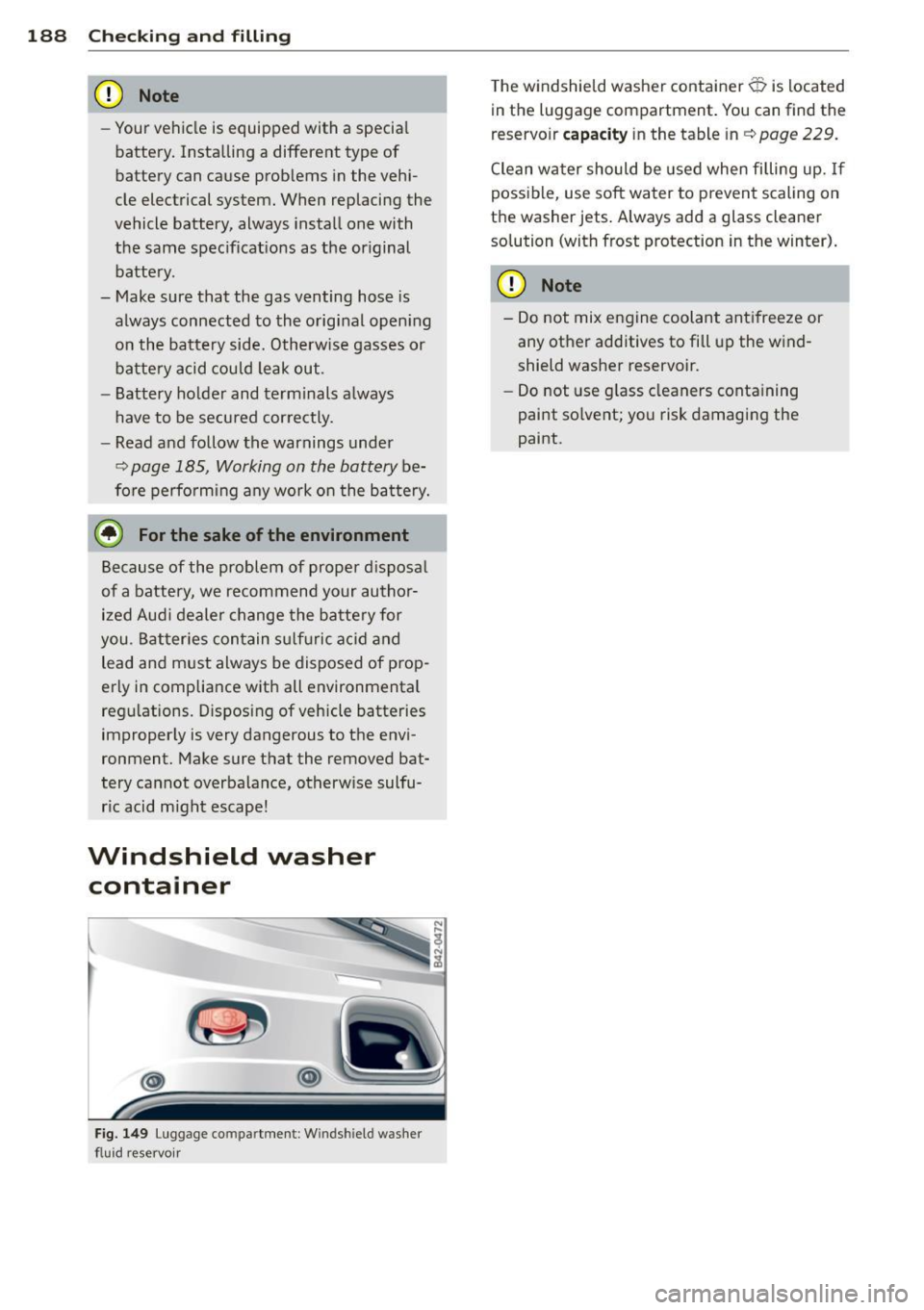
Fig. 149 Luggage co m pa rtment : W inds hield washer
fl uid reservo ir
T he windshield washer container O is located
in the luggag e compartment. You can find the
reservo ir
c a pacit y in the table in c::> page 229.
Clean water should be used when filling up. If
possible, use soft water to prevent scaling on
the washer jets . Always add a glass cleaner
solution (with frost protection in the winter) .
(D Note
-Do not mix engine coolant antifreeze or
any other additives to fill up the wind
shield washer reservoir.
- Do not use g lass cleaners conta ining
pai nt so lvent; you risk damaging the
paint.
Page 191 of 244
Tires and wheels
Tires
General notes
Tires may be the least appreciated and most
abused parts of a motor vehicle .
Tires may be the least appreciated and most
abused parts of a motor vehicle . T ires are,
however, one of the most important parts of a
vehicle, particularly considering the compara
tively small patch of rubber on each tire that
assures that a ll- important contact between
you, you r vehicle and the road.
Maintaining the correct tire pressure, mak ing
sure that your vehicle and its tires do not have
to carry mo re weight than they can safely han
d le, avoiding damage from road hazards and
r eg ularly inspect ing t ires for damage i nclud
ing cuts, slashes irregu la r wear and ove rall
condition are the most important things that
you can do to he lp avoid s udden tire failure in
cluding tread separat ion and blowouts.
A voidin g damage
If yo u have to d rive over a curb or similar ob
stacle, drive very slow ly and as close as possi
b le at a right angle to the curb.
A lways keep chemicals incl ud ing grease, o il ,
gasoline and brake fluid off the t ires .
I nspect the t ires regularly for damage (cuts,
cracks or b listers, etc.). Remove any fo reign
bod ies embedde d in the treads.
Storing tires Mark tires when you remove them to indicate
the direction of rotation . T his ensures you to
be ab le to mount them correctly when you re
i nstall them .
When removed, the whee ls or t ires should be
sto red in a cool, d ry and preferably dark place .
Store tires in a vertical pos ition if they are not
mounted on r ims, in a horizontal pos it ion if
they are mounted on rims .
Tires an d wheel s 189
New tires
New ti res h ave to be broken in~& .
The tread depth of new t ires may vary, accord
ing to the type a nd make of t ire and the tread
patte rn.
H idden damage
Damage to tires and r ims is ofte n not readily
visible . If you notice unusual v ib rat ion or the
vehicle pulls to one s ide, th is may ind icate
that one of the t ires has been damaged . T he
ti res m ust be chec ked immed iate ly by an au
thorized Audi dea le r or q ua lified wor kshop .
Unidirectional tires
A un idirectional tire can be identified by ar
rows on the sidewa ll, that po int in the direc
tion the t ire is designed to rotate. You must
f ol low the specified di rection o f rotation . T his
is necessary so that these tires can develop
their optimum characteristics regarding grip,
road noise, wear and hydrop laning resistance.
For more information
~ page 216.
A WARNING
New tires or t ires that are o ld, worn or
damaged cannot provide maximum con
trol and braking ability .
-
-New tires tend to be slippery and must
be broken in. To reduce the r isk of losing
control, a co llision and ser ious personal
in ju ries, d rive with special ca re for the
fi rst 350 m iles ( 560 km).
- Driving with worn or damaged tires can
lead to loss of control, sudden tire fail
ure, including a blowout and sudden de
fl ation, cras hes and se riou s personal in
juries . Have wo rn or damaged t ires re
placed immediate ly.
- Ti res age even if they are not being used
and can fail sudden ly, especially at hig h
speeds. Tires that are more than 6 years
old can only be used in an emergency
and then w ith special care and at low
speed.
•
•
Page 193 of 244
Maximum loaded vehicle weight
means the sum of:
(a) Curb weight
(b) Accessory weight
(c) Vehicle capacity weight, and
(d) Production options weight
Maximum (permissible) inflation pressure
means the maximum cold inflation pressure
to which a tire may be inflated. Also called
"maximum inflation pressu re."
Normal occupant weight
means 150 lbs. (68 k ilograms) times the
nu mber of occupants seated in the vehicle up
to the total seating capacity of your vehicle.
Occupant distribution
means distribution of occupants in a vehicle .
Outer diameter
means the overa ll diameter of an inflated new
tire.
Overall width
means the linear distance between the exteri
ors of the sidewalls of an inflated tire, includ
ing e levations due to labeling, decorations, or
protective bands or ribs.
Ply
means a layer of rubber-coated para llel cords.
Production options weight
means the comb ined weight of those installed
regular production options weighing over 5
lbs . (2 .3 kg) in excess of those standard items
which they replace, not previously considered
in curb weight or accessory weight, including
heavy duty brakes, r ide leve lers, roof rack,
heavy duty battery, and specia l trim .
Radial ply tire
means a pneumatic t ire in which the p ly cords
that extend to the beads are laid at substan
tially 90 degrees to the centerline of the
tread.
Tires and wheels 191
Recommended inflation pressure
see ~ page 190, Cold tire inflation pressure.
Reinforced tire
means a t ire designed to operate at higher
loads and at higher inflat ion pressures than
the corresponding standard tire. Re inforced
ti res my be ident ified as "XL" , "xl", "E XTRA
LOAD", or "RF" on the sidewall.
Rim
means a metal support for a tire or a tire and
tube assembly upon which the tire beads are
seated.
Rim diameter
means nom inal d iameter of the bead seat. If
you change your wheel s ize, you w ill have to
purchase new tires to match the new r im di
ameter.
Rim size designation
means r im diameter and width.
Rim width
means nom inal distance between rim fla nges.
Sidewall
means that portion of a tire between the
tread and bead.
Speed rating (letter code)
means the speed at which a tire is designed to
be driven for extended periods of time. The
ratings range from 93 mph (150 km/h) to
186 mph (298 km/h)
~ page 200 . You may
not find this information on all tires because
it is not requ ired by law.
T he speed rating letter code, where applica
ble, is molded on the tire sidewall and indi
cates the maximum pe rm issib le road speeds
~ .&. in Winter tires on page 204.
Tire pressure monitoring system
means a system that detects when one or
more of a veh icle's tires are underinflated and
illuminates a low tire pressure warning tell
tale.
•
•