warning AUDI R8 SPYDER 2011 Owners Manual
[x] Cancel search | Manufacturer: AUDI, Model Year: 2011, Model line: R8 SPYDER, Model: AUDI R8 SPYDER 2011Pages: 244, PDF Size: 59.74 MB
Page 196 of 244
194 Tire s and wheel s
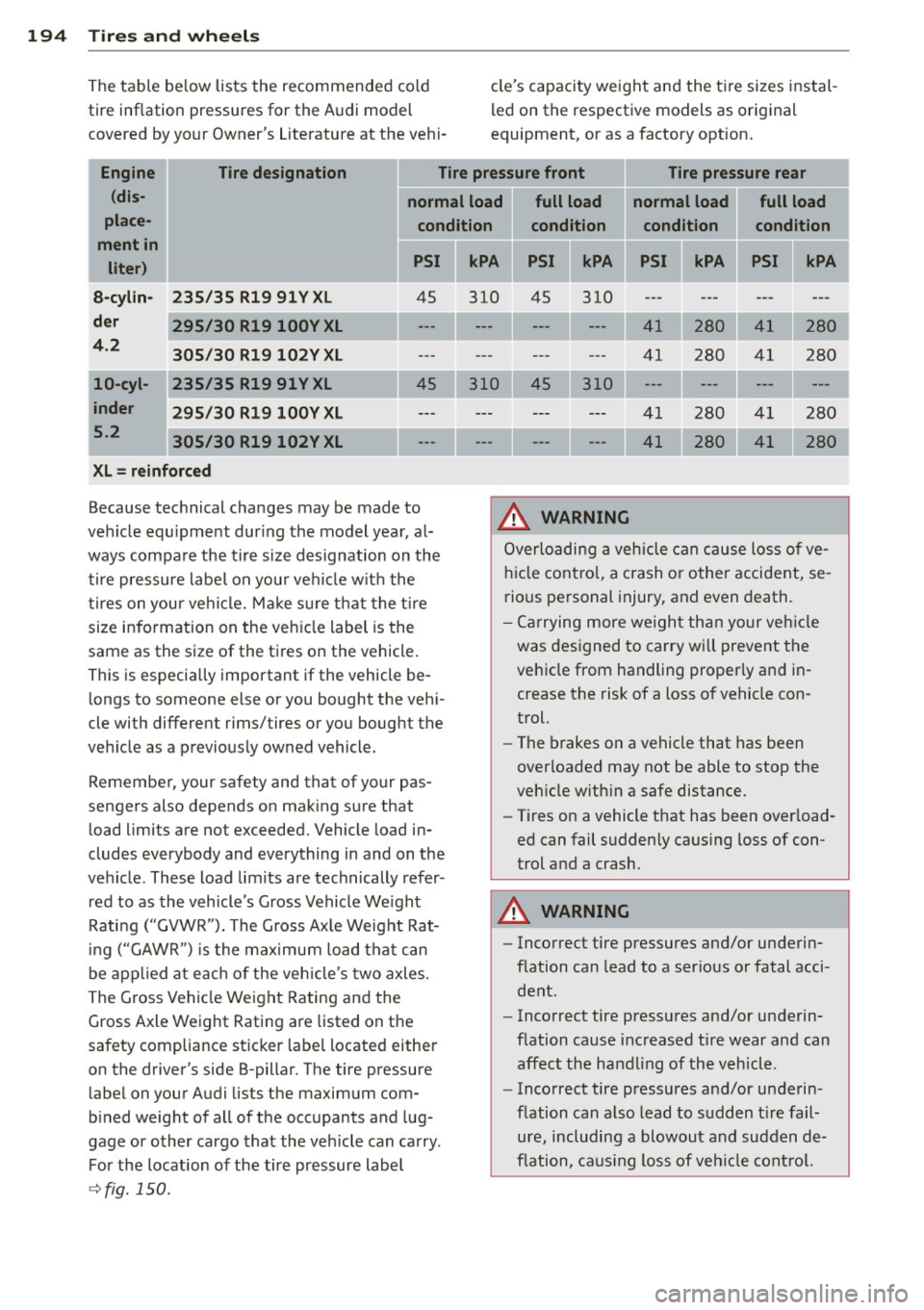
The table be low lists the recommended cold
tire inflation pressures for the Audi model
covered by your Owner's Literature at the vehi- cle's capacity weight and the tire sizes instal
led on the respective models as original
equipment, or as a factory option.
Engine
(dis
place
ment in Tire designation
Tire pressure front Tire pressure rear
normal load full load normal load full load condition condition condition condition
liter )
a -cylin
der
4 .2
inder
5.2 235
/3 5 R1 9 9 1 V
XL
295 /30 R19 100V X L
305 /30 R1 9 10 2V X L
235 /35 R19 91 V X L
295 /30 R1 9 100V XL
305 /30 R19 102V X L
XL= reinf orc ed
PSI
45
Because tec hnical changes may be made to
vehicle equ ipment dur ing the model yea r, a l
ways compare the tire size designation on the
tire pressure labe l on you r vehi cle w it h the
tires on your vehicle. Make s ure that the ti re
size information on the veh icle label is the
same as the size of the tires on the vehicle.
This is especially important if the vehicle be
longs to someone else or you bought the vehi
cle with different rims/tires or you bought the
vehicle as a previously owned vehicle.
Remember, your safety and that of your pas
sengers also depends on mak ing sure that
load limits are not exceeded. Vehicle load in
cludes everybody and everything in and on the
veh icle . These load lim its are technically refer
red to as the vehicle's G ross Vehicle We ight
Rati ng ("GVWR"). The G ross Ax le Weight Rat
i ng ("GAWR") is the max imum load that can
be app lied at each o f the veh icle's two axles.
The G ross Vehicle Weight Rating and the
Gross Axle Weight Rating are listed on the
safety compliance stic ker labe l located either
on the driver's side B-pillar. The tire pressure
labe l on your Audi lists the maximum com
b ined weight of all of the occupants and lug
gage or other cargo that the veh icle can carry.
For the location of the tire pressure label
¢ fig. 15 0 .
kPA PSI kPA PSI
310 45 310
41
41
kPA PSI
280 41
280 41
kPA
280
280
280
280
.&_ WARNING
Overloading a vehicle can cause loss of ve
h icle cont ro l, a crash o r other accident, se
r ious pe rsonal injury, and even death.
- Ca rrying more we igh t than your veh icle
was designed to carry wi ll prevent the
vehicle from handling properly and in
crease the risk of a loss of vehicle con
trol.
- The brakes on a vehicle that has been
overloaded may not be able to stop the
veh icle w ith in a safe distance.
- Tires on a vehicle that has been over load
ed can fail s uddenly ca us ing loss of con
trol and a crash.
.&_ WARNING
- Incorrect tire pressures and/or underin
flation can lead to a serious or fatal acci
dent.
- Inco rrect tire pressures and/or underin
f lation cause increased tire wear and can
affect the handling of the vehicle.
- Inco rrect tire pressures and/or underin
f lation can a lso lead to s udden t ire fail
ure, including a blowout and sudden de
flation, ca using loss of veh icle cont ro l.
Page 198 of 244
196 Tires and wheels
wheels you have to adjust the tire pressures
on all wheels.
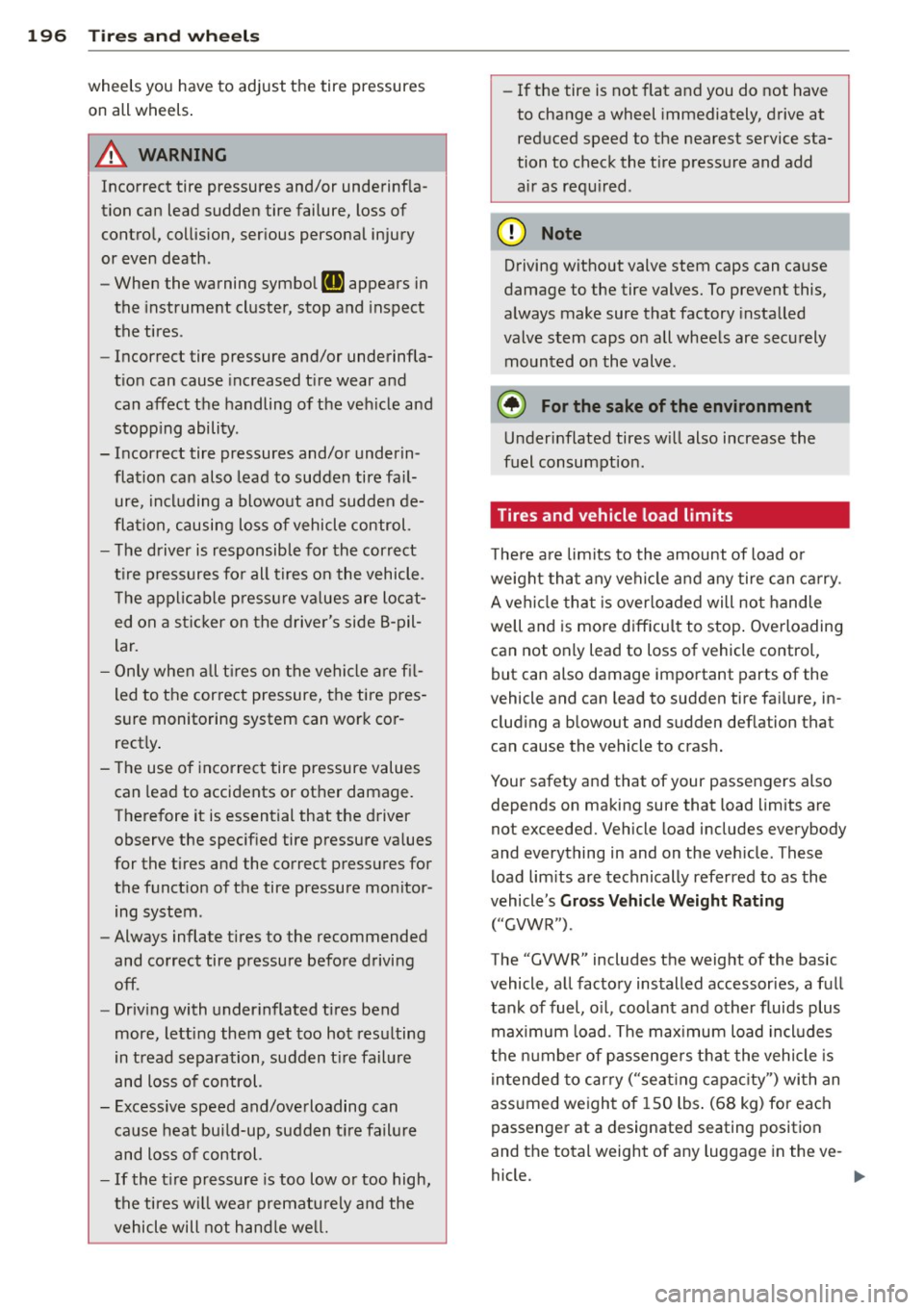
A WARNING
Incorrect tire pressures and/or underinfla
tion can lead sudden tire failure, loss of
control, collision, serious personal injury
or even death.
- When the warning symbol
RI] appears in
the instrument cluster, stop and inspect
the tires .
- Incorrect tire pressure and/or underinfla
tion can cause increased tire wear and
can affect the handling of the vehicle and
stopping ability .
- Incorrect tire pressures and/or underin flation can also lead to sudden tire fail
ure, including a blowout and sudden de
flation, causing loss of vehicle control.
- The driver is responsible for the correct
tire pressures for all tires on the vehicle .
The applicable pressure values are locat
ed on a sticker on the driver's side 8-pil
lar.
- Only when all tires on the vehicle are fil
led to the correct pressure, the tire pres
sure monitoring system can work cor
rectly.
- The use of incorrect tire pressure values
can lead to accidents or other damage.
Therefore it is essential that the driver
observe the specified tire pressure values
for the tires and the correct pressures for
the function of the tire pressure monitor
ing system .
- Always inflate tires to the recommended
and correct tire pressure before driving
off .
- Driving with underinflated tires bend
more, letting them get too hot resulting
in tread separation, sudden tire failure
and loss of control.
- Excessive speed and/overloading can
cause heat build-up, sudden tire failure
and loss of control.
- If the tire pressure is too low or too high,
the tires will wear prematurely and the
vehicle will not handle well. -
If the tire is not flat and you do not have
to change a wheel immediately, drive at
reduced speed to the nearest service sta
tion to check the tire pressure and add
air as required .
(D Note
Driving without valve stem caps can cause
damage to the tire valves. To prevent this,
always make sure that factory installed
valve stem caps on all wheels are securely mounted on the valve.
@ For the sake of the environment
Underinflated tires will also increase the
fuel consumption .
Tires and vehicle load limits
There are limits to the amount of load or
weight that any vehicle and any tire can carry .
A vehicle that is overloaded will not handle
well and is more difficult to stop. Overloading
can not only lead to loss of vehicle control,
but can also damage important parts of the
vehicle and can lead to sudden tire failure, in cluding a blowout and sudden deflation that
can cause the vehicle to crash.
Your safety and that of your passengers also depends on making sure that load limits are
not exceeded. Vehicle load includes everybody
and everything in and on the vehicle . These
load limits are technically referred to as the
vehicle 's
Gross Vehicle Weight Rating
("GVWR").
The "GVWR" includes the weight of the basic
vehicle, all factory installed accessories, a full
tank of fuel, oil, coolant and other fluids plus
maximum load. The maximum load includes
the number of passengers that the vehicle is
intended to carry ("seating capacity") with an
assumed weight of 150 lbs. (68 kg) for each
passenger at a designated seating position
and the total weight of any luggage in the ve-
hicle. ..,_
Page 199 of 244
The Gross Axle Weight Rating ("GAWR") is
the maximum load that can be applied at each
of the vehicle's two axles.
The Gross Vehicle Weight Rating and the
Gross Axle Weight Rating are listed on the
safety compliance sticker labe l located on the
driver's side B-pi llar . Your Audi has 2 seat ing
positions in the front for total seat ing capac i
t y of 2. Each seating posi tion has a safety belt
c::> page 109, Safety belts.
The fact that there is an upper limit to your
ve hicle's Gross Veh icle Weight Rating means
that the total weight of whatever is being car
ried in the veh icle is limited . The more passen
gers in the veh icle or passengers who a re
heavier than the standard weights assumed
mean that less weight can be carried as lug
gage.
The t ire pressure label on your Audi also lists
the maximum combined we ight of all of the
occupants and luggage o r othe r cargo that
the vehicle can carry. For the location of the
la be l
c::>page 193, fig. 150.
A WARNING
Overloading a vehicle can cause loss of ve
hicle control, a crash or other accident, se
r ious personal injury, and even death.
- Carrying more weight than your vehicle
was designed to carry will prevent the
vehicle from handling properly and in
crease the risk of the loss of veh icle con
trol.
- The brakes on a veh icle that has been
overloaded may not be able to stop the
vehicle within a safe distance .
- Tires on a vehicle that has been overload
ed can fail suddenly, includ ing a b lowout
and sudden deflation, causing loss of
control and a crash.
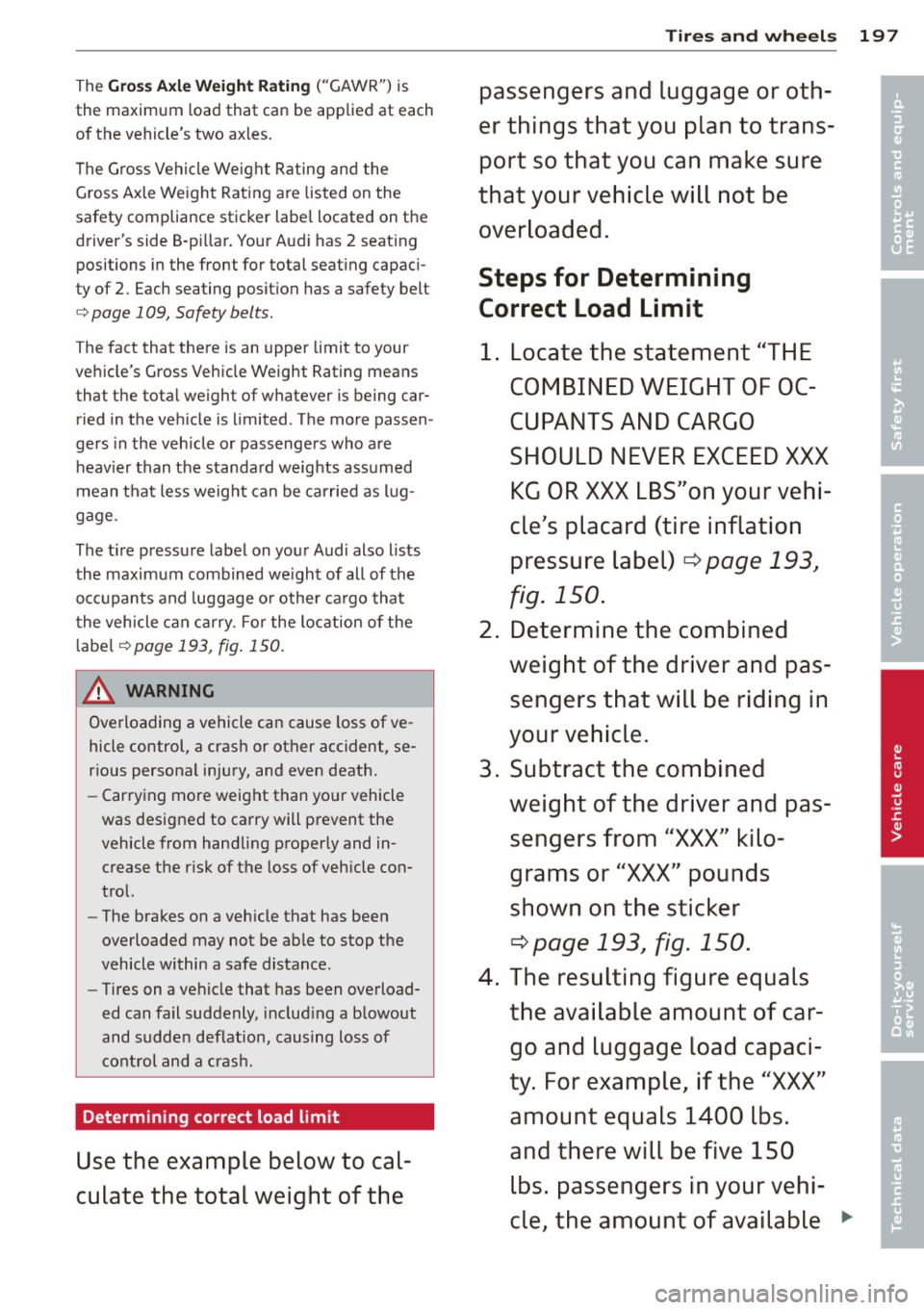
Determining correct load limit
Use the example below to cal
culate the total weight of the
Tires and wheels 197
passengers and luggage or oth
er things that you plan to trans
port so that you can make sure
that your vehicle will not be
overloaded.
Steps for Determining
Correct Load Limit
1. Locate the statement "THE
COMBINED WEIGHT OF OC
CUPANTS AND CARGO
SHOULD NEVER EXCEED XXX
KG OR XXX LBS"on your vehi
cle's placard (tire inflation
pressure label)
¢ page 193,
fig. 150.
2. Determine the combined weight of the driver and pas
sengers that will be riding in
your vehicle.
3. Subtract the combined
weight of the driver and pas
sengers from
"XXX" kilo
grams or
"XXX" pounds
shown on the sticker
¢ page 193, fig. 150.
4. The resulting figure equals
the available amount of car
go and luggage load capaci-
ty. For example, if the
"XXX"
amount equals 1400 lbs.
and there will be five 150
lbs. passengers in your vehi
c le, the amount of available .,..
•
•
Page 201 of 244
A WARNING
Sudden tire failure can lead to loss of con
trol, a crash and serious personal injury!
- Never drive a vehicle when the tread on
any tire is worn down to the wear indica
tors.
- Worn tires are a safety hazard, they do
not grip well on wet roads and increase
your risk of "hydroplaning" and loss of
control.
- Always keep chemicals that can cause
tire damage, such as grease, oil, gasoline
and brake fluid away from t ires.
- Tires age even if they are not be ing used
and can fail suddenly, especially at high
speeds . Tir es that are more than 6 years
old can only be used in an emergency
and then with special care and at lower
speeds.
- Never mount used tires on your vehicle if
you are not sure of their" previous histo
ry ." Old used tires may have been dam
aged even though the damage cannot be
seen that can lead to sudden tire failure
and loss of vehicle control.
Tires and wheels 199
New tires and replacing tires and wheels
New tires and wheels have to be broken in .
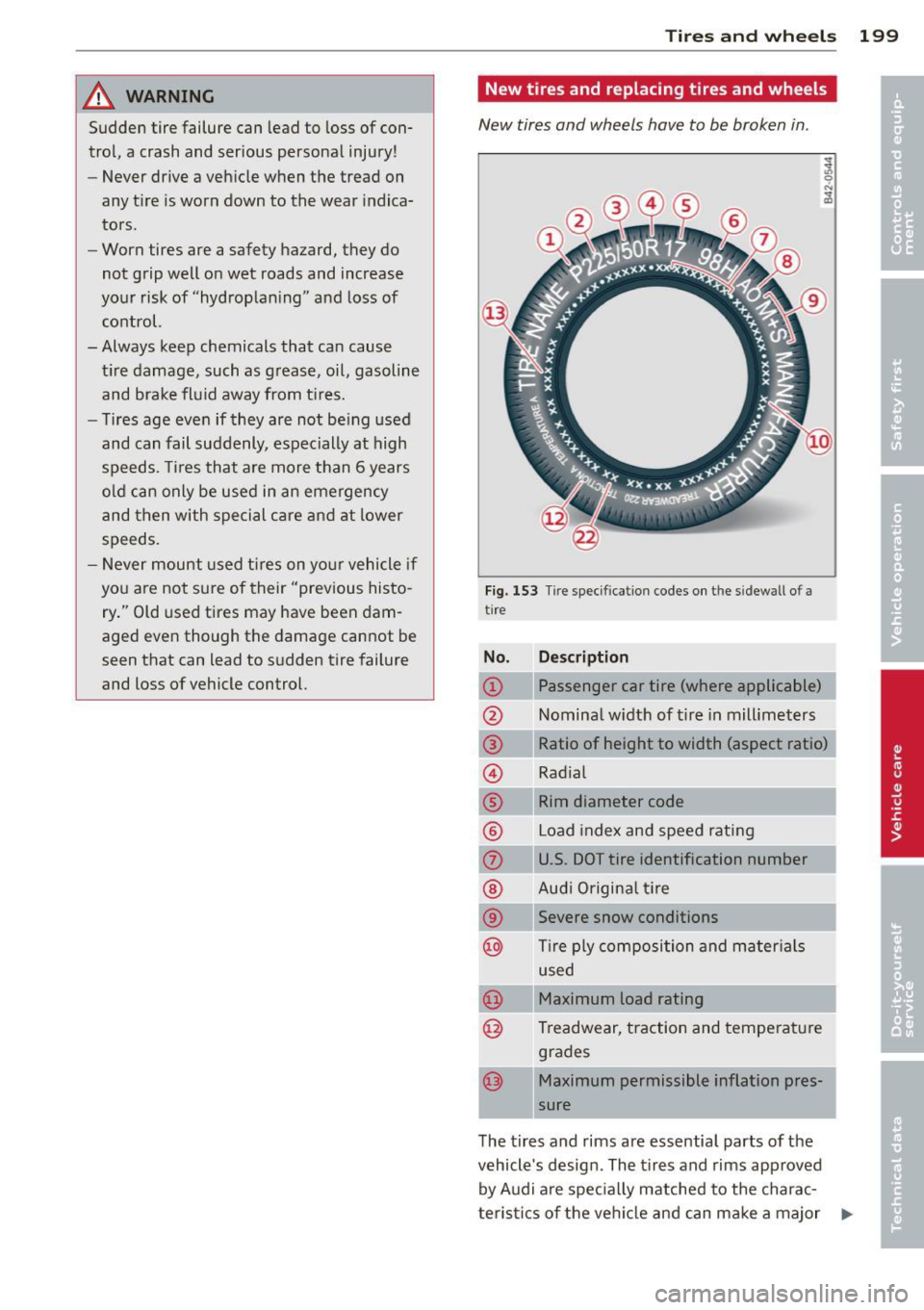
Fig. 153 Tir e specificat ion codes on t he s idewall o f a
tire
No. Description
CD Passenger car tire (where applicable)
@ Nominal w idth of tire in millimeters
® Ratio of height to width (aspect ratio)
© Radial
® Rim diameter code
® Load index and speed rating
(f) U.S. DOT tire identification number
® Audi Origina l tire
® Severe snow conditions
@ T ire ply composition and materials
used
@ Maximum load rating
@ Treadwear, traction and temperature
grades
@ Maximum permissible inflation pres-
sure
The tires and rims are essential parts of the
vehicle's design . The tires and rims approved
by Audi are spec ially matched to the charac
teristics of the vehicle and can make a major .,.
•
Page 204 of 244
202 Tir es and whee ls
The installation of replacement tires with
steel cord body plies in the tire sidewall may
cause ma lfunction of the tire pressure moni
toring system, and is not recommended (cord material information in molded on the tire
sidewall) .
Always check your tire pressure monitoring
system indicator after replacing one or more
tires on your vehicle. If the tire pressure moni
toring system indicator flashes, or is on, your
system is not work ing properly.
A WARNING
- Us ing incorrect or unmatched tires and/
or wheels or improper t ire and whee l
combinations can lead to loss of contro l,
co llision and serious persona l injury.
- Always use tires, rims and wheel bo lts
that meet the specifications of orig inal
factory-installed t ires or other combina
tions that have been specifically ap
proved by the vehicle manufacturer .
- Tires age even if they are not being used and can fail su ddenly, especially at high
speeds. Tires that are more than 6 years
o ld can only be used in an emergency
and then with special care and at lower
speeds .
- Never mount used tires on your vehicle if
you a re not sure of their "previous histo ry." Old used tires may have been dam
aged even though the damage cannot be
seen that can lead to sudden tire failure
and loss of vehicle control.
- Only the wheel/tire s izes spec ified by the
manufactu rer may be used on veh icles
with all-wheel dr ive.
- Never drive faste r than the maxim um
speed for which the tires on your veh icle
are ra ted because tires that are driven
f aster than their rated speed can fail
sudden ly .
- Overloading ti res cause heat build-up,
sudden tire failure, incl uding a blowout
and sudden deflation and loss of control. -
Temperature grades apply to tires that
are properly inflated and not over or un
derinflated.
- For technical reasons it is not always
possible to use wheels from other vehi
cles -in some cases not even wheels
from the same veh icle model.
- Do not use run-flat tires on your vehicle.
Using run-flat t ires can lead to veh icle
damage or crashes .
@ Note
- For technical reasons, it is not generally
possible to use the wheel rims from oth
er veh icles . Th is can hold true for wheels
of the same vehicle type .
- If you should put different wheels and
tires on your veh icle (e.g . winter wheels
and tires), you must be certain that the
wheels and tires are compatible with the tire pressure monitoring system. Other
w ise the system will register a malfunc
tion and a fau lt message w ill be dis
played. For more information, contact
your authorized Audi dealer.
(D Note
- When installing new tires, be care ful not
to damage the va lves or tire pressure
monitoring system sensors.
- Never drive without the valve stem cap.
The va lves cou ld get damaged.
- If the sensors must be replaced, then
the valve must also be replaced at the
same time .
@ For the sake of the environment
Dispose of o ld tires in accordance with the
l ocal requirements .
@ Tips
Tires with the iden tificatio n "RO l" have
been specially matched with your A udi. We
r ecommend using on ly these tires because
they meet the highest standards regarding
safety and driving characteristics when used correctly . Your authorized Audi R8
Page 205 of 244
dealer will g ladly provide you with more
information.
Uniform tire quality grading
- Tread wear
- Traction AA A B C
- T emperature ABC
Quality grades can be found where applicable
on the ti re side wa ll between tread shoulde r
and maximum section wid th ¢ page 199,
fig. 153 .
For example : Tread wear 200, Tract ion AA ,
Tempe ratu re A .
All passenger car tires must conform to Feder
al Safety Requi rements in addition to these
grad es.
Tread we ar
The tread wear grade is a comparative rating
based on the wear rate of the tire when tested
under controlled conditions on a spec ified
government test course.
For example, a t ire graded 150 would wear
one and one half (1 1/2) t imes as well on the
government course as a tire graded 100 .
The relat ive perform a nee of ti res depends
upon the actual conditions of their use, how
ever, and may depart sign ificantly from the
norm due to var iat ions in dr iv ing habits, serv
i ce practices and differences in road cha racter
i stics and climate.
Traction
The traction grades, from highest to lowest,
are AA, A, Band
C. Those grades represent the
tire's abil ity to stop on wet pavement as
measured unde r controlled cond it ions on
spec ified gove rnment test su rfaces of asphalt
and concrete . A tire ma rked C may h ave poor
tr action perfo rm ance¢ &..
Temp erature
The temperature grades are A (the h ighest),
B, and C, repr ese nting the t ire's resistance to
the gene rat io n of heat and i ts ab ility to dissi-
Tire s an d wheel s 203
pate heat when tested under controlled condi
tions on a specified indoor laboratory test
whee l.
Sustaine d high temperature can cause the
mater ia l of the tire to degenerate and red uce
tire life, and excessive tempe rat ure ca n lead
to s udden tire failure ¢ &. .
T he gr ade C correspon ds to a level of pe rform
ance which all passenger car tires must meet u nder the Federal Motor Vehicle Safety Stand
ard No . 109 . Grades Band A represent higher
l evels of performance on the laboratory test
whee l than the minimum requ ired by law.
A WARNING
The traction grade assigned to th is tire is
based on straight-ahead braking traction
tests, and does not include accele rat ion,
cor neri ng, hy droplaning or peak t ra ction
ch aracte rist ics.
A WARNING
T he temperature grade for this tire is es
tablished for a tire that is properly inf lated
and not overloaded . Excess ive speed, un
derinflation, or excessive loading, e it h er
separately or in combinat ion, can ca use
heat bui ldup and possible tire failure.
Winter tires
Winter tires con improve vehicle handling on
snow and ice. At temperatures below 45 °F (7 °C) we recommend changing to winter
tires.
In some heavy snow areas, local governments
may require true w inter or "snow" tires, those
with very deeply cut tread. T hese tires should
o nl y be used in pairs and be installed o n all
fou r wheels . Make sure you purchase snow
ti res that a re the same si ze and construction
type as the othe r ti res on you r vehicle.
If your vehicle is equipped w ith all-whee l
drive*, th is w ill improve traction during winter
driv ing, even with the s tanda rd tires . Howev-
er, we stro ngly recommend that you always ..,.
•
•
Page 206 of 244
204 Tir es and whe els
eq uip all four wheels on your vehicle with cor
rectly fitted winter tires or all-season tires,
when winter road conditions are expected. This a lso improves the vehicle's braking per
formance and reduces stopping distances.
Summer tires provide less grip on ice and
snow.
W inter t ires (snow t ires) must always be fitted
on all four wheels.
Compat ible tire pressure mon itor ing sensors
must be installed on all fou r winter tires for
the tire pressure monitoring system to func
tion proper ly ~
page 201 .
Ask your authorized Aud i dea ler or qualified
wo rkshop for permitted
winter tir e sizes. Use
only radia l winter tires .
W inter t ires lose the ir effectiveness when the
tread is worn down to a depth of 0.157 inch
(4 mm) .
Only drive with winter tires under winter con
d itions . Summer tires handle better when
there is no snow or ice on the roads and the
temperature is above 45 °F (7 °C).
Please always remember that w inte r tires may
have a lower speed rating than the t ires origi
na lly installed on your veh icle at the t ime i t
was manufactured. Please see
r:!> page 200 ,
Speed roting (letter code) for a list ing of the
speed rating letter codes and the maximum
speed at which the tires can be driven.
The speed ra ting letter code
(~ page 191) is
on the s ide wall of the tire
r::!> poge 199.
A WARNING
Winter tires have maximum speed limits
that may be lower than your vehicle's max
im um speed . Always know the maxim um
speed before driving off. Never drive faster
than the speed permitted for your specific
w inte r tires . This will cause damage to the
tires leading to an accident and serious
personal in ju ry to you and your passen
gers.
A WARNING
Driving faster than the maximum speed
for which the winter tires on your veh icle
were designed can cause t ire failure in
cluding a blowout and sudden deflation,
l oss of cont ro l, crashes and ser ious per
sonal injuries. Have wo rn o r damaged ti res
r eplaced immediately.
- W inte r ti res have maxim um speed rating
that may be lower than your vehicle 's
maximum speed.
- Never drive fas ter than the speed for
which the win ter or othe r ti res installed
on yo ur vehicle are rated.
A WARNING ~
A lways ad just your driving to the road and
traffic condit ions. Never let the good ac
celeration of the winter tires and all-wheel
drive tempt you into taking extra risks. Al
ways remember:
- When braking, an all-wheel drive veh icle
handles in the same way as a front drive
veh icle.
- Drive carefully and reduce your speed on
icy and slippery roads, even w inter t ires
cannot help under black ice conditions .
~ For the sake of the environment
Use summer tires when weather condi
tions permit. They are qu ieter, do not wear
as quickly and reduce fuel consumpt ion.
Snow chains
-
S now cha ins may be fitted only to the rea r
whee ls, and o nly to certa in tire sizes . Ask your
autho rized Aud i dea le r o n whi ch tire sizes
snow c hains ca n be used.
T he snow chains must have low-profile links
and must not be t hicker than 0 .53 inch
(13 .5 mm), in cl ud ing the lock.
Remove wheel center covers before putt ing
snow c ha ins on your vehicle~@ . For safety
reasons cover caps must then be f itted over
Page 207 of 244
the wheel bolts. These are available from au
thorized Audi dealers.
A WARNING
Using the wrong snow chains for your vehi
cle or installing them incorrectly can in
crease the risk of loss of control leading to
serious personal injury.
- Snow chains are available in different
sizes. Always make sure to follow the in
structions provided by the snow chain
manufacturer .
- When driving with snow chains, never
drive faster than the speed permitted for
your specific snow chains.
- Always observe local regulations.
- Remove snow chains before driving on
roads not covered with snow to avoid
damaging tires and wearing the snow
chains down unnecessarily.
- Snow chains, which come into direct con
tact with the wheel rim, can scratch or
damage it. Therefore, make sure that the
snow chains are suitably covered . Check
the position of the snow chains after
driving a few yards and correct if neces
sary. Follow the instructions from the
snow chain manufacturer when doing so.
(D Tips
Where snow chains are mandatory oncer
tain roads, this normally also applies to ve
hicles with all-wheel drive.
Wheel bolts
Wheel bolts must always be tightened to the
correct torque.
The design of wheel bolts is matched to the
factory installed rims. If different rims are fit
ted, the correct wheel bolts with the right
length and correctly shaped bolt heads must
be used. This ensures that wheels are fitted
securely and that the brake system functions
correctly .
Tires and wheels 205
In certain circumstances, you may not use
wheel bolts from a different vehicle -even if it
is the same model
r:!> page 211.
A WARNING
Improperly tightened or maintained wheel
bolts can become loose causing loss of
control, a collision and serious personal in
jury.
- Always keep the wheel bolts and the
threads in the wheel hubs clean so the
wheel bolts can turn easily and be prop erly tightened.
- Never grease or oil the wheel bolts and
the threads in the wheel hubs. They can
become loose while driving if greased or
oiled, even if tightened to the specified
torque.
- Only use wheel bolts that belong to the
rim being installed.
- Never use different wheels bolts on your
vehicle.
-Always maintain the correct tightening
torque for the wheel bolts to reduce the
risk of a wheel loss. If the tightening tor
que of the wheel bolts is too low, they
can loosen and come out when the vehi
cle is moving.
If the tightening torque is
too high, the wheel bolts and threads
can be damaged and the wheel can be
come loose.
(D Note
The specified torque for the wheel bolts is
90 ft lb (120 Nm) with a tolerance of ± 7 .4
ft lb( ± 10 Nm). Torque wheel bolts diago
nally. After changing a wheel, the torque
must be checked as soon as possible with a
torque wrench -preferably by an author
ized Audi dealer or qualified workshop.
Low aspect ratio tires
Your Audi is factory-equipped with low aspect
ratio tires. These tires have been thoroughly
tested and been selected specifically for your model for their superb performance, road feel
and handling under a variety of driving
IJ>,
•
•
Page 209 of 244
soon as possible, and inflate them to the
proper pressure. Driving on a significant ly un
der-inflated tire causes the tire to overheat
and can lead to tire failure. Under-inflation a l
so reduces fuel efficiency and tire tread l ife,
and may affect the veh icle 's handling and
stopping ab ility.
Please note that the TPMS is not a substitute
for proper t ire maintenance, and it is the dr iv
er's responsib ility to ma inta in correct t ire
p ress ure , even if under- inflation has not
reached the leve l to t rigger illumination of the
TPMS low tire pressure telltale .
Your veh icle has also been equ ipped with a
TPMS malfunction indicato r to indicate when
the system is not ope rating properly. The
TPMS malfunc tion indica to r i s combined wi th
the low t ire p ressu re tell ta le. When the sys
tem detec ts a malf unct ion, the te lltale will
flash for approximately one minute and then remain continuo usly ill uminated . This se
q uence will cont inue upon subsequent vehicle
start-ups as long as the ma lfunction ex ists.
When the malfunction indicator is ill uminat
ed, the system may not be able to detect or
signa l low t ire pressure as intended . TPMS
malfunct ions may occ ur for a variety of rea
sons, including the ins talla tion of replace
ment or alternate tires o r whee ls on the veh i
cle that prevent the TPMS from funct io ni ng
p roperly . Always check the TPMS malfunct ion
t ellta le afte r replacing one o r more t ires or
wheels o n your veh icle to ensure tha t the re
p lacemen t or a lternate tires and wheels allow
the TPMS to continue to function properly .
Introduction
The tire pressure monitoring system monitors
air pressure in all four road wheels while the
vehicle is moving .
As soon as the tire pressu re mo nitor ing sys
tem senses a s ignificant loss o f air pressure in
one or severa l ti res, text messages and yellow
symbo ls appear in the instr ument cluster dis
p lay to alert the driver. The
[al warning light
Tire s an d wheel s 207
in the instrument cluster comes on when the
ti re is significant ly underinflated
Q page 34.
The wa rni ng lig ht [al also illu minates i n the
case of a system mal fun ct io n.
Be aware that t ire pressure is a lso dependent
o n the tempe ratu re of the t ire. For eve ry 18 ° F
(10 °C) incre ase in tir e te mper ature, tire pres
s u re inc reases by about 1.5 psi (0 .1 bar). The
ti re warms up while the vehicle is moving and
ti re p ress ure rises . So you sho uld ad just tire
pressure only when they a re
cold, when the
temperature of the tires is roughly the same
as the ambient a ir temperature.
In order to keep the tire press ure monitoring
system p roperly ca librated, t ire press ure on
all four tires sho uld be checked at regu lar in
terva ls.
The tire pressure is shown on the label located
on the dr iver's side B-pillar (v is ib le when the
door is open) .
A WARNING
When the tire pressure mo nitoring system
war ning light is lit , one o r more of your
tires is s ignificantly under-infla ted . You
shou ld stop and check your tires as soon as
pos sib le, and in flate t hem to the proper
p ress ure a s in dic ate d on the ve hicle's ti re
p ress ure lab el
¢page 19 3. D riving on a
significantly under -inflated ti re causes t he
tire to over heat and can lead to tire failure .
Under-inflat ion also is like ly to impair the
vehicle's handling and stopping ab ility.
@ For the sake of the environment
D riving wit h un der -inflated tires red uces
fuel efficiency an d tire t read life.
(D Tips
- E ach tire should be chec ked monthly
w hen the tem perature of the tires is
about the same as amb ient a ir tempera
t u re and set to the recommended infla
tion pressure as specified on the tire
pressure label
¢ pag e 193.
•
•
Page 212 of 244
210 Consum er Inf orm ati on
steadi ly reduced the scope of maintenance
and repairs which can be carried out by vehicle
owners.
Als o, sa fe ty a nd en vir onm ent al con
cerns p lace very strict limits on the nature of
repairs and adjustments to engine and trans
miss ion parts which an owner can perform .
Maintenance, adjustments and repa irs usua lly
require special tools, testing devices and oth
er equipment available to specially trained
workshop personnel in order to assure proper pe rformance, reliab ility and safety of the vehi
cle and its many systems .
Improper maintenance, adjustments and re pa irs can impair the operation and reliab ility
of your vehicle and even void your vehicle war
ranty. Therefore , proof of servic ing in accord
ance w ith the ma intenance schedule may be a
condition for upholding a poss ible warranty
claim made within the warranty period.
Above all, operational safety can be adversely
affected, c reating unnecessary risks for you
and your passengers .
If in doubt about any se rv icing, have it done
by your author ized Audi dealer or any other
p roperly equipped and qualified workshop .
We strong ly urge you to give yo ur a utho rized
Aud i dealer the opportunity to perfo rm all
schedu led maintenance and necessary repairs.
Your dea ler has the facilities, original parts
and trained spec ialists to keep your vehicle
running properly .
Performing limit ed ma int enance your self
The following pages describe a limited num
ber of proced ures which can be performed on
your ve hicle with ordinary too ls, shou ld the
need arise and trained personnel be unavaila
ble. Before performing any of these proce
dures, always thoroughly read all of the app li
cable text and carefully follow the instruc
tions given . Always rigorously observe the
WARNINGS p rovided.
Before you ch eck a nything in th e eng ine
co mpartm ent , alwa ys re ad and h eed all
WA RNINGS
c::> .&. and c::> ..&. in Working in the
engine compartment on page 175.
A WARNING
- Serious personal injury may occur as a re
sult of improperly performed mainte
nance, adjustments or repa irs .
- Always be extremely careful when work
ing on the vehicle . Always follow com
monly accepted safety pract ices and gen
eral common sense. Never r is k personal
injury.
- Do not attempt any of the maintenance ,
checks or repairs descr ibed on the fol
lowing pages if you are not fu lly fam iliar
with these or other procedures with re
spect to the vehicle, or are uncertain how
to proceed .
- Do not do any work without the proper
too ls and equipment. Have the necessa ry
work done by your authorized A udi deal
er or another proper ly equipped and
qualified workshop.
- Always remove the ignition key before
anyone gets under the veh icle.
- Always support your veh icle with safety
stands if it is necessary to work under neath the vehicle . The jack* is not ade
quate for this purpose and cou ld collapse
causing ser ious personal inju ry.
- If you must work underneath the vehicle
with the wheels on the ground, a lways
make sure the vehicle is on level ground,
that the wheels a re a lways secure ly
b locked and that t he engine cannot be
started.
- Always make sure the transmission se
lec to r l ever is in "N" (Neut ral) (R t ron ic)
or Neutral (manual transmission) and
the hand bra ke is f irmly app lied.
@ For the sake of the environment
- Changing the engine sett ings will ad
verse ly affect emission leve ls. Th is is det
r imental to the environment and increas
es fuel consumpt ion .
- Always observe environmenta l regu la
tions when disposing of old eng ine oil,
used brake flu id, dirty engine coo lant,
spent batte ries o r worn out tires.