warning AUDI R8 SPYDER 2011 Owners Manual
[x] Cancel search | Manufacturer: AUDI, Model Year: 2011, Model line: R8 SPYDER, Model: AUDI R8 SPYDER 2011Pages: 244, PDF Size: 59.74 MB
Page 150 of 244
148 Child Safety
-Make sure t hat the PASSENGER AIR BAG
OFF
light comes on and stays on all the
time whenever the ignition is switched on .
A WARNING
Rearward -fac ing ch ild restra ints:
- A ch ild in a rearward-facing child safety
seat installed on the front passenger
seat will be ser iously injured and can be
killed if the front airbag inflates - even
with an Advanced Airbag System.
- The inflating a irbag will hit the child
safety seat or infant carri er wit h great
force and w ill smash the ch ild safety seat
and child against the b ackrest, door or
roof.
- Alway s be espe cially caref ul if you must
ins tall a re arwa rd fa cing child s afety seat
on the front passenge r seat in exception
al circumstances .
- A tight tether st rap on a rearward-facing
child rest raint attached to the front pas
senger seat can put too much pressu re
on the weight-mat in the seat and reg is
ter a heavier weight in the Advanced A ir
bag System. The heav ier we ight regis
tered can make the system work as
though an adult were on the seat and de
ploy the Advanced Ai rbag when it must
be s uppressed causing ser ious o r even
f a tal inj ury to the child .
- Make su re that the
PASSENGER AIR BAG
OFF
light comes on and s tays on all the
t ime whe never the ignition i s switched
on.
- Never install a rearward facing child
safety seat on the front passenger seat
unless the
PASSENGER AIR BAG OFF
light comes on and stays on . If t he PAS·
SENGER AIR BAG OFF
light does not
come on and stay on the inflating airbag
will hit the child safety seat or infant car
rie r with great fo rce and will smash the
child safety seat and child against the
backrest, door or roof. Have the airbag
system inspected immediately by your
au thori zed Au di d ealer .
Activating the convertible locking
retractor
Use the convertible locking retractor to se
cu re a child re strain t.
Always heed the ch ild safety sea t manufactur
er's instr uctions when installing a child re
st ra in t in your veh icle . To a ctivate the conve r
t ible lo cking re tractor:
.,. Place t he ch ild restraint on a seat .
.,. Slowly pu ll the belt
all the way out .
.,. Route i t around or th roug h the child re
s train t belt pa th
~ .&, .
.,. Push the ch ild safety seat down with you r
full weight to get the safety be lt really tight.
.,. Insert the belt tongue into the buckle for
that seating position .
.,. Guide the safety belt back i nto the retractor
until the be lt lies flat and snug o n the child
safety seat.
"" Yo u should hear a "cl icking " noise as the
be lt winds back into the inertia ree l. Test the
convert ible lo cki ng re tr actor by pulling on
t he belt. You s hould no longer be ab le to
pull t he be lt out of the retrac to r. T he con
vertible locking retracto r is now activated .
.,. Make s ure that the red release button is fac
ing away from the child rest raint so that it
can be unbuckled quick ly.
.,. Pull on the belt to make sure the safety be lt
is properly tight and fastened so that the
s e at ca nnot move forwa rd or sideways more
than one inch ( 2.S cm).
A WARNING
Using the wrong child res traint o r an i m
pr operly ins talled chi ld restraint can cause
se rious pe rsonal injury or deat h in a c rash.
- Always ma ke sure tha t t he safe ty belt re-
trac to r i s loc ked when insta lling a child
safety seat. An un locke d safety belt re
tracto r cannot hold the child safety seat
in place dur ing norma l dr iving o r in a
crash.
- Always buckle the child sa fety seat firmly
-
in place even if a ch ild is not sitt ing in it. ~
Page 151 of 244
A loos e chi ld safety seat can fly around
dur ing a sudden stop or in a crash.
- Always make sure the seat backrest to
wh ich the child restraint is installed is in
an upr ight position . Otherwise, the seat
back wi th the child safety seat attached
to it could fly forward in the event of an
acc ident or other emergency situat ion.
- Always read and heed all WARNINGS
whenever using a child restrained in ave
hicle is being used
~ page 138. Special
precautions apply when installing a ch ild
safety sea t on the fron t passenge r sea t
~ page 119, Child restrain ts on the front
seat -some important things to know.
Deactivating the convertible locking
retractor
The convertible locking r etractor for child re
straints will be deactivated automatically
when the belt is wound all the way back into t he re trac tor.
~ Press the red button on the safety belt buck
le . T he be lt tongue wi ll pop out of the buck
le.
~ Gu ide the sa fe ty belt all the w ay b ack into
its stowed posit ion.
A lw ays let the safety belt ret ract comp lete ly
into its stowed posit ion. The safe ty belt c an
now be used as an ord inary safety bel t wi th
out the convert ible lock ing retractor for chi ld
restra ints .
If the convert ible locking retractor shou ld be
ac tivated inadver ten tly, the safety belt must
be unfastened and guided completely back in
to its stowed position to deactivate th is fea
ture . If the convertib le locking retractor is not
deactivated, the sa fe ty belt will g radually be
come tighter and uncomfo rtab le to wear .
A WARNING
Improperly insta lled child sa fe ty seats in
crease the risk of ser ious personal inju ry
and death in a collision.
Child Sa fet y 149
-Never unfasten the safety belt to deacti
vate the convertible locking retractor for
child restraints while the vehicle is mov
ing. You would not be restrained and
could be serious ly inju red in an accide nt.
- Always read a nd heed all WARNINGS
wheneve r us ing a child restrained in ave
hicle is being used
Q page 138 . Special
prec autions app ly when insta lling a child
safety sea t on the fron t pa ssenger seat
Q page 119, Child restraints on the fron t
seat -some important things to know.
Additional Information
Sources of information about child
restraints and their use
T he re a re a number of sources of additiona l
in forma tion abo ut child re st ra in t se lec tion , in
stalla tion and use:
N HTSA advises that the best ch ild safety seat
i s the one t hat fits you r ch ild and fits in you r
vehicle , and that yo u will use correct ly and
c onsistently.
Try before you buy !
U.S National Highway Traffic Safety Admin
istration
Tel.: 1 -888 -327 -4236 (TTY: 1 -800 -424 -9153)
www . n htsa .gov
National SAFE KIDS Campaign
T el.: (202) 662-0600
www .safek ids .org
Safety BeltSafe U.S.A
Tel.: (800) 7 45-SAFE ( English)
Tel.: (800) 747-SANO (Span is h)
www .carseat .org
T ransport Canada Information Centre
Tel.: 1 (800) 333-03 71 o r call
1 (613) 998-8616 if you are in the Ottawa
area
www .tc .gc.ca/ roadsafety
Audi Customer CARE
Tel.: (800) 822-2834 •
•
Page 153 of 244
as a pulsing motion of the brake pedal, ac
companied by some noises. In order for ABS
to be able to operate optimally in th is range,
you must keep the brake pedal depressed -
never "pump the brakes" . You should not ex
pect that braking d istances w ill be
shortened
under all circumstances with ABS . Braking dis
tance may even be slightly
longer, for exam
p le on gravel or wi th fresh snow on a slippery
surface .
If a sign ificant
speed differential between the
d rive wheels on one axle is determined (for
examp le, on a su rface that is s lippery
on one
side),
the EDS brakes the spinn ing whee l and
transfers power to the other drive whee ls.
This is done up to a speed of about 60 mph (100 km/h) . Noises from the brake system
signal that whee l spin is being controlled.
I f one whee l spins when starting from a com
p lete stop because o f a different grip (for ex
ample , one wheel o n ice), keep your foot
hard
on the accelerator until the veh icle starts to
move.
If the wheels spin , ASR wi ll automatically re
duce engine torque and match power to road
surface conditions .
Switching on Sport mod e
In specific driving situations (e.g. Launch Con
trol), you swi tch ASR and ESP to Sport mode
by pressing the
[!I button once . The indicator
light
11 illuminates and ESP sport -Wa rni ng!
Restric ted stab ility
appears . "Slip" is matched
to the speed. You should do this only if your
driving skill and traffic cond it ions permit .
Switching ASR /ESP off
In certain sit uations (e .g . in deep snow, on a
l oose surface, o r when rocking the vehicle
free), switch ASR and ESP off by pressing the
[ill button for more than 3 seconds. The ind ica
tor light
I) illuminates and ES P sw itc hed off -
Warning! R estricted stability
appears . You
should do th is only if your driving skill and
traffic cond itions pe rmit .
Int ellig ent technolog y 151
Switching ASR /ESP on
Activate ASR/ ESP by p ressing the [!I button
again. The message
ESP on appears in the d is
play briefly.
Brake overheating
So that the disc b rake on a b raked wheel does
not overheat, the EDS switches off automati
ca lly if there is un usua lly severe loa ding at
th is wheel. The vehicle is st ill drivable and has
the same properties as a vehicle wit hout EDS .
As soon as the brake has cooled down, EDS
swi tches on aga in automatically.
A WARNING
- Even ESP, ABS, EDS and ASR cannot over
come the laws of physics . You should
keep this in m ind in particular on an icy
or wet road. If the systems intervene,
you shou ld adjust your speed immediate
ly to road and traff ic conditions . Do not
be tempted by the increased safety pro
vided to take risks -you risk having an
accident.
- Please keep in mind that the r isk of an
accident is i ncreased by driving too fast,
pa rti cularly in corners and on icy or wet
ro ads, and by drivi ng too close to the ve
hicle ahead . Even ES P, ABS, E DS and ASR
cannot eliminate the increased risk of
having an accident.
-Apply the throttle ca re fully when accel
erating on a consistently s lippery sur
face, e.g. on ice and snow . The drive
wheels can spin in spite of the EDS and thereby affect vehicle stability -you risk
having an accident .
- Please note that when ASR or ESP/ASR is
deactivated, the drive wheels can spin on
icy and slippery roads and the veh icle can
break away -the re is a risk of skidd ing!
(D Tips
- In the event of a defect in the rear spoil-
er system or in Audi magnet ic ride, it can
happen that ASR and ASR/ESP cannot be .,.
•
•
Page 154 of 244
152 Intelligent te chn olog y
deactivat ed, or they are activated auto
matically in the deactivated state .
- If a malfunction occurs in the E DS, this is
signaled by an indicator light, see
~ page 18.
- Some tracks (e.g . steeply banked turns)
may affect ESP response.
Rear spoiler
T h e rear spoil er improv es vehicle handling
and enhances driver control .
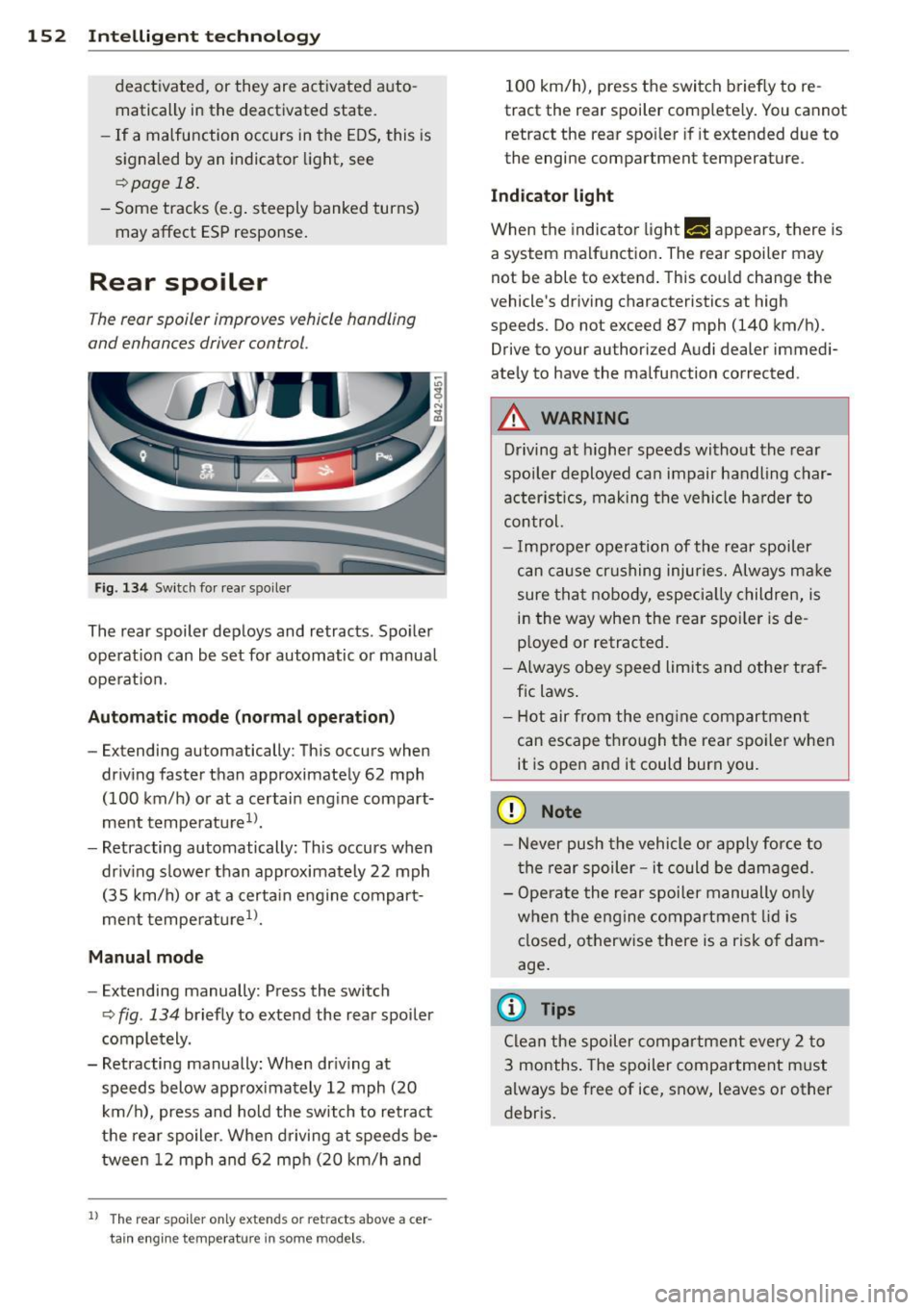
Fig . 134 Sw it ch for re ar s po ile r
The rear spoi ler deploys and retracts . Spo iler
operat ion can be set fo r automatic or manual
operation.
Automatic mode (no rmal operation )
-Extending automa tically : This oc curs when
driv ing faster than approximately 62 mph
(100 km/h) or at a certain eng ine compart
ment tempe rature
1>.
- Retracting automatically : This occurs when
dr iv ing slower than approximately 22 mph
(35 km/h) or at a certain engine compart
ment temperature
1> .
M anual mode
- Extending manually : Press the switch
~ fig . 134 briefly to extend the rear spoiler
completely .
- Retracting manually : When dr iv ing at
speeds below approximately 12 mph (20 km/h), press and hold the switch to retract
the rear spo iler. When driving at speeds be
tween 12 mph and 62 mph (20 km/h and
l) The rear s po iler o nly e xten ds or ret racts a bove ac er
ta in eng in e te mp erat ure in some m odels.
100 km/h), press the switch briefly to re
tract the rea r spoiler comp lete ly. You cannot
retract the rear spoi ler if it extended due to
the engine compartment temperature .
Indicator light
When the indicato r light f.-j appears, there is
a system malfunction . The rear spoiler may
not be able to extend . This cou ld change the
veh icle's d riving characterist ics at h igh
s peeds. Do not exceed 87 mph (140 km/h) .
Drive to your au thorized Audi dealer immedi
ately to have the malfunction corrected .
A WARNING
Driving at higher speeds without the rear
spoiler deployed ca n impair handling char
acteristics, making the ve hicle ha rder to
control.
- I mp rope r operation of the rear spoiler
can cau se crushing injuries. Always ma ke
sure tha t nobody, especia lly children, is
i n the way when the rear spoi ler is de
p loyed or retracted.
- Always obey speed limits and other traf
fic laws .
- H ot air from the eng ine compartmen t
can escape thro ugh the rear spo iler when
it is open and it could burn you .
(D Note
-Never push the vehicle or apply force to
t he rear spoiler -it could be damaged.
- Ope rate the rear spoiler manually on ly
when the eng ine compartmen t lid is
closed, otherwise there is a ris k of dam
age .
(D Tips
Clean the spoiler comp artment eve ry 2 to
3 months. The spoiler compa rtment m ust
always be free of ice, snow, leaves or other
debr is.
Page 155 of 244
Braking
New brake pads
During the firs t 250 miles (4 00 km), new
b rake pads do not possess their f ull braking
effect, they have to be "broken in" first. The
d istance can be ten times longer in ve hicles
with ceramic brakes *. Yo u can compensate f or
this slightly reduced b rak ing power by push
in g harder on the b rake pedal. Avoid heavy
br ak ing loads during the b reak -in period.
Operating conditions and driving habits
The brakes on today's automob iles are st ill
subject to wear, depending largely on operat
ing conditi ons and dr iv ing habits
c:> & . On ve
hi cles that are either driven mostly in stop
a n d-go ci ty traffic o r are d riven ha rd, the
b rake pads should be checked by you r auth or
iz ed A udi dealer more o ften than specifie d in
the
Warranty & Maintenan ce booklet . Fail ure
to have your b rake pads inspected can res ult
i n re duced b rake performance.
O n steep slo pes, you shou ld use the b ra kin g
effec t of the eng ine. Th is w ay, yo u prevent un
n ecessa ry wea r on the bra ke system . If you
must use yo ur brakes, do not ho ld the bra kes
down continuously. P ump the brakes at inte r
va ls.
Moisture or road salt
A t speed s above 70 mph ( 110 k m/h) and wit h
the windshield wipe rs swi tched
on (at le ast in
terval stage 4), the bra ke pads are br iefly a p
p lied against the bra ke discs. T his occ urs at
regu lar intervals witho ut the driver noticing
and prov ides for better brake response time
u nder wet condit io ns.
Unde r ce rtain conditions, for examp le, w hen
driving thr ough water or ve ry heavy rain, or
even after was hing yo ur vehicle, the brak ing
effect ca n be red uced d ue to moisture (or in
freezing conditions ice) on the brake pads. A
few ca utious brake applicat ions should d ry off
t he bra ke pads o r rem ove any ice coa tings.
The effective ness of the brakes can be reduced
when the vehicle is dr iven o n a salt-covered
Intelligent technology 153
road and the b ra kes are no t used . Li kewise,
yo u clean off accu mulated salt coatin g from
brake d iscs and pads with a few cautio us ap
plications of t he brake
c:> & .
Corrosion
The re may be a tendency for di rt to build up
on the brake pads and cor ros ion to form on
the discs if t he car is not driven regu la rly or
on ly for short trips w ith litt le use of the
brakes.
If the brakes are not use d frequently, o r if cor
r os ion has formed on the discs, it is adv isa ble
to clean off the pads and d iscs by braking
firmly a few times from a moderately high
speed
c:> & .
Faults in the brake system
If you shou ld not ice a sudden in crease i n
brake pedal trave l, t hen one of the two brake
c ir cuits may have fa iled. Dr ive immediately to
the nearest qualified wor kshop to have the
damage repaired . Dr ive at reduced speed on
the way there and ant ici pate longer stopping
dis tances and high er pedal p ress ure c:> & .
Low brake fluid level
Malfunctions can occ ur in the brake system if
the brake fluid level is too low. The brake flu id
level is monitored elect ro nica lly.
Brake power assist unit
T he bra ke power assist unit increases the
pressure that you generate w ith the brake
pedal. It work s only when the engine is run
ning.
Brake lining wear status
B ra ke lining wear may be che cke d by visual in
s p ection of t he condition of the bra ke pads
th ro ugh the open ings in the wheel. If neces
sary, the w hee l may be removed fo r thi s i n
spect ion
c:> page 216 .
A WARNING
- You should perform braking mane uvers
f o r th e purpos e of cleaning the brake
s ys tem only if roa d condit ions permit.
•
•
Page 157 of 244
Driving with your
quattro ®
With all-wheel drive, all four wheels are driv
en .
General information
With all-wheel drive, power is distributed to
all four wheels . This happens automatically
depending on your driving style and the road
conditions at the time. See also
t::;> page 150.
Winter tires
When driving in the winter, your vehicle with
all-wheel drive has an advantage, even with regular tires. In winter road conditions it may
be advisable to mount winter tires (or all -sea
son t ires) for improved driveability and brak
ing: these tires must be mounted on
all four
wheels.
Snow chains
Where snow chains are mandatory on certain
roads, th is normally also applies to vehicles
with all-wheel drive
Q page 204 , Snow
chains.
Replacing wheels/tires
Only the wheel/tire sizes specified by the
manufacturer may be used on vehicles with
all-wheel drive
<=> page 199.
A WARNING
-Always adjust your driving to road and
traffic conditions. Do not let the extra
safety afforded by all-wheel drive tempt
you into taking extra risks.
- Although a ll-wheel drive is very effect ive,
always remember that braking capacity
is limited by tire traction. You should
therefore not drive at excessive speeds
on icy or slippery road surfaces.
- On wet road surfaces, be careful not to
drive too fast because the front wheels
cou ld beg in to slide on top of the water
(aquaplaning). If this should occur, you
will have no warning from a sudden in
crease in engine speed as with a front-
-
Intelligent technology 155
wheel drive vehicle. Always drive at
speeds which are su ited to the road con
ditions. -risk of crash.
Energy management
Starting ability is optimized
Energy management controls the distribution
of electrical energy and thus optimizes the
availability of electrical energy for starting the engine.
If a vehicle with a conventional energy system
is not driven for a long per iod of time, the bat
tery is discharged by idling current consumers
(e .g. immobi lizer). In certain circumstances it
can resu lt in the re being insufficient energy
available to start the engine.
Intelligent energy management in your vehi
cle handles the distribution of e lectr ical ener
gy. Starting ability is markedly improved and
the life of the battery is extended .
Basically, energy management consists of
battery diagnosis , idling current manage
ment
and dynamic energy management .
Battery diagnosis
Battery diagnosis continuously determines
the state of the battery. Sensors determine
battery voltage, battery current and battery
temperature . This determines the current
state of charge and the power of the battery.
Idling current management
Idling current management reduces energy
consumption while the vehicle is standing.
With the ign ition switched off, it controls the
energy supply to the various electrical compo
nents. Data from battery diagnosis is consid
ered.
Depending on the battery's state of charge,
individual cons umers are gradually turned off
to prevent excessive discharge of the battery
and thus maintain starting capability. .,..
•
•
Page 160 of 244
158 Driving and en vi ro nm ent
Driving and
environment
Break-in period
A new vehicle must be broken in, and the break-in per iod should be 1,500 miles (2,500
km) . Do not use full acceleration for the first
600 miles (1,000 km) and do not exceed the
maximum eng ine speed of 6,000 rpm You
must also not use fu ll acce lerat ion between
600 and 1,200 mi les (1,000 to 2,000 km).
F rom 1,200 to 1,500 mi les (2,000 to 2,500
km), you can gradua lly increase maxim um en
gine speed to 8,250 rpm for brief periods.
During the first ho urs of operation, there is
g reater friction in the engine and the trans
mission than later when a ll the moving parts
have broken in.
The way yo u drive duri ng the first 1,500 miles
(2,500 km) affects engine quality. If you drive
at moderate engine speeds thereafter, partic
u lar ly when the engine is cold, yo u reduce en
g ine wear and increase the potential mileage
of the engine.
Do not drive at RPMs that are too low. Shift
down when the engine is no longer running
"smoothly". Extreme ly high RPMs are gov
erned automatically.
Driving through water
on roads
Note the following to avoid vehicle damage
when dr iving through water, for example on
flooded roads:
- The water must not be any higher than the
bottom of the vehicle body .
- Do not drive faster than wa lking speed.
.&_ WARNING
After driving through water, mud, slush,
etc., the brakes may be slow to take effect
because of wet b rake roto rs and pads. Dry
t he brakes fi rst by bra king carefully to re
sto re the full braking effect.
-
(D Note
Vehicle components such as the eng ine,
transmission, suspension or e lectrical sys
tem can be severe ly damaged by dr iv ing
through water.
@ Tips
- Check the depth of the water before d riv
ing through it.
- Do not stop the vehicle, drive in reverse
or switch the engine off when driving
through water.
- Keep in mind that oncoming vehicles
may create waves that raise the water
level and make it too deep for your vehi
cle to drive through safely .
- Avo id driving through salt water because
it can cause corros ion.
Catalytic converter
You must use lead-free gasoline in your veh i
cle, otherwise you will destroy the catalyt ic
converter.
Never run the fuel tank completely dry; their
regular fuel supply could cause misfires . This
allows unburned fuel into the exhaust system,
poss ibly resulting in overheating and damage
to the catalytic converter .
.&_ WARNING ,-
-Do not park or operate the vehicle in
areas where the hot exha ust system may
come in co nta ct with dry g rass, brush,
fue l spills or o ther material which can
cause a fire.
- Do not app ly addition al under coating or
r u stproofing on or nea r the exhaust
manifold, exhaust pipes, catalytic con
verter or heat shields . Dur ing driving, the
substance used for undercoating could
overheat and cause a fire.
(D Note
To ensure efficient o peration of the Emis
s ion Control System:
Page 163 of 244
Cleaning and protect ion
General information
Regular core preserves vehicle value.
Regular and correct care will contribute to
maintaini ng the beauty and value of your Au
d i. Furthermore, good care may be a condition
for substantiating a warranty cla im should
corrosion damage or paint defects occur.
Your authorized Audi R8 dealer has a variety
of
d edicat ed ve hicl e-car e produ ct s. Please
make sure you apply them correctly .
A WARNING
-Cleaning agents may be poisonous. Keep
them out of the reach of children.
- Heed all caution labels .
- Always read directions on the container before using any product. Follow the di
rect ions carefu lly.
- Most chemical cleaners are concentrated and have to be diluted .
- Use spot removing fluids only in well
ventilated areas .
- Do not use gasoline, kerosene, d iesel
fuel, nail polis h remover or other volatile
fluids . They may be toxic, flammab le or
haza rdous in other ways. Do not wash,
wa x or d ry the vehicle wi th the ign it ion
on or the eng ine running.
- Do not clean the undersides of chassis,
fenders, wheel covers, e tc. wit h out pro
tecting your hands and arms . You may
c u t yourself on sharp -edged metal parts .
- Moist ure and ice on brakes may imp air
braking efficiency
c:> page 153, Broking.
T est the brakes carefully each time you
wash the vehicle.
@) For the sake of the environment
Select only environmentally friend ly clean
ing products . Leftover clean ing products
should not disposed of in the household
waste .
Cleaning and protec tion 16 1
Care of exterior
Washing your vehicle
The longer i nsect rema ins, bird dropp ings,
t ree res in , ro ad and indust rial dust, tar , soo t
particles, road salt, and o ther aggressive de
pos its remain on the vehicle su rface, the more
lasting their destructive effect will be . High
temperatures, for example from intense s un
light, intensify the corrosive effect.
After the end of winter road salting, the un derside of the vehicle shou ld be thoroughly
washed .
Automatic car washes
You must t ake the necessary precautions s uch
as clos ing t he windows and convert ible top
before using an automatic car wash.
If yo ur
vehicle has specia l accessories - e.g . spoilers,
radio antenna -it is best to speak to the oper
ator of the car wash c:>(D .
Only use car washes where the vehicle re
mains stationary and the cleaning equipment
moves around the veh icle while washing and
drying. It is not possib le to use car washes
where the vehicle is moved forward on a con
veyer
c:> ,& .
It is preferab le to wash your vehicle in a
brush less carwash .
Washing with a pow er wa sher
When was hing yo ur vehicle with a power
washe r, be sure to follow the operating in
structions for the power washer. This applies particu larly to the
p ressure and the spra ying
distance .
Mainta in sufficient distance from
soft materials such as rubber hoses, sound
deade ning mater ial, and the park ing aid sen
sors* that are located i n the front or rear
bumper.
Do not use washers with
a ro tating jet or a
nozzle spraying
a h igh pr essur e je t of wate r in
any case.
IJl,-
•
•
Page 164 of 244
162 Cleaning and protection
Hand washing
When washing your vehicle by hand, first soft
en the dirt with copious amounts of water and
rinse it
off as best you can.
Then clean the vehicle using a soft
sponge, an
auto glove or a low-pressure wash brush.
Work from the top down to the bottom, start
ing with the convertible top
¢ page 163. Use
a
shampoo only for v ery stubborn dirt.
Rinse the sponge or auto glove thoroughly at
frequent intervals.
Clean the wheels, door sills and similar areas last. Use a separate sponge for this.
_& WARNING
-Car washes with conveyors can damage
the vehicle tires, which could cause the tire to lose pressure suddenly while driv
ing and put you at risk for an accident.
Do not use car washes with conveyors.
- Switch
off the ignition when you wash
your vehicle to avoid an accident.
- Protect your hands and arms from sharp
metal edges when you clean the under
body, the inside of the wheel wells or the
wheel covers to avoid cutting yourself.
- When washing your vehicle in the winter :
Moisture and ice in the brake system can
affect the brakes.
- Never wash tires with a jet that sprays
water in a direct stream . This could cause
invisible damage to the tires and weaken
them, even if the spray is from a relative
ly long distance and for a short time .
Damaged and weakened tires can fail
and cause accidents and personal injury.
(D Note
- Never drive your vehicle through any au
tomatic car wash that fails to provide ei
ther sufficient clearance for your vehicle
or sufficient track width for your tires. Risk of expensive damage to the vehicle's
underbody , tires, and rims!
- As described in your Warranty
& Mainte
nance booklet, damage or malfunction due to misuse of the vehicle or failure to
operate the vehicle in accordance with
the
instructions of this Owner's Manual
will not be covered under warranty.
- Fold the exterior mirrors flat - there is a
risk of damaging the exterior mirrors .
Power folding exterior mirrors must not
be folded in or out by hand. Use the pow
er function!
- Do not wash the vehicle in direct sun
light. You may damage the paint.
- Do not use sponges designed to remove
insects, rough kitchen sponges, or simi
lar products. You risk damaging the
paint surface.
- You should remove debris (such as in
sects) from the headlight lenses on a
regular basis, for example when refuel
ing your vehicle. Never clean the head
lights with a dry cloth or sponge . Use a
wet cloth or sponge .
It is best to use
soapy water.
- Never clean tires using a nozzle that
sprays water in a direct stream. Damage
can occur even with a relatively long
spraying distance and for a very short
time.
- To avoid damaging your vehicle, always
make sure that there is sufficient dis
tance between the spray head and soft materials like rubber hoses, plastic parts
and sound-deadening materials. Never
aim the spray head at the same point for
a long time. This also applies to cleaning
headlights and painted bumpers. Re
member: the closer the nozzle is to the
surface of the material, the greater the
stress on the material.
- Never clean the convertible top using a
power washer.
@) For the sake of the environment
Wash your vehicle only at specially de
signed facilities. They can prevent any dirty
water contaminated by oil from entering
the waste water. In certain areas washing
a car outside of such facilities is not per
mitted.
Page 165 of 244
Convertible top care
The convertible top requires special core.
Keeping your top looking great and making
certain that it lasts a long time depend to a
great extent on proper use and care. Remove b ird droppings as soon as possible, since the
corrosive chem icals in them will cause the
rubber impregnat io n i n your top to swell and
possibly allow the fab ric to leak.
W ith
normal soiling, all you need to do is
clear the top with a soft brush and clear wa
ter. Always brush in the direction of the fabric
from front to rear.
If the top is
very dirty and has spotted areas
clean it with a brush us ing a convert ible top
cl eane r. A lways brush in the direction of the
fabr ic from front to rear. Rinse w ith plenty of
clear wa te r, a nd a llow the top to air -dry.
Chamois are not suitable fo r d ry ing the top.
Never use gasoline, spot remover, benzene,
pa int thinner or solvents to remove spots. We
recommend that you only use cleaners espe
cially fo rmu lated for use on convertible tops,
a nd that you follow the p rod uce use directions
caref ully. Au thor ized A udi deals can provide
deta iled i nformation.
A WARNING
Always read and heed a ll WA RNINGS and
the information on
r:!;> page 1 61.
CD Note
N ever use a high-pressu re power was he r to
clean t he conver tible top.
Wind deflector
C lea r the wind deflecto r with water or, if it is
heavi ly soiled, a chemically neutra l cleaning
solut ion.
A WARNING
Always read and heed a ll WARNI NGS and
the information on
r:!;>poge 161.
Cleaning and protec tion 163
Waxing and polishing
Waxing
Wax ing pro tects the paint. When water no
l o nger clearly
b eads on the clean pai nt you
sho uld renew yo ur vehicle's pro tect io n by ap
ply ing a good
hard w ax polish .
Even if you regularly use a wa x process in the
ca r wash, we recommend protect ing the pa int
at leas t tw ice pe r year u sing har d wax.
It is muc h eas ie r to clean insects and other
debris from
freshly waxed paint.
Polishing
Polishing is necessary on ly if the paint on your
vehicle has lost its shine and if you cannot
achieve any gloss with wax mater ials.
If the po lish you use does not contain any
preservative ingredients, yo u will have to wax
the paint afterwards.
A WARNING
Always read and heed all WARNING and
other Information ~ page 161.
CD Note
Do not treat matte anodized meta l trim,
plastic, or rubber parts with polish or wax.
Trim strips
Fo r environmental reasons, Audi fabricates
the b right t rim s trips and trim p ieces from
pure ch romium-free al uminum.
-
D irt and marks on the trim strips shou ld be
removed w it h a
pH-balan ced cleani ng agent
(do not use a chrome cleane r). Pa int polishes
are a lso not suitable for the ca re of decorative
parts and trim s trips. Al ka line cleane rs wh ich
are often used be fore en ter ing c ar washes can
ca use du ll o r milky spots when they dry.
Autho rized Aud i dea le rs ca rry clean ing p rod
u cts which have bee n tested f or use on yo ur
vehicle and are no t harmfu l to the environ
ment.
•
•