warning AUDI R8 SPYDER 2011 Owners Manual
[x] Cancel search | Manufacturer: AUDI, Model Year: 2011, Model line: R8 SPYDER, Model: AUDI R8 SPYDER 2011Pages: 244, PDF Size: 59.74 MB
Page 138 of 244
136 Airbag system
o ther injuries, for example, swelling, bruising,
and minor abrasions can also be associated
with deployed side airbags. Remember too,
side airbags wi ll deploy only once and on ly in
certain kinds of accidents - your safety belts
are a lways there to offer protect ion .
Vehicle damage, repa ir costs or even the lack
of vehicle damage are not necessarily an indi
cation of over-sensitive or failed airbag activa
tion . In some co llisions, both front and side
a irbags may inflate. Remember too, that air
bags will dep loy only once and only in certain
kinds of collisions -your safety be lts a re al
ways there to offer protec tion in those acci
dents in wh ic h ai rbags are not supposed to
deploy or when they have already deployed .
The side airbag system will not deploy:
- when the ignition is turned off
- in s ide collisions when the acceleration
measured by the sensor is too low
- in front-end collisions
- in rear-end collisions
- in rollovers.
I n some types of acc idents the front a irbags
and side a irbags may be triggered together.
A WARNING
- Safety belts and t he ai rbag system will
only provide protection when occ upants
are in the proper seating posit ion
¢page 137.
-If the airbag indicator light comes on
when the veh icle is being used, have the
system inspected immediately by your
authorized Audi dealer. The a irbag may
not work p roperly when the vehicl e ac
celeration in a side co llision is h igh
enough to activa te the airbag.
-
How supplemental side airbags work
Side airbags deploy instantly and can help re
duce the risk of upper torso injuries for occu
pants who are properly restrained.
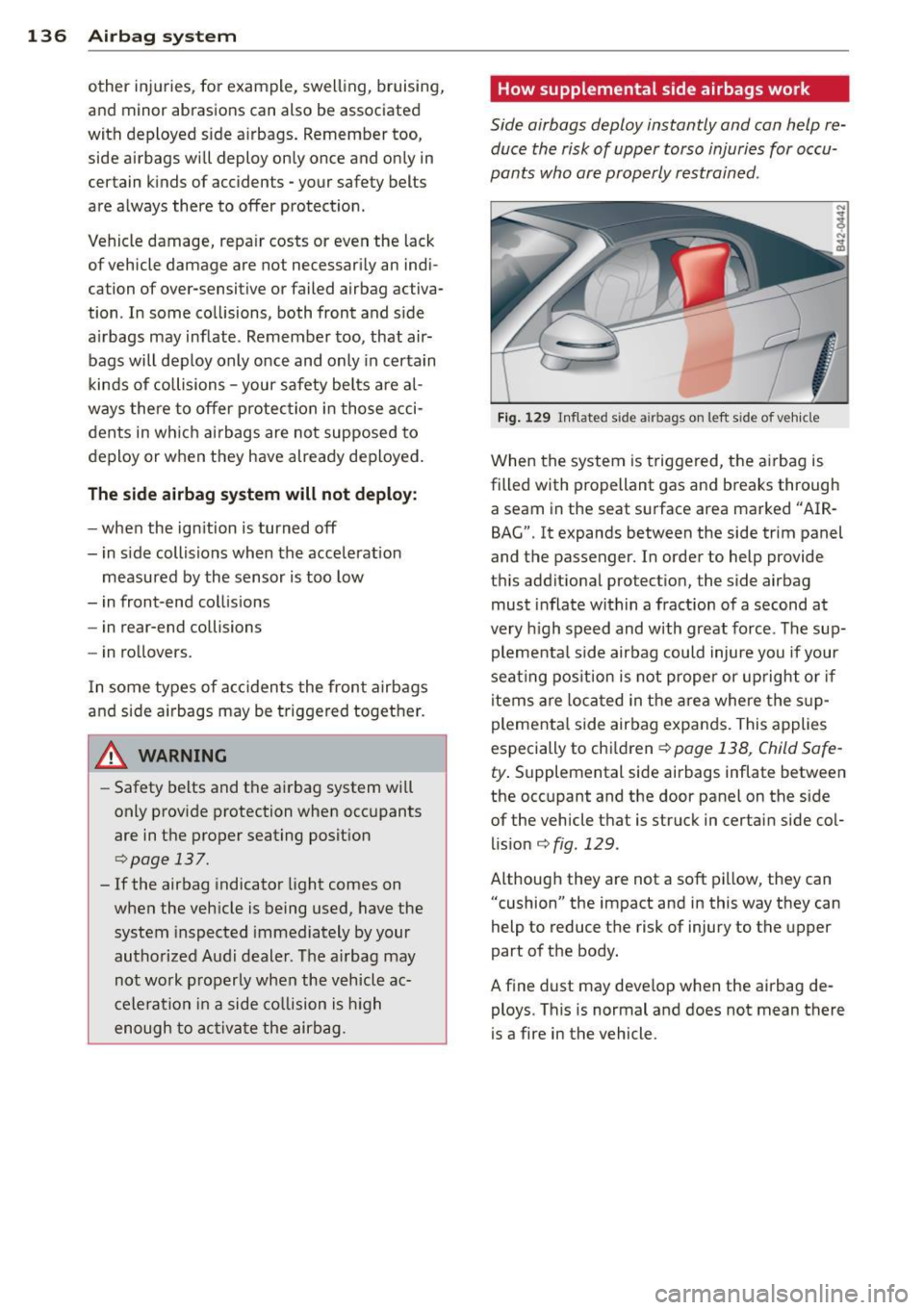
F ig . 1 29 Inflated s ide a irbags on left s ide of veh icle
When the system is triggered, the airbag is
filled with propellant gas and b reaks through
a seam in the seat surface area ma rked "AIR
BAG".
It expands between the side trim panel
and the passenger. In order to help provide
t hi s additional protection, the side airbag
must inflate w ithin a fraction of a second at
very h igh speed and with great force . The sup
pleme nta l side airbag could injure you if your
seat ing pos it ion is not proper or upright or if
items are loca ted in the area where the s up
pleme nta l side airbag expands. This applies
especially to children ¢
page 138, Child Safe
ty .
Supplemental side airbags inflate between
the occ upant and the door panel on the side
of the vehicle that is struck in certain side col
lis ion ¢
fig. 129.
Although they are not a soft pi llow, they can
"cushion" the impact and in this way they can
help to reduce the risk of injury to the upper
part of the body.
A fine dust may deve lop when the airbag de
ploys. This is normal and does not mean there
is a fire in the vehicle.
Page 139 of 244
Important safety instructions on the
side airbag system
Airbags are only supplemental restraints. Al
ways properly wear safety belts and ride in a
proper seating position.
There is a lot that you and your passengers
must know and act accordingly to help the
safety belts and airbags do their job to pro
vide supplemental protection .
A WARNING
An inflating side airbag can cause serious
or fatal injury. Improperly wearing safety
belts and improper seating positions in
crease the risk of serious personal injury
and death whenever a vehicle is being
used .
- In order to reduce the risk of injury when
the supplemental side airbag inflates:
-Always sit in an upright position and
never lean against the area where the
supplemental side airbag is located.
- Never let a child or anyone else rest
their head against the side trim panel
in the area where the supplemental
side airbag inflates.
- Always make sure that safety belts are worn correctly,
- Do not let anyone sitting in the front
seat put their hand or any other parts
of their body out of the window.
- Always make sure that the side airbag can inflate without interference.
- Never install seat covers or replace
ment upholstery over the front seat backs that have not been specifically
approved by Audi.
- Never use additional seat cushions that
cover the areas where the side airbags
deploy.
- Damage to the original seat covers or
to the seam in the area of the side air bag module must always be repaired
immediately by an authorized Audi
dealer.
Airbag system 137
- Objects between you and the airbag can
increase the risk of injury in an accident
by interfering with the way the airbag
deploys or by being pushed into you as
the airbag inflates.
- Never place or attach accessories or
other objects (such as cup holders, tel ephone brackets, or even large, bulky
objects) on the doors, over or near the
area marked "AIRBAG" on the seat backrests .
- Such objects and accessories can be come dangerous projectiles and cause injury when the supplemental side air
bag deploys.
- Never carry any objects or pets in the
deployment space between them and
the airbags or allow children or other passengers to travel in this position .
- Always prevent the side airbags from be
ing damaged by heavy objects knocking
against or hitting the sides of the seat backs.
- The airbag system can only be triggered
once . If the airbag has been triggered,
the system must be replaced by an au
thorized Audi dealer.
- Damage (cracks, deep scratches etc.) to
the original seat covers or to the seam in
the area of the side airbag module must
always be repaired immediately by an au
thorized Audi dealer.
- If children are seated improperly , their
risk of injury increases in the case of an
accident
c:> page 138, Child Safety.
- Never attempt to modify any compo
nents of the airbag system in any way .
•
•
Page 140 of 244
138 Child Safety
Child Safety
Important things to know
Introduction
The physical princip les of what happens when
your vehicle is in a crash app ly also to children
¢ page 112. But unlike adu lts and teenagers,
their muscles and bones are not fully devel
oped. In many respects children are at greater risk of serious injury in crashes than adults.
Because children 's bod ies are not fully deve l
oped, they require restraint systems especial ly designed for their s ize, weight, and body
structure . Many countries and all states of the
United States and provinces of Canada have
l aws requ iring the use of approved ch ild re
straint systems fo r infants and small child ren.
In a frontal crash at a speed of 20-35 mph
(30-56 km/h) the forces acting on a 13-pound
(6 kg) infant w ill be more than 20 times the
weight of the child. Thi s means the weight of
the child would s uddenly be more than
260 pounds (120 kg) . Under these conditions,
only an appropriate chi ld restraint properly
used can reduce the risk of serious injury.
Child restraints, like adult safety belts, must
be used properly to be effective. Used improp
erly, they can increase the risk of ser ious in
jury in an accident.
Consult the child safety seat manufacturer's instructions in order to be sure the seat is
right for your ch ild's s ize
c> page 141 , Impor
tant safety instructions for using child safety
seats .
Please be sure to read and heed all of
the impo rtant informat io n and WARNINGS
about child safety, Advanced A irbags, and the
installation of child restraints in this chapter.
There is a lot you need to know about the Ad
vanced A irbags in your vehicle and how they
wo rk when infants and children in chi ld re
straints are on the front passenger seat. Be
cause o f the large amount of important info r
mation, we cannot repeat it all here. We urge
you to read the detailed information in this owner's manual about airbags and the Ad
vanced Airbag System in your vehicle and the
very important information about transport
ing children on the front passenger seat.
Please be sure to heed the WARNINGS - they
are extremely important for your safety and
the safety of your passengers, especially in
fants and small children.
.&, WARNING
-
A ll vehicle occupants and especially chi l
dren must be restrained properly whenev
er riding in a vehicle. An unrestrained or
improperly restrained child could be in
jur ed by str ik ing the interior or by being
ejected from the vehicle dur ing a sudden
maneuver or impact. An unrestra ined or
i mproperly restra ined child is also at great
er risk of injury or death through contact
with an inflat ing airbag.
.&, WARNING
--Children on the front seat of any car even
with Advanced Airbags can be seriously in
jured or even killed when an airbag in
flates. A child in a rearward-fac ing child
safety seat installed on the front passen
ger seat will be seriously injured and can
be killed if the front airbag inflates .
- The inflating airbag will hit the child
safety seat or infant carrier with great
force and will smash the child safety seat
and child aga inst the backrest, door or
roof.
- Never install a rearward facing child safety seat on the front passenger seat
unless the
PASSENGER AIR BAG OFF
light comes on and stays on . If the PAS
SENGER AIR BAG OFF
l ight does not
come on and stay on, the inflating airbag
will hit the child safety seat or infant car
rier w ith great force and will smash the
child safety seat and child against the backrest, door or roof. Have the airbag
system inspected immediately by your
author ized Audi dealer.
Page 141 of 244
A WARNING ,~
If, in exceptional circumstances, you must
install a forward-facing child restraint on
the front passenger's seat:
- Always make sure the forward-facing
seat has been designed and certified by
its manufacturer for use on a front seat
with a passenger front and side airbag.
-Always follow the manufacturer's in
structions provided with the child safety
seat or carrier.
- Always move the passenger seat into its
rearmost position in the seat's fore and
aft adjustment range, as far away from
the airbag as possible before installing
the child restraint. The backrest must be
adjusted to an upright position.
- Always make sure that the
PASSENGER
AIR BAG OFF light comes on and stays
on all the time whenever the ignition is
switched on.
Advanced front airbag system and children
Your vehicle is equipped with an "Advanced
Airbag System" in compliance with United
States Federal Motor Vehicle Safety Standard
(FMVSS) 208 as applicable at the time your
vehicle was manufactured.
The Advanced Airbag system in your vehicle
has been certified to meet the "low-risk" re
quirements for 3- and 6- year-old children on
the passenger side and small adults on the
driver side. The low risk deployment criteria
are intended to reduce the risk of injury
through interaction with the airbag that can
occur, for example, by being too close to the
steering wheel and instrument panel when
the airbag inflates. In addition, the system has been certified to comply with the "sup
pression" requirements of the Safety Stand
ard, to turn
off the front airbag for infants up
to 12 months who are restrained on the front
passenger seat in child restraints that are list
ed in the Standard.
Child Safety 139
Even though your vehicle is equipped with an
Advanced Airbag system, a child should al
ways ride in the seat properly restrained for
its age and si ze. The airbag on the passenger
side makes the front seat a potentially dan
gerous place for a child to ride . The front seat
is not the safest place for a child in a forward
facing child safety seat . It can be a very dan
gerous place for an infant or a larger child in a
rearward-facing seat.
Advanced Airbags and the weight
sensing mat in the front seat
The Advanced Airbag System in your vehicle detects the presence of an infant or child in a
child restraint on the front passenger seat us
ing the weight -sensing mat in the seat cush
ion and the sensor below the safety belt latch
on the front passenger seat that measures the
tension on the safety belt.
The weight -sensing mat measures total
weight of the child and the child safety seat
and a child blanket on the front passenger
seat. The weight on the front passenger seat
is related to the design of the child restraint
and its "footprint", the size and shape of the
bottom of the child restraint as it sits on the
seat. The weight of a child restraint and its
"footprint" vary for different kinds of child re
straints and for the different models of the
same kind of child restraint offered by child
restraint manufacturers .
The weight ranges for the individual types,
makes and models of child restraints that the
NHTSA has specified in the Safety Standard
together with the weight ranges of typical in
fants and typical 1 year-old child have been
stored in the control unit of the Advanced Air
bag System. When a child restraint is being
used on the front passenger seat with a typi
cal 1 year-old child, the Advanced Airbag Sys
tem compares the weight measured by the
weight sensing mat with the information stor
ed in the electronic control unit.
The electronic control unit also registers the
tension on the front passenger safety belt. ..,. •
•
Page 143 of 244
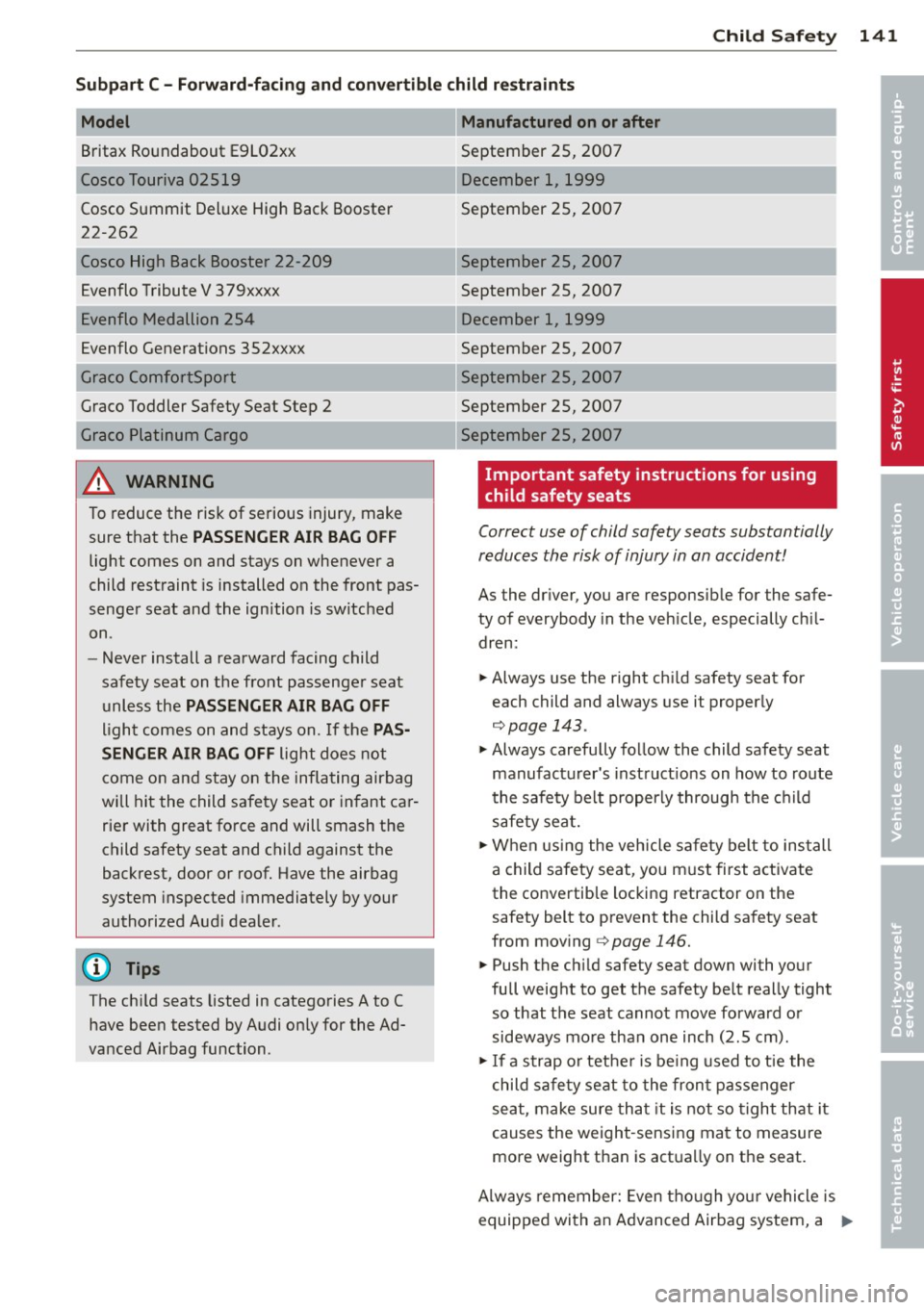
Child Safety 141
Subpart
C -Forward-facing and convertible child restraints
Model
Britax Roundabout E9L02xx
Cosco Touriva 02519
Cosco Summit Deluxe High Back Booster
22-262
Cosco High Back Booster 22-209
Manufactured on or after
September 25, 2007
December 1, 1999
September 25, 2007
September 25, 2007
September 25, 2007
Evenflo Tribute V 379xxxx
E venflo Medallion 254
----------
Evenflo Generations 352xxxx
Graco ComfortSport
----~-,
December 1, 1999
September 25, 2007
September 25, 2007
September 25, 2007
Graco Toddler Safety Seat Step 2
Graco Platinum Cargo
-------
& WARNING
To reduce the risk of serious injury, make
sure that the
PASSENGER AIR BAG OFF
light comes on and stays on whenever a
child restraint is installed on the front pas
senger seat and the ignition is switched
on .
- Never install a rearward facing child
safety seat on the front passenger seat
unless the
PASSENGER AIR BAG OFF
light comes on and stays on. If the PAS
SENGER AIR BAG OFF
light does not
come on and stay on the inflating airbag
will hit the child safety seat or infant car
rier with great force and will smash the
child safety seat and child against the
backrest, door or roof. Have the airbag
system inspected immediately by your
authorized Audi dealer .
(D Tips
The child seats listed in categories A to C
have been tested by Audi only for the Ad
vanced Airbag function. September 25, 2007
Important safety instructions for using
child safety seats
Correct use of child safety seats substantially
reduces the risk of injury in an accident!
As the driver, you are responsible for the safe
ty of everybody in the veh icle, especially ch il
dren:
.., Always use the right chi ld safety seat for
each child and always use it properly
¢page 143.
.., Always carefully follow the child safety seat
manufacturer's instruct ions on how to route
the safety belt properly through the child
safety seat.
.., When using the vehicle sa fety belt to install
a child safety seat, you must first activate
the convertib le locking retractor on the
safety belt to prevent the child safety seat
from moving ¢
page 146.
.., Push the ch ild safety seat down with your
full weight to get the safety belt really tight
so that the seat cannot move forward or
sideways more than one inch (2 .5 cm).
"'If a strap or tethe r is being used to tie the
child safety seat to the front passenger
seat , make sure that it is not so tight that it
causes the weight-sensing mat to measure
more weight than is actua lly on the seat.
Always remember: Even though your vehicle is
equipped with an Advanced Airbag system, a .,..
•
•
Page 144 of 244
142 Child Safety
child should a lways ride in the seat properly
restrained for its age and size.
A WARNING
Not using a ch ild safety seat, using the
wrong ch ild safety seat or improperly in
stalling a child restraint increases the risk
of serious personal injury and death .
- All veh icle occupants and especially chil
dren must always be restrained properly
whenever riding in a vehicle .
- An unrestra ined or improperly rest rain
ed child can be injured or killed by be
ing thrown against the inside of the ve
hicle or by being ejected from it d uring
a sudden maneuver or impact.
- An unrestrained or improperly restrain
ed child is at much greater risk of injury
or death by being struck by an inflat ing
airbag.
- Commercially ava ilable child safety seats
are required to comply with U.S. Federal
Motor Vehicle Safety Standard (FMVSS)
213 (in Canada CMVSS 213).
- When buying a ch ild restra int, sele ct
one that fits yo ur child and the veh icle .
- Only use child restrain t sys tems tha t
fu lly contact the flat portion of the
seat cushion . The child restraint must
not tip or lean to either side . Aud i does
not recommend using ch ild safety
seats that rest on legs or tube-like
frames. They do not provide adequate
contact w ith the seat.
- Always heed all legal requirements per
taining to the installation and use of
child safety seats and carefully follow
the instructions p rov ided by the manu
facture r of the seat you are using .
- Never let mo re than one child occupy a
child safety seat .
- Never let babies or older chi ld ren ride in
a vehicle while s itting on the lap of an
other passenger.
- Ho lding a chi ld in your arms is neve r a
substitute for a child restraint system. -
The st rongest pe rson could not hold
the child w ith the forces that ex ist in
an accident. The child will str ike the in
terior of the veh icle and can also be
struck by the passenger.
- The child and the passenger can also
injure each another in an acc ident.
- Never install a rearward facing child
safety seat on the front passenger seat
un less the
PASSENGER AIR BAG OFF
light comes on and stays on . If the PAS
SENGER AIR BAG OFF
l ight does not
come on and stay on the infl ating a irbag
will hit the child safety seat or infant car rier w ith great force and w ill smash the
child safety seat and child against the backrest, door or roof. Have the a irbag
system inspected immediately by your
author ized Audi dealer.
- Forward-facing child safety seats insta l
led on the front passenger's seat can in
terfere w ith the airbag when it inflates
and cause serious injury to the chi ld .
- If exceptional circumstances require the
use of a forward-facing child restraint on
the front passenger's seat, the ch ild 's
safety and we ll-being require that the
following specia l precautions be taken :
- Make sure the forward-fac ing seat has
been designed and certified by its man
ufacturer for use on a front seat w ith a
passenger front and side airbag.
-Always carefully follow the manufac turer's instructions provided w ith the
child safety seat or carrier.
- Always move the front passenger seat
i nto the rearmost position of the pas
senger seat 's fore and aft adjustment
range, and as far away from the airbag
as possible before installing the ch ild
r est raint.
- Always make sure that nothing p re
vents the front passenger's seat from being moved to the rea rmost position
i n its fore and aft adjus tment range.
- Always make sure that the backrest is
i n the upright pos ition.
Page 145 of 244
-Always buc kle the c hild safety seat firmly
in place even if a child is not s itting in it.
A loose ch il d safety seat can fly ar ound
dur ing a su dden stop or in a col lisio n.
- Always read and heed all WARNINGS
whenever using a child restrained in ave
hicle is being used
<=> page 109, Safety
belts,
c> page 117, Airbag system and
¢ page 138, Child Safety.
A WARNING
To reduce the risk of serious injury, make
sure that the
PASSENGER AIR BAG OFF
light comes on and stays on whe never a
child rest rain t is installed on the front pas
senger seat and the ignition is switched
on.
- Never install a rearward facing child safety seat on the front passenger seat
unless the
PASS ENGER AIR BAG OFF
light comes on and stays on. If the PAS
SENGER AIR BAG OFF
light does not
come o n and stay on the inflating airbag
w ill hit the child safety seat o r infant car
rier with great fo rce and will smash the
child safety seat and child again st the
backrest, door or roo f. Have the airb ag
system inspected immedia tely by your
authorized Audi dea ler.
Child safety seats
Infant seats
.
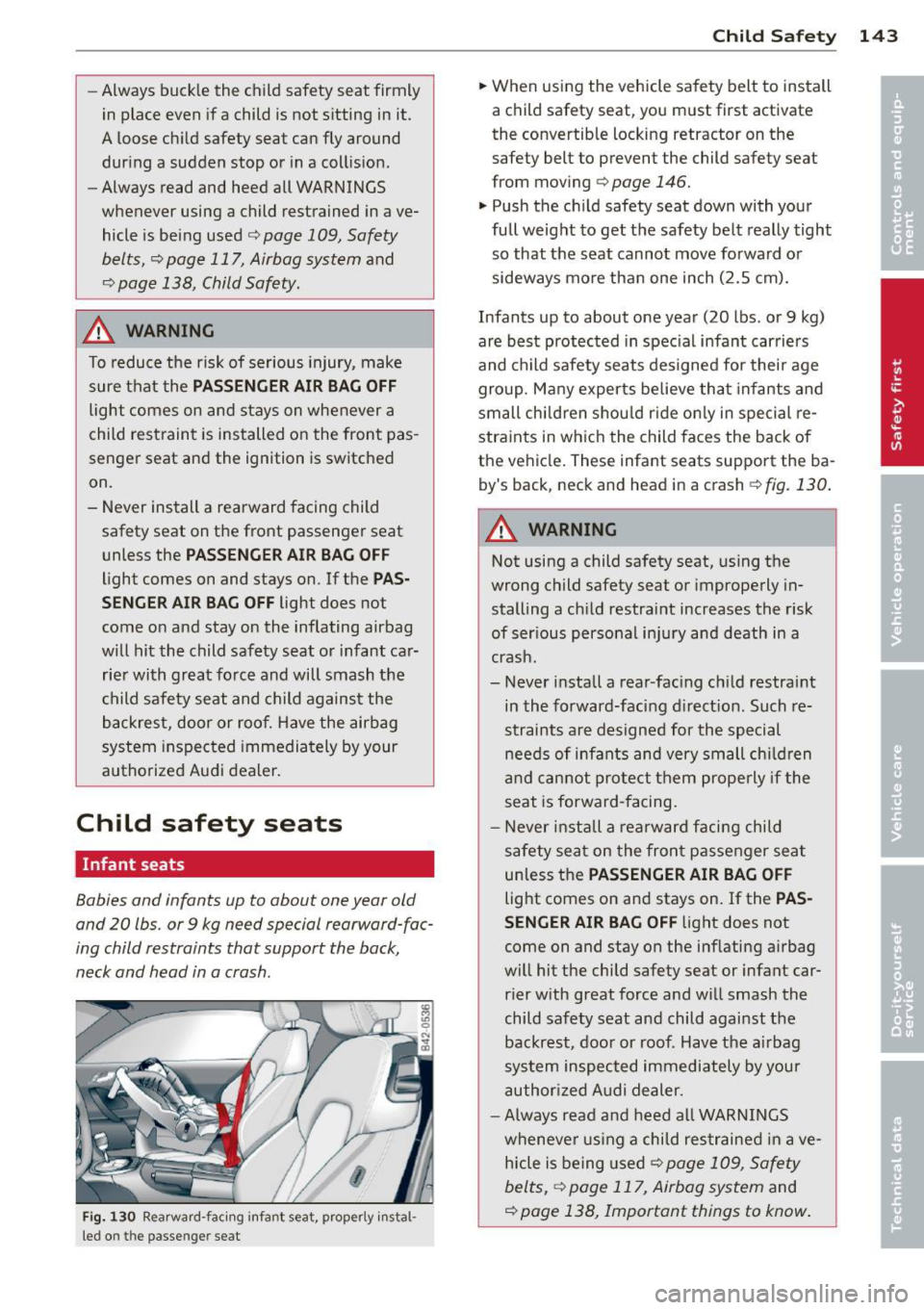
Babies and infants up to about one year old
and 20 lbs. or 9 kg need special rearward-fac
ing child restraints that support the back,
neck and head in a crash.
Fi g. 1 30 Rearward -fac ing infa nt seat , prope rly in sta l
le d on t he p asse nger seat
Child S afety 143
.. When using the vehicle sa fet y belt to install
a child safety seat , you must first activate
the convertible locking retractor on the
safety belt to prevent the child safety seat
from mov ing
c> page 146.
.. Push the ch ild safety seat down with you r
full weig ht to get t he safety be lt really tight
so that the seat cannot move forwa rd o r
sideways mo re tha n one inch ( 2.5 cm).
Infants up to about one year
(20 lbs . or 9 kg)
are best protec ted in spec ial infant carriers
and ch ild safety seats designed for thei r age
gro up. Ma ny exper ts believe that infants and
sm all chi ld ren s hou ld r ide o nly in speci al re
stra ints in which the child faces the back of
the ve hicle . These infant seats sup port the ba
by's back, neck and head in a c rash
c> fig . 130 .
A WARNING
Not using a child safety seat, using t he
wrong child safety seat or improperly in
stalling a ch ild restrai nt increases the risk
of ser ious personal inju ry and death in a
crash.
- Never i nstall a rear -fac ing ch ild restrai nt
in the forward-facing d irect ion . Such re
straints are designed for the special needs of infants and very small chi ldren
and cannot pro te ct them properly if the
seat is forward- facing.
-
- Never install a rearward facing child
safe ty sea t on the fron t passenger sea t
unless t he
PASSENGER AIR BAG OFF
light comes on and stays on. If the PAS·
SENGER AIR BAG OFF
li ght does not
come on and stay on the inf lating a irbag
wi ll hit the child safety seat or infant car
rier w ith great f orce and w ill smash the
child safety seat and child agai nst t he
backrest, door or roof. Hav e the a irbag
sy stem in spected immediately by your
a uthor ized A udi de aler.
- Always rea d and heed all WAR NIN GS
wheneve r us ing a child res traine d in ave
hicle is be ing used
c> p age 109, Safety
belts, ¢page 117, Airbag system
and
c> page 138, Important things to know .
Page 146 of 244
144 Child Safet y
Convertible child safety seats
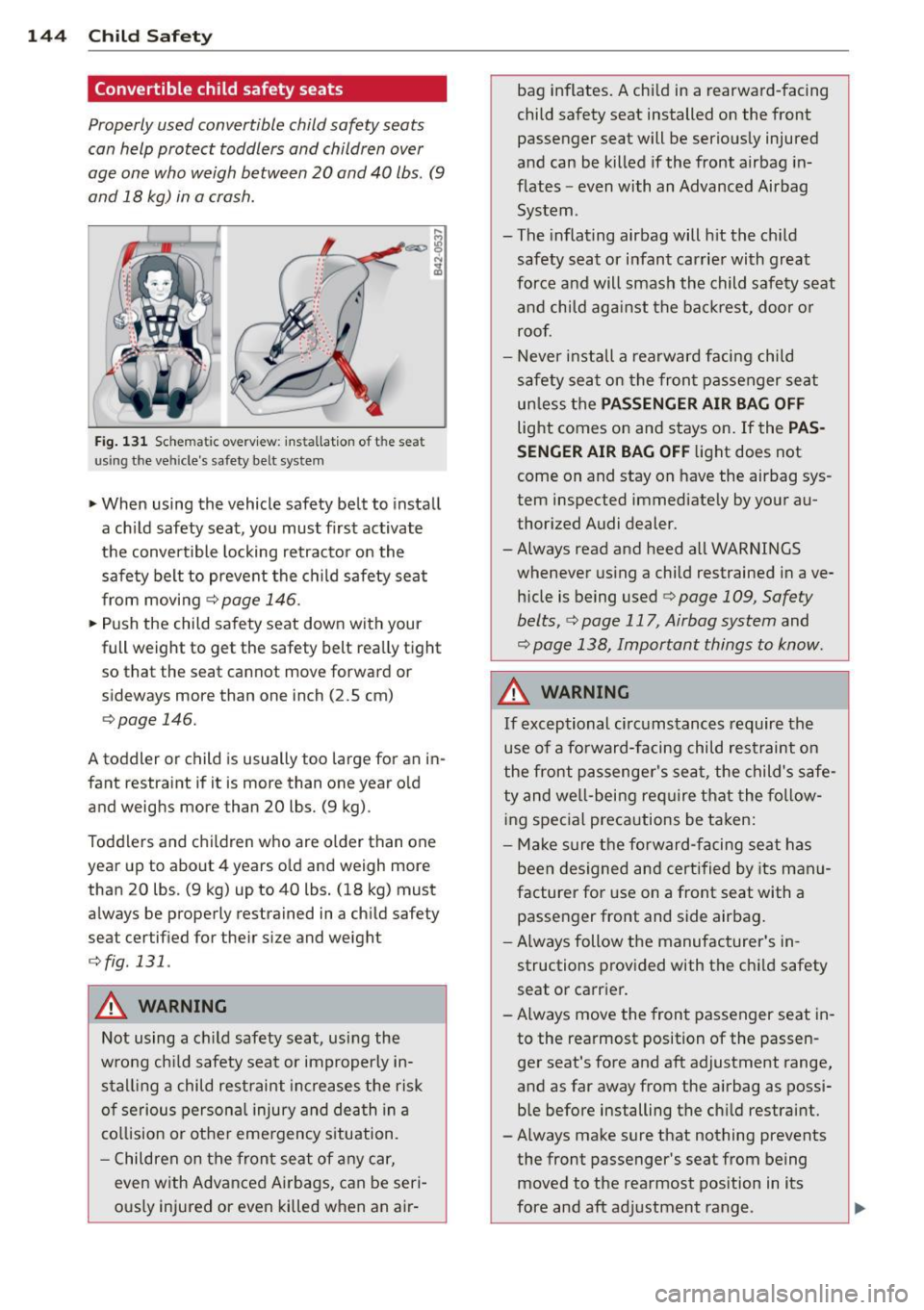
Properly used convertible child safety seats
can help protect toddlers and children over
age one who weigh between
20 and 40 lbs. (9
and 18 kg) in a crash.
Fig . 13 1 Schematic overv iew: in stallat ion of t he seat
us ing the ve hicle's safety belt system
~ When using the vehicle safety belt to install
a ch ild safety seat, you must first activate
the convertible locking retractor on the safety belt to prevent the c hild safety seat
from movi ng
Qpage 146.
~ Push the child safety seat down with your
full weight to get the safety belt rea lly tight
so that the seat cannot move forward or
sideways more than one inch (2.5 cm)
Qpage 146.
A toddler or child is usually too large for an in
fant restraint if it is more than one year old
and weighs more than 20 lbs. (9 kg) .
Toddlers and c hildren who are o lder than one
year up to about 4 years o ld and weigh more
than 20 lbs. (9 kg) up to 40 lbs. (18 kg) must
a lways be properly restrained in a child safety
seat certified for their size and weight
Qfig. 131 .
&_ WARNING
Not using a ch ild safety seat, us ing the
w rong ch ild safety seat or improperly in
stal ling a child re straint increases the risk
o f se rious persona l injury and de ath in a
co llision or othe r eme rgency s ituation.
- Children on t he front seat of a ny car,
even w ith Advanced A irbags, can be seri
ous ly injured or even killed when an air -bag inflates. A chi
ld in a rearward-facing
child safety seat installed on the front
passenger seat will be serious ly injured
and can be killed if the front airbag in
flates -even with an Advanced Airbag
System .
- The inflating airbag will h it the ch ild
safety seat or infant carrie r with great
for ce and will smash the child saf ety seat
and child aga inst the ba ckrest, doo r or
roof.
- Neve r install a rearward facing child
safety sea t on the fron t passenger sea t
un less t he
PASSENGER AIR BAG OFF
light comes on and stays on. If the PAS
SENGER AIR BAG OF F
light does not
come on and stay on have the airbag sys
tem inspected immediately by your au
thorized Audi dealer.
- Always read and heed all WARNINGS
whenever us ing a child restrained in ave
h icle is being used
¢ page 109, Safety
belts,
Q page 117, Airbag system and
Q page 138, Important things to know .
&_ WARNING
--
If exceptional circumstances require the
use of a fo rward-facing child restraint on
the front pa ssenger 's sea t, the child's safe
ty and we ll-bei ng req uire t hat the fo llow
i ng spec ial precautions be taken:
- Make sure the forward- facing seat has
been designed and cert ified by its man u
facturer for use on a front seat with a
passenger front and side airbag.
- Always follow the manufacturer 's in
structions p rovided with the chi ld safety
seat or carrie r.
- A lways move the front passenger seat in
to the rearmost position of the passen ger seat's fore and aft adjustment range,
and as far away from the airbag as possib le before installing t he ch ild restraint.
- Always make sure that nothing prevents
the front passenger 's seat from being
moved to the rearmost position in its
fore and aft adjustment range .
Page 148 of 244
146 Child Safety
will receive serious or possibly even fata l in
jury.
I n o rder for the airbag to offe r protection, it is
important that all vehicle occupants, especia l
l y any children, who must be in the front seat
because of exceptional circumstances, be
properly restrained and as far away from the
a irbag as poss ible. By keep ing room between
the child's body and the front of the passen
ger compartment, the airbag can inflate com
pletely and provide supplemental protection
in certain frontal collisions.
_& WARNING
Not using a booster seat, us ing the boos
ter sea t imprope rly, incorre ct ly ins talling a
booste r seat or using the vehicle safety
belt improperly increases the risk of seri
ous personal injury and death in a collision
or other emergency s ituation. To help re
duce the risk of ser ious persona l injury
and/or death:
-Always make sure to position the should
er port ion of the three-po int belt over
the midd le of ch ild's shou lder .
- Never let the shoulder port ion of the belt
rest against or across the neck, face,
chin , or throat of the child .
- Always make sure the lap belt portion of
the three-po int be lt is worn snug and
passes as low as possib le across the
child's pelvis. Neve r let the belt pass over
the soft abdomen .
- Failure to properly route safety belts
over a ch ild 's body will cause severe inju
ries in an ac ciden t or other emergency
situa tion
9 page 109 .
-Children on the front seat of any car,
even w ith Advanced A irbags, can be seri
o usly injured or even killed when an air
bag inf lates .
- Never le t a child sta nd or knee l on the
sea t.
- Never let a child ride in the ca rgo a rea of
yo ur vehicle .
- Always remember that a ch ild lean ing
forward, si tting s ideways or out of posi-
.
tion in any way d uring an accident can be
struck by a dep loying a irbag. This will re
sult in ser ious personal injury or death.
- If you must install a booster seat on the
front passenger seat because of excep
tional circumstances the
PASSENGER
AIR BAG OFF
li ght m ust come on and
stay on, whenever the ignition is switch
ed on.
- If the
PASSENGER AIR BAG OFF light
does not come on and stay on, pe rform
the che cks descr ibed
9 page 128, Moni
toring the Advan ced Airbag System.
- If the PASSENGER AIR BAG OFF li ght
does not come on and stay on whenever
the igni tion is switched on the infla ting
a ir bag w ill hi t the child sa fety seat or in
fant car rier with g reat force an d will
smash the child safety seat and child
aga inst the backrest, door or roof. Have
the airbag system inspected immed iately
by your Audi dea ler.
- Always read and heed all WAR NINGS
whenever using a child restrained in ave
h icle is being used
¢ page 109, Safety
belts, ~page 117, Airbag system
and
~ page 138, Important things to know.
Installing a child safety
seat
' Securing a child safety seat using a
safety belt
Safety belts for the front passenger con be
locked with the convertible locking retractor
to properly secure child safety seats .
The safety belts emergency locking retractors
for the front passenger's seat safety belt have
a convertible locking retracto r fo r ch ild re
st ra ints . The safety be lt must be loc ked so
that be lt webb ing ca nnot unree l. The retrac
tor can be act ivated to lock the safety belt and
prevent the safety be lt webb ing from loosen
ing up during norma l dr iv ing. A chi ld safety
seat can only be properly insta lled when t he
safety belt is locked so that the child and child
safety seat will stay in place. .,.
Page 149 of 244
Always remember: Even though your vehicle is
equipped with an Advanced Airbag system, a
child should always ride in the seat properly restrained for its age and si ze.
_&. WARNING
Improperly installed child safety seats in
crease the risk of serious personal injury
and death in a collision .
- Always make sure that the safety belt re
tractor is locked when installing a child
safety seat . An unlocked safety belt re
tractor cannot hold the child safety seat
in place during normal driving or in a
crash.
- Always buckle the child safety seat firmly
in place even if a child is not sitting in it.
A loose child safety seat can fly around
during a sudden stop or in a collision.
- The inflating airbag will hit the child
safety seat or infant carrier with great
force and will smash the child safety seat
and child against the backrest, door or
roof.
- Forward-facing child safety seats or in
fant carriers installed on the front pas
senger's seat may interfere with the de ployment of the airbag and cause serious
injury to the child.
- Always read and heed all WARNINGS
whenever using a child restrained in ave
hicle is being used
r::;,page 138. Special
precautions apply when installing a child
safety seat on the front passenger seat
r::;, page 119, Child restraints on the front
seat -some important things to know.
_&. WARNING
-
Always take special precautions if you
must install a forward or rearward-facing
child restraint on the front passenger's
seat in exceptional situations:
- Whenever a forward or rearward-facing child restraint is installed on the front
passenger seat, the
PASSENGER AIR
BAG OFF
light must come on and stay on
whenever the ignition is switched on.
Child Safety 147
- If the PASSENGER AIR BAG OFF light
does not come on and stay on, perform
the checks described
r::;, page 128, Moni
toring the Advanced Airbag System.
- If the PASSENGER AIR BAG OFF light
does not come on and stay on whenever
the ignition is switched on the inflating
airbag will hit the child safety seat or in
fant carrier with great force and will
smash the child safety seat and child
against the backrest, door or roof. Have
the airbag system inspected immediately
by your Audi dealer.
- Improper installation of child restraints
can reduce their effectiveness or even prevent them from providing any protec
tion.
- An improperly installed child restraint
can interfere with the airbag as it de ploys and seriously injure or even kill the
child.
- Always carefully follow the manufactur
er's instructions provided with the child
safety seat or carrier.
- Never place additional items on the seat
that can increase the total weight regis
tered by the weight-sensing mat and can
cause injury in a crash.
_&. WARNING
Forward-facing child restraints:
- Always make sure the forward-facing
seat has been designed and certified by
its manufacturer for use on a front seat
with a passenger front and side airbag.
- Never put the forward-facing child re straint up, against or very near the in
strument panel.
- Always move the passenger seat into its
rearmost position in the seat's fore and
aft adjustment range, as far away from
the airbag as possible before installing
the forward-facing child restraint. The
backrest must be adjusted to an upright
position. •
•