gas type AUDI R8 SPYDER 2011 Owners Manual
[x] Cancel search | Manufacturer: AUDI, Model Year: 2011, Model line: R8 SPYDER, Model: AUDI R8 SPYDER 2011Pages: 244, PDF Size: 59.74 MB
Page 138 of 244
136 Airbag system
o ther injuries, for example, swelling, bruising,
and minor abrasions can also be associated
with deployed side airbags. Remember too,
side airbags wi ll deploy only once and on ly in
certain kinds of accidents - your safety belts
are a lways there to offer protect ion .
Vehicle damage, repa ir costs or even the lack
of vehicle damage are not necessarily an indi
cation of over-sensitive or failed airbag activa
tion . In some co llisions, both front and side
a irbags may inflate. Remember too, that air
bags will dep loy only once and only in certain
kinds of collisions -your safety be lts a re al
ways there to offer protec tion in those acci
dents in wh ic h ai rbags are not supposed to
deploy or when they have already deployed .
The side airbag system will not deploy:
- when the ignition is turned off
- in s ide collisions when the acceleration
measured by the sensor is too low
- in front-end collisions
- in rear-end collisions
- in rollovers.
I n some types of acc idents the front a irbags
and side a irbags may be triggered together.
A WARNING
- Safety belts and t he ai rbag system will
only provide protection when occ upants
are in the proper seating posit ion
¢page 137.
-If the airbag indicator light comes on
when the veh icle is being used, have the
system inspected immediately by your
authorized Audi dealer. The a irbag may
not work p roperly when the vehicl e ac
celeration in a side co llision is h igh
enough to activa te the airbag.
-
How supplemental side airbags work
Side airbags deploy instantly and can help re
duce the risk of upper torso injuries for occu
pants who are properly restrained.
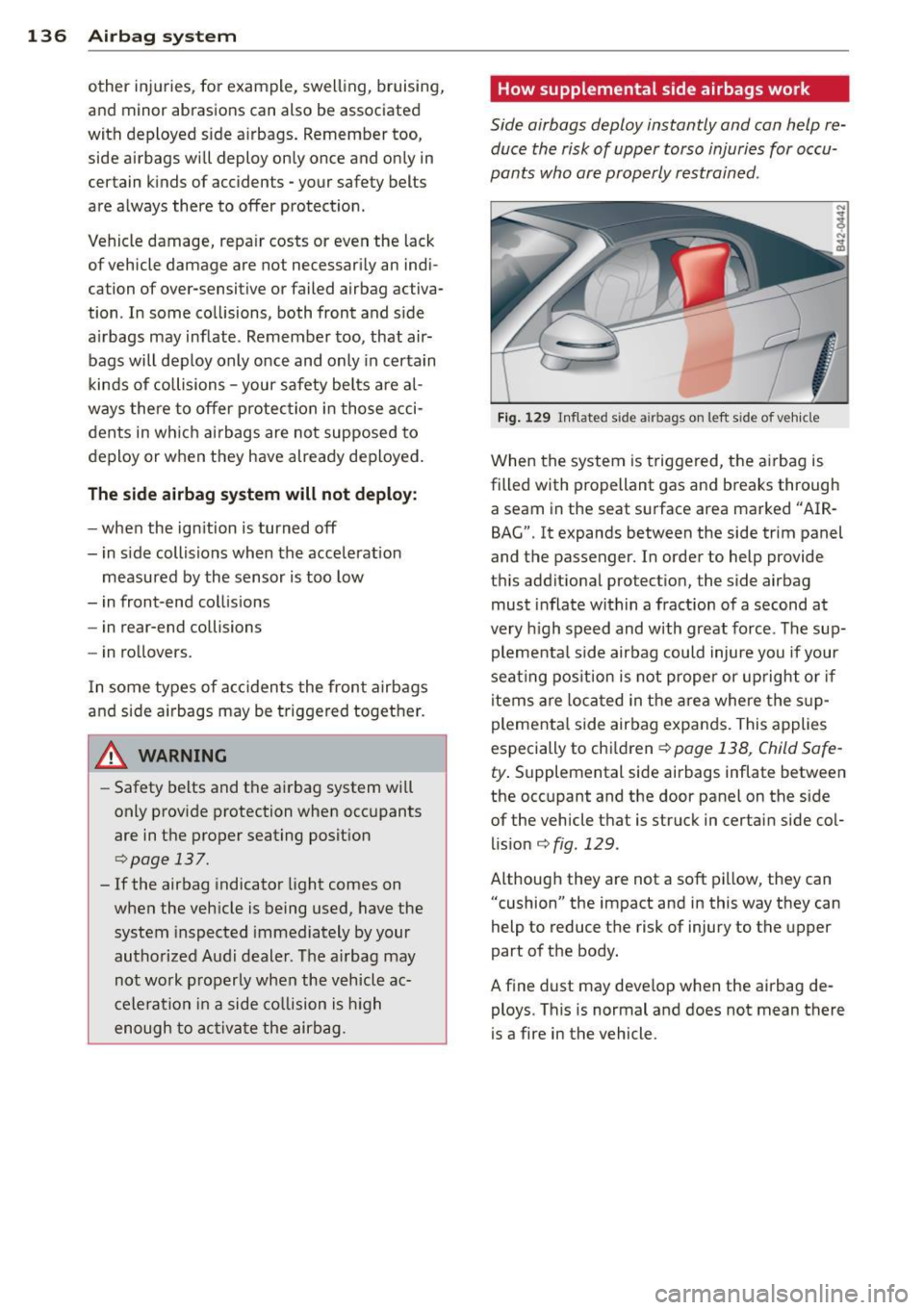
F ig . 1 29 Inflated s ide a irbags on left s ide of veh icle
When the system is triggered, the airbag is
filled with propellant gas and b reaks through
a seam in the seat surface area ma rked "AIR
BAG".
It expands between the side trim panel
and the passenger. In order to help provide
t hi s additional protection, the side airbag
must inflate w ithin a fraction of a second at
very h igh speed and with great force . The sup
pleme nta l side airbag could injure you if your
seat ing pos it ion is not proper or upright or if
items are loca ted in the area where the s up
pleme nta l side airbag expands. This applies
especially to children ¢
page 138, Child Safe
ty .
Supplemental side airbags inflate between
the occ upant and the door panel on the side
of the vehicle that is struck in certain side col
lis ion ¢
fig. 129.
Although they are not a soft pi llow, they can
"cushion" the impact and in this way they can
help to reduce the risk of injury to the upper
part of the body.
A fine dust may deve lop when the airbag de
ploys. This is normal and does not mean there
is a fire in the vehicle.
Page 173 of 244

-Blend must contain not more than 15%
MTBE.
Seasonally adjusted gasoline
Many gasoline grades are blended to perform
espec ially we ll for winter or summer driving.
During seasonal change-over, we suggest that
you fill up at busy gas stat ions where the sea
sonal adjustment is more likely to be made in
time .
(D Note
-Methanol fuels which do not meet these
requirements may cause corrosion and
damage to plastic and rubber compo
nents in the fuel system .
- Do not use fue ls that fail to meet the
specified criter ia in this chapter.
- If you are unable to determine whether
or not a particular fue l blend meets the
specifications, ask your service station or
its fuel supp lier.
- Do not use fuel for which the contents
cannot be identified.
- Fuel system damage and performance
problems resulting from the use of fuels
different from those specified are not
the responsibility of Audi and are not
covered under the New Vehicle or the Emission Control System Warranties.
- If you experience a loss of fuel economy
or driveability and performance prob l ems due to the use of one of these fuel
blends, we recommend that you switch
to unblended fuel.
Gasoline additives
A major concern among many auto manufac
turers is carbon deposit build- up caused by
the type of gasoline you use.
Although gasoline grades differ from one manufacturer to another , they have certain
things in common. All gasoline grades contain
substances that can cause deposits to collect
on vital engine parts, such as fuel injectors
and intake valves. Although most gasoline brands include additives to keep engine and
Fuel supply and filling your fuel tank 171
fuel systems clean, they are not equally effec
tive .
A udi recommends using TOP TIER Detergent
Gasoline. For more information on TOP TIER
Detergent Gasoline, please go to the official
website (www.toptiergas.com).
After an extended period of using inadequate
fuels, built-up carbon deposits can rob yo ur
engine of peak performance.
Q) Note
Damage or malfunction due to poor fue l
quality is not covered by the Aud i New Ve
hicle Limited Warranty.
Fuel tank
Fuel filler neck
The fuel filler neck is located on the right rear
side panel behind the fuel fille r flap.
If the unlocking system should fail, you can
still open the flap manually -for detailed in
structions see ¢
page 173.
You can find the fuel tank capacity of your ve hicle in
Technical Data ¢ page 228.
The label on the inside of the fuel fi ller flap
tells you the correct fue l for your vehicle. For
more information about fuel specifications,
see ¢
page 170.
Your vehicle fue l tank has an on -board refue l
ing vapor recovery system. This feature helps
to prevent fuel vapors from escaping from the
tank and polluting the environment while you refuel your vehicle . In order to fill the tank
properly while protecting the environment,
please fo llow this refueling procedure careful
ly.
_&. WARNING
Under normal operating conditions, never
carry additional fue l conta iners in yo ur car.
Gas canisters and other containers used to
transport f uel can be dangero us. Such con
tainers, full or empty, may leak and could
cause a fire in a collis ion. If you must
•
•
Page 189 of 244
~ Install the battery cover.
~ Close the luggage compartment lid
¢page 42.
When charging at low voltages (e.g. with a
trickle charger), the battery cables do not
have to be disconnected first. Before charging
at
high voltages, i.e. "fast charging", you
must disconnect both cables. In either case,
follow the instructions from the manufacturer
of the charger .
Fastcharging a battery is
dangerous ¢.&. in
Working on the battery on page 185 .
It re
quires special charging equipment and the knowledge to go with it. We recommend hav
ing your battery fast charged only by a quali
fied workshop.
A discharged battery can
freeze at tempera
tures of only 32 °F (0 °C) . Allow a frozen bat
tery to thaw completely before attempting to
charge it¢ ,&. . However, we recommend not
using a thawed battery again because the bat
tery casing can be cracked due to ice forma
tion and can leak battery acid.
Do not open the battery caps when charging
the battery.
_& WARNING
-
Charging a battery can be dangerous.
- Never charge a frozen battery .
It may ex
plode because of gas trapped in the ice.
Allow a frozen battery to thaw out first.
- Do not reuse batteries which were fro
zen. The battery housing may have
cracked and weakened when the battery
froze.
- Charge the battery in a well ventilated
area. Keep away from open flame or elec
trical spark. Do not smoke. Hydrogen gas
generated by the battery is explosive.
- To reduce the danger of explosion , never
connect or disconnect charger cables
while the charger is operating.
- Fast charging a battery is dangerous and
should only be attempted by a compe
tent technician with the proper equip ment.
Checking and filling 187
- Battery acid that may spill during charg
ing should be washed off with a solution
of warm water and baking soda to neu
tralize the acid .
@ Note
Never use a fast charger as a booster to
start the engine. This will seriously dam
age sensitive electronic components, such
as control units, relays, radio, etc ., as well
as the battery charger .
(D Tips
-The vehicle battery must not be charged
with a standard small charger that plugs
into the cigarette lighter or outlet .
- Only charge the battery through the con
nections in the luggage compartment.
Replacing the battery
The new battery must have the same specifi
cations as the old one.
Your vehicle is equipped with an intelligent
energy management system for distributing
electricity ¢
page 155. The battery charges
better in vehicles with the energy manage
ment system than in vehicles without the sys
tem. To ensure that the additional power is
available after replacing the battery , replacing
with the same type of battery from the same
manufacturer (like the battery that was deliv
ered with the vehicle) is recommended. An au
thori zed dealer mus t code the battery in the
energy management control module .
T he new battery must have the same capacity,
voltage (12 volts), current and design and it
must be sealed with plugs. The battery must
conform to the standards TL 825 06 (from Oc
tober 2006) and VW 7 50 73 (from August 2001).
Since the vehicle battery is difficult to reach,
we recommend having the battery replaced by
an authorized Audi R8 dealer or other quali-
fied workshop . ..,. •
•
Page 190 of 244
188 Checking and filling
(D Note
-Your vehicle is equipped with a specia l
battery. Installing a different type of
battery can cause prob lems in the vehi
cle electrical system. When replacing the
vehicle battery, always install one with
the same spec ificat ions as the original
batte ry .
- Make sure that the gas venting hose is
always connected to the o riginal open ing
on the battery side. Otherw ise gasses or
ba tte ry acid cou ld leak out .
- Battery ho lder and term inals a lways
have to be secured cor rectly.
- Read and follow the warnings under
9 page 185, Working on the battery be
fore performing any work on the batte ry.
@ For the sake of the environment
Because of the problem of proper disposal
of a battery, we recommend your author
ized Audi dealer change the batte ry for
you . Batter ies contain s ulf uric ac id and
lead and must always be disposed of prop
erly in compliance with all environmenta l
reg ulations. D isposing of vehicle batteries
improperly is very dangerous to the envi
ronment. Make sure that the removed bat
tery ca nnot overbalance, otherwise sulfu
r ic acid might escape!
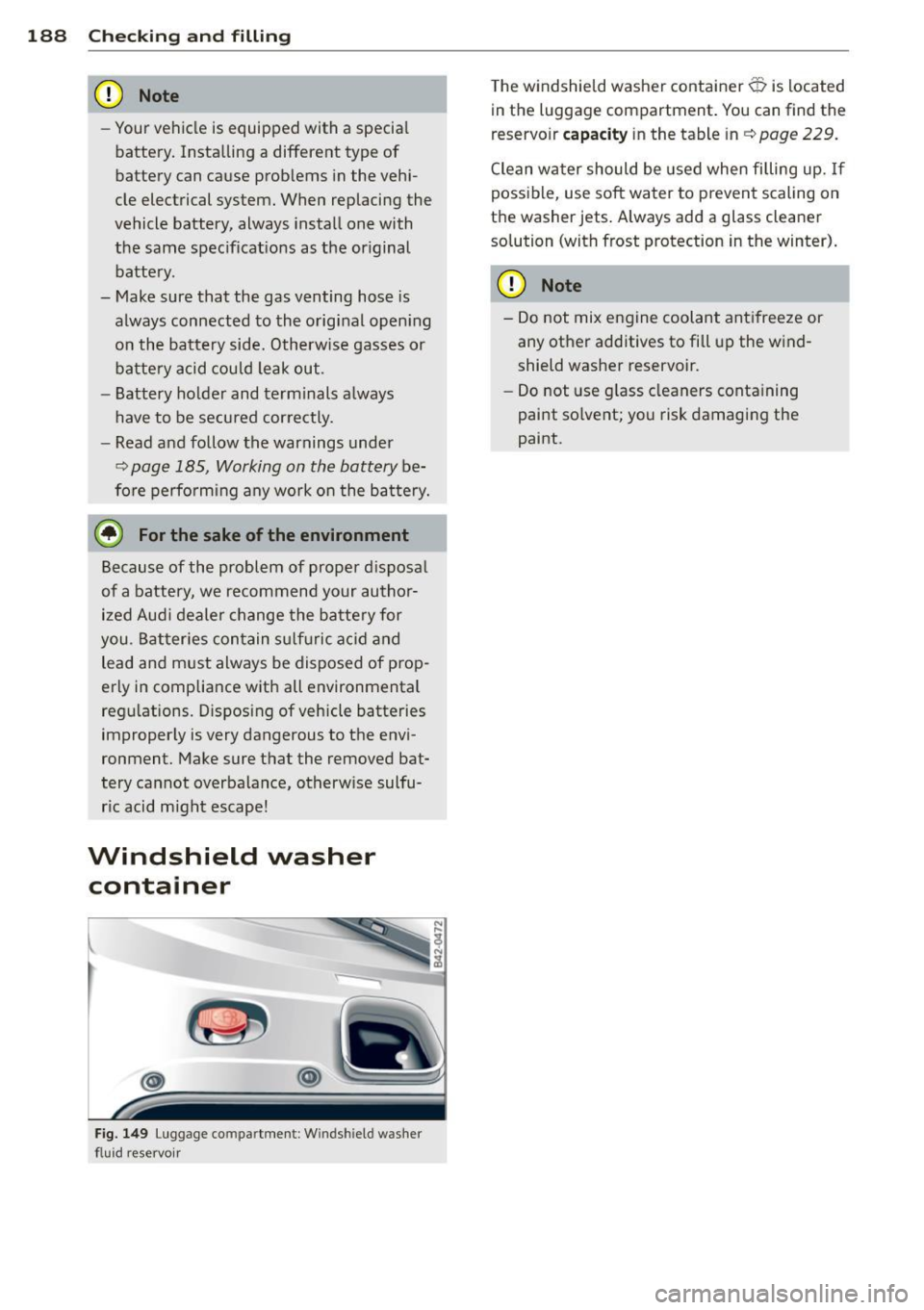
Windshield washer
container
Fig. 149 Luggage co m pa rtment : W inds hield washer
fl uid reservo ir
T he windshield washer container O is located
in the luggag e compartment. You can find the
reservo ir
c a pacit y in the table in c::> page 229.
Clean water should be used when filling up. If
possible, use soft water to prevent scaling on
the washer jets . Always add a glass cleaner
solution (with frost protection in the winter) .
(D Note
-Do not mix engine coolant antifreeze or
any other additives to fill up the wind
shield washer reservoir.
- Do not use g lass cleaners conta ining
pai nt so lvent; you risk damaging the
paint.
Page 191 of 244
Tires and wheels
Tires
General notes
Tires may be the least appreciated and most
abused parts of a motor vehicle .
Tires may be the least appreciated and most
abused parts of a motor vehicle . T ires are,
however, one of the most important parts of a
vehicle, particularly considering the compara
tively small patch of rubber on each tire that
assures that a ll- important contact between
you, you r vehicle and the road.
Maintaining the correct tire pressure, mak ing
sure that your vehicle and its tires do not have
to carry mo re weight than they can safely han
d le, avoiding damage from road hazards and
r eg ularly inspect ing t ires for damage i nclud
ing cuts, slashes irregu la r wear and ove rall
condition are the most important things that
you can do to he lp avoid s udden tire failure in
cluding tread separat ion and blowouts.
A voidin g damage
If yo u have to d rive over a curb or similar ob
stacle, drive very slow ly and as close as possi
b le at a right angle to the curb.
A lways keep chemicals incl ud ing grease, o il ,
gasoline and brake fluid off the t ires .
I nspect the t ires regularly for damage (cuts,
cracks or b listers, etc.). Remove any fo reign
bod ies embedde d in the treads.
Storing tires Mark tires when you remove them to indicate
the direction of rotation . T his ensures you to
be ab le to mount them correctly when you re
i nstall them .
When removed, the whee ls or t ires should be
sto red in a cool, d ry and preferably dark place .
Store tires in a vertical pos ition if they are not
mounted on r ims, in a horizontal pos it ion if
they are mounted on rims .
Tires an d wheel s 189
New tires
New ti res h ave to be broken in~& .
The tread depth of new t ires may vary, accord
ing to the type a nd make of t ire and the tread
patte rn.
H idden damage
Damage to tires and r ims is ofte n not readily
visible . If you notice unusual v ib rat ion or the
vehicle pulls to one s ide, th is may ind icate
that one of the t ires has been damaged . T he
ti res m ust be chec ked immed iate ly by an au
thorized Audi dea le r or q ua lified wor kshop .
Unidirectional tires
A un idirectional tire can be identified by ar
rows on the sidewa ll, that po int in the direc
tion the t ire is designed to rotate. You must
f ol low the specified di rection o f rotation . T his
is necessary so that these tires can develop
their optimum characteristics regarding grip,
road noise, wear and hydrop laning resistance.
For more information
~ page 216.
A WARNING
New tires or t ires that are o ld, worn or
damaged cannot provide maximum con
trol and braking ability .
-
-New tires tend to be slippery and must
be broken in. To reduce the r isk of losing
control, a co llision and ser ious personal
in ju ries, d rive with special ca re for the
fi rst 350 m iles ( 560 km).
- Driving with worn or damaged tires can
lead to loss of control, sudden tire fail
ure, including a blowout and sudden de
fl ation, cras hes and se riou s personal in
juries . Have wo rn or damaged t ires re
placed immediate ly.
- Ti res age even if they are not being used
and can fail sudden ly, especially at hig h
speeds. Tires that are more than 6 years
old can only be used in an emergency
and then w ith special care and at low
speed.
•
•