lock AUDI R8 SPYDER 2012 Workshop Manual
[x] Cancel search | Manufacturer: AUDI, Model Year: 2012, Model line: R8 SPYDER, Model: AUDI R8 SPYDER 2012Pages: 236, PDF Size: 59.24 MB
Page 168 of 236
166 Fuel suppl y and filli ng your fuel t ank
transport fue l to use for your lawn mower,
snow blower, etc., be very careful and al
ways observe local and state laws regard
ing the use, transportat ion and storage of
such fuel containers. Make certain the con
tainer meets industry standards (ANSI/
AS TM F852 -86).
(D Note
Never drive your vehicle until the fuel tank
is completely dry. The irregular supply of
fuel can cause misfir ing. Gasoline cou ld
e nte r into the exhaust system and damage
the cata lytic conve rter.
Refueling
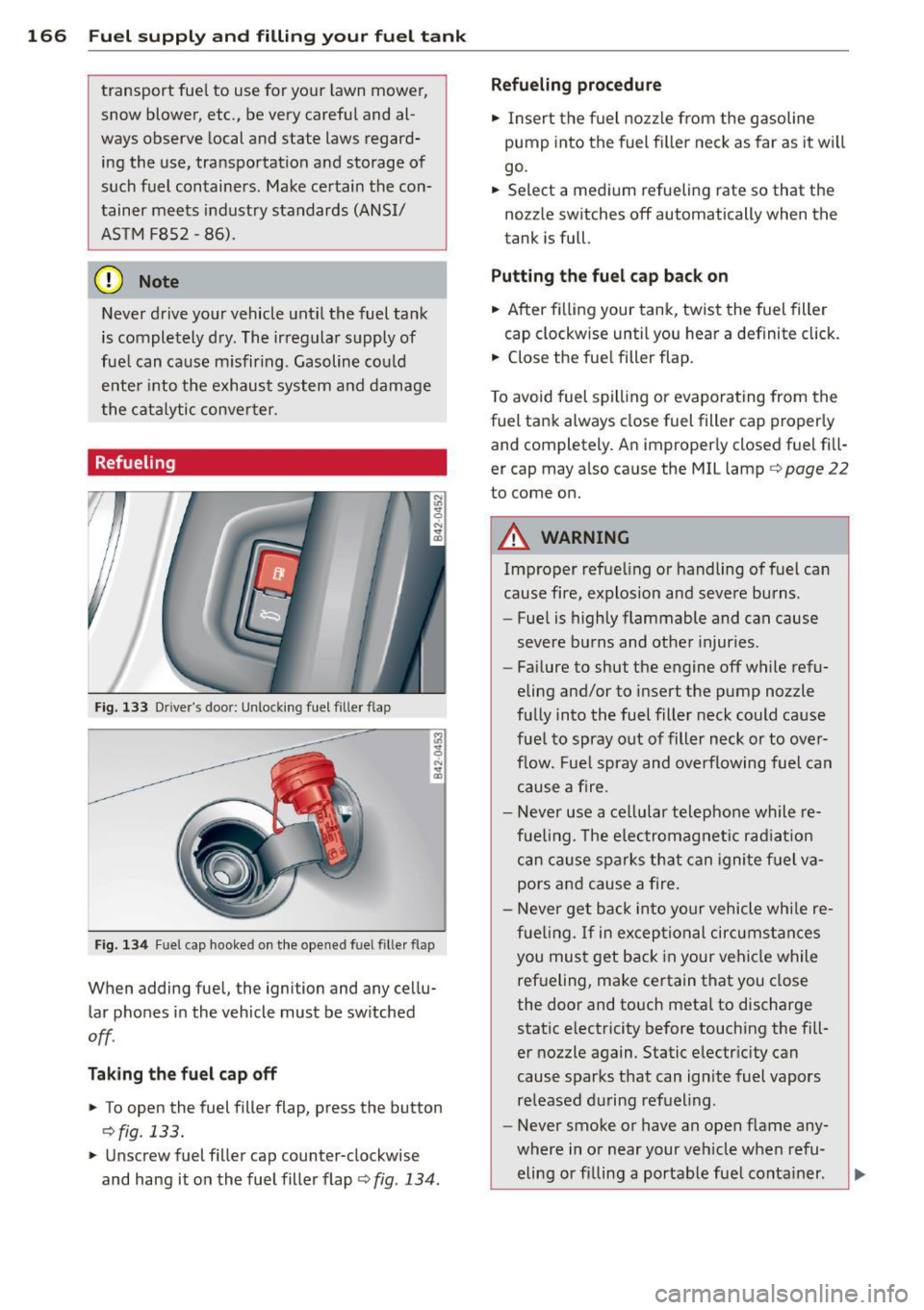
Fig. 133 D river 's doo r: Unlocki ng fuel filler flap
Fig. 134 Fuel cap hooked on the opened fuel filler flap
When adding fuel, the ignition and any cellu
lar phones in the vehicle must be sw itched
off .
Tak ing th e fuel cap off
• To open the fuel filler flap, press the button
9fig. 133.
• Unscrew fuel filler cap counter-clockwise
and hang it on the fuel filler flap ¢
fig. 134 .
Refueling procedure
• Insert the f uel nozzle from the gasoline
pump into the fuel fi ller neck as far as it wi ll
go .
• Select a med ium refueling rate so that the
nozzle switches off automatically when the
tank is full.
Putting th e fu el cap bac k on
• After fi lling your tank, twist the fuel filler
cap clockwise until you hear a definite click.
• Close the fue l filler flap.
T o avoid fuel spilling or evaporating from the
fuel tank always close fuel filler cap properly and completely. An improperly closed fuel fi ll
er cap may also cause the MIL lamp¢
page 22
to come on.
A WARNING
Improper refue ling or handling of fuel can
cause fire, explosion and severe burns.
- Fuel is highly flammable and can cause
severe burns and other injuries.
- Fai lure to shut the engine off while refu
eling and/or to insert the pump nozzle
fully into the fuel filler neck could cause
fuel to spray out of filler neck or to ove r
flow. F ue l spray and overflowing fuel can
cause a fire.
- Never use a ce llular telephone while re
fue ling. The electromagnet ic rad iat io n
can cause spa rks that can igni te fuel va
pors and cause a fire.
- Never get back into your vehicle whi le re
fue ling.
If in exceptio nal circumstances
you must get back in your vehicle while
ref ueling, make certain that you close
the door and touch metal to discharge
static electricity before touching the fill
er nozzle again. Static electricity can
cause sparks that can ignite fuel vapors
re leased d uring refueling .
- Never smoke or have an open f lame any
where in o r near your veh icle when refu
eling or filling a portable fue l conta iner.
Page 169 of 236
-For your safety, we strongly recommend
that you do not travel with a portable
fuel container in your vehicle. The con
tainer, full or empty may leak and could
cause a fire , especially in a crash .
-If, under exceptional circumstances, you
must transport a portable fuel container,
please observe the following:
- Never fill a portable fuel container
while it is anywhere in or on the vehicle (for example, in the luggage compart
ment, or on the trunk) . Static electrici
t y can build up while filling and can ig
nite fuel vapors causing a fire .
- Always place a portable fuel container
on the ground before filling .
- Always keep the filler nozzle complete
ly inside the portable container before
and during filling.
- If filling a portable container made of
metal, the filler nozzle must always be
in contact with the container . This will
help prevent static electricity from dis
charging and cause a fire.
- Never spill fuel inside the vehicle or
luggage compartment. Fuel vapors are
highly flammable.
- Always observe local and state/provin
cial laws regarding the use, storage
and transportation of fuel containers
- Make certain the fuel container meets
industry standards (ANSI/ ASTM
F852-86).
(D Note
I f any fuel has spilled onto the car, it
should be removed immediately to prevent
damage to the paint.
@ For the sake of the environment
As soon as the correctly operated nozzle switches off automatically for the first
time, the tank is full. Do not try to add
more fuel because fuel may spill out. In
addition, the expansion space in the fuel
tank will be filled -causing the fuel to
Fuel supply and filling your fuel tank 167
overflow when it becomes warm and pol
lute the environment.
a) Tips
- Running your engine while refueling may
cause vapors to escape or even fuel to
spill out of the tank. This would then
shut off the fuel nozzle before the tank
is full.
- Do not refuel your vehicle with the igni
tion switched on. The fuel gauge may
otherwise not indicate the correct fuel
level after refueling .
Unlocking the fuel filler flap
by hand
You can open the fuel filler flap by hand if the
power locking sy stem should fail .
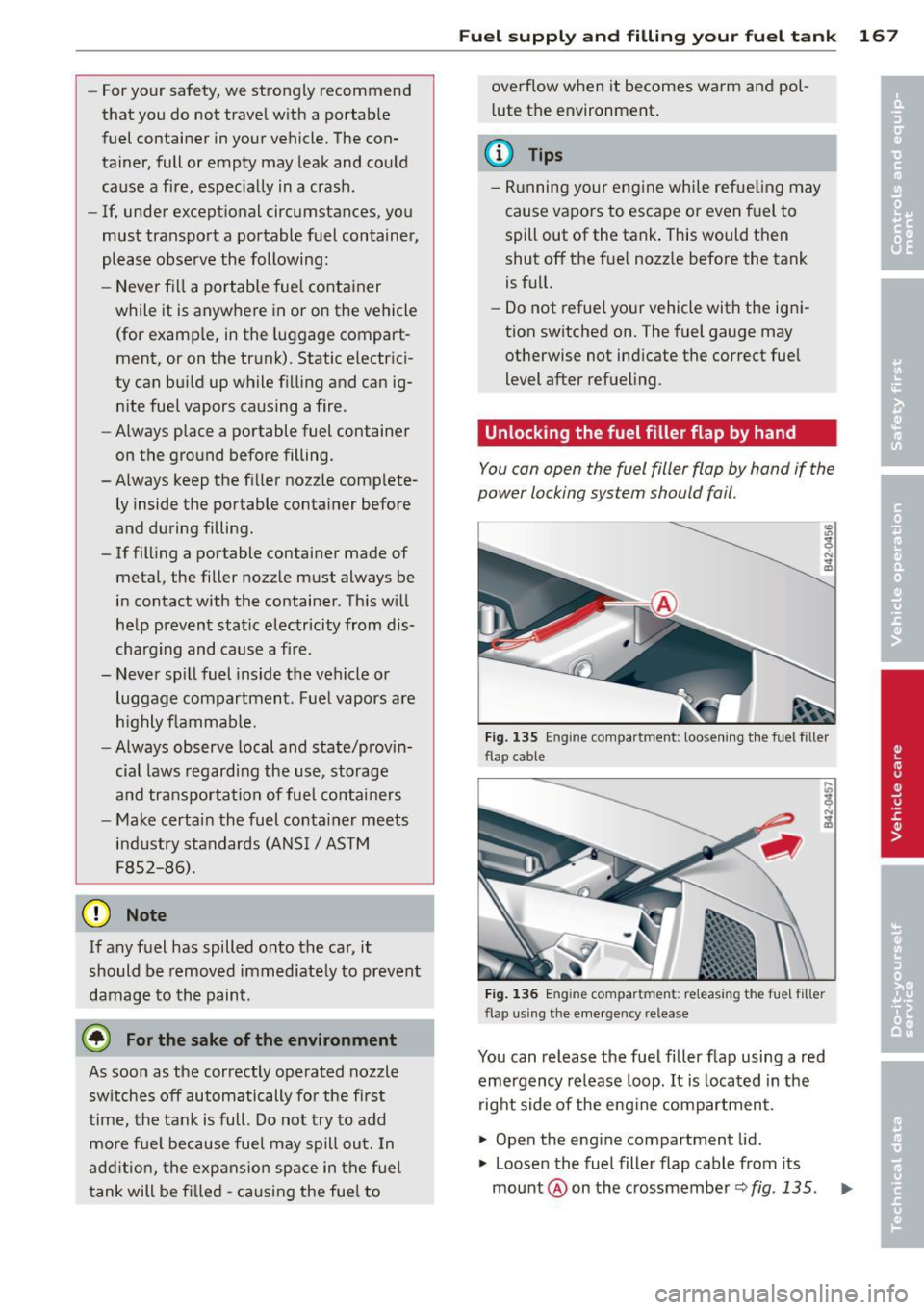
Fig. 135 En gin e compar tment: loo sening the fue l fill er
fl ap cab le
Fig. 136 Engine compar tment: re lea sing the fuel fille r
flap using the emer gen cy re le ase
You can release the fuel filler flap using a red
emergency release loop .
It is located in the
right side of the engine compartment.
.. Open the engine compartment lid.
.. Loosen the fuel filler flap cable from its
mount @ on the crossmember
~ fig. 135 . liJJ,,
Page 172 of 236
1 7 0 Che cking and filling
(D Note
When adding fluids, a lways make sure that
they are poured into the proper container or filler opening, otherwise serious dam
age to veh icle systems will occur.
@ For the sake of the environment
To detect leaks in time, inspect the vehicle
floor pan from underneath regu larly . If
you see spots from oil or other vehicle flu ids, have your vehicle inspected by an au
thorized Audi dealer.
Releasing the engine compartment lid
The engine compartment lid is released from
inside the vehicle .
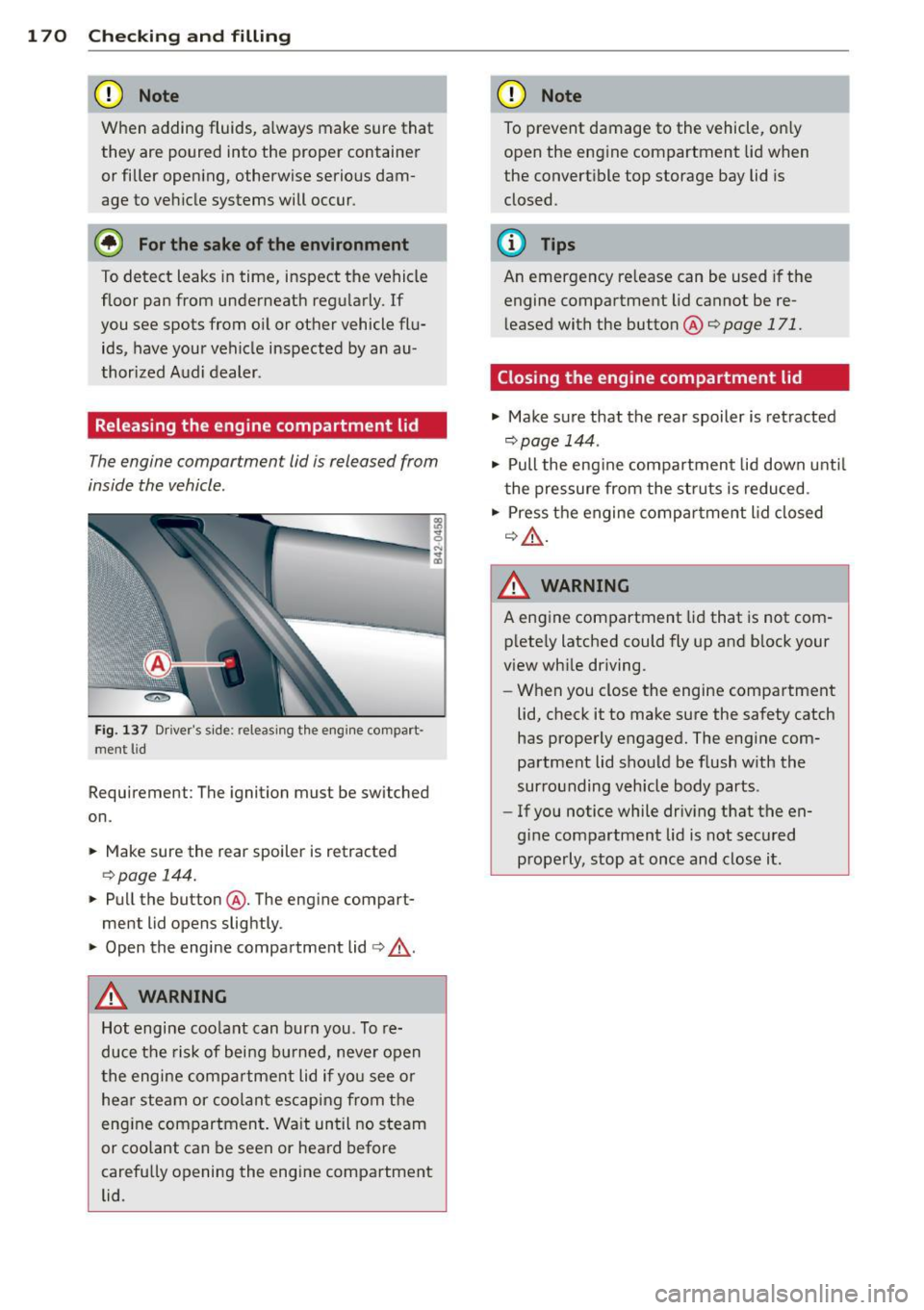
Fig. 137 Driver's side: releasing t he engine co mpart
ment lid
Requirement : The ignition must be switched
on.
... Make sure the rear spoiler is retracted
¢page 144 .
... Pull the button @. The eng ine compart
ment lid opens slightly .
... Open the engine compartment lid
c> ,& .
A WARNING
-
Hot engine coo lant can burn you . To re
duce the risk of being bu rned, never open
the engine compartment lid if yo u see or
hear steam or coolant escaping from the
eng ine compartment. Wait until no steam
or coolant can be seen or heard before
carefully opening the engine compartment
lid.
(D Note
To prevent damage to the vehicle, on ly
open the engine compartment lid when
the convert ible top storage bay lid is
closed.
(D Tips
An emergency re lease can be used if the
engine compartment lid cannot be re
leased with the button
® ¢ page 171.
Closing the engine compartment lid
... Make sure that the rear spoiler is retracted
Qpage 144.
.,. Pull the eng ine compartment lid down unti l
the pressure from the struts is reduced .
... Press the engine compartment lid closed
Q&. .
A WARNING
A engine compartment lid that is not com
plete ly latched could fly up and b lock your
view wh ile driving.
- When you close the engine compartment
lid, check it to make sure the safety catch
has properly engaged. The engine com
partment lid should be flush with the
surrounding vehicle body parts.
- If you notice while driving that the en
gine compartment lid is not secured
properly, stop at once and close it.
Page 178 of 236
1 7 6 Che cking and filling
your cooling system and could result in
damage not covered by your New Vehicle Limited Warranty .
Checking the engine coolant level
Proceed carefully when checking the coolant.
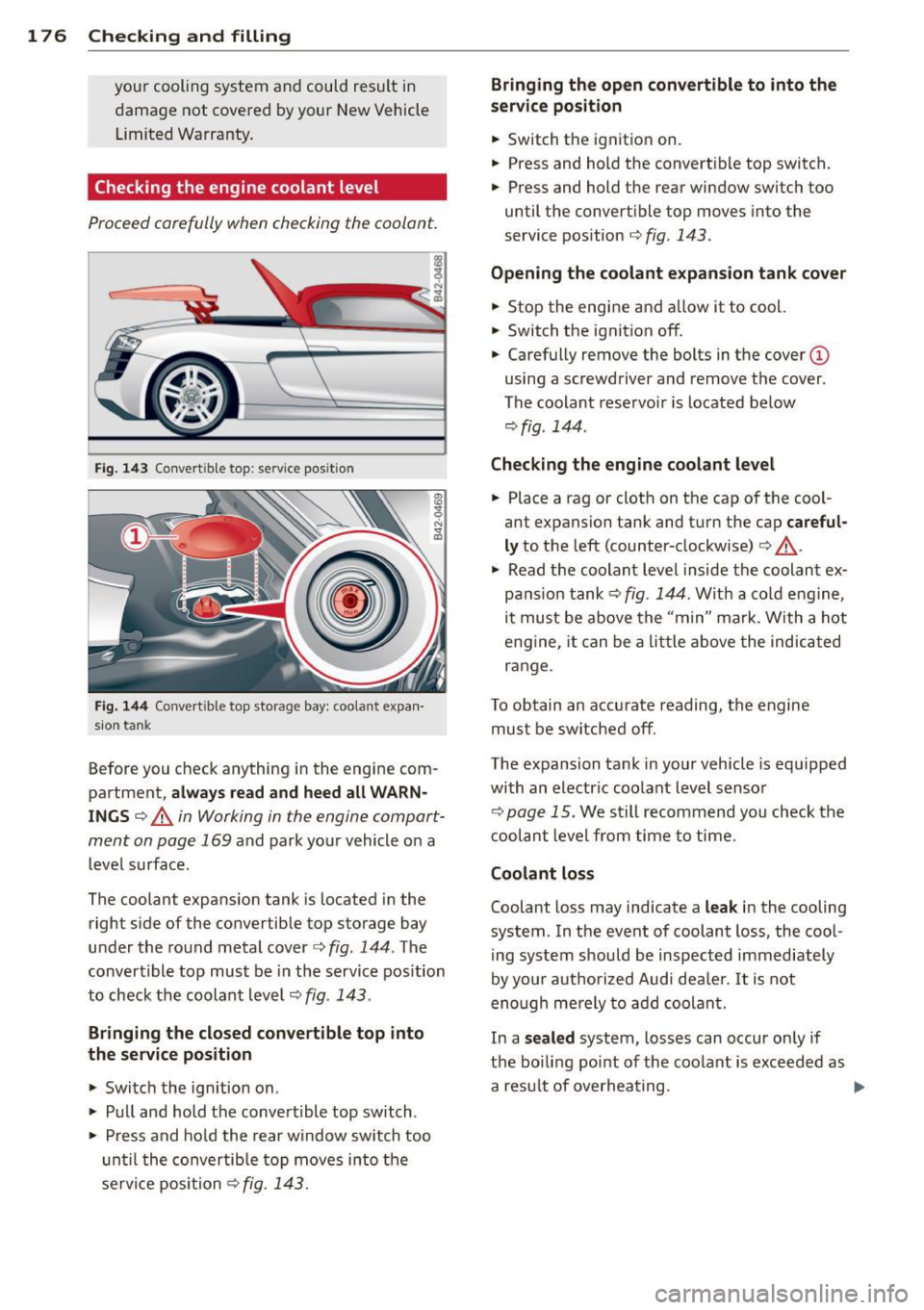
Fig . 1 43 Co nvert ible top: se rv ice pos it ion
F ig . 14 4 Convert ib le top storage bay: coolant expan·
sio n tank
Before you check anything in the engine com
partment,
a lwa ys r ead and heed all WARN
INGS ¢.&.. in Working in the engine compart
ment on page
169 and park your vehicle on a
level surface .
The coolant expansion tank is located in the right s ide of the convertible top storage bay
under the round metal cover¢
fig. 144 . The
convertible top must be in the service position
to check the coolant leve l
¢fig . 143 .
Bringing the closed con ve rtible top into
th e s ervic e position
~ Switch the ignition on .
~ Pull and hold the convert ible top switch .
~ Press and hold the rear window switch too
u nti l the convertib le top moves into the
service position¢
fig. 143.
Bringing the op en conv ertible to into the
service position
~ Switch the ignition on.
~ Press and hold the convertible top switch.
~ Press and hold the rear window switch too
until the convertible top moves into the
service position¢
fig . 143 .
Opening the coolant e xpan sion tank cover
~ Stop the engine and allow it to cool.
~ Switch the ignition off.
~ Carefully remove the bolts in the cover (D
using a screwdriver and remove the cover.
The coolant reservoir is located below
¢fig. 144.
Chec king the engine cool ant level
~ Place a rag or cloth on the cap of the cool
ant expansion tank and turn the cap
careful
ly
to the left (counter-clockwise) ¢ .&_.
~ Read the coolant level inside the coolant ex
pans ion tank ¢
fig. 144 . With a co ld engine,
it must be above the "min" mark. With a hot
eng ine, it can be a little above the indicated
range.
T o obtain an accu rate reading, the engine
must be switched off.
The expansion ta nk in your vehicle is equ ipped
with an electric coo lant level sensor
¢page 15. We still recommend you check the
c oolant level from time to time.
Coolant loss
Coolant loss may indicate a leak in the cooling
system . In the event of coolant loss, the cool
i ng system shou ld be inspected immediately
by your aut horized Audi dea ler. It is not
eno ugh me rely to add coolant.
In a
s ea le d system, losses can occur on ly if
the boiling point of the coo lant is exceeded as
a resu lt of overheating.
Page 179 of 236
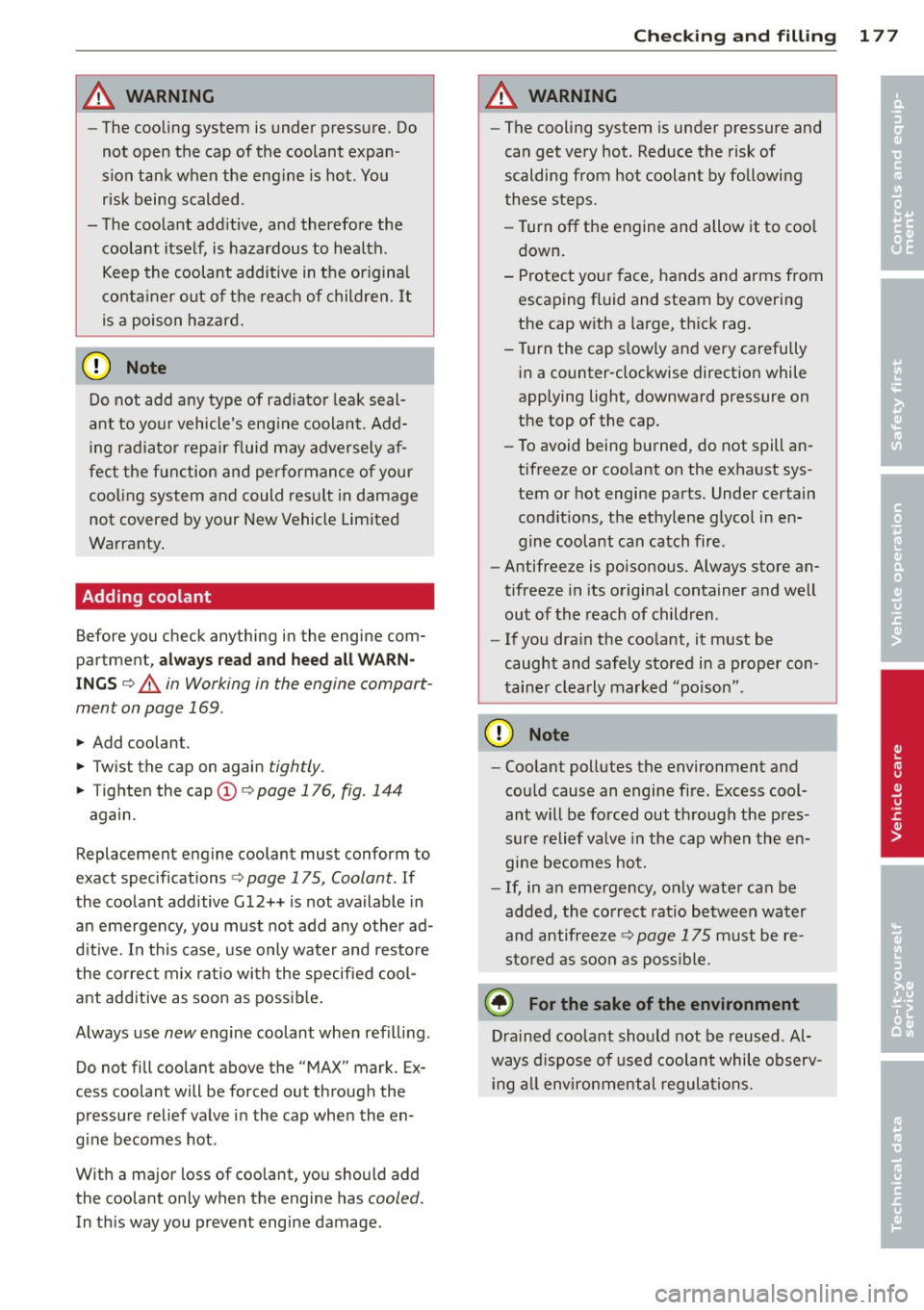
A WARNING ,~
- The cooling system is under pressure. Do
notopenthecapofthecoolantexpan
sion tank when the engine is hot . You
risk being scalded .
- The coolant additive, and therefore the coolant itself, is hazardous to health.
Keep the coolant additive in the original
container out of the reach of children. It
is a poison hazard.
(D Note
Do not add any type of radiator leak seal
ant to your vehicle's engine coolant. Add
ing radiator repair fluid may adversely af
fect the function and performance of your cooling system and could result in damage
not covered by your New Vehicle Limited
Warranty.
Adding coolant
Before you check anything in the engine com
partment,
always read and heed all WARN
INGS ¢ &. in Working in the engine compart
ment on page 169.
.. Add coolant .
.. Twist the cap on again
tightly .
.. Tighten the cap (D ¢ page 176, fig . 144
again.
Replacement engine coolan t must conform to
exact specifications ¢
page 175, Coolant . If
the coolant additive G12+ + is not available in
an emergency, you must not add any other ad
ditive. In this case, use only water and restore
the correct mix ratio with the specified cool
ant additive as soon as possible.
Always use
new engine coolant when refilling .
Do not fill coolant above the "MAX" mark. Ex
cess coolant will be forced out through the pressure relief valve in the cap when the en
gine becomes hot .
With a major loss of coolant, you should add
the coolant only when the engine has
cooled.
In this way you prevent engine damage .
Checking and filling 177
A WARNING
-The cooling system is under pressure and
can get very hot . Reduce the risk of
scalding from hot coolant by following
these steps .
- Turn off the engine and allow it to cool
down.
- Protect your face, hands and arms from escaping fluid and steam by covering
the cap with a large, thick rag.
- Turn the cap slowly and very carefully in a counter-clockwise direction while
applying light, downward pressure on
the top of the cap.
- To avoid being burned, do not spill an
tifreeze or coolant on the exhaust sys
tem or hot engine parts. Under certain
conditions, the ethylene glycol in en
gine coolant can catch fire .
- Antifreeze is poisonous. Always store an
tifreeze in its original container and well
out of the reach of children.
- If you drain the coolant, it must be
caught and safely stored in a proper con
tainer clearly marked "poison".
Q) Note
-Coolant pollutes the environment and
could cause an engine fire. Excess cool
ant will be forced out through the pres
sure relief valve in the cap when the en
gine becomes hot.
- If, in an emergency, only water can be
added, the correct ratio between water
and antifreeze ¢
page 175 must be re
stored as soon as possible.
@ For the sake of the environment
Drained coolant should not be reused. Al
ways dispose of used coolant while observ
ing all environmental regulations.
•
•
Page 191 of 236
Checking tire pressure
The correct tire pressure for the tires original
ly installed on your vehicle is listed on the tire
pressure label located on driver's side 8-pil lar.
The recommended t ire pressures are on the
tire pressure label and in the table
r:=> page 187, Cold tire inflation pressure . T his
means that the pressure must be checked and
a d ju sted when the tire has not been driven for
mo re than a couple of mi les (kilometers) at
l ow speeds during the p revious three hours.
Air in the tires expands when the tire heats up
as a result of internal fr iction as it flexes in
use. The tire pressure is higher when the tire
h as warmed up than when it is "cold".
It is the inflation pressure in a "cold" tire that
counts. Therefore, you shou ld never let air out
of a warm tire to match "Cold tire inflation pressure" recommendations
c> page 187. The
tires would then be under infla ted and could
fa il suddenly.
The tire pressure label on yo ur Audi lists t he
recommended cold t ire inflat io n pressures for
the new, or igina l equipment tires that were
on your vehicle at the t ime it was manufac
tured. For the location of the label
r=> page 187, fig. 148.
Most tires lose a ir natu rally over time. They
can also lose some a ir if you dr ive ove r a pot
h ole o r hit a curb while pa rking.
It is usua lly
n ot poss ib le to see whe ther the radial t ires
used today a re underi nflated just by looking
at them.
Therefore, be sure to check tire pressures at
l east o nce a month and always before going
on a long trip. Make sure to take the number
of people and the amount of luggage into ac
count when adjusting tire pressure for a trip -
even one that you would not consider to be
"long". See r:=>page 190, Tires and vehicle
load limits for more important information.
Always use an accurate tire pressure gauge
when check ing and adjusting inflation pres
sures . Check all of the t ires. If the pressure in
Tire s an d wheel s 189
any tire is too high when the tire is "cold", let
air out of the tire slowly with the edge of the
tire ga uge and keep checking the pressure un
ti l yo u reach the pressure that is correct for
the load (passengers and luggage) and kind of
driv ing you plan to do .
If the pressure in any ti re is too low, note the
difference between the pressure in the cold
tire and the pressure you need and add the air
that you need to reach the correct pressure for
t h e ve hicle load (passenge rs and luggage) for
the tires on your vehicle as l isted on the on
you r vehicle and in this ma nual a nd the k ind
of d riving you plan to do.
Never ex ceed the max imum inflation pres
sure listed on the tire sidewall for any rea
s on.
Remember that the vehicle manufacturer, not
t h e tire manu factu rer, determines t he correct
ti re p ressu re fo r th e tires on your ve hicl e.
It is important to check the t ire pressure when
the tires are co ld .
- Read the required tire pressure from the t ire
pressure labe l located on drive r's side B-pil
lar.
- T urn the va lve stem cap counter-clockw ise
to remove it from the tire va lve.
- Place the air pressure gauge on the valve.
- The tire pressures should o nly be checked
and ad justed when the tires are co ld . The
slightly raised pressures of warm tires must
not be reduced.
- Adj ust the tire pressure to the load you are
carrying.
- Reinstall the valve stem cap on the va lve.
When should I check the tire pr essu re?
T he co rrect ti re pressu re is especially impor
t a nt a t high speeds. The pressure should
therefore be checked at least once a month
and always before starting a jo urney .
When should I adjust the tire pressures ?
Adjust the tire pressure to the load you a re
ca rrying. After chang ing a whee l
or replacing .,..
•
•
Page 209 of 236
.. Install the adapter @ as far as it wi ll go on
to the anti-theft wheel bolt
(D .
.. Push the wheel wrench over the adapter @
as far as it will go.
.. Loosen or tighten the wheel bolt
i=>page 209.
We recommend a lways keeping the wheel
bolt adapter with you in the vehicle . It should
be stored in the vehicle tool k it.
There is a
co de number for the wheel bolt
l ocking device, stamped on the face of the
adapter . You can use th is number to obtain a
replacement adapter at an authorized Aud i
dealership, if necessa ry .
{!) Tips
Write down the wheel bolt locking dev ice
code number and store it in a safe place,
away from the vehicle.
Raising the vehicle
Ap plies to vehicles: with origina l Audi jack
The vehicle must be li~ed with the jack* first
before the wheel can be removed.
•
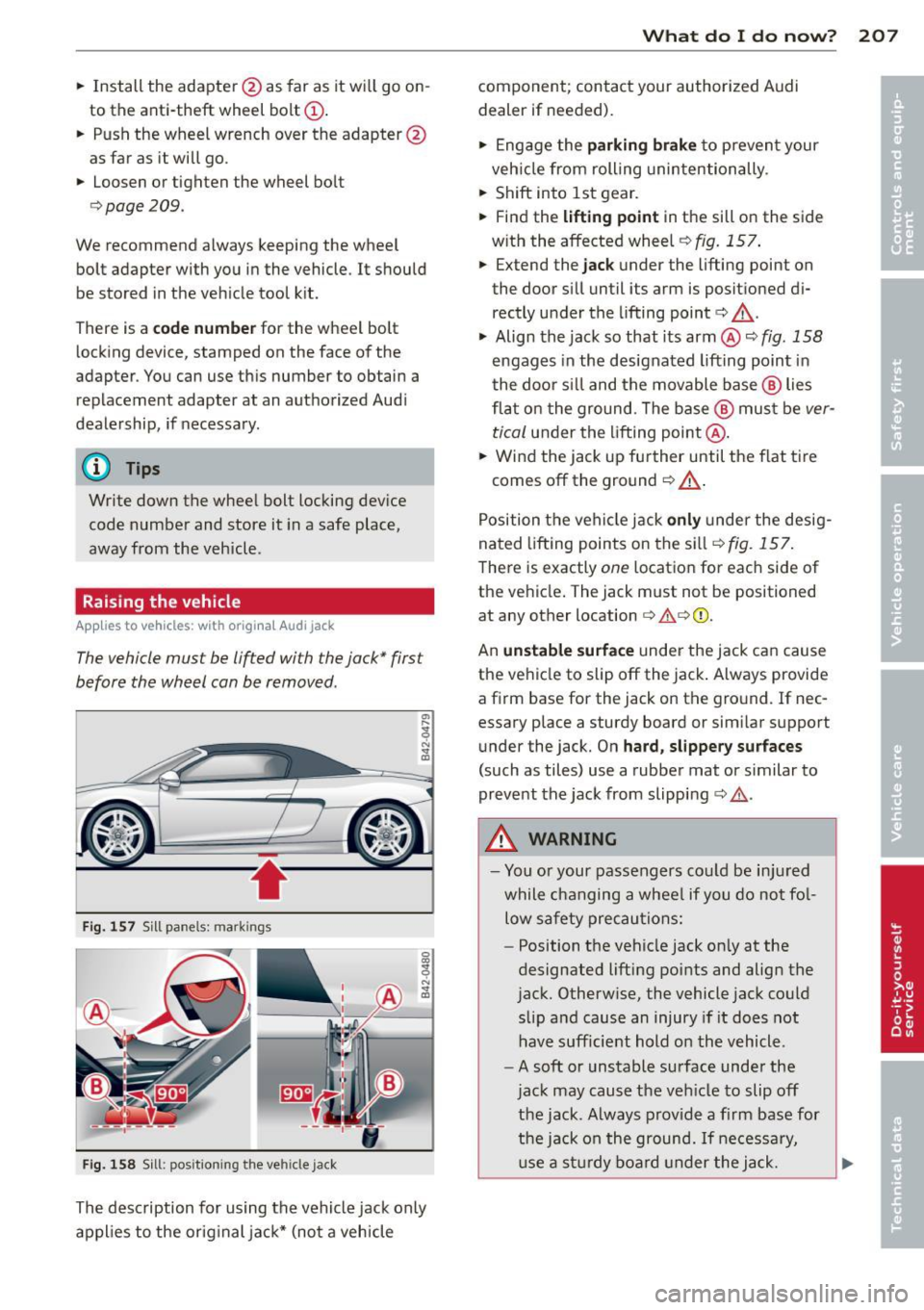
Fi g. 157 Sill pane ls: markings
Fig. 158 Sill: posit ion ing the vehicle jack
0 co
~
"' ;g
The description for using the vehicle jack only
appl ies to the or ig inal jack* (no t a veh icle
What do I d o now ? 207
component; contact your authorized Audi
dealer if needed) .
.,. Engage the
parking brak e to prevent your
veh icle from rolling unintentionally .
.. Shift into 1st gear.
.. Find the
liftin g po int in the sill on the side
w ith the affected wheel
c:> fig. 157 .
.. Extend the jack under the lifting point on
the door s ill until its arm is positioned di
rectly under the lifting point
c:> /.1. .
.,. Align the jack so that its arm @c::> fig. 158
engages in the designated lifting point in
the door s ill and the movable base @ lies
flat on the ground. The base @ must be
ver
tical
under the lifting point @ .
.. Wind the jack up further until the flat tire
comes
off the ground c:> /.1. .
Position the veh icle jack only under the desig
nated lifting points on the sill ¢
fig. 157.
There is exactly one locat io n for eac h side of
the vehicle . The jack must not be positioned
at any other location
c:> & c:>Q) .
An un stable surfac e under the jack can cause
the ve hicle to slip
off the jack . Always provide
a firm base for the jack on the ground . If nec
essary place a sturdy board or simi lar s upport
under the jack. On
hard , sl ipper y sur faces
(such as tiles) use a rubber mat or similar to
prevent the jack from slipping c::>
&.
A WARNING
-You or your passengers co uld be in jured
while changing a wheel if you do no t fo l
low safety precautions:
- Position the vehicle jack on ly at the
designated lifting points and align the
jack. Otherwise, the vehicle jack could slip a nd cause an injury if it does not
have sufficient hold o n the vehicle.
- A soft or unstable surface under the
jac k may cause the ve hicle to slip off
the jack . Always provide a firm base for
the jack on the ground. If necessary, u se a st urdy board under the jack.
Page 210 of 236
208 What do I do now ?
-On hard, slippery surface (such as tiles)
use a rubber mat or similar to prevent
the jack from slipping.
- To help prevent injury to yourself and
your passengers:
- D o not raise the vehicle u nti l yo u a re
sure the ja ck is sec urely engaged.
- P assenge rs must not rema in i n the ve
h icl e when it is ja ck ed up.
- M ake sure t hat passengers wait in a
safe p lace away fro m the vehicle and
well away from the road and traffi c.
- M ake sur e jac k position is correct, ad
just as necessary and then co ntinue to
r ai se the j ack .
CD Note
A floo r jack or the pads o n the hoist arms
m ust
not be posit ioned at the points
s hown
-arrows-.
Remov ing the wheel
Follow these instructions step-by-step for
changing the wheel.
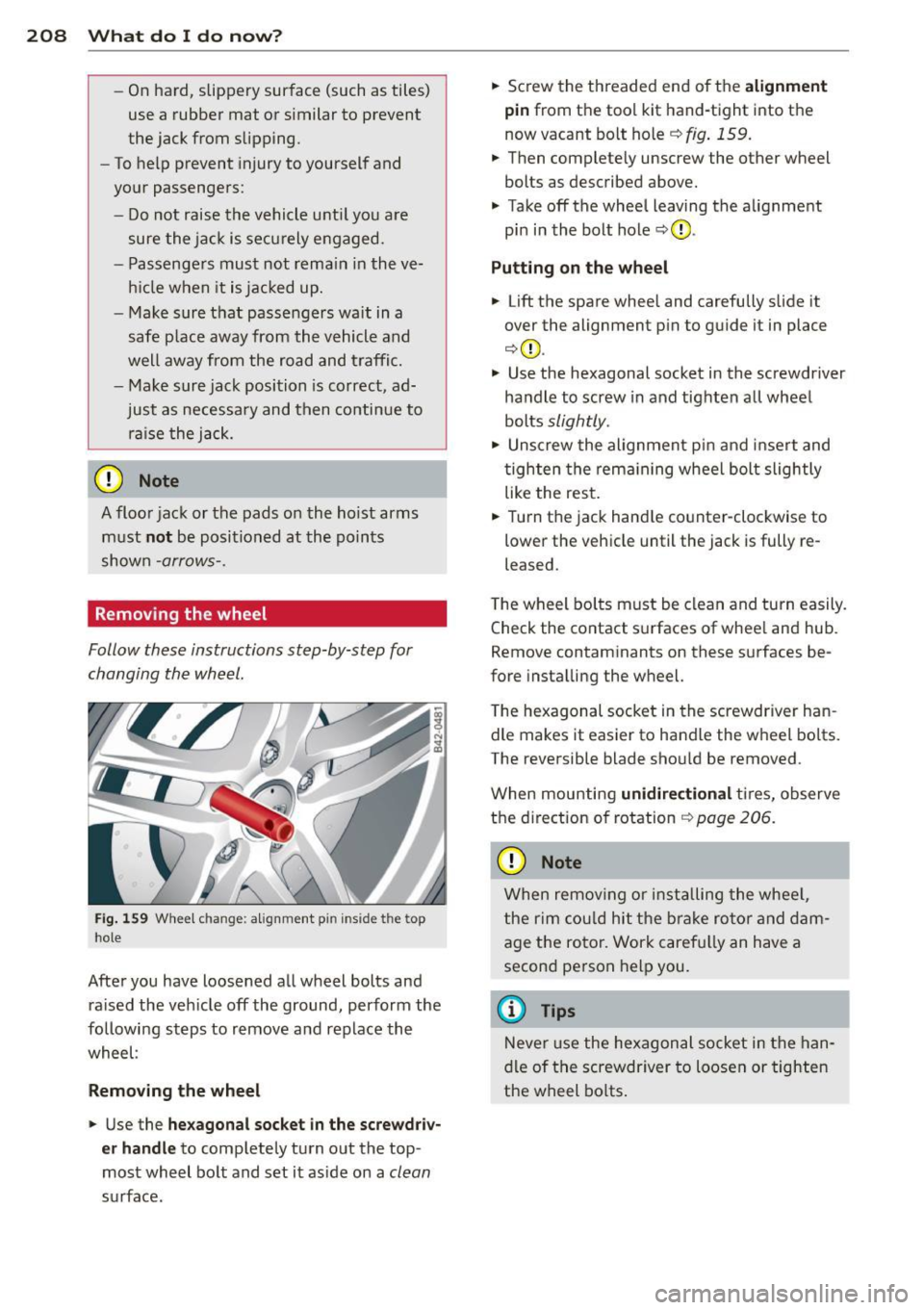
F ig. 1 59 Whee l change: alignment pin inside the top
hole
Afte r you have loosened a ll wheel bolts and
ra ised the veh icle off the ground, perform the
following steps to remove a nd rep lace the
wheel :
Removing the wheel
" Use the hexagonal socket in the screwdri v
er handle
to comp lete ly tu rn out the top
most wheel bo lt and set it as ide on a
clean
surface. "
Sc rew the th readed end of the
alignment
pin
from th e tool kit hand-tight into t he
now vacant bolt ho le
c::> fig . 159.
" Then complete ly unscrew the other wheel
bolts as described above.
" Take off the whee l leaving the a lignment
p in in the bolt hole
c::>(D .
Putting on the wheel
" Lift the spare whee l and carefully s lide it
over the alignment pin to guide it in place
c::>(D .
" Use the hexagonal socket in the screwdriver
ha ndle to screw in and tighten a ll whee l
bolts
slightly .
" Uns crew the alignment p in and insert and
tighten the rem aining wheel bol t slightly
like the res t.
" Tur n t he jack hand le co unter-clockwise to
lower the vehicle until the jack is fully re
leased.
T he wheel bo lts must be clean and turn easily.
Check the contact s urfaces of whee l and hub.
Remove contaminants on these surfaces be
fore insta lling the w heel.
T he hexagonal socket in the screwdriver ha n
dle makes it easier to handle the w heel bo lts.
The reversible blade should be removed.
When mounting
unidirectional ti res, observe
the d irection o f rotation
c::> page 206.
CD Note
W hen remov ing or inst alling the whee l,
t he r im cou ld hi t the b ra ke ro tor and dam
age the ro tor . Wor k caref ully an have a
second pe rson hel p you.
(D Tips
Neve r use the he xagona l socket in the han
d l e of t he screwdriver to loosen or tighten
the wheel bo lts .
Page 211 of 236
Tightening wheel bolts
~ Fit the wheel bolt wren ch over the wheel
bolt and push it down as far as it will go
1l.
~ Close your gr ip around the end of the
wrenc h handle fo r maximum torque and
turn each whee l bolt
clockwi se u nti l it sits
t ight.
H ave the
tightening torque of the whee l bolts
checked as soon as possible with a torque
wrench. It shou ld be 120 Nm.
Chec k the
tir e pre ssure as soon as possible .
Return the vehicle tool kit to its proper place .
A WARNING
Loosening the wheel bo lts is prohib ited;
da nger of an accident!
@ Tips
- Never try and use the hexagona l socke t
i n the handle of the screwdr iver to loos
en or tighten the w heel bolts.
- If yo u have dete rm ined t hat wheel bolts
a re cor roded and difficult to t urn, the
bo lts must be rep laced befo re checking
the to rque.
- Unti l the tig hte ning torque is checked,
d rive at redu ced speeds as a precaution .
Notes on wheel change
Please read the information ¢ page 193, New
tires and replacing tires and wheels ,
if you are
going to use a spare t ire which is different
from the tires on you r veh icle.
Afte r you change a tire :
- Check the tire pressure on the spare imme
diately after mounting.
- Have the wheel bolt t ightening torque
chec ked w ith a torq ue wrench as soon as
poss ib le by your author ized A udi dealer or a
qualified service sta tion .
1) You need t he appro pria te adapte r to t ig hte n th e an ti
t h eft whee l bolt s
c:> page 206 .
What do I do now? 209
- With stee l and alloy wheel rims, the whee l
bolts are correctly tightened at a torque of
90 ft lb (120 Nm) .
- If you notice while changing a tire that the
wheel bo lts are corroded and difficu lt to
turn, then they shou ld be rep laced before
you check the tightening torque.
- Replace the flat tire with a new one and
have it installed on your vehicle as soon as
possible . Remount the wheel cover.
Until then , d riv e with e xtra care and at re
duced speeds.
A WARNING
- If you are going to equ ip your vehicle
with tires or rims which differ from those
which were facto ry installed, then be
sure to read the information ¢
page 193,
New tires and replacing tir es and
wheels.
- Always sto re the tools secu rely in lug
gage compartment. Othe rwise, in a n ac
cident o r su dden maneuver they cou ld fly
forwdrd, CciU5ing injury to pd55enger5 in
the vehicle.
(D Note
Do not use comme rcially avai lab le tire
sea lants . Otherwise, the e le ctr ic al compo
nen ts of t he tire p ressu re monitoring sys
tem * wi ll no longe r work proper ly and the
sensor fo r the tire pressure mon itor ing
system will have to be rep laced by a quali
fied workshop.
Jump-starting
General
If necessary, the engine can be started by
connecting it to the battery of another vehi
cle.
If the engi ne should fail to start because of a
discharged or weak battery, the battery can be
II>
•
•
Page 214 of 236
212 What do I do now ?
-Please note that the procedure for con
necting a jumper cable as described
above applies spec ifically to the case of
your vehicle be ing jump started. When
you are giving a jump start to another ve
hicle, do
not connect the negative( -) ca
ble to the negat ive( -) terminal on the
discharged bat tery ©-Instead, securely
con nect the negative( -) cable to either a
solid meta l comp onent that i s firmly
bo lted to the engine b lock or to the en
gine block itself . If the battery that is be
ing charged does not vent to the outside,
escaping battery gas cou ld ign ite and ex
plode!
Emergency towing
with commercial tow
truck
General hints
Your Audi requires special handling for tow
ing.
The following information is to be used by
commercia l tow truck operators who know
how to operate their equipment safe ly.
- Never tow your A udi, towing will cause dam
age to the engine and transmission .
- Never wrap the safety chains or winch cables
around the brake lines.
- To preven t unnecessary damage, your Audi
must be transported with a ca r carr ie r (flat
bed truck).
- To load the vehicle on to the flat bed, use
the towing loop fo und in the veh icle tools
and attach to the front anchorage
~ page 212.
A WARNING
A vehicle being towed is not safe for pas
senge rs. Never allow anyone to r ide in a
veh icle being towed, for any reason.
(D Note
The vehicle has very low gro und clea rance.
Make sure that no damage is caused to the
-
u nderside of the vehicle when it is being
l oaded onto a f lat bed t ruck .
Front towing loop
Do not install the front towing loop until it is
needed.
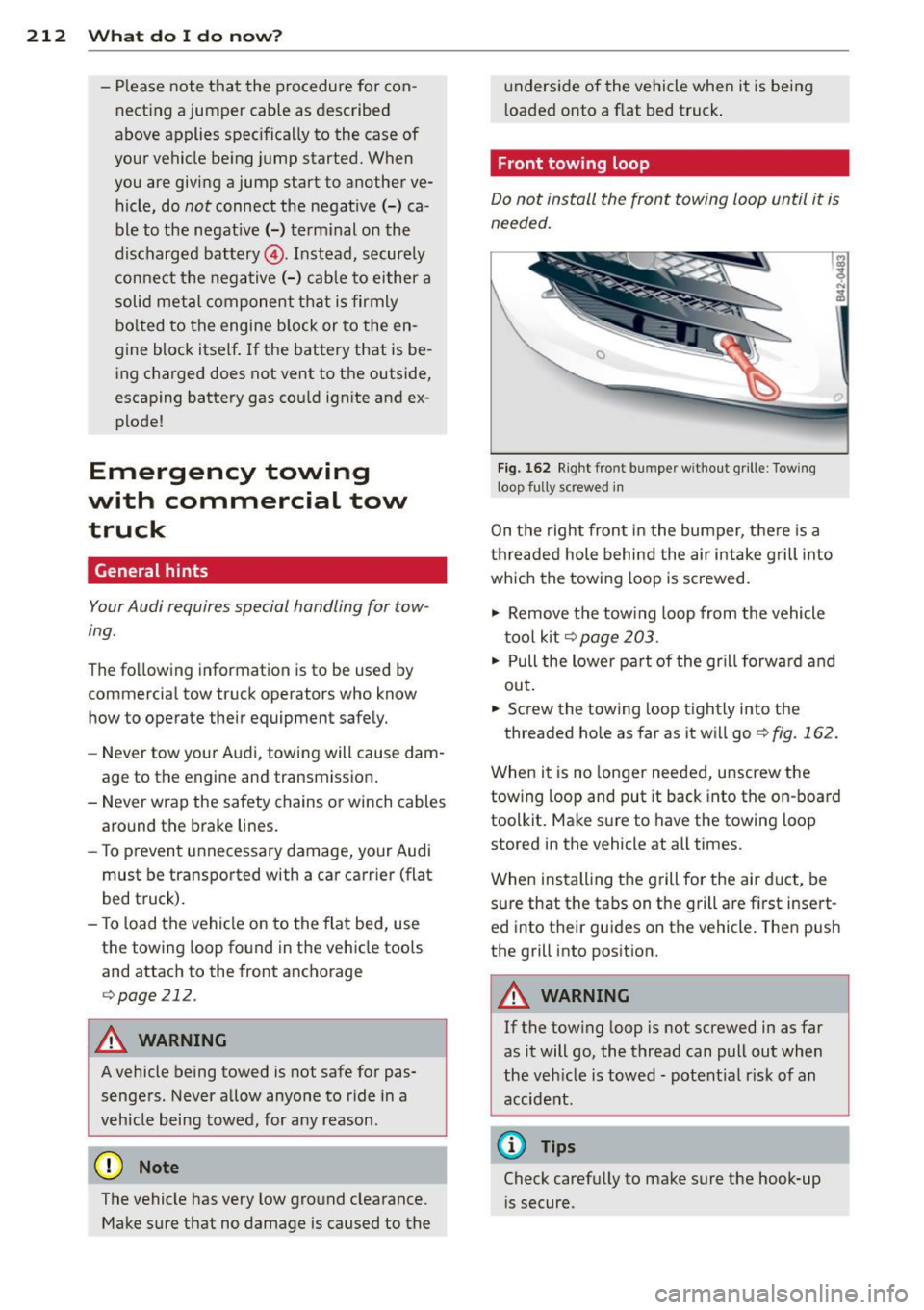
Fi g. 162 Righ t front bumper witho ut g rille : Tow ing
l oop
fully screwed in
On t he right fron t in the bumper, there is a
th readed hole behind the air in take grill into
which the towing loop is screwed.
"' Remove the tow ing loop from the vehicle
t oo l kit
~page 203.
"' Pull the lower part of the gr ill forward and
out .
"' Sc rew the towing loop tightly into the
threaded ho le as far as it wi ll go ¢
fig. 162.
When it is no longer needed, unscrew the
towing loop and put it back into the on -board
toolkit . Make su re to have the towing loop
stored in the vehicle at all times.
When installing t he grill for the air d uct, be
s u re that the tabs on the grill are f irst inse rt
ed into their guides on the vehicle . Then push
the grill into pos ition.
A WARNING
= If the tow ing loop is not screwed in as far
as it will go, the thread can pull out when
the veh icle is towed -potent ial r is k of an
a ccident.
@ Tips
Check caref ully to make sure the hook-up
i s secure.