light AUDI R8 SPYDER 2014 Owners Manual
[x] Cancel search | Manufacturer: AUDI, Model Year: 2014, Model line: R8 SPYDER, Model: AUDI R8 SPYDER 2014Pages: 244, PDF Size: 61.06 MB
Page 163 of 244
You should also clean the inside of the win
dow g lass at regular intervals.
The cloth or chamois used on paint s urfaces
contains wax res idue. Use a separate clo th or
chamo is to dry the window glass.
Cl eaning the rear window
Aud i recommends cleaning the window us ing
a soft cotto n cloth and water mixed with
cleaning solution or window cleaner
(1: 1 mix
ture) . To avoid streaks, do not wipe the win
dow dry with paper towels.
D o not use any clean ing so lutions that conta in
ammonia, acids , silicone or fluo ride or clean
e rs that are abrasive or cou ld cause scratches .
Do not use any alkaline cleaning solutions.
A WARNING
- The windshie ld must not be treated with
water-repellent materials. They can in
crease glare under poor visib ility condi
t ions such as wetness, darkness, or when
the sun is low on the horizon. In addi
t ion, they can cause the windshield wip
ers to chatter.
- Always read and heed all WARNINGS and
other information
r:::> page 156.
(D Note
-Never use warm or hot water to remove
snow and ice from windows and mirrors.
This could cause the glass to c rack.
- To prevent damage to the wires of the
rear defogger, do not place any adhesive
stickers on the inside of the rear window
ove r the wires.
- To he lp prevent di rt from scratching the
window, always scrape in a forward d i
r ection - pus hing the scraper away from
you - never back and fo rth.
Wheels
Regular care is required to preserve the deco
rative appearance of the wheels . Road sa lt
and b rake dust must be washed off regu larly
or the wheels wi ll be damaged.
Cleaning and protec tion 16 1
Use only specia l acid -free cleaning agents. You
can find proper wheel cleaner at authorized
Audi dealers and specia lty stores . Do not leave
the cleaner on the whee ls longer than speci
fied. Wheel cleaners containing acid can dam
age the surface of the w heel bo lts .
Pa int polish or other abrasive materials must
not be used when caring for wheels. If the
protective coat ing has been damaged, from
stones for example, touch up the damage as
soon as possible .
A WARNING
-Moisture and ice on brakes may affect
brak ing eff ic iency -
c:::> page 146, General
information.
T est the bra kes ca re fully af
ter each vehicle wash .
- Always read and heed a ll WAR NINGS and
the information¢
page 156.
Exhaust tail pipes
-
Road salt and other corrosive materials wi ll
damage the material in the exhaust tail pipes
if they are not cleaned regularly . Do not clea n
the tail pipes with wheel cleaner, pa int polish,
chrome polish or other abras ive cleaners.
Clean the tail pipes with car care products
that are suitable for stainless steel.
Your authorized Audi dea ler can provide clean
ing products that have been tested and ap
proved for your vehicle.
Care of interior
Radio-/Navigation* display
T he disp lay may be cleaned with a soft cloth
and commercially-avai lab le "LCD cleaner".
The cloth should be coated lightly with the
cleaning so lution when cleaning the disp lay.
Q) Note
To prevent scratches, only clean the dis
play when it is dry .
•
•
Page 165 of 244
@ Tips
Open Velcro fasteners on your clothing can
damage the seat cover. Please make sure
that Velcro fasteners are closed.
Natural leather
App lies to vehicles: with natura l leather
Audi makes great efforts to maintain the
properties , natural look and feel of interior
leather.
G ene ra l
We offer many different types of leather on
our veh icles. Most are different types of nappa
leather, which has a smooth surface and
comes in various co lors .
The intensity of the color determines the visu
al characteristics and appearance . If the sur
face of the leather has a typical natural look,
then the leather is a nappa leather that has
been left in a relatively natural condition. This
leather offers particularly good comfort and
breathes well. F ine veins, closed grains, insect
b ites, skin folds, and subtle variations in co lor
remain visible . These cha racte ristics demon
strate that the mater ia l is na tural.
Natural nappa leather is not covered by a col
or finish .
It is therefore more sensitive to so il
ing and wear, wh ich is something you need to
consider if ch ild ren, an imals o r othe r factors
m ight prove to be particularly hard on the
l eather .
By contrast, leather types that are cove red by
a co lored finish laye r are more durable. This
h as a posit ive effect on the leather's resist
ance to wear and soiling in daily use . On the
other hand, the typical characteristics of natu
ra l leather are bare ly or not apparent. Howev
er, this does not mean that the leather itself
is of infer ior quality.
Ca re and handling
Because of the exclusive nat ure of the types of
l eather that Audi uses and their unique prop
erties (such as sensitivity to oils, grease, soi l
ing, etc.), you will need to be somewhat care-
Cleaning and protec tion 163
ful with these leathers, and a ce rtain type of
care is required. For example, dark clothing
mater ia ls can disco lor leather seats (especia l
l y if such clothing is damp and was not dyed
correctly) . Dust and dirt particles in pores,
folds, and seams can have an abrasive effect
and can damage the leather surface as well as
weaken seams .
The leather should be cleaned regularly as needed . After having been used for a relat ively
long time, your leather seats will acqu ire a
rich aged fin ish . This is a character istic of nat
ural leathe r and a s ign of true quality.
In order to maintain the value of this natural
product over the life of your ve hicle, you
shou ld follow the recommendat ions below:
(D Note
- To keep your leather from b leac hing out,
do not allow it to be exposed to bright
sunlight for long periods of time . If you
have to leave the veh icle parked outside
for long per iods, cover the leather to
protect it from direct exposure to s un
light.
- Sharp objects on clothing, such as zip
pers, rivets or sharp pieces on belts can
leave permanent sc ratches or scrape
marks on the surface of the leather .
{i) Tips
-After each time you clean the leather and
at regular intervals, use a leather preser
vative creme that contains UV-b lockers
and that works into the leather. Th is
creme will nour ish and mo isturize the
leather, helping it to breathe and stay
supple . It also helps to build up a protec
tive coating on the surface .
- Clean the leather every 2 - 3 months,
and clean any areas that get soiled.
- Remove fresh marks made by ballpo int
pens, ink, lipstick, shoe polish, etc. as
soon as poss ible.
- Preserve the color of the leather as need
ed by us ing a special colored leather care
creme to touch up areas of uneven color . •
•
Page 166 of 244
164 Cleaning and protection
Cleaning and caring for leather
upholstery and trim
Applies to vehicles: with natural leather
Natural leather requires special care and at
tention.
Normal cleaning
• Clean soiled are as with a slightly moistened
cotton or woolen cloth.
More stubborn dirt
• More stubborn dirt can be removed using a
cloth saturated with a mild soap solution (2
tablespoons mild liquid soap).
• Never allow the soap solution to saturate
the leather , and make certain that no water
soaks into the seams .
• Wipe off the soap solution with a soft, dry
cloth .
Cleaning spots
• Remove fresh water-based spots (such as
coffee, tea, juices, blood) with an absorbent
cloth or paper towel.
• Remove fresh
grease or oil-based spots
(such as butter, mayonnaise , chocolate) with
an absorbent cloth or paper towel, or use
the cleaner from the leather care kit if the
spot has not yet penetrated into the surface
of the leather.
• Use an oil/grease dissolving spray, if
oil/
grease spots have dried on.
• Remove specific kinds of spots (ballpoint
pen, felt marker, fingernail polish, water
based paint, shoe polish, etc.) with a spot
remover specifically formulated for leather .
Leather care
• Every half year use an approved leather care
product (available from your authorized
Audi dealer) to care for the leather .
• Apply the product very sparingly.
• Wipe it off with a damp cloth.
If you have any questions about cleaning and
caring for the leather in your vehicle, it is best
to contact your authorized Audi dealer, who
will be glad to help you and tell you about our
full range of leather care products, such as: -
Leather cleaning and care kit
- Cremes to care for colored leather
- Spot removers for ballpoint pens, shoe pol-
ish, etc.
- Oil/grease dissolving spray
- New and upcoming products .
_&. WARNING
-Always read and heed all WARNINGS and
the information
~ page 156.
(D Note
-Never use chemical solvents (e.g . lighter
fluid, turpentine), waxes, shoe polish or similar products on the leather surfaces
in your Audi .
- To avoid damage, have stubborn stains
removed by a commercial cleaning spe
cialist.
Cleaning Alcantara ® (synthetic suede)
Applies to vehicles: with Alcantara upholstery
Removing dust and dirt
• Moisten a cloth, squeeze out excess water
and wipe down the seat surfaces.
Removing stains
• Moisten a cloth with lukewarm water or
with diluted
ethyl (rubbing) alcohol.
"' Dab at the stain . Start at the outside and
work inwards .
• Once the stain is no longer visible, use a soft
dry cloth or tissue to soak up the moisture.
Do not use leather cleaning products on Al
cantara.
You may use a suitable shampoo for removing dust and dirt .
Dust and grit in the pores and seams can
scratch and damage the surface . If the car is
left standing in the sun for long periods, the
Alcantara covers should be protected against
direct sunlight to prevent it from fading .
Slight color variations will develop in normal
use and are not an indication of material dete-
rioration. ""
Page 167 of 244
(D Note
-Never use chemical solvents (e.g . lighter
flu id, turpentine), waxes, shoe polish or
s imilar products on Alcantara ® surfaces.
- To avoid damage, have stubborn stains
removed by a commercia l cleaning spe
cialist.
- Do not use brushes, stiff sponges or sim
ilarly abrasive cleaning aids.
Safety belts
Heavily soiled safety belts may not retract
properly .
~ Keep belts clean.
~ For cleaning, use a mild soap and water sol
ution. Let belts dry thoroughly and away
from direct sunlight.
~ Do not allow inertia reel safety belts to re
tract before they are completely d ry.
~ Check the condition of your safety belts reg
ularly.
A WARNING
Damaged safety belts can break in a crash.
- Any thing tha t might damage you r safety
belts co uld mean that you and your pas
sengers wo uld not be adequately pro
tected in an accident.
- Safety belt performance depends on cor rect installation . Never remove belts
from the vehicle to clean them.
- Do not use chemical cleaning agents,
bleach o r dyes . They have corrosive prop
erties which weaken the webbing.
- When cleaning your safety belts, inspect
them for damage. If you discover dam
age, see your authorized Audi dea ler.
- Always read and heed all WARNINGS and
the informat ion
¢page 156.
1) Use o nly the correct cleaning sol utio ns. Neve r use gas
oline or d iese l fuel.
Cleaning and protec tion
Engine compartment
Be especially careful when cleaning the en
gine compartment.
Corrosion p rotection
The engine compartment and transmission
have been corrosion-protected at the factory.
Good anti-corrosion treatmen t is very impor
tant, partic ularly in the winter.
If the vehicle
is frequently driven on salt treated roads, the
entire engine compartment and plenum panel
shou ld be thoroughly cleaned at the end of
winter and retreated to prevent salt damage .
At the same time, the underside of the veh icle
shou ld be washed as well.
If the engine compartment is cleaned at any
time with grease remov ing solutions
1>, or if
you have the engine washed, the a nti-corro
s ion treatment is almost always removed as
well.
It i s therefo re essentia l to have a long
lasti ng corrosion protection reapplied to all
su rfaces, seams, joints and components in the
engine compa rtment .
A WARNING
--=
Be aware: The eng ine compartment of any
motor veh icle is a potentially hazardous
area.
- Before work ing in the engine compart
ment, be sure to read the information
¢page 172.
-Before reaching into the front p lenum
panel, a lways remove the ignit ion key.
Otherwise, the w indshield wiper system
could u nintentionally be sw itched on,
possibly caus ing persona l injury from the
mov ing wipe r linkage.
- Never reach i nto the area around or
touch the rad iator fan. The aux iliary fan
is tempe ratu re controlled and ca n sw itch
on s uddenly -even when the ignition is
off. .,.
165
•
•
Page 174 of 244
17 2 Che cking and filling
Checking and filling
Engine compartment
Lid
Releasing the engine compartment lid
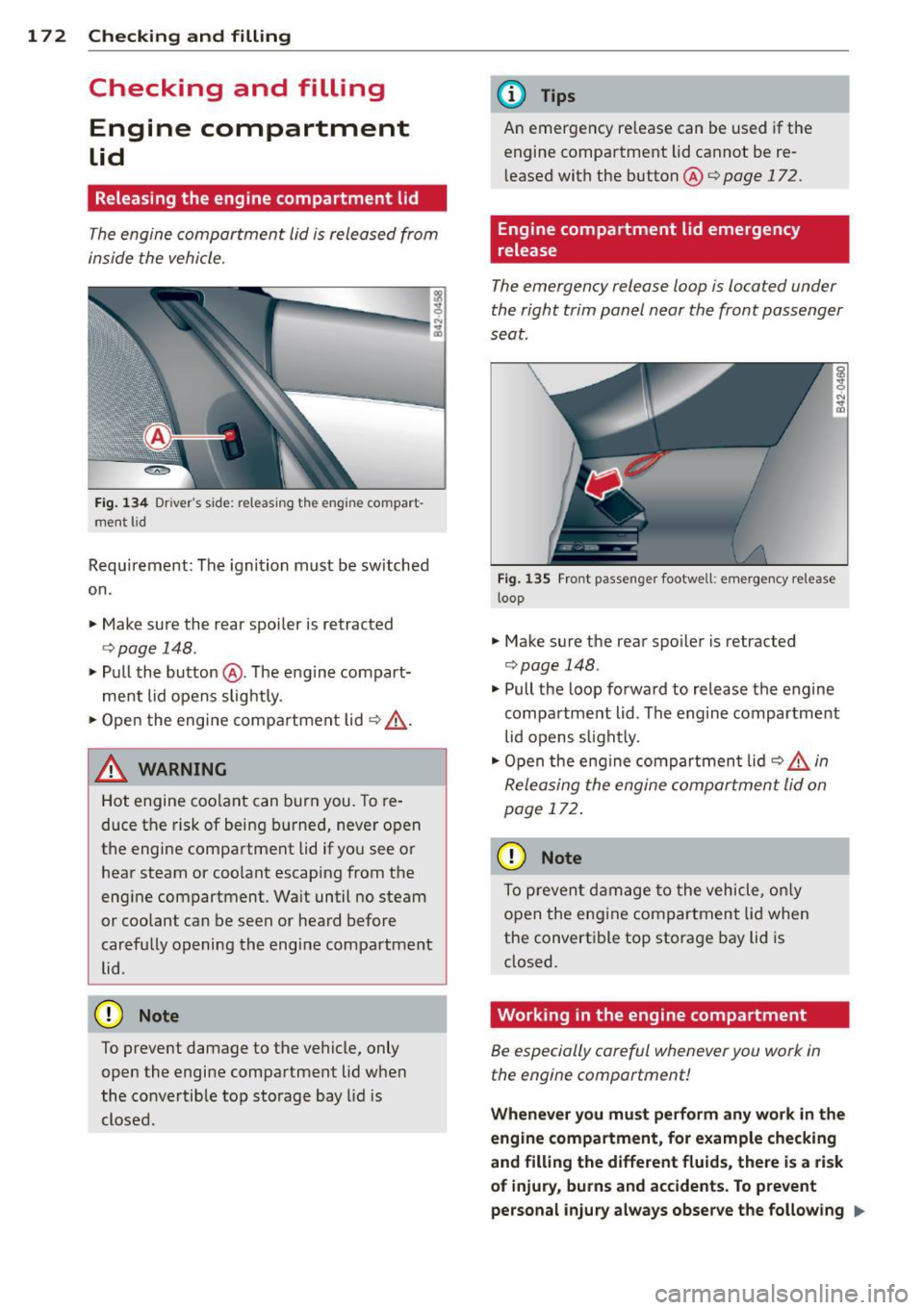
The engine compartment lid is released from
in side the vehicle.
Fi g. 1 34 Drive r's s id e: re le asi ng th e eng ine co mpart
ment lid
R equ irement : The ignition must be sw itched
on.
.,. Make sure the rear spoiler is retracted
<=> page 148 .
.,. Pull the button @. The e ngine compart
ment lid opens slightly .
.,. Ope n the engi ne compa rtme nt lid
c:> .&, .
.&_ WARNING
Hot engine coo lant can burn you. To re
duce the risk of bei ng bur ned,
neve r open
the engine compartment lid if yo u see or
hear steam or coolant escaping from the
eng ine compartment. Wa it until no steam
or coolant can be seen or heard before
carefu lly opening the engine compartment
lid .
CD Note
To prevent damage to the vehicle, only
ope n the engi ne compartment lid when
t he convertib le top storage bay lid is
closed .
(D Tips
An emergency re lease can be used i f th e
engine compartment lid cannot be re
l eased with the
button @r::::>page 172.
Engine compartment lid emergency
release
The emergency release loop is located under
the right trim panel near the front passenger
seat.
F ig . 1 35 Fro nt passenger footwe ll: em erge ncy release
l oop
.,. Make sure the rear spo iler is retracted
<=> page 148 .
.,. Pull the loop forwa rd to release the engine
compa rtme nt lid . The engine compar tment
lid o pens s lig htly .
.,. Open the eng ine comp artmen t lid
c:> .&, in
Releasing the engine compartment lid on
page 172 .
CD Note
To preven t dam age to the vehicle, only
open the en gine compartment lid when
the convert ible top stora ge bay lid is
closed.
Working in the engine compartment
Be especially careful whenever you work in
the engine compartment!
Whenever you mu st perform any work in the
engine compartment, for example checking and filling the different fluids, there is a risk
of injury, burn s and accidents. To prevent
personal injury always observe the following
Ill-
Page 180 of 244
1 78 Che cking and filling
authorized Audi dealer will have to deny war
ranty cov erage un less you present to the dea l
er proof in the form of Serv ice o r Repair Or
ders tha t all sched uled maintena nce was per
f ormed in a t imely manner .
Engine oil consumption
T he engine in your vehicle depends on an ade
quate amoun t of oil to lubricate and cool all
of its moving par ts.
In order to provide effective l ubrication and
cooling of internal engine components, a ll in
ternal comb ustion eng ines consume a certa in
amount of o il. O il consumption var ies from
engine to eng ine and may c hange significa ntly
over the life of the eng ine . T ypically, eng ines
with a specifie d break-in per iod (see
c::> p oge 153) consume more oil during the
b reak-in per io d t han they co nsume after oil
consumption has sta bilized.
Unde r no rma l conditions, the rate of oil con
sum ption depends on the qu ality and vi scosity
of the oi l, the R PM ( revo lutions per m inute) at
which t he engine is ope rated, the ambient
temperature and road cond itio ns. Furthe r fac
tors are the amount of o il d ilution from water
condensation or fuel residue and the ox ida
ti on level of the oi l. As any engine is subject to
wear as mileage bu ilds up , the oil consump
tion may increase over t ime until replacement
of worn componen ts may become necessary.
W ith all these variables com ing into play, no
standa rd rate of o il consumption can be es
tablished or specif ied . T he re is no alternative
to regular and frequent checking of the oil lev
e l, see
Note .
If the ye llow eng ine o il level warning symbol
i n t he inst rument cluster
1\1 lights up, you
should check the o il l evel as soon as possibl e
c::> page 178. Top off the oil at you r earliest
conven ie nc e
c::>page 180.
_& WARNING
Before yo u check any thin g in t he engine
compartment , always read and hee d all
-
WAR NIN GS c::> & in Working in the engine
compartment on page 173.
(D Note
D riving wit h an insufficient o il level is like
l y to cause severe dama ge to the e ngine.
(D Tips
- The oil pressure warning display. is
not an indicator of the oil level. Do not
rely on it. Instead, check the oil level in
your engine at regular intervals , pref
erably each time you refuel, and always
before going on a long trip .
- If
you have t he impression yo ur engine
cons umes excessive amounts of o il, we
recommend that you consu lt your Aud i
deale r to have the cause of your concer n
prope rly diagnosed . K eep in m ind that
th e accu rat e meas urement of o il con
s u m ptio n re quires grea t care and may
t a ke some time. Y our Audi de aler h as i n
st ru ctio ns abou t how to measure oil con
sumption acc urately .
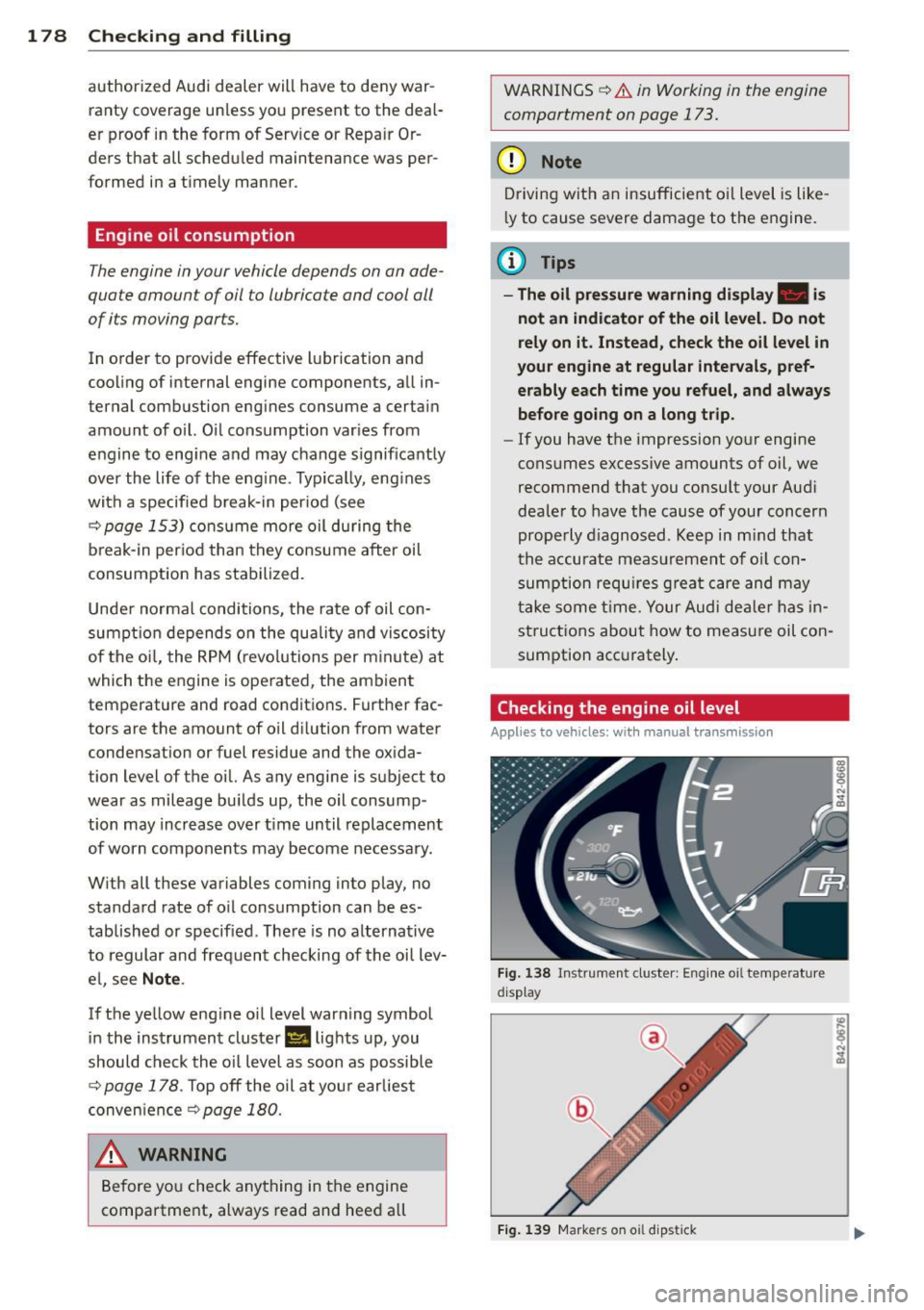
Checking the engine oil level
Applies to vehicles: with manual transmiss ion
Fig . 1 38 In st ru men t cl uste r: E ng in e oi l te m pe ratu re
d isp lay
Fig. 139 M arkers on o il dip stick
Page 185 of 244
container out of the reach of children. It
is a poison hazard.
@ Note
Do not add any type of radiator leak seal
ant to your vehicle's engine coolant. Add
ing radiator repair fluid may adversely af
fect the function and performance of your
cooling system and could result in damage
not covered by your New Vehicle Lim ited
Warranty.
Adding coolant
Before you check anything in the engine com
partment,
always read and heed all WARN
INGS q A in Working in the engine compart
ment on pag e 173.
"'Add coolant .
"'Twist the cap on again
tightly.
"'Tighten the cap (D q page 182, fig. 145
again.
Replacement engine coolant must conform to
exact specifications
q page 181, Coolant .
We recommend using only coolant additive
G12++, G13 or in an emergency G12 +. Do
not
use a different additive. In an emergency use
plain water until you can get the correct addi
tive and can restore the correct ratio. This
should be done as soon as possible.
If you have lost a considerable amount of
coolant, then you should add cold antifreeze
and cold water only when the engine is cold.
Always use
new engine coolant when refilling .
Do not fill coolant above the "max" mark. Ex
cess coolant will be forced out through the
pressure relief valve in the cap when the en
gine becomes hot.
A WARNING
- The cooling system is under pressure and
can get very hot. Reduce the risk of
scalding from hot coolant by following
these steps.
Checking and filling 183
- Turn off the engine and allow it to cool
down.
- Protect your face, hands and arms from
escaping fluid and steam by covering
the cap with a large, thick rag.
- Turn the cap slowly and very carefully
in a counter-clockwise direction while
applying light, downward pressure on
the top of the cap.
- To avoid being burned, do not spill an
tifreeze or coolant on the exhaust sys
tem or hot engine parts. Under certain
conditions, the ethylene glycol in en
gine coolant can catch fire .
- Antifreeze is poisonous. Always store an
tifreeze in its original container and well
out of the reach of children.
- If you drain the coolant, it must be
caught and safely stored in a proper con
tainer clearly marked "poison" .
Q) Note
- Coolant pollutes the environment and
could cause an engine fire . Ex cess cool
ant will be forced out through the pres
sure relief valve in the cap when the en
gine becomes hot.
- If, in an emergency, only water can be
added, the correct ratio between water
and antifreeze
q page 181 must be re
stored as soon as possible.
@ For the sake of the environment
Drained coolant should not be reused . Al
ways dispose of used coolant while observ
ing all environmental regulations.
Brake fluid
Have the brake fluid changed by an experi
enced t echnician.
Brake fluid absorbs moisture from the air. If
the water content in the brake fluid is too
high, corrosion in the brake system may result
afte r a period of time. The boiling point of the
brake fluid will also decrease considerably and
decrease braking performance. .,.. •
•
Page 188 of 244
186 Checking and filling
No
- sparks
@
-flames
-smoking.
--· W hen a b att ery is ch arg ed , it produc es
A hydrogen ga s whi ch i s ex plosive and
could cause p ers onal injury.
®
Alway s keep the battery well out of
reach of children.
A WARNING
Whenever working on the battery or on the electrical system, there is the r isk of
inju ry, acc ident and
even fire. Read and
heed the following WARNINGS:
- Always wear eye protection . Do not let
battery acid or any lead part icles get on
yo ur sk in or cloth ing . Sh ield your eyes .
Explosive gases can cause blindness or
other injury.
- Battery acid contains sulfur ic acid. Sulfu
ric acid can cause blindness and
severe
burns.
- Always wear gloves and eye protection .
Do not tilt the battery because ac id
could lea k out of the vent ilation open
ings.
- If you get battery acid in yo ur eyes or
on your sk in, immediately rinse with
cold water for severa l m inutes and get
medical attention.
- I f you should ingest any battery acid,
see k medical attention immediately.
- Do not expose the battery to an open
flame, electric sparks o r an open ligh t.
- Do not smoke .
- Do not interchange the positive and neg-
ative cables .
- When working on the battery, be sure
not to short-circuit the terminals with
tools or other metal objects. This would
cause the battery to heat up
very quickly,
wh ich could lead to damage or e xplosion
and personal injury.
- When a battery is charged, it produces
hydrogen gas which is explosive and
cou ld cause persona l injury. -
Always keep the battery well out of the
reach of children.
- Before work is done on the elect rical sys
tem, disconnect the negative ground ca
ble.
- Before performing any work on the e lec
tr ica l system, switch off the engine and
ignit ion as well as any electrical equip
ment. The negative cable on the battery
must be disconnected .
If you are just go
i n g to replace a light bulb, then it is
enough to switch off the lights.
- Before disconnecting the battery, switch
off the anti-theft alarm system! Other
wise you wi ll set off the alarm.
- When disconnecting the battery, first
d isconnect the negat ive cab le and then
the posit ive cab le.
- Before reconnecting the batte ry, ma ke
sure all e lectr ica l consumers are sw itch
ed off. Reconne ct the pos it ive cable first
an d then the negative cable. Never inter
change the cables -this could start a fi re!
- Never ch arge a fro zen or a thawed-out
battery. I t could exp lode! I f a battery has
frozen, then it must be replaced . A dis
charged batte ry can freeze
over at 32 °F
(0 oc).
- Make sure the vent hose is always attach
ed to the opening on the s ide of the bat
tery .
- Never use batteries which a re damaged .
Danger of explosion! Always replace a
damaged battery .
A WARNING
California Proposition 65 Warning:
- Battery posts, terminals and related ac
cessories conta in lead and lead com
pounds, chemicals known to the State of
California to cause cancer and reproduc
tive problems . Wash hands after han
dling.
Page 190 of 244

188 Checking and filling
cracked and weakened when the battery
froze.
- Charge the battery in a we ll ventilated
area. Keep away from open f lame or elec
trical spark. Do not smoke. Hydrogen gas
generated by the battery is explosive.
- To reduce the danger of explosion, never
connect or disconnect charger cables
wh ile the charger is operating.
- Fast charg ing a battery is dangerous and
should only be attempted by a compe
tent technicia n w ith the proper equip
me nt.
- Battery acid that may spill during charg
ing should be washed off with a solution
of warm water and baking soda to neu
tralize the acid.
(D Note
Never use a fast charger as a booster to
start the engine. This will seriously dam
age sensitive electronic components, such
as control units, relays, rad io, etc., as we ll
as t he battery charger.
(D Tips
- The vehicle battery must not be charged
with a standard small charger that p lugs
i nto the c igarette lighte r o r outlet.
- Only charge the battery through the con
nect ions in the luggage compartment.
Windshield washer
container
Fig. 148 Luggage compartment: Wind shie ld washer
fl uid reser voir
T he washer fluid container is marked with the
symbol
O on its cap ~page 174, fig. 136 .
,. Lift the fi ller cap tongue to add washer flu
id. You can fil l the container to the top.
,. Press the cap back onto the filler neck after
fi lling the container .
You can find the reservo ir
c a p acit y in the table
in
~ page225
Clean water should be used when filling up. If
possible, use soft water to prevent scaling on
the washer jets. Always add a glass cleane r
solution (with frost protection in the winter).
(D Note
- Do not mix e ngine coolant ant ifreeze or
any other additives to fill up the w ind
shield washer reservoir .
- Do not use g lass cleaners conta ining
pai nt so lvent; you risk damaging the
paint.
Page 196 of 244
194 Tire s and wheel s
that are stored . The system does not recog
nize the load cond ition of your vehicle.
See the il lustration ~
fig. 149 for the location
of the label on dr iver's side 8-pillar (color of
the actua l labe l and exact location on the ve
hicle wi LL vary slightly).
Note that the followi ng tab le is accurate at
the time o f go ing to press and is subject to
change. In the event of discrepancies, the tire pressure label on driver's s
ide 8 -pillar always
takes precedence .
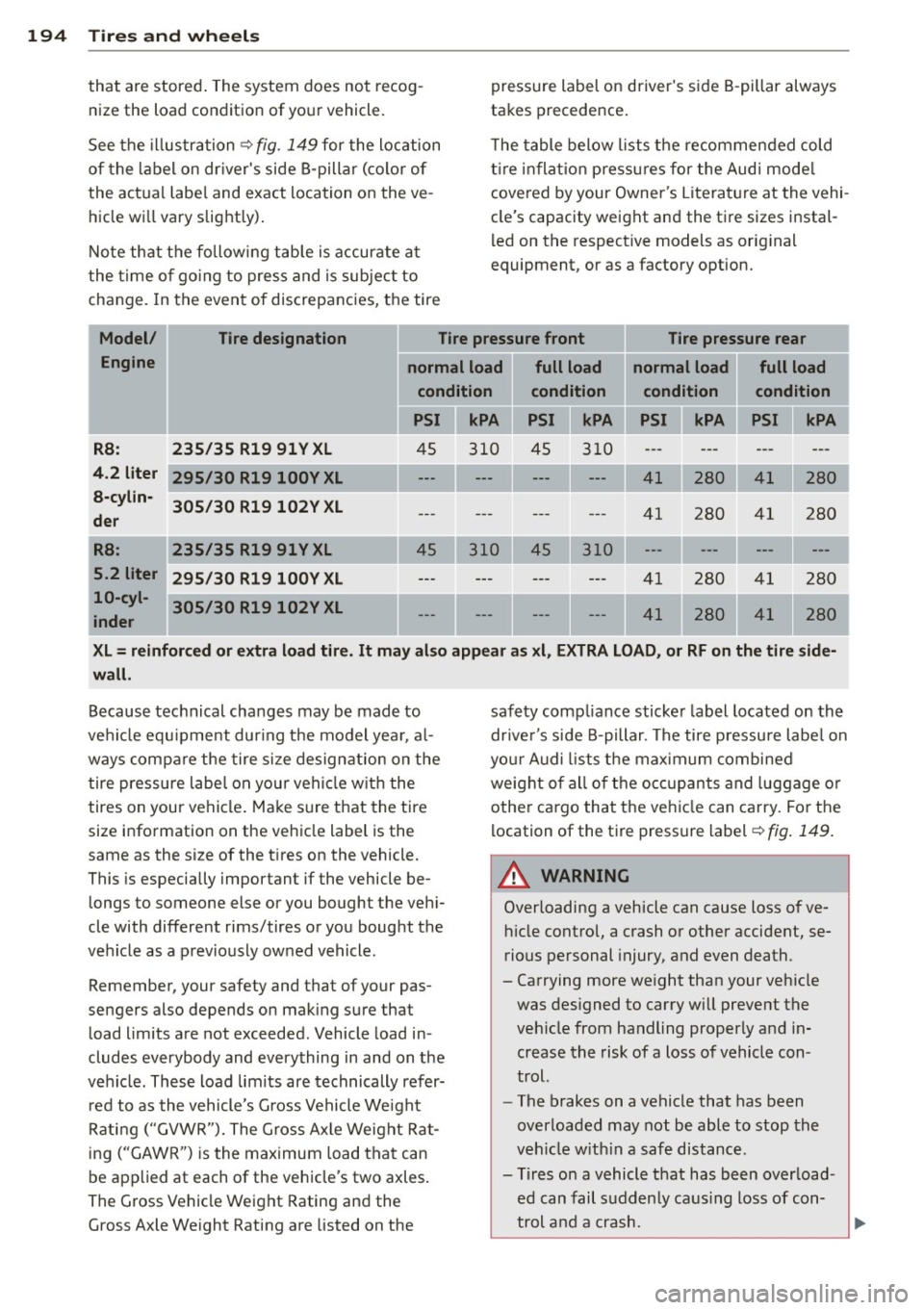
T he table below l ists t he recommended cold
t ire inflat ion pressu res for the Aud i mode l
covered by your Owner's Literat ure at the vehi
cle's capacity weight and the tir e sizes i nstal
l ed on the respective models as orig inal
equipment, or as a facto ry option.
I Model / \I Tire designation
Tire pressure front Tire pressure rear I
Engine
normal load full load normal load full load
condition condition condition condition
PSI II kPA PSI II kPA PSI ]I kPA
PSI II kPA
RS: 235/35 R19 91 Y XL 45
310 45 310
4 .2 liter
295 /30 R19 lOOY X L 280
8-c ylin-
305/30 R1 9 102V
XL
der 41
280 41
280
RS: 235/35 R19 91 Y XL 45
5.2 liter 295 /30 R19 l00Y XL 41 280 41
280
10-cyl-
305 /30 R19 102V XL
inder 41 280 41 280
--XL= reinforc ed or extra load tire. It may also a ppear as xl , EXTRA LOAD, or RF on the tire side·
wall.
Because tec hnical changes may be made to
ve hicle equ ipment dur ing the model yea r, a l
ways compare the tire size designation on the
tire pressure labe l on your vehicle w ith the
tires on your vehicle . Make s ure that the t ire
size information on the ve hicle label is the
same as the size of the tires on the vehicle.
This is especially important if the vehicle be
longs to someone else or you bough t the veh i
cle with different rims/tires or you bought the
ve hicle as a previously owned vehicle .
Remember, your safety and that of your pas
sengers also depends on mak ing sure that
load limits are not exceeded . Vehicle load in
cludes everybody and everything in and on the
vehicle. These load lim its are technically refer
r ed to as the vehicle 's Gross Vehicle We ight
Rating ("GVWR"). The G ross Ax le Weight Rat
ing ("GAWR") is the maximum load that can
be applied at each of the vehicle's two axles .
The Gross Vehicle Weight Rating and the
G ross Axle Weight Rating are listed on the safety compl
iance sticker label located on the
driver's side 8-pillar. The tire p ressure labe l on
yo ur Audi lists the max im um combined
weight of all o f the occ upants and luggage or
othe r ca rgo that the vehicle can carry. Fo r the
location of the tire pressure label
~ fig . 149.
A WARNING
Overloading a vehicle can cause loss of ve
h icle contro l, a crash or other accident, se
rious personal injury, and even death.
- Carrying more we ight than your veh icle
was designed to carry will prevent the
veh icle from handling properly a nd i n
crease the risk of a loss of vehicle con
trol.
- The brakes on a vehicle that has been
overloaded may not be able to stop the
veh icle w ith in a safe distance.
- Tires on a vehicle that has been overload
ed can fail suddenly ca using loss of con
trol and a crash.