light AUDI R8 SPYDER 2014 Manual PDF
[x] Cancel search | Manufacturer: AUDI, Model Year: 2014, Model line: R8 SPYDER, Model: AUDI R8 SPYDER 2014Pages: 244, PDF Size: 61.06 MB
Page 131 of 244
The airbag system is monitored electronically
to make certain that it is functioning properly
at all times. Each time you turn on the igni
tion, the airbag system indicator light will
come on for a few seconds (self diagnostics) .
The side airbag system supp lements the safe
ty belts and can help to reduce the risk of in
jury to the driver's and front passenger's up
per torso and head injuries on the side of the
ve hicle that is st ruck in a side co llision . The
airbag deploys in s ide impacts and only when
the veh icle acce lerat ion registered by the con
trol un it is high enough. If this rate is below
the refe rence va lue p rogrammed into the con
trol un it, the s ide a irbags w ill not be trig
gered, even though the car may be bad ly dam
aged as a result of the collision . It is not pos
sib le to define an airbag tr igger ing range that
will cover every poss ible angle of impact,
since the c ircumstances will vary considerab ly
between one collision and anothe r. Important
factors include, fo r example, the nature (hard
or soft) of the impacting object, the angle of i mpa ct, veh icle speed, e tc.¢
page 130, Im
portant safety instru ctions on the side airbag
system .
Aside from the ir normal safety function, safe
ty belts wor k to he lp keep t he d river or front
passenger in posi tion in the event of a side
coll is ion so that the side a irbags can provide
p rotection.
The airbag sys tem is
not a subs titute for your
safety be lt. R athe r, it is pa rt of the overall oc
cupant res traint system in your veh icle . Al
ways remember that the side airbag system
can only he lp to protect you if you are wearing
your safety belt and wear ing it properly. Th is
is another reason w hy you sho uld always wear
your safety belts, not just because the law re
qu ires you to do so¢
page 103, General
notes.
It is important to remember that while the
supp lemental s ide a irbag system is designed
to reduce the like lihood of serious injur ies,
other i njuries, for example, swell ing, b ruising,
and minor abras ions can also be assoc iated
with deployed s ide a irbags . Remem ber too,
A irbag system 129
side airbags wi ll dep loy only once and only in
certain kinds of accidents -your safety belts
are always the re to offer p rotection.
Vehicle damage, repair costs or even t he lack
of ve hicle damage are not necessarily an indi
cation of over-sensitive or failed airbag activa
tion . In some coll is ions, both front and side
airbags may inflate. Remember too, that air bags will deploy only once a nd only in certain
k inds of col lisions -your safety be lts a re al
ways the re to offe r protection in those acc i
dents in which airbags are not supposed to
deploy or when they have a lready deployed .
The side airbag system will not deploy:
-when the ignit io n is turned off
- in side co llisions when the acceleration
meas ured by the sensor is too low
- in rear-end co llisions
- in rollove rs .
In some types of ac cidents the front airbags
and s ide a ir b ag s may be triggere d toge ther.
A_ WARNING
- Safety belts and the airbag system wi ll
only provide protection when occupants
are in the proper seating position
¢page 130.
-If the ai rbag indicator light comes on
when the vehicle is being used, have the
system inspected immediately by your
author ized Audi dealer. The airbag may
not work properly when the vehicle ac
c e leration in a side collis ion is high
e nough to activate t he a irbag. •
•
Page 134 of 244
132 Child Safety
Child Safety
Important things to know
Introduction
The physical principles of what happens when
your vehicle is in a crash apply also to children
c::> page 104, What happens to occupants not
wearing safety belts? .
But unlike adults and
teenagers, their muscles and bones are not
fully developed . In many respects children are
at greater risk of serious injury in crashes than
adults.
Because children's bodies are not fully devel
oped, they require restraint systems especial
ly designed for their size, weight, and body
structure . Many countries and all states of the
United States and provinces of Canada have
laws requiring the use of approved child re
straint systems for infants and small children.
In a frontal crash at a speed of 20-35 mph
(30-56 km/h) the forces acting on a 13-pound
(6 kg) infant will be more than 20 times the
weight of the child. This means the weight of
the child would suddenly be more than 260 pounds (120 kg). Under these conditions,
only an appropriate child restraint properly used can reduce the risk of serious injury.
Child restraints, like adult safety belts, must
be used properly to be effective. Used improp
erly, they can increase the risk of serious in
jury in an accident.
Consult the child safety seat manufacturer's instructions in order to be sure the seat is
right for your child's size
c::> page 135, Impor
tant safety instructions for using child safety
seats.
Please be sure to read and heed all of
the important information and WARNINGS
about child safety, Advanced Airbags, and the
installation of child restraints in this chapter.
There is a lot you need to know about the Ad
vanced Airbags in your vehicle and how they
work when infants and children in child re
straints are on the front passenger seat. Be
cause of the large amount of important infor- mation, we cannot repeat it all here. We urge
you to read the detailed information in this
owner's manual about airbags and the Ad
vanced Airbag System in your vehicle and the
very important information about transport ing children on the front passenger seat.
Please be sure to heed the WARNINGS - they
are extremely important for your safety and
the safety of your passengers, especially in
fants and small children.
A WARNING
-
All vehicle occupants and especially chil
dren must be restrained properly whenev
er riding in a vehicle. An unrestrained or
improperly restrained child could be in
jured by striking the interior or by being
ejected from the vehicle during a sudden maneuver or impact. An unrestrained or
improperly restrained child is also at great
er risk of injury or death through contact
with an inflating airbag.
_& WARNING
Children on the front seat of any car even
with Advanced Airbags can be seriously in
jured or even killed when an airbag in
flates. A child in a rearward-facing child
safety seat installed on the front passen
ger seat will be seriously injured and can
be killed if the front airbag inflates.
- The inflating airbag will hit the child
safety seat or infant carrier with great
force and will smash the child safety seat
and child against the backrest, door or roof.
- Never install a rearward facing child
safety seat on the front passenger seat
unless the
PASSENGER AIR BAG OFF
light comes on and stays on. If the PAS·
SENGER AIR BAG OFF
light does not
come on and stay on, have the airbag
system inspected immediately by your
Audi dealer.
.
Page 135 of 244

A WARNING
-=
If, in exceptional circumstances, you must
install a forward-facing child restraint on
the front passenger's seat:
- Always make sure the forward-facing
seat has been designed and certified by
its manufacturer for use on a front seat
with a passenger front and side airbag.
-Always follow the manufacturer's in
structions provided with the child safety
seat or carrier.
- Always move the passenger seat into its
rearmost position in the seat's fore and
aft adjustment range, as far away from
the airbag as possible before installing
the child restraint. The backrest must be
adjusted to an upright position.
- Always make sure that the
PASSENGER
AIR BAG OFF light comes on and stays
on all the time whenever the ignition is
switched on.
(D Tips
Always replace child restraints that were
installed in a vehicle during a crash. Dam
age to a child restraint that is not visible
could cause it to fail in another collision
situation.
Advanced front airbag system and children
Your vehicle is equipped with an "Advanced
Airbag System" in compliance with United
States Federal Motor Vehicle Safety Standard
(FMVSS) 208 as applicable at the time your
vehicle was manufactured.
The Advanced Airbag system in your vehicle
has been certified to meet the "low-risk " re
quirements for 3- and 6- year-old children on
the passenger side and small adults on the
driver side. The low risk deployment criteria
are intended to reduce the risk of injury
through interaction with the airbag that can
occur, for example, by being too close to the
steering wheel and instrument panel when
the airbag inflates. In addition, the system
Child Safety 133
has been certified to comply with the "sup
pression" requirements of the Safety Stand
ard, to turn off the front airbag for infants up
to 12 months who are restrained on the front passenger seat in child restraints that are list
ed in the Standard .
Even though your vehicle is equipped with an
Advanced Airbag system, a child should al
ways ride in the seat properly restrained for
its age and size . The airbag on the passenger
side makes the front seat a potentially dan
gerous place for a child to ride. The front seat
is not the safest place for a child in a forward
facing child safety seat .
It can be a very dan
gerous place for an infant or a larger child in a
rearward-facing seat.
Advanced Airbags and the weight
sensing mat in the front seat
The Advanced Airbag System in your vehicle
detects the presence of an infant or child in a
child restraint on the front passenger seat us
ing the weight-sensing mat in the seat cush
ion and the sensor below the safety belt latch
on the front passenger seat that measures the
tension on the safety belt.
The weight-sensing mat measures total
weight of the child and the child safety seat
and a child blanket on the front passenger
seat. The weight on the front passenger seat
is related to the design of the child restraint
and its "footprint", the size and shape of the
bottom of the child restraint as it sits on the
seat. The weight of a child restraint and its
"footprint" vary for different kinds of child re
straints and for the different models of the
same kind of child restraint offered by child restraint manufacturers.
The weight ranges for the individual types,
makes and models of child restraints that the
NHTSA has specified in the Safety Standard
together with the weight ranges of typical in
fants and typical 1 year-old child have been
stored in the control unit of the Advanced Air
bag System. When a child restraint is being
used on the front passenger seat with a
ll-
•
•
Page 136 of 244
134 Child Saf ety
typical 1 year -old chi ld, the Advanced Airbag
System compares the weight meas ured by the
weight sensing mat with the in format ion stor
ed in the electron ic contro l unit.
The electron ic contro l unit a lso registers the
tension on the front passenge r safety belt.
The tens ion on the safety be lt fo r the front
passenger seat will be d ifferent for an adult
who is properly using the safety belt as com
pared to the tension on t he be lt whe n it is
used to attach a child restraint to the seat.
The senso r below the latch fo r the safety be lt
fo r the front seat passenger measu res the
tension on the be lt. T he inp ut from this sen
sor is then used with the we igh t to "decide",
whether there is a chi ld restraint with a typica l
1 year-o ld child o n the front passenger seat
and whether or not the airbag must be turned
off.
Child restraints and Advanced Airbags
Regardless of the ch ild restraint that you use,
make sure tha t it has been ce rtified to meet
Un ited States Fede ral Motor Vehicle Safety
S tanda rds a nd has been cer tified by its manu
facture r fo r u se wit h an air bag. If i n excep
tional circumstances yo u m ust use it on the
front passenge r seat, caref ully read all of the
info rmation on c hild safety an d Advanced Air
bags and heed a ll of the app licable WARN
INGS. Make certai n that t he child restraint is
correctly recognized by the weig ht-sensing
mat i nside the front passenger seat, that the
fro nt passenge r airbag is tur ned off and that
the airbag status is a lways correctly signaled
by the
PASSENGER AIR BAG OFF light .
Many types and models of child restra ints
have been ava ilable over the years, new mod
e ls ar e introduced regularly incorporat ing new
a nd improved designs a nd older models are
taken out of p ro du ction. Child res traints are
not stan dardized . Ch ild restra ints o f the same
type typically have different weights and s izes
a nd d ifferent 'footprints,' the s ize and s hape
of the bottom o f the child restraint that sits
on the seat, when they are installed on a veh i
cle seat. These differences make it virtually impossible to certify compliance wi
th t he re
quirements for a dvanced airbags with eac h
and every ch ild restra int that has ever been
sold in the past or wi ll be sold over the course
of the useful life of your veh icle.
For t his reason, the United States National
Hig hway T raffic Safety Adm inistrat ion has
published a list of spec ific type, ma kes and
m odels of child restraints that must be used
to certify comp liance of the Advanced Airbag
System i n your veh icle w ith the su ppr ession
r equirem ents of Federal Motor Vehicle Safety
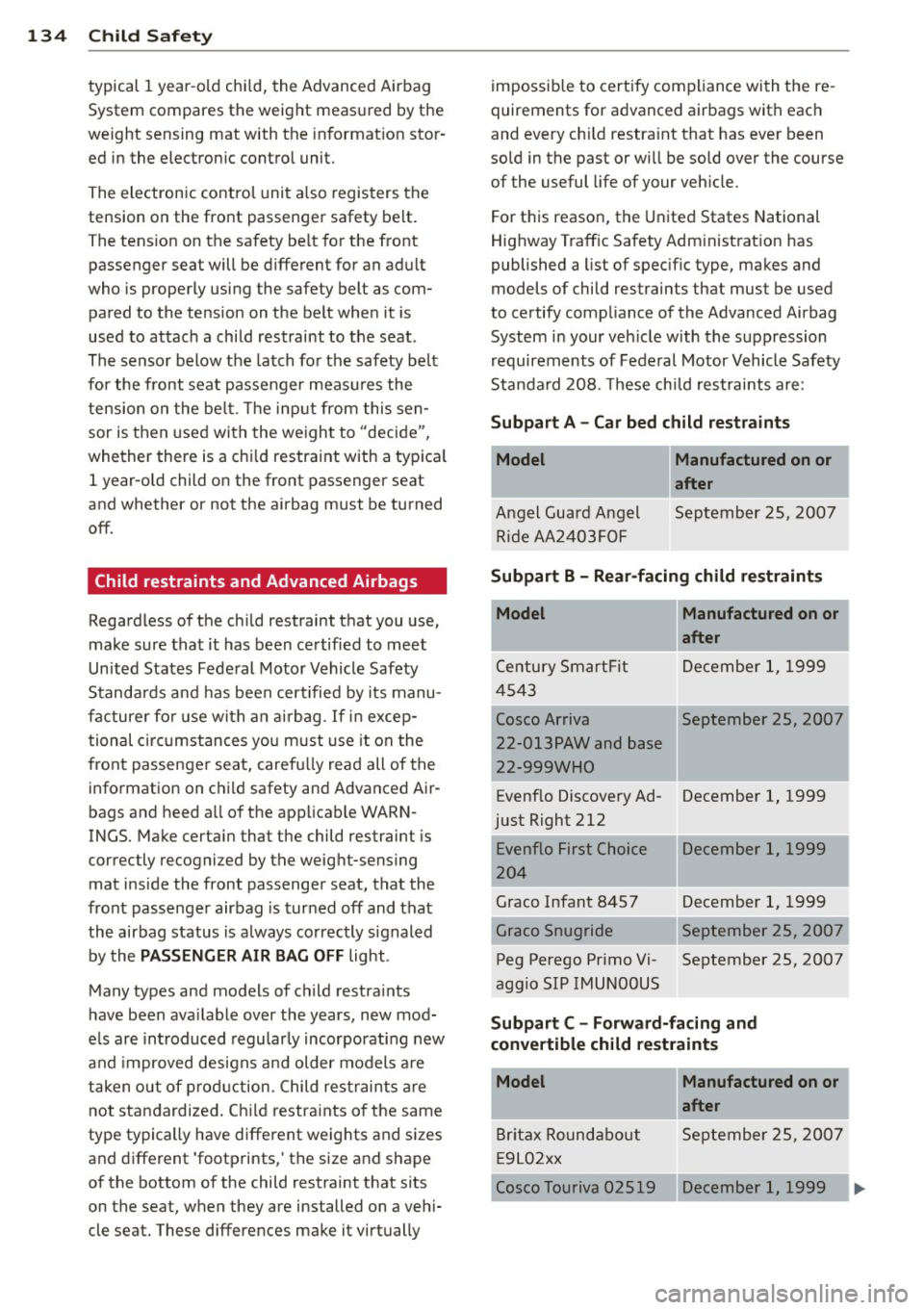
Standa rd 208. These chi ld restraints a re :
Subpart A -Car bed child restraints
Model
Angel Guard Angel
R ide AA 2403F OF Manufactured on or
after
September 25, 2007
Subpart B - Rear-facing child restraints
Model
Century Sm art Fi t
4 543
Cosco Arriva
22 -013PAW and base
22-999 WHO
Evenflo Discove ry Ad
just Right 212
E venflo First Choice
2 04
Graco Infant 8457
G raco Snug ride
Peg Perego Pr im o Vi
aggio SIP IMU NOOUS Manufactured on or
after
D ecembe r 1, 1999
Septemb er 25, 20 07
Decembe r 1, 1999
D ecember 1, 1 999
Decembe r 1, 1999
September 25, 2007
September 25, 2007
Subpart C -Forward-facing and
convertible child restraints '
.
'
.
Model Manufactured on or
·
B rita x Round about
E 9 L0 2xx after
Sep
tember 25, 2007
Cosco Touriva 02519 Decemb er
1, 1999
'
Page 137 of 244
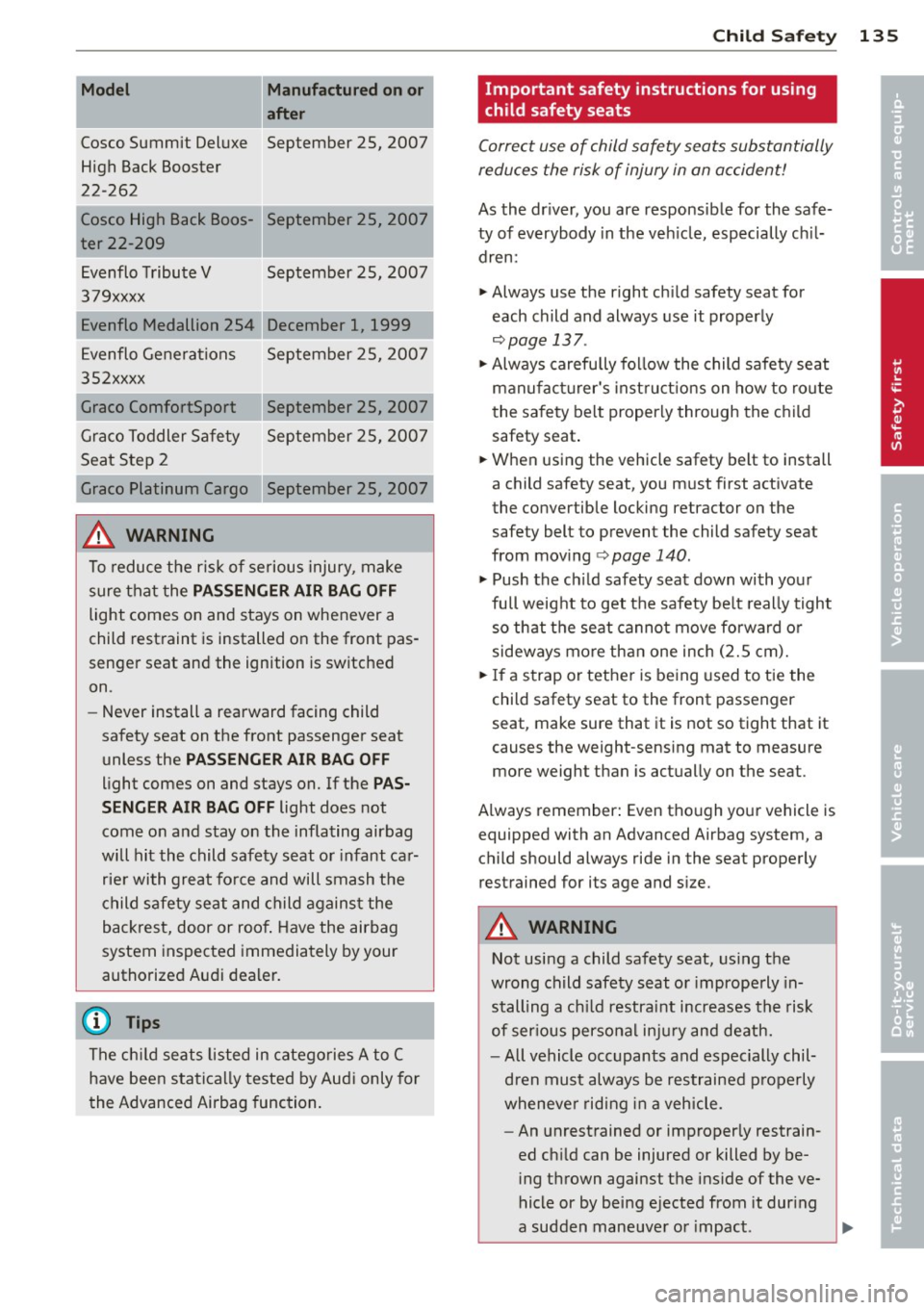
Model Manufactured on or
after
Cosco Summit Deluxe September 25, 2007
H igh Back Bo oste r
22-262
Co sco High Bac k Boos -September 2S, 2007
ter 22- 209
Evenfl o Tribut e V
379xxxx September 25, 2007
December 1, 1999
E
venflo Genera tions September 25, 2007
35 2xxxx
Grace ComfortSport September 2S, 2007
Grace Toddler Sa fety September 25, 200 7
Seat Step 2
Graco Platinum Cargo September 25, 2007
A WARNING
T o reduce the risk of serious injury, make
sure that the
PASSENGER AIR BAG OFF
light comes on and stays on whenever a
child rest raint is installed on the front pas
senger seat and the ignition is switched
on.
- Never install a rearward facing child
safety seat on the front passenger seat
unless the
PASSENGER AIR BAG OFF
light comes on and stays on. If the PAS
SENGER AIR BAG OFF
light does not
come on a nd stay on the inflating airbag
will hit the child safety seat o r infant ca r
rie r wi th great fo rce and will smash the
c hild s afety seat and child agains t the
backrest, door or roof . Have the airbag
system inspected immedia tely by your
authorized Audi dealer.
(D Tips
The ch ild seats listed in catego ries A to C
have been sta tica lly tested by Au di only for
the Advanced Airbag function.
.
Child Sa fet y 135
Important safety instructions for us ing
child safety seats
Correct use of child safety seats substantially
reduces the risk of injury in an accident!
As the dr iver, you are respons ible for the safe
ty of everybody in the veh icle , especially ch il
dren:
.. Always use the right ch ild safety seat for
each child and always use it properly
r=;, page 137.
.. Always carefully fo llow the child safe ty seat
manufac turer's inst ruct io ns on how to ro ute
the sa fe ty be lt properly through the c hild
safety seat .
.. When using the vehicle safety belt to install
a child safety seat, you m ust first activate
the convertible locking retractor on the
safety belt to prevent the child safety seat
from mov ing
¢ page 140 .
.. Push the ch ild safety seat down with yo ur
full weight to get the safety be lt really tight
so that the seat cannot
move fo rwa rd o r
sideways more th an one inch
(2.5 cm).
.. If a s trap or tet her is be ing used to tie the
child safety seat to the front passenger
seat, make sure that it is not so tight that it
causes the weight-sensing mat to measure
more weight than is act ually on the seat.
A lways remember : Even tho ugh yo ur vehicle is
equipped with an Advanced Airbag system, a
c hi ld should always ride in the seat properly
restrained for its age and s ize.
A WARNING
N ot using a child safety seat, using the
wrong ch ild safety seat o r imprope rly in
stalling a ch ild restraint increases the risk
of ser ious persona l inju ry and death.
- All vehicle occupants and especially chil
dren must always be restrained p rope rly
wheneve r riding in a vehicle.
-
- An unrest rained or improper ly restrain
ed ch ild can be injured or killed by be
i ng t hrown against the ins ide of the
ve
hicle or by being e jected from it dur ing
a sudden maneuve r o r i mpact .
•
•
Page 138 of 244
136 Child Safety
-An unrestrained or improperly restrain
ed child is at much greater risk of injury
or death by being struck by an inflating
airbag .
- Commercially available child safety seats
are required to comply with U.S. Federal
Motor Vehicle Safety Standard (FMVSS)
213 (in Canada CMVSS 213).
- When buying a child restraint, select
one that fits your child and the vehicle.
- Only use child restraint systems that
fully contact the flat portion of the
seat cushion. The child restraint must
not tip or lean to either side. Audi does
not recommend using child safety
seats that rest on legs or tube-like
frames . They do not provide adequate
contact with the seat .
- Always heed all legal requirements per
taining to the installation and use of
child safety seats and carefully follow
the instructions provided by the manu
facturer of the seat you are using.
- Never let more than one child occupy a
child safety seat.
- Never let babies or older children ride in
a vehicle while sitting on the lap of an
other passenger.
- Holding a child in your arms is never a
substitute for a child restraint system.
- The strongest person could not hold
the child with the forces that exist in
an accident. The child will strike the in
terior of the vehicle and can also be
struck by the passenger .
- The child and the passenger can also
injure each another in an accident.
- Never install a rearward facing child
safety seat on the front passenger seat
unless the
PASSENGER AIR BAG OFF
light comes on and stays on. If the PAS
SENGER AIR BAG OFF
light does not
come on and stay on the inflating airbag
will hit the child safety seat or infant car
rier with great force and will smash the
child safety seat and child against the
backrest, door or roof. Have the airbag system inspected immediately by your
authorized Audi dealer.
- Forward-facing child safety seats instal
led on the front passenger's seat can in
terfere with the airbag when it inflates
and cause serious injury to the child.
- If exceptional circumstances require the
use of a forward-facing child restraint on
the front passenger's seat, the child's
safety and well -being require that the
following special precautions be taken :
- Make sure the forward-facing seat has
been designed and certified by its man
ufacturer for use on a front seat with a
passenger front and side airbag.
- Always carefully follow the manufac
turer's instructions provided with the
child safety seat or carrier.
- Always move the front passenger seat
into the rearmost position of the pas
senger seat 's fore and aft adjustment
range, and as far away from the airbag
as possible before installing the child
restraint.
- Always make sure that nothing pre
vents the front passenger's seat from
being moved to the rearmost position
in its fore and aft adjustment range.
- Always make sure that the backrest is
in the upright position.
- Always buckle the child safety seat firmly
in place even if a child is not sitting in it.
A loose child safety seat can fly around
during a sudden stop or in a collision.
- Always read and heed all WARNINGS
whenever using a child restrained in ave
hicle is being used
¢ page 103, Safety
belts,
¢ page 111, Airbag system and
~ page 132, Child Safety .
A WARNING ~
To reduce the risk of serious injury, make
sure that the
PASSENGER AIR BAG OFF
light comes on and stays on whenever a
child restraint is installed on the front pas
senger seat and the ignition is switched
on.
Page 139 of 244
-Never install a rearward facing child
safety seat on the front passenger seat
unless the
PAS SENGER AIR BA G OFF
light comes on and stays on . If the PA S
SEN GER AI R BAG OFF
light does not
come on and stay on the inflating airbag
will hit the child safety seat o r infant car
r ie r with great fo rce and will smash the
child safety seat and child against the
backrest, door or roof . Have the airbag
system inspected immediately by your authorized Audi dealer .
Child safety seats
Infant seats
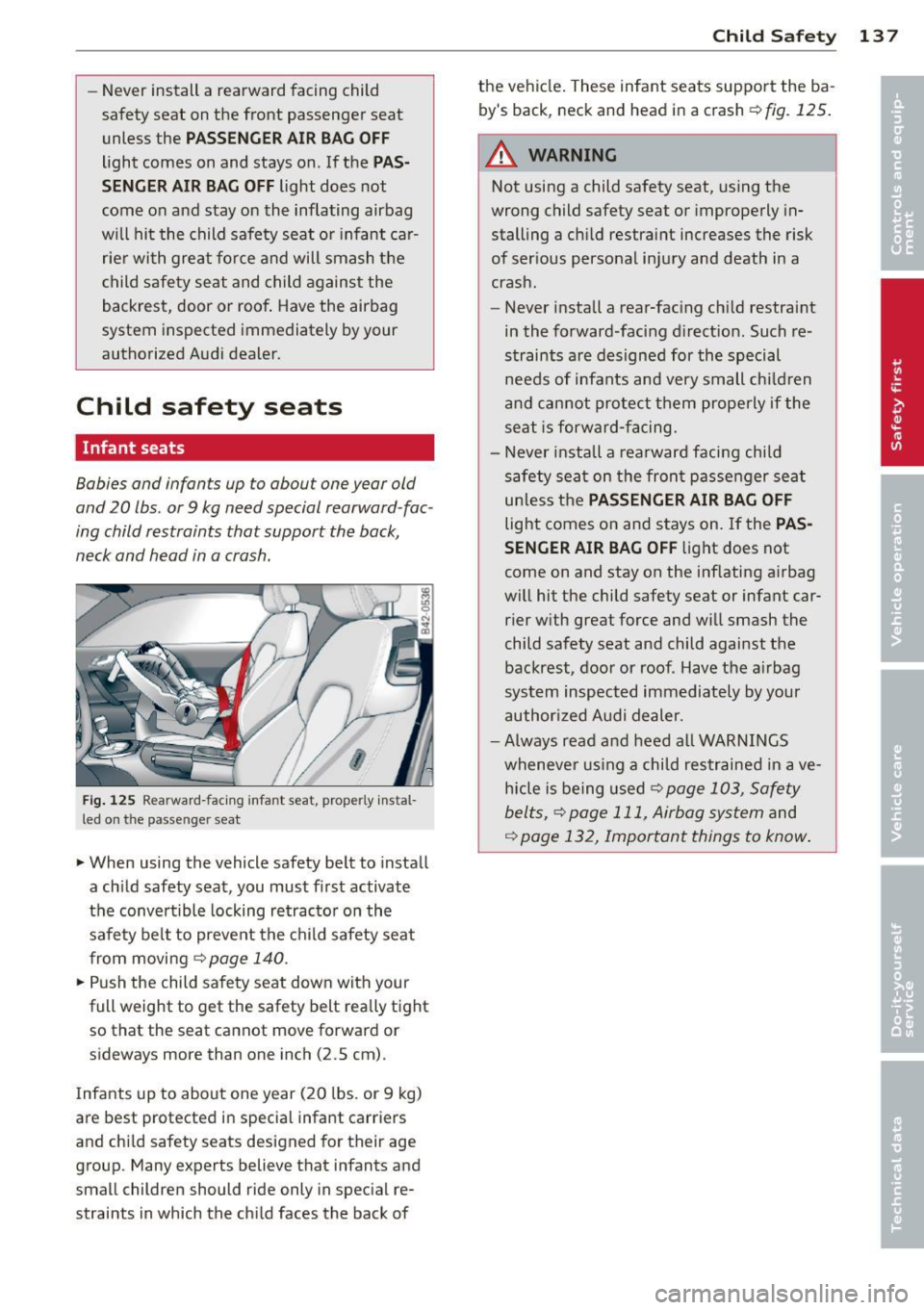
Babies and infants up to abou t one year old
and 20 lbs . or 9 kg need special rearward -fac
ing child restraints that support the back,
neck and head in a crash.
Fig . 125 Re arwar d-fa cing infan t sea t, pr operly instal
le d on t he p asseng er se at
"' When using the vehicle safety belt to in stall
a ch ild safety seat , you must first activate
the convertible locking retractor on the
safety belt to prevent the ch ild safety seat
from moving
r::!v page 140 .
"' Push the child sa fety seat dow n with your
full weight to get the safety bel t rea lly tight
so that the seat cannot move forward or
sideways more than one inch (2 .5 cm) .
I nfants up to about one year (20 lbs. or 9 kg)
are best prot ected in special infant carriers
and chi ld safety seats design ed for their age
group . Many experts believe that infants and
sm all ch ildren should ride only in spec ia l re
straints in which the ch ild faces the back of
Child S afety 13 7
the vehicle. These infant seats support the ba
by 's back, neck and head in a crash~
fig. 125.
A WARNING
Not using a child safety seat, using the
wrong child safety seat or improperly in
stalling a child restraint increases the risk
of ser ious personal injury and death in a
crash.
- Never install a rear-fac ing ch ild restraint
in the forward -facing d irect ion . Such re
straints are designed for the special needs of infants and very small chi ld ren
and cannot protect them properly if the
seat is forward-facing.
- Never install a rearward facing child
safety sea t on the fron t passenger seat
un less t he
PASSENGER AIR BAG OFF
light comes on and stays on. If the PAS·
SENGER A IR BAG OFF
light does not
come on and stay on the inf lating a irbag
will hit the child safety seat or infant car
rier w ith great f orce and w ill smash the
child safety seat and child against the backrest, door or roof . Have the a irbag
sys tem inspected immediately by your
author ized Audi dealer.
- Always read and heed al l WARNINGS
whenever us ing a child restrained in ave
hicle is being used
r::!v page 103, Safety
belts, r::!vpage 111, Airbag system
and
r::!v page 132, Important things to know .
Page 140 of 244
138 Child Safet y
Convertible child safety seats
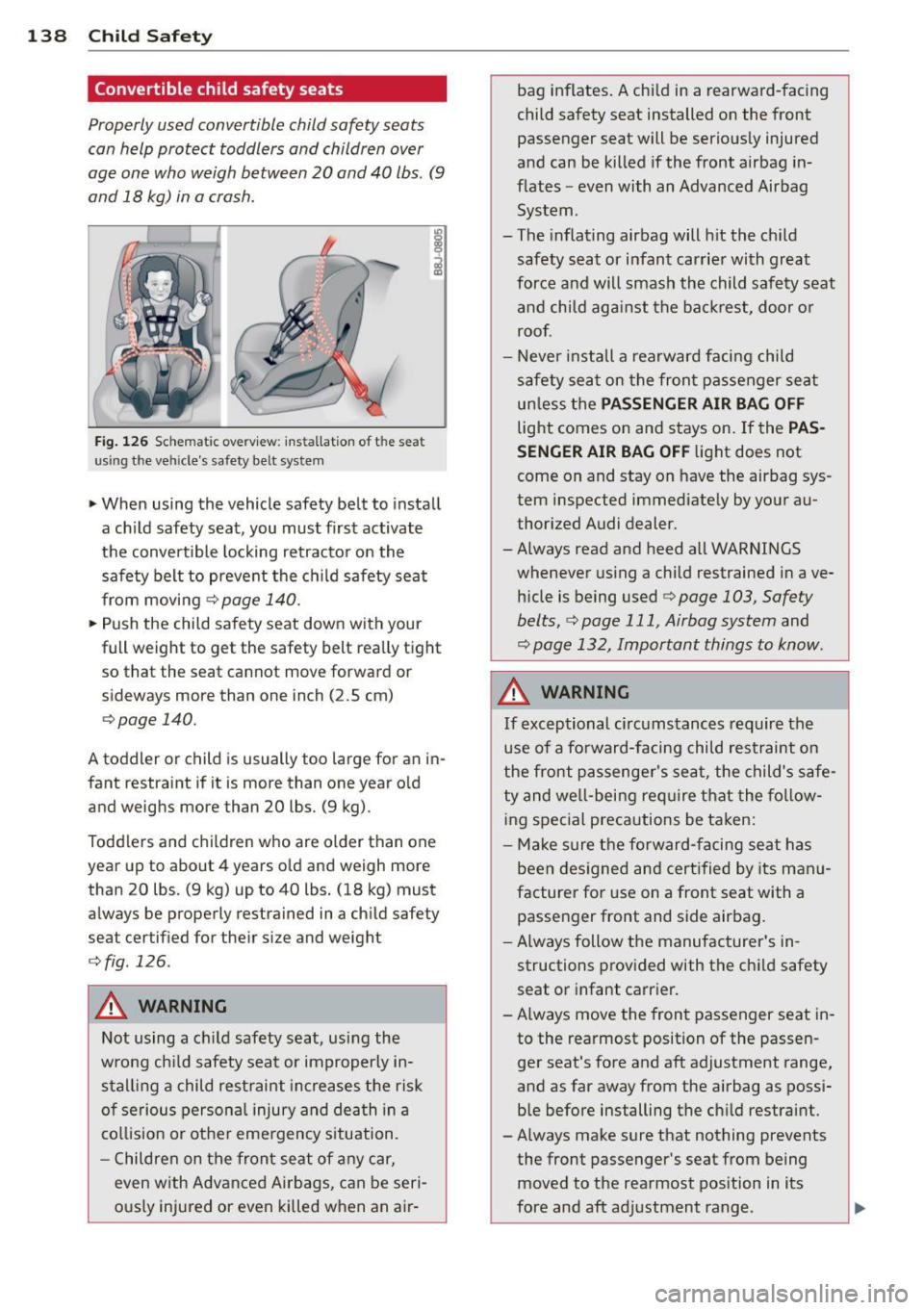
Properly used convertible child safety seats
can help protect toddlers and children over
age one who weigh between
20 and 40 lbs. (9
and 18 kg) in a crash.
Fig . 126 Schematic overv iew: installat ion of the seat
usin g the vehicle's safety belt system
~ When using the vehicle safety belt to install
a ch ild safety seat, you must first activate
the convertible locking retractor on the safety belt to prevent the c hild safety seat
from movi ng
Q page 140.
~ Push the child safety seat down with your
full weight to get the safety belt rea lly tight
so that the seat cannot move forward or
sideways more than one inch (2.5 cm)
Qpage 140.
A toddler or child is usually too large for an in
fant restraint if it is more than one year old
and weighs more than 20 lbs. (9 kg) .
Toddlers and ch ildren who are o lder than one
year up to about 4 years o ld and weigh more
than 20 lbs . (9 kg) up to 40 lbs. (18 kg) must
always be properly restrained in a child safety
seat certi fied for the ir size and weight
Qfig. 126.
&_ WARNING
Not using a ch ild safety seat, us ing the
w rong ch ild safety seat or improperly in
stal ling a child restraint increases the risk
o f se rious persona l injury and death in a
co llision or othe r eme rgency s ituation.
- Children on t he front seat of a ny car,
even w ith Advanced A irbags, can be seri
ous ly injured or even killed when an air- bag inflates. A chi
ld in a rearward-facing
child safety seat installed on the front
passenger seat will be seriously injured
and can be killed if the front airbag in
flates -even with an Advanced Airbag
System .
- The inflating airbag will h it the ch ild
safety seat or infant carrie r with great
for ce and will smash the child safety seat
and child aga inst the ba ckrest, door or
roof .
- Neve r install a rearward facing child
safety sea t on the fron t passenger seat
un less the
PASSENGER AIR BAG OFF
light comes on and stays on. If the PAS
SENGER AIR BAG OF F
light does not
come on and stay on have the airbag sys
tem inspected immediately by your au
thorized Audi dealer.
- Always read and heed all WARNINGS
whenever us ing a child restrained in ave
h icle is being used
¢ page 103, Safety
belts,
Q page 111, Airbag system and
Q page 132, Important things to know .
&_ WARNING
--
If exceptional circumstances require the
use of a fo rward-facing child restraint on
the front passenger 's seat , the child's safe
ty and well-bei ng req uire t hat the fo llow
i ng spec ial precautions be taken:
- Make sure the forward- facing seat has
been designed and cert ified by its man u
facturer for use on a front seat with a
passenger front and side airbag.
- Always follow the manufacturer 's in
structions p rovided with the chi ld safety
seat or infant carrier.
- A lways move the front passenger seat in
to the rearmost position of the passen ger seat's fore and aft adjustment range,
and as far away from the airbag as possi
b le before installing the child restraint.
- Always make sure that nothing prevents
the front passenger 's seat from being
moved to the rearmost position in its
fore and aft adjustment range .
Page 141 of 244
-Always make sure the backrest 1s in an
upr ight position.
- Make sure that the
PASSENGER AIR BAG
O FF
light comes on and stays on all the
t ime whenever the ignition is switched
on.
- If the light does not stay on, perform the checks.
- If the
PASSENGER AIR BAG O FF light
does not come on and stay on have the
airbag system inspected immed iately by
your Audi dealer.
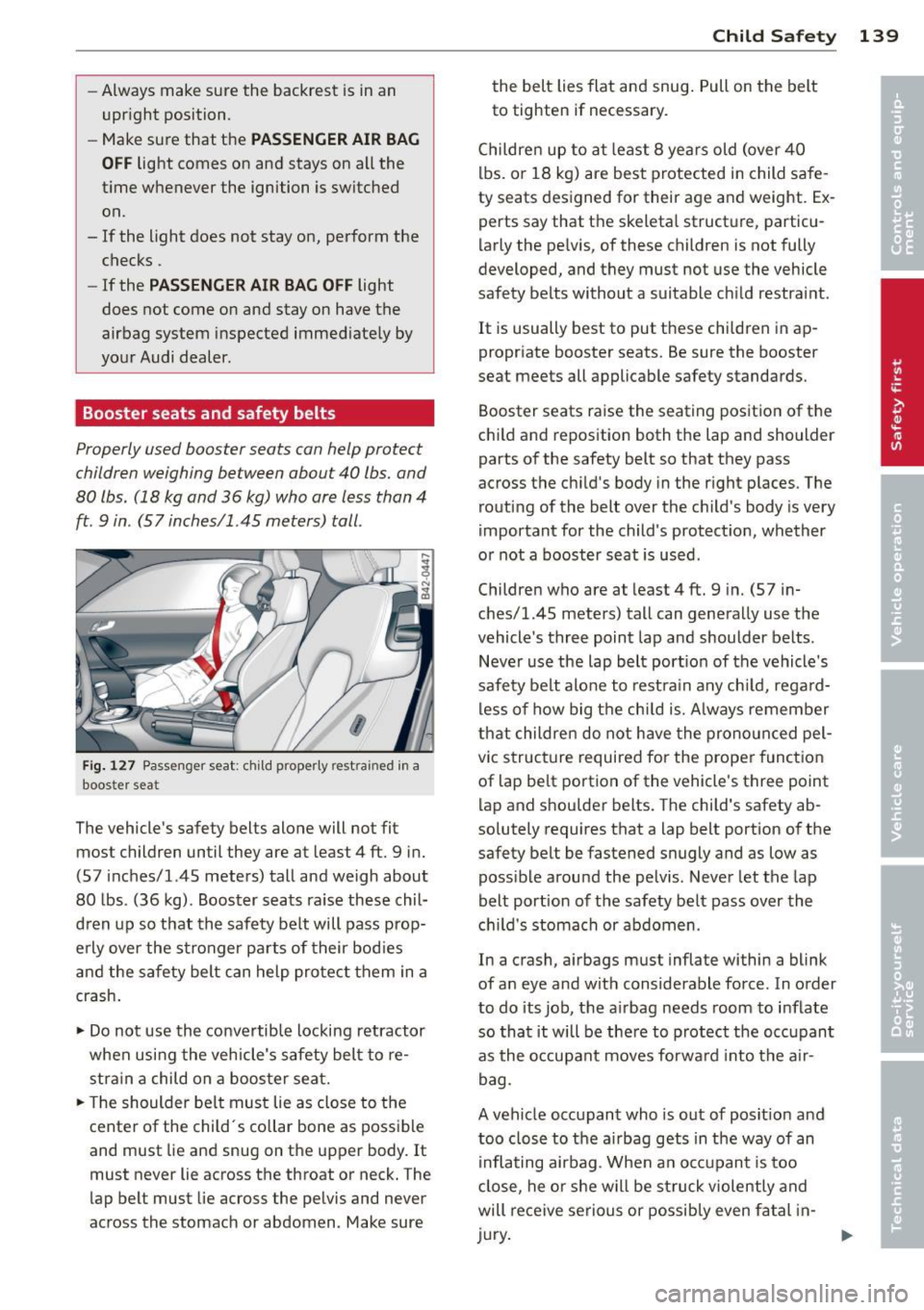
Booster seats and safety belts
Properly used booster seats con help protect
children weighing between about 40 lbs. and
80 lbs. (18 kg and 36 kg) who ore less than 4
ft. 9 in . (57 inches/1 .45 meters) toll.
F ig. 12 7 Passenger seat: child proper ly restrained in a
booster seat
The vehicle's safety belts alone will not fit
most children until they are at least 4
ft. 9 in.
(57 inches/1.45 meters) tall and weigh about
80 lbs. (36 kg). Booster seats ra ise these chil
d ren up so that the safety belt will pass prop
erly over the stronger parts of their bod ies
and the safety belt can help protect them in a
crash .
~ Do not use the convertible locking retractor
when usi ng the veh icle's safety belt to re
stra in a child on a booster seat.
~ The shoulder be lt must lie as close to the
cente r of the child· s collar bone as possible
and must lie and snug on the upper body. It must never lie across the throat or neck. The
lap belt must lie across the pelvis and never
across the stomach or abdomen. Make sure
Child S afety 139
the belt lies flat and snug . Pull on the belt
to tighten if necessary.
Childre n up to at least 8 yea rs old (over 40
lbs. o r
18 kg) are best protected in child safe
ty seats designed for their age and weight.
Ex
perts say that the skeletal structure, particu
larly the pe lvis, of these children is not fully
developed, and they must not use the vehicle
safety belts without a suitable ch ild restrai nt.
It is usually best to put these children in ap
propriate booster seats. Be sure the booster
seat meets all applicable safety standards.
Booster seats raise the seating pos ition of the
ch ild and repos ition both the lap and shoulder
parts of the safety belt so that they pass
across the ch ild's body in the r ight places. The
routing of the belt over the child's body is very
important for the child's protect ion, whether
or not a booster seat is used.
Children who are at least 4
ft. 9 in. (57 in
ches/1.45 meters) tall can generally use the
vehicle 's three point lap and shoulder belts.
Never use the lap belt port io n of the vehicle's
safety belt alone to restra in any ch ild, rega rd
less of how big the chi ld is. A lways remember
that children do not have the prono unced pel
vic structure required for the prope r function
of lap belt portion of the vehicle's three point
lap and shoulder belts. The child's safety ab
solutely requires that a lap belt portion of the
safety belt be fastened snugly and as low as poss ible around the pelvis. Never let the lap
belt portion of the safety belt pass over the
ch ild's stomach or abdomen.
In a crash, a irbags must inflate within a blink
of an eye and with considerable force . In order
to do its job, the a irbag needs room to inflate
so that it will be there to p rotect the occupant
as the occupant moves forward into the a ir
bag.
A vehicle occupant who is out of posit ion and
too close to the a irbag gets in the way of an
i nflating airbag. When a n occupant is too
close, he or she will be st ruck violently and
will re ceive se rious or possibly even fatal in -
jury .
ll-
Page 142 of 244
140 Child Safety
In order for the airbag to offer protection, it is
important that all vehicle occupants, especial
ly any children, who must be in the front seat
because of exceptional circumstances, be
properly restrained and as far away from the
airbag as possible. By keeping room between
the child's body and the front of the passen
ger compartment, the airbag can inflate com
pletely and provide supplemental protection
in certain frontal collisions .
& WARNING
Not using a booster seat, using the boos
ter seat improperly , incorrectly installing a
booster seat or using the vehicle safety
belt improperly increases the risk of seri
ous personal injury and death in a collision
or other emergency situation. To help re
duce the risk of serious personal injury
and/or death:
- The shoulder belt must lie as close to the
center of the child's collar bone as possi
ble and must lie and snug on the upper
body .
It must never lie across the throat
or neck. The lap belt must lie across the
pelvis and never across the stomach or
abdomen. Make sure the belt lies flat
and snug. Pull on the belt to tighten if
necessary.
- Failure to properly route safety belts
over a child's body will cause severe inju
ries in an accident or other emergency
situation
c::;,poge 103.
-Children on the front seat of any car,
even with Advanced Airbags, can be seri
ously injured or even killed when an air
bag inflates.
- Never let a child stand or kneel on the
seat.
- Never let a child ride in the cargo area of
your vehicle.
- Always remember that a child leaning
forward, sitting sideways or out of posi
tion in any way during an accident can be
struck by a deploying airbag. This will re
sult in serious personal injury or death.
- If you must install a booster seat on the
front passenger seat because of excep -
-
tional circumstances the PASSENGER
AIR BAG OFF
light must come on and
stay on, whenever the ignition is switch
ed on.
- If the
PASSENGER AIR BAG OFF light
does not come on and stay on, perform
the checks described .
- If the
PASSENGER AIR BAG OFF light
does not come on and stay on whenever
the ignition is switched on the inflating
airbag will hit the child safety seat or in
fant carrier with great force and will
smash the child safety seat and child
against the backrest, door or roof. Have
the airbag system inspected immediately
by your Audi dealer.
- Always read and heed all WARNINGS
whenever using a child restrained in ave
hicle is being used
¢page 103, Safety
belts,
c::;, page 111 , Airbag system and
c::;, page 132, Important things to know.
Installing a child safety
seat
Securing a child safety seat using a
safety belt
Safety belts for the front passenger con be
locked with the convertible locking retractor
to properly secure child safety sea ts.
The safety belts emergency locking retractors
for the front passenger's seat safety belt have
a convertible locking retractor for child re
straints . The safety belt must be locked so
that belt webbing cannot unreel. The retrac
tor can be activated to lock the safety belt and
prevent the safety belt webbing from loosen
ing up during normal driving. A child safety
seat can only be properly installed when the
safety belt is locked so that the child and child
safety seat will stay in place.
Always remember: Even though your vehicle is
equipped with an Advanced Airbag system, a
child should always ride in the seat properly
restrained for its age and size.
II>-