engine AUDI R8 SPYDER 2015 Workshop Manual
[x] Cancel search | Manufacturer: AUDI, Model Year: 2015, Model line: R8 SPYDER, Model: AUDI R8 SPYDER 2015Pages: 232, PDF Size: 58.36 MB
Page 155 of 232
.... N
l'
N "1: .... I.O
"' N
"' ....
(D Note
Never drive yo ur vehicle unti l the fuel tank is
completely dry . The irregular supp ly of fuel
can cause misfir ing. Gasoline co uld enter into
the exhaust system and damage the catalyt ic
converter .
Refueling
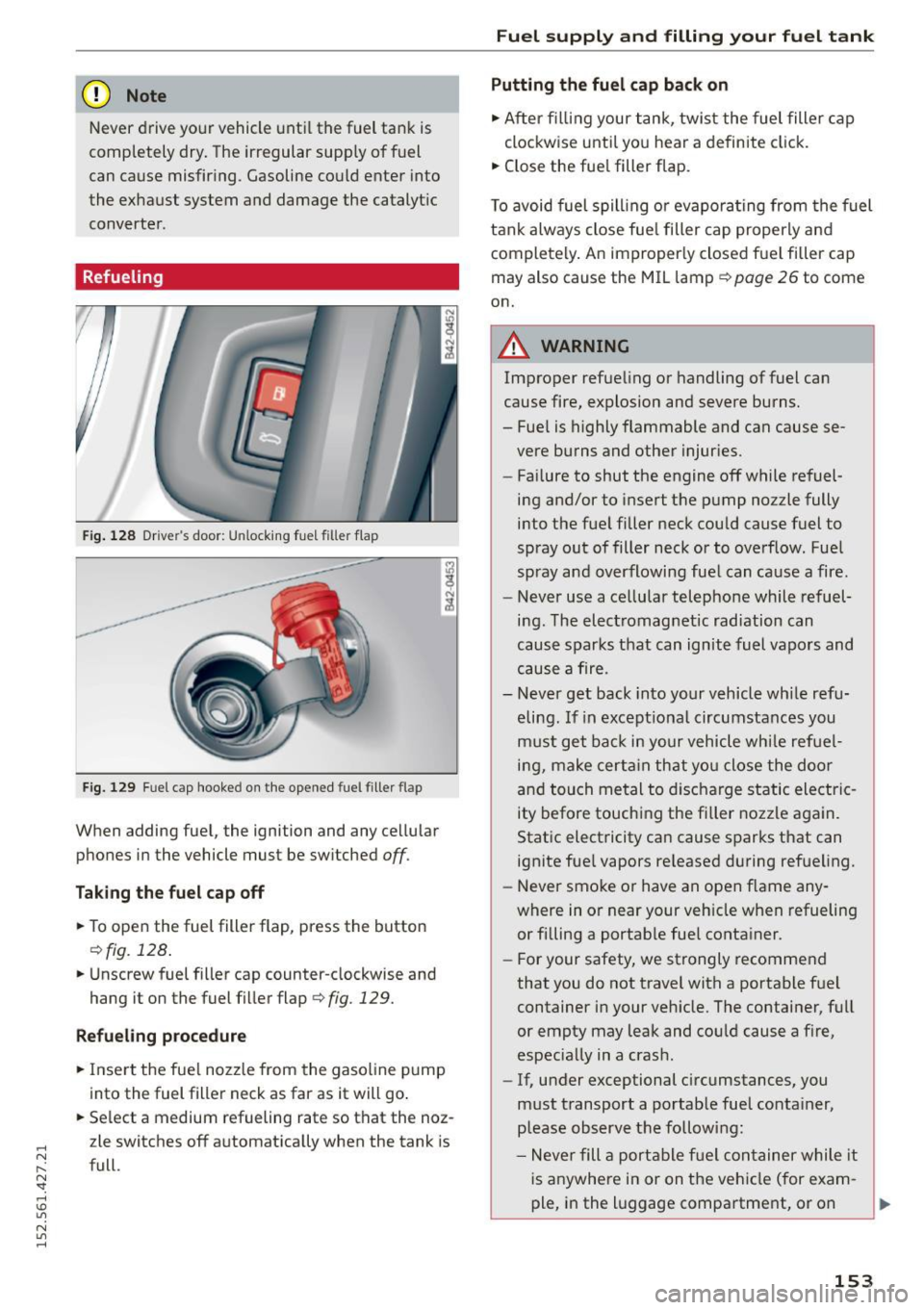
F ig. 12 8 Drive r's door: Unlocking f uel filler f lap
F ig . 129 Fu el cap hooke d on th e opene d fu el fil ler fla p
When adding fuel, the ignition and any cellular
phones in the vehicle must be sw itched
off .
Taking the fuel cap off
.. To open the fuel filler flap, press the button
¢ fig. 128 .
.. Unscrew fuel filler cap counte r-clockwise and
hang it on the fuel filler flap
¢ fig. 129.
Refueling procedure
.. Inse rt the fue l nozz le from the gasoline pump
into the fuel filler neck as far as it will go .
.. Se lect a medium refueling rate so that the noz
z le switches off automat ica lly when the tank is
full.
Fuel supply and filling your fuel tank
Putting the fuel cap back on
.,. After f illing your tank, twis t the fuel filler cap
clockw ise unti l yo u hear a definite cl ick .
.. Close the fue l filler flap.
T o avoid fuel spill ing o r evapora ting from the fuel
tank always close fue l filler cap properly and
complete ly . An improper ly closed f uel filler cap
may also cause the MIL lamp ¢
page 26 to come
on.
A WARNING
--Improper refue ling or handling of fuel can
cause fire, explosion and severe burns.
- Fue l is highly flammable and can cause se
vere burns and other injur ies.
- Fa ilure to shut the engine off while re fuel
ing and/or to insert the pump nozzle fully
into the fue l filler neck cou ld cause fuel to
spray out of filler neck or to overflow. Fue l
sp ray an d overflowing fue l can ca use a fire.
- Never use a ce llular telepho ne while refuel
ing . T he elec tromagnetic radiation can
cause sparks that can ignite fuel vapo rs and
cau se a fire .
- Never get back into yo ur vehicle wh ile refu
e ling . If in except iona l circumst ances you
m ust get ba ck in yo ur vehicle whi le refuel
i n g, make cert ain that yo u close the doo r
a nd tou ch me tal to disch arge st atic electric
ity before touch ing the filler nozzle aga in.
Static elect ricity ca n cause s parks that can
ignite fue l vapors re leased d uring refueling.
- Never smoke o r have an open f lame any
where in or near your veh icle w hen refueling
or fi lling a portab le fue l conta iner.
- For your safety, we strongly recomme nd
that you do not travel with a portable f uel
container in your veh icle. The container, f ull
or empty may leak and cou ld cause a f ire,
especia lly in a cras h .
- If, under exceptional c ircumstances, you
must t ransport a po rtab le fuel conta iner,
p lease observe t he follow ing :
- Never fill a por table fuel co ntainer while it
is anywhere in or on the veh icle (for exam -
p le, in the l uggage compa rtme nt, or on ..,.
153
Page 156 of 232
Fuel supply and filling your fuel tank
the trunk). Static electricity can build up
while filling and can ignite fuel vapors
causing a fire.
- Always place a portable fuel container on
the ground before f illing.
- Always keep the fi ller nozzle comp letely
inside the portable container before and
during filling.
- If filling a portable container made of
metal, the filler nozzle must always be in
contact with the container. This will help prevent static electricity from discharging
and cause a fire .
- Never sp ill fuel inside the vehicle or lug
gage compartment. Fuel vapors are highly
f la mmab le.
- Always observe local and state/provincial
laws regarding the use, storage and trans
portat ion of fuel containers.
- Make certain the fuel container meets in
dustry standards (ANSI/ ASTM F8S2 -86) .
(D Note
If any fuel has spilled onto the car, it should
be removed immediately to prevent damage
to the paint .
@ For the sake of the environment
As soon as the correctly operated nozzle
switches off automatically for the first time,
the tank is full. Do not try to add more fuel
because fuel may spill out. In addition, the
expansion space in the fuel tank will be filled -
causing the fuel to overflow when it becomes
warm and pollute the enviro nment.
@ Tips
- Running your engine while refueling may
cause vapors to escape or even fue l to spill
out of the tank. This would then shut off the
fuel nozzle before the tank is full.
- Do not refuel your vehicle w ith the ignition
switched on . The fuel gauge may otherwise
not indicate the correct fuel level after refu
e ling.
154
Unlocking the fuel filler flap by hand
You can open the fuel filler flap by hand if the
power locking system should fail .
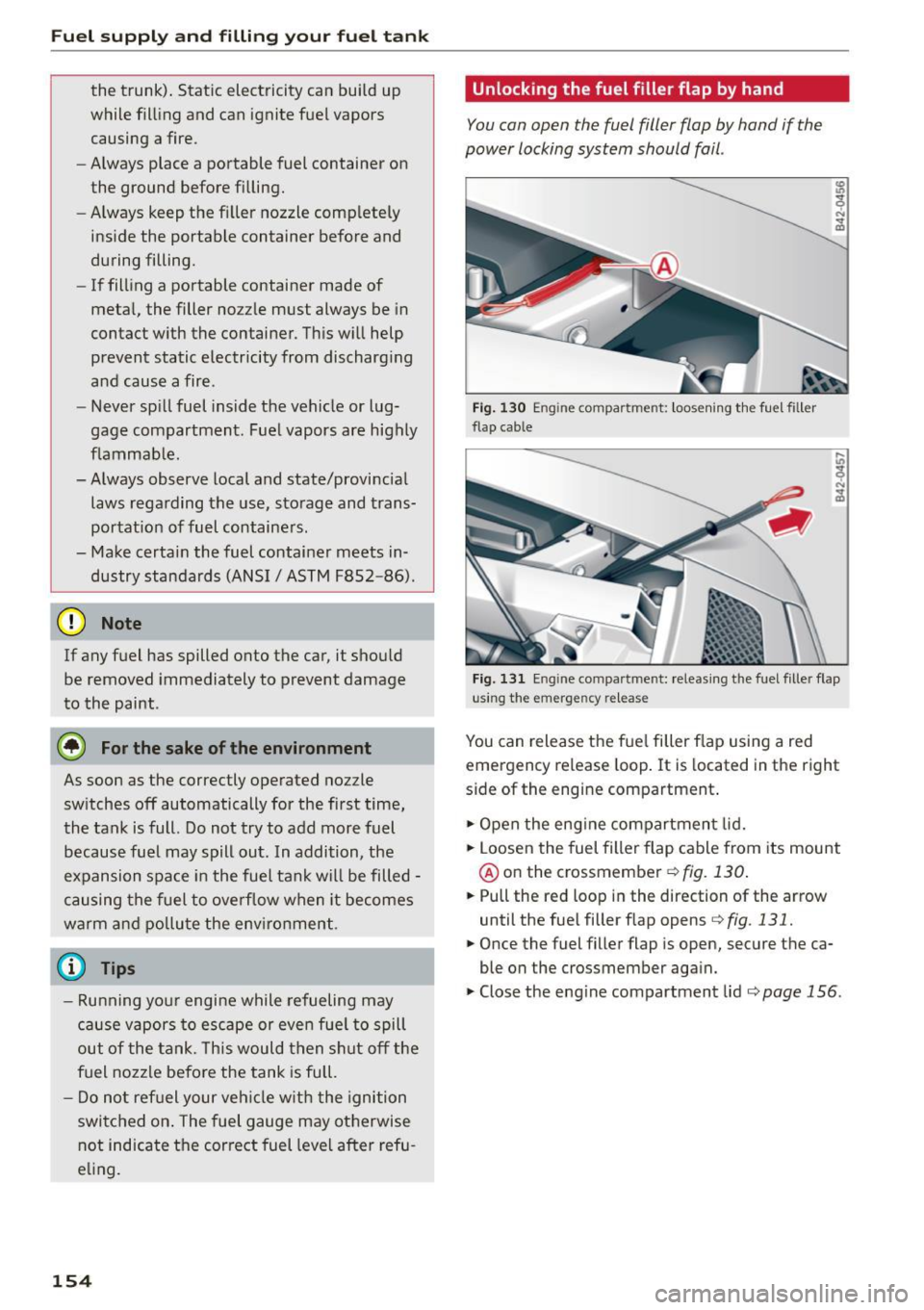
Fig. 130 Engine compartme nt: loosening the fuel filler
flap cable
Fig. 131 Eng ine compa rtment: releasing the fuel filler flap
using the emergency re lease
You can release the fue l filler f lap using a red
emergency release loop . It is located in the right
side of the engine compartment .
.,. Open the engine compartment lid.
.,. Loosen the fuel filler flap cable from its mount
@ on the crossmember
r::;, fig. 130 .
.,. Pull the red loop in the direction of the arrow
until the fue l filler flap opens
r::;, fig. 131.
.,. Once the fuel filler flap is open, secure the ca
ble on the crossmember again .
.,. Close the eng ine compartment lid
r::;, page 156.
Page 157 of 232
.... N
l'
N "1: .... I.O
"' N
"' ....
Checking and filling Engine compartment lid
Releasing the engine compartment lid
The engine compartment lid is released from in
side the vehicle.
~
-------- .J;
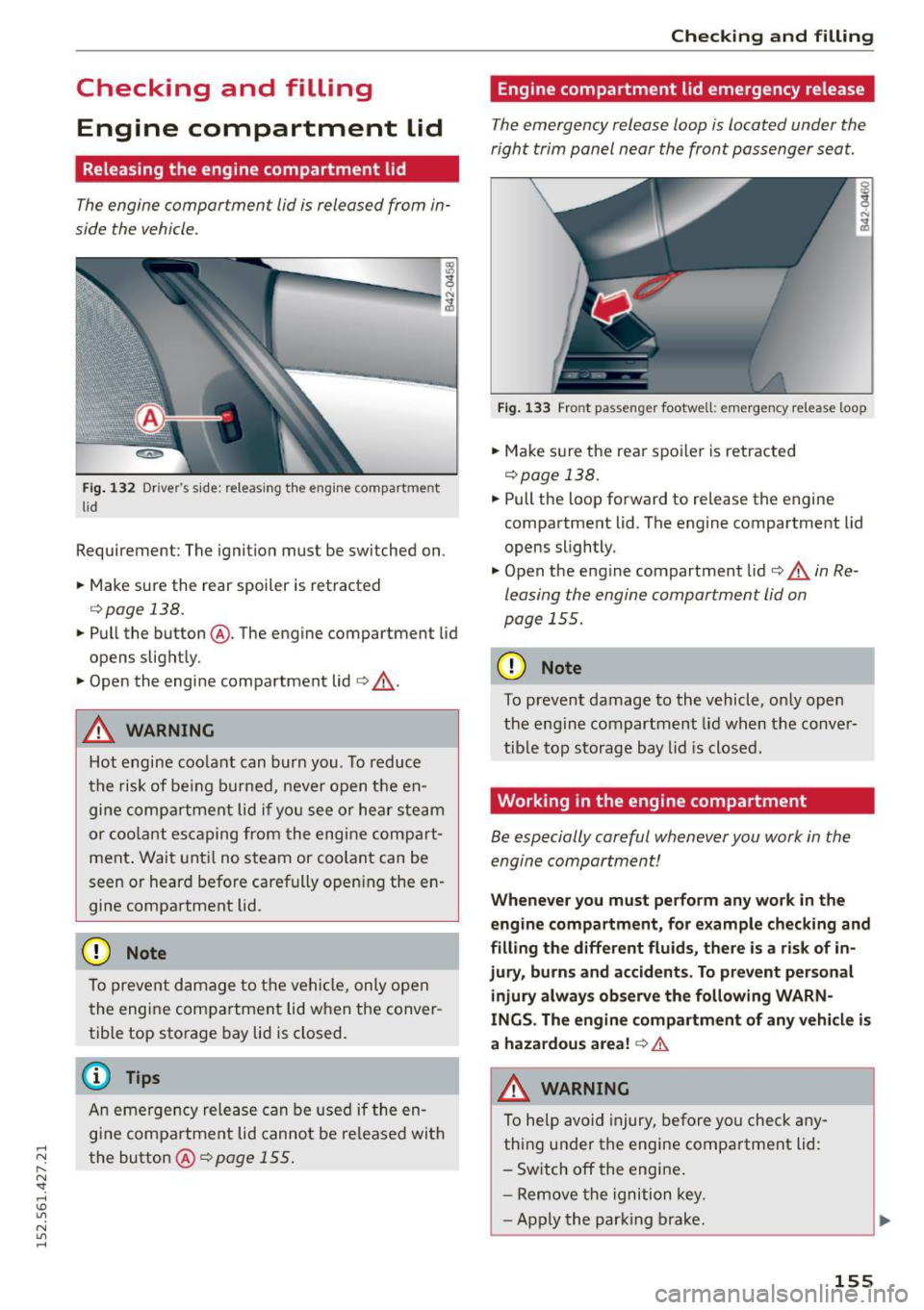
Fig. 132 Driver's side: releasing t he engine compartment
lid
Requirement: The ignition must be switched on .
" Make sure the rear spoiler is retracted
¢page 138.
"Pull the button @. The engine compartment lid
opens slight ly.
" Open the engi ne compartment lid¢_&, .
& WARNING
Hot engine coo lant can burn you. To reduce
t he risk of be ing burned, never open the en
gi ne comp artment lid i f yo u s ee or he ar s team
or cool an t es caping from the engine compart
ment . Wait unt il no steam or coo lant can be
seen or heard befo re carefully open ing the e n
gine compartment lid.
CD Note
To preve nt d amage to t he veh icle, only open
t he engine compartment lid when the conver
tible top storage bay lid is closed.
@ Tips
An emergency release can be use d if the en
gi ne compa rtment lid canno t be re leased with
the button @¢
page 155 .
-
Checking and filling
Engine compartment lid emergency release
The emergency release loop is located under the
right trim panel near the front passenger seat.
F ig . 1 33 Front passenger footwell: emerge ncy release loop
"Ma ke su re the rea r spoile r is retracted
¢page 138.
" Pull the loop forward to release the engine
compartment lid. The engine compartment lid
opens slightly.
" Open the engine compartment lid¢ &,
in Re
leasing the engine compartment lid on
page 155.
CD Note
To prevent damage to the vehicle, o nly open
the engine compartment lid when the conve r
tib le to p storage bay lid is closed.
Working in the engine compartment
Be especially careful whenever you work in the
engin e compartment!
Whenever you must perform any work in the
eng ine compartm ent, for example checking and
filling the differ ent fluid s, there is a ri sk of in
jury, burns and accident s. To prevent personal
injury alway s ob serve the following WARN
INGS . The engine compartment of any vehicle is
a hazardou s area !
c:> &.
,&. WARNING
To help avoid injury, be fore yo u check any
thing u nder the engine compartment lid:
- Sw itch off the engi ne .
- Remove the ignition key .
- Apply the par king brake.
-
155
Page 158 of 232
Checking and filling
-Move selector lever of S tronic to "N" (Neu
tral); put manual transmission in Neutral.
- Always let the engine cool down. Hot com
ponents will burn skin on contact .
- To reduce the risk of being burned, never
open the engine compartment lid if you see
or hear steam or coolant escaping from the
engine compartment. Wait until no steam
or coolant can be seen or heard before care
fully opening the engine compartment lid.
- Keep children away from the engine com
partment .
- Never spill fluids on hot engine compo
nents. They can cause a fire.
- Never open the coolant reservoir cap when
the engine is still warm . The coolant system
is pressurized and hot coolant could spray
out .
- Protect your face, hands and arm from
steam or hot engine coolant by placing a
thick rag over the cap when you open the coolant reservoir .
- Do not remove the engine cover under any
circumstances . This increases the risk of
burns.
- If work on the fuel system or the electrical
system is necessary :
- Always disconnect the battery.
- Never smoke or work near heaters or open
flames. Fluids in the engine compartment
could start a fire.
- Keep an approved fire extinguisher imme
diately available .
- To avoid electrical shock and personal injury
while the engine is running or being started,
never touch:
- Ignition cables
- Other components of the high voltage
electronic ignition system.
- If you must perform a check or repair with
the engine running:
- First, fully apply the parking brake, move
selector lever of S tronic to
"N" (Neutral);
put manual transmission in Neutral.
- Always use extreme caution to prevent
clothing, jewelry, or long hair from getting
caught in the radiator fan, V-belts or other
156
moving parts, or from contacting hot
parts. Tie back hair before starting, and
wear no clothing that will hang or droop into the engine.
- Minimize exposure to emission and chemi
cal hazards
¢ .&..
A WARNING
California Proposition 65 Warning:
- Engine exhaust, some of its constituents,
and certain vehicle components contain or
emit chemicals known to the State of Cali
fornia to cause cancer and birth defects and reproductive harm. In addition, certain flu
ids contained in vehicles and certain prod
ucts of component wear contain or emit
chemicals known to the State of California
to cause cancer and birth defects or other
reproductive harm.
- Battery posts, terminals and related acces
sories contain lead and lead compounds,
chemicals known to the State of California
to cause cancer and reproductive harms.
Wash hands after handling.
@ Note
When adding fluids, always make sure that
they are poured into the proper container or
filler opening, otherwise serious damage to
vehicle systems will occur.
@ For the sake of the environment
To detect leaks in time , inspect the vehicle
floor pan from underneath regularly. If you
see spots from oil or other vehicle fluids, have
your vehicle inspected by an authorized Audi
dealer .
· Closing the engine compartment lid
.. Make sure that the rear spoiler is retracted
¢page 138 .
.. Pull the engine compartment lid down until the
pressure from the struts is reduced.
.. Press the engine compartment lid closed
¢ _A . ..,
Page 159 of 232
.... N
l'
N "1: .... I.O
"' N
"' ....
_& WARNING
-When you close the engine compartment
lid, check it to make sure the safety catch
has properly engaged . The engine compart-
Engine compartment
Checking and filling
ment lid should be flush with the surround
ing vehicle body parts.
-If you notice while driving that the engine
compartment lid is not secured properly,
stop at once and close it.
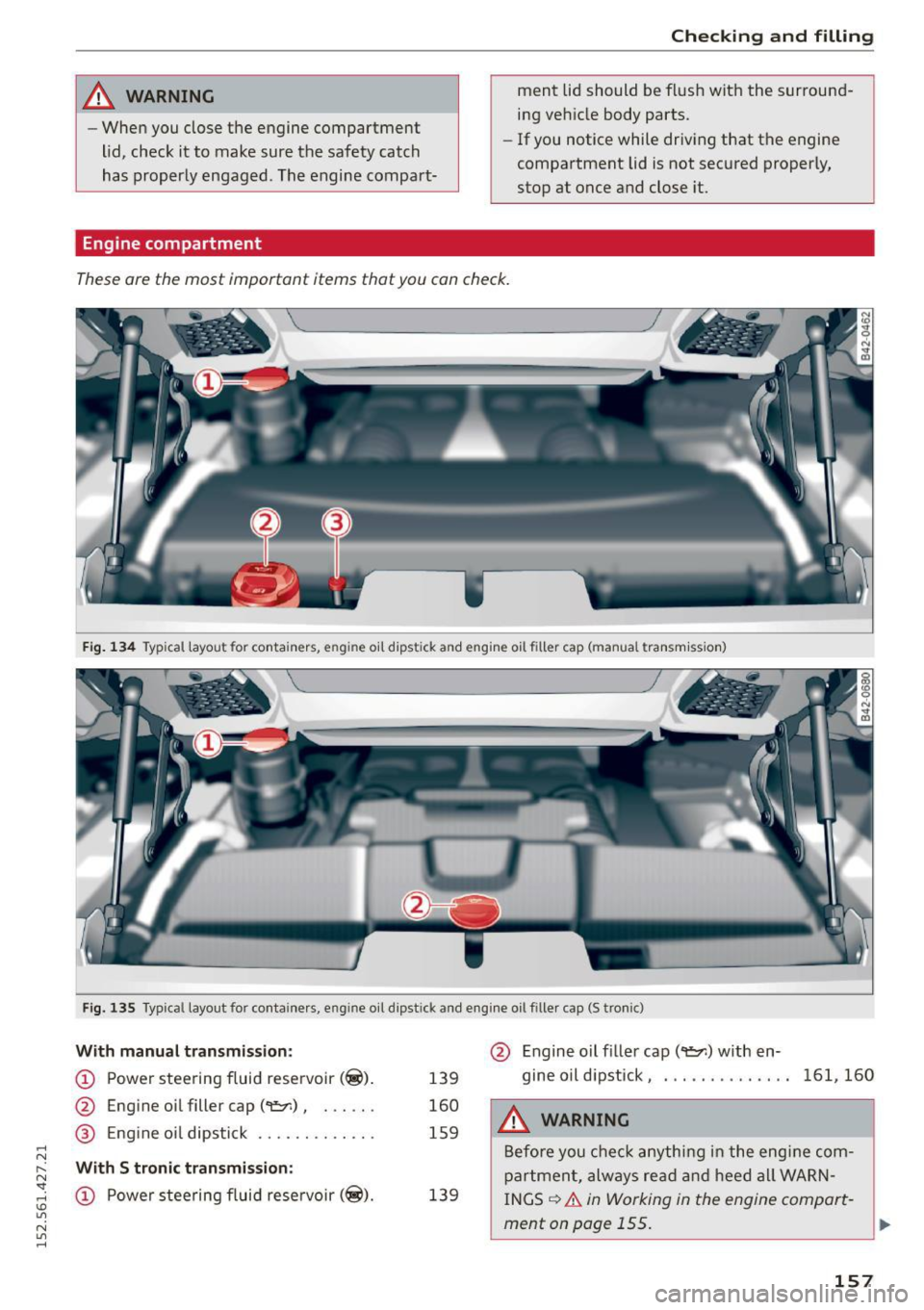
These ore the most important items that you con check.
Fig. 134 Typical l ayout for conta iners , engine oil dipst ick and engin e oil fille r cap (manual tran smis sion)
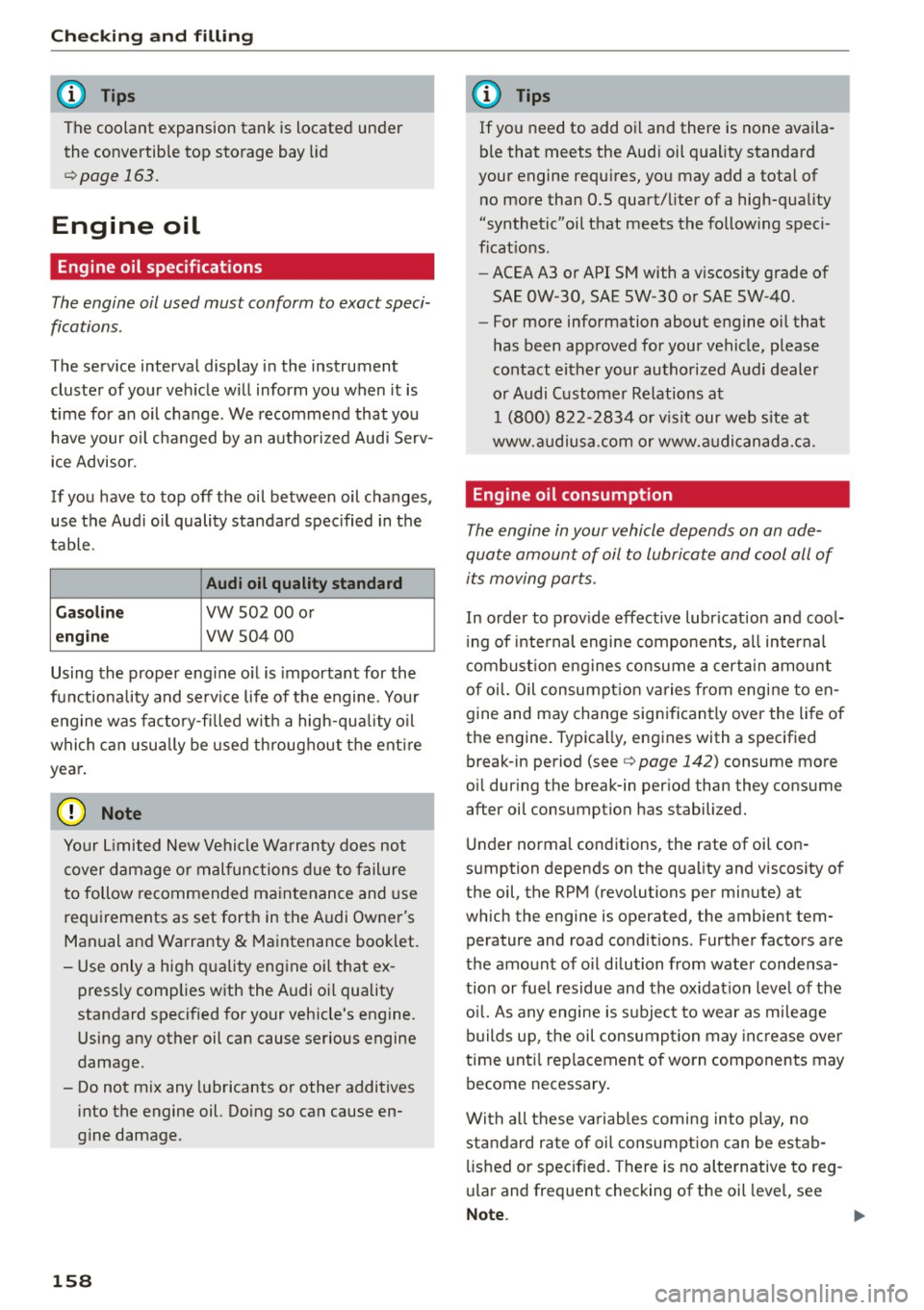
Fig. 135 Typica l layout for conta iners, engine o il dipst ick and e ng in e oil fille r cap (S tronic)
With manual transmission:
(!) Power steering fluid reservoir(@).
@ Engine oil filler cap ("1::r.) , ... .. .
@ Engin e oil dipstick ............ .
With S tronic transmission:
(!) Power steering fluid reservoir(@).
139
160
159
139
@ Engine oil filler cap ("1::r.) with en-
gine oil dipstick, ............ .. 161,160
_& WARNING
Before you check anything in the engine com
partment, always read and heed all WARN
INGS ~ .&. in Working in the engine compart-
ment on page 155. ..,.
157
Page 160 of 232
Checking and filling
(D Tips
The coolant expansion tank is located under the convertible top storage bay lid
¢page 163.
Engine oil
Engine oil specificat ions
The engine oil used must conform to exact speci
fications .
The service interval display in the instrument
cluster of your vehicle will inform you when it is
time for an oil change . We recommend that you
have your oil changed by an authorized Audi Serv
ice Advisor.
If you have to top off the oil between oil changes,
use the Audi oil quality standard specified in the
table.
Audi oil quality standard
Gasoline
VW 502 00 or
engine vw 504 00
Using the proper engine oil is important for the
functionality and service life of the engine. Your
engine was factory-filled with a high-quality oil
which can usually be used throughout the entire
year.
(D Note
Your Limited New Vehicle Warranty does not
cover damage or malfunctions due to failure
to follow recommended maintenance and use
requirements as set forth in the Audi Owner's
Manual and Warranty
& Maintenance booklet.
- Use only a high quality engine oil that ex-
pressly complies with the Audi oil quality
standard specified for your vehicle's engine .
Using any other oil can cause serious engine
damage.
- Do not mix any lubricants or other additives
into the engine oil. Doing so can cause en
gine damage.
158
(D Tips
If you need to add oil and there is none availa
ble that meets the Audi oil quality standard
your engine requires, you may add a total of
no more than 0.5 quart/liter of a high-quality
"synthetic"oil that meets the following speci
fications.
- ACEA A3 or API SM with a viscosity grade of
SAE OW-30, SAE 5W-30 or SAE 5W-40.
- For more information about engine oil that
has been approved for your vehicle, please
contact either your authorized Audi dealer
or Audi Customer Relations at
1 (800) 822-2834 or visit our web site at
www.audiusa.com or www.audicanada.ca.
Engine oil consumption
The engine in your vehicle depends on on ade
quate amount of oil to lubricate and cool all of
its moving ports.
In order to provide effective lubrication and cool
ing of internal engine components, all internal
combustion engines consume a certain amount
of oil. Oil consumption varies from engine to en
gine and may change significantly over the life of
the engine. Typically, engines with a specified break-in period (see
¢ page 142) consume more
oil during the break-in period than they consume
after oil consumption has stabili zed.
Under normal conditions , the rate of oil con
sumption depends on the quality and viscosity of
the oil, the RPM (revolutions per minute) at
which the engine is operated, the ambient tem perature and road conditions . Further factors are
the amount of oil dilution from water condensa
tion or fuel residue and the oxidation level of the
oil. As any engine is subject to wear as mileage
builds up, the oil consumption may increase over
time until replacement of worn components may
become necessary.
With all these variables coming into play, no
standard rate of oil consumption can be estab
lished or specified. There is no alternative to reg
ular and frequent checking of the oil level, see
Note.
Page 161 of 232
.... N
l'
N "1: .... I.O
"' N
"' ....
If the yellow engine oil level warning symbol in
the instrument cluster
Ell lights up, you should
check the oil leve l as soon as possible
¢ page 159. Top off the oil at your earliest con
venience
¢ page 160.
A WARNING
Before you check anything in the engine com
partment, always read and heed all WARN
INGS
¢&. in Working in the engine compart
ment on page 155.
(D Note
Dr iving with an insufficient oil level is like ly to
cause severe damage to the engine.
@ Tips
- The oil pressure warning display. is not
an indicator of the oil l evel. Do not rely on
it . Instead, check the oil l evel in your en
gine at regular interval s, pref erably each
time y ou refu el, and alway s before going
o n a long trip .
- If
you have the imp ression your e ngine co n
s u mes ex cess ive amo unts of o il, we re com
mend tha t you cons ult yo ur A udi dealer to
have the cause of your concern properly di
agnosed. Keep in mind that the accurate measurement of oil consumpt ion requires
great care and may take some time. Your
A udi dealer has instructions about how to
measure oil consumpt ion accurately.
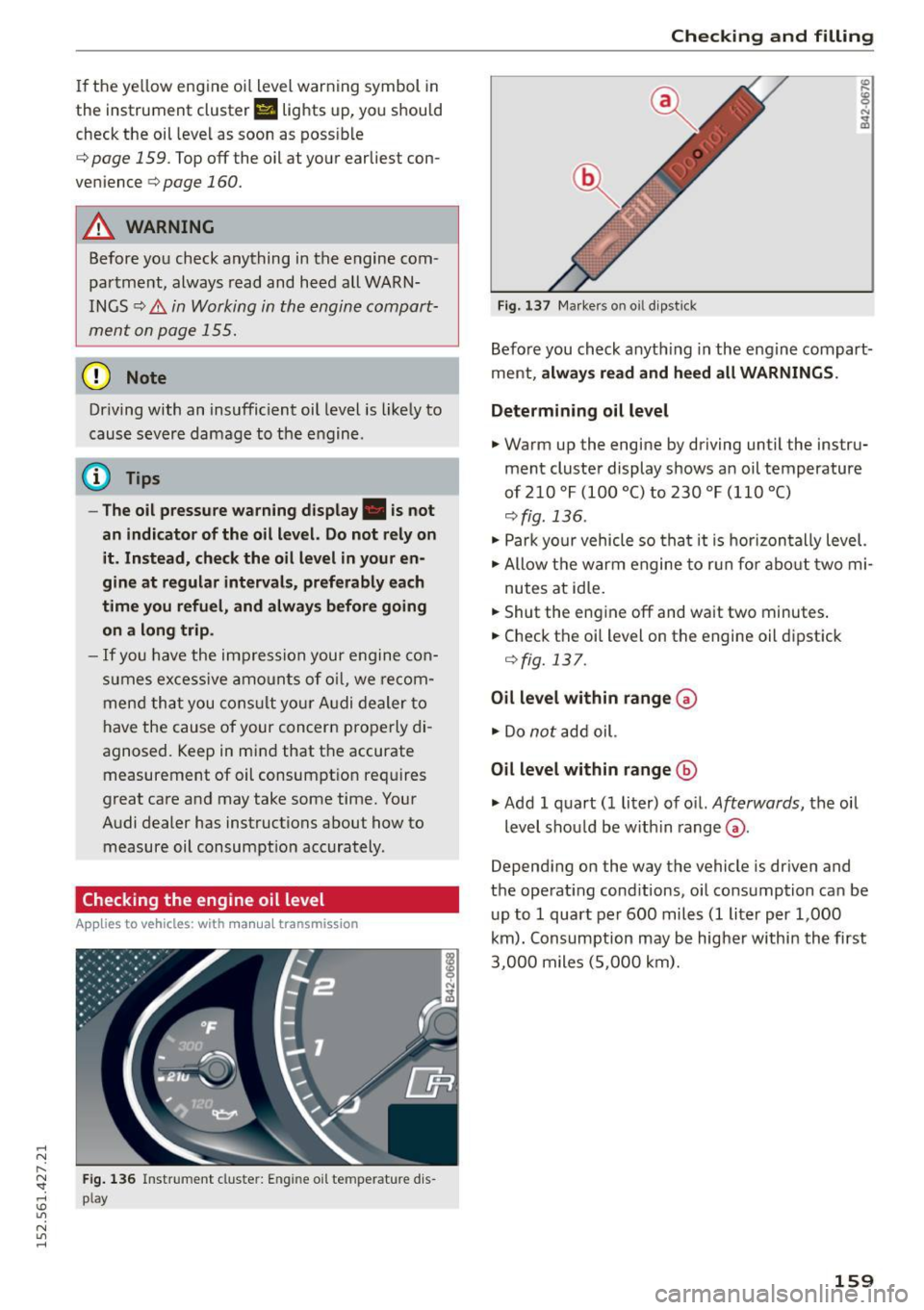
Checking the engine oil level
Ap plies to vehicles: with ma nual transmission
F ig . 1 36 Ins trument cluste r: Engine oil temperature dis
p lay
Chec king and filling
Fig. 137 Ma rke rs on oi l d ipst ick
Before you ch eck a nyth ing in the engine compart
ment,
alwa ys read and h eed all WARNINGS .
Determin ing
oil level
.,. Warm up the engine by driving until the instru
ment cluste r display shows an oil temperature
of 210 °F (100 °C) to 230 °F (110 °C)
¢ fig. 136 .
.,. Park your vehicle so tha t it is hor izon tally level.
.,. Allow t he warm engine to r un fo r abo ut two mi
nutes at idle.
.. Shut the engine off and wait two minutes .
.. Check the oil level on the engine oil dipst ick
¢fig. 137.
Oil level within range (v
.,. Do not add oil.
Oil level within range@
.,. Add 1 quart (1 liter) of o il. Afterwards, the oil
level shou ld be w ith in range
G) .
Depend ing on the way the vehicle is driven and
the operat ing cond itions, oil consumption ca n be
u p to 1 quart per 600 miles(! liter per 1,000
km). Consumption may be higher withi n th e first
3,0 00 miles (5,000 km) .
159
Page 162 of 232
Checking and filling
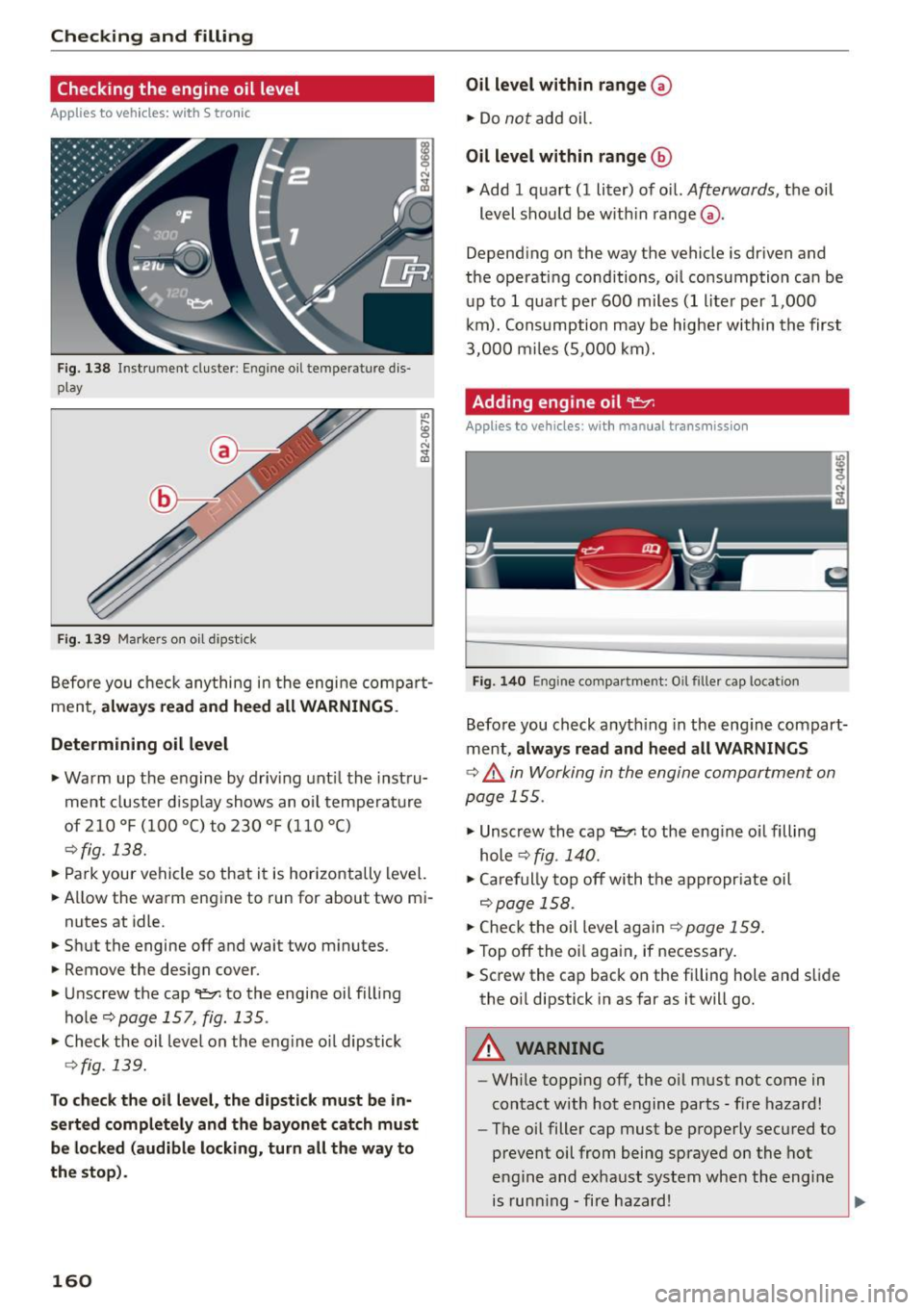
Checking the engine oil level
App lies to veh icles: w ith S tro nic
Fig. 138 Inst rumen t cl uste r: Eng ine oil temperature dis
play
Fig. 139 Markers on o il dipstic k
Before you check anything in the engine compart
ment,
always read and heed all WARNINGS .
Determining oil level
• Warm up the engine by driv ing until the inst ru
ment cluster display shows an o il temperature
of 210 ° F (100 °C) to 230 ° F (110 °C)
¢fig. 138.
"Park your vehicle so that it is horizonta lly level.
• Allow the warm engine to run for about two mi-
nutes at idle.
• Shut the engine off and wait two minutes.
• Remove the design cover.
" Unscrew the cap
'l:::,-: to the engine oil fil ling
hole¢
page 157, fig . 135 .
• Check the oil level on the engine oil dipstick
¢ fig . 139.
To check the oil level, the dipstick must be in
serted completely and the bayonet catch must
be locked (audible locking, turn all the way to
the stop).
160
Oil level within range (v
" Do not add oil.
Oil level within range@
• Add 1 quart (1 liter) of o il. A~erwards, the oil
level should be w ithin range
(v .
Depending on the way the vehicle is driven and
the operating cond itions, oil consumption can be
up to 1 quart per 600 miles (1 liter per 1,000
km). Consumption may be higher within the first
3,000 miles (5,000 km).
Adding engine oil~
Applies to vehicles: wi th manual t rans miss ion
Fig . 140 Engine compartment: Oil fille r cap location
Befo re you check anyth ing in the eng ine compart
ment,
always read and heed all WARNINGS
¢ .&. in Working in the engine compartment on
page 155.
"Unscrew the cap ce:;,, to the eng ine oi l filling
hole ¢
fig. 140 .
"Carefully top off with the appropriate oil
<=)page 158.
"Check the oil level again ¢ page 159 .
"Top off the oil again, if necessary.
" Screw the cap back on the filling hole and slide
the oi l dipstick in as far as it will go.
A WARNING
- Wh ile topping off, the o il must not come in
contact with hot engine parts - f ire hazard!
- The oil filler cap must be properly secured to
prevent oil from being sprayed on the hot
engine and exhaust system when the engine
is runn ing - fire hazard! .,._
Page 163 of 232
-If your skin has come in contact with the en
gine oil, you must subsequently cleanse it
thoroughly.
0 Note
- The oil level must not be above range
¢ page 159, fig. 137 0-danger of convert
er or engine damage! Contact an authorized
Audi dealer to draw off oil, if necessary.
- Audi does not recommend the use of oil ad
ditives. They may damage the engine and
adversely affect your New Vehicle Warranty.
@ For the sake of the environment
- Under no circumstances can the oil come in
contact with the sewage network or the soil.
- Observe and follow legal regu lations when
disposing of empty oil containers.
Adding engine oil~
Applies to vehicles: with S tron ic
0 N
-N
~
"' a,
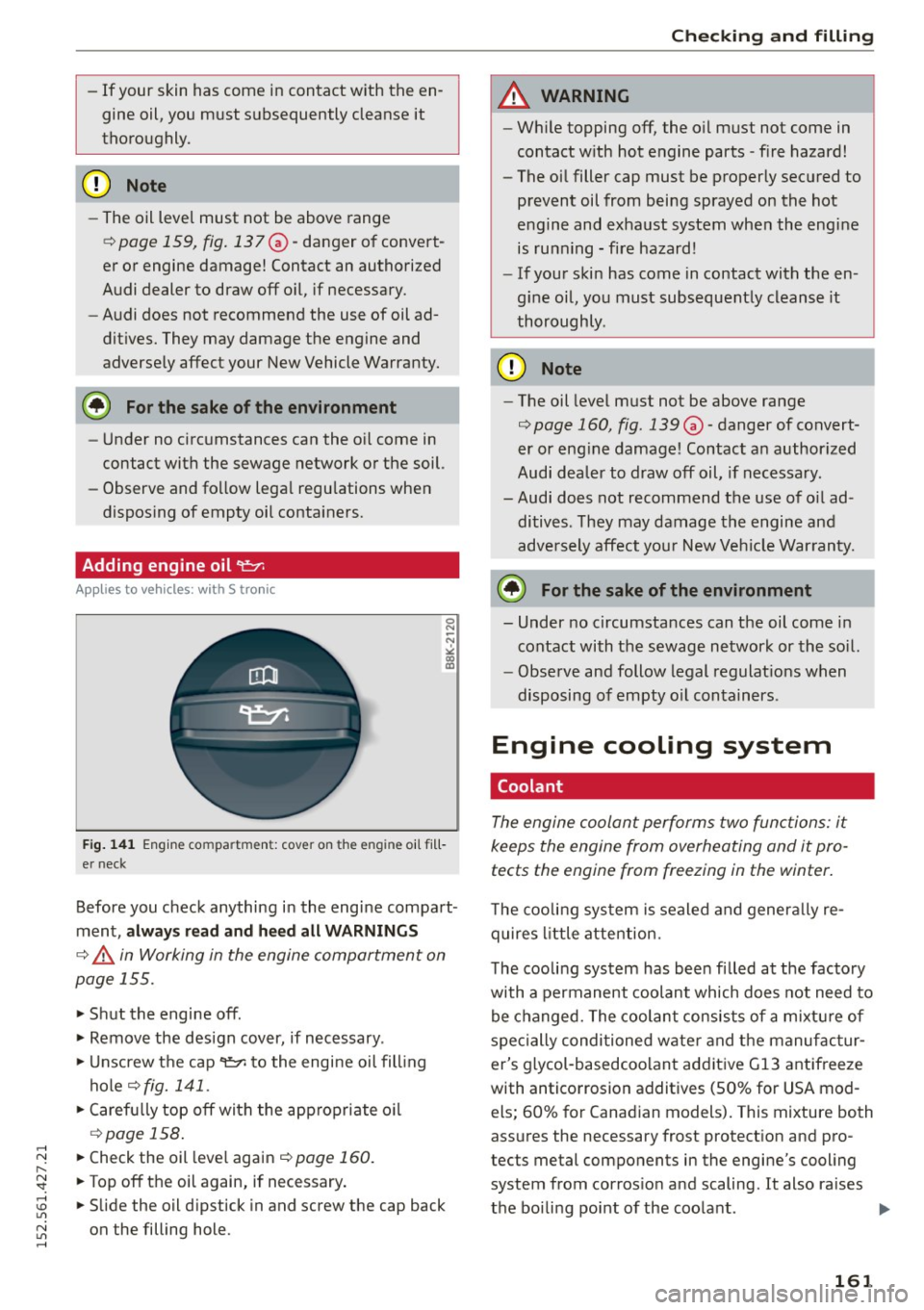
F ig . 141 Engin e co mp artm en t: cove r on t he engin e oil fi ll
er neck
Before you check anything in the engine compart
ment,
always read and heed all WARNINGS
¢.&. in Working in the engine compartment on
page 155.
.,. Shut the engine off .
.. Remove the design cover, if necessary .
.,. Unscrew the cap
'l=?1 to the engine oil fill ing
hole ¢
fig. 141 .
.. Carefully top off with the appropriate o il
¢page 158.
.. Check the oil level again ¢ page 160.
.. Top off the oil again, if necessary .
.. Slide the oil dipstick in and screw the cap back
on the filling hole.
Chec king and filling
A WARNING
- While topping off, the oil must not come in
contact with hot engine parts -fire hazard!
- The oil filler cap must be properly secured to
prevent oil from being sprayed on the hot
engine and exhaust system when the engine
is running -fire hazard!
- If your skin has come in contact with the en
g ine oil, you must subsequently cleanse it
thoroughly .
(D Note
-The oil level must not be above range
¢ page 160, fig . 139 0 -danger of convert
er or eng ine damage! Contact an author ized
Audi dea ler to draw off oil, if necessary.
- Audi does not recommend the use of oil ad
ditives . They may damage the engine and
adversely affect you r New Vehicle Warranty.
@ For the sake of the environment
- Under no circumstances can the oil come in
contact with the sewage network or the soil.
- Observe and follow legal regulations when
disposing of empty o il containers .
Engine cooling system
Coolant
The engine coolant performs two functions: it
keeps the engine from overheating and it pro
tects the engine from freezing in the winter.
T he coo ling system is sealed and genera lly re
quires little attention.
The cooling system has been filled at the factory
with a permanent coolant which does not need to
be changed. The coolant consists of a mixtu re of
specially conditioned wate r and the manufactur
er's glycol-basedcoolant additive Gl3 antifreeze
with anticorrosion additives (50% for USA mod els; 60% for Canadian models). This mixture both
assures the necessary frost protection and pro
tects metal components in the engine's cooling
system from corrosio n and scaling. It also ra ises
the boiling point of the coolant .
1111-
161
Page 164 of 232
Checking and filling
Do not reduce the concentration of the coo lant in
the summer by adding p lain water.
The propor·
tion of coolant additive must be at least 50%
but not more than 60%
to maintain antifreeze
protection and cooling efficiency .
If the coolant
frost protection is too low, the coolant could
freeze and damage the ve hicle heating and en
g ine cooling system .
For year-round driving, antifreeze is added at the
factory for temperatures down to:
- - 31 ° F ( -3 5 °C) USA
- - 40 °F ( - 40 °C) Canada .
If you must add coolant, use a mixture of water
and coolant additive. Mixing the coolant additive
with distilled water is recommended .
& WARNING
Before you check anything in the engine com
partment, always read and heed all WARN
INGS
<=> .&. in Working in the engine compart
ment on page 155.
(D Note
- Before winter sets in, have the coolant
checked to see if the coolant additive in your
vehicle is sufficient to meet the climate con
dit ions . This is especially important if you
live in a region where the winter is extreme
l y cold. If necessary, increase the proportion
of coolant add itive to 60%.
- When adding coolant addit ive to your cool
in g system, remember:
- We recommend using only coolant addi
tive G12++ or G13 for your vehicle. This
coolant additive is available at authorized
Audi dealers. Other types of antifreeze can
signif icant ly reduce corrosion protection.
The resulting corrosion can cause a loss of
coolant and serious engine damage.
- Do not add any type of radiator leak sealant
to your vehicle's engine coolant. Add ing ra
diator repair fluid may adversely affect the
funct ion and pe rformance of your cooling
system and could result in damage not cov
ered by you r New Vehicle Lim ited Warranty.
162
Checking the engine coolant level
Proceed carefully when checking the coolant .
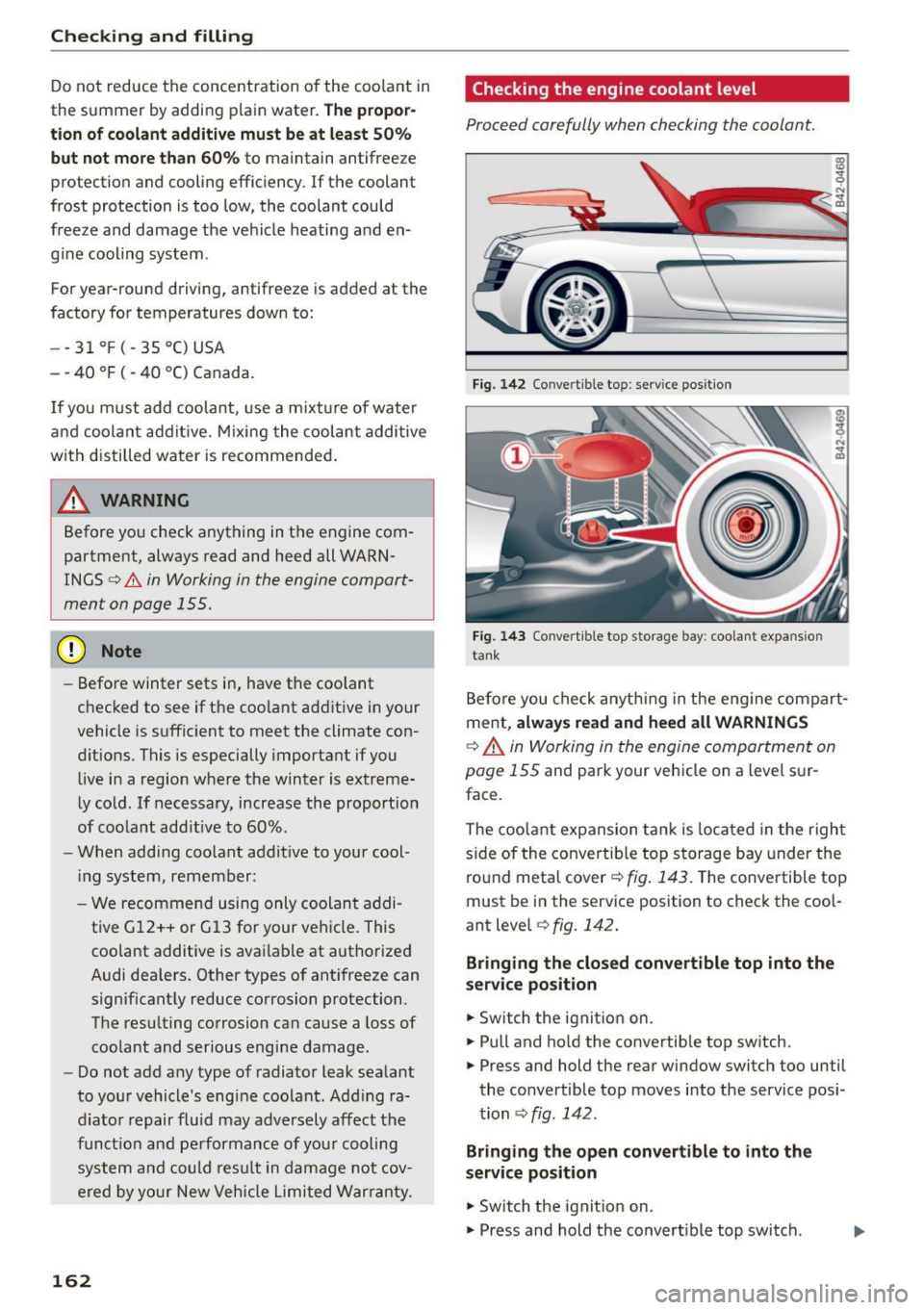
Fig. 142 Conve rtible top : serv ice pos it ion
Fig. 143 Co nve rtible top storage bay : coolant expa nsion
tank
Before you check anything in the eng ine compart
ment,
always read and heed all WARNINGS
c:> .&. in Working in the engine compartment on
page 155
and park your vehicle on a leve l su r
face.
The coolant expansion tank is loca ted in the right
s ide of the convertib le top storage bay under the
round metal cover
cf;, fig. 143. The convertible top
must be in the service position to check the cool
ant level
i=;, fig . 142.
Bringing the closed convertible top into the
service position
.,. Switch the ignition on.
.,. Pull and ho ld the convertib le top switch.
.,. Press and hold the rear window switch too until
the convertible top moves into the service posi
tion <=>
fig. 142.
Bringing the open convertible to into the
service position
.,. Switch the ignition on .
.,. Press and hold the convert ible top switch .