engine AUDI R8 SPYDER 2015 Owner's Manual
[x] Cancel search | Manufacturer: AUDI, Model Year: 2015, Model line: R8 SPYDER, Model: AUDI R8 SPYDER 2015Pages: 232, PDF Size: 58.36 MB
Page 44 of 232
Convertible top
@ Tips
Have a second person assist when closing the
convert ible top . Opening the storage bay lid
and positioning the convertible top is easier
when a second perso n is assist ing.
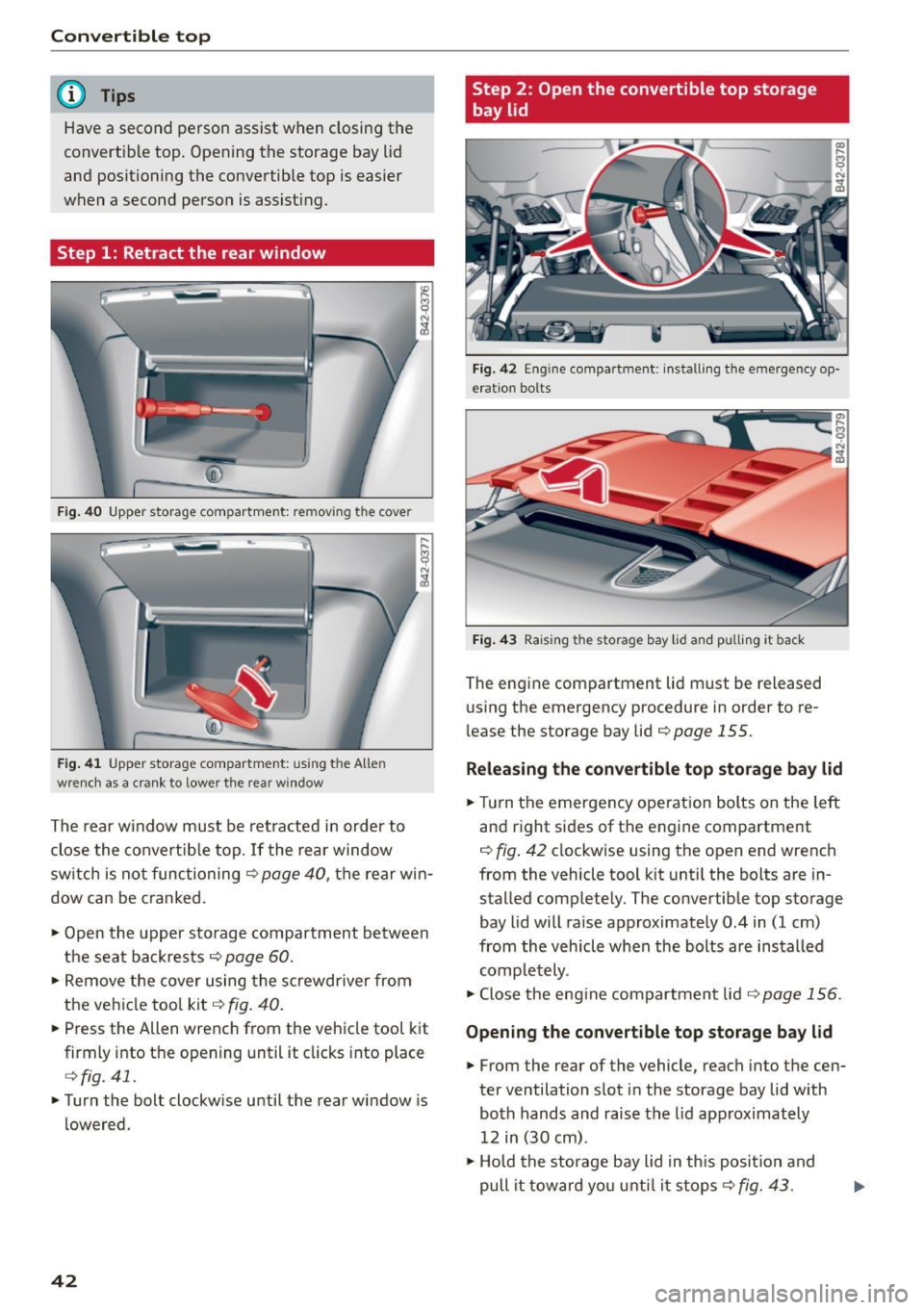
Step 1: Retract the rear window
F ig . 40 Upper sto rage compar tmen t: re movin g the cover
Fig . 4 1 Upper sto rage compartment : using t he Alle n
wr ench as a cra nk to lowe r the rea r w indow
The rear w indow must be retracted in order to
close the convertible top .
If the rear window
sw itch is not func tioning
¢ page 40, the rear w in
dow can be cranked.
" Open the upper storage compartment between
the seat back res ts ¢
page 60.
" Remove the cover using the screwdriver from
the vehicle too l kit ¢
fig. 40.
"Press the Allen wrench from the vehicle tool kit
firmly into the opening until it clicks into place
¢ fig . 41.
"Turn the bolt clockw ise until the rear window is
lowered.
42
Step 2: Open the convertible top storage
bay lid
F ig . 4 2 Eng ine compa rtm ent: in st. ail ing t he e merge ncy op ·
era tion bo lt s
F ig . 4 3 Rais in g t he sto rag e bay lid an d pulling it ba ck
The engin e compartment lid must be released
using the emergency p rocedu re in order to re
lease the storage bay lid
¢page 155 .
Relea sing the convertibl e top storage bay lid
"T urn the emergency operation bolts on the left
and r ight sides of the engine compartment
¢ fig. 42 clockwise using the open end wrench
from the vehicle tool kit unti l the bolts are in
stalled comp lete ly. The convertible top storage
bay lid will ra ise approximately 0 .4 in (1 cm)
from the vehicle when the bolts are installed
comp letely .
" Close the eng ine compartment lid ¢
page 156.
Opening the con vertible top storage b ay lid
" From the rear of the vehicle, reach into the cen
ter ventilation slot in the storage bay lid with
both hands and raise the lid app roximately
12 in (30 cm) .
" Ho ld the storage bay lid in th is position and
pull it toward you unti l it stops
¢ fig. 43.
Page 45 of 232
.... N
l'
N "1: .... I.O
"' N
"' ....
_& WARNING
When working in the engine compartment:
- Turn the engine off .
- Activate the parking brake.
- In vehicles with a manual transmission,
move the shifter lever into idle. In vehicles
with the R tronic transmission, move these
lector lever into the N position.
- Remove the ignition key.
- Let the engine cool down.
- Keep children away from the engine com-
partment .
0 Note
To prevent damage to the vehicle, only open
the convertible top storage bay lid when the
engine compartment lid is closed.
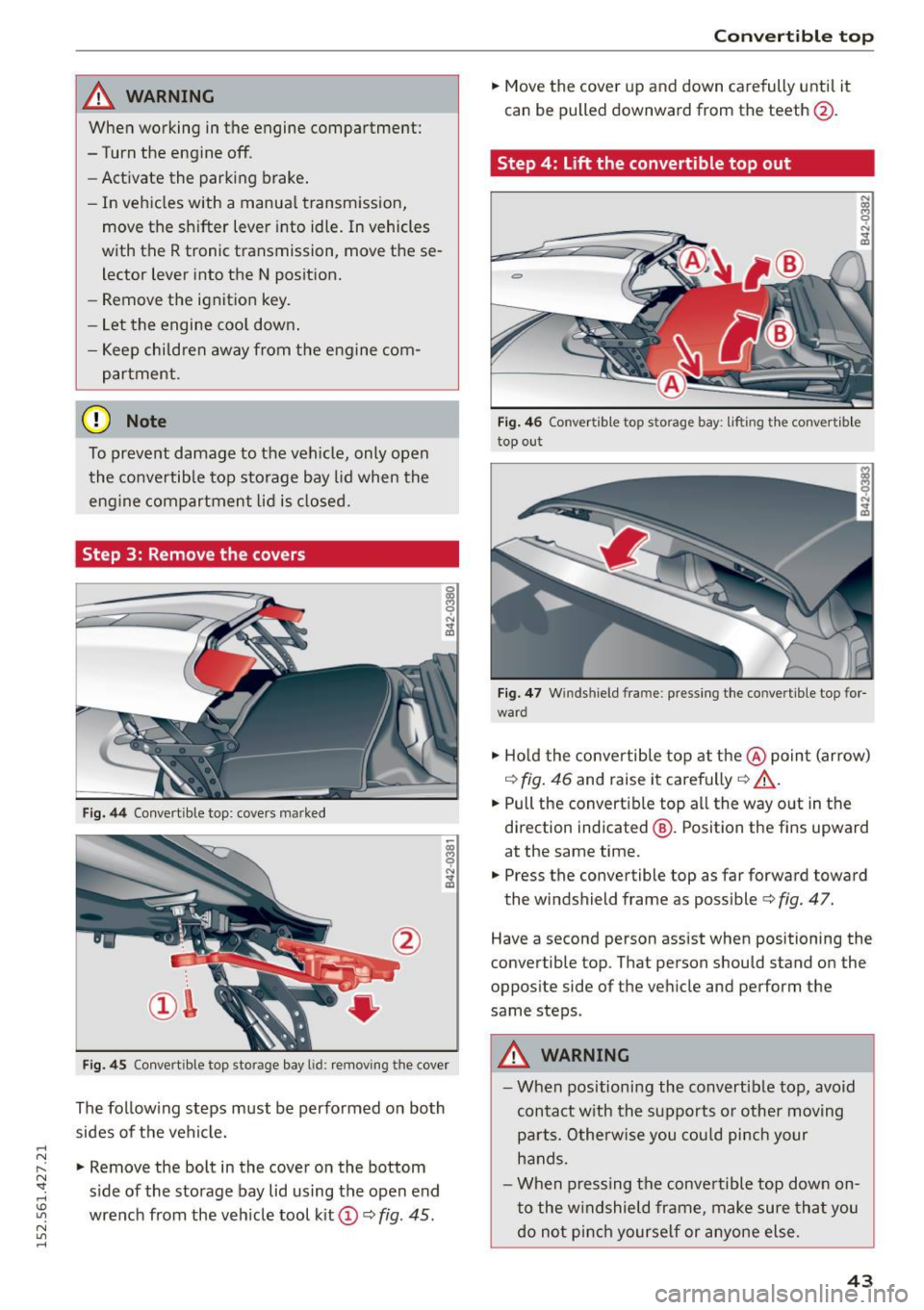
Step 3: Remove the covers
Fig. 44 Convertible top: covers marked
. '
®Ir
! N .., a,
Fig. 45 Convertible top sto rage bay l id : removing the cover
The following steps must be performed on both
sides of the vehicle.
.,. Remove the bolt in the cover on the bottom
side of the storage bay lid using the open end
wrench from the vehicle tool kit@ c::>
fig. 45 .
Convertible top
.,. Move the cover up and down carefully until it
can be pulled downward from the teeth @.
Step 4: Lift the convertible top out
Fig. 46 Convertible top s torage bay: lifting the conver tible
top out
Fig. 47 W inds hield fra me: pressing the co nve rtible top for
ward
.,. Hold the convertible top at the @ point (arrow)
c::>
fig. 46 and raise it carefully c::> &, .
.,. Pull the convertible top all the way out in the
direction indicated @. Position the fins upward
at the same time .
.,. Press the convertible top as far forward toward
the windshield frame as possible c::>
fig. 47.
Have a second person assist when positioning the
convertible top. That person should stand on the
opposite side of the vehicle and perform the
same steps.
_& WARNING
-- When positioning the convertible top, avoid
contact with the supports or other moving
parts. Otherwise you could pinch your
hands.
- When pressing the convertible top down on
to the windshield frame, make sure that you
do not pinch yourself or anyone else.
43
Page 54 of 232
Clear vision
in the interval wipe position and then come back
a while later and drive off, the rain sensor will re
activate itself after the vehicle speed has exceed
ed 4 mph (6 km/h).
The rain sensor* is only activated with the wiper
lever set to position(!). When it starts to rain,
the rain sensor will automatically activate the in
termittent wiping mode.
To reduce the sensitivity of the sensor, move
switch @ down. To increase the sensitivity, move
the switch up. The higher you adjust the sensitivi
ty, the faster the sensor will react when it senses moisture on the windshield. The pauses between
wiper turns depend not only on the sensitivity setting, but on the vehicle speed as well.
During brief stops, e.g . at a red light, wiper mo
tion will automatically be reduced to the next
lower speed . Wipers already turning at low speed
change to intermittent wiping.
When the ignition is turned on, the washer jets
are heated.
A WARNING
- Wiper blades are crucial for safe driving! On
ly when they are in good condition are they
able to clear the windows properly to pro
vide uncompromising visibility. Worn or
damaged wiper blades are a safety hazard
¢ page 53, Replacing windshield wiper
blades!
- The light/rain sensor* is only designed to as
sist and support the driver. It remains en
tirely the driver's responsibility to monitor outside weather conditions and to manually
activate the wipers as soon as rain or drizzle
reduces visibility through the windshield .
- The windshield must not be treated with
water-repellent materials. They can increase
glare under poor visibility conditions such as
wetness, darkness, or when the sun is low
on the horizon . In addition, they can cause
the windshield wipers to chatter.
(D Note
In freezing or near freezing conditions:
52
- Always check that the wiper blades are not
frozen to the glass before you turn the wip
ers on. Loosen a wiper blade which is frozen
in place before operating the wipers to pre
vent damage to the wiper blade or the wiper
motor .
- Do not use the wipers to clear a frosted win
dow. Using the wipers as a convenient ice
scraper will destroy the wiper blades .
- Before you take your vehicle to an automatic
car wash, make sure you have the wind
shield wiper system switched off (lever in position
0), otherwise the windshield wiper
system could get damaged in the car wash if
it should suddenly come on.
(D Tips
- The windshield wipers are switched off
when the ignition is turned off. Activate the
windshield wipers after the ignition is
switched back on by moving the windshield
wiper lever to any position.
- Worn or dirty windshield wiper blades cause
smearing, which can affect the operation of
the light/rain sensor*. Check the condition
of your windshield wiper blades regularly.
- The rain sensor is part of the interval wiping
system. Turning off the ignition will also de
activate the rain sensor . To reactivate the
sensor, switch off the interval wiping func
tion, then switch it back on again.
- Applies to vehicles with light/rain sensor:
When the wipers are switched on manually
and in rain conditions, the automatic head
lights* turn on <=>
page 46, Lights or off dur
ing the day when the wipers are no longer
operating. The automatic headlights* func
tion is available in this case only when the
light switch is in the "AUTO" position
<=>
page 46, fig. 55.
- Make sure the washer fluid reservoir in the
engine compartment is topped off before
going on a long trip. Look up<=>
page 168
for checking and filling the washer contain
er.
- The wipers only operate with the hood com
pletely closed.
Page 63 of 232
.... N
l'
N "1: rl I.O
"' N
"' ....
Warm and cold Climate controls
Controls
Warm and cold
The climate controls automatically maintain the selected temperature in the vehicle interior through
out each season .
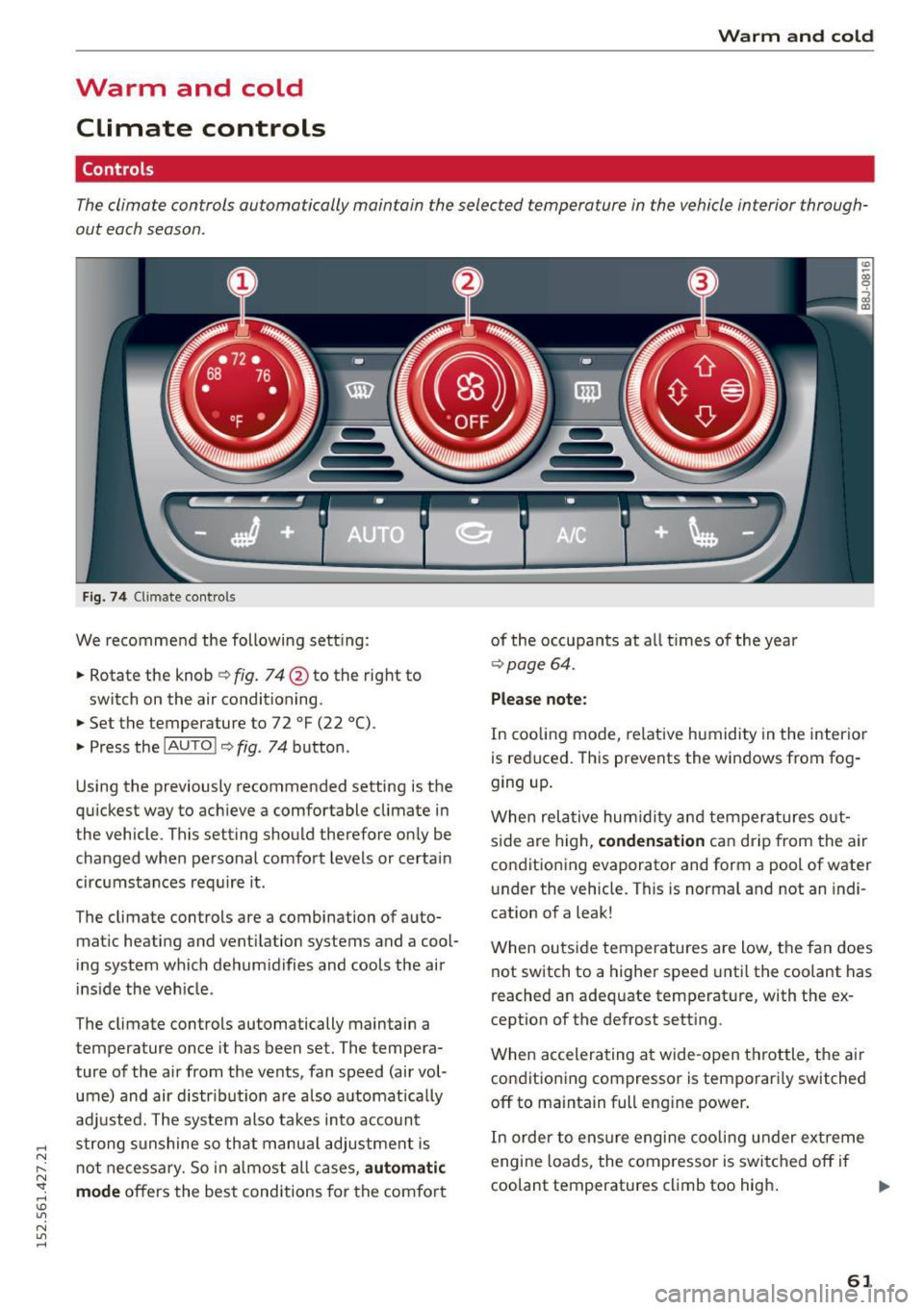
Fig . 74 Cl imate co ntrols
We recommend the following sett ing :
.. Rotate the knob
Q fig. 74 @ to the right to
switch on the air conditioning .
.,. Set the temperature to 72
°F (22 °() .
.. Press the !AU TO ! Q fig . 74 button .
Using the previously recommended setting is the
qu ickest way to ach ieve a comfortable climate in
the vehicle . This setting should therefore on ly be
changed when personal comfort levels or certain
circumstances req uire it .
The climate controls are a combination of a uto
mat ic heating and vent ilation systems and a cool
ing system which dehum idifies and cools the air
ins ide the veh icle .
The climate controls automatically maintain a
temperature once it has been set. The tempera ture of the air from the ve nts, fan speed (air vol
ume) and air d istr ibut ion are also a utomat ically
adj usted. The system also takes into account
strong sunshine so that manua l adjustment is
n o t necessary. So in almost all ca ses,
automatic
mode
offers the best conditions for the comfo rt of the occupants at a
ll times of the year
Q page 64 .
Please note :
In cooling mode , relative humidity in the interior
is reduced. This prevents the windows from fog
ging up .
When relative hum idity a nd temperatures o ut
s ide are high,
condensation can drip from the air
condit ioning evaporator and form a pool of water
under the vehicle . This is normal and not an indi
cation of a leak!
When outs ide temperatures are low, the fan does
not switch to a higher speed unti l the coolant has
reached an adequate temperat ure, with the ex
cept ion of the defrost setting .
When accelerating a t wide-open throttle, the ai r
condit ioning compressor is temporari ly switched
off to ma intain full eng ine power .
In order to ensure engine coo ling under ext reme
engine loads, the compressor is switched off if
coolant temperatures climb too high .
IJl>
61
Page 66 of 232
Warm and cold
Rear window defogger
The r ear window d efogger clears th e re ar win
dow of cond ensation .
.,. Press the~ button c:;, page 61, fig . 74 to turn
the rear window defogger on and off.
The rear w indow defogger works only when the
engine is running. The indicator light in the but
ton illuminates when the rear window defogger
is turned on .
The window between the cockpit and engine
compartment is also cleared with the rear w in
dow.
The rear window defogger is switched off auto
mat ica lly after approx. 10 minutes.
@ For the sake of the environment
As soon as the rea r window is clear, yo u
should switch the rear window defogger off .
The reduced power consumpt ion has a benef i
cial effect on f uel consumption.
Heated seats
A pp lies to veh icles: w ith heated seats
The seat cushion and the seatback of the front
seats can be heated electrically.
.,. Press the heated sea ts b utton I-J + I c:;, page 61,
fig . 74
to set the level of heat ing des ired.
T he range o f control s goes from 1 to 3. The he at
set ting selected is shown by LEDs above the but
ton.
_& WARNING
Individua ls with reduced sensitivity to pain o r
tempe rat ure could develop burns when us ing
the seat heating function. To reduce the risk
o f i njury, these ind iv iduals s hould n ot use seat
heating.
@ Note
To avo id damage to the heating elements in
the seats, do not kneel on the seats o r place
heavy loads on a small a rea of the seat.
64
Automatic operation ~
Standard operating mode at all times of the
year .
Turning on automat ic oper ation
.,. Set the temperat ure you want .
.,. Press the
IAUTO I button c:;, page 61, fig. 74.
Automat ic operation ensures constant tempera
tures in the interior and dehumidifies the air in
s ide the veh icle. Air temperature, vo lume, and
distribution are controlled automatically to reach
or maintain the desired interio r temperature as
quic kly as possible. Fluc tuat io ns in exterio r tem
perature and the effects of temperature from the
pos it ion of t he sun are compe nsated for auto
matically.
Manual air recirculation mode~
The recirculation mode prevents polluted outside
air from entering the vehicle in te rior.
Switching on air recirculation
.,. Press the button~ c:;, page 61, fig. 74, c:;, _&.
Switching off air recirculation
.,. Press the button ~ again, or
.,. Press the
IAUTO I button, or
.,. Press the~ button .
I n recircu lation mode, air is drawn from the ve hi
cle inter io r, fil tered, an d recirc ulated . We recom
mend that you select recirculation mode
briefly
c:;, .&. under the following conditions:
When driving thro ugh a tunne l or in a traffic jam
so that exhaust f umes and odo rs ca nnot enter
the ve hicle interio r.
A WARNING
You sho uld not use the recirculation mode for
a n extended period si nce no fresh air is drawn
i n , and with th e air conditioning sw itched off
the w indows c an fo g up - th is increases the
risk of an ac cident!
Page 67 of 232
..... N
r-N "': ..... \!) 1.1"1
N 1.1"1 .....
A/C operation ~
Switching on A /C
~ Press the !AIC ! button~ page 61, fig . 74.
Switching A /C off
~ Press the !AIC ! button again.
The cooling system is switched on during A/Cop
eration - the heating and venti lation system is
contro lled automatically.
(D Tips
If the LED in the switch stays on after A/Cop
eration has been switched off(= switching the
A/C off), there is a fault in an air conditioning
component. Please consult an author ized
Aud i dea ler when there is an operating prob
lem.
Using the climate controls economically
Economical use of the climate controls helps to
save fuel.
When climate control is working in coo ling mode,
engine performance is red uced and fuel con
sumpt ion is affected. To keep the time the air
conditioning is on as short as possible, you
should do the following:
~ If you would like to save f uel, switch the air
condit ion ing
off.
~ If you open the w indows wh ile driving, switch
the a ir cond it ion ing
off .
~ If the vehicle is ext remely hot due to the heat
of the sun, briefly open doors and w indows.
@ For the sake of the environment
When you save fuel, you reduce em iss ions
from the vehicle .
Warm and cold
65
Page 68 of 232
On the road
On the road
Steering
Adjusting the steering wheel column
The steering wheel position can be continuously
adjusted in height and distance .
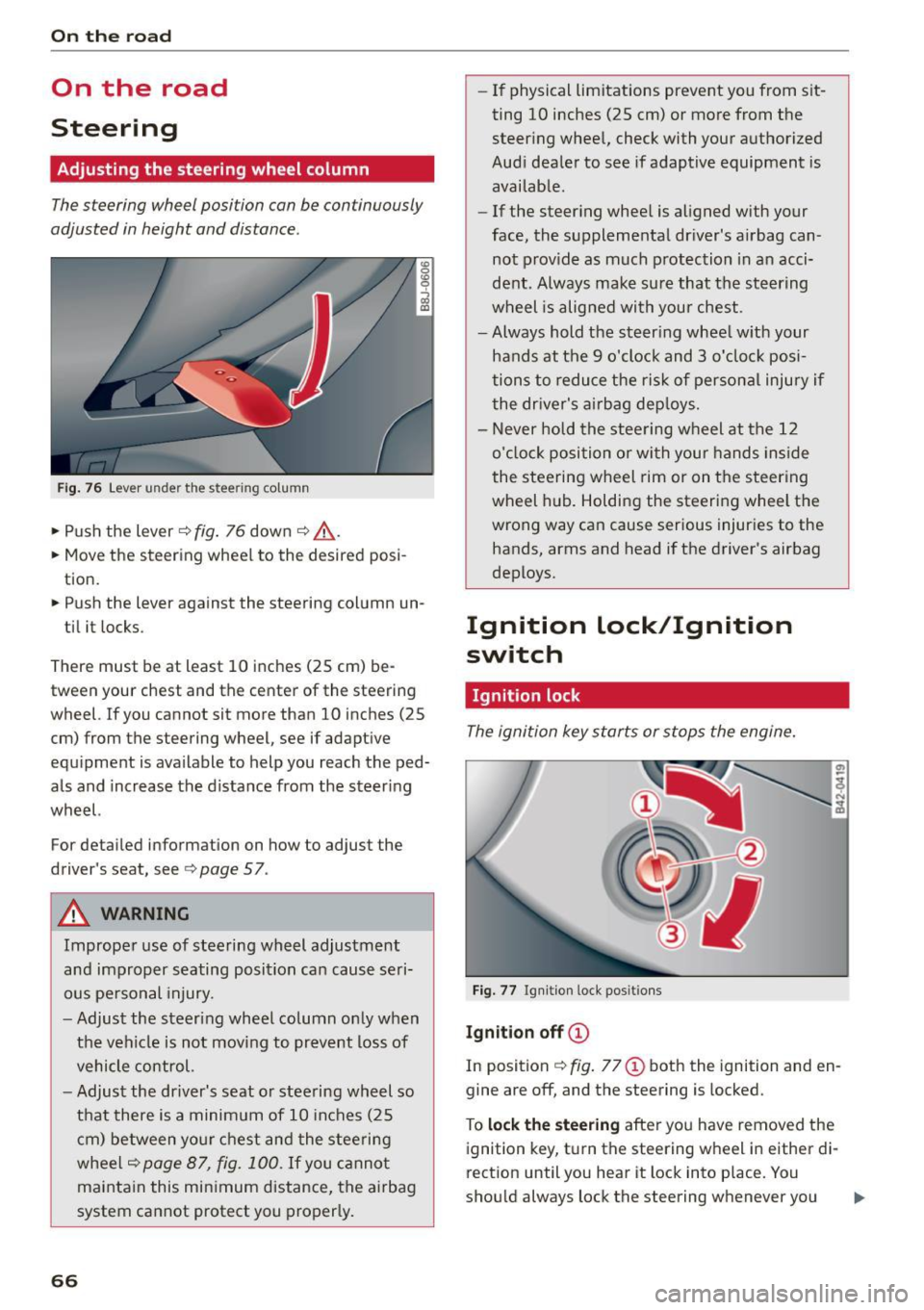
Fig. 76 Lever u nde r the stee rin g co lumn
... Push the lever ¢ fig. 76 down ¢ _&.. .
... Move the steering wheel to the desired posi
tion .
... Push the lever against the steering column un-
til it locks .
There must be at least 10 inches (25 cm) be
tween your chest and the center of the steering
wheel. If you cannot sit more than 10 inches (25
cm) from the steering wheel, see if adaptive
equipment is ava ilable to help you reach the ped
als and increase the distance from the steering
wheel.
For detailed information on how to adjust the
driver's seat, see
¢ page 57.
A WARNING
Improper use of steering wheel adjustment
and improper seating position can cause seri
ous pe rsonal injury.
- Adjust the steering wheel column only when
the vehicle is not moving to prevent loss of
vehicle control.
- Adjust the driver's seat or stee ring wheel so
that there is a minimum of 10 inches (25
cm) between your chest and the steering
wheel¢
page 87, fig. 100. If you cannot
maintain this min imum distance, the airbag
system cannot protect you proper ly.
66
- If physical limitations prevent you from sit
ting 10 inches (25 cm) or more from the steering wheel, check with your authorized
Audi dealer to see if adaptive equipment is
available.
- If the steering wheel is aligned with your
face, the supplemental dr iver's airbag can
not p rov ide as much protection in an acci
dent. Always make sure that the steering
wheel is aligned with your chest.
- Always hold the steering wheel w ith your
hands at the 9 o'clock and 3 o'clock posi
tions to reduce the risk of persona l injury if
the dr iver's airbag dep loys.
- Never hold the steering wheel at the 12 o'clock position or with your hands inside
the steering wheel rim or on the steering
wheel h ub. Holding the steering wheel the
wrong way can cause serious injuries to the hands, arms and head if the driver's airbag
deploys.
Ignition Lock/Ignition
switch
Ignition lock
The ignition key starts or stops the engine.
Fig. 77 Ign it ion lock posit ions
Ignit ion off CD
In position ¢ fig. 77 (D both the ignition and en
gine are off, and the steering is locked.
To
l ock the steering after you have removed the
ignition key, t urn the steering wheel in either di
rection until you hear it lock into place. You
should always lock the steering whenever you .,.
Page 69 of 232
..... N
r-N "': ..... \!) 1.1"1
N 1.1"1 .....
leave your vehicle . This makes vehicle theft even
more difficu lt
c::> & .
Ign ition on @
After switching the ignition on, the needles move
all the way up and then down.
If it is difficult to turn the key after you have in
serted it into the ign ition lock, turn the steering
wheel back and forth. This w ill take the load off
the steering lock mechanism and you will be able
to turn the key freely and start the engine.
Starting the engine @
In this position the engine starts . Wh ile the en
g ine is starting, the power supply to the head
l ights and other elect rical consume rs is tempo ra
ri ly inte rrupted to conserve battery power . After
the engine has started, re lease the key and it will
return to position @.
Before the sta rter can be opera ted again the key
m ust be t urned back to position (!). The
n on-re
pe at lo ck
prevents you from damaging the start
er when the engine is running .
A WARNING
-Never remove the key from the ignition lock
wh ile the vehicle is mov ing. The steer ing
wheel will lock causing loss of control.
- If you have to leave your vehicle - even for
just a min ute - a lways remove the ignit ion
key and take it with you. This is espec ially
important if you are going to leave ch ildren
behind in the veh icle . The ch ildren could
start the engine o r use other veh icle con
t ro ls. Unsuperv ised use of vehicle controls
( f or example, power windows) can c ause se
rious persona l injuries .
@ Tips
If the veh icle battery has been d isconnected
and then reconnected, then yo u m ust leave
t he key in posit ion @ for abou t 5 seconds be
fore you can start the engine .
On the road
Starting and stopping
the engine
Starting the engine
The engine can only be started with your original
Audi key.
On vehicles with S tronic*, the engine can be
sta rted in the neutra l position N and in each gear
(1 - 7 and R).
.,. Set the park ing brake
c::> .&_ .
.,. On veh icles with manual transmiss ion*, fully
dep ress the clutch peda l.
.,. Press and hold the bra ke peda l.
.,. Tu rn the ignition key to posit ion @
c::> page 66,
fig. 77 -do not depress the gas pedal when
starting the engine.
.,. Let go of the key as soon as the engine starts -
the starter m ust not cont inue to run. On
veh ides with S tronic, se lect gear position N .
A cold engine may at first be loud afte r it has
been started. This is due to the hydraulic valves
building up the oil pressure. This is normal and
no need for concern .
If the engine does not start immediately, stop
trying after 10 seconds and then try to restart
the engine about 30 seconds later .
A WARNING
--
-Never start or let the eng ine run in a con
f ined or enclosed area. Exhaust fumes from
the eng ine contain carbon mo noxide, a co l
o rl ess and odo rless gas. Carbon monoxide
can be fatal if i nhaled .
- Never leave the engine id ling unattended .
A n unattended ve hicl e w ith a running en
g in e poses a dange r of pe rsonal inj ury or
theft .
- W ith the engine r unning and a gear engag
ed, you have to ho ld the vehicle wi th the
foot b rake .
(D Note
-Avo id h igh engine speeds, fast acceleration
o r heavy engi ne loads whi le the engine is
st il l c old . T his could d amage t he engine.
67
Page 70 of 232
On the road
- The engine cannot be started by pushing or
towing the vehicle .
@I For the sake of the environment
To avoid unnecessary eng ine wear and to re
duce exhaust emissions , do not let your vehi
cle stand and warm up. Be ready to drive
off
immediately after starting your vehicle.
Stopping the engine
On vehicle s wi th S tron ic*, the engine can be
turned
off in the neutral position N and in each
gear (1 -7 and R) .
.. Tu rn the ignition key to posit ion (!) co
page 66,
fig. 77 .
A WARNING
- Never turn off the engine until the vehicle
has come to a complete stop .
- The brake booster and servotronic only work
when the eng ine is running . W ith the igni
t ion turned
off , you have to apply more force
when steering or braking. Since you cannot
steer and stop normally , this can lead to ac
c idents and serious injuries .
(D Note
-If the engine has been under heavy load for
an extended period of time, heat builds up
i n the eng ine compartment after the engine
i s switched
off -there is a r isk of damag ing
the engine . A llow the engine to continue to
run at id le for a short time or drive until it
has coo led down before you turn it off
q page 73.
-If the engine has been under heavy load for
an extended period of time, it can become
extremely hot . You should not park your ve
hicle over easily combustible objects or
areas (e .g . grass or leaves) . There is a risk of
starting a fire .
{!) Tips
After the engine has been switched off, the ra
diator fan can continue to run for up to 10 m i
nutes - even w ith the ignition switched
off . It
68
can also switch on again after some time if
the coo lant temperature rises as the result of
heat bu ildup or if the engine compartment is
heated by the sun's rays and the engine is hot .
Parking brake
Parking brake
When the parking brake is set, it prevents the ve
hicle from rolling away unintentionally.
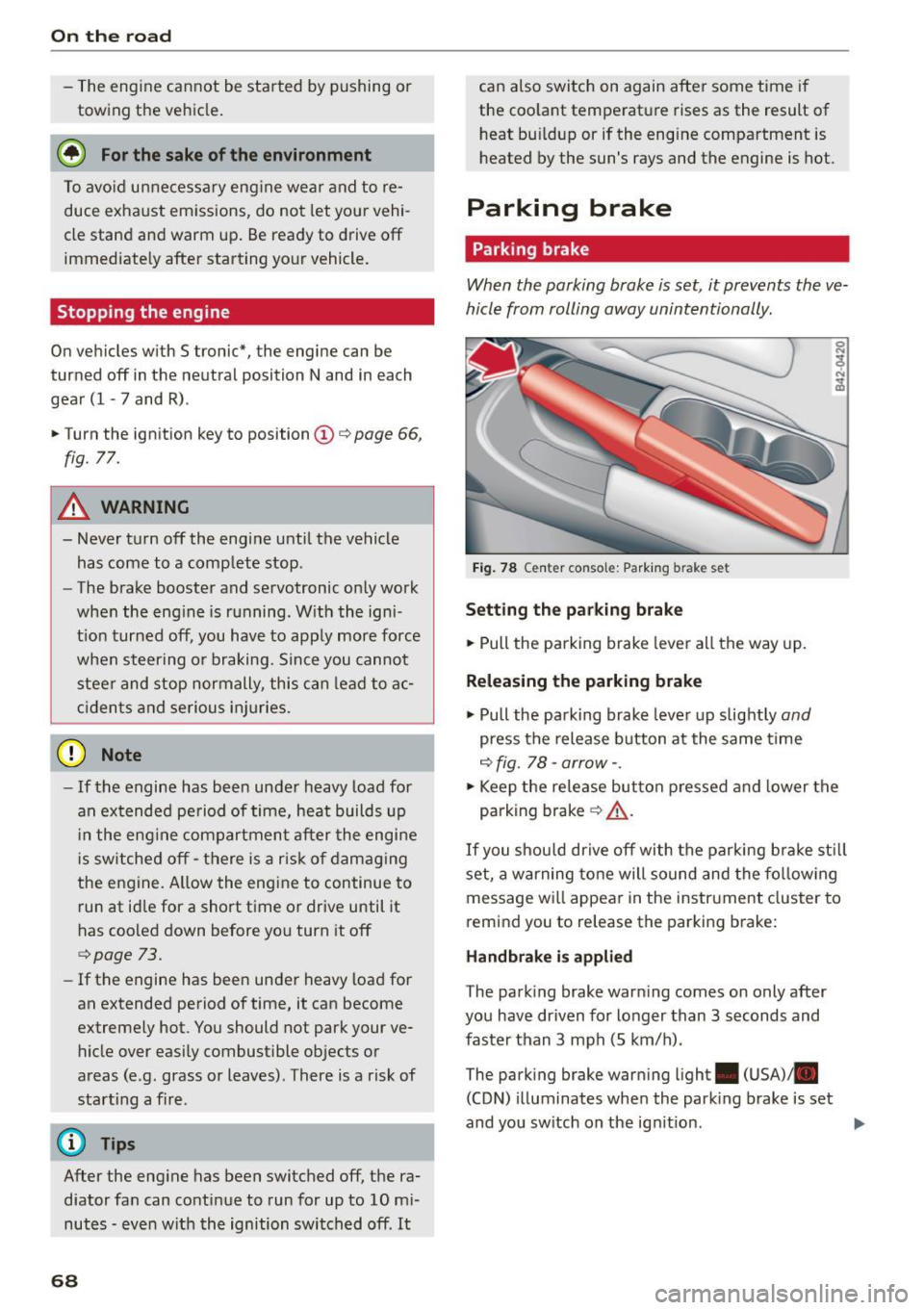
Fig . 78 C ente r co nsol e: Park ing bra ke set
S etting th e pa rking brak e
.. Pull th e parking brake lever all the way up.
Releasing the p arkin g brake
.. Pull the parking brake lever up slightly and
press the release button at the same time
c::> fig . 78 -arrow- .
.. Keep the release button pressed and lower the
parking brak e
q &_.
If you shou ld drive off with the parking bra ke st ill
set, a warning tone will sound and the fo llow ing
message wi ll appear in the instrument cluster to
r e mind you to release the parking brake:
H and brake i s appli ed
T he park ing brake warn ing comes on only after
you have driven for longer than 3 seconds and
faster than 3 mph (5 km/h) .
The parking brake warning ligh t. (USA)/ .
(CON) illuminates whe n the park ing brake is set
and you sw itch on the ign it ion .
Page 71 of 232
..... N
r-N "': ..... \!) ..,.,
N ..,., .....
A WARNING
-=
Always release t he parkin g brake completely.
A part ially engaged brake will over heat th e
rear brakes, reduce their effect iveness and
cause excess ive wear. This could lead to brake
fai lure and an accident.
([) Note
Only after the ve hicle has come to complete
stop, sho uld you firmly set the parking brake
and move the gearshift lever into a gear.
Parking
Parking
~ Stop t he vehicle using the brake pedal.
~ Set the parking b ra ke firmly.
~ Swi tch off the engine.
~ Move t he se lecto r lever into the P pos ition ( au
tomatic t ransmis sion )
or move the gearshift
lever into 1st . gear
(manual transmission )
c:>.&_ .
~ When on incl ines or declines, turn the steering
whee l so that t he vehicle w ill roll into the curb
if it beg ins to move .
A WARNING
This is how yo u can reduce the risk of in jury
w hen leav ing you r vehicle.
-
- Never park the vehicle whe re it ca n come i n
co ntact wi th dry g rass, spilled fuel or a ny
other flammable mater ials.
- Never allow anyone - especially small chi l
dre n -to remai n in t he vehicle when it is
locked. Locke d doors ma ke i t mo re d iff icult
for rescuers to access the passenger com
partment in the event of an emergency .
Dange r to life!
- Never leave c hildren unsupervised in the ve
hicle. C hildren cou ld re lease the par king
brake or move the gearshift lever out of
gear. The vehicle could sta rt to roll away and
cause an accident .
- No matter what the season is, the tempera
ture in a parked veh icle can reach dangerous
levels.
On th e road
Starting on hills
Applies to vehicles: wit h hill ho ld assist
Hill ho ld assist makes it eas ier to sta rt on hills.
The system is activated when the brake peda l is
depressed
for a few seconds .
After releasing the brake pedal, the b rake power
is he ld for a
brief moment to prevent the vehicle
from rol ling back when starting . At this time, you
can eas ily beg in to move your vehicle.
A WARNING
- I f you did not begin moving imme diate ly af
ter re leasi ng the b ra ke peda l, unde r ce rtain
cir cumstan ces, the vehicle w ould beg in to
roll bac kward. Depress t he brake pe dal im
mediately or engage the hand brake.
- Should t he e ngine sta ll, dep ress the brake
pe dal immed iately or enga ge the hand
b rake.
- I n or der to preven t the vehicle from roll ing
back unintentionally when s tarting in s top
and-go traffic, keep the brake pe dal de
pressed for a few seconds before driving off.
(D Tips
You can find o ut if yo ur vehicle is eq uipped
wi th "Hill hold ass ist" at an autho riz ed Au di
d ealersh ip.
Speed warning system
Speed warning system
The speed warning system helps you to keep your
driving speed below a set speed limit .
The speed warn ing system warns the driver if he
exceeds a previously stored max imum speed. A
warning tone will sound as soon as the veh icle
speed exceeds the set speed by about
3 mph
(3 km/h) . At the same t ime, a warning symbo l
appea rs i n the display .
The speed warn ing system has
two warn ing
thre sholds
tha t function independe ntly of each
othe r and t hat have somewhat d iffe rent pu rpos
es:
69