engine AUDI R8 SPYDER 2015 Repair Manual
[x] Cancel search | Manufacturer: AUDI, Model Year: 2015, Model line: R8 SPYDER, Model: AUDI R8 SPYDER 2015Pages: 232, PDF Size: 58.36 MB
Page 165 of 232
..... N
r-N "': ..... \!) ..,.,
N ..,., .....
"' Press and ho ld the rear window switch too unti l
the convertible top moves into the service posi
t ion
r::!) fig. 142.
Opening th e cool ant e xp ansi on tank cov er
"' Stop the engine and allow it to coo l.
"' Switch the ignition off.
"' Carefu lly remove the bolts in the cover(!) using
a screwdriver and remove the cover. The cool
ant reservoir is located be low
c:> fig. 143 .
Check ing th e engine coolant l eve l
"' Place a rag or cloth on the cap of the coo lant
expansion tank and turn the cap
ca re full y to
the left (counter-clockwise)
c:> A .
"'Read the coo lant level inside the coolant expan
s ion tank
c:> fig . 143. With a co ld engine, it
must be above the "min" mark. W ith a hot en
gine, it can be a little above the ind icated
range .
To obtain an accurate read ing, the eng ine must
be switched off.
The expansion tank in your vehicle is equipped
with an electric coolant level sensor
r::!) page 14.
We still recommend you check the coolant level
from time to time .
Coolant lo ss
Coolant loss may indicate a leak in the cooling
system . In the event of coolant loss, the cooling
system should be inspected immediately by your
author iz ed Audi dealer. It is not enough merely
to add coolant.
In a
s e a led system, losses can occur only if the
boiling point of the coo lant is exceeded as a re
sult of overheat ing.
A WARNING
- The cooling system is under pressure. Do
not open the cap of the coolant expans ion
tank when the engine is hot. You risk being
sca lded.
-
- The coolant add itive, and therefore the cool
ant itself, is hazardous to health. Keep the
c oolant additive in the or igina l co ntainer out
of the re ach of children.
It is a poison haz
ard.
Ch eck ing and fillin g
(D Note
Do not add any type of radiator leak sea lant
to your vehicle's engine coolant . Add ing radia
tor repair fluid may adversely affect the func
tion and performance of your cooling system
and could result in damage not covered by
your New Veh icle Limited Warranty.
Adding coolant
Befo re you check a nyth ing in the eng ine compart
ment,
alwa ys read and he ed all WARNING S
r::!) A in Working in the engine compartment on
page 155.
"' Add coolant m ixed in the correct rat io
c:> page 161, Coolant.
"' Twist the cap on again tightly.
"'Tighten the cap(!) <::!)page 162, fig. 143 again .
Replacement engine coo lant must conform to ex
act specifications
c:> page 161, Coolant .
We recommend using only coolant add it ive Gl2+
+, G l3
or in an emergency Gl2 +. Do not use a
different additive. In an emergency use pla in wa
ter unt il you ca n get the correct add itive and can
restore the co rrect ratio . This should be done as
soon as possib le .
If you have los t a considerab le amount of cool
ant, then you shou ld add cold antifreeze and cold
water only when the engine is co ld .
Always use
new engine coo lant when refilling .
Do not fill coolant above the "max" mark. Excess
coolant will be forced out through the pressure
relief valve in the cap when the eng ine becomes
hot.
A WARNING
- The cooling system is under pressure and
can get very hot. Reduce the risk of scalding
from hot coolant by following these steps .
- Turn off the engine and allow it to cool
down .
- Protect your face, hands and arms from escaping fluid and steam by covering the
cap with a large, thick rag.
163
Page 166 of 232
Checking and filling
-Turn the cap slowly and very carefully in a
counter-clockwise direction while applying
light, downward pressure on the top of
the cap .
- To avoid being burned, do not spill anti
freeze or coolant on the exhaust system or hot engine parts. Under certain condi
tions, the ethylene glycol in engine cool
ant can catch fire .
- Antifreeze is poisonous. Always store anti
freeze in its original container and well out of the reach of children .
- If you drain the coolant, it must be caught
and safely stored in a proper container
clearly marked "poison".
CD Note
-Coolant pollutes the environment and could
cause an engine fire . Excess coolant will be
forced out through the pressure relief valve
in the cap when the engine becomes hot.
-If, in an emergency, only water can be add
ed, the correct ratio between water and an
tifreeze
¢ page 161 must be restored as
soon as possible.
@ For the sake of the environment
Drained coolant should not be reused. Always
dispose of used coolant while observing all
environmental regulations.
Brake fluid
Have the brake fluid changed by an experienced
technician.
Brake fluid absorbs moisture from the air. If the
water content in the brake fluid is too high, cor
rosion in the brake system may result after a peri
od of time. The boiling point of the brake fluid
will also decrease considerably and decrease
braking performance.
Therefore, the brake fluid must be changed
every
two years.
Always use new brake fluid which con
forms to Federal Motor Vehicle Standard "FMVSS
116 DOT 4".
164
Brake fluid is replaced according to the Audi
maintenance service schedule . Your authorized
Audi dealer is equipped with the necessary spe
cial tools and replacement parts, has the neces
sary expertise, and can dispose of the used fluid .
A WARNING
-Brake fluid is poisonous . It must be stored
only in the closed original container out of
the reach of children!
- Brake failure can result from old or inappro priate brake fluid. Observe these precau
tions:
- Use only brake fluid that meets SAE speci
fication
J 1703 and conforms to Federal
Motor Vehicle Standard
116. Always check
with your authorized Audi dealer to make
sure you are using the correct brake fluid .
The correct type of brake fluid is also indi cated on the brake fluid reservoir.
- The brake fluid must be new . Heavy use of
the brakes can cause a vapor lock if the brake fluid is left in the system too long.
This can seriously affect the efficiency
of
the brakes as well as your safety . This
could result in an accident.
CD Note
Brake fluid will damage the paint of your vehi
cle.
@ For the sake of the environment
Because of the problem of proper disposal of
brake fluid as well as the special tools re
quired and the necessary expertise, we rec
ommend that you have the brake fluid
changed by your authorized Audi dealer.
Battery
General information '
Your vehicle is equipped with a special battery, an
ACM battery . This battery is located in the lug
gage compartment and must be replaced with an
original equipment battery. Under normal oper
ating conditions, the battery is
maintenance-
free. ..,_
Page 168 of 232
Checking and filling
(D Tips
If your vehicle is left standing for several
weeks at extremely low temperatures, the
ve
hicle battery should be removed and stored
where it will not freeze. This will prevent it
from being damaged and having to be re placed .
Working on the battery
Be especially careful when working on or near
the battery!
The battery is located in the luggage compart
ment behind a
cover. Before you work on or near
the battery ,
read and heed all WARNINGS c> &_.
Always heed the safety warnings, when working
on the vehicle battery or the vehicle electrical
system to prevent injury.
The following WARNINGS are very important
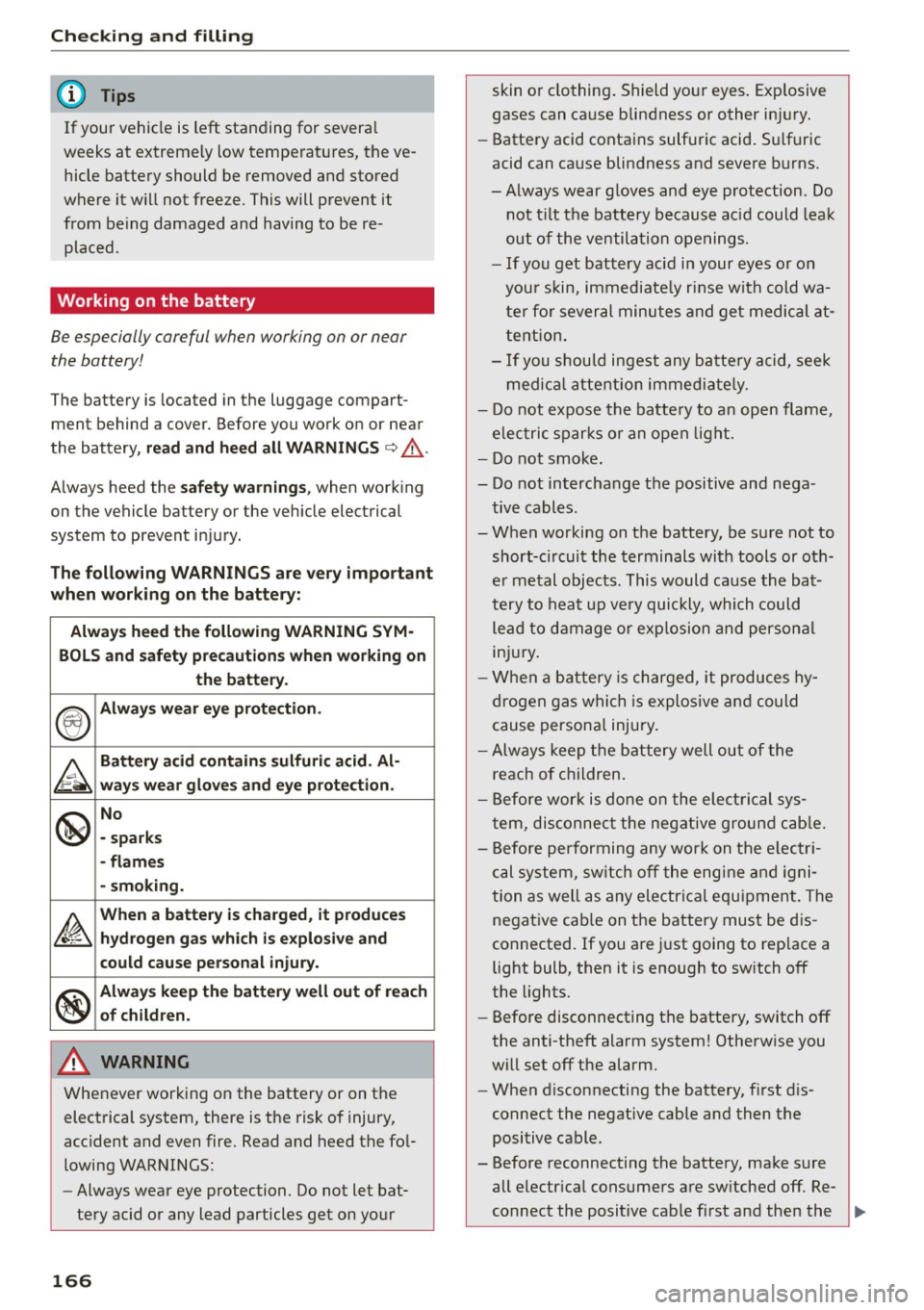
when working on the battery:
Always heed the following WARNING SYM-
BOLS and safety precautions when working on
the battery.
®
Always wear eye protection.
&
Battery acid contains sulfuric acid. Al·
ways wear gloves and eye protection.
@
No
- sparks
- flames
- smoking.
~
When a battery is charged, it produces
hydrogen gas which is explosive and
could cause personal injury.
®
Always keep the battery well out of reach
of children.
.&_ WARNING
Whenever working on the battery or on the
electrical system, there is the risk of injury,
accident and even fire. Read and heed the fol
lowing WARNINGS:
- Always wear eye protection. Do not let bat
tery acid or any lead particles get on your
166
skin or clothing. Shield your eyes. Explosive
gases can cause blindness or other injury.
- Battery acid contains sulfuric acid. Sulfuric
acid can cause blindness and severe burns.
-Always wear gloves and eye protection . Do
not tilt the battery because acid could leak
out of the ventilation openings.
- If you get battery acid in your eyes or on
your skin, immediately rinse with cold wa
ter for several minutes and get medical at
tention.
- If you should ingest any battery acid, seek
medical attention immediately.
- Do not expose the battery to an open flame,
electric sparks or an open light.
- Do not smoke.
- Do not interchange the positive and nega- tive cables.
- When working on the battery, be sure not to
short-circuit the terminals with tools or oth
er metal objects. This would cause the bat
tery to heat up very quickly, which could
lead to damage or explosion and personal
injury.
- When a battery is charged, it produces hy
drogen gas which is explosive and could
cause personal injury.
- Always keep the battery well out of the
reach of children.
- Before work is done on the electrical sys
tem, disconnect the negative ground cable.
- Before performing any work on the electri
cal system, switch off the engine and igni
tion as well as any electrical equipment. The
negative cable on the battery must be dis
connected. If you are just going to replace a
light bulb, then it is enough to switch off
the lights.
- Before disconnecting the battery, switch off
the anti-theft alarm system! Otherwise you
will set off the alarm.
- When disconnecting the battery, first dis
connect the negative cable and then the
positive cable.
- Before reconnecting the battery, make sure all electrical consumers are switched off. Re
connect the positive cable first and then the
~
Page 170 of 232
Checking and filling
thaw completely before attempting to charge it
c> &. . However, we recommend not us ing a
thawed battery again because the battery casing
can be cracked due to ice format ion and can leak
battery acid.
Do no t open the battery caps when charging the
battery .
A WARNING
Charging a battery can be dangerous.
- Never charge a frozen battery. It may ex
plode because of gas trapped in the ice. Al
low a frozen battery to thaw out first.
- Do not reuse batteries which were frozen.
The battery housing may have cracked and
weakened when the battery froze.
- Charge the battery in a we ll ventilated area.
Keep away from open flame or electrical
spark. Do not smoke . Hydrogen gas generat
ed by the battery is explosive .
- To reduce the danger of explosion, never
connect or disconnect charger cables while
the charger is operating .
- Fast charg ing a battery is dangerous and
should only be attempted by a competent
technician with the proper equipment .
- Battery acid that may spill during charg ing
sho uld be washed off w ith a solution of
warm water and baking soda to neutralize
the acid.
CD Note
Never use a fast charger as a booster to start
the engine. This will seriously damage sensi
tive electronic components, such as control
units, re lays, radio, etc., as well as the batte ry
charger.
@ Tips
- The vehicle battery must not be charged
with a standard small charger that plugs in
to the cigarette lighter or outl et.
- Only charge the battery through the connec
tions in the luggage compartment.
168
Windshield washer
container
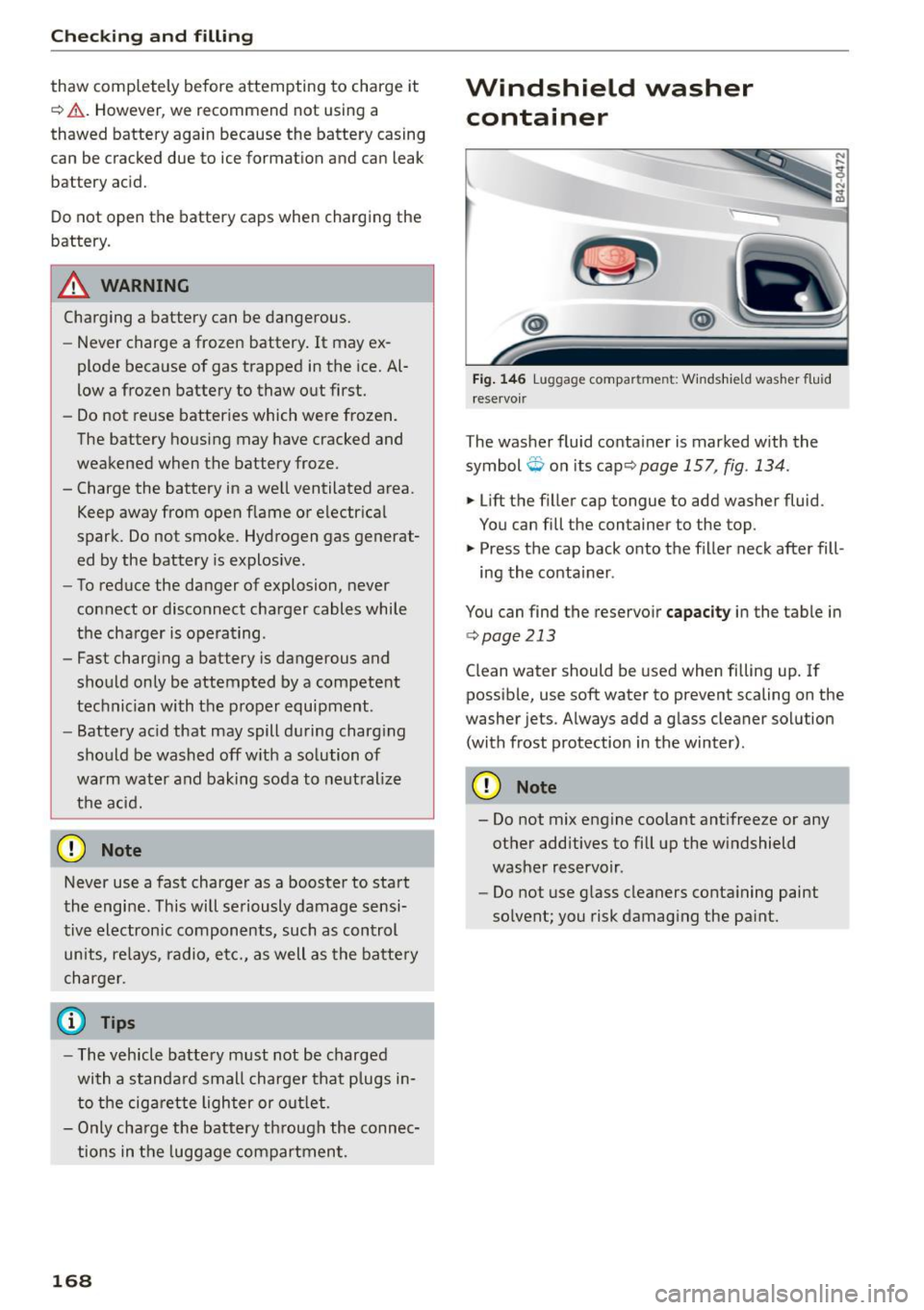
Fig. 146 Lu ggage compar tment: Wind shi eld wash er fl uid
reservoir
The washer fluid container is marked with the
symbol
Q on its cap c>page 157, fig . 134.
.. Lift the filler cap tongue to add washer fluid.
You can fill the container to the top .
.. Press the cap back onto the filler neck after fill -
ing the container .
You can find the reservoir capacity in the table in
¢page 213
Clean water should be used when filling up. If
possible, use soft water to prevent scaling on the
washer jets. Always add a glass cleaner solution
(with frost protection in the winter).
CD Note
- Do not mix engine coolant antifreeze or any
other additives to fill up the windshield
washer reservoir .
- Do not use glass cleaners containing paint
solvent; you risk damaging the paint.
Page 180 of 232
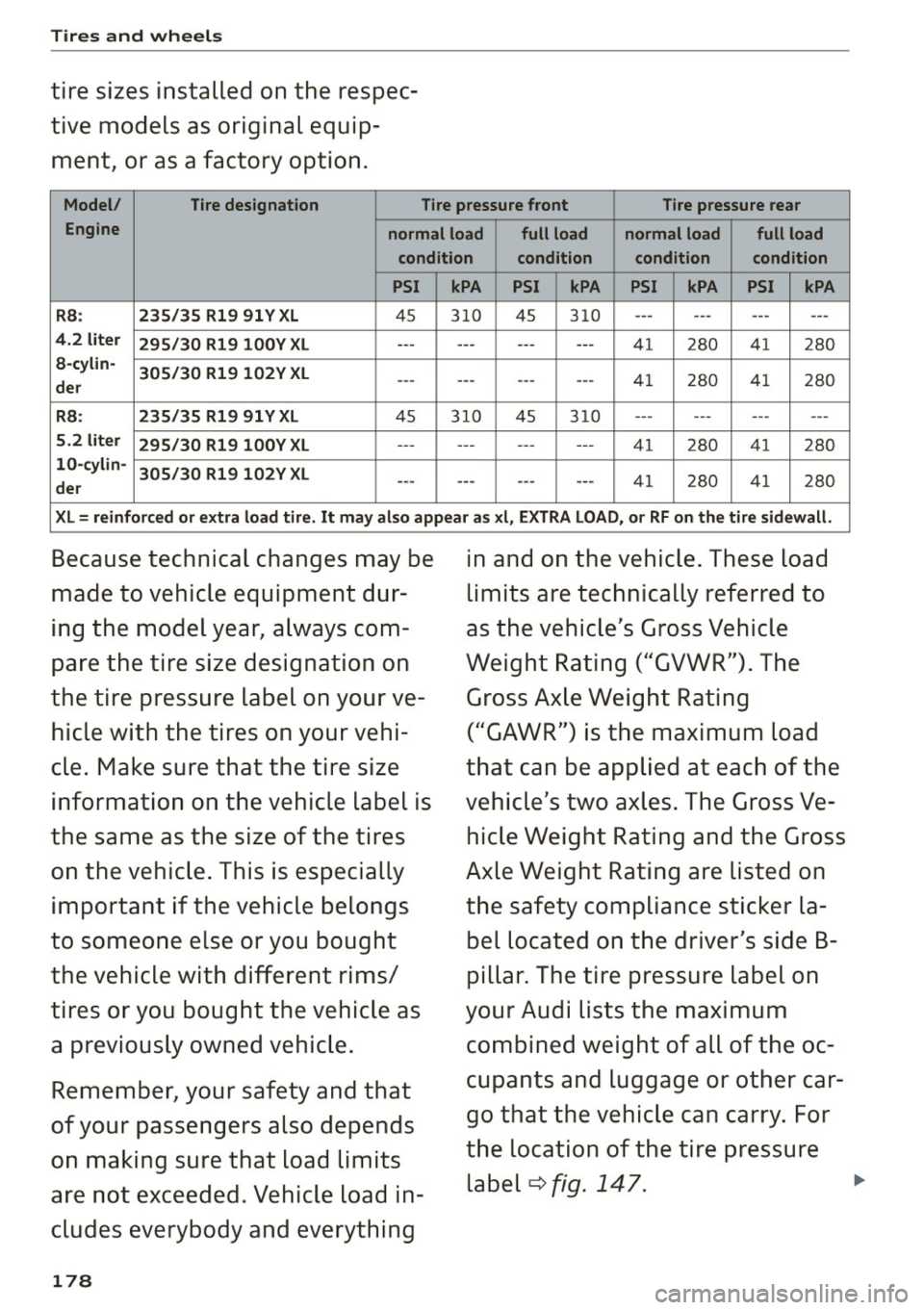
Tires and wheels
tire sizes installed on the respec
tive models as original equipment, or as a factory option.
Model/ Tire designation Tire pressure front Tire pressure rear
Engine normal load full load normal load full load
condition condition condition condition
PSI kPA PSI kPA PSI kPA PSI kPA
RS: 235/35 Rl9 91 Y XL 45 310 45 310 ------ ------
4.2 liter
295/30 Rl9 lOOY XL ------------41 280 41 280
S-cylin-
305/30 Rl9 102V XL
der
--- --- ------41
280 41 280
RS: 235/35 Rl9 91 Y XL 45 310 45 310 --------- ---
5.2 liter
295/30 Rl9 lOOY XL --------- ---41
280 41
280
10-cylin-
305/30 Rl9 102V XL
der
--- ------
---41 280 41 280
XL= reinforced or extra load tire. It may also appear as xl, EXTRA LOAD, or RF on the tire sidewall.
Because technical changes may be
made to vehicle equipment dur
ing the model year, always com
pare the tire size designation on
the tire pressure label on your ve hicle with the tires on your vehi
cle. Make sure that the tire size information on the vehicle label is
the same as the size of the tires on the vehicle. This is especially
important if the vehicle belongs
to someone else or you bought
the vehicle with different rims/
tires or you bought the vehicle as a previously owned vehicle.
Remember, your safety and that
of your passengers also depends
on making sure that load limits
are not exceeded. Vehicle load in
cludes everybody and everything
178
in and on the vehicle. These load
limits are technically referred to
as the vehicle's Gross Vehicle
Weight Rating ("GVWR"). The
Gross Axle Weight Rating ("GAWR") is the maximum load
that can be applied at each of the
vehicle's two axles. The Gross Ve hicle Weight Rating and the Gross
Axle Weight Rating are listed on
the safety compliance sticker la bel located on the driver's side B
pillar. The tire pressure label on
your Audi lists the maximum combined weight of all of the oc
cupants and luggage or other car
go that the vehicle can carry. For
the location of the tire pressure label ¢
fig. 147.
Page 200 of 232
Tires and wheels
and tires are compatible with the tire pres
sure monitoring system. Otherwise the sys
tem will register a malfunction and a fault message will be displayed. For more infor
mation, contact your authorized Audi deal
er.
- For Declaration of Compliance to United
States FCC and Industry Canada regulations
c:> page 218.
Programming a new set of tires
Applies to veh icles: w ith tire pressure monitoring syste m
When driving with a new set of tires, you can pro
gram them to the tire pressure monitoring sys
tem using the menu disp lay.
.,. Turn the ignition on .
.,. Select the menu:
Set> Tire pressure > Wheel
change.
.,. Confirm that you would like to begin the pro
gramming process . The message
Wheel sen
sors are being initialised. This may take a few
minutes ...
appears in the instrument cluster
display.
You can switch between programmed tire sets at
any time without reinitializing the system.
(D Tips
- If the programming process was not com
pleted successfully, the message
Wheel
sensors could not be initialised
appears in
the display and them indicator light
turns on. If this happens, repeat the proce
dure.
- Do not store the tire pressure if there are
snow chains on the tire.
TPMS Tire pressure monitoring system
malfunction
A malfunction can have various causes.
If the [I] warning light in the instrument cluster
flashes for approximately one minute and then
remains continuously illuminated and additional
ly
the m symbol appears in the display, the tire
pressure monitoring system is not available. The
198
text Tire pressure! System malfunction appears
in the display. This can have various causes.
- A wheel sensor or other component may have
fai led.
- During initialization the system has detected
more than 4 wheels on the vehicle, for example
while driving next to another car with a tire pressure monitoring system.
- Audi replacement parts were not used.
- If snow cha ins are being used, system function
can be compromised due to the shielding prop
erties of the chains .
- The tire pressure monitoring system may not
be available because of a rad io malfunction.
- Transmitters with the same frequency, such as
radio headphones in the vehicle or radio equip
ment, can cause a temporary disruption of the
system through excessive electromagnetic
fields .
- Eliminate the interference if you can and then
proceed as follows: Turn off the engine for 20
minutes. Then drive another 10 minutes.
If the
warning light comes on again, you should con
tact your authorized Audi dealer immediately
to have the problem corrected.
- Do not use commercially available tire sealants.
Otherwise, the electrical components of the
tire pressure monitoring system will no longer
work properly and the sensor for the tire pres
sure monitoring system will have to be replaced
by a qualified workshop.
Page 201 of 232
What do I do now? Trunk escape handle
Appl ies to vehicles: with trunk escape handle
In case of an emergency, the front lid can be
opened from the inside using the trunk escape
handle.
.. To open the front lid pull the handle.
The trunk escape handle inside t he luggage com
partment is made of fluorescent material to glow
in the dark .
.&_ WARNING
The trunk escape handle is to be used only in
an emergency.
Vehicle tool kit
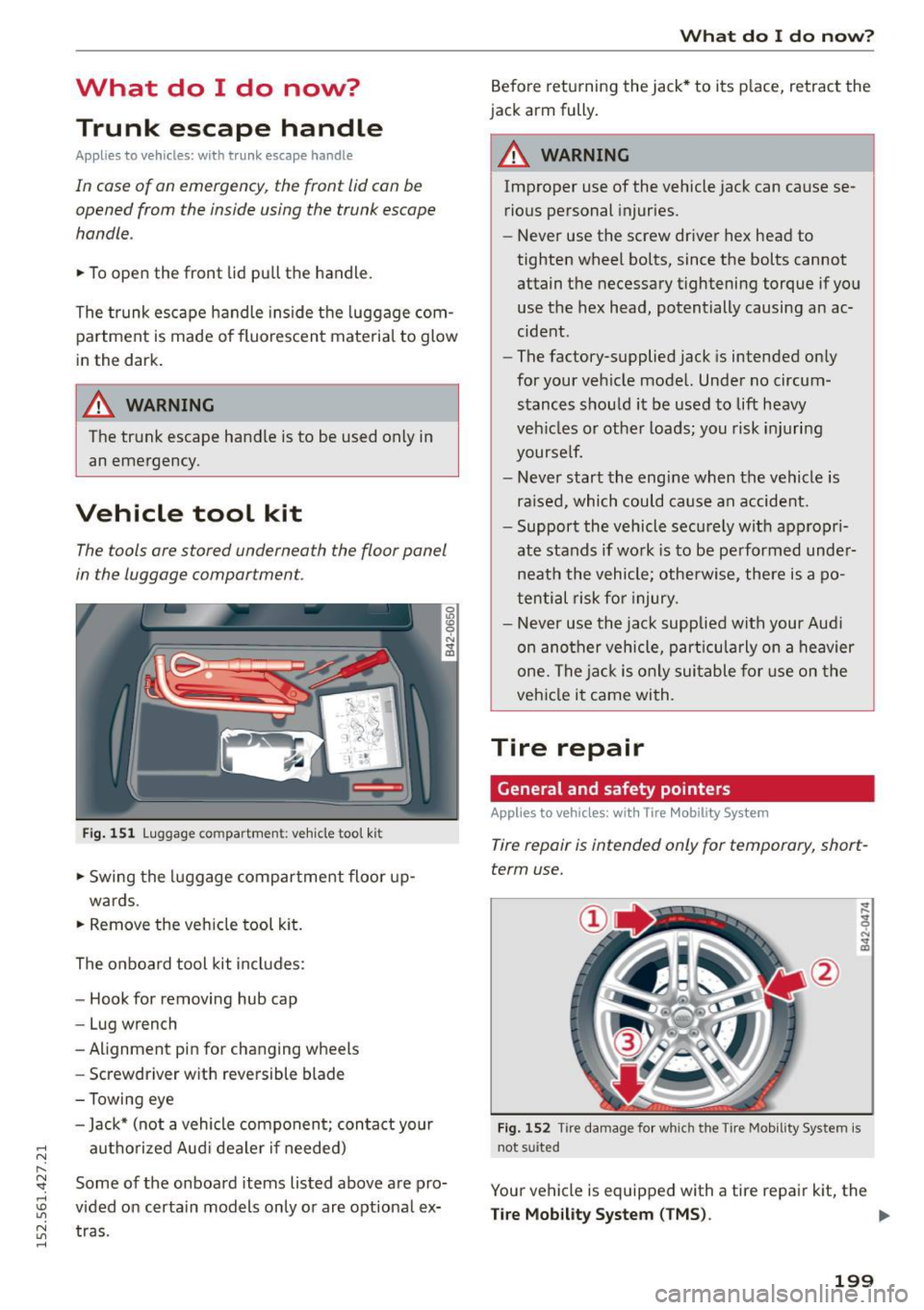
The tools are stored underneath the floor panel
in the luggage compartment.
Fig. 151 Luggage compartment: veh icle tool kit
"' Swing the luggage compar tment floo r up-
wards .
.. Remove the vehicle tool kit.
The onboard tool kit incl udes:
- Hook for removing hub cap
- Lug wrench
- Alignment pin for changing wheels
- Screwdr iver w ith reversible blade
- Towing eye
- Jack* (not a vehicle component; contact your
,..... authorized Aud i dealer i f needed)
N
I'-
~ Some of the on board items listed above are pro-
.... :5: vided on certa in models only or are optiona l ex-
N l/1 .... tras.
What do I do no w?
Before returning the jack* to its p lace, retract the
jack arm fully.
.&_ WARNING
-
Improper use of the vehicle jack can cause se-
rious personal injuries.
- Never use the screw driver hex head to
tighten wheel bo lts, since the bolts cannot
attain the necessary tightening torque if yo u
use the hex head, potentially causing an ac
cident.
- The factory-supplied jack is intended only
for your veh icle model. Under no circum
stances should it be used to
lift heavy
veh icles or other loads; you risk injuring
yourse lf.
- Never start the engine when the vehicle is
raised, which could cause an accident.
- Support the vehicle securely with appropri
ate stands if work is to be pe rformed under
neath the vehicle; otherwise, the re is a po
tential risk fo r injury.
- Never use the jack supplied with your Aud i
on another vehicle, part icularly on a heavier
one. The jack is only suitable for use on the
vehicle it came with.
Tire repair
General and safety pointers
Applies to vehicles: with Tire Mobility System
Tire repair is intended only for temporary, short
term use.
Fig. 152 Tire damage for which the Tire Mobility System Is
not suited
Your vehicle is equipped with a tire repa ir kit, the
T ire Mob il it y Sy stem ( TMS). .,.
19 9
Page 208 of 232
What do I do now?
-Repl ace th e fl at ti re with a n ew one and h ave
it ins talled on you r vehicle as soon as
po ssible. Remount the wheel co ve r.
Until th en, driv e with extr a car e and at redu ced
s pe eds .
A WARNING
-If you are go ing to equip your vehicle with
t ires or rims which differ from those wh ich
were factory installed, then be sure to read
the informat ion¢
page 186, New tires and
replacing tires and wheels.
- Always store the tools securely in luggage
compartment . Otherwise, in an accident or
sudden maneuver they cou ld fly forward,
caus ing injury to passengers i n the vehicle .
(D Note
Do not use commercially available t ire sea l
ants. Otherwise, the electrical components of
the t ire pressure monito ring system* will no
longer wo rk properly and the sensor fo r the
tire pressure monitor ing system will have to
be rep laced by a qualified workshop.
Jump-starting
General
If necessary, the engine can be started by con
necting it to the battery of another vehicle.
-
If the engine sho uld fail to start because of a d is
charged or weak battery, the battery can be con
nected to the battery of
another vehicle, using a
pai r of jumpe r cable s to start the engine.
Both batteries must be rated at 12 vo lts. The
ca
pacit y
(Ah) of the booster battery must not be
substantially less than the capacity of the dis
charged battery.
Jump er c ables
Use only jumper cables of sufficiently large cro ss
s e ctio n
to safely carry the s tarte r cu rrent . Refer
to the manufact urer's specifications.
Use o nly jumper cables wh ich have
insulated ter
minal clamps and are p roperly marked for d is
tinction:
206
plu s(+) ca ble : in most cases colo red red
minu s(-) c abl e:
in most cases colo red bla ck
A WARNING
-
Batteries conta in e lectr ic ity, acid, and gas.
Any of these can cause very serious or fata l in
jury . Follow the instructions below for sa fe
handling of your vehicle's battery.
- Always shie ld your eyes and avoid leaning
over the battery whenever possib le .
- A discharged battery can a lready freeze at
tempera tures just below 32 °F (0 °C). Befo re
connecting a jumper cab le, the frozen bat
tery must be thawed comp lete ly, otherwise
it could exp lode.
- Do not allow battery acid to contact eyes or
skin . Flush any contacted area with water
immed iately.
- Improper use of a booster battery to start a
veh icle may cause an explosion.
- Vehicle batter ies generate explosive gases .
Keep sparks, f lame and lighted cigarettes
away from batteries.
- Do not try to jump start any vehicle with a
low acid level in the battery.
- The voltage of the booster battery must al
so have a 12 -Vo lt rat ing. The capacity (Ah)
of the booster battery should not be lower
than that of the discharged battery. Use of batter ies of different voltage or substantial
ly different "Ah" rating may cause an explo
sion and personal injury.
- Never charge a frozen battery. Gas trapped
in the ice may cause an exp losion .
- Never charge or use a battery that has been frozen. The battery case may have be weak
ened.
- Use of batter ies of different voltage or sub
stantially d iffe rent capacity (Ah) rating may
cause an exp losion and injury. The capacity
(Ah) of the booster battery sho uld not be
lower than that of the discharged battery.
- Before you check anything in the engine
compa rtment, always re ad and heed all
WARNINGS
¢page 155, Working in the en -
gine comportment. .,,.
Page 209 of 232
.... N
l'
N "1: rl I.O
"' N
"' ....
(D Note
-Applying a higher vo ltage booster battery
will cause expensive damage to sensitive electronic components, such as control
units, relays, radio, etc.
- T here m ust be no e lectrica l contact between
the vehicles as otherwise current could al
ready start to flow as soon as the pos itive
(+) terminals are connected .
@ Tips
-The discharged battery must be properly
con nected to the vehicle's electrical system.
- Switch
off any car phone, or follow the car
phone instruct ions for this situation.
Use of jumper cables
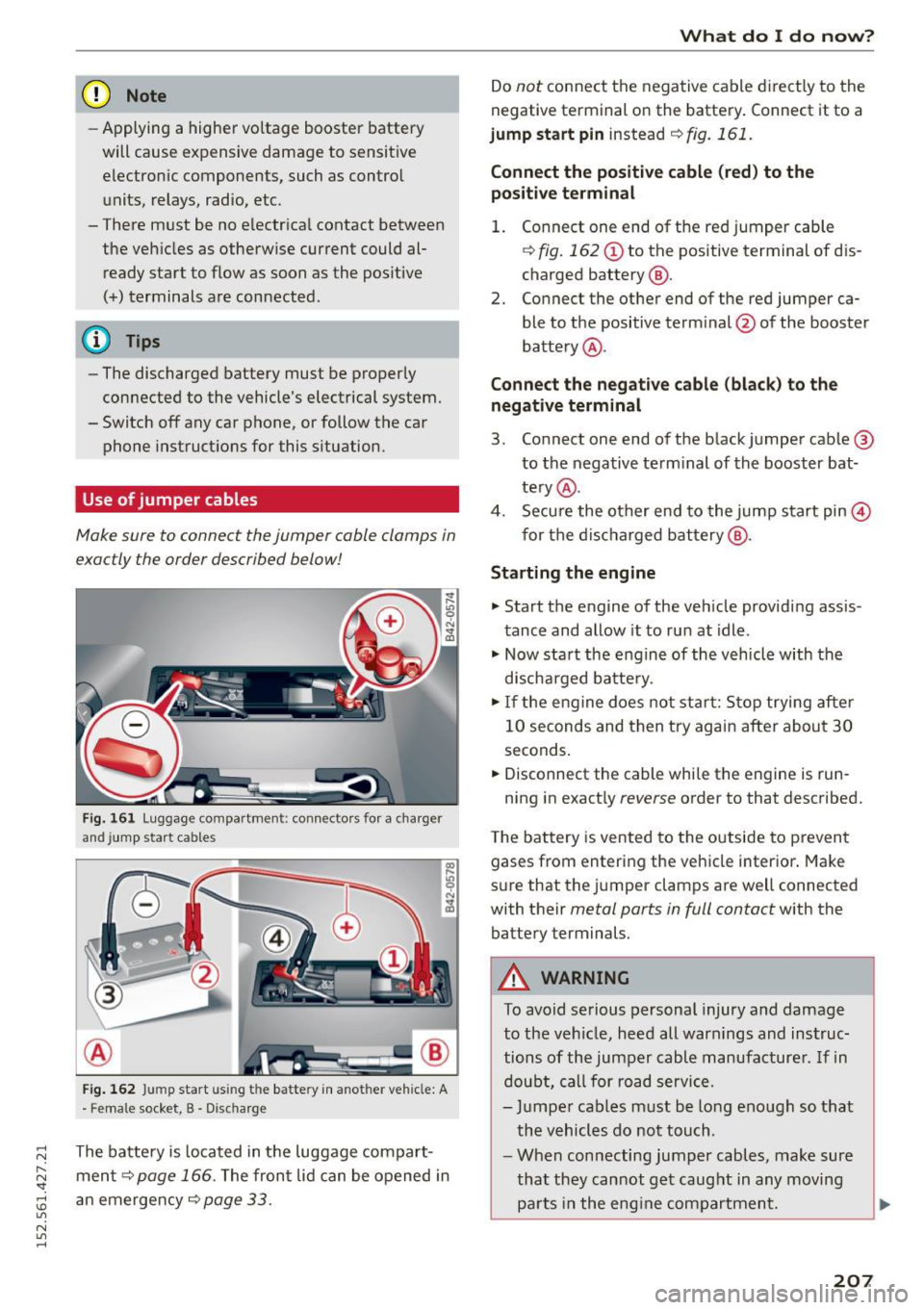
Make sure to connect the jumper coble clomps in
exa ctly the order described below!
F ig . 161 Luggag e comp artm ent: conn ectors fo r a charg er
an d jump start cab les
®
Fig . 162 Jump start using th e batte ry in a not her ve hicl e: A
• Fe male sock et, B • D isch arge
The batte ry is located in the luggage compart
ment ~
page 166 . The front lid can be opened in
a n emergency
r=;, poge 33.
What do I do no w?
Do not connect the negative cable d irect ly to the
n egat ive terminal on the battery . Connect it to a
jump start pin instead r=;, fig. 161.
Connect the po sitive cable (r e d ) to the
po sitive terminal
1. Connect one end of the red jumper cab le
r=;, fig . 162 (D to th e positive t erminal of dis
charged battery @.
2. Connect the o ther end of the red jumper ca
ble to the positive term inal @ofthe booster
battery @.
Conne ct the neg ative c able (bl ack ) to the
neg ativ e terminal
3. Connect one end of the b lack jumper cable @
to the negative term inal of the booster bat
tery @.
4. Secu re the other end to the jump start pin@
for the d isc harged battery @.
Starting the engine
"'Start the engine of the veh icle provid ing assis
tance and allow it to run at idle .
"' Now sta rt the engine of the vehicle with the
d ischa rged ba ttery.
"'I f the engine does not star t: Stop trying afte r
10 seconds and then try again after about 30
seconds .
"' Disconnect the cable while the engine is run-
ning in exact ly
reverse orde r to that described.
T he bat tery is vented to the outside to p reven t
gases from entering the vehicle interior . Make
s u re that th e jumper clamps ar e well connect ed
with their
metal ports in full contact with the
battery terminals.
A WARNING .
To avoid se rious personal injury and damage
to the veh icle , heed all warnings and ins truc
tions of the jumper cable manufacture r. If in
doubt, call for road service.
- Ju mpe r cables m ust be long eno ugh so that
the vehicles do not touch .
- When connecting jumper cables, make sure
that they can not g et caug ht in any moving
parts in the eng ine compartment. ..,.
207
Page 210 of 232
What do I do now?
- Be fo re you check a nything in t he e ngine
compartment, always read and heed all
WARNINGS
Q page 155, Working in the en
gine compartment .
CD Note
Improper hook-up of jumper cables can ruin
the generator.
- Always connect POSITIVE( +) to POSITIVE
( + ), and NEGA TIVE(-) to NEGATIV E(-)
gro und post of the battery manager control
unit.
- Check that a ll screw plugs on the battery
cells are screwed in firmly . If not, tighten
plugs prior to connect ing clamp on negat ive
battery terminal.
- Please note that the procedure for connect
i ng a jumper cable as described above ap
plies specifically to the case of your vehicle
being jump started. When you a re g iving a
ju mp sta rt to another vehicle, do
not con
n e ct the neg ative(- ) ca b le to the negative
( - ) terminal o n the discharged battery @.
Instead, se curely connect the negative(-)
cab le to either a solid metal component
that is f irm ly bolted to the engine block or
to the engine block itself . If the battery that
i s bei ng charged does not vent to the out
s ide , escap ing battery gas could ignite and
explode!
Emergency towing with
commercial tow truck
General hints
Your Audi requires special handling for towing.
The fo llow ing in formation is to be used by com
mercial tow truck operators who know how to op
erate their equipment safely .
- Never tow your A ud i, tow ing will cause damage
to the engine and transmiss ion .
- Never wrap the safety chains o r winch cables
around the b rake lines.
- To preven t un ne cessary d am age, yo ur Audi
mus t be transpor ted with a car carrier ( flat bed
t ruck) .
208
-To load the vehicle on to the flat bed , use the
tow ing loop found in the vehicle tools and at
tach to the front anchorage
Q page 208.
_& WARNING
A veh icle being towed is not safe for passen
gers. Never a llow anyone to ride in a vehicle
being towed, fo r any reason.
CD Note
The vehicle has ver y low ground clearance.
M ake sure that no damage is caused to the
underside of the vehicle when it is being load
ed onto a flat bed truck .
Front towing loop
Do not install the front towing loop un til it is
needed.
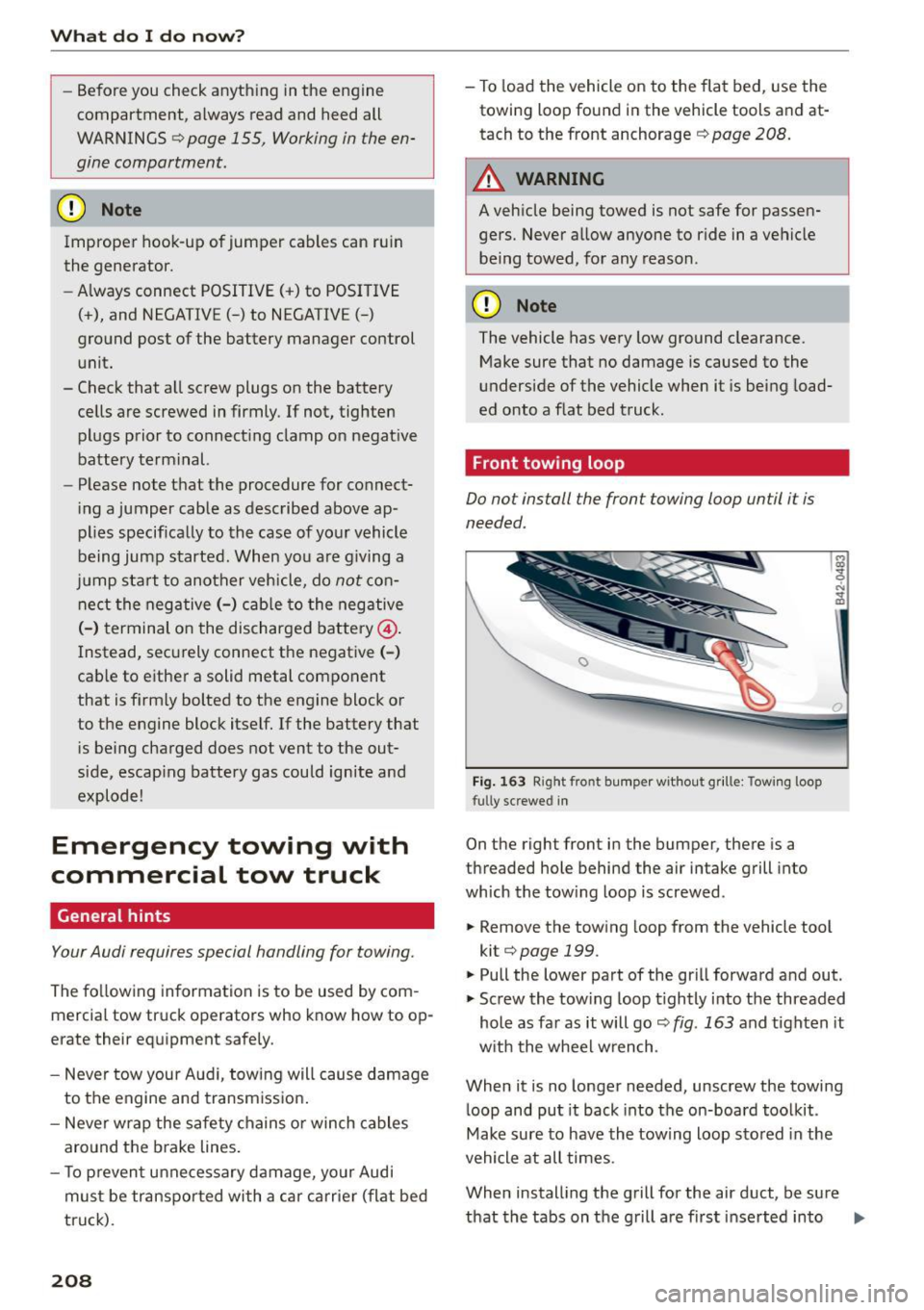
Fi g. 163 Righ t fro nt bu m per w it h ou t gr ille: Tow ing loo p
full y screwe d in
On the right front in the bumper , there is a
t h readed hole behind the air intake g rill into
which the tow ing loop is screwed .
.,. Remove the tow ing loop from the vehicle tool
kit
Q page 199 .
.,. Pull the lower part of the gr ill forward a nd out .
.,. Sc rew the tow ing loop t ightly into t he threaded
hol e as fa r as it will go
Q fig . 163 and tighten it
w ith the wheel w rench .
When it is no longer needed, unscrew the towing
l oop and put it back into the on-boa rd too lkit .
Make sure to have th e towing loop sto red in the
vehicle at all times .
When install ing the grill for the air duct, be sure
that the tabs on t he g rill a re first inserted into .,..