ignition AUDI RS5 CABRIOLET 2013 Repair Manual
[x] Cancel search | Manufacturer: AUDI, Model Year: 2013, Model line: RS5 CABRIOLET, Model: AUDI RS5 CABRIOLET 2013Pages: 286, PDF Size: 71 MB
Page 165 of 286

range, and as far away from the a irbag
as poss ible before instal ling the child
restraint.
- Always make sure that nothing pre
vents the front passenger's seat from
be ing moved to the rearmost position
i n its fore and aft adjustment range.
- Always make sure that the backrest is
in the upr ight position.
- Always buckle the child safety seat firmly
in place even i f a child is not sitting in it.
A loose ch ild safety seat can fly around
dur ing a sudden stop or in a coll is ion .
- Always read and heed all WARNINGS
whenever using a child restrained in ave
hicle is being used
c:::;,page 129, Safety
belts,
c:::;, page 137, Airbag system and
¢ page 158, Child Safety.
.8, WARNING
To reduce the risk of serious injury, make
sure tha t t he
PASSENGER AIR BAG OFF
light comes on and stays on whenever a
child rest raint is installed on the front pas
senger seat and the ignition is switched
on.
- Take the child restraint off the front pas
senger seat and install it proper ly at one
of the rear seat positions if the
PASSEN
GER AIR BAG OFF
light does not stay on.
- Have the airbag system inspected by
your authorized Aud i dealer immediate
ly.
Secure unused safety belts on the rear
seat
F ig. 160 Schematic overview: kee p un used safety be lts
away from chil dren in child safe ty seats. @-oute r rear
safety be lt
.
Child S afety 163
If a child safety seat is used on the rea r bench,
especially with LATCH universal lower ancho
rages, the unused safety belts
must be se
cured so that the child in the child restraint
cannot reach them
c:::;, &,.
-Guide the safety belt webbing @behind the
head restra int of the seat where the child re
straint is installed¢
fig. 160. When doing
so, do not engage the switchable locking re
tractor ! You should not hear a "clicking"
sound when wind ing up the safety belt.
- Let the belt retractor wind up the safety belt
webbing.
.8, WARNING
A child in a chi ld safety seat installed with
the LA TCH lower a nc ho rages or with the
stan dard safety be lt or a child in a boos ter
se at o n the rea r seat co uld play with un
used rea r seat safety belts and become en
tang led . This cou ld cause t he chi ld ser ious
personal injury and even death.
-A lways secure unused rear seat sa fe ty
be lts out of reach of children in child
seats such as by proper ly rout ing them
around the head restraint of the seat
where the ch ild restraint is installed.
- Never activate the switchable locking re
tracto r when routing the safety belts
around the head restraints.
Page 168 of 286
166 Child Safety
belts, ¢page 137, Airbag system and
c:> page 158, Important things to know.
A WARNING
If exceptional circumstances require the
use of a forward-facing child restraint on
the front passenger's seat, the child's safe
ty and well-being require that the follow ing special precautions be taken :
- Make sure the forward -facing seat has
been designed and certified by its manu
facturer for use on a front seat with a
passenger front and side airbag.
-Always follow the manufacturer's in
structions provided with the child safety
seat or infant carrier.
- Always move the front passenger seat in
to the rearmost position of the passen
ger seat's fore and aft adjustment range,
and as far away from the airbag as possi
ble before installing the child restraint .
- Always make sure that nothing prevents
the front passenger's seat from being
moved to the rearmost position in its
fore and aft adjustment range.
- Always make sure the backrest is in an
upright position.
- Make sure that the
PASSENGER AIR BAG
OFF
light comes on and stays on all the
time whenever the ignition is switched on .
- If the light does not stay on, perform the
checks ¢
page 148, Monitoring the Ad ·
vanced Airbag System.
- Take the child restraint off the front pas
senger seat and install it properly at one
of the rear seat positions if the
PASSEN
GER AIR BAG OFF
light does not stay on
whenever the ignition is switched on .
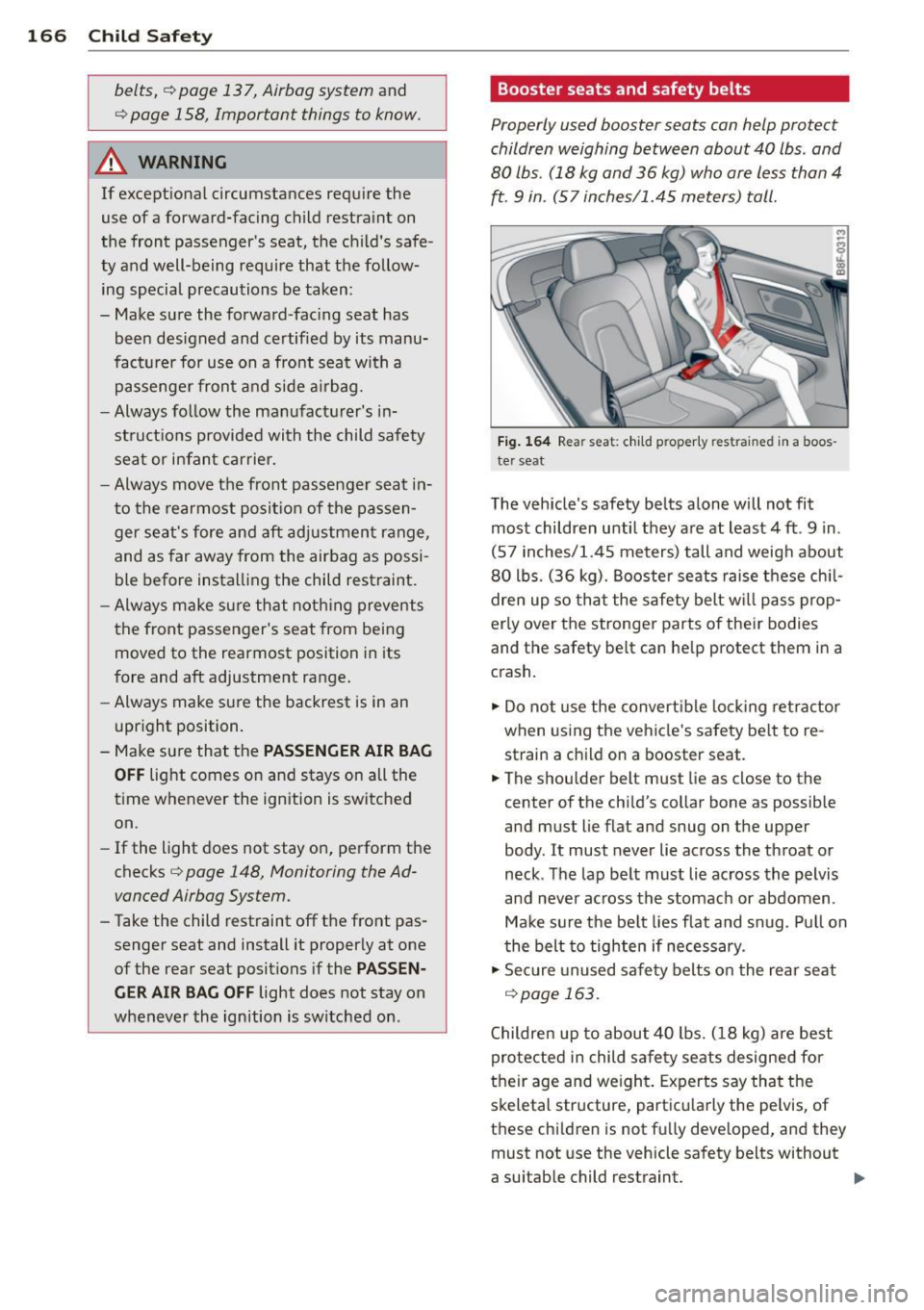
Booster seats and safety belts
Properly used booster seats can help protect
children weighing between about 40 lbs . and
80 lbs . (18 kg and 36 kg) who are
less than 4
ft. 9 in. (57 inches/1.45 meters) tall.
Fig. 164 Rea r seat : child p rop erly r estrained in a boo s
te r se at
The vehicle's safety belts alone will not fit
most children until they are at least 4
ft . 9 in .
(57 inches/1.45 meters) tall and weigh about
80 lbs.
(36 kg). Booster seats raise these chil
dren up so that the safety belt will pass prop
erly over the stronger parts of their bodies
and the safety belt can help protect them in a
crash.
.. Do not use the convertible locking retractor
when using the vehicle's safety belt to re strain a child on a booster seat.
.. The shoulder belt must lie as close to the
center of the child 's collar bone as possible
and mu st lie flat and snug on the upper
body.
It must never lie across the throat or
neck . The lap belt must lie across the pelvis
and never across the stomach or abdomen .
Make sure the belt lies flat and snug . Pull on
the belt to tighten if necessary .
.. Secure unused safety belts on the rear seat
c::>page 163.
Children up to about 40 lbs. (18 kg) are best
protected in child safety seats designed for
their age and weight. Experts say that the
skeletal structure, particularly the pelvis, of
these children is not fully developed, and they must not use the vehicle safety belts without
a suitable child res traint.
...
Page 169 of 286
It is usually best to put these children in ap
propriate booster seats. Be sure the booster
seat meets all applicable safety standards.
Booster seats raise the seating position of the
child and reposition both the lap and shoulder
parts of the safety belt so that they pass
across the child 's body in the right places. The
routing of the belt over the child's body is very
important for the child's protection, whether
or not a booster seat is used. Children age 12
and under must always ride in the rear seat.
Children who are at least 4
ft. 9 in. (57 in
ches/1.45 meters) tall can generally use the
vehicle's three point lap and shoulder belts.
Never use the lap belt portion of the vehicle's
safety belt alone to restrain any child, regard less of how big the child is. Always remember
that children do not have the pronounced pel
vic structure required for the proper function
of lap belt portion of the vehicle's three point
lap and shoulder belts. The child's safety ab
solutely req uires that a lap belt portion of the
safety belt be fastened snugly and as low as
possible around the pelvis. Never let the lap
belt portion of the safety belt pass over the
child's stomach or abdomen.
In a crash, airbags must inflate within a blink
of an eye and with considerable force. In order
to do its job, the airbag needs room to inflate
so that it will be there to protect the occupant
as the occupant moves forward into the air bag.
A vehicle occupant who is out of position and
too close to the airbag gets in the way of an
inflating airbag. When an occupant is too
close, he or she will be struck violently and
will receive serious or possibly even fatal in
jury.
In order for the airbag to offer protection, it is
important that all vehicle occupants, especial
ly any children, who must be in the front seat
because of exceptional circumstances, be
properly restrained and as far away from the
airbag as possible. By keeping room between
the child's body and the front of the passen
ger compartment, the airbag can infla te com-
Child Safety 167
pletely and provide supplemental protection
in certain frontal collisions.
A WARNING
Not using a booster seat, using the boos
ter seat improperly, incorrectly installing a
booster seat or using the vehicle safety
belt improperly increases the risk of seri
ous personal injury and death in a collision
or other emergency situation. To help re
duce the risk of serious personal injury
and/or death:
- The shoulder belt must lie as close to the
center of the child's collar bone as possi ble and must lie flat and snug on the up
per body. It must never lie across the
throat or neck. The lap belt must lie
across the pelvis and never across the
stomach or abdomen. Make sure the belt
lies flat and snug. Pull on the belt to
tighten if necessary .
- Failure to properly route safety belts
over a child's body will cause severe inju
ries in an accident or other emergency
situation
~page 129.
- The rear side of the child safety seat
should be positioned as close as possible
to the backrest on the vehicle seat .
- Children on the front seat of any car, even with Advanced Airbags, can be seri
ously injured or even killed when an air
bag inflates .
- Never let a child stand or kneel on any
seat .
- Never let a child ride in the cargo area of
your vehicle.
- Always remember that a child leaning
forward, sitting sideways or out of posi
tion in any way during an accident can be
struck by a deploying airbag. This will re
sult in serious personal injury or death .
- If you must install a booster seat on the
front passenger seat because of excep
tional circumstances the
PASSENGER
AIR BAG OFF
light must come on and
stay on, whenever the ignition is switch
ed on. •
•
-
Page 170 of 286
168 Child Saf ety
- If the PASS ENGER AIR BAG O FF li ght
does not come on and stay on, perform
the checks described
c:> page 148, Moni
toring the Advanced Airbag System .
-Take the child restraint off the front pas
senger seat and install it properly at one
of the rear seat positions if the
PASSEN
GER AIR BAG OFF
light does not stay on
whenever the ignition is switched on.
- Always read and heed all WARNINGS whenever using a child rest rained in ave
hicle is being used
c:> page 129, Safety
belts, c:>page
137, Airbag sy st em and
<:?v page 158, Important things to know.
Installing a child safety
seat
Securing a child safety seat using a
safety belt
Safety belts for the rear seats and the front
pas senger 's seat can be locked with the con
vertible locking retractor to properly secure
child safety seats.
The safe ty belts eme rgency lock ing re tractors
fo r the re ar seats safe ty belts and for the
fro nt passenger's seat safety belt have a con
vertible locking retracto r fo r child restraints.
The safety belt must be locked so that belt
webbing cannot unree l. The retractor can be
activated to lock the safety be lt and prevent
the safety belt webbing from loosening up
during normal driving . A child safety seat can
only be properly installed when the safety belt
i s locked so that the child and child safety
seat will stay in place.
A lways remember: Even thoug h your veh icle is
eq uipped w it h an Advanced A irbag system, all
ch ildren , espec ia lly those 12 yea rs and yo ung
e r, should always ride in the ba ck seat proper
l y res traine d for thei r age and weig ht.
_& WARNING
Imprope rly insta lled child sa fe ty seats in
crease the risk of ser ious personal inju ry
and death in a collision. -
Always make sure that the safety belt re
tractor is locked when insta lling a child
safety seat. An unlocked safety belt re
tractor cannot hold the child safety seat in place dur ing no rma l dr iving o r in a
crash .
- Always buckle the child safety seat firmly in place even if a ch ild is not sitt ing in it .
A loose child safety seat can fly aroun d
du ring a s udden st op or in a colli sion.
- I f the backrest is not securely la tched,
the child and the child restraint will be
throw n forward toge ther with t he ba ck
rest and will strike par ts of the vehicle
interior. The child can be se riously in
jured or killed.
- Never inst all rearward-facing child safety
seats or infant ca rr iers on the front pas
senger seat . A child will be serious ly in
jured and can be killed when the passen
ger airbag i nflates.
- The inflating airbag will h it the ch ild
safety seat or infant carrier with great
force and will smash the child safety seat
and child aga inst the back rest , center
armrest, doo r or roof.
- Always install rearward-facing ch ild safe
ty seats or infa nt carriers on the rea r
seat .
- Forwa rd-facing child safety seats or in
fant car riers installed on the front pas
senger's seat may interfere with t he de
p loyment of t he a irbag and cause serious
i njur y to the child .
-It is safer to ins tall a forward-facing
child safety seat on the rear seat.
- Always read and heed all WAR NIN GS
whe neve r using a child restrai ned in ave
h icle i s being u sed
c:> page 158. Special
p reca utions apply when ins tal ling a child
safety seat on the fron t passenger seat
c:> page 138, Child restraints on the front
seat -some important things to know.
_& WARNING
--
Always take specia l precautions if you
must install a forwa rd or rearward-facing
Page 171 of 286
child restraint on the front passenger's
seat in exceptional situations:
- Whenever a forward or rearward-facing
child restraint is installed on the front
passenger seat, the
PASSENGER AIR
BAG OFF
light must come on and stay on
whenever the ignition is switched on .
-If the PASSENGER AIR BAG OFF light
does not come on and stay on, perform
the checks described
~ page 148, Moni
toring the Advanced Airbag System .
- Take the child restraint off the front pas
senger seat and install it properly at one
of the rear seat positions if the
PASSEN·
GER AIR BAG OFF
light does not stay on
whenever the ignition is switched on.
- Improper installation of child restraints
can reduce their effectiveness or even
prevent them from providing any protec
tion.
- An improperly installed child restraint
can interfere with the airbag as it de
ploys and seriously injure or even kill the
<;hild.
- Always carefully follow the manufactur
er's instructions provided with the child
safety seat or carrier.
- Never place additional items on the seat
that can increase the total weight regis
tered by the weight-sensing mat and can cause injury in a crash.
_&. WARNING
Forward-facing child restraints:
- Always make sure the forward-facing
seat has been designed and certified by
its manufacturer for use on a front seat
with a passenger front and side airbag.
- Never put the forward-facing child re·
straint up, against or very near the in
strument panel.
- Always move the passenger seat into its
rearmost position in the seat's fore and
aft adjustment range, as far away from
the airbag as possible before installing
the forward-facing child restraint. The
Child Safety 169
backrest must be adjusted to an upright
position.
- Make sure that the
PASSENGER AIR BAG
OFF
light comes on and stays on all the
time whenever the ignition is switched
on .
_&. WARNING
"' Rearward-facing child restraints:
-A child in a rearward-facing child safety
seat installed on the front passenger
seat will be seriously injured and can be
killed if the front airbag inflates - even
with an Advanced Airbag System .
- The inflating airbag will hit the child
safety seat or infant carrier with great
force and will smash the child safety seat
and child against the backrest, center
armrest, door or roof.
-Always be especially careful if you must
install a rearward facing child safety seat
on the front passenger seat in exception
al circumstances.
-A tight tether strap on a rearward-facing
child restraint attached to the front pas
senger seat can put too much pressure
on the weight-mat in the seat and regis
ter a heavier weight in the Advanced Air bag System. The heavier weight regis
tered can make the system work as
though an adult were on the seat and de
ploy the Advanced Airbag when it must
be suppressed causing serious or even
fatal injury to the child.
- Make sure that the
PASSENGER AIR BAG
OFF
light comes on and stays on all the
time whenever the ignition is switched
on.
- If the PASSENGER AIR BAG OFF light
does not come on and stay on, immedi
ately install the rearward-facing child
safety seat in a rear seating position and
have the airbag system inspected by your
authorized Audi dealer. •
•
Page 185 of 286
functions will be available again when you
switch on the ignition and start the engine.
With the engine turned off
If you listen to the radio, for example, with
the eng ine turned off or use othe r MM I fu nc
tions, the battery is being discha rged.
I f starting capability is jeopardized due to en
e rgy consumpt ion, the fo llow ing warning ap
pears in the MMI disp lay :
Plea se start the eng ine soon or th e sys tem
w ill b e turn ed off .
The warning ind icates that the system will be
turned off automatically after 3 m inutes . If
you wish to cont inue us ing the functions , you
have to start the engine.
With the engine running
Although electrical energy is generated when
the vehicle is be ing driven, the battery can be
come discharged . Th is happens mostly when
little energy is be ing generated and a great
deal consumed and the battery's state of
charge is no t optimal.
To br ing the energy balance back into equili
b rium, consumers which require especially
l arge amounts of energy are tempo rarily cut
back or swit ched off. Heating systems in par
ticular requ ire a g reat dea l o f energy. If you
notice, fo r example, that the heated seats* or
the heated rear window are not heating, they have been temporari ly cut back or switched
off. These systems will be ava ilab le again as
soon as the energy balance has been restored.
You will a lso notice that engine idle speed has
been increased slightly . This is norma l and not
a cause for concern . By increasing engine idle
speed the add itiona l energy required is gener
ated and the battery is charged.
Int ellig ent technolog y 183
•
•
Page 188 of 286
186 Driving and en vironm ent
-Be aware that just one tank fi lling with
le a ded fuel will already seriously de
grade the performance of the catalytic
converter.
- Do not exceed the correct engine oil leve l
qpage 212.
-Do not drive until the fuel tank becomes
completely empty. The eng ine could mis
fire. Unburned fuel could also get into
the exhaust system and this could cause
t h e catalyt ic converte r to overheat.
- Do not turn off the ignition while the ve
hicle is moving.
- Do not continue to operate your vehicle
under these conditions, as otherw ise fuel
can reach the catalytic converter. This
could result in overheat ing of the co n
ve rter, req uiring its repla ceme nt.
- To assure efficient operation of the Emis
s ion Control System:
- Have your veh icle maintained properly
and in accordance with the service rec
ommendations in your Warranty
&
Ma intenance booklet.
- Lack o f proper maintenance as well as
improper use of the vehicle will impa ir
the funct ion of the emission control
system and cou ld lead to damage.
@) For the sake of the environment
Even when the Emission Control System is
operati ng properly, the exhaust gas can
have a sulfur-like exhaust gas smell under
some operating sta tes. This depends on
t he s ulfur content of the fue l being used .
Using a differe nt brand of fuel may help,
or filling the t ank w it h lead-free super
grade gaso line .
Operate your vehicle
economically and
minimize pollution
General
Your personal style of driving will determine
the economy of your vehicle, as well as ex
haust and noise levels.
F uel economy, environmenta l impact, and
wear on your engine, brakes and tires largely
depend on three factors:
- your personal driving s tyle
- oper ating conditions
- technical limitat ions
If you ant ic ipate what you need to do next and
drive economica lly, you can easily cut your
fuel consumpt ion by 10-15 percent . This sec
t ion w ill give you some tips on how you can
help the env ironment and your po cketbook.
@ Tips
The consumption estimates as published
by ENVIRON MENTAL PROTEC TION AG ENCY
( EP A) and Transpo rt Canada may no t corre
s pon d to your actual consump tion on the
r oad, which will va ry depending upon vehi
cle load and speed, road and weather con
dit ions, trip length, etc.
Drive smoothly and keep a lookout
ahead
Vehicles use the most fuel when they ore ac
celerating.
.,. Avoid unnecessary accelerating and brak ing.
Vehicles use the mos t fu el when they are ac
ce le rat ing. If yo u ant icipate what is going to
happen next, you will need to brake less and,
t hu s, acce le rate less . Let the vehicle coast
whenever possible -for examp le when you see
t h at the next traff ic light is red.
Page 189 of 286
Avoid full throttle
Driving at moderate speeds saves fuel and
improves your mileage.
""Try and keep well below your car's maximum
speed.
Accelerating gently reduces fuel consump
tion, engine wear, and does not disturb the
environment.
Fu el consumption, exhaust emissions and en
g ine noise increase disproportionately at high
speeds. If you drive at approximately three
quarters of top speed, fuel consumption will
be reduced by one half. Never drive faster
than the posted speed limit and weather con
ditions permit .
Reducing unnecessary idling
Even when your car is just idling it burns up
fuel.
""Shut the engine off when you are not driving
the vehicle.
"" Do not warm up the vehicle by letting the
engine run at idle .
It makes sense to shut
off the engine in traff ic
jams, when waiting for trains to pass at ra il
road crossings, or at traffic lights that have
l ong wa its on red. Turning the engine
off for
just
30-40 seconds saves more fue l than is
burned starting the engine again .
It takes a long time for the engine to warm up
fully when it is running at idle. However, wear
and noxious emissions are especially high
when the engine is warming up. So you should
drive away as soon as you start the engine and
avoid running at high rpms while the engine is
still warming up.
(D Note
Do not leave engine idling unattended af
ter starting . If warning lights should come
on to indicate improper operation, they
would go unheeded. Extended idling also
produces heat, which cou ld result in over-
Driving and environment 187
'
heating or othe r damage to the vehicle or
other property.
Regular maintenance
A badly tuned engine unnecessarily wastes a
lot of fuel.
""H ave your veh icle serviced at regular inter-
vals.
By having your vehicle regu larly serviced by an
au thorized Aud i dea ler helps to ensure that it
runs properly and economic all y. The condition
of your veh icle not on ly affects its safety and
ability to hold its va lue, it a lso affects
fuel
consumption .
Check your oil each time you fill your tank.
The amount of o il used is related to engine
load and speed.
It is normal for the oil consumption of a new
engine to reach its lowest value after a certain
mileage has been driven.
You must drive your vehicle about 3,000 miles
(5,000 kilometers) before you can properly
assess oil consumpt ion.
This also app lies to fue l consumption and en
gine output.
(U) Note
- Have your vehicle maintained properly
and in accordance with the service rec
ommendations in your Warranty
& Main
tenance booklet. Lack of proper mainte
nance as well as improper use of the ve
hicle will impair the function of the
emission control system and could lead
to damage.
- Do not alter or remove any component of
the Emission Control System unless ap
proved by the manufacturer.
- Do not alter or remove any device, such
as heat shields, switches, ignition wires,
valves, which are designed to protect
your vehicle's Emission Control System
and other important vehicle compo
nents .
•
•
Page 203 of 286

If the engine compartment is cleaned at any
time with grease removing solutions
1>, or if
you have the engine washed, the anti-corro
sion treatment is almost always removed as
well. It is therefore essential to have a long
lasting corrosion protection reapplied to all
surfaces , seams, joints and components in the
engine compartment .
.8, WARNING
Be aware: The engine compa rtment of any
motor vehicle is a potentially h azardous
area .
- Before working in the engine compart
ment, be s ure to read the informat ion
r=;, page207 .
-Before reaching into the front plenum
pane l, always remove the ignition key .
Otherwise, the windshield wiper system
cou ld unintentiona lly be switched on,
poss ibly causing personal injury from the
moving wiper linkage.
- Never reach into the area around or
touch the radiator fan. The auxiliary fan
is temperature controlled and can switch
on suddenly- even when the ign it ion is
off .
- Do not wash, wax or dry the engine w ith
the engine running . Moving or hot parts
could inju re you .
- Do not clean the underside of the chas
sis, fenders, wheel covers, or other hard
to reach parts w ithout protecti ng your
hands and arms. You may cut yourse lf on
s harp-edged metal parts .
- Always read and heed all WARN INGS and
othe r information
r=;, page 189.
l ) Use o nly the co rr ect clean in g s olu tio ns. Ne ve r use ga s
o line or d ie sel fuel.
Cleaning and protec tion 20 1
•
•
Page 206 of 286
204 Fuel suppl y and filli ng your fu el t ank
transport fue l to use for your lawn mower,
snow blower, etc., be very careful and al
ways observe local and state laws regard
ing the use, transportat ion and storage of
such fuel containers . Make certain the con
tainer meets industry standards (ANSI/
AS TM F852 -86) .
(D Note
Never drive your vehicle until the fuel tank
is completely empty. The irregular supply
of fuel can cause misfiring . Gasoline could
e nte r the exhaust system and damage t he
catalyt ic converter.
Refuelling
Fig. 171 Rig ht rea r veh icle s ide: Ope ning the fuel fille r
f lap
Fi g. 1 72 Fuel filler fla p with attached fuel c ap
When activating the central locking, the fuel
fi ller flap is automatically un locked or locked.
Refue l the vehicle with the ignition turned
off .
Taking th e fu el cap off
,.. Turn off the ignit ion.
,.. Press the left side of the fue l filler flap to
open it q fig .171-a rrow -.
"" Unsc rew fuel cap counter -clockwise and
hang it on the fuel filler flap
~ fig. 172 .
Refuell ing proc edur e
,.. Insert the fuel nozzle from the gasoline
pump into the fuel fille r neck as far as it will
go .
,.. Sele ct a med ium r efuelling rate so that the
no zz le switches off automatically when the
tank i s full.
Putting the fu el cap back on
,.. After fi lling your tank, twist the fuel cap
clockwise as far as it will go .
,.. Close the fue l fill er flap.
T o avoid fuel spilling or evaporating from the
fuel tank always close fuel cap properly and complete ly .
A WARNING
-
Improper refue ling or handling of fuel can
cause fire, explosion and severe burns.
- Fue l is highly flammable and can cause
severe burns and other injur ies.
- Failure to shut the engine off while refu
eling and/or to insert the pump nozzle
fully into the fuel filler neck could cause
fuel to spray out of filler neck or to over
flow . Fuel spray and overflowing fuel can
cause a fire .
- Never use a cellular telephone while re
fueling . The electromagnet ic rad iat ion
can cause sparks that can ignite fuel va
pors and cause a fire .
- Never get back into your vehicle white re
fueling .
If in exceptional circumstances
you mu st get back in your vehicle while
ref ueling, make ce rtain that you close
the door and touch metal to discharge static electricity before touching the fill
er nozzle again. Static e lectricity can
cause sparks that can ignite fuel vapors
released during ref ueling .
- Never smoke or have an open f lame any
where in or near your veh icle when refu
eling or filling a portab le fuel conta iner.
- For your safety, we strongly recommend
that you do not travel with a portable