light AUDI RS5 COUPE 2015 Owners Manual
[x] Cancel search | Manufacturer: AUDI, Model Year: 2015, Model line: RS5 COUPE, Model: AUDI RS5 COUPE 2015Pages: 254, PDF Size: 64.12 MB
Page 182 of 254
Driving and th e environment
It makes sense to shut off the engine in traffic
jams, when waiting for trains to pass at rai lroad
crossings, or at traff ic lights that have long waits
on red. Turning the eng ine off for just 30-40 sec
onds saves more fuel than is burned starting the
engine again .
It takes a long time for the engine to warm up
fully when it is running at idle. However, wear
and nox ious em issions are especially h igh when
the engine is warm ing up. So you should dr ive
away as soon as you start the engine and avoid running at high rpms while the engine is still
warming up.
{[) Note
Do not leave engine idling unattended after
starting. If warning lights should come on to
indicate improper operation, they would go
unheeded. Extended id ling a lso produces
heat, wh ich co uld resu lt in overheating or ot h
er damage to the vehicle or other property .
Regular maintenance
A badly tuned engine unnecessarily wastes a lot
of fuel.
~ Have you r vehicle se rv iced at regular i nte rva ls.
By having your vehicle regularly serviced by an
author ized Audi dealer helps to ensure that it
r u ns p roperly and economically. The condition of
your veh icle not only affe cts its safety and ability
to hold its va lue, i t also affects
fue l con sump
tion.
Ch eck your oil each tim e you fill your tank .
The amount of oil used is related to engine load
and speed .
It is normal for the oil consumption of a new en
g ine to reach its lowest value after a certain mile
age has been driven.
You must drive yo ur vehicle about 3,000 miles
(5,000 ki lometers) before you can properly as
sess o il consumption .
This a lso applies to fuel consumption and engine
output .
180
(D Note
-Have your veh icle ma intained properly and
in accordance with the service recommenda
tions in your Warranty
& Maintenance book
let. Lack of proper maintenance as well as
improper use of the vehicle will impair the
function of the emission control system and cou ld lead to damage .
- Do not alter or remove any component of the Emission Control System unless ap
proved by the manufacturer.
- Do not alter or remove any device, such as
heat shields, sw itches, ignit ion wires,
valves, which a re des igned to p rotect your
vehicle's Emission Control System and other
impo rtant vehicle components.
Fewer short trips
Fuel consumption will always be relatively high
on short trips.
~ Tr y to avoid dr iv ing sho rt distances w ith a co ld
eng ine .
The eng ine and cata lytic converter have to reach
their opt imal
op erat ing temperature to reduce
fuel consumpt io n and noxious em issions effec
tive ly.
Just after starting, a co ld eng ine in a mid -s ize car
o nly achieves a fuel economy of 6-8 m iles per
gallon (30-40 l/100 km). After about a half a
mile, fuel economy climbs to 12 mpg ( 20 l/100
k m). After about
2.5 mi les ( 4 km) , the eng ine is
at i ts p roper operating tempera ture and fuel
economy has reached a normal level. So you can
see that yo u should avo id short trips whenever
poss ib le.
The
outside temperature is also cr itical in th is re
gard. Your car cons umes more fuel in the winter
than in the summer.
Page 183 of 254
Care and cleaning
General information
Regular, proper care helps to maintain your vehi
cle's value. It can a lso be a req uirement when
submitting warranty claims for corrosion damage
and paint defects on the body.
The necessary care products can be obtained
from your a uthorized Audi dea ler . Read and fol
l ow the instructions for use on the packaging .
A WARNING
- Using cleaning and care products incorrectly
can be dangerous to your health.
- Always store cleaning and care products out of reach of children to reduce the r isk of po i
soning .
@) For the sake of the environment
-Preferably use environmentally-friendly
products when b uying cleaning agents.
- Do not dispose of leftover cleaning and care
products with h ousehold tras h.
Car washes
The longer that deposits remain on the vehicle ,
the more the s urface may be damaged . H igh
temperatures s uch as those caused by s unlight
increase the damaging effect.
Before washing, rinse off heavy deposits with
p lenty of water.
S tu bbor n depos its s uch a s bird dropp ings o r tree
sap are best removed w ith plenty of wa ter and a
microfiber cloth .
A lso, was h the unde rs ide of your vehi cle once
ro ad salt s tops be ing use d fo r t he season .
Pressure washers
When washing your ve hicles w ith a pressure
washer, always follow the operating instructions p rov ided with t he p ress ure washer. This is espe-
"' "' cially importan t in reg ard to the p ress ure and 0::
~ sp ray ing dist ance. Do not aim the spray direc tly
~ at seals on side windows, doors, the hood, the 1.1"1
~ rear lid or the sunroof * or at tires, rubber hoses, ,....,
Care and cleaning
insulat ing mater ia l, sensors * or camera lenses *.
Keep a distance of at least 16 inches (40 cm) .
D o no t remove snow and ice with a pressu re
washe r.
Never use rotary nozzles or high pressure noz
zles.
The water temperature must not be above 140 °F
(60 °C) .
Automat ic car washes
Sp ray off the ve hicle before washing .
Make sure tha t the w indows and roo f* are close d
and the windshield wipers are off . Follow inst ruc
tions from the car wash operator, especially if
there are accessor ies attached to your vehicle.
If possible, use car washes th at do not h ave
brushes.
Only use car washes whe re the vehicle rem ains
stationa ry and the w ashing eq uipmen t moves
aro und the veh icle when w ash ing and dry ing . Car
washes that move the vehicle thro ugh the car
wash using a c hain are n ot recommende d.
Washing by hand
Clean the ve hicl e s tarting fro m the top and work
i ng down using a soft sponge or cleaning b rush .
U se solven t-free cleani ng p ro du cts .
Washing vehicles with matte finish paint by
hand
To avoid d amaging the paint whe n was hing, first
r emove dus t and la rge particles from yo ur vehi
cle . Insects, g rease s pots and finge rprints are
best removed with a spec ial cleaner for matte
finish paint.
Apply t he p rod uct us ing a micro fiber cloth . To
avoi d damaging the paint surface, do not use too
much pressure.
Rinse the ve hicl e thoro ughly with water. Then
clean usi ng a neutra l shampoo and a soft mic ro
fi ber cloth .
Rinse the ve hicle thoro ughly again and le t it air
dry. Remove any wate r residue using a s ham my. .,.
181
Page 184 of 254

Care and cleaning
A WARNING
- Only wash the vehicle when the ignition is
off and follow the instructions from the car
wash operator to reduce the risk of acci
dents.
- To reduce the risk of cuts, protect yourse lf
from sharp metal components when wash
ing the underbody or the inside of the wheel
housings.
- After washing the vehicle, the braking effect may be delayed due to moisture on the
brake rotors or ice in the winter . The brakes
must be dried first w ith a few careful brake
applications.
@ Note
- If you wash the vehicle in an automatic car
wash, you must fold the exterior mirrors in
to reduce the risk of damage to the mirrors.
Power folding exterior mirrors* must only
be fo lded in and out us ing the power folding
funct ion.
- To prevent pa int damage, do not wash the
vehicle in direct sunlight .
- To reduce the risk of damage to the surface,
do not use insect removing sponges, kitchen
sponges or similar items.
- Matte finish painted vehicle components:
- To reduce the risk of damage to the sur-
face, do not use polishing agents or hard
wax.
- Never use protective wax. It can destroy
the matte finish effect.
- Do not place any stickers or magnetic
signs on vehicle parts painted with matte
finish paint. The paint could be damaged
when the stickers or magnets are re moved.
@ For the sake of the environment
On ly wash the vehicle in facilities specially de
signed for that purpose. This will reduce the
risk of dirty water contaminated with oil from
entering the sewer system.
182
-
Placing your vehicle out
of service
If you would like to take your vehicle out of serv
ice for a longer time, contact your authorized
Audi dealer or qualified repair facility. They will
advise you of important measures, such as corro
s ion protec tion , maintenance and storage proce
dures. Also follow the information about the bat
tery
~ page 196.
Page 189 of 254
"' N
0:: loo
rl I.O
"' N
"' rl
Checking and Filling Hood
Releasing and opening the engine hood
The engine hood is released from inside the vehi
cle.
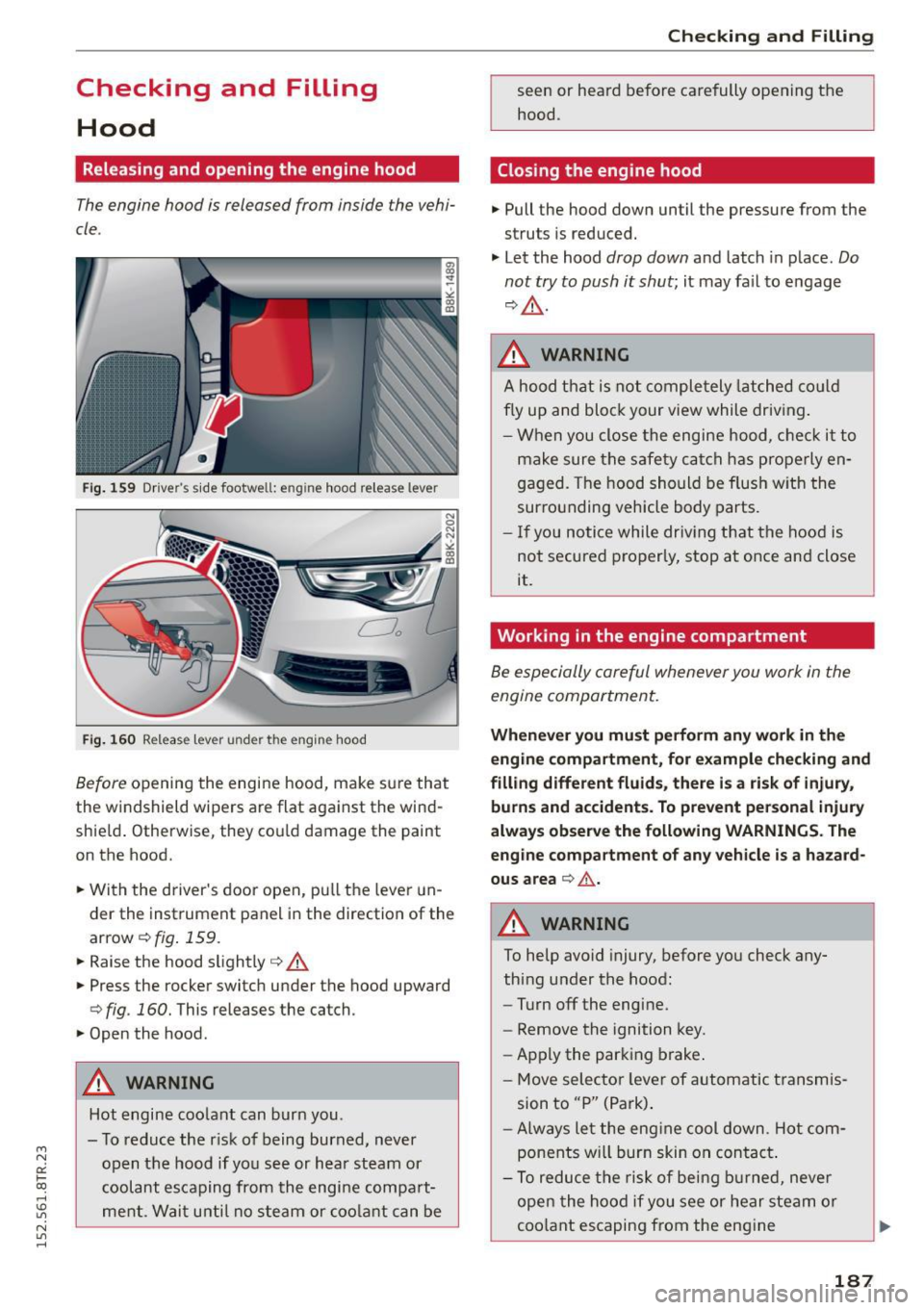
Fig. 159 Driver's side footwell: e ng in e hood release lever
Fig. 160 Releas e lev er un der t he e ngin e hood
Before opening the engine hood, make sure that
the windshield wipers are flat against the wind
shield . Otherwise, they could damage the paint
on the hood.
.. With the driver's door open, pu ll the lever un
der the instrument panel in the direction of the
arrow
c::> fig . 159.
.. Ra ise the hood slightly c::> &.
.. Press the rocker switch under the hood upward
c::> fig . 160. This releases the catch .
.. Open the hood.
A WARNING
Hot engine coolant can burn you.
- To reduce the r isk of being burned, never
open the hood if you see or hear steam or
coolant escaping from the engine compa rt
ment. Wait until no steam or coolant can be
Checking and Filling
seen or heard before carefully opening the
hood .
Closing the engine hood
.. Pull the hood down until the pressure from the
struts is reduced.
"' Let the hood
drop down and latch in place. Do
not try to push it shut;
it may fa il to engage
c::> &. -
A WARNING
A hood that is not comp letely latched could
fly up and block your view while driving.
- When you close the engine hood, check it to
make sure the safety catch has properly en
gaged . The hood should be flush with the
surrounding vehicle body parts.
- If you notice while driv ing that the hood is
not secured properly, stop at once and close
it.
Working in the engine compartment
Be especially careful whenever you work in the
engine compartment.
-
Whenever you must perform any work in the
engine compartment, for example checking and
filling different fluids , there i s a risk of injury ,
burns and accidents. To prevent personal injury
always observe the following WARNINGS . The
engine compartment of any vehicle is a hazard
ous area
c:> .&. .
A WARNING
-
To help avoid injury, before you check any-
thing under the hood:
- Turn off the engine.
- Remove the ignition key .
- Apply the parking brake.
- Move selector lever of automatic transmis-
sion to "P" (Park) .
-Always let the engine cool down. Hot com
ponents wi ll burn skin on contact .
- To reduce the risk of being burned, never
open the hood if you see or hear steam o r
coo lant escaping from the engine
187
Page 191 of 254
"' N
0:: I-co
rl I.O
"' N
"' rl
Check in g and Fillin g
Engine compartment
Engine compartment
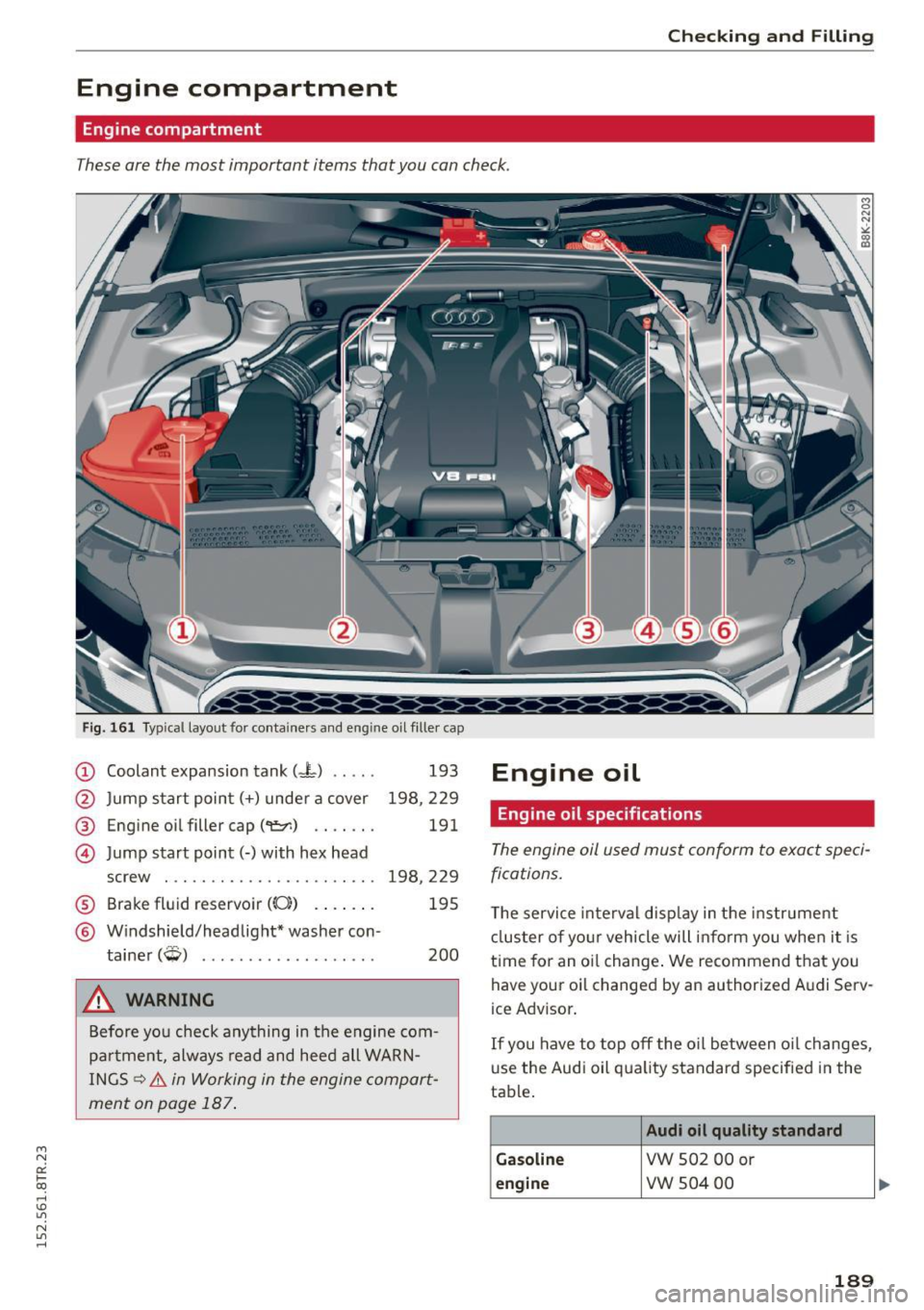
These are the most important items that you can check.
Fig. 161 Typical layout for containers and eng ine oil filler cap
(D Coolant expansion tank (.J-) .. .. .
@ Jump start point(+) under a cover
@ Engine oil filler cap(~) .... .. .
@ Jump start point(-) with hex head
screw . ............... ...... .
® Brake fluid reservoir ((0) .. .. .. .
@ Windshield/headlight* washer con-
tainer
(Q) .................. .
&, WARNING
193
198,229
191
198,229 195
200
Before you check anything in the engine com
pa rtment, always read and heed all WARN
INGS
~ .&. in Working in the engine compart
ment on page 187 .
Engine oil
Engine oil specifications
The engine oil used must conform to exact speci
fications.
T he service interval disp lay in the instr ument
cluster of your vehicle will inform you when it is
time for an oi l change. We recommend that you
have your oil changed by an authorized A udi Serv
ice Advisor .
If you have to top off the o il between o il changes,
use the Audi oil qua lity standard specified in the
table .
Audi oil quality standard
G as oline
VW S02 00 or
eng ine vw 504 00
1 8 9
Page 192 of 254
Checking and F ill in g
Using the proper engine o il is important for the
functionality and service life of the engine. Your
engine was factory-fi lled w ith a high-quality o il
which can usually be used throughout the ent ire
year.
@) Note
Your L imited New Vehicle Warranty does not
cover damage or malfunctions due to failure
to follow recommended ma intenance and use
requ irements as set forth in the Audi Ow ne r's
Manual and Wa rranty
& Ma intenance booklet .
- Use only a high quality eng ine oil t hat ex-
pressly comp lies w ith the Audi o il quality
standard specified for your vehicle's e ngine .
Using a ny other oil can cause se rious engine
damage.
- Do not mix any lubricants o r othe r addit ives
i nto the engine oil. Doing so can cause en
g ine damage.
(D Tips
If you need to add oil and there is none availa
ble that meets the Audi o il quality standard
y o ur eng ine requires, you m ay add a total of
no more than 0.5 quart/li ter o f a h igh-quali ty
"synthet ic"oil that meets the fo llowing speci
fications .
- V ehicles wi th gasoline engine: AC EA A3 o r
API SM with a viscosity grade of SAE 0W- 30,
SAE SW -30 or SAE SW-40 .
- Fo r more informa tion abo ut engine oi l that
has been approved for your vehicle, please
contact either you r a uthorized Aud i dea ler
or Audi Customer Relations at
1 (800) 822-2834 or visit o ur web site at
www .aud iusa.com or www .aud icanada .ca .
Engine oil consumption
The engine in your vehicle depends on an ade
quate amount of oil to lubricate and cool all of
its moving parts .
In order to provide effective lubrication and cool
i n g of in ternal engine components, all interna l
combustion engines consume a certai n amount
of oil. O il consumption var ies from engine to en
g ine and may change significant ly ove r the life of
190
the engine. Typically, eng ines with a specif ied
break-in period (see
¢ page 177) consume mo re
o il dur ing the b reak -in per iod than they consume
after oil consumption has stabili zed.
U nder normal cond itions , the rate of oi l con
s u mption depends on t he qu ality and viscosity of
the oil, the RPM (revolutions per minute) at
which the engine is operated, the ambient tem
perature and road condit ions. Further factors are
the amount of o il di lution from water condensa
tion or fuel residue and the ox idat ion level of the
o il. As any engine is s ubject to wear as mileage
builds up, t he oil consump tion may inc rease ove r
t ime unt il rep lacement of wo rn component s may
become necessary.
With a ll these va riab les coming into p lay, no
sta ndard ra te of oil consumpt ion can be estab
li shed or spe cified . There i s no altern ative to reg
u la r and freq uent checking o f the oil leve l, see
Note .
If the yellow e ngine oi l leve l wa rning symbo l El
in the instr ument cluster lights up, yo u should
chec k the o il level as soon as possible
¢ page 191 . Top off the oil at your ear liest con
venience ¢page 191.
A WARNING
Before you chec k anything in the eng ine com
partment, always read and heed a ll WARN
INGS¢ .&. in Working in the engine compart
ment on page 187 .
@ Note
Driving with an insufficient oi l level is likely to
cause severe damage to the engine.
(D Tips
- The oil pressu re warning display. is not
an indicator of the oil level. Do not rely on
it . Instead, check the oil level in your en
gine at regular intervals, preferably each
time you refuel, and always before going on a long trip.
- If you have the impression yo ur engine con
sumes excessive amounts of oil, we r ecom-
mend that yo u consult an au tho rized Audi .,.
Page 196 of 254
Checking and Filling
"' Place a thick rag over th e coolant expansion
tank and
carefully turn the cap counter-clock
wise
¢ ,& .
"'Read the engine coolant level inside the coolan t
expansion tank
¢ fig . 164, ¢page 189,
fig. 16 1.
With a cold engine , the coolant level
should be between the ' 'MIN" and "MAX " mark
ings
¢ fig . 165 -arrows- . When the engine is
warm, the level may be slightly above the
"MAX" marking.
"'Add coolant mixed in the correct ratio, if neces
sary ¢
page 192 . Coolant may be a maximum
of 1 mm above the MAX marking.
"' Twist the cap on again
tightly .
The location of the coolant expansion tank can be
seen in the engine compartment illustration
¢ page 189.
To obtain an accurate reading , the engine must
be switched off.
The expansion tank in your vehicle is equipped
with an electric coolant level sensor.
When the coolant level is too low, the warning
light in the Auto-Check System¢
page 17 will
blink until you add coolant and the level has been
restored to normal. Even though there is an elec
tric coolant level sensor, we still recommend you
check the coolant level from time to time.
Coolant loss
Coolant loss may indicate a leak in the cooling
system. In the event of coolant loss, the cooling
system should be inspected immediately by your
authorized Audi dealer. It is not enough merely
to add coolant.
In a
sealed system, losses can occur only if the
boiling point of the coolant is exceeded as a re
sult of overheating.
Adding coolant
Replacement engine coolant must conform to ex
act specifications ¢
page 192, Coolant.
We recommend using only coolant additive Gl2+
+ , G l3
or in an emergency Gl2+ . Do not use a
different additive . In an emergency use plain wa
ter until you can get the correct additive and can
194
restore the correct ratio. This should be done as
soon as possible.
If you have lost a considerable amount of cool
ant, then you should add cold antifreeze and cold
water only when the engine is cold.
Always use
new engine coolant when refilling.
Do not fill coolant above the "MAX" mark. Excess
coolant will be forced out through the pressure
relief valve in the cap when the engine becomes
hot.
,&_ WARNING
- The cooling system is under pressure and
can get very hot. Reduce the risk of scalding
from hot coolant by following these steps.
- Turn off the engine and allow it to cool
down .
- Protect your face, hands and arms from
escaping fluid and steam by covering the
cap with a large, thick rag .
- Turn the cap slowly and very carefully in a
counter-clockwise direction while applying
light, downward pressure on the top of
the cap .
- To avoid being burned, do not spill anti
freeze or coolant on the exhaust system or
hot engine parts. Under certain condi
tions, the ethylene glycol in engine cool
ant can catch fire.
- Antifreeze is poisonous. Always store anti
freeze in its original container and well out
of the reach of children.
- If you drain the coolant, it must be caught
and safely stored in a proper container
clearly marked "poison".
(D Note
- Do not add any type of radiator leak sealant
to your vehicle's engine coolant. Adding ra
diator repair fluid may adversely affect the
function and performance of your cooling
system and could result in damage not cov
ered by your New Vehicle Limited Warranty.
- Coolant pollutes the environment and could
-
cause an engine fire. Excess coolant will be .,.
Page 197 of 254
"' N
0:: loo
rl I.O
"' N
"' rl
forced out through the pressure relief valve
in the cap when the engine becomes hot.
- If, in an emergency, only water can be add
ed, the correct ratio between water and an
tifreeze
q page 192 must be restored as
soon as possib le.
@ For the sake of the environment
Drained coolant should not be reused . Always
dispose of used coolant while observ ing a ll
environmental regulations.
Radiator fan
The radiator fan switches on automatically by it
self.
The radiator fan is driven by the engine via the V
be lt. The viscous clutch regulates the speed of
the fan according to the temperature of the cool
ant.
An auxiliary e lectr ic radiator fan * switches on and
off depending on coo lant temperature and other
veh icle operating conditions.
Afte r you switch the engine off, the a uxiliary fan
can cont inue running for up to 10 minutes -even
with the ignition off. It can even switch on again
l ater by itself
Q .&. , if
- the temperature of the engine coolant rises due
to the heat bui ld-up from the eng ine in the en
gine compartment, or
- the engine compartment heats up because the
vehicle is parked in intense sunlight.
_& WARNING
- To reduce the r isk of personal injury never
touch the radiator fan.
- The aux iliary e lectr ic fan is temperature con
trolled and can switch on suddenly even
when the engine is not running.
- The auxiliary radiator fan switches on auto
matically when the engine coo lant reaches a
certain temperature and will continue to run
until the coolant temperature drops.
Ch eck in g and Fillin g
Brake fluid
Checking brake fluid level
The broke fluid level con be checked with a quick
glance.
F ig . 1 66 Engine compartment: Cover on the brake fluid
r eservoir
Before you check anyth ing in the engine compart
ment,
a lw ays r ead and h eed all WARNING S
q ,& in Working in the engine compartment on
page 187.
., Read the brake fluid level from the brake fluid
reservoir
q fig. 166, r:> page 189, fig. 161. The
brake fluid level must be between the "MIN"
and "MAX" markings.
The brake fluid reservo ir is located at the rear
part ition of the engine compartment on the left
s ide
q page 189.
The fluid level may drop slightly after some time
due to the automatic adjustment of the brake
pads. This is not cause for alarm.
If the brake fluid level falls
considerably below
the "MIN" mark, the brake warning/indicator
light (U.S. models:
1111 , Canad ian models: .
will come on
Q page 15 . Do not continue to oper
ate the vehicl e. The complete brake system
shou ld be thoroughly chec ked by an autho rized
A udi dealer or qualified workshop and the cause
corrected. If the brake fluid level is too low, the
brake warning/indicator light will illuminate .
Contact an a uthorized Audi dea ler
immedi ately .
(0 Tips
The brake fl uid reservoir is located under
neath the cover.
195
Page 198 of 254
Checking and F ill in g
Changing brake fluid
Have the brake fluid changed by an experienced
technician .
Brake fluid absorbs moisture from the a ir. If the
water content in the brake fluid is too high, cor
rosion in the brake system may result after a peri
od of time. The boiling point of the brake fluid
will also dec rease conside rably and dec rease
b ra ki ng perfo rman ce.
Therefore, the brake flu id must be changed
e ve ry
two y ear s.
Always use new b rake fluid wh ic h con
forms to Fede ral Motor Vehicle Standard " FMVSS
1 16 DOT 4".
The brake fluid reservoir can be difficult to reach,
therefo re , we recommend that yo u have the
b rake fluid changed by your authori zed
Audi
dealer . Your dealer has the cor re ct too ls , the
righ t brake fluid an d the know-how to do t his for
you.
A WARNING
- Brake fluid is po isonous. It must be stored
only in the closed orig inal container out of
the reach of children!
- Brake fai lure can result from old o r inappro
pr iate bra ke fluid . Observe these p recau
t ions:
- Use on ly bra ke fluid t hat meets SA E speci
fication
J 17 03 and confo rms to Fede ral
M otor Vehicle S tand ard 116 . Always check
wit h your author ized Audi dea ler to make
sure yo u are using the correct brake f lui d.
The cor rect type of b rake fluid is a lso indi
cated on the bra ke fluid reservo ir.
- The brake fluid m ust be new. Heavy use of
the bra kes can cause a va por l ock if the
brake fluid is left in the system too long.
This ca n ser iously affect the effic iency of
the brakes as we ll as your safety . This
co uld res ult in an accident.
@ Note
Brake f lu id will damage the paint of y our vehi
cle.
196
® For the sake of the environment
Because of t he prob lem of prope r disposal of
brake fluid as well as the special tools re
q uired and the necessary expert ise, we rec
ommend that yo u have the brake f lu id
changed by your autho rized Aud i dea le r.
Battery
General information
Under normal operating conditions, the battery
i n your A ud i does not need any maintenance .
With
high outside temperatures or long dai ly
drives we recommend that you have the e lectro
l yte level checked by an aut horized Aud i dea ler or
qualified workshop . The e lectrolyte leve l should
also be chec ked each time the batte ry is cha rged
¢ page 198.
Have the battery checked when you take your ve
hicle i n for service . You are well adv ised to re
place a battery that is older than 5 years .
With certain types of airbag deployment, the bat
tery is disco nnected from the ve hicle elect rical
system for safety reasons
¢ A in Repair , care
and disposal of the airbags on page 141 .
Disconnecting the battery terminals
Some vehicle functions (power window reg ula
tors, for example) are lost if the battery te rm i
nals are d isconnected . These funct ions have to be
r elearned after the battery t ermina ls are con
nected again . To prevent t his, the battery sho uld
o nl y be disconnected from the ve hicle e lectr ica l
system when absolute ly necessary fo r rep airs.
Vehicles not driven for long periods
If you do not drive your vehicle ove r a period of
several days or weeks, electrical components are gradua lly cut back or sw itched off . T his reduces
energy cons umption and mainta ins start ing ca
pabili ty ove r a longer period¢
page 175.
Some of the convenience funct ions may not ope r
ate, such as the inter ior lights or the power s eat
adjus tment . The conve nien ce f unct io ns w ill be
ava ila ble again when you tu rn on the ig nition an d
star t the eng ine. ..,..
Page 199 of 254

M N
0:: loo ,...., \!) 1.1'1
N 1.1'1 ,....,
Winter ope rati on
During the winter months, battery capacity tends
to decrease as temperatures drop. This is because
more power is also cons umed w hile starting, and
the headlights, rear window defogger, etc., are used more often.
Avoid unnecessary power consumption, particu l arly in city traffic or when traveling only short
distances. Let your authorized Audi dea ler check
the capacity of the vehicle battery before winter sets inc:>
page 198. A well charged battery will
not only prevent starting problems when the
weather is cold, but will also last longer .
@ Tips
If your vehicle is left standing for several
weeks at extremely low temperatures, the ve
hicle battery should be removed and stored
where it will not freeze. This will prevent it
from being damaged and having to be re
placed.
Working on the battery
Be especially careful when working on or near
the battery.
The battery is located in the luggage compart
ment under the floor. Before you check anything
in the luggage compa rtme nt,
re ad and heed all
WARN ING S
c:> .&_.
Always heed the saf ety warn ing s, when work ing
on the vehicle battery or the veh icle electrical
system to prevent injury.
The following WARNIN GS are v ery i mport ant
when working on the battery:
Alw ays heed the follow ing W ARNING SYM-
BOLS and safety pr ecaution s when work ing on
th e batt ery .
®
Alw ay s we ar eye p rotectio n.
A
Batter y acid conta in s s ulfu ric acid . Al-
ways wear gl oves and e ye prote cti on.
Checking and Fillin g
@
No
- sp ark s
- fl ame s
- smoking .
~
When a battery is charged, it produ ce s
. hydrogen ga s which is e xplo sive and
could cause p ersonal in jury.
®
Alw ay s ke ep the b attery well out of r each
of child ren .
_& WARNING
--
Whenever working on the battery or on the
electr ica l system, there is the risk of injury,
accident and even f ire. Read and heed the fol
low ing WARNINGS:
- Always wear eye protection. Do not let bat
tery ac id or any lead particles get on your
skin or clothing. Shield you r eyes . Explosive
gases can cause blindness or other injury.
- Battery acid conta ins sulfuric acid. Sulfuric
acid can cause blindness and severe burns .
- Always wear g loves and eye protection. Do
not tilt the battery because acid could leak
out of the ventilation openings.
- If you get battery acid in your eyes or on your skin, immediate ly rinse with cold wa
ter for several minutes and get medical at
tent ion.
- If you shou ld ingest any battery acid, seek
medica l attent ion immed iate ly.
- Do not expose the battery to an open flame,
electric sparks or an open light .
- Do not smoke .
- Do not interchange the positive and nega-
tive cables .
- When working on the battery, be s ure not to
short-circuit the terminals wi th tools or oth
er metal objects . This would cause the bat
tery to heat up very quickly, which could lead to damage or exp losion and personal
injury.
- When a battery is charged, it produces hy
drogen gas which is explos ive and could
cause personal injury.
- Always keep the battery well out of the
reach of children.
197