brake light AUDI RS5 COUPE 2015 Owner's Manual
[x] Cancel search | Manufacturer: AUDI, Model Year: 2015, Model line: RS5 COUPE, Model: AUDI RS5 COUPE 2015Pages: 254, PDF Size: 64.12 MB
Page 88 of 254
Automatic transmi ssion
"' Move the selector leve r to the D/S position to
select sport mode (5) or select the
dyn ami c
driv ing mode in drive select* ¢ page 102 .
"'Press the brake peda l strongly with your left
foot and hold it down for at least 1 second.
"' At the same time, press the accelerator pedal
down completely with your right foot until the
engine reaches and maintains a high RPM .
"' Remove your foot from t he b rake pedal w it hi n 5
seco nds ¢,& .
A WARNING
-Always adapt you r driving to the traffic flow.
- Only use the La unch Control P rogram when
road and t raff ic conditions a llow i t and oth
er drivers wi ll not be endangered or annoye d
by your driving and the veh icle's accelera
t ion.
- Please note that the driving wheels can spin
and the vehicle can brea k away w hen spo rt
mode is switched on, especially when the
road is slippery.
- Once you have accelerated, yo u should
switch sport mode off
by pressing the
I ~ OF FI button.
(D Tips
- The t ransmission tempe ratu re may inc rease
significantly after using the La unch Control
Program. If that happens, the program may
not be available for a few minutes. It will be
ava ilable again after a coo l-down period .
- When accelerat ing using the Launch Contro l
program, all vehicle pa rts a re subject to
heavy loads. This can result in increased
w ear.
Transmission malfunction
[i1 Transmission : Press brake pedal and sele ct
gear again .
Press the brake pedal and se lect the desi red se
lecto r leve r pos it ion aga in . You can then continue
d riving.
[O] Transmi ssion overheating: Please drive con
servativ ely.
86
The transm ission temperat ure has inc reased s ig
nificantly d ue to the sporty driving manner. Drive
i n a less sporty manne r until the temperature re
turns to the normal range and the indicator light
switches of.
[i1 Trans mission malfunction: You can continue
driving
The re is a system mal func tion in the t ransm is
s ion . You may contin ue driving . Drive to yo ur au
thorized Audi dea ler or qualified repa ir facility
soon to have the malfunction corrected .
[i1 Transmission malfun ction : Limited driving
functionality
There is a system malfunct ion in the t ransm is
s io n. The t ransm ission is swi tching to eme rgency
mode. This mode on ly shifts in to cer tain gears or
will no longer shift at al l. The engine may stall.
D rive to your authorized A udi dealer or qualified
repair fac ility immediately to have the mal func
tion corrected.
[il ffl Trans mission malfunction: No reverse
You can continue dri ving
There is a system malfunct ion in the t ransm is
s ion. The t ransm ission is swi tch ing to eme rgency
mode. This mode on ly shifts into certain gears or
will no longer shift at al l. The engine may sta ll.
You cannot engage the reverse gear. Drive to yo ur
authori zed Aud i dea ler or q ualified repa ir facility
i mmediately to have the malfunct ion corrected.
[i1 Transmission malfunction: Stop vehicle and
shift to park.
Do no t con tinue dr iv ing . Se lec t the P sele ctor lev
er position and see your au thorized A udi dealer
o r q ualified repai r facility for assistance.
(D Note
If th e tr ansmission swi tches to emer gen cy
mode, you should take the ve hicle to an au
thorized Audi dea lership as soon as possible
to have the condition corrected.
Page 93 of 254

"' N
0:: loo
rl I.O
"' N
"' rl
Audi adapt ive crui se cont rol and bra king gu ard
tachometer @and is also shown briefly in the
display @
i::> fig. 95.
Switching Audi adapti ve c ru ise contr ol off
~ Push the lever away from you into position @
unt il it clicks into place. The message
AC C off
appea rs .
@ Indicator lights
II -Adaptive cru ise control is switched on. No
vehicles are detected up ahead . The stored speed
i s ma inta ined.
• -A moving vehicle is detected up ahead . The
adapt ive cruise control system regulates the
speed and distance to the moving vehicle ahead
and accelerates/brakes automatically .
• -When automatic braking is not able to keep
enough d istance to a prev iously detected mov ing
vehicle up ahead, you must take control and
brake ¢
page 93, Request for driver interven
tion.
© Displa y
If adaptive cruise control is not shown in the d is
play, you can call it up with the !RESETI button
¢page 23.
Based on the symbo ls in the d isplay, you can de
termine if the system is ma inta ining a distance to
the vehicle ahead and what that distance is .
N o v ehicl e -No vehicle ahead was detected.
Wh it e v ehi cle -A vehicle ahead was detected .
Red v ehicl e -Prompt for the d river to take action
¢page 93.
Both arrows on the scale © indicate the distance
to the veh icle ahead. No arrow appears when the
vehi cle is on an open road and there is no object
ahead .
If an object is detected ahead, the arrow
moves on the scale.
The green zone on the scale shows the stored dis
tance . For informa tion on chang ing the stored
d ista nce, refe r to ¢
page 92 . If the distance se
l ected is too close or may soon become too close,
the arrows move into the red zone on the scale .
A WARNING
Improper use of the adaptive cruise control
can cause collisions, other accidents and se ri
ous personal injuries.
- Pressing the !SET ! button when driving at
speeds below 20 mph (30 km/h), w ill auto
matica lly accelerate the vehicle to 20 mph
(30 km/h), which is the mi nimum speed
that can be set.
a) Tips
- If you switch the ignit ion or the adaptive
cruise control off, the set speed is erased
from the system memo ry.
- The electronic stab ilizat ion cont rol (ESC)
and the anti-slip-reg ulat ion (ASR) are a uto
matically turned on when the adaptive
cruise contro l is turned on. Both systems
cannot be turned off if the adaptive c ruise
control is turned on .
Changing the speed
Applies to vehicles: wit h Aud i adapt ive cru ise control
0
f
•
0
Fig . 96 Se lecto r lever: chang ing the speed
~ To increase o r reduce the speed in increments,
tap the lever up or down.
~ To increase o r reduce the speed q uickly, hold
the lever up or down until the red LED @ reach
es the des ired speed ¢
page 90, fig . 95.
Following any changes, the new stored speed wi ll
be displayed briefly in the display @¢
page 90,
fig . 95.
91
Page 96 of 254

Audi adaptive cruise control and braking guard
Audi braking guard
Description
Applies to veh icles: w ith Audi adaptive cruise co ntrol
F ig. 100 Instrument cluster : approach warn ing
Braking guard uses a radar sensor. It also func
tions within the limits of the system when adap
tive cruise control is switched off.
What can Audi braking guard do?
When detected in time, the system can assess
situations when a vehicle ahead brakes suddenly
or if your own vehicle is traveling at a high speed
and approaching a vehicle up ahead that is mov
ing more slowly . Braking guard does not react if it
cannot detect the situation .
The system advises you of various situations:
- The
distance warning is given if you are too
close to the vehicle ahead for a long time. If the
vehicle ahead brakes sharply, you will not be
able to avoid a collision. The indicator light.
in the display comes on .
- The
approach warning is given when a detected
vehicle up ahead in your lane is moving much
more slowly than you are or if it brakes sharply .
When this warning is given, it may only be pos
s ib le to avoid a collision by swerving or braking
sharply. The indicator light . and indicato r in
the display will wa rn you about the danger
¢ fig. 100 . You will also hear an acoustic signa l.
If you do not react fast enough or do not react at
all to the situation, Braking guard will intervene
by braking and the message
braking guard inter
vention
will appear.
ll Thi s is not available in so me c oun tries.
94
- If a co llision is imminent, the system wi ll first
provide an
acute warning by br iefly and sharply
app ly in g the brakes.
- If you do not react to the acute warning, brak
ing guard can brake within the limits of the sys
tem. This reduces the vehicle speed in the event
of a collision.
- At speeds under 20 mph (30 km/h), the system
can initiate a complete deceleration shortly be
fore a collisionl l_
-If the braking guard senses that you are not
braking hard enough when a collision is immi
nent, it can increase the braking force.
Which functions can be controlled?
You can switch braking guard and the distance/
approach warning on or off in the radio or MMI
c> page 95, Settings in the radio/MM!.
A WARNING
Lack of attent ion can cause collisions, other
accidents and ser ious personal injuries. The
braking guard is an assist system and cannot
prevent a coll is ion by itself. The dr iver must
always intervene. The driver is always respon
sib le for braking at the correct time.
- Always pay close attent ion to traffic, even
when the braking guard is switched on. Be
ready to intervene and be ready to take com
plete control whenever necessary. Always
keep the safe and legal distance between
your vehicle and vehicles up ahead.
- Braking guard works within limits and will
not respond outside the system limits, for
examp le when approaching a stopped vehi
cle or stationary obstacle (end of a traffic
jam or vehicle that has broken down in traf
fic).
- Always remember that the radar sensor for
the braking guard works only w ith in defined
detection and range limits that may prevent
the proper detection of other vehicles.
- The radar sensor's function and range can
be reduced by rain, snow and heavy spray.
Moving vehicles up ahead may not be
-
Page 171 of 254

M N
0:: loo ,...., \!) 1.1"1
N 1.1"1 ,....,
shared, please see your contract with the
wireless telecommunications provider and the
"About Aud i connect" tab in your vehicle's
MMI*:
IMENU I button> Audi connect > About
Audi connect .
Electronic Stabilization
Control (ESC)
Description
ESC helps to improve road holding and vehicle
dynamics to help reduce the probability of skid
ding and loss of vehicle control. It works only
when the engine is running. ESC detects certain
d ifficu lt driving situations, including when the ve
hicle is beginn ing to spin (yaw) out of control and
helps you to get the vehicle back under control by
selectively braking the whee ls, and/or reducing
engine power and prov iding steer ing ass istance
to help hold the vehicle on the driver's intended
course. The indicator light
Bl in the instrument
cluster blinks when ESC is taking action to help
you control the veh icle.
ESC has limitations.
It is important to remember
that ESC cannot overcome the laws of physics. It
will not always be able to help out under all con
ditions you may come up against. For example, ESC may not always be able to help you master
situations where there is a sudden change in the
coefficient of frict ion of the road surface . Whe n
there is a section of dry road that is suddenly cov
ered with water, slush or snow, ESC cannot per
form the same way it wou ld on the dry surface. If
the vehicle hydroplanes (rides on a cushion of wa
ter instead of the road surface), ESC will not be
ab le to he lp you steer the vehicle because contact
with the pavement has been interrupted and the
vehicle cannot be braked or steered . During fast
cornering, particularly on winding roads, ESC
cannot always deal as effectively with difficult
driving situations than at lower speeds. Whe n
tow ing a trailer, ESC is not able to help you regain
con trol as it wou ld if you were no t towing a trail
er .
A lways adjust your speed and dr iving sty le to
road, traffic and weather conditions. ESC cannot
override the vehicle's physical limits, increase the
Smart Technology
available traction, or keep a vehicle on the road i f
road departure is a result of driver inattention.
Instead, ESC improves the possibility of keeping
the vehicle under control and on the road dur ing
extreme maneuvers by using the driver's steering
inputs to help keep the vehicle go ing in the in
tended direction. If you are traveling at a speed
that causes you to run off the road before ESC
can prov ide any assistance, you may not expe ri
ence the benefits of ESC.
ESC is switched on all the time . In certain situa
t ions when you need less traction, you can switch
off ASR by pressing the button
[ru ~ page 170,
fig. 152 or ~page 170, fig . 153. Be sure to
switch ASR on again when you no longer need
less traction.
T he following systems are integrated in the ESC:
Anti-lock braking system (ABS)
ABS prevents the wheels from locking up when braking. The vehicle can still be steered even dur
i ng hard braki ng. Apply steady pressure to the
brake pedal. Do not pump the pedal. A pulsing in
the brake pedal indicates that the system is he lp
ing you to brake the vehicle.
Brake assist system
The brake ass ist system can decrease braking dis
tance . It increases braking power when the driver
presses the brake peda l quickly in emergency sit
u at ions. You must press and hold the brake pedal
until t he situat ion is over. In vehicles with adap
tive cruise control*, the brake assist system is
more sensitive if the distance detected to the ve
hicle ahead is too sma ll.
Anti-slip regulation (ASR)
ASR red uces eng ine power when the drive wheels
begin to spin and adapts the force to the road
conditions. This makes it easier to start, acce le r
ate and drive up hills.
Electronic differential lock (EDL)
T he EDL brakes whee ls that are spinning and
transfers the drive power to the other wheels.
T his function is available up to about 60 mph
(100 km/h).
169
Page 174 of 254
Smart Technolog y
-Manua l retraction: At speeds up to about
10 mph (20 km/h) , retract the rear spoiler by
pressing and holding the switch. At speeds be
tween 10 mph (20 km/h) and 75 mph (120 km/h), retract the rear spoiler by tapping
on the switch
Ind icat or light
- Rear sp oile r: sy st em m alfu ncti on
The rear spoiler may not have extended due to a
malfunct ion . This cou ld change the vehicle's driv
ing characteristics at high speeds . Do not drive at
speeds above 85 mph (140 km/h) . Drive to the
nearest authorized Audi dealer or qualified repair
facility to have the malfunction corrected.
A WARNING
Dr iv ing at higher speeds w ithout the rear
spoiler deployed can impa ir handling charac
teristics, mak ing the veh icle harder to co ntrol.
- Always make sure that the spoiler is de-
ployed when driving at speeds over 85 mph
(140 km/h) . If the rear spoiler warn ing/ indi
c ator light in t he instrument cluster comes
on, the rear spoi ler may not have deployed .
- Never dr ive at speeds highe r than 85 mph
(140 km/ h) if the spoiler is not deployed.
Have the spo iler inspected as soon as possi
ble by an author ized Audi dealer or qualif ied
workshop.
- Always obey speed limi ts and o ther traffic
laws .
A WARNING ,.__.__
Improper ope ration of the rear spoiler can
cause crushing injuries .
- Always make sure that nobody, espec ia lly
children, is in the way when the rear spo iler
is deployed or retracted .
(D Note
Never push the vehicle or apply fo rce to the
rea r spo ile r - i t cou ld be damaged.
(D Tips
Clean the spo ile r compartment every 2 to 3
months. The spoiler compartment m ust al-
172
-
ways be free of ice, snow, leaves or other de bris .
Braking
What affects braking efficiency?
New brake pads
During the first 250 miles (400 km), new brake
pads do not possess their full braking e ffect, they
have to be "broken in" first¢.&. . The break -in pe
riod can be considerably longe r for vehicles with
ceramic brake rotors*. You can compensate for
th is slightly reduced braking power by pushing
harder on the brake pedal. Avoid heavy braking
loads during the b reak-in period.
Op era ting condition s and dri ving h abit s
The brakes on today's automobiles are still sub
j ect to wear, depending largely on operating con
dit ions and driving habits ¢.&, . On vehicles that
are either dr iven most ly in stop-and-go city traf
fic or are driven hard, the brake pads should be
checked by yo ur autho rized Aud i dealer more of
ten than specified in the
Warranty & Mainte·
nan ce bookl et.
Fail ure to have you r brake pads
i nspected c an resu lt in red uced b rake pe rform
ance.
On steep slopes, you shou ld use the braking ef
fect of the engine. This way, you prevent unnec
essary wear on the bra ke system. If yo u must use
you r brakes, do not hold the brakes down contin
u ously. Pump the brakes at intervals .
Operating noise
Noises may occur when brakin g depending on the
speed, braking force and ou ts ide cond itions su ch
as tempera ture and hum idity.
Due to the nature of the materials used in ceram
i c bra ke roto rs*, noises may become mo re appa
r ent at low speeds.
Effect of water and road salt
In certa in situations, for examp le after driv ing
through water, in heavy rain, after overnight con
densation or after washing your car , the braking
effect can be redu ced by moistu re or ice on the
1111>
Page 176 of 254
Smart Technolog y
-If y ou dama ge the front spo iler, or if you in
sta ll a di fferent spoile r, be sure the air flow
to the front brakes is not obstructed . Other
wise the brake system co uld overheat reduc
ing the effectiveness o f the enti re brake sys
tem .
- Failure of one brake c ircuit will impair the
braking capab ility r esult ing in a n increased
stopp ing distance. Avoid driving the veh icle
and have it towed to the nearest au thorized
Audi de aler or qualified workshop.
- Never let the vehicle ro ll to a stop with the
engine shut off .
-If the brake booster is not work ing, the
brake pedal must be pressed considerably
harder to make up for the lack of booste r as
sistance .
Electro-mechanical
power assist, dynamic
steering
The electro-mechanical power assist helps the
driver when steering .
Power steering adapts electronically based on
the vehicle speed .
Indicator lights and me ss a ges
• Steering defe cti ve! Do not dri ve vehicle!
If th is indicator light tu rns on and stays on and
this message appears, the power steering may
have fa iled .
D o
n ot co ntinue driving. See yo ur authorized
Audi dealer or a qua lified repair fac ility for assis
tance.
l;r-ij Dynamic steering : System fault! You can
c on tinu e drivin g
If the indicator light tu rns on and the message
appears, the steer ing may be more difficult to
move or mo re sensitive than usual. The steer ing
wheel may a lso be at an ang le when dr iv ing
straight.
Drive s low ly to your author ized Audi dealer or
qua lified wor kshop to have the malfunction cor
rected.
174
':r-ij Dynamic stee ring: initializing
If this drive r message appears and the indicator
li gh t is flashing on the instr ument pane l, dynam
i c s teer ing* is being rein itia lized. After sta rting
the engine, the steering wheel w ill move slightly.
Re-initialization might be necessary if the steer
i ng whee l was moved hard to the left and right
while the vehicle was not moving. The display goes out as soon as initialization is comp lete.
A WARNING
H ave the dynamic steering* system malfunc
tion repaired as soon as possible by an author ized A udi dealer or qualified wo rkshop -risk
of accident!
@ Tips
- If the . or ':rfl indicator light only stays on
for a sho rt time, you may cont inue driving.
- The dynamic steering* stab ility systems are
not availab le in the event of a system mal
function.
- For add itiona l information on dynamic
steering*, refer to~ page 101.
Driving with your quattro
With all-wheel drive, all four wheels are driven .
General information
With all-wheel drive, power is distributed to all
four wheels . This happens automatically depend
i ng on your driving style and the road conditions
at the t ime . See also ~ page 169.
A center d ifferential distributes the driving power
variably to the front and rear axle. It works to
gether w ith select ive whee l torque control, which
activates w hen d rivi ng throug h curves
~ page 170 . With the spo rt diffe rential*, power
dist ribution to the rear wheels is variab le and can
be adjusted with drive select~ page 101.
The all-whee l dr ive concept is des igned for hig h
engine power . Yo ur vehicle is exceptiona lly pow
e rfu l and has excellen t drivi ng cha racte rist ics
both unde r normal d riving condi tions and o n
snow and ice . Always read and follow sa fe ty pre-
ca utions ~& .
1111>
Page 180 of 254
Driving and th e environment
(D Tips
-Check the depth of the water before driving
through it.
- Do not stop the veh icle, drive in reverse or
switch the engine
off when driving through
water.
- Keep in mind that oncoming vehicles may
create waves that raise the water level and
make it too deep for your vehicle to dr ive
through safely.
- Avoid driving through sa lt water because it
can cause corrosion.
Warming up and cooling down
By carefully warming up and cooling down your
veh icle, you can help ensure that it is not over
stressed unnecessar ily du ring sporty dr iv ing.
When warming up, the vehicle is driven at a max imum engine speed of 6000 RPM in order to ra ise
the engine oil temperature to a m inimum of
140 °F (60 °C). T he tires also only reach their full
road holding capab ility once they have wa rmed
up.
The cooling fan can continue to run in your vehi
cle after the eng ine is switched
off. However,
d riving the vehicle to cool it dow n is part icu larly
important. During sporty d riving, the engine and
brakes , the exhaust system, and the transmission
all become extremely hot. Before you park the
vehicle, you should drive it for a few mi les/kilo
meters at light load in the low rpm range to al
low it to cool down.
Catalytic converter
It is very important that your emission control
system (catalytic converter) is functioning prop erly to ensure that your vehicle is running in on
environmentally sound manner .
.. Always use lead -free gasoline c::> page 183,
Fuel supply.
.. Never ru n the tank down a ll the way to empty.
.. Neve r pu t too m uch motor oil in your engine
c::> page 191, 't:::?: Adding engine oil .
178
.. Never try to push -or tow-start your vehicle .
The catalytic converte r is an effi cient "clean-up"
device b uilt into the exha ust system of the veh i
cle. The cata lytic conve rter burns many o f the
po llutants in the exhaust gas before they are re
l eased into the atmosphere.
The exclusive use of unleaded fue l is c ritically im
po rtant for the life of the catalytic conver ter and
proper functioning of the engine .
A WARNING
-The temperature of the exhaust system is
high, both when driving and after stopping
the engine.
- Never touch the exhaust tail pipes once they
have become hot. Th is could resu lt in burns.
- Do not park or operate the vehicle in areas
where the hot exha ust system may come in
contact with dry grass, brush, fuel spill or
other material which can cause a fire.
- Do not apply additional undercoating or rustproof ing on or near the exhaust mani
fold, exhaust pipes, catalytic converter or
heat shields. During dr iving, the substance
used for unde rcoat ing could overheat and
cau se a fire.
@ Note
- Be aware that just one tank fill ing with lead
ed
fuel w ill al ready ser iously degrade the
performance of the catalytic converter.
- Do not exceed the correct engine oil level
c::>poge 191.
-Do not drive until the fue l tank becomes
completely empty . T he engine cou ld m isfire .
Unburned fu el could also get into the ex
haus t sys tem a nd this could cause the cata
lyt ic converte r to overheat.
- Do not turn
off the ignition while the vehicle
is
moving.
- Do not continue to operate your veh icle un
der these condi tions, as otherwise f uel can
re ach the cat aly tic converter. This could re
s u lt in ove rheat ing of the c onve rter, requ ir
ing its replacement .
- T o assure efficient oper ation of the Emission
~
Cont ro l System: ..,_
Page 181 of 254

M N
0:: loo ,...., \!) ..,.,
N ..,., ,....,
-Have your veh icle maintained properly and
in accordance with the service recommen
dations in your Warranty
& Maintenance
book let.
- Lack of proper maintenance as well as im
proper use of the vehicle will impair the
function of the emission control system and could lead to damage.
@ For the sake of the environment
Even when the Emission Control System is op
erating properly, the exhaust gas can have a
sulfur-like exhaust gas smell under some op
erating states. This depends on the sulfur
content of the fuel being used . Using a differ
ent brand of fuel may help, or filling the tank
w ith lead-free super grade gasoline.
Shutting down vehicle
If you wou ld like your vehicle to remain inopera
tive for a longer period of time, contact an Audi
or other specialized dealer. T hey can advise you
on necessary precautions e.g. corrosion preven
tion, maintenance and storage. Pay attention to
additional information concerning the battery. Refer to
c:;, page 196.
Economical and environ
mentally-friendly driving
General
Your personal style of driving will determine the
economy of your vehicle, as well as exhaust and
noise levels.
Fu el economy, environmental impact , and wear
on your engine, brakes and tires largely depend
on three factors:
- your personal driving style
- operating conditions
- technical limitations
If you anticipate what you need to do next and
drive economically, you can easily cut your fue l
consumption by 10-15 percent. This sect ion will
give you some tips on how you can help the envi
ronment and your pocketbook .
Driving and the environment
(D Tips
The consumption estimates as published by
ENVIRONMENTAL PROTECTION AGENCY (EPA)
and Transport Canada may not correspond to
your actual consumption on the road, which
will vary depending upon vehicle load and
speed, road and weather conditions, tr ip
l ength, etc.
Drive smoothly and keep a lookout ahead
Vehicles use the most fuel when they are acceler
ating .
.. Avoid unnecessary accelerating and braking .
Vehicles use the most fuel when they are acceler
ating. If you anticipate what is going to happen next, you will need to brake less and , thus, accel
erate less. Let the veh icle coast whenever possi
ble -for example when you see that the next traf
fic light is red.
Avoid full throttle
Driving at moderate speeds saves fuel and im
proves your mileage .
.. Try and keep well below your car's maximum
speed.
Acce lerating gently reduces fue l consumption,
engine wear, and does not disturb the environ
ment .
Fuel consumpt ion, exhaust emiss ions and engine
noise increase disproportionately at high speeds.
If you drive at approximate ly three quarters of
top speed, fue l consump tion will be reduced by
one half. Never drive faster than the posted
speed l imit and weather cond itions permit .
Reducing unnecessary idling
Even when your car is just idling it burns up fuel.
.. Shut the eng ine off when you are not driving
the vehicle.
.. Do not warm up the vehicle by letting the en-
gine run at idle .
ll>
179
Page 184 of 254

Care and cleaning
A WARNING
- Only wash the vehicle when the ignition is
off and follow the instructions from the car
wash operator to reduce the risk of acci
dents.
- To reduce the risk of cuts, protect yourse lf
from sharp metal components when wash
ing the underbody or the inside of the wheel
housings.
- After washing the vehicle, the braking effect may be delayed due to moisture on the
brake rotors or ice in the winter . The brakes
must be dried first w ith a few careful brake
applications.
@ Note
- If you wash the vehicle in an automatic car
wash, you must fold the exterior mirrors in
to reduce the risk of damage to the mirrors.
Power folding exterior mirrors* must only
be fo lded in and out us ing the power folding
funct ion.
- To prevent pa int damage, do not wash the
vehicle in direct sunlight .
- To reduce the risk of damage to the surface,
do not use insect removing sponges, kitchen
sponges or similar items.
- Matte finish painted vehicle components:
- To reduce the risk of damage to the sur-
face, do not use polishing agents or hard
wax.
- Never use protective wax. It can destroy
the matte finish effect.
- Do not place any stickers or magnetic
signs on vehicle parts painted with matte
finish paint. The paint could be damaged
when the stickers or magnets are re moved.
@ For the sake of the environment
On ly wash the vehicle in facilities specially de
signed for that purpose. This will reduce the
risk of dirty water contaminated with oil from
entering the sewer system.
182
-
Placing your vehicle out
of service
If you would like to take your vehicle out of serv
ice for a longer time, contact your authorized
Audi dealer or qualified repair facility. They will
advise you of important measures, such as corro
s ion protec tion , maintenance and storage proce
dures. Also follow the information about the bat
tery
~ page 196.
Page 189 of 254
"' N
0:: loo
rl I.O
"' N
"' rl
Checking and Filling Hood
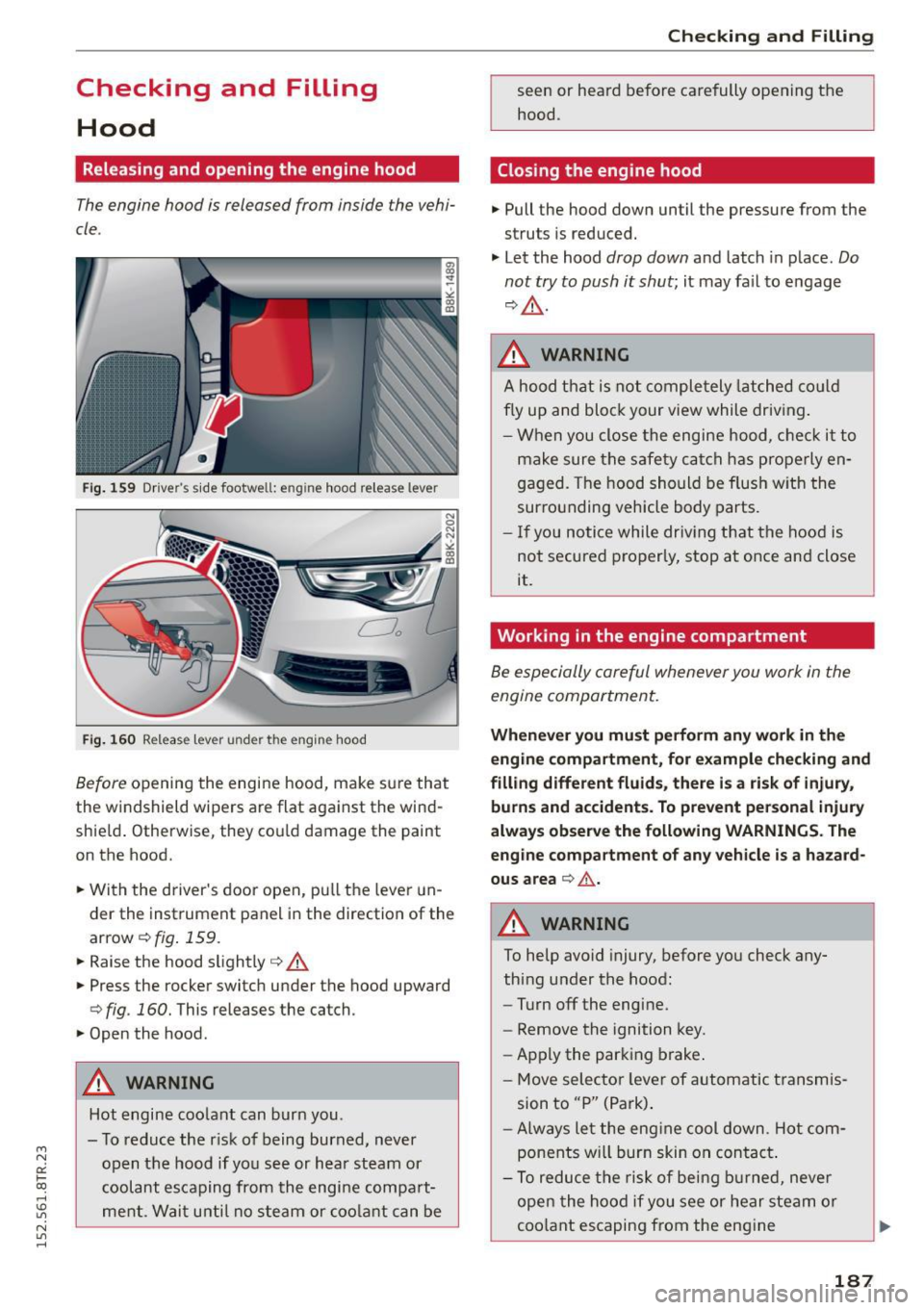
Releasing and opening the engine hood
The engine hood is released from inside the vehi
cle.
Fig. 159 Driver's side footwell: e ng in e hood release lever
Fig. 160 Releas e lev er un der t he e ngin e hood
Before opening the engine hood, make sure that
the windshield wipers are flat against the wind
shield . Otherwise, they could damage the paint
on the hood.
.. With the driver's door open, pu ll the lever un
der the instrument panel in the direction of the
arrow
c::> fig . 159.
.. Ra ise the hood slightly c::> &.
.. Press the rocker switch under the hood upward
c::> fig . 160. This releases the catch .
.. Open the hood.
A WARNING
Hot engine coolant can burn you.
- To reduce the r isk of being burned, never
open the hood if you see or hear steam or
coolant escaping from the engine compa rt
ment. Wait until no steam or coolant can be
Checking and Filling
seen or heard before carefully opening the
hood .
Closing the engine hood
.. Pull the hood down until the pressure from the
struts is reduced.
"' Let the hood
drop down and latch in place. Do
not try to push it shut;
it may fa il to engage
c::> &. -
A WARNING
A hood that is not comp letely latched could
fly up and block your view while driving.
- When you close the engine hood, check it to
make sure the safety catch has properly en
gaged . The hood should be flush with the
surrounding vehicle body parts.
- If you notice while driv ing that the hood is
not secured properly, stop at once and close
it.
Working in the engine compartment
Be especially careful whenever you work in the
engine compartment.
-
Whenever you must perform any work in the
engine compartment, for example checking and
filling different fluids , there i s a risk of injury ,
burns and accidents. To prevent personal injury
always observe the following WARNINGS . The
engine compartment of any vehicle is a hazard
ous area
c:> .&. .
A WARNING
-
To help avoid injury, before you check any-
thing under the hood:
- Turn off the engine.
- Remove the ignition key .
- Apply the parking brake.
- Move selector lever of automatic transmis-
sion to "P" (Park) .
-Always let the engine cool down. Hot com
ponents wi ll burn skin on contact .
- To reduce the risk of being burned, never
open the hood if you see or hear steam o r
coo lant escaping from the engine
187