door lock AUDI RS5 COUPE 2015 Owner's Manual
[x] Cancel search | Manufacturer: AUDI, Model Year: 2015, Model line: RS5 COUPE, Model: AUDI RS5 COUPE 2015Pages: 254, PDF Size: 64.12 MB
Page 85 of 254
"' N
0:: loo
rl I.O
"'
(Neutral) for more than approximately 2 seconds,
without the brake pedal being pressed.
Release button
The release button on the selector lever prevents
the lever from being accidentally shifted into cer
tain positions. Depending on the direction of the
shift, the selector lever locks at different posi
tions . The positions are highlighted in the i llus
tration ¢
fig. 84.
Ignition key safety interlock
The key cannot be removed from the ignition un
l ess the selecto r lever is in the P park position .
When the ignition key is removed, the selector
lever will be locked in the P position.
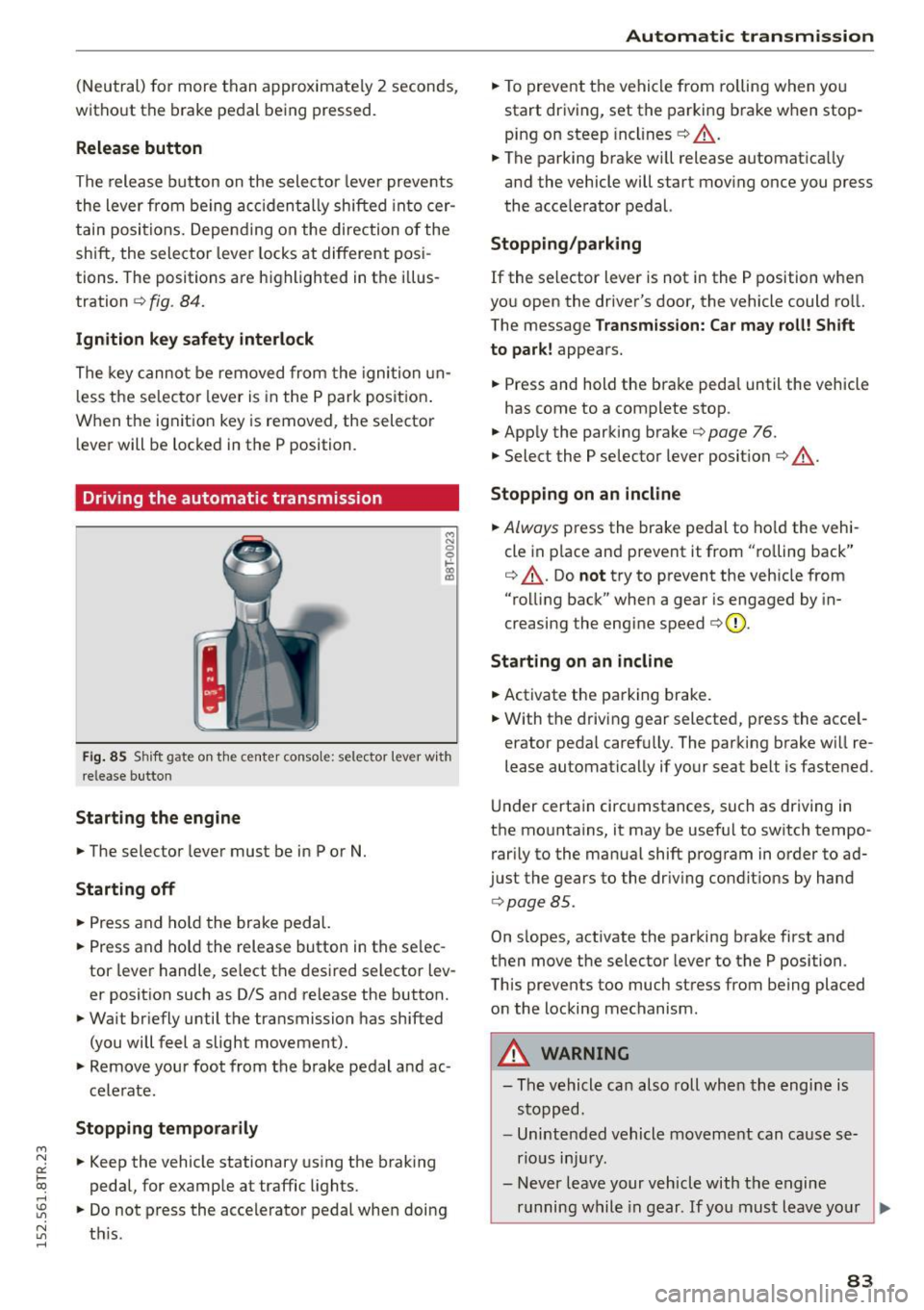
Driving the automatic transmission
M N 0 0 .,:.
gi
Fig. 85 Shift gate on the center conso le: selector lever with
release butto n
Starting the engine
.,. The selector lever must be in P or N.
Starting off
.,. Press and hold the brake pedal.
.,. Press and ho ld the release button in the se lec
tor lever handle, select the desired selector lev
er position such as D/S and release the button.
.,. Wait briefly until the transmission has shifted
(you will feel a slight movement).
.,. Remove your foot from the brake pedal and ac
celerate.
Stopping temporarily
.,. Keep the vehicle stationary using the braking
pedal, for example at traffic lights.
.,. Do not press the accele rator pedal when doing
~ t hi s. rl
Automatic transmission
.,. To prevent the vehicle from rolling when you
start driving, set the parking brake when stop
ping on steep inclines¢ &_.
.,. The parking brake wi ll release automatica lly
and the vehicle will start moving once you press
the acce lerator pedal.
Stopping /parking
If the selector lever is not in the P position when
you open the driver's door, the vehicle could ro ll.
The message
Transmission: Car may roll! Shift
to park!
appears.
.,. Press and hold the brake peda l until the vehicle
has come to a complete stop.
.. App ly the parking brake¢
page 76.
.,. Select the P selector lever posit ion ¢ &_ .
Stopping on an incline
.,. Always press the brake pedal to hold the vehi
cle in p lace and prevent it from "ro lling back"
¢ &_ . Do
not try to prevent the veh icle from
"rolling back" when a gear is engaged by in
creasing the engine speed ¢(D .
Starting on an incline
.,. Activate the parking brake .
.,. With the driving gear selected, press the acce l
erator pedal carefu lly. The parking brake will re
lease automatically if your seat belt is fastened.
Und er certain circumstances, such as driving in
the mountains, it may be useful to switch tempo rarily to the manual shift program in order to ad
just the gears to the driving conditions by hand
¢page 85 .
On s lopes, activate the parking brake first and
then move the selector lever to the P position.
This prevents too much stress from being placed on the locking mechanism .
_& WARNING
-
-The vehicle can also roll when the engine is
stopped.
- Unintended vehicle movement can cause se
rious injury.
- Never leave your vehicle with the engine
running while in gear. If you must leave your
~
83
Page 119 of 254

"' N
0:: loo
rl I.O
"' N
"' rl
Storing cargo correctly
Loading the luggage compartment
All luggage and other objects must be properly
stowed and secured in the luggage compart
ment.
Fig . 120 Safe load position ing: place heavy objects as low
and as far forwa rd as poss ible.
"' N .,. ~ ,,: CX) ID
Loose items in the luggage compartment can
shift suddenly, changing vehicle handling charac
teristics. Loose items can also increase the risk of
serious personal injury in a sudden veh icle ma
neuver or in a coll is ion.
,.. Distribute the load evenly in the luggage com
partment.
,.. Always place and p roperly secure heavy items in
the luggage compartment as low and as far for
ward as possible
¢ fig . 120.
,.. Secure the load with the cargo net* or with
non-elastic straps secured to the tie-downs
Qpage 64.
,.. Make sure that the rear seatback is securely
latched in place.
A WARNING
Improperly stored luggage or other items can
fly through the veh icle causing serious per
sonal injury in the event of ha rd braking or an
accident. To help reduce the r isk of serious
personal injury:
- Always put objects, for examp le, luggage or
other heavy items in the luggage compart
ment.
- Always secure objects in the luggage com
partment us ing the tie-down eye lets and
suitable straps.
Dri vin g s afe ty
A WARNING
-Heavy loads wi ll influence the way your vehi-
cle handles . To help reduce the risk of a loss
of control leading to serious personal injury:
- Always keep in mind when transporting
heavy objects, that a change in the center of
grav ity can also cause changes in vehicle
handling:
- Always distribute the load as evenly as
possible .
- Place heavy objects as far forward in the
luggage compartment as possib le .
- Never exceed the Gross Axle We ight Rating
or the Gross Vehicle Weight Rating specified
on the safety compliance s ticker on the left
door jamb. Exceeding permissib le weight
standards can cause the vehicle to slide and
handle differently .
- Please observe information on safe dr iving
¢page 111 .
A WARNING
-To help prevent poisonous exhaust gas from
being drawn into the vehicle, always keep the
rear lid closed wh ile driving.
- Never transport objects la rger than those
fitting completely into the luggage area be
cause the rear lid cannot be fully closed .
- If you absolutely must dr ive with the rear lid
open, observe the following notes to reduce
the risk of poisoning:
- Close all windows,
- Close the s unroof,
- Open all a ir outlets in the ins trumen t pan-
el,
- Switch off the air recirculat ion,
- Set the fresh air fan to the highest speed.
A WARNING
-A lways make sure that the doors , all windows,
the sunroof and the rear lid are securely
closed and locked to reduce the risk of injury
when the vehicle is not being used.
- After closing the rear lid, always make sure that it is properly closed and locked.
~
117
Page 158 of 254

Child safety
The airbag on the passenger side makes the front
seat a potentially dangerous place for a child to
ride. The front seat is not the safest place for a
child in a forward-facing child seat. It is a very
dangerous place for an infant or a larger child in
a rearward -facing seat .
A WARNING
Not using a child safety seat, using the wrong
child safety seat or improperly installing a
child restraint increases the risk of serious
personal inju ry and death in a crash.
- Never install rearward-facing child safety
seats or infant carriers on the front passen
ger seat -even w ith an Advanced Airbag Sys
tem . A child will be seriously injured and can
be killed when the inflating airbag hits the
child safety seat or infant carrier with great
force and smashes the child safety seat and
child against the backrest, center armrest,
door or roof¢
page 129, Child restraints on
the front seat -some important things to
know .
-Always install rearward -facing child safety
seats or infant carriers on the rear seat.
- Never install a rearward-facing child re
straint in the forward-facing direction. Such restraints are designed for the special needs
of infants and very small children and can
not protect them properly if the seat is for
ward-facing .
- If you must install a rearward facing child
safety seat on the front passenger seat be
cause of exceptional circumstances and the
PASSENGER AIR BAG OFF light does not
come on and stay on, immediately install
the rearward-facing child safety seat in a
rear seating position and have the airbag
system inspected by your authorized Audi
dealer.
- Always read and heed all WARNINGS when
ever using a child restrained in a vehicle is
being used
~ page 120, Safety belts,
~ page 128, Airbag system and
¢ page 150, Important information.
156
Convertible child safety seats
Properly used convertible child safety seats can
help protect toddlers and children over age one who weigh between 20 and 40 lbs. (9 and 18 kg)
in a crash .
Fig. 143 Schem atic ove rview: instal la ti on of the attach
ments applicable to a LATCH seat
Fig. 144 Sc hematic ove rview : instal lat ion of the seat using
t he vehicl e's sa fet y bel t system
.. When using the vehicle safety belt to install a
child safety seat, you must first activate the
convertible locking retractor on the safety belt
to prevent the child safety seat from moving
¢
page 159 or install the seat using the LATC H
attachments.
.,. Push the chi ld safety seat down with your full
weight to get the safety belt really tight so that
the seat cannot move forward or sideways more
than one inch (2.5 cm)
~ page 159.
.. If the child safety seat is equipped with a tether
strap, attach it to the tether anchors
¢page 165.
.. Secure unused safety belts on the rear seat
¢ page 155.
A toddler or child is usually too large for an in
fant restraint if it is more than one year old and
weighs more than 20 lbs . (9 kg) .
IJJ,,
Page 162 of 254
Child safety
A WARNING
Improperly installed child safety seats in
crease the risk of serious personal injury and
death in a collision .
- Always make sure that the safety belt re
tractor is locked when installing a child safe
ty seat . An unlocked safety belt retractor
cannot hold the child safety seat in place
during normal driving or in a crash.
- Always buckle the child safety seat firmly in
place even if a child is not sitting in it. A
loose child safety seat can fly around during
a sudden stop or in a collision.
- If the backrest is not securely latched, the
child and the child restraint will be thrown
forward together with the backrest and will
strike parts of the vehicle interior. The child
can be seriously injured or killed.
- Never install rearward-facing child safety seats or infant carriers on the front passen
ger seat . A child will be seriously injured and
can be killed when the passenger airbag in
flates.
- The inflating airbag will hit the child safety
seat or infant carrier with great force and
will smash the child safety seat and child
against the backrest, center armrest, door or roof.
- Always install rearward-facing child safety
seats or infant carriers on the rear seat.
- Forward-facing child safe ty seats or infant
carriers installed on the front passenger's
seat may interfere with the deployment of
the airbag and cause serious injury to the child.
- It is safer to install a forward-facing child
safety seat on the rear seat.
- Always read and heed all WARNINGS when
ever using a child restrained in a vehicle is
being used~
page 150 . Special precautions
apply when installing a child safety seat on
the front passenger seat~
page 129, Child
restraints on the front seat -some impor
tant things to know.
160
A WARNING
-
Always take special precautions if you must
install a forward or rearward-facing child re
straint on the front passenger's seat in excep
tional situations:
- Whenever a forward or rearward -facing
child restraint is installed on the front pas
senger seat, the
PASSENGER AIR BAG OFF
light must come on and stay on whenever
the ignition is switched on.
- If the PASSENGER AIR BAG OFF light does
not come on and stay on, perform the
checks described ~
page 138, Monitoring
the Advanced Airbag System.
- Take the child restraint off the front passen
ger seat and install it properly at one of the
rear seat positions if the
PASSENGER AIR
BAG OFF
light does not stay on whenever
the ignition is switched on.
- Improper installation of child restraints can
reduce their effectiveness or even prevent
them from providing any protection.
- An improperly installed child restraint can
interfere with the airbag as it deploys and
seriously injure or even kill the child .
- Always carefully follow the manufacturer 's
instructions provided with the child safety
seat or carrier.
- Never place additional items on the seat
that can increase the total weight registered
by the weight-sensing mat and can cause in
jury in a crash .
A WARNING
Forward-facing child restraints:
- Always make sure the forward-facing seat
has been designed and certified by its man
ufacturer for use on a front seat with a pas
senger front and side airbag .
- Never put the forward-facing child restraint up , against or very near the instrument pan
el.
-Always move the passenger seat into its
rearmost position in the seat's fore and aft
-
Page 163 of 254
M N
0:: loo ,...., \!) ..,.,
N ..,., ,....,
adjustment range, as far away from the air
bag as possible before installing the for
ward-facing child restraint. The backrest must be adjusted to an upright position .
- Make sure that the
PASSENGER AIR BAG
OFF
light comes on and stays on all the time
whenever the ignition is switched on .
A WARNING
Rearward-facing child restraints:
- A child in a rearward-facing child safety seat
installed on the front passenger seat will be
seriously injured and can be killed if the
front airbag inflates -even with an Ad
vanced Airbag System.
- The inflating airbag will hit the child safety
seat or infant carrier with great force and
will smash the child safety seat and child
against the backrest, center armrest, door
or roof.
- Always be especially careful if you must in
stall a rearward facing child safety seat on
the front passenger seat in exceptional cir
cumstances.
- A tight tether strap on a rearward-facing
child restraint attached to the front passen
ger seat can put too much pressure on the
weight-mat in the seat and register a heavi er weight in the Advanced Airbag System .
The heavier weight registered can make the
system work as though an adult were on the
seat and deploy the Advanced Airbag when
it must be suppressed causing serious or
even fatal injury to the child.
- Make sure that the
PASSENGER AIR BAG
OFF
light comes on and stays on all the time
whenever the ignition is switched on.
- If the PASSENGER AIR BAG OFF light does
not come on and stay on, immediately in
stall the rearward-facing child safety seat in
a rear seating position and have the airbag
system inspected by your authorized Audi
dealer.
Child safety
Activating the convertible locking retractor
Use the convertible locking retractor to secure a
child restraint .
Always heed the child safety seat manufacturer's
instruc tions when installing a child restrain t in
your vehicle . To activate the convertible locking
retractor:
.. Place the child restraint on a sea t, preferably on
the rear seat.
.. Slowly pull the belt
all the way out .
.. Route it around or through the child restraint
belt path
~ . & .
.. Push the child safety seat down with your full
weight to get the safety belt really tight.
.. Insert the belt tongue into the buckle for that
seating posit ion.
.. Guide the saf ety belt back into the retractor un
til the belt lies flat and snug on the child safety
seat .
.. You should hear a "clicking" noise as the belt
winds back into the inertia reel. Test the con
vertible locking retractor by pulling on the belt .
You should no longer be able to pull the belt
out of the retractor. The convertible locking re
tractor is now activated .
.. Make sure that the red release button is facing
away from the child restraint so that it can be
unbuckled quickly.
.. Pull on the belt to make sure the safety belt is
properly tight and fastened so that the seat
cannot move forward or sideways more than
one inch (2 .5 cm) .
A WARNING
Using the wrong child restraint or an improp
erly installed child restraint can cause serious
personal injury or death in a crash .
- Always make sure that the safety belt re
tractor is locked when installing a child safe
ty seat. An unlocked safety belt retractor
cannot hold the child safety seat in place
during normal driving or in a crash.
- Always buckle the child safety seat firmly in place even if a child is not sitting in it. A
loose child safety seat can fly around during
a sudden stop or in a crash. ..,.
161
Page 187 of 254

"' N
0:: loo
rl I.O
"' N
"' rl
the exhaust system and damage the catalytic
converter.
Refuelling
Fig . 155 Rig ht re ar v ehicl e sid e: Op enin g the fuel fille r flap
Fig. 156 Fuel f ill er fla p with atta ched fuel cap
When activating the central locking, the fuel fi ll
er flap is automatically un locked or locked . Re
fuel the veh icle with the ignition turned
off.
Taking the fuel cap off
~T urnoff the ignition.
~ Press the left side of the fue l filler flap to open
it
q fig. 155 -arrow -.
~ Unscrew fuel cap count er-clockw ise and hang it
on the fuel filler flap~
fig. 156.
Refuelling procedure
~ Insert the fuel nozzle from the gasol ine pump
into the fuel filler neck as far as it will go.
~ Select a medium refuelling rate so that the
nozzle switches off automat ica lly when the
tank is full.
Putting the fuel cap back on
~ After filling your tank, tw ist the f uel cap clock
wise as far as it wi ll go.
~ Close the fuel filler flap.
Fuel and Refueling
To avoid fuel spilling or evaporating from the fuel
tank always close fue l cap proper ly and com
pletely .
A WARNING
--
Improper refueling or handling of fuel can
cause fire, explosion and severe burns.
- Fuel is highly flammable and can cause se
vere burns and other injuries.
- Failure to shut the engine off while refuel
ing and/or to insert the pump noz zle fully
into the fue l filler neck could cause fuel to
spray out of filler neck or to overflow . Fuel
spray and overflowing fuel can cause a fire.
- Never use a cellular telephone while refuel
ing. The electromagnetic radiation can
cause sparks that can ignite fuel vapors and
cause a fire .
- Never get back into your vehicle while refu
eling. If in exceptional circumstances you
must get back in your vehicle whi le refuel
ing, make certain that you close the door
and touch metal to discharge static electric
ity before touching the filler nozzle again.
Static electricity can cause sparks that can ignite fue l vapors re leased during refueling.
- Never smoke or have an open f lame any
where in or near your vehicle when refueling
or filling a portable fue l conta iner .
- For your safety, we strongly recommend
that you do not travel with a portable f uel
container in your vehicle. The container, full
or empty may leak and cou ld cause a fire,
especially in a crash.
- If, under exceptional circumstances, you
must transport a portable fuel container,
ple ase observe the following:
- Never fill a portable fuel container while it
is anywhere in or on the veh icle (for exam
ple, in the luggage compartment, or on
the trunk). Static e lectricity can build up
while filling and can ignite fuel vapors
causing a f ire.
- Always place a portab le fue l container on
the ground before filling .
185
Page 188 of 254

Fuel and Refueling
-Always keep the fi ller nozzle completely
inside the portable container before and
during filling.
- If filling a portable container made of
metal, the filler nozzle must always be in
contact with the container. This will help
prevent static electricity from discharging
and cause a fire .
-Never sp ill fuel inside the vehicle or lug
gage compartment. Fuel vapors are highly
flammab le.
-Always observe local and state/provincia l
laws regarding the use, storage and trans
portat ion of fuel containers.
- Make certain the fuel container meets in
dustry standards (ANSI/ ASTM F852 -86) .
(D Note
If any fuel has spilled onto the car, it should
be removed immediately to prevent damage
to the paint .
@ For the sake of the environment
As soon as the correctly operated nozzle
switches off automatically for the first time,
the tank is full. Do not try to add more fuel
because fuel may spill out . In addition, the
expansion space in the fuel tank will be filled·
causing the fuel to overflow when it becomes
warm and pollute the environment.
(j) Tips
- Running your engine while refuelling may
cause vapors to escape or even cause fuel to
sp il l out of the tank . This wo uld then shut
off the fuel nozzle before the tank is full.
- Do not refuel your veh icle with the ignition
turned on. The fuel gauge may otherwise
not indicate the correct fuel level after refu
elling.
- The fuel filler flap of your vehicle is not
l ocked when you lock the vehicle from the
inside .
186
Unlocking the fuel filler flap by hand
You can open the fuel filler flap by hand if the
power locking system should fail .
Fig. 157 Luggage compartme nt: ope ning the side trim
Fig. 158 Luggage compartment: Emer gency open ing of
fuel fil ler flap
The emergency opening mechanism is located
behind the right side trim panel in the luggage
compartment.
Opening the side trim
.. Insert a tool such as a screwdriver ¢page 216
or the emergency key into the right side of the
upper gap¢
fig. 157.
.. Pry upward to release the trim .
Fuel filler door emergency release
.. Loosen the strap from its bracket and pull on it
¢ fig. 158. You can now open the fuel filler flap
as usual
¢page 185.
Page 189 of 254
"' N
0:: loo
rl I.O
"' N
"' rl
Checking and Filling Hood
Releasing and opening the engine hood
The engine hood is released from inside the vehi
cle.
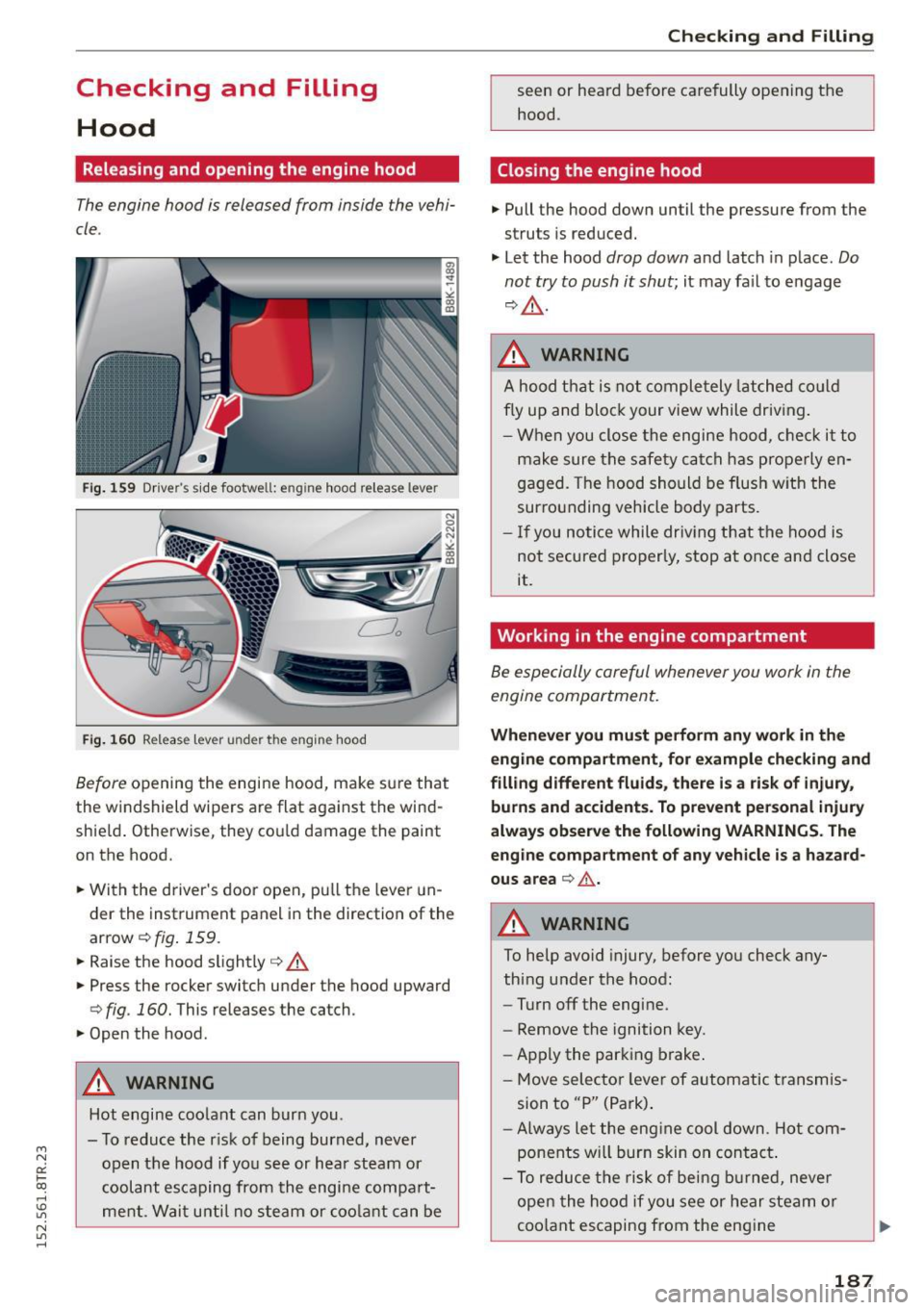
Fig. 159 Driver's side footwell: e ng in e hood release lever
Fig. 160 Releas e lev er un der t he e ngin e hood
Before opening the engine hood, make sure that
the windshield wipers are flat against the wind
shield . Otherwise, they could damage the paint
on the hood.
.. With the driver's door open, pu ll the lever un
der the instrument panel in the direction of the
arrow
c::> fig . 159.
.. Ra ise the hood slightly c::> &.
.. Press the rocker switch under the hood upward
c::> fig . 160. This releases the catch .
.. Open the hood.
A WARNING
Hot engine coolant can burn you.
- To reduce the r isk of being burned, never
open the hood if you see or hear steam or
coolant escaping from the engine compa rt
ment. Wait until no steam or coolant can be
Checking and Filling
seen or heard before carefully opening the
hood .
Closing the engine hood
.. Pull the hood down until the pressure from the
struts is reduced.
"' Let the hood
drop down and latch in place. Do
not try to push it shut;
it may fa il to engage
c::> &. -
A WARNING
A hood that is not comp letely latched could
fly up and block your view while driving.
- When you close the engine hood, check it to
make sure the safety catch has properly en
gaged . The hood should be flush with the
surrounding vehicle body parts.
- If you notice while driv ing that the hood is
not secured properly, stop at once and close
it.
Working in the engine compartment
Be especially careful whenever you work in the
engine compartment.
-
Whenever you must perform any work in the
engine compartment, for example checking and
filling different fluids , there i s a risk of injury ,
burns and accidents. To prevent personal injury
always observe the following WARNINGS . The
engine compartment of any vehicle is a hazard
ous area
c:> .&. .
A WARNING
-
To help avoid injury, before you check any-
thing under the hood:
- Turn off the engine.
- Remove the ignition key .
- Apply the parking brake.
- Move selector lever of automatic transmis-
sion to "P" (Park) .
-Always let the engine cool down. Hot com
ponents wi ll burn skin on contact .
- To reduce the risk of being burned, never
open the hood if you see or hear steam o r
coo lant escaping from the engine
187
Page 227 of 254
"' N
0:: loo
rl I.O
"' N
"' rl
Fu se pa nel @ (black )
No. Consumer
1 Dynamic steering
2 Electron ic Stabilization Control (module)
A/C system pressure sensor, electrome-
chanical parking brake, HomeLink, auto-
3 mat
ic dimming interior rear view mirror,
air quality/outside air sensor, Electron ic
Stabilization Control (button)
s Sound actuator
6 Headlight range control/headl
ight (corner-
ing light)
7 Headlight (cornering light)
Control modu les (electromechanical park-
8 ing brake, shock absorber, q uattro sport),
DCDC converte r
9 Adaptive
cruise control
10 Shift gate/clutch sensor
11 Side assist
1 2 Headlight range cont ro l, parking system
13 Airbag
14 Rear
wiper (a llroad)
15 Auxiliary fuse (instrument panel)
16 Auxiliary
fuse termina l 15 (engine area)
Fuse p anel @ (brown )
No. C onsumer
2 Brake light sensor
3 Fuel pump
4 Clutch sensor
5
Left seat heating with/without seat venti-
lation
6 Electronic Stabilization Control (electric)
7 Ho rn
8
Front left door (window regulator, central
locking, mirror, switch, lighting)
9 Windshield wiper motor
10 Electronic Stabilization Control (valves) Fu
ses a nd bulb s
No. Consumer
Two-door mode ls: rear left window regula-
11 tor; Four-door
models: rear left door (win-
dow regulator, central locking, switch,
light ing)
12 Rain and l
ight sensor
Fuse panel © (r e d )
No . Con sumer
3 Lumbar support
4 Dynamic steering
5 Inter
ior l ight ing (Cabriolet)
6 Windshie
ld washer system, headlight
washer system
7 Vehicle electrica l system control module 1
8 Vehicle electr ica l system control module 1
9 Left rear
window regulator motor (Ca brio-
let)/su nroof
10 Vehicle electr ica l system co ntrol module 1
11 Right rear
window regulator (Cabriolet)/
sun shade motor
12 Anti-theft
alarm warning system
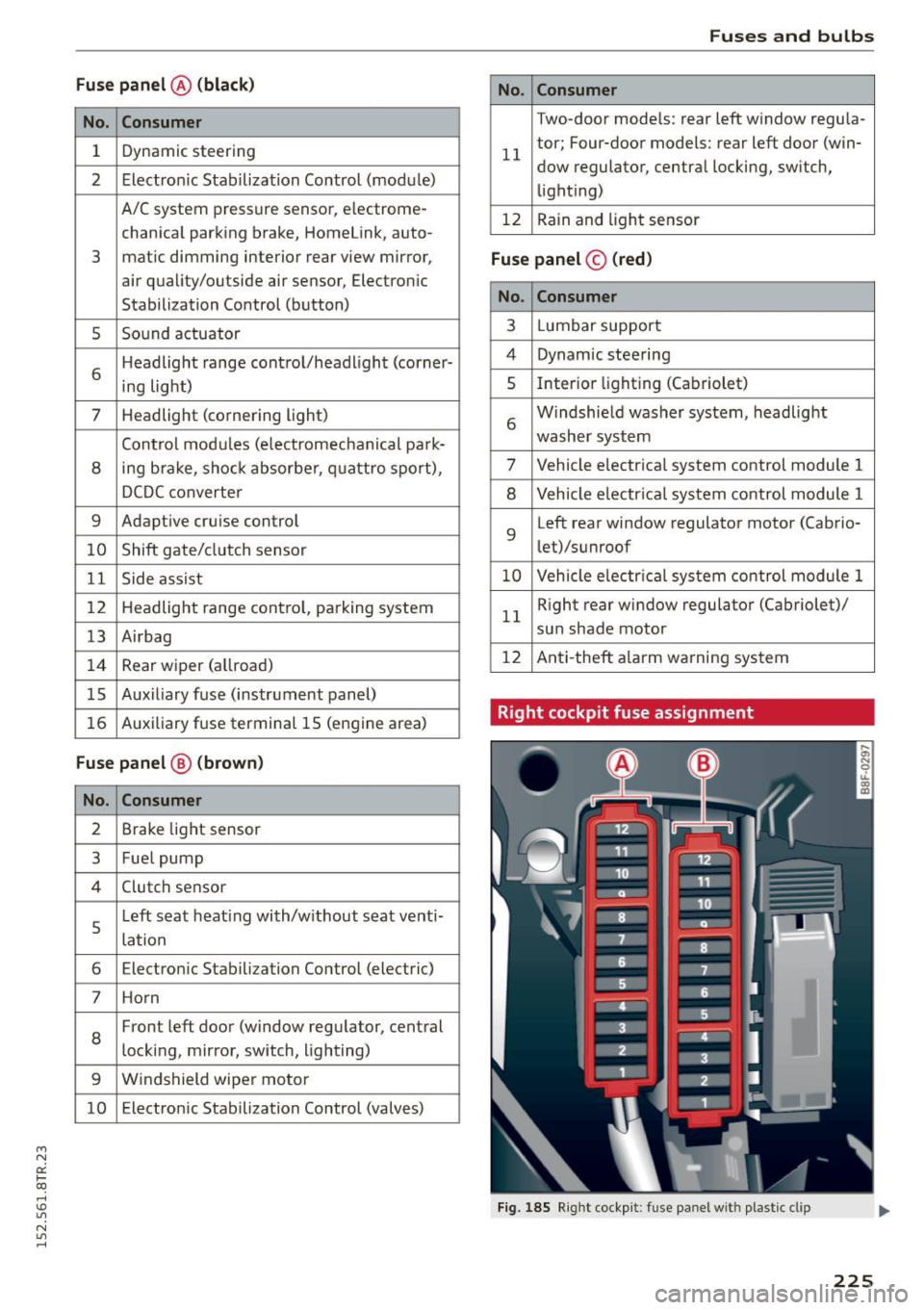
Right cockpit fuse assignment
Fig. 185 Right cockpit: fu se panel with plastic cl ip
225
Page 229 of 254
M N
0:: loo ,...., \!) 1.1'1
N 1.1'1 ,....,
Fuse panel© (brown)
No. Consumer
1 Luggage compartment lid control module
(allroad)
2 12-volt socket, cigarette lighter
3 DCDC converter path 1
4 DCDC converter path 2, sound amplifie r,
rad io
6 Right upper cabin heating (Cabriolet)
7 Electromechanical parking brake
9
Right front door (window regulator, cen-
tral locking, mirror, switch, lighting)
10 Left upper cabin
heating (Cabriolet)
Two-door models: rear right w indow regu-
11 lator; Four-door models: rear
right door
(window regulator, central locking, switch,
lighting)
12 Cell phone prep
Fuse
panel © (black)
No. Consumer
1 Right front seat heating
4 MMI
5 Radio
6 Rear view camera
7 Rear window heater (allroad)
8 Rear
Seat Entertainment
Bulbs
Replacing bulbs
For your safety, we recommend that you have
your authorized Audi dealer replace any bulbs for
you .
It is becoming increasingly more and more diffi
cult to replace vehicle light bulbs since in many
cases , other parts of the car must first be re
moved before you are ab le to get to the bulb .
This applies especially to the light bulbs in the
front of you r ca r which you can only reach
through the engine compartment .
Sheet metal and bulb holders can have sharp
edges that can cause ser ious cuts, parts must be
Fuses and bulbs
correct ly taken apart and then properly put back
together to help prevent breakage of parts and
long term damage from water that can enter
housings that have not been properly resealed.
For your safety, we recommend that you have
your authorized Audi dea ler replace any bulbs for
you, since your dealer has the proper tools, the
correct bulbs and the expertise.
Gas discharge lamp s (Xenon lights)*:
Due to the high electr ical voltage, have the bulbs
replaced by a qualified technician . Head lights
with Xenon light are identified by the high volt
age sticker.
A WARNING
Changing Xenon lamps without the necessary
equipment can cause serious personal injury.
- Bulbs are pressurized and can explode when
being changed . Potential risk of injury!
- On vehicles equipped with gas discharge
bu lbs (Xenon light) * life -threatening injuries
can result from improper handling of the
high -vo ltage portions of such lamps!
-On ly your authorized Audi dealer or quali
fied workshop shou ld change the bulbs in
gas discharge lamps. There are parts with
sharp edges on the openings and on the
bulb holders that can cause serious cuts . If
you are uncertain about what to do, have
the wor k performed by an autho rized Audi
dealer or qualified workshop. Serious per
sonal injury may result from improperly per
formed work .
(D Tips
-If you st ill prefer to replace the light bulbs
yourself, be aware that the eng ine compart
ment is a hazardous area to work
inq page 187 q &..
-It is best to ask your authorized Audi dealer
whenever you want to change a bulb.
227