stop start AUDI RS7 SPORTBACK 2014 Owner's Manual
[x] Cancel search | Manufacturer: AUDI, Model Year: 2014, Model line: RS7 SPORTBACK, Model: AUDI RS7 SPORTBACK 2014Pages: 292, PDF Size: 73.56 MB
Page 216 of 292
214 Check ing and filling
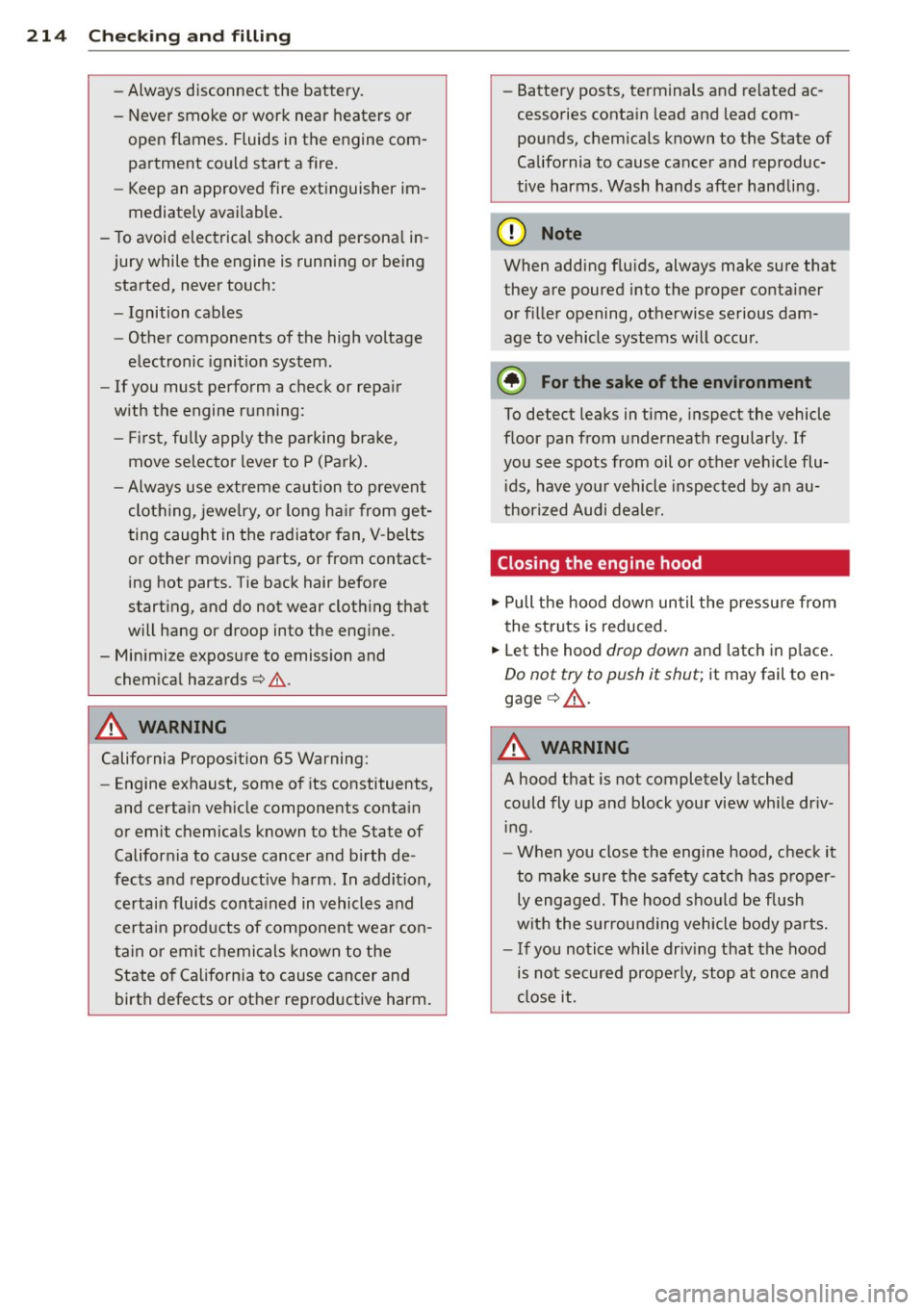
- Always disconnect the battery.
- Never smoke or work near heaters or open flames . Fluids in the engine com
partment could start a fire.
- Keep an approved fire extinguisher im
mediately available.
- To avoid electrical shock and persona l in
jury while the engine is running or being started, never touch:
- Ignition cables
- Other components of the high voltage
electronic ignition system.
- If you must perform a check or repa ir
with the engine running:
- Fi rst, fully apply the parking bra ke,
move se lec to r lever to P (Pa rk) .
- Always use extreme caution to preven t
clot hing, jewe lry, or long h air from ge t
ting caught in the radiator fan, V -belts
or other moving parts, or from contact ing hot parts. Tie back hair before
start ing, and do not wear cloth ing that
will hang or droop into the eng ine.
- Min imize exposure to emission and
chemica l hazards¢ ,&..
A WARNING
California Propos ition 65 Warning:
- Engine exhaust, some of its constituents,
and certa in veh icle components conta in
or emit chemicals known to the State of
Califor nia to cause cancer and b irth de
fec ts a nd reproduct ive ha rm. In addition,
certain fluids conta ined in vehicles and
certa in prod ucts of co mponent wear co n
ta in o r emi t chemicals known to the
State o f Ca lifornia to cause can cer and
birth defects or ot her reproductive harm. -
Battery posts, terminals and re lated ac
cessories conta in lead and lead com
pounds, chemicals known to the State of
California to cause cance r and reproduc
tive harms. Wash hands after handling .
(D Note
When adding flu ids, always make sure that
they are poured into the proper conta iner
or f iller opening, otherwise serious dam
age to vehicle systems w ill occur.
® For the sake of the environment
To detect leaks in time, inspect the vehicle
floor pan from underneath regularly. If
you see spots from oil or other ve hicle flu
i ds, have yo ur vehicle inspected by a n au
thori zed Audi dea le r.
Closing the engine hood
.,. Pull the hood down un til the pressure from
t he struts is reduced.
.,. Let the hood drop down and latch in p lace .
Do not try to push it shut; it may fail to en
gage ¢&_ .
A WARNING
-
A hood that is not completely latched
could fly up and b lock your view while dr iv
ing.
- When you close the engine hood, check it
to make sure the safety catch has p roper
ly engaged. The hood sho uld be flush
with the surrou nding vehicle body pa rts.
- If you notice while driv ing t hat the hood
is not s ecured prope rly, stop at onc e and
close it.
Page 237 of 292
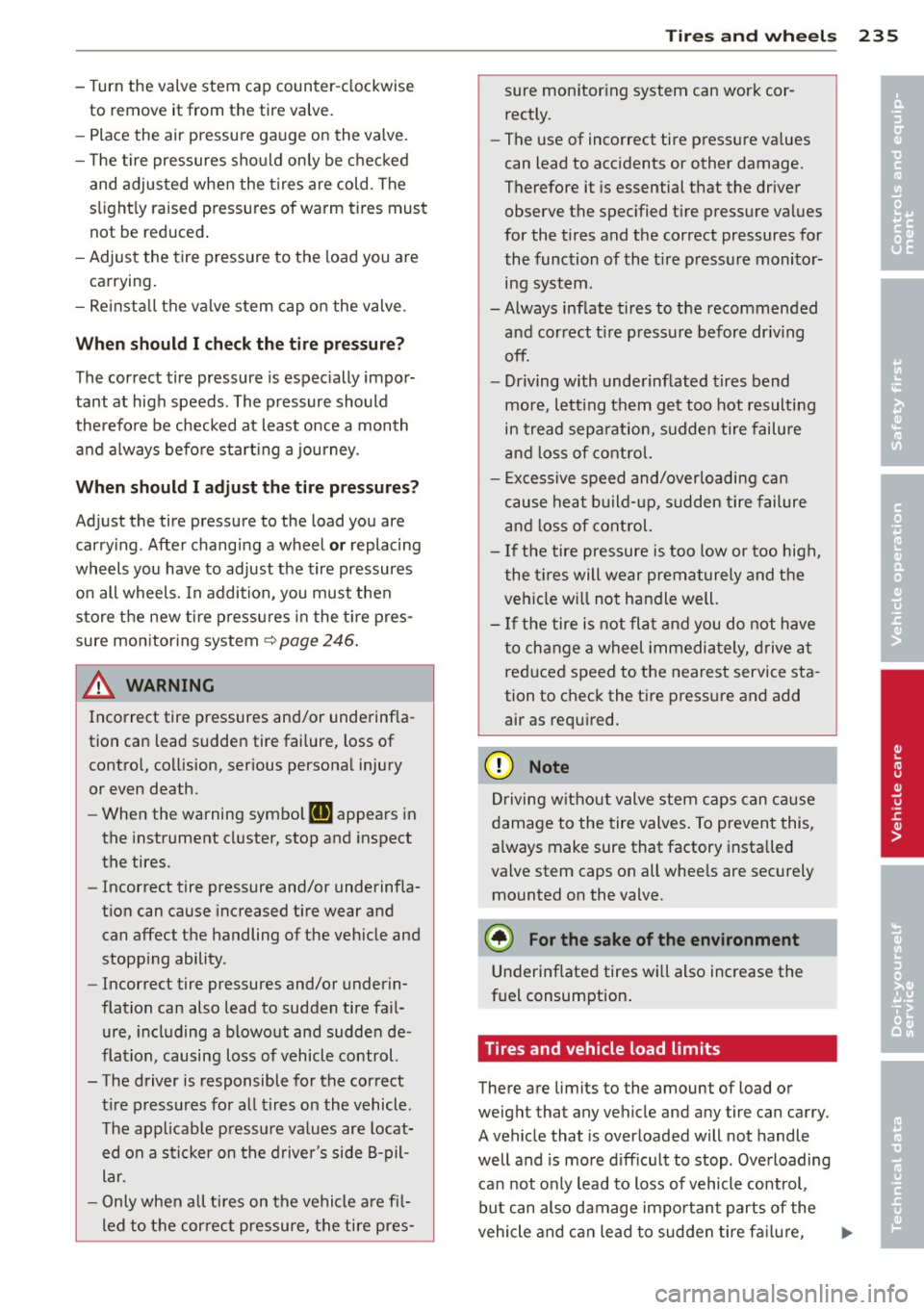
-Turn the valv e stem cap counter-clockwise
to remove it from the tire valve.
- Place the air pressure gauge on the valve.
- The tire pressures should only be checked
and adjus ted when the tires are cold . The
s li ght ly raised p ressures of warm tires must
not be reduced .
- Adjust the tire pressure to the load you are
carrying .
- Re insta ll the va lve stem cap on the valve.
When should I che ck the tire pres sur e?
The correct tire pressure is espec ially impor
tant at high speeds. The pressure should
therefo re be checked at least once a month
and a lways before start ing a journey.
When should I adjust the tire p re ssure s?
Adjust the tire pressure to the load you are
carry ing . After changing a wheel
o r replacing
wheels you have to adjust the tire pressures
on all wheels. In addition , you must then
store the new ti re pressu res in the t ire pres
sure monitoring system
r::!.> page 246 .
A WARNING
Incorrect tire pressures and/or underinf la
tion can lead sudden tire failure, loss of contro l, collision, serious persona l injury
or even death.
- When the warning symbo l
[ti] appears in
the instrument cl uster, stop and inspect
the tires.
- Incorrect tire pressure and/or underinfla
t ion can cause increased tire wear and
can affect the handling of the veh icle and
stopp ing ability .
- Incorrect tire pressures and/or underin
flation can also lead to sudden tire fa il
ure, including a blowout and sudden de
flation, causing loss of vehicle control.
- The driver is responsible for the correct
tir e pressures fo r all t ires on the vehicle .
T he applicable pressu re va lues are locat
ed on a stic ker on the drive r's side B-pil
lar .
- Only when a ll t ires on the vehicle are fi l
led to t he cor rect pressure, the ti re p res-
Tire s an d wheel s 235
sure monitor ing system can work cor
rectly.
- The use of incorrect tire pressure va lues
can lead to acc idents or other damage.
Therefore it is essential that the driver
observe the spec ified t ire pressure values
for the tires and the correct pressures for
the function of the t i re p ress ure monito r
ing system .
- Always inf late t ires to the recommended
a nd correct t ire p ress ure before dr iv ing
off.
- Driving with unde rinflated tires bend
mo re, lett ing t hem get too hot resulti ng
in tread separation, s udden tire failure
and loss of cont ro l.
- Excess ive speed and/overloadi ng can
cause heat b uild- up, sudden tire failure
a nd loss of cont rol.
- If the tire pressure is too low or too high,
the t ires will wear prema turely and the
veh icle w ill not handle well.
- If the tire is not fla t and you do not have
to ch ange a wheel immedia tely, drive a t
red uced speed to the nearest service sta
tion to check the t ire p ress ure and add
air as requi red.
(D Note
Dr iving w it h out valve stem c aps can c ause
damage to the tire valves . To prevent this,
a lways make sure that factory insta lled
va lve stem caps on all whee ls are sec urely
mounted on the valve .
@ For the sake of the env ironment
Un derinflated tires wi ll also increase the
fuel consumption .
Tires and vehicle load limits
There are limits to the amount of load or
weight that any vehicle and any tire can carry.
A vehicle that is overloaded will not handle
well and is mo re d iff icult to stop. Overloading
can not o nly lead to loss of vehicle control,
but can also damage important parts of the
vehicle and c an le ad to sudden tire fa ilu re, .,..
•
•
Page 248 of 292
246 Tires and wheels
Refer to ¢page 243 for mo re detailed infor
mation regarding winter tires .
Tire pressure
monitoring system
(D General notes
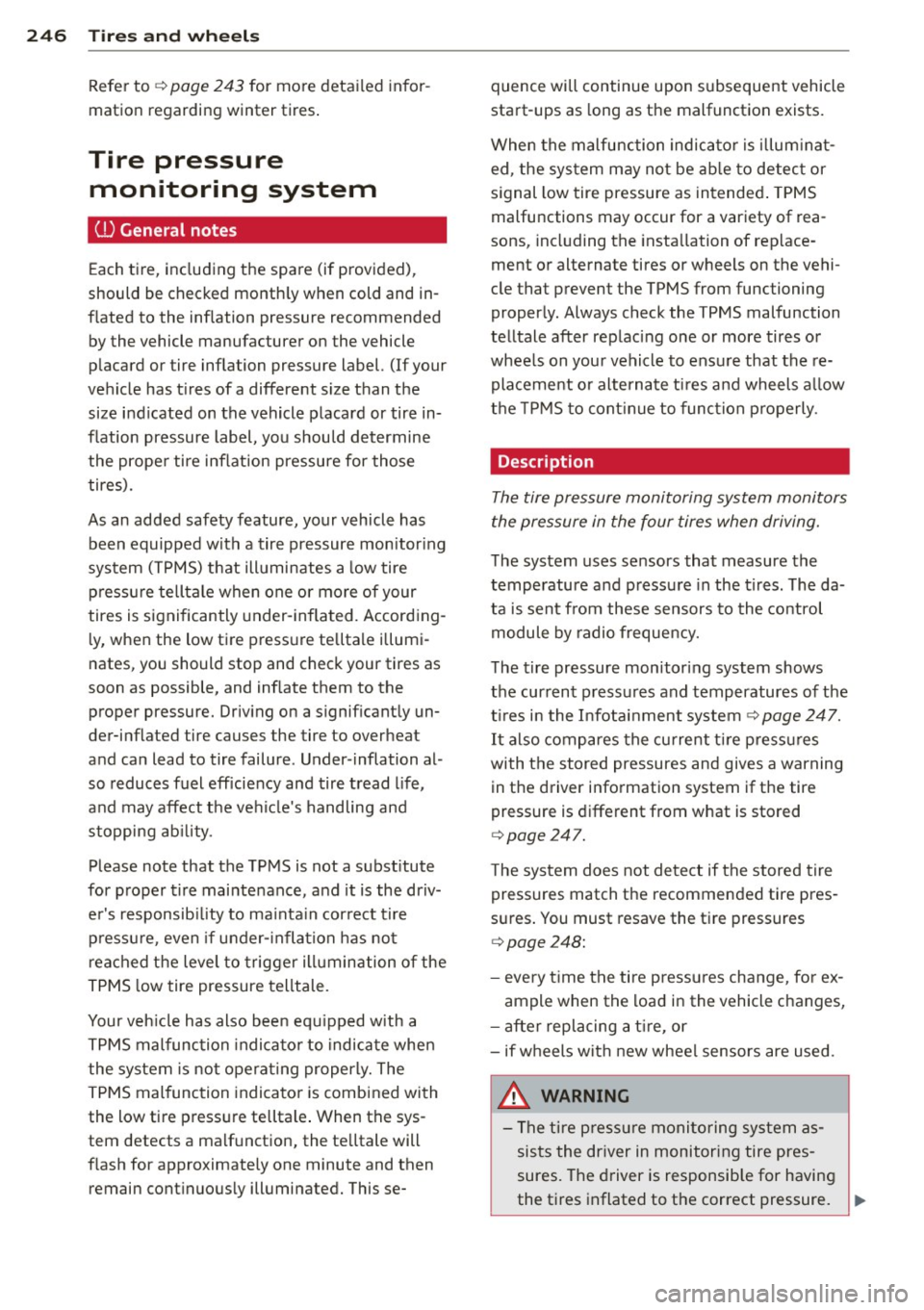
Each tire, including the spare (if provided) ,
should be checked monthly when cold and in
flated to the inflation pressure recommended by the vehicle manufacturer on the vehicle
placard or tire inflation pressure label. (If your
vehicle has tires of a different size than the
size indicated on the vehicle placard or tire in
flation pressure label, you shou ld determine
the proper tire inflation pressure for those
tires).
As an added safety feature, your vehicle has
been equipped with a tire pressure monitor ing
system (TPMS) that illuminates a low tire
p ressure telltale when one or more of your
tires is significantly under-inflated. According
ly, when the low tire pressure telltale illumi
nates, you should stop and check your tires as
soon as possible, and inflate them to the proper pressure. Driving on a significantly un
der-inflated tire causes the tire to overheat
and can lead to tire failure . Under -inflation al
so reduces fuel efficiency and tire tread life,
and may affect the vehicle's handling and
stopping ab ility.
Please note that the TPMS is not a subst itute
for proper tire maintenance, and it is the driv
e r's responsib ility to ma inta in correct tire
pressure, even if under-inflation has not
reached the level to trigger illumination of the
TPMS low tire pressure telltale.
Your veh icle has also been equ ipped w ith a
TPMS malfunction indicator to indicate when
the system is not operating properly. The
TPMS malfunction indicator is combined with
the low tire pressure telltale . When the sys
tem detects a malfunction, the te lltale will
flash for approximately one minute and then remain continuously illuminated. This se- quence will continue upon subsequent vehicle
start-ups as
long as the malfunction exists.
When the malfunction indicator is illum inat
ed, the system may not be ab le to detect or
signal low tire pressure as intended . TPMS
malfunctions may occur for a variety of rea
sons, including the installation of replace
ment or alternate tires or wheels on the vehi
cle that prevent the TPMS from functioning
properly. Always check the TPMS malfunction
telltale after replacing one or more tires or
wheels on your vehicle to ensure that the re
placement o r alternate ti res and wheels allow
the TPM S to cont inue to function properly.
Description
The tire pressure monitoring system monitors
the pressure in the four tires when driving.
The system uses sensors that measure the
temperature and pressure in the tires. Theda
ta is sent from these sensors to the control
module by radio frequency.
The tire pressure monitoring system shows
the current pressures and temperatures of the
tires in the Infotainment system
¢page 247.
It also compares the current tire pressures
with the stored pressures and gives a warning in the driver information system if the tire
pressure is different from what is stored
¢ page 247.
The system does not detect if the stored tire
pressures match the recommended tire pres
sures. You must resave the tire pressures
¢page 248:
- eve ry time the tire p ressu res change, for ex
ample when the load in the vehicle changes,
- after replacing a t ire, or
- if wheels w ith new wheel sensors are used .
_&. WARNING
-The tire pressu re monitoring sys tem as
sists the driver in monitoring tire pres
sures. The driver is responsible for having
the tires inflated to the correct pressure. ..,.
Page 264 of 292
262 Fuses and bulb s
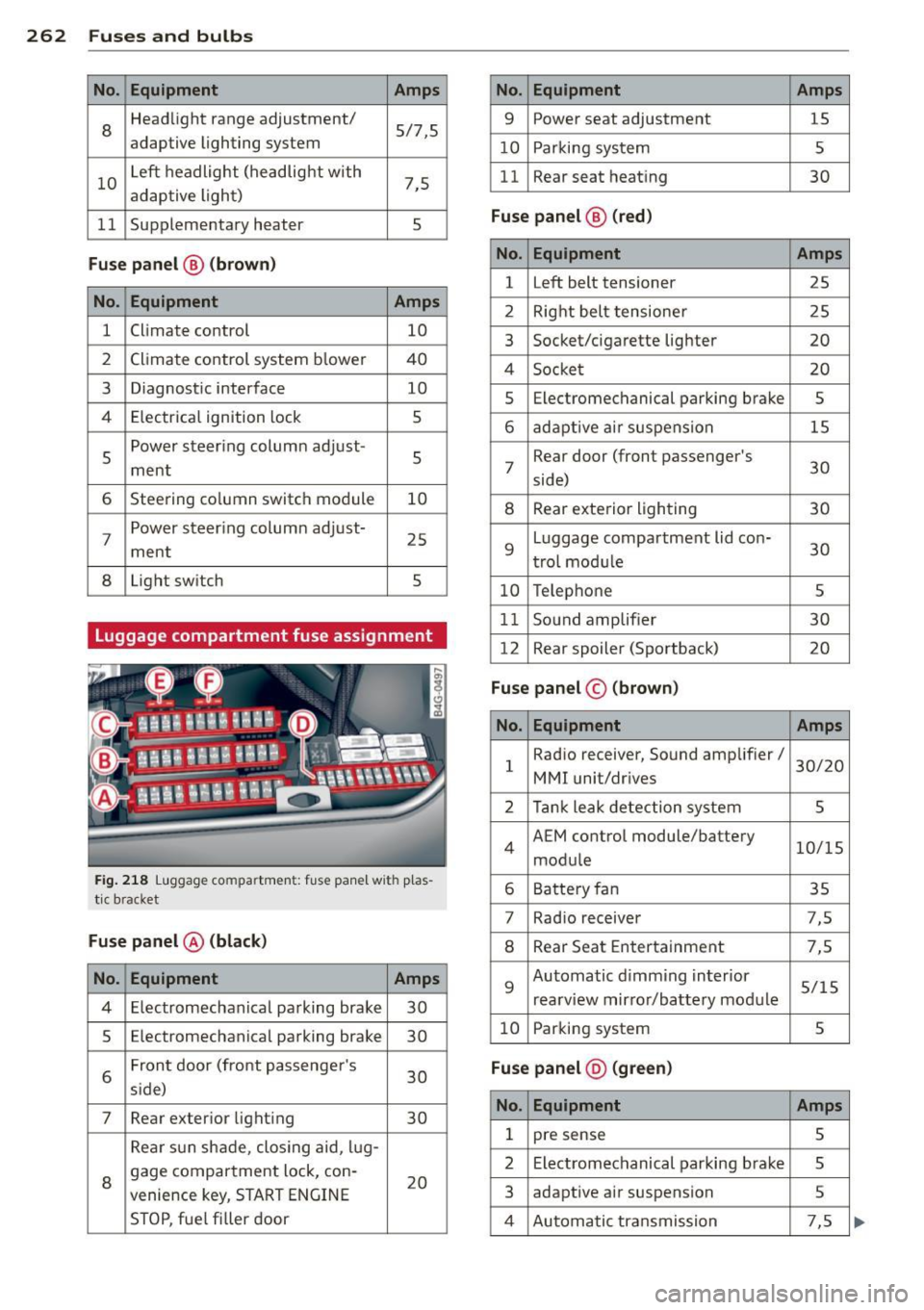
No. Equ ipment Amps
8
Headlight range adjustment/
5/7,S
adaptive lighting system
10 Left headlight
(headlight with
7,5
adaptive light)
11 Supplementary
heater
s
Fuse p ane l@ (b ro w n)
No . Equipment Amps
1 Climate control
10
2 Climate control system blower 40
3 Diagnostic interface
10
4 E lectrical ignition lock
s
s
Power steering column adjust-
s ment
6 Steering column switch module
10
7 Power steering column adjust-
ment
25
8 Light
switch
s
Luggage compartment fuse assignment
Fig. 218 Luggage compartment: fuse panel with plas
tic bracket
Fuse p anel @ (b la ck )
No. Equipment Amps
4 E lectromechanical parking brake 30
s Electromechanical parking brake
30
6 Front door
(front passenger's
30
s ide)
7 Rear exter ior lighting
30
Rear sun shade, closing aid, lug-
8 gage compartment lock, con-
20
venience key, START ENGINE
STOP, fuel filler door
No. Equipment Amps
9 Power seat adjustment
15
10 Parking system
s
11 Rear seat
heating
30
Fuse pan el@ (r e d )
No . Equipment Amps
l Left belt tensioner
25
2 Right belt tensioner 25
3 Socket/cigarette
lighter
20
4 Socket 20
s Electromechanical parking brake s
6 adaptive ai r suspension 15
7 Rear door
(front passenger's
30
side)
8 Rear exterior lighting 30
9 Luggage compartment
lid con-
30
t rol modu le
10 Telephone
s
11 Sound amplifier 30
12 Rear
spoiler (Sportback)
20
Fuse pan el© (brown)
No . Equipment Amps
1 Radio
receiver, Sound amplifier/
30/20
MMI unit/drives
2 Tank leak detection system
s
4 AEM
control module/battery
10/15
module
6 Battery fan 35
7 Rad
io receiver 7,S
8 Rear Seat Entertainment 7,5
9 Automatic d
imming interior
5/15
rearview mirror/battery module
10 Parking system
s
Fuse pan el@ (gre en)
No . Equipment Amps
1 pre sense s
2 Electromechanical parking brake s
3 adaptive
air suspension 5
4 Automatic transmission 7,5
Page 265 of 292
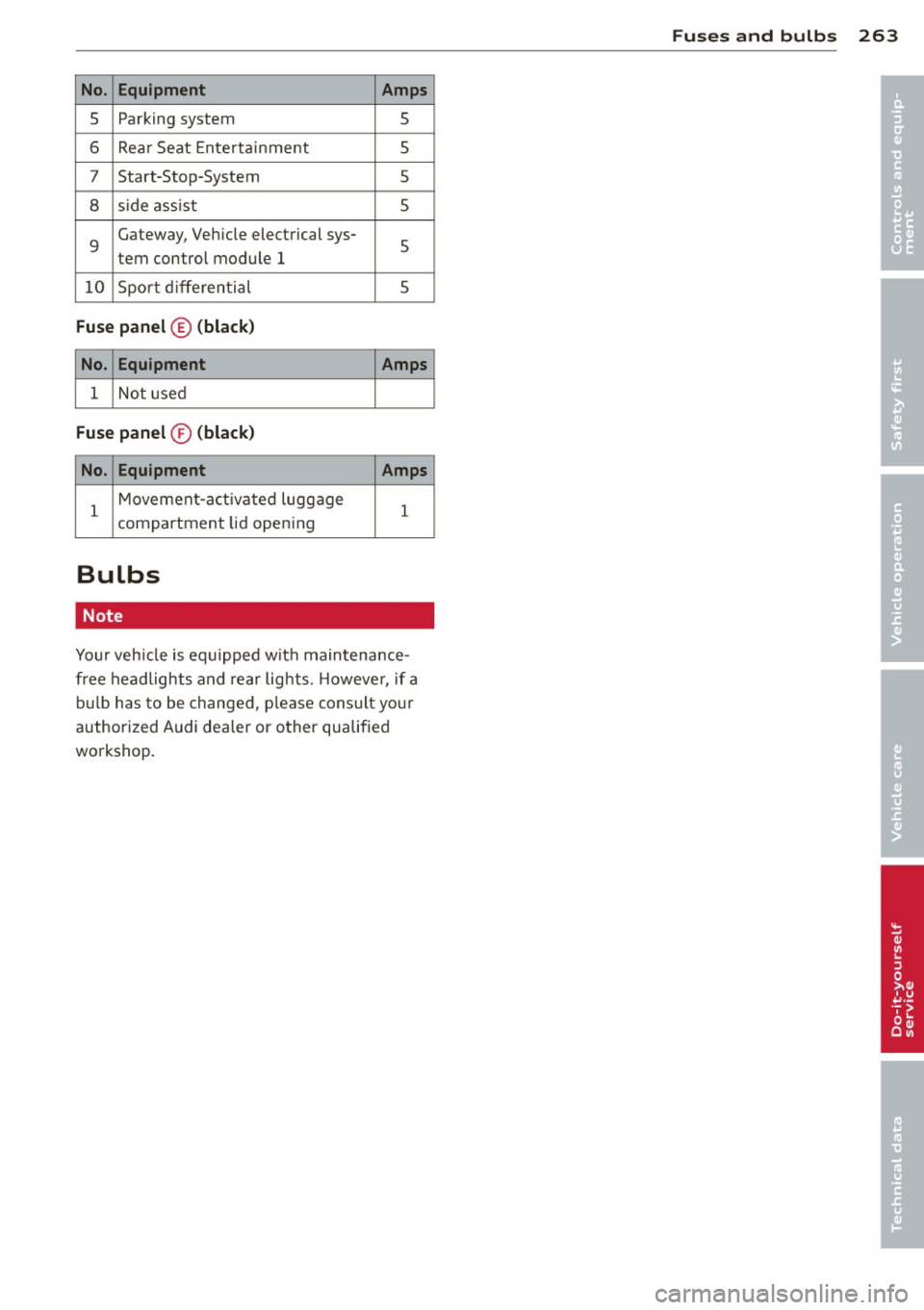
No. Equipment Amps
5 Parking system 5
6 Rear Seat Entertainment 5
7 Start-Stop-System 5
8 side ass ist 5
9
Gateway, Vehicle electrical sys-
5 tern control module 1
10 Sport d ifferen tial
5
Fu se p anel © (black )
No. Equipment Amps
1 Not used
Fu se p anel ® (black )
No. Equipment Amps
1 Movement-activated luggage
1
compartment lid opening
Bulbs
Note
Your veh icle is equipped with maintenance
free headlights and rear lights. Howeve r, if a
bu lb has to be changed, p lease consult yo ur
authorized Audi dealer or other qualified
workshop.
Fu ses and bulb s 263
•
•
Page 282 of 292
280 Index
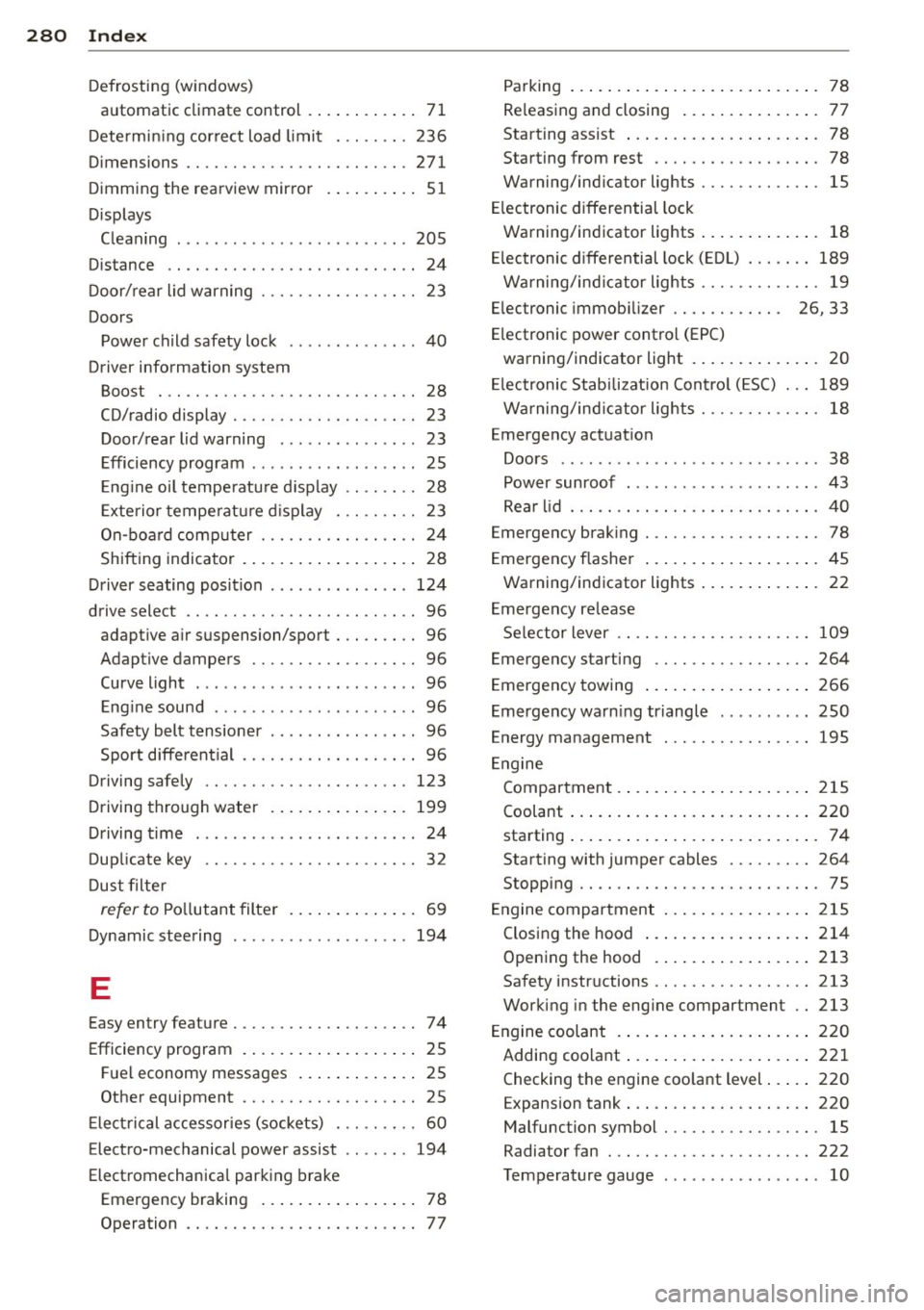
Defrosting (windows)
automatic climate control . ... ... ... .. 71
Determining correct load limit ... .... . 236
Dimensions ................. .. .... . 271
Dimming the rearview mirror . ..... .. .. 51
Displays Cleaning . .. .......... ...... ... .. . 205
Distance . . . . . . . . . . . . . . . . . . . . . . . . . . . 24
Door/rear lid warning . . . . . . . . . . . . . . . . . 23
Doors Power child safety lock ........ .. .... 40
Driver information system Boost ... .. ............. .. .. .. ... . 28
CD/radio display . . . . . . . . . . . . . . . . . . . . 23
Door/rear lid warning . . . . . . . . . . . . . . . 23
Efficiency program . ........... .. .. .. 25
En gin e oi l tempe rature display .. .. .. . . 28
E xterior tempe rature display . .. .. .. . . 23
On -board computer . . . . . . . . . . . . . . . . . 24
Shifting indicator . . . . . . . . . . . . . . . . . . . 28
Driver seating position . . . . . . . . . . . . . . . 124
drive select ................. .. .... .. 96
adaptive air suspension/sport ... ...... 96
Adaptive dampers . . . . . . . . . . . . . . . . . . 96
Curve light . . . . . . . . . . . . . . . . . . . . . . . . 96
Engine sound .. .... ...... .. .. .. .. .. 96
Safety belt tensioner . . . . . . . . . . . . . . . . 96
Sport different ial . . . . . . . . . . . . . . . . . . . 96
Driving safely . . . . . . . . . . . . . . . . . . . . . . 123
Driving through water .......... .. ... 199
Driving time ............... ... .. .. .. 24
Duplicate key ............... .. .... .. 32
Dust filter
r e fer to Pollutant filter . . . . . . . . . . . . . . 69
Dynamic steering .......... .. .. .. .. . 194
E
Easy entry feature . . . . . . . . . . . . . . . . . . . . 7 4
Efficiency program . . . . . . . . . . . . . . . . . . . 25
Fu el economy messages . . . . . . . . . . . . . 25
Other equipment . . . . . . . . . . . . . . . . . . . 25
E lectrical accessories (sockets) . . . . . . . . . 60
Electro-mechanical power assist .. .. .. . 194
Electromechanical parking brake
Emergency braking . . . . . . . . . . . . . . . . . 78
Operation . . . . . . . . . . . . . . . . . . . . . . . . . 77 Parking ...
.... .. ............. ..... 78
Releasing and closing ............... 77
Starting assist . . . . . . . . . . . . . . . . . . . . . 78
Starting from rest . . . . . . . . . . . . . . . . . . 78
Warning/indicator lights ........ .... . 15
Electronic differential lock
Warning/indicator lights ............ . 18
Electronic differential lock (ED L) . . . . . . . 189
Warning/indicator lights ............ . 19
Elec tronic immobilizer . . . . . . . . . . . . 26, 33
E lectronic power control (EPC)
warning/indicator light .............. 20
Electronic Stabilization Control (ESC) . .. 189
Warning/indicator lights .......... .. . 18
Emergency actuation Doors ...... .. .. .. ...... ..... .. .. . 38
Power sunroof . .. ................ .. 43
Rear lid ....... .. ............. .... . 40
Emergency braking .............. .... . 78
Emergency flasher . . . . . . . . . . . . . . . . . . . 45
Warning/indicator lights ............. 22
Emergency release
Selector lever .... ............. .... 109
Emergency starting ............. ....
264
Emergency towing ................. . 266
Emergency warning triangle .......... 250
Energy management ............ .... 195
Engine Compartment .... ............. .... 215
Coolant ....... .. .. ............ ... 220
starting ....... .. .. .............. .. 74
Starting with jumper cables ....... .. 264
Stopping .. .... .. ............. .... . 75
Engine compartment ................ 215 Closing the hood .............. .... 214
Opening the hood ................ . 213
Safety instructions ............. .... 213
Working in the engine compartment .. 213
Engine coolant .... ................ . 220
Adding coolant ... ................ . 221
Checking the engine coo lant level ..... 220
Expansion tank ... ............. .. .. 220
Malfunction symbol . . . . . . . . . . . . . . . . . 15
Radiator fan ...... .............. .. 222
Temperature gauge ......... ...... .. 10
Page 288 of 292
28 6 Index
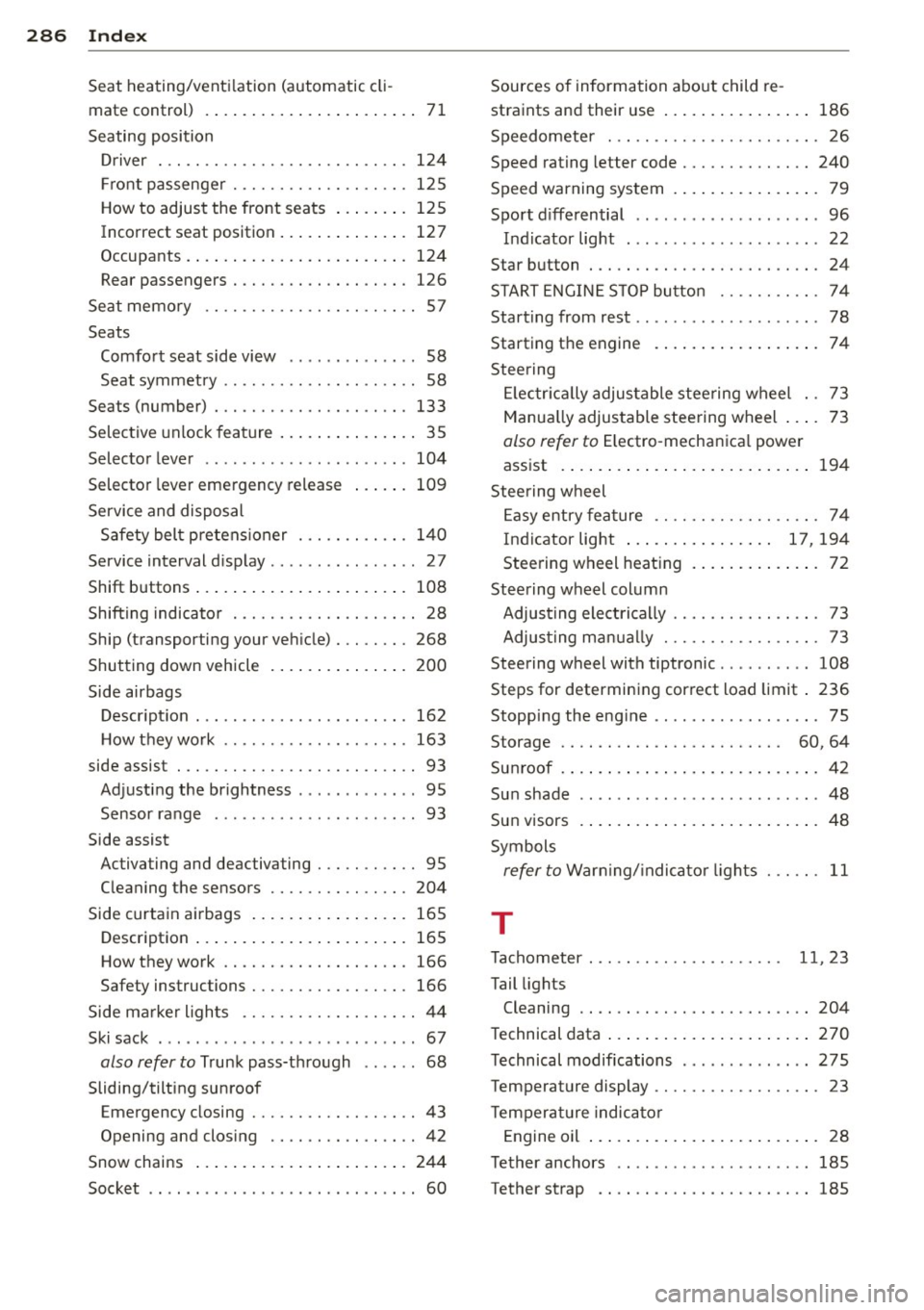
Seat heating/venti lation (automatic cli-
mate control) . . . . . . . . . . . . . . . . . . . . . . . 71
Seating position Dr iver . .. .. ............. .. .. .. .. . 124
Fr ont passenger .......... .. .. .... . 125
How to adjust the front seats . . . . . . . . 125
Incorrect seat position ... .. .. .. .... . 127
Occupants . ... . .. ..... ... .. .. .... . 124
Rear passengers . . . . . . . . . . . . . . . . . . . 126
Seat memo ry ........... .. .. .. .. .. .. 57
Seats Comfort seat side view . . . . . . . . . . . . . . 58
Seat symmetry . . . . . . . . . . . . . . . . . . . . . 58
Seats (number) . ........... .. .. .... . 133
Selective unlock feature ... .. .. .. .. .. . . 35
Selector lever ... .... .... .. .. .. .. .. . 104
Selector lever eme rgency release ..... . 109
Service and disposal Safety belt pretens ioner ... .. .. .... . 140
Service interval d isplay ....... ... .. .... 27
Shift buttons .... . ...... ... .. .. .... . 108
Shifting indicator . . . . . . . . . . . . . . . . . . . . 28
Ship (transporting your ve hicle) . .. ..... 268
Shutting down vehicle . ... .. .. ... ... . 200
Side airbags Descr ipt ion . ... . ...... ... .. .. .. .. . 162
H ow they work ......... .. .. .. .. .. . 163
side assist . . . . . . . . . . . . . . . . . . . . . . . . . . 93
Adjusting the brightness ....... .. .... 95
Sensor range .. .... ...... .. .. .. .. .. 93
Side assist Activating and deactivating . .. .. .. .. . . 95
C leaning the sensors ...... .. .. .. .. . 204
Side curtain airbags ..... ... .. .. .... . 165
Description .... .. ..... ... .. .. .... . 165
How they work ........... .. .. .... . 166
Safety instructions ........ .. .. .. .. . 166
Side marker ligh ts ......... .... .... .. 44
Ski sack ... .. ................ ... ... . 67
also refer to Trunk pass-through .. .. .. 68
Sliding/tilting sunroof Emergency closing ........ .. .. .... .. 43
Opening and clos ing .. .. .. .... .. .. . . 42
Snow chains .... . ...... ... .. .. .... . 244
Socket .. .. .. ................ ... ... . 60 Sources of information abo
ut child re-
straints and their use .... ..... ... .. .. 186
Speedometer . . . . . . . . . . . . . . . . . . . . . . . 26
Speed rating letter code .......... .... 240
Speed warning system . .. ..... ... .. .. . 79
Sport d ifferential .. ..... ........... .. 96
Indicator light ... ..... ........... .. 22
Star button . . . . . . . . . . . . . . . . . . . . . . . . . 24
START ENG INE S TO P bu tton ...... .... . 74
Starting from rest . . . . . . . . . . . . . . . . . . . . 78
Starting the engine . .... ..... ... .. .. . 74
Stee ring
El ectr ically adjustable stee ring wheel . . 73
Manua lly adjustable steering wheel ... . 73
also refer to Electro -mecha nica l powe r
ass ist . ... .... .. .. ... ..... ... .. .. 194
Stee ring wheel
E asy entry fea ture ... .......... .. .. . 7 4
Indicator light . . . . . . . . . . . . . . . . 17,194
Stee ring w heel heating . ..... .... . .. . 72
Stee ring wheel column
Adjusting electri cally . . . . . . . . . . . . . . . . 73
Adjus ting ma nually ............ .. .. . 73
Steering wheel with tiptronic .......... 108
Steps for determin ing correct load limit . 236
Stopping the eng ine .. .. ...... ... .. .. . 75
Storage . . . . . . . . . . . . . . . . . . . . . . . . 60, 64
Sunroof . ... .. .. .. .. ... ..... ... .. .. . 42
Sun shade ...... .. .. ... ....... .... .. 48
Sun visors . ..... .. .. ... ..... ... .. .. . 48
Symbols
refer to War ning/ indica to r li ghts . .. .. . 11
T
Tacho meter . . . . . . . . . . . . . . . . . . . . . 11, 23
Tail lights Cleaning .. .. ... ... ... ..... ... .. .. 204
T echnical data ..... .. ... ..... ... .. .. 270
T echnical modifications .............. 275
Temperature display ............. .... . 23
T empera ture indica tor
Engine oil . . . . . . . . . . . . . . . . . . . . . . . . . 28
T ether anchors . ... ... .. .. ... ..... .. 185
Tether strap .. .. .. ............. .. .. 185