brake AUDI RS7 SPORTBACK 2014 Workshop Manual
[x] Cancel search | Manufacturer: AUDI, Model Year: 2014, Model line: RS7 SPORTBACK, Model: AUDI RS7 SPORTBACK 2014Pages: 292, PDF Size: 73.56 MB
Page 238 of 292
236 Tire s and whee ls
including a blowout and sudden deflation that
can cause the vehicle to crash.
Your safety and that of your passenge rs a lso
depends on making s ure that load limits are
not exceeded. Vehicle load includes everybody
and everything in and on the vehicle. These
load limits are techn ically referred to as the
vehicle's
Gr oss Veh icl e W eight R ating
("GVWR").
The "GVWR" includes the weight of the basic
ve hicle, all factory installed accessories, a full
tank of fuel, oil, coolant and other fluids plus
maximum load. The maximum load includes
the number of passengers that the vehicle is
i ntended to carry ("seating capacity") with a n
assumed weight of 150 lbs (68 kg) for each
passenger at a des ignated seat ing pos ition
and the tota l we ight of any luggage in the ve
h icle.
The
Gro ss Axle Weight Rating ("GAWR") is
the maximum load that can be app lied at each
of the vehicle's two axles .
The G ross Vehicle Weight Rating and the
Gross Axle Weight Rating are listed on the
safety compliance st icker labe l located on the
driver 's side B-p illar. Your A udi has 4 seating
positions, 2 in the front and 2 in the rear for
total seating capacity of 4. Each seating posi
tion has a safety belt
9 page 133, Safety
belts.
The fact that there is an upper limit to your
vehicle's Gross Vehicle Weight Rating means
that the tota l weight of whatever is being car
ried in the vehicle is limited. The more passen
gers in the veh icle or passengers who are
heav ier than the standard weights assumed
mean that less weight can be carried as lug
gage.
The tire pressure label on your Audi also lists
the maximum combined weight of all of the
occupants and luggage or other cargo that
the veh icle can carry . For the location of the
l abe l
9page 232, fig. 195.
A WARNING
Overloading a vehicle can cause loss of ve
h icle contro l, a crash or other accident, se
rious personal injury, and even death.
- Carrying more we ight than your veh icle
was des igned to carry will prevent the
veh icle from handling properly and in
crease the risk of the loss of vehicle con
trol.
- The brakes on a vehicle that has been
overloaded may not be able to stop the
veh icle w ith in a safe distance.
- Tires on a vehicle that has been overload
ed can fail suddenly, including a blowout
and sudden deflation, causing loss of
control and a crash.
- Always make sure that the total lo ad be
ing transpor ted does not make the veh i
cle heavier than the vehicle's Gross Vehi
cle Weight Rating.
Determining correct load limit
U se the exa mple belo w to ca l
c ula te the t otal weight of the
p ass engers a nd lu ggage or oth
e r thin gs that yo u plan to tran s
p o rt so t hat yo u can make sur e
th at yo ur vehi cle w ill n ot be
ove rloa ded.
Steps for Determining
Correct Load Limit
1. Lo cate th e statement "THE
COMBINED WEIGH T OF Q C-
CU PANT S A ND CARGO
SHOULD NE VER E XCEED XXX
KG OR XXX LBS" on your ve
hicle 's placard (tire inflation
11>
Page 240 of 292
238 Tires and wheels
symbols) indicate the positions of the tread
wear indicators. Worn tires must be replaced. Different figures may apply in other countries
c::> & .
Tire pressure
Incorrect tire p ressure causes premature wear
and can cause sudden tire blow-out. For this
reason, tire pressure must be checked at least
once a month
c::> page 234.
Driving style
Driving fast around curves, heavy acceleration
and hard braking increase tire wear.
Rotating tires for more even wear
For all four tir es on your vehicle to have the
same se rv ice life, we recommend that the
front and rear tires are rotated according to
the tire manufacturer's suggested tire rota
tion intervals. Please remember the follow
ing:
- T ire rotation inte rva ls may differ from the
vehicle serv ice intervals outlined in your
Warranty
& Maintenance booklet.
- T he longer one tire is used in one location
on the vehicle, the more it wears at certa in
points; therefore, we recommend that you
follow the tire manufacturer's suggested
tire rotation intervals.
- Vehicles with front-wheel drive experience
more tread wear on the front whee ls com
pared to all-whee l drive (quattro).
- Please rotate ti res as shown
c::> fig. 198.
-Extra care must be taken when rotating di-
rection-specific tires
c::> page 2 59.
Wheel balancing
The wheels on new vehicles are balanced .
Ho wever, various situations during everyday
driving can cause them to become unbal
anced, resu lting in vibrations you can usually
feel through the steering wheel.
Unba lanced wheels must be rebalanced to
avoid excessive wea r on steering, suspension
and tires . A wheel must a lso be rebalanced
when a new tire is installed. Incorrect wheel alignment
Incorrect
wheel alignment can cause exces
sive tire wear, impairing the safety of the vehi
cle. If tires show excessive wear, have the
wheel alignment checked by an a uthorized
Audi dealer or qualified workshop.
All-wheel drive
Vehicles with quattro must always have tires
of the same size, construction and tread type.
For details see
c::>page 195.
_8 WARNING
-Sudden tire fa ilure can lead to loss of con-
trol, a crash and serious personal injury!
- Never drive a vehicle when the tread on
any tire is worn down to the wear indica
tors.
- Worn t ires are a safety hazard, they do
not grip well on wet roads and increase
your risk of "hydroplaning" and loss of
control.
- Always keep chemicals that can cause
tire damage, such as grease, o il, gasoline
and brake fluid away from tires.
- Tires age even if they are not being used
and can fai l suddenly, especially at high
speeds. Tires that are more than 6 yea rs
old can only be used in an emergency
and then w ith specia l care and at lower
speeds.
- Never mount used tires on your veh icle if
you are not sure of their "previous histo
ry." O ld used tires may have been dam
aged even though the damage cannot be
seen that can lead to sudden tire fai lure
and loss of vehicle control.
Page 243 of 292
manufacturers also must indicate the materi
als in the tire, which include steel, nylon, pol
yester, and others.
M ax imum Load R atin g
This numbe r indicates the maximum load in
kilograms and pounds that can be carried by
the tire.
Tire qualit y gra ding for treadw ear,
t ract ion , and temp erature r esistanc e
Tread wear , traction and temperature g rades
¢ page 242.
Maximum Permissible Inflation Pressur e
This number is the greatest amount of air
pressure that sho uld ever be put in the ti re
under normal driving conditions.
_& WARNING ,...__._
- Using incorrect or unmatched tires and/
or whee ls or improper tire and whee l
combinations can lead to loss of contro l,
co llision and serious persona l injury.
- Always use tires, rims and wheel bo lts
that meet the specifications of original
factory-installed tires or other combina t ions that have been spec ifically ap
proved by the vehicle manufacturer.
- Tires age even if they are not being used
and can fail suddenly, especially at high
speeds . Tires that are more than 6 years
old can only be used in an emergency
and then with special care and at lower
speeds .
- Never mount used tires on your vehicle if
you are not su re of their "previous histo
ry." Old used ti res may have been dam
aged even though the damage cannot be
seen that can lead to s udden tire failure
and loss of vehicle control.
- All four wheels must be fitted with radia l
tires of the same type, size (rolling cir c u mference) and the same tread pattern.
Driving with different tires red uces veh i
cle handling and can lead to a loss of
control.
Tire s an d wheel s 241
-If the replacement tire is not the same as
the t ires that are mounted on the veh icle
- for example with winter tires - only use
the replacement tire for a short per iod of
time and drive with extra care . Refit the
normal road whee l as soon as safely pos
sible.
- Never drive faster than the max imum
speed for which the tires on you r vehicle
a re rated because tires that are dr iven
faster than thei r rated speed ca n fa il
suddenly .
- Ove rloading tires ca use heat build-up,
sudden tire fa ilure, including a blowou t
and sudden deflation and loss of cont ro l.
- Temperature grades apply to ti res that
are properly inflated and not over or un
derinf lated .
- F or technical reasons it is not always
possible to use whee ls from other
vehicles -in some cases not even whee ls
from the same veh icle mode l.
- If you install wheel trim discs on the ve
hicle wheels, make sure that the air flow
to the brakes is not b locked. Reduced air
flow to the brakes can them to overheat, increas ing stopping d istances and caus
ing a co llision.
- Run flat tires may only be used on
veh icles that were equipped with them
at the factory . The veh icle must have a
chassis designed for run flat tires . Incor
rect use of ru n flat ti res can lead to vehi
cle damage or accide nts. Che ck with an
author ized Audi dealer or tire spe cialist
to see if your vehicle can be eq uipped
with run flat tires . If run flat tires are
used, they must be installed on all four
wheels. Mixing tire types is not permit
ted.
@ Note
- For technical reasons, it is not generally
possible to use the wheel rims from oth
er veh icles. Th is can hold tr ue for wheels
of the same vehicle type. .,..
•
•
Page 254 of 292
252 What do I do now?
(D Note
Do not use commerc ia lly available tire
sealants . The electrical components of the
tire pressure mon itoring system will no
longer work properly.
@ For the sake of the environment
Used sealant bottles can be dropped off at
a recycl ing facility.
@ Tips
- If sealant has run out, allow it to dry.
Then you can peel it off.
- Have the tire sealant replaced every 4
years at a dea lership.
Preliminary steps
Some preliminary steps ore necessary for tire
repair.
.,. If you have a fla t t ire, park the veh icle as far
as possible from moving traffic.
.,. Apply the
parking brake firmly .
.,. Move the
selector lever to the P position .
.,. Check whether a repair using the Tire Mobili
ty System is possible Q page 251, General
and safety pointers .
.,. Have all passengers leave the vehicle and
stay away from the danger zone
q ,& .
.,. Take the s ealant bottle and the electric air
pump
from the luggage compartment un
der the floor.
.,. Remove the "max . SO mph" (80 km/h) stick
er from the sealant bottle and aff ix it to the
instrument cluster in the driver's view .
A WARNING
-Turn the hazard flashers on and set up
the warning triangle* if you have a flat
tire in moving traffic. In this way you pro
tect you rs elf and other road users .
- Make sure that all passengers are in a
safe place, out of the danger zone (for
example, behind a guard ra il).
-
(D Note
Particular care is necessary if you are mak
ing a tire repa ir on a steep incl ine.
@ Tips
Obey all laws.
Making a tire repair
Tire repair consists of the following sections.
Fig. 206 Parts of t he Tire Mob ility System
Fig. 207 Co nn ector for the Tire Mobility Sys tem
Assembling Tire Mobility System
.,. Open the lid @of the electric air pump
qfig. 206.
.,. Pull the plug @and the pressure hose ®
with the gauge out of the housing .
.,. Screw the pressure hose ® of the electric
air pump onto the flange ® of the sealant
bottle @.
.,. Push the sealant bottle w ith the flange
down into the recess@ on the lid of the
electric air pump .
.,. Remove the d ust cap from the valve of the
defective tire .
.,. Screw the hose@) onto the valve
(J)
qfig. 207 .
.,. Insert the plug@¢ fig. 206 into the socket
for the cigarette lighter.
IJJ,
Page 258 of 292
256 What do I do now?
Loosening
.,. Slide the wheel wrench onto the wheel bolt
as far as it will go.
.,. Take tight hold of the
end of the wrench
handle and turn the wheel bolts
counter
clockwise
about one single turn in the direc
t ion of arrow
c:;, fig. 209.
Tightening
.,. Slide the wheel wrench onto the wheel bolt
as far as it will go .
.,. Take tight hold of the
end of the wrench
hand le and turn each wheel bolt
clockwise
until it is seated.
_& WARNING
- Do not use force or hurry when changing
a wheel -you can cause the vehicle to slip
off the jack and cause serious personal injuries.
- Do not loosen the wheel bolts more than
one turn
before you raise the vehicle with
the jack. -You risk an injury.
@ Tips
- Never use the hexagonal socket in the
handle of the screwdriver to loosen or
tighten the wheel bolts.
- If a wheel bolt is very tight, you may find
it easier to loosen by carefully pushing
down on the end of the wheel bolt
wrench with
one foot only. As you do so,
hold on to the car to keep your balance
and take care not to slip.
Ra ising the vehicle
The vehicle must be lifted with the jack first
before the wheel can be removed .
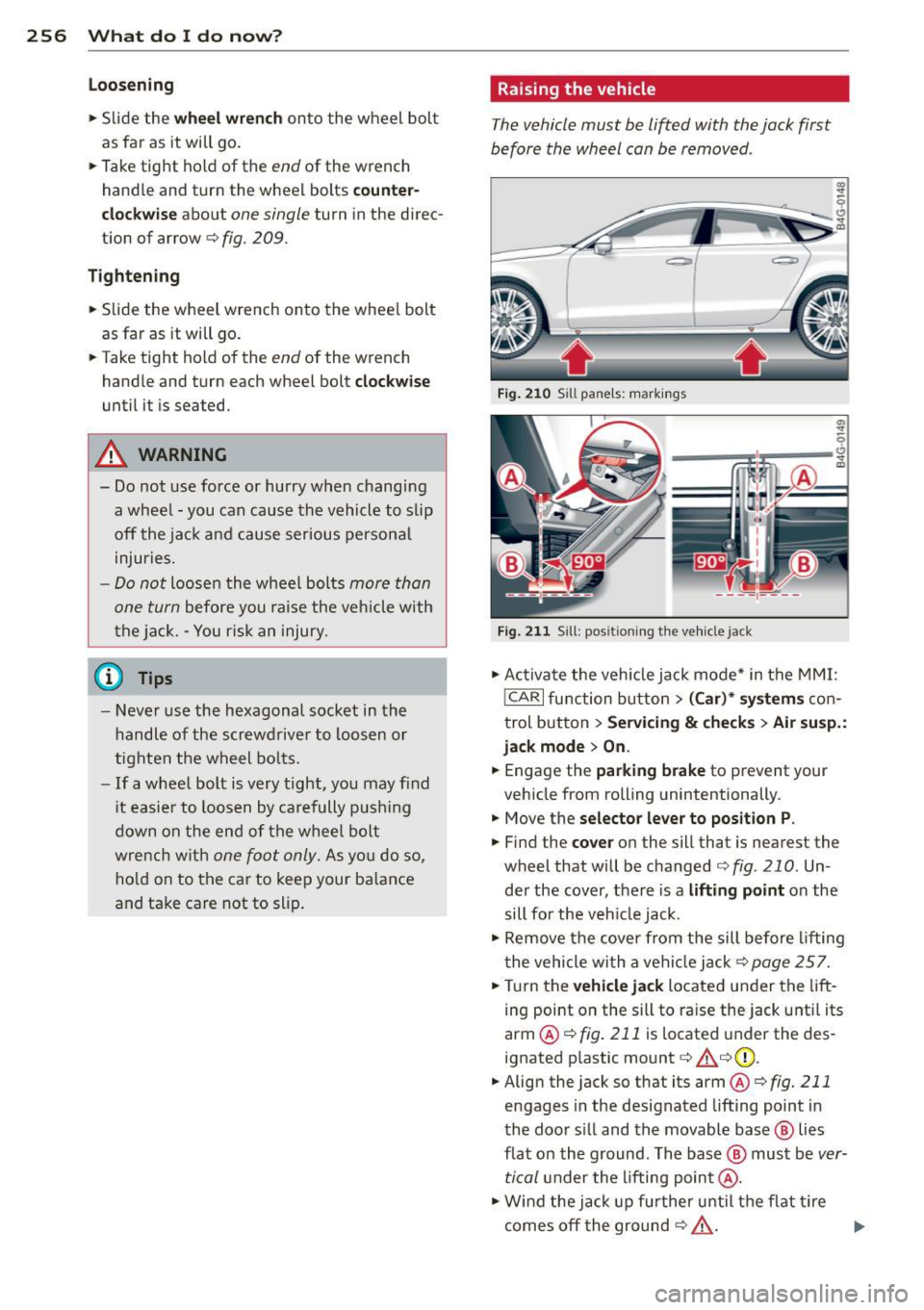
Fig. 210 Sill pane ls : markings
; q
--~~~~~-~
Fig. 211 Sill: posit ioning the Ve hicle jack
.,. Activate the vehicle jack mode* in the MMI:
!CARI function button> (Car)* systems con
trol button>
Servicing & checks> Air susp.:
jack mode
> On.
.,. Engage the parking brake to prevent your
vehicle from rolling unintentionally.
.,. Move the
selector lever to position P .
.,. Find the cover on the sill that is nearest the
wheel that will be changed
c:;, fig. 210 . Un
der the cover, there is a
lifting point on the
sill for the vehicle jack .
.,. Remove the cover from the sill before lifting
the vehicle with a vehicle jack
c:;, page 257 .
.,. Turn the vehicle jack located under the lift
ing point on the sill to raise the jack until its
arm @
c:;, fig. 211 is located under the des
ignated plastic mount
c:;, &c:;,(I) ,
.,. Align the jack so that its arm @ c:;, fig. 211
engages in the designated lifting point in
the door s ill and the movable base @ lies
flat on the ground . The base @ must be
ver
tical
under the lifting point @ .
.,. Wind the jack up further until the flat tire
comes off the ground
c:;, & . ..,.
Page 260 of 292
2 58 What do I do now ?
Taking the wheel off/installing a wheel
Follow these instructions step-by-step for
changing the wheel.
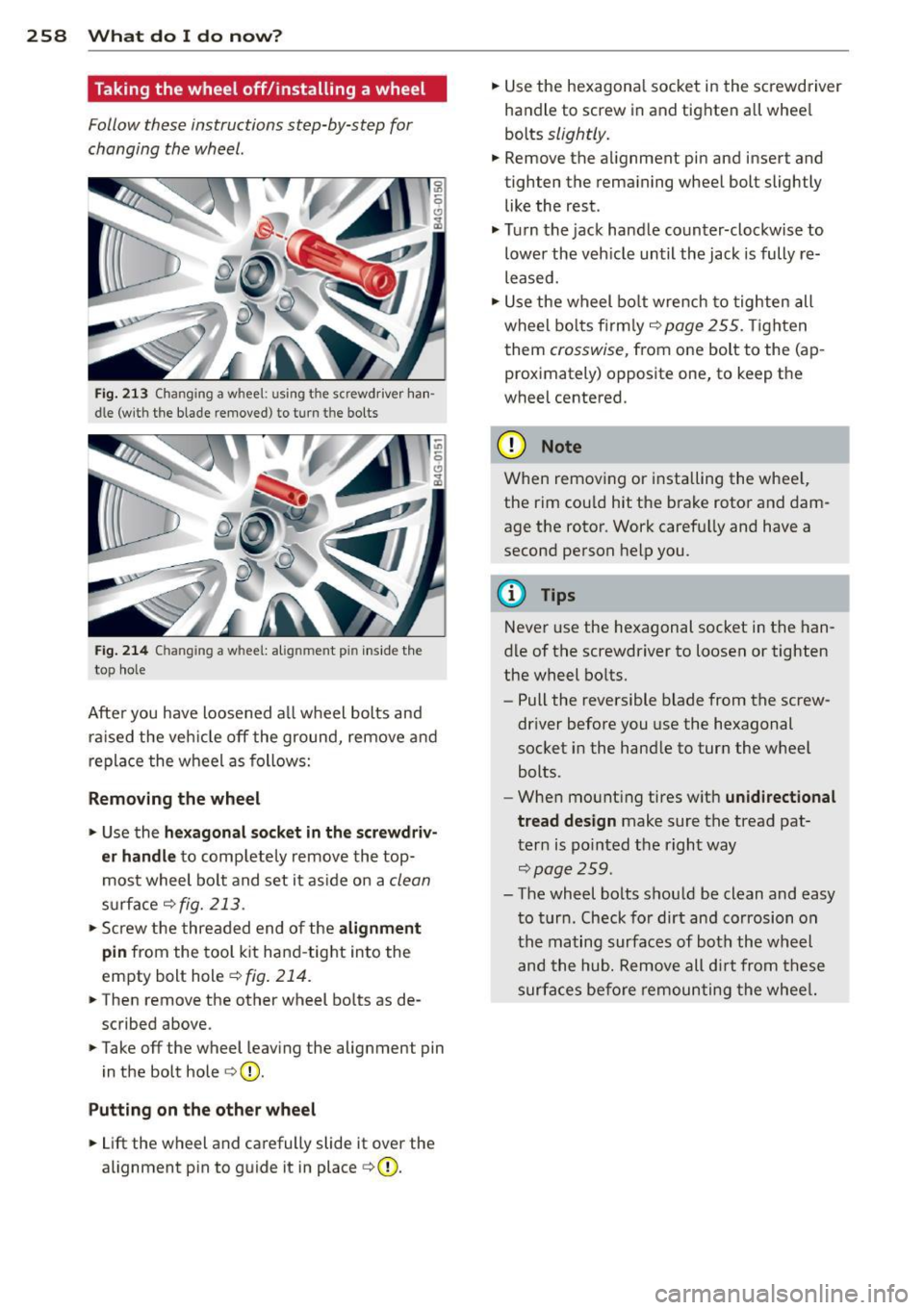
Fig. 213 Changing a whee l: u sing the screwdriver han
dle (w ith the blade removed } to turn t he bolts
Fig . 214 C hanging a w hee l: al ignm en t pi n inside the
top hole
Afte r you have loosened a ll wheel bolts and
raised the vehicle off the ground, remove and
replace the wheel as follows:
Removing the wheel
.. Use the hexagonal socket in the screwdriv
er handle
to comp letely remove the top
most wheel bolt and set it aside on a
clean
surface c:> fig. 213 .
.. Screw the threaded end of the alignment
pin
from the tool kit hand -tight into the
empty bolt hole
c:> fig. 214.
.. The n remove the other wheel bo lts as de
scribed above .
.. Take off the wheel leaving the alignment pin
in the bolt hole
c:> (D .
Putting on the other wheel
.. Lift the wheel and carefully slide it over the
alignment pin to guide it in place
c:>(D.
.. Use the hexagonal socket in the screwdriver
handle to screw in and tighten all whee l
bolts
slightly.
.. Remove the alignment pin and insert and
tighten the remaining wheel bolt slightly like the rest .
.. Turn the jack handle counter-clockwise to
lower the vehicle until the jack is fully re
leased .
.. Use the wheel bolt wrench to tighten all
wheel bolts fir m ly
c:> page 255 . Tighten
them
crosswise, from one bolt to the (ap
proximately) opposite one, to keep the
wheel centered.
(D Note
When remov ing or installing the wheel,
the rim cou ld hit the brake rotor and dam
age the rotor. Work carefu lly and have a
second person help you.
(D Tips
Never use the hexagonal socket in the han
d le of the screwdriver to loosen or tighten
the wheel bolts.
- Pull the reversible blade from the screw
driver before you use the hexagonal
socket in the handle to turn the wheel
bolts.
- When mounting tires w ith
unidirectional
tread design
make sure the tread pat
tern is pointed the right way
c:>page25 9.
-The wheel bolts should be clean and easy
to turn . Check for dirt and corrosion on
the mating surfaces of both the wheel
and the hub. Remove all dirt from these
surfaces before remounting the wheel.
Page 262 of 292
260 Fuses and bulbs
Fuses and bulbs
Fuses
Replacing fuses
Fuses that have blown will have metal strips
that have burned through.
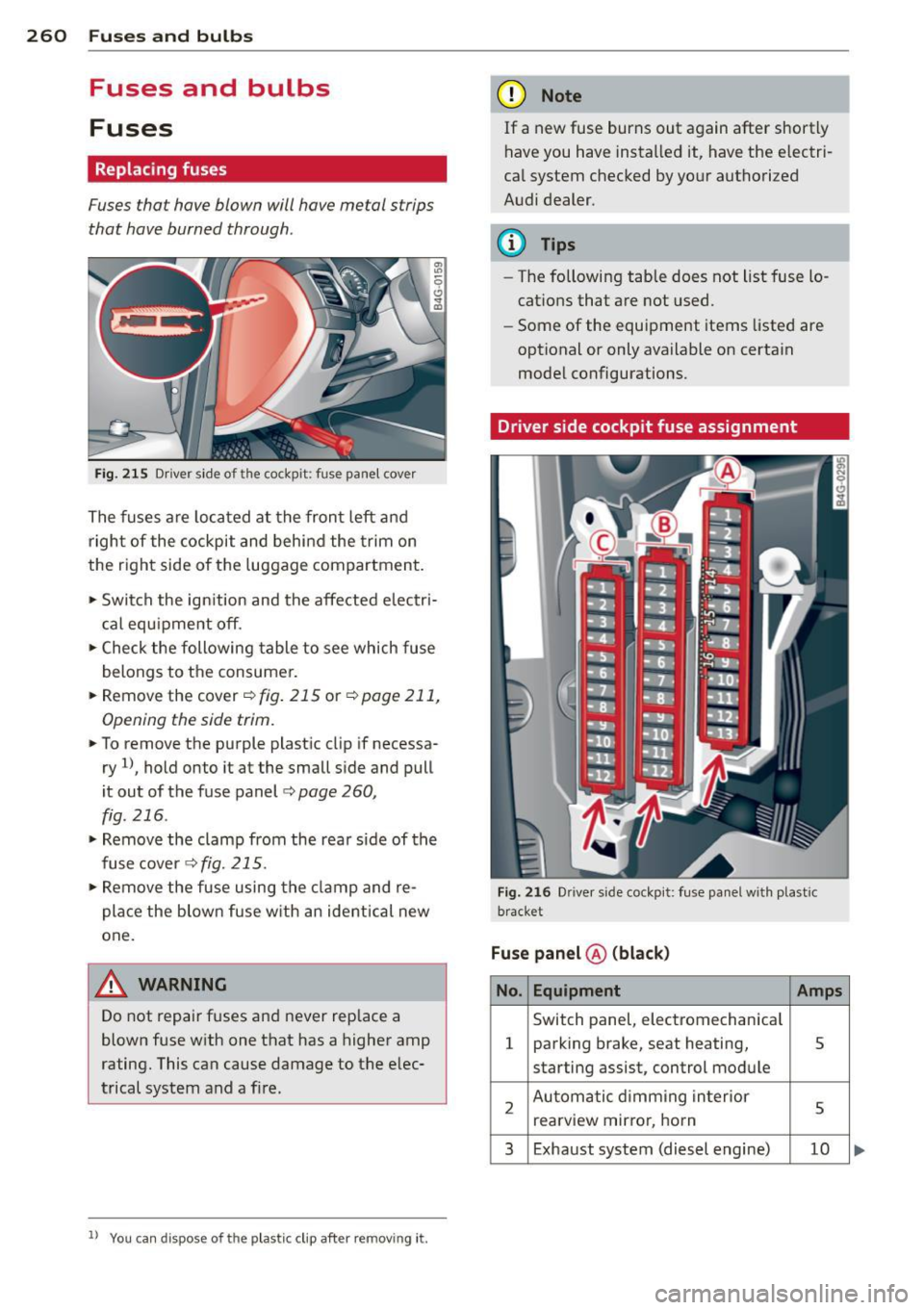
Fig. 215 Driver side of the cockpit: fuse panel cover
The fuses are located at the front left and
right of the cockpit and behind the trim on
the right side of the luggage compartment.
• Switch the ign ition and the affected electri
cal equ ipment off.
• Check the following table to see which fuse
belongs to the consumer.
• Remove the cover ¢
fig. 215 or¢ page 211,
Opening the side trim.
• To remove the purple plastic clip if necessa
ry
ll, hold onto it at the small side and pull
it out of the fuse panel
c:> page 260,
fig. 216 .
• Remove the clamp from the rear s ide of the
fusecover <>fig.
215.
• Remove the fuse using the clamp and re
pla ce the blown fuse w ith an ident ical new
one.
A WARNING
Do not repair fuses and never replace a
blown fuse with one that has a higher amp
rating. This can cause damage to the elec
trical system and a fire.
ll You can dis pose of the plastic clip after re moving it.
(D Note
If a new fuse burns out again after shortly
have you have installed it, have the electri
cal system checked by your authorized
Audi dealer.
(D Tips
-The following table does not list fuse lo
cations that are not used.
- Some of the equipment items listed are
optional or only available on certain
model configurations.
Driver side cockpit fuse assignment
Fig. 216 Dr ive r side cockpit: fuse panel with plastic
bracket
Fuse panel ® (black)
No. Equipment Amps
Switch panel, electromechanical
1 parking brake, seat heating, 5
starting assist, control module
2 Automatic dimming interior
5 rearview mirro r, horn
3 Exhaust system (diesel engine) 10
Page 263 of 292
No. Equ ipment Amps
4 Suspension control system sen-s sor
s
E
lectronic Stabilization Cont rol
s (ESC) module
6 Climate control
5
7 Adaptive cruise control 10
8
Airbag control module, front
5
passenger's seat sensor system
9 Gateway 5
Homelink (garage doo r opener),
10 night vis ion system cont ro l 5
module
11 Image
processing (active lane
10
ass ist, adaptive cruise control)
12 Dynamic steering 5
13 Terminal 15 in
the instrument
15
panel
14 Terminal 15
in the luggage com-
partment 30
15 Terminal 15
(engine)
15
16 Starter 40
Fu se pa nel ® (b rown )
No . Equipment Amps
1 Gateway
5
2 C limate control 10
3 E
lectronic Stabili zation Contro l
10
(ESC) module
4 Fron
t door (driver 's side)
30
s
Power seat adjustment (driver's
7,5
seat)
6 Dynam
ic steering
35
7 Sunroof 20
8
Rear door control module (driv-
15
er 's side)
9 Lumbar support (
Front passen-
s ger seat)
10 Tire pressure
monitoring system
5
11 Su
nroof, rear spoi ler (Sportba ck)
20
12 Driver
door control module
15
Fuse s and bulb s 261
Fuse pan el© (r e d )
No . Equipment
2 Fuel pump
3 Brake light sensor/brake pedal
sensor system
AdBlue control module (Diesel)/
4 Engine acoust ics
5 Left rear door cont rol modu le
6 Power seat adjustment
(pas-
senge r's seat)
7 Horn
8 Windshield wiper motor
9 Light/rain sensor, heater
for vid-
eo camera in windscreen
10 L umba r support (driver seat)
1 1 Front
passenger door control
modu le
12 Right rea r door cont rol modu le
Front passenger side cockpit fuse
assignment Amp
s
25
5/5
5/7,S 30
7,5 15
30
s
5
15
15
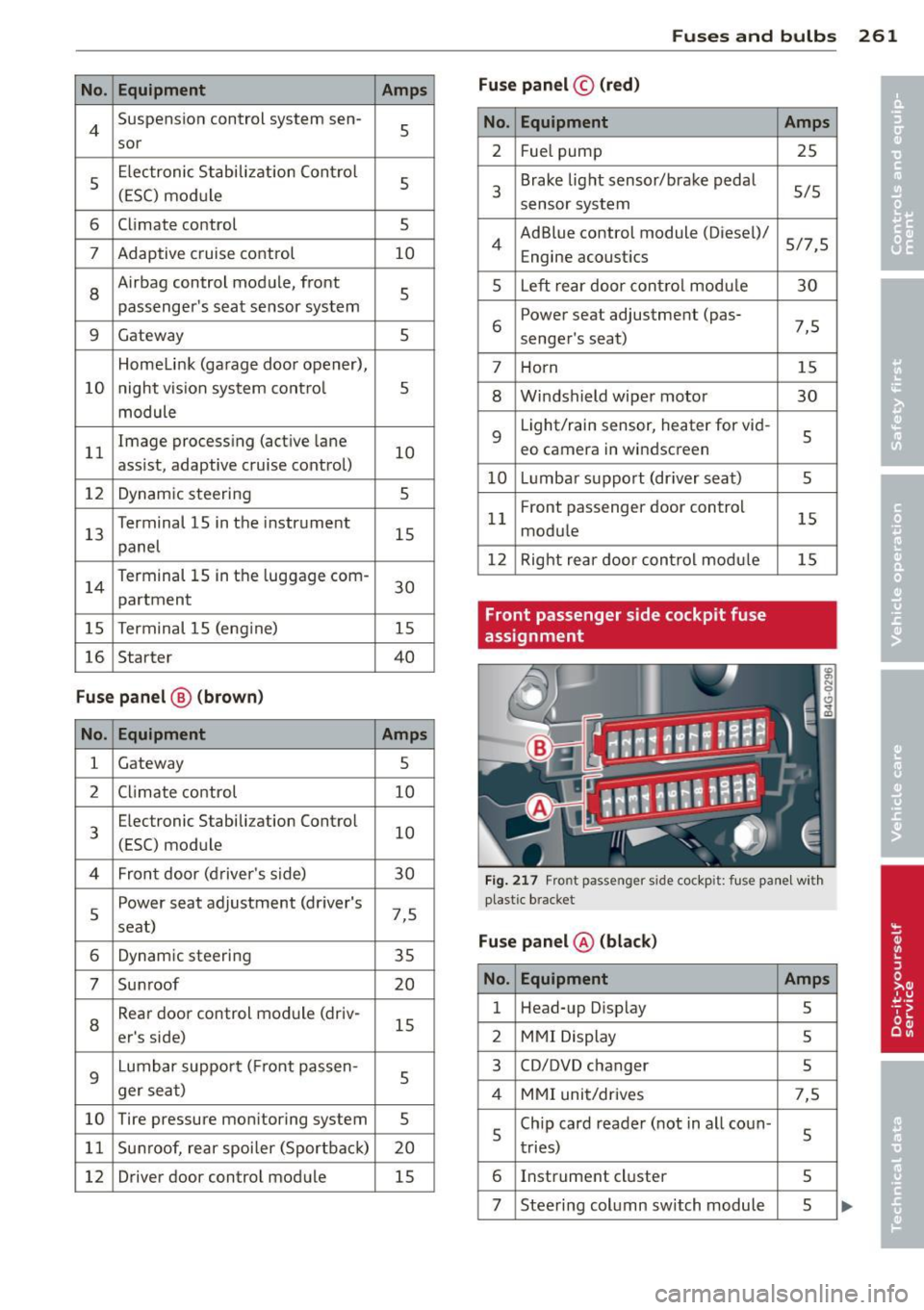
F ig . 217 Front passenger side cockpit: fuse pa nel w it h
plast ic brac ket
Fuse panel @ (bla ck)
No . Equipment Amps
1 Head-up
Display
5
2 MMI Display 5
3 CO/DVD changer
5
4 MMI unit/drives 7,5
5 Chip
card reader (not in all coun-
5
tries)
6 Instrument
cluster
5
7 Steering column switch module 5 ...
Page 264 of 292
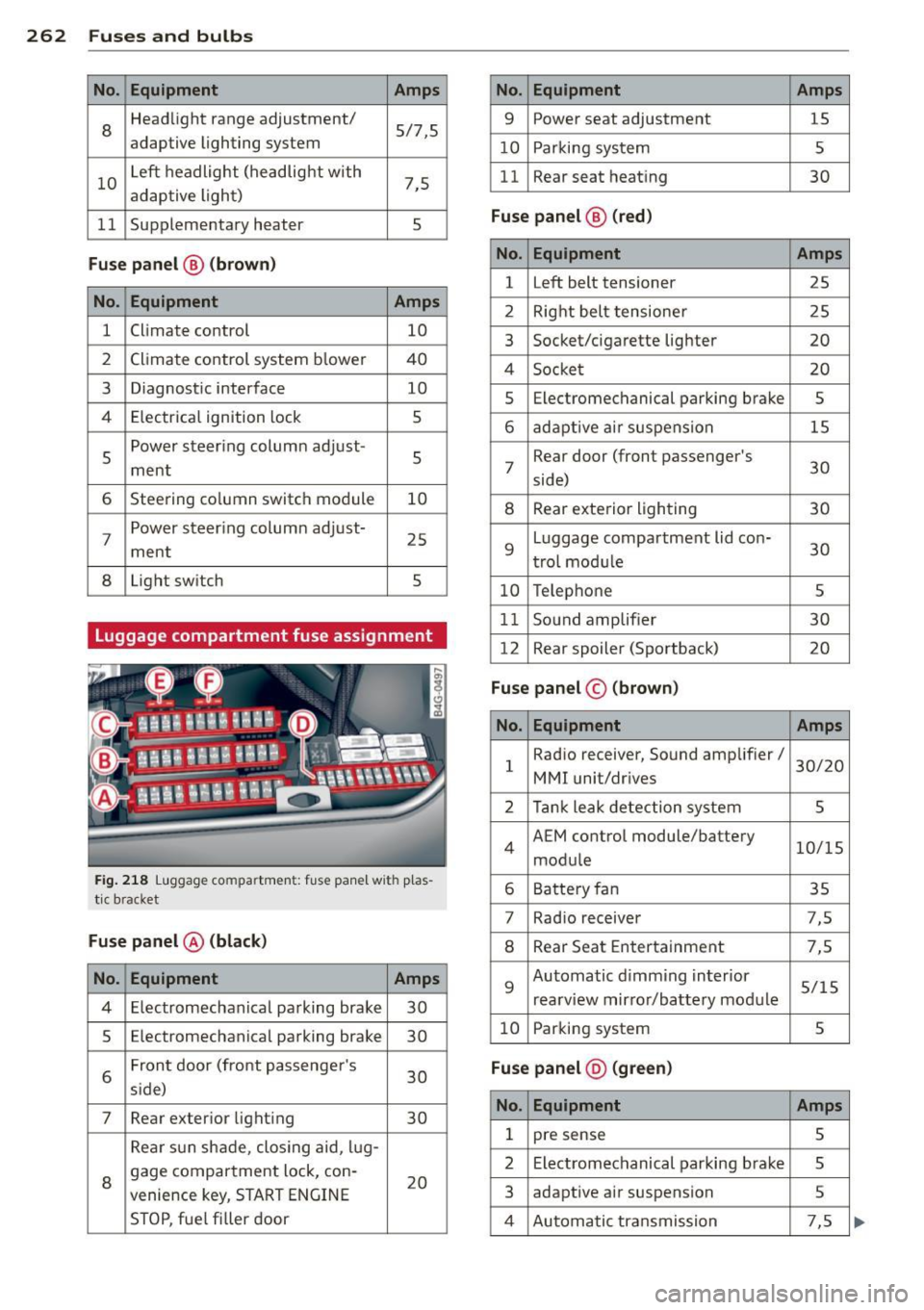
262 Fuses and bulb s
No. Equ ipment Amps
8
Headlight range adjustment/
5/7,S
adaptive lighting system
10 Left headlight
(headlight with
7,5
adaptive light)
11 Supplementary
heater
s
Fuse p ane l@ (b ro w n)
No . Equipment Amps
1 Climate control
10
2 Climate control system blower 40
3 Diagnostic interface
10
4 E lectrical ignition lock
s
s
Power steering column adjust-
s ment
6 Steering column switch module
10
7 Power steering column adjust-
ment
25
8 Light
switch
s
Luggage compartment fuse assignment
Fig. 218 Luggage compartment: fuse panel with plas
tic bracket
Fuse p anel @ (b la ck )
No. Equipment Amps
4 E lectromechanical parking brake 30
s Electromechanical parking brake
30
6 Front door
(front passenger's
30
s ide)
7 Rear exter ior lighting
30
Rear sun shade, closing aid, lug-
8 gage compartment lock, con-
20
venience key, START ENGINE
STOP, fuel filler door
No. Equipment Amps
9 Power seat adjustment
15
10 Parking system
s
11 Rear seat
heating
30
Fuse pan el@ (r e d )
No . Equipment Amps
l Left belt tensioner
25
2 Right belt tensioner 25
3 Socket/cigarette
lighter
20
4 Socket 20
s Electromechanical parking brake s
6 adaptive ai r suspension 15
7 Rear door
(front passenger's
30
side)
8 Rear exterior lighting 30
9 Luggage compartment
lid con-
30
t rol modu le
10 Telephone
s
11 Sound amplifier 30
12 Rear
spoiler (Sportback)
20
Fuse pan el© (brown)
No . Equipment Amps
1 Radio
receiver, Sound amplifier/
30/20
MMI unit/drives
2 Tank leak detection system
s
4 AEM
control module/battery
10/15
module
6 Battery fan 35
7 Rad
io receiver 7,S
8 Rear Seat Entertainment 7,5
9 Automatic d
imming interior
5/15
rearview mirror/battery module
10 Parking system
s
Fuse pan el@ (gre en)
No . Equipment Amps
1 pre sense s
2 Electromechanical parking brake s
3 adaptive
air suspension 5
4 Automatic transmission 7,5
Page 267 of 292
@ Tips
The disc harged battery must be properly
connected to the vehicle's electrical sys
tem. When jump starting or charg ing the
battery, never connect the negative
ground cable to the batte ry negat ive post
because the ba tte ry manager system must
be ab le to detect the battery's state of
charge. Always connect the negative
g round cab le to the negative ground pos t
of t he battery manager cont ro l unit.
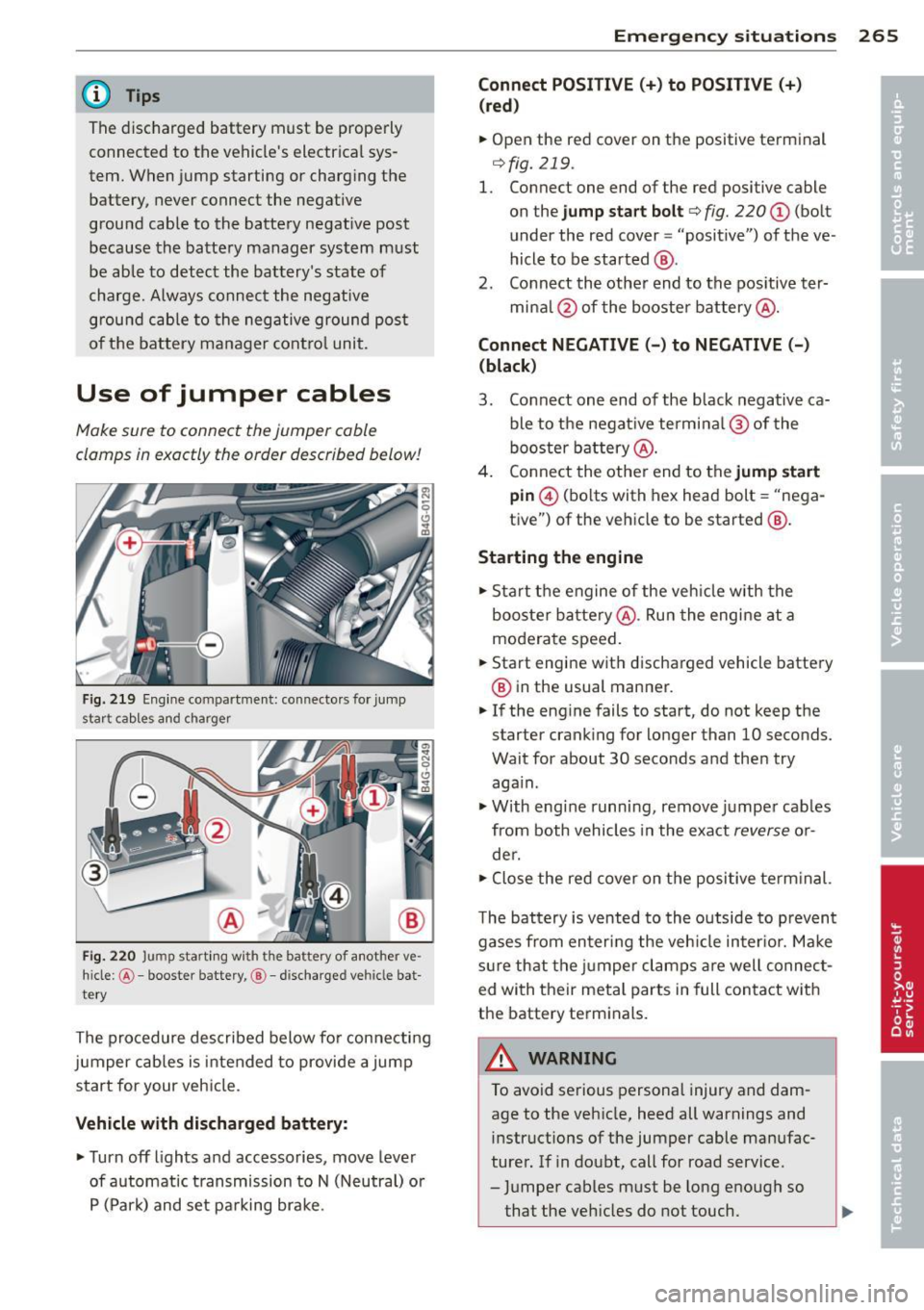
Use of jumper cables
Make sure to connect the jumper coble
clomps in exactly the order described b elow!
Fi g. 21 9 Eng ine co mpar tment: connecto rs for jum p
s tar t cab les and ch arg er
F ig. 220 Jump start in g w ith t he ba ttery of a not her ve ·
hi cle :
@-booster battery, ®-disc harged ve hicle bat
te ry
The procedure des cribed below fo r connecti ng
jumper cables is intended to provide a jump
start for your veh icle.
Vehicle with discharged battery :
• Turnoff lights and accessories, move lever
of automatic t ransmission to N (Neu tral) o r
P ( Par k) and set pa rking brake .
Emergenc y situ ation s 265
Connect POSI TIVE(+) to POSITIVE(+)
(red )
• Open the red cov er on the posit ive te rminal
¢ fig. 219 .
1. Connect one end of the red positive cable
on the jump sta rt bolt
¢ fig. 220 (D (bolt
under the red cover = "positive") of the ve
hicle to be started @.
2 . Connect th e othe r end to the pos itive ter-
mi na l@ of the booster battery @.
Connect NEGATIVE( -) to NEGATIVE(-)
(black )
3. Connect one end of the black negative ca ble to the negat ive termi na l@ of the
booster b attery @.
4. Connect the othe r end to the jump start
pin @ (bo lts w ith hex head bolt = "nega
tive") of the vehicle to be started @.
Starting the engine • Sta rt the e ngine of the veh icle w ith the
booste r ba tte ry @ . Ru n the engi ne at a
modera te speed.
• Start engine w it h discha rged vehicle battery
@ in the usual manner.
• If the eng ine fails to start, do not keep the
starter c ranking for longer than 10 seconds.
Wait for about 30 seco nds a nd the n try
aga in .
• With eng ine runni ng,
remove ju mpe r cab les
from both vehicles in the exact
reverse o r
de r.
• Close the re d
cover on the positive te rm inal.
T he battery is v ented to th e outside to p rev ent
gases from en ter ing the veh icle in ter io r. Ma ke
s ur e th at the jumper clamps are well connec t
ed with their meta l parts in full con ta ct w ith
the battery term inals.
,8. WARNING
To avoid se rious personal injury and dam
age to the veh icle, heed all warnings and
instructions of the jumper cable man ufac
ture r. If in doubt, call for road service .
- Ju mpe r cables m ust be long enough so
that the veh icles d o not touch.
-