tow AUDI RS7 SPORTBACK 2015 User Guide
[x] Cancel search | Manufacturer: AUDI, Model Year: 2015, Model line: RS7 SPORTBACK, Model: AUDI RS7 SPORTBACK 2015Pages: 302, PDF Size: 74.76 MB
Page 77 of 302
M N
0::
Starting th e engin e
"'Pre ss the brake peda l r::!> _&..
"'Press the I START ENGINE STOP I button
r::!>fig. 83. T he engine will start .
If the engine should not sta rt immediately ,
the sta rting process is automatically stopped
after a short time. Repeat starting procedure .
A WARNING
-Never allow the engine to run in confined
spaces -danger of asphyxiation .
- Never t urn off the engine unti l the vehi
cle has come to a complete stop.
- The brake booster and power steering
only work when the engine is running . If
the engine is off, you have to use more
force when steering or braking. Because
you cannot steer and brake as you usua l
ly would, this could lead to crashes and
ser ious injur ies .
(D Note
-Avoid high engine rpm, full throttle and
heavy engine loads unti l the engine has
reached operating temperature -other
wise yo u risk eng ine damage.
- The eng ine cannot be started by pushing
or tow ing the veh icle.
(D Tips
- After a cold engine is started, there may
be a brief period of increased noise be
ca use oil pressure mus t fi rst bu ild up in
the hyd raulic valve adjusters . This is nor
mal and not a ca use for concern.
- If you leave the vehicle with the ignit ion
switched on, the ignition will switch off
after a certai n pe riod of time. P lease
note tha t electr ica l equipment s uch as
exterior lights wi ll switch off as well
when that happens.
Stopping the engine
~ "' Bring your vehicle to a complet e stop. ,....,
~ "' Move the selector lever to the P or N po si-
,...., tion.
"' ,....,
On th e ro ad 75
"'Press the I START ENGINE ST OP I button
r::!>poge 74, fig . 83.
Ste ering lock
T he s teering locks when yo u tur n the engine
off using t he
I S TA RT ENGINE STO P! bu tton
and open the d river 's doo r. The locked steer
ing helps prevent vehicle theft.
Emergency off
If necessary, the engine can be switched off
with the selector lever in the R or D/S posi
t ion. The engine stops if you press the
I S TAR T ENG IN E ST OP I button at speeds below
6 mph (10 km/ h) .
A WARNING
- Never turn off the engine until the vehi
cle has come to a complete stop.
- The brake booster and power stee ring
only work when the eng ine is r unning . If
the engine is off, you have to use more
force when steering or braking. Because
you cannot steer and brake as you usual
ly would, this co uld lead to crashes and
serio us inju ries .
- For safety reasons , you should a lways
pa rk your vehicle w it h the selector lever
in P. Otherwise, the vehicle could inad
ver ten tly roll away.
- After the eng ine has been switched off,
the radiator fa n can cont in ue to run for
up to 10 minu tes -even with the ignition
sw itche d off . It can also sw itch on again
after some time i f th e coolant tempera
ture rises as the result of a heat b uildup
or if the engine is hot and the engine
compartment is additionally heated by
the sun's rays.
(U) Note
Do not stop the engine immediately after
hard o r extended driving. Keep the engine
running for approximate ly two minutes to
prevent excess ive heat bu ild-up .
Page 82 of 302
80 On the road
the distance between your vehicle and
other vehicles.
- For safety reasons, the cruise control
should not be used in the city, in stop and-go traffic, on twisting roads and
when road conditions are poor (such as
ice, fog, gravel, heavy rain and hydro
planing) -risk of accident .
- Turn off the cruise control temporarily
when entering turn lanes, highway exit
lanes or in construction zones.
- Please note that inadvertently "resting" your foot on the accelerator pedal causes
the cruise control not to brake. This is
because the cruise control is overridden
by the driver's acceleration.
- If a brake system malfunction such as
overheating occurs when the cruise con
trol system is switched on, the braking
function in the system may be switched
off. The other cruise control functions re
main active as long as the indicator light
II (US models) !Iii (Canadian models)
is on.
The brake lights illuminate as soon as the
brakes decelerate automatically.
Changing speed
Applies to vehicles: with cru ise control
.,. To increase/decrease the speed in incre
ments, tap the lever in the
010 direction
¢ page 79, fig . 86
.,. To increase/decrease the speed quickly, hold
the lever in the
010 direction until the de
sired speed is displayed.
You can also press the accelerator pedal down
to increase your speed, e.g . if you want to
pass someone. The speed you saved earlier
will resume as soon as you release the acceler
ator pedal.
If , however, you exceed your saved speed by
6 mph (10 km/h) for longer than 5 minutes,
the cruise control will turn off temporarily.
The green symbol
II (US models) !Iii (Cana- dian models) in the display will go out but the
saved speed remains the same.
Presetting your speed
Applies to vehicles: with cruise cont
rol
You can preset your desired speed while the
vehicle is not moving.
.,. Switch on the ignition.
.,. Pull lever into position@¢
page 79,
fig. 86.
.,. Press the lever in the 0 or 0 direction to
increase or decrease your speed.
.,. Release the lever to save that speed.
This function makes it possible, for example,
to save the speed you want before driving on
the highway. Once on the highway, activate
the cruise control by pulling the lever toward
@.
Switching the system off
Applies to vehicles: with cruise control
Temporary deactivation
.,. Press the brake pedal, or
.,. Press the lever into position@(not clicked
into place)
~ page 79, fig . 86, or
.,. Drive for longer than 5 minutes at more
than 5 mph (10 km/h) above the stored
speed.
Switching off completely
.,. Press lever into position @ (clicked into
place), or
.,. Switch the ignition off .
The system retains the saved speed if you de
activate the cruise control temporarily. To re
sume the saved speed, release the brake ped
al and pull the lever to position @.
Switching the ignition off erases the saved
speed .
A WARNING
-You should only return to the saved speed
if it is not too fast for the current traffic
conditions -risk of an accident!
Page 83 of 302
"' N
a:: I.J "". rl I.O
"' rl
"' rl
Audi adapt ive crui se c ontrol an d bra kin g guard 81
Audi adaptive cruise
control and braking
guard
Introduction
App lies to vehicles: with Audi adaptive cruise control
The adaptive cruise control system assists the
driver by regu lating vehicle speed and helping
to maintain a set distance to the vehicle
ahead, within the limits of the system . If the
system detects a moving vehicle up ahead,
adaptive cruise control can brake and then ac
celerate your vehicle. Th is he lps to make driv
ing more comfortable both on long highway
stretches and in stop-and-go traffic.
The braking guard system can warn you about
an impending collision and initiate braking
maneuvers¢
page 87.
Adaptive cruise control and braking guard
have technical limitations that you must
know, so please read this section carefully, un
derstand how the system works and use them
properly at all times.
General information
General information
Applies to vehicles: with Audi adaptive cruise control
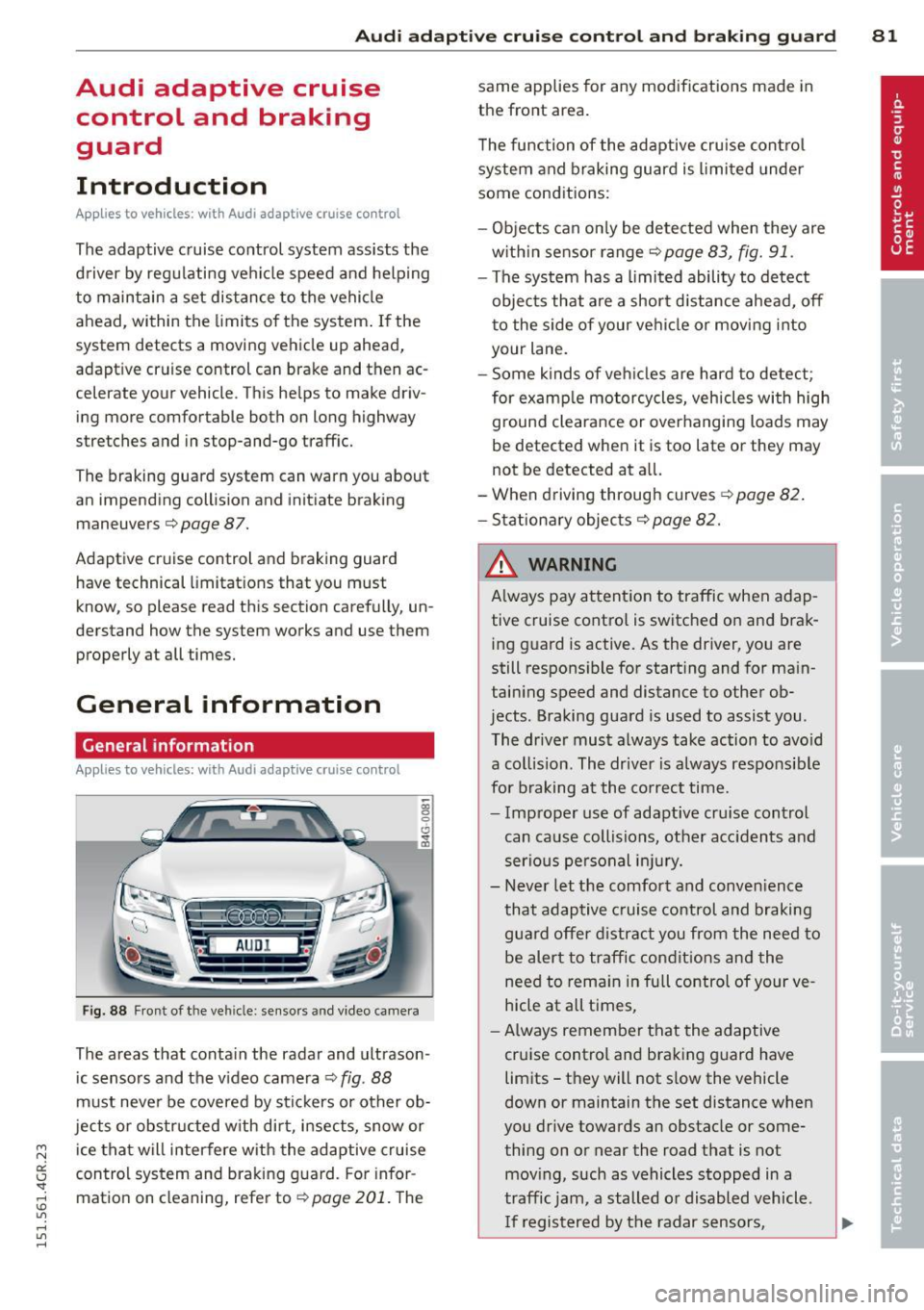
Fig. 88 Front of the vehicle: sensors and video came ra
The areas that contain the radar and ultrason
ic sensors and the v ideo camera ¢
fig. 88
must neve r be covered by stickers or other ob
jects or obstructed with dirt, insects, snow or
ice that will interfere with the adaptive cruise
control system and braking guard. For infor
mation on cleaning, refer to¢
page 201. The same applies for any modifications made in
the front area.
T he function of the adaptive cru ise contro l
system and braking guard is limited under
some conditions:
- Objects can on ly be detected when they are
w ith in sensor range
¢page 83, fig. 91 .
-The system has a limited ability to detect
objects that are a shor t distance ahead,
off
t o the side of your vehicle or moving into
your lane.
- Some kinds of ve hicles are hard to detect;
for examp le motorcycles, vehicles with high
ground clearance or overhanging loads may
be detected when it is too late or they may
not be detected at all.
- When driving through curves
¢page 82 .
- Stationary objects¢ page 82.
& WARNING
Always pay attent ion to traffic when adap
tive cruise control is switched on and brak ing g uard is active. As the driver, you are
still respons ible for starting and for ma in
taining speed and distance to other ob
jects . Braking guard is used to assist you .
The driver must always take action to avo id
a collision. The driver is always responsible
for braking at the co rrect time.
- Improper use of adaptive cru ise control
can cause collisions, other acc idents and
serious pe rsonal in jury.
- Never let the comfort and conven ience
that adaptive cruise control and braking
guard offer d istract you from the need to
be alert to traffic condit ions and the
need to rema in in full control of your ve
hicle at all times,
- Always remember that the adaptive
cruise control and braking guard have
limits -they will not s low the vehicle
down or maintain the set distance when
you drive towards an obstacle or some
thing on or near the road that is not
mov ing, such as vehicles stopped in a
traffic jam, a stalled or disabled vehicle .
I f registered by the radar sensors,
Page 85 of 302
"' N
a:: I.J "". rl I.O
"' rl
"' rl
Audi adaptive cruise control and braking guard 83
@ is located in front of that vehicle, the sys
tem will not react to the stationary vehicle.
Audi adaptive cruise
control
Description
Applies to vehicles: with Audi adaptive cruise co ntrol
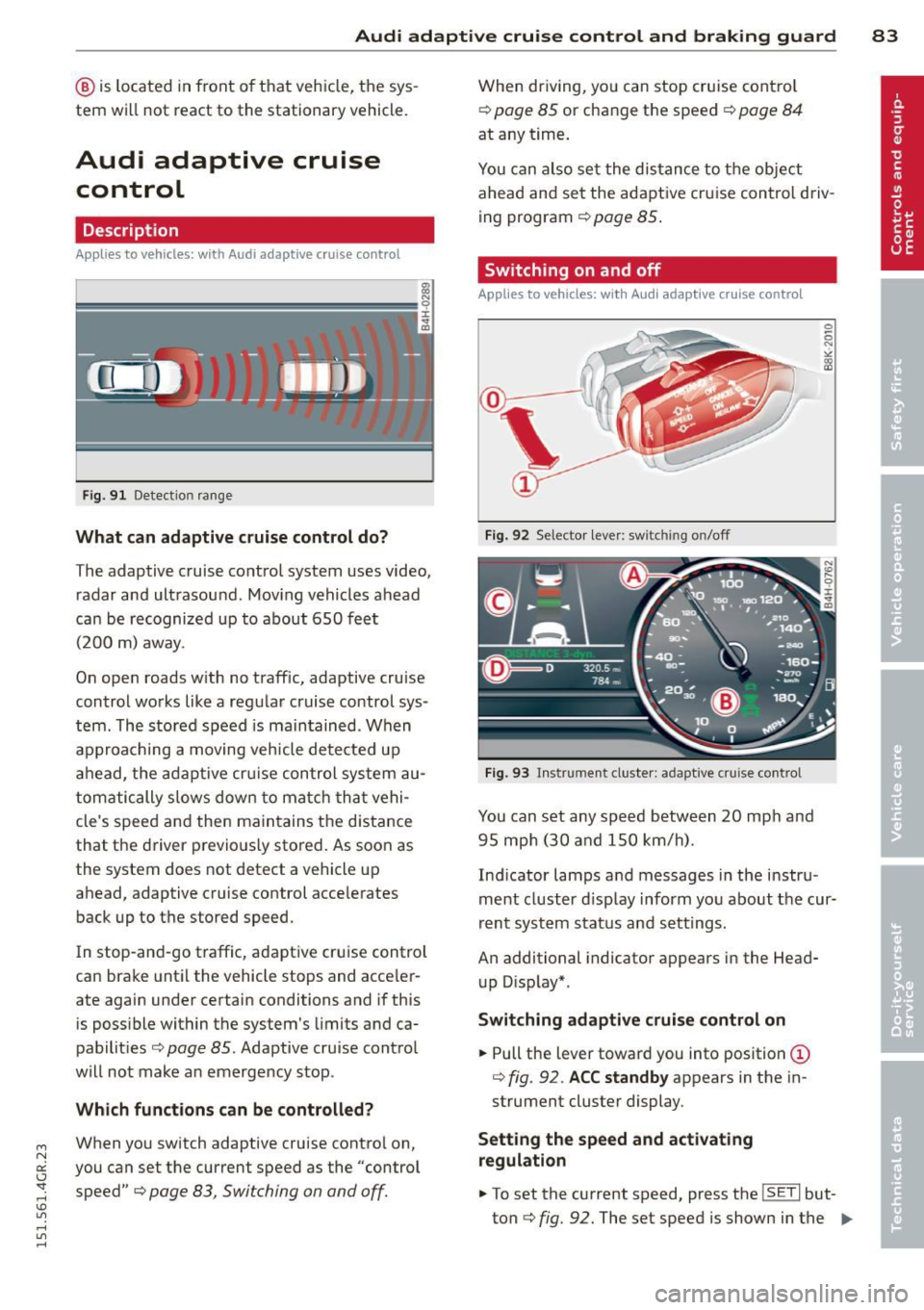
Fig. 91 Detectio n range
What can adaptive cruise control do?
The adaptive cruise control system uses video,
radar and ultrasound . Moving vehicles ahead
can be recognized up to about 650 feet (200 m) away.
On open roads w ith no traff ic, adaptive cruise
control works like a regular cruise control sys
tem. The stored speed is maintained . When
approaching a moving vehicle detected up
ahead, the adaptive cruise control system au
tomatically slows down to match that vehi
cle's speed and then maintains the distance
that the driver previously stored. As soon as
the system does not detect a vehicle up
ahead, adaptive cruise control accelerates
back up to the stored speed.
In stop-and-go traffic, adaptive cruise control
can brake until the vehicle stops and acce ler
ate again under certain conditions and if this
is possible within the system 's limits and ca
pabilities
c> page 85. Adaptive cruise control
will not make an emergency stop .
Which functions can be controlled?
When you switch adaptive cruise contro l on,
you can set the current speed as the "control speed"
c> page 83, Switching on and off.
When driving, you can stop cruise control
c> page 85 or change the speed c> page 84
at any time.
You can also set the distance to the object
ahead and set the adaptive cruise control driv
ing program
c> page 85 .
Switching on and off
Applies to vehicles: with Audi adaptive cruise control
Fig. 92 Selector lever: sw itchin g on/off
Fig. 93 Instrumen t cl uster : ad apt ive crui se cont rol
You can set any speed between 20 mph and
95 mph (30 and 150 km/h).
Indicator lamps and messages in the instru
ment cluster d isplay inform you about the cur
rent system status and settings.
An additional indicator appears in the Head
up Display* .
Switching adaptive cruise control on
.,. Pull the lever toward you into position (D
c> fig. 92 . ACC standby appears in the in
strument cluster display .
Setting the speed and activating
regulation
.,. To set the current speed, press the ISETI but
ton
c> fig. 92. The set speed is shown in the IJJ,,
Page 87 of 302
"' N
a:: I.J "". rl I.O
"' rl
"' rl
Audi adaptive cruise control and braking guard 85
Following any changes, the new stored speed
will be displayed briefly in the display @
r::!) page 83, fig. 93.
Driving in stop-and-go traffic
Applies to vehicles: with Audi adaptive cruise co ntrol
The adaptive cruise control system also as
sists you in stop-and-go traffic. If a previous
detected vehicle ahead stops, your vehicle will brake to a stop, within the limits of the sys
tem.
.,. To resume driv ing with adaptive cruise con
trol, tap the accelerator pedal or
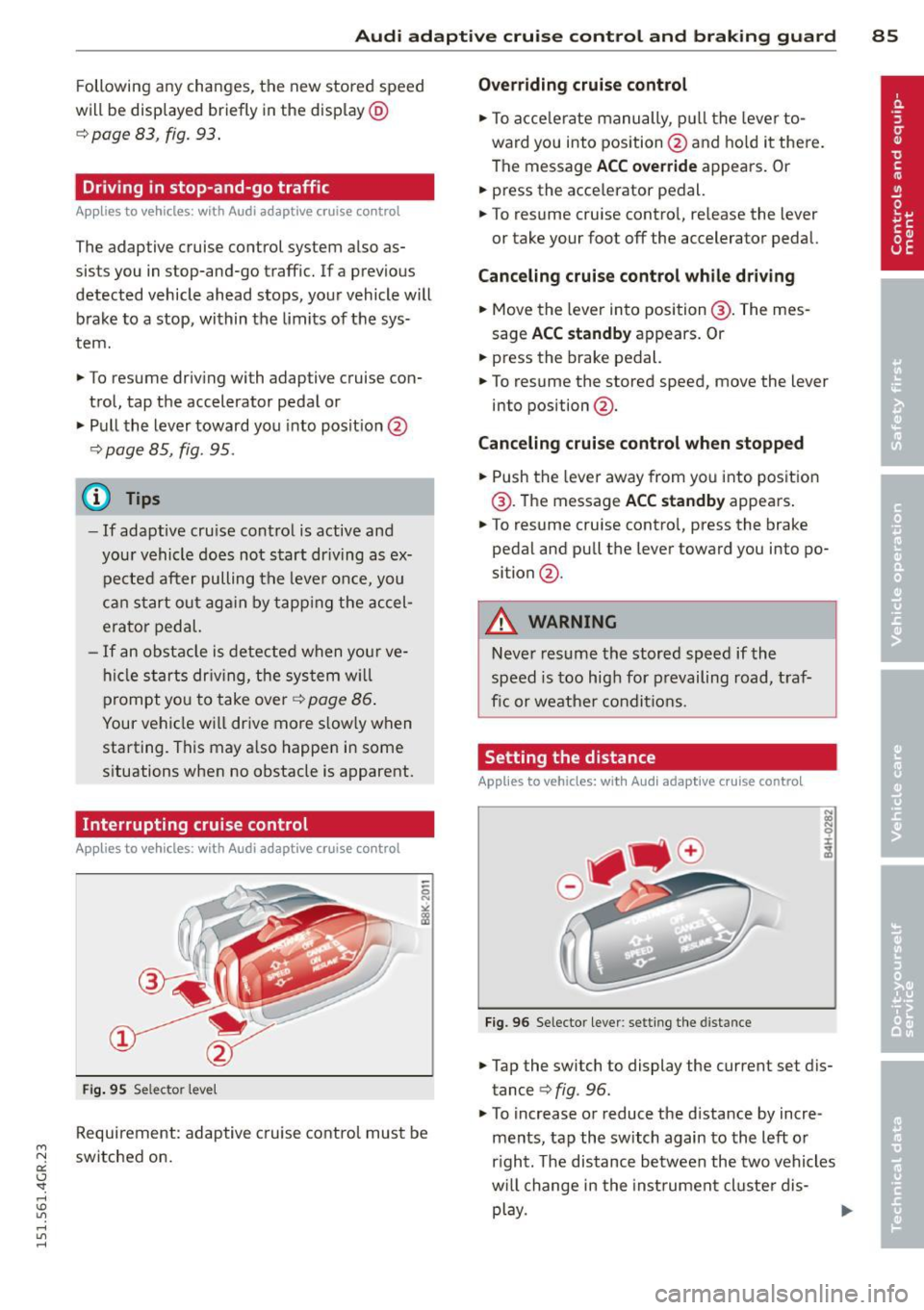
.,. Pull the lever toward you into posit ion @
¢page 85, fig. 95 .
@ Tips
-If adaptive cru ise control is active and
your vehicle does not start driving as ex
pected after pulling the lever once, you
can start out again by tapping the accel
erator pedal.
-If an obstacle is detected when your ve
hicle sta rts driving, the system will
prompt you to take over¢
page 86.
Your vehicle will drive more slow ly when
starting. This may also happen in some
situations when no obstacle is apparent.
Interrupting cruise control
App lies to vehicles: with Audi adaptive cruise control
Fig . 95 Se lector leve l
Requirement: adaptive cruise control must be
switched on.
Overriding cruise control
.,. To acce lerate manually, p ull the lever to
ward you into position@and hold it there.
The message
ACC override appears. Or
.. press the acce lerator pedal.
.,. To resume cruise control, re lease the lever
or take your foot off the accelerator pedal.
Canceling cruise control while driving
.,. Move the lever into position @. The mes
sage
ACC standby appears. Or
.,. press the brake pedal.
.,. To resume the stored speed, move the lever
into position @ .
Canceling cruise control when stopped
.,. Push the lever away from you into position
@ . The message
ACC standby appears .
.,. To resume cruise contro l, press the brake
pedal and pu ll the lever toward you into po
sition @.
A WARNING
-
Never resume the stored speed if the
speed is too high for prevailing road, traf
fic or weather conditions.
Setting the distance
Applies to vehicles: wit h Audi adapt ive cr uise contro l
Fig. 96 Selector lever: setting the distance
.,. Tap the switch to display the current set dis
tance ¢
fig. 96.
.,. To increase or reduce the distance by incre
ments, tap the switch again to the left or
r ight. The distance between the two vehicles
w ill change in the instrument cluster dis-
play. ..,.
Page 95 of 302
"' N
a:: I.J "". rl I.O
"' rl
"' rl
Audi side assist Lane Change Assistant
Description
App lies to vehicles: with side assist
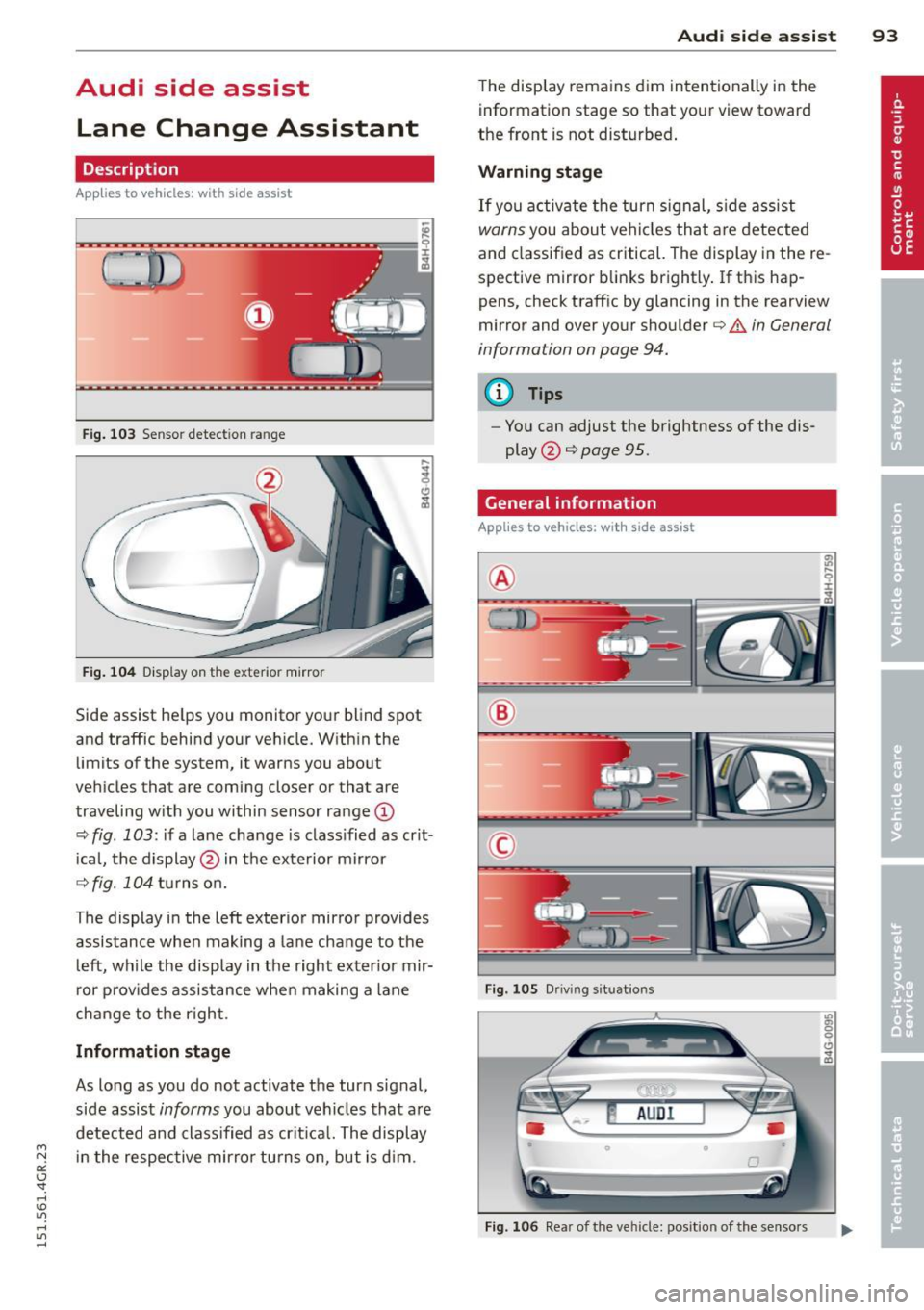
Fig. 103 Sensor detection range
Fig. 104 Display on the exterior mirror
Side assist he lps you monitor your blind spot
and traffic behind your veh icle. With in the
limits of the system, it warns you about
vehicles that are coming closer or that are
traveling w ith you within sensor range
(D
c::, fig . 103: if a lane change is class ified as crit
ical, the display@ in the exterior mirror
c::>fig.1 04turnson.
Th e display in the left exterior mirror provides
assistance when making a lane change to the
le ft, while the display in the right exterior mir
r or provides assistance when making a lane
change to the right.
Information stage
As long as you do not activate the turn signal,
side assist
informs you about vehicles that are
detected and classified as crit ical. The display
in the respective mirror turns on, but is d im.
Audi side assist 93
The display remains dim intentionally in the
information stage so that your view toward
the front is not disturbed .
Warning stage
If you activate the turn signal, side assist
warns you about vehicles that are detected
and classified as critical. The display in the re
spective mirror blinks brightly . If this hap
pens, check traff ic by glancing in the rearview
mirror and over your shoulder
c::> A in General
information on page 94.
@ Tips
- Yo u can adjust the brightness of the dis
play @ c::>
page 95.
General information
Applies to vehicles: with side assist
®
®
©
Fig. 105 Driving situations
Fig . 106 Rear of the vehicle: position of the senso rs
Page 99 of 302
"' N
a:: I.J "". rl I.O
"' rl
"' rl
ability to accelerate on curves. The vehicle is
very responsive to steering.
Curve light*
The curve light adapts to driv ing on curves.
The pivot ing action and the light ing are also
adapted to the mode.
Ad apti ve crui se contr ol*
The behavior when accelerat ing can be ad just
ed from comfortable to sporty, depending on
the dr ive se lect mode . Adaptive cruise control
also responds to the driving behav ior of the
veh icle ahead in a more conservative or sporty
manner .
Engine sound
The sound of the engine is adapted to these
l ected mode and ranges from subtle to sporty.
(D Note
-Make sure there is enough clearance
above and below the vehicle when park
i ng. The height of the vehicle can change
once it is parked d ue to temperature
fluctuations, changes to the load condi
tions and changes to the driving modes,
which can affect clearance.
- When transporting the vehicle on a car
carrier, train, ship or by other means, on
l y tie the veh icle down at the running
surface of the tires, which is the outer
circumference. Securing the vehicle at
the axle components, suspension struts
or tow ing eyes is not perm itted because
the p ressure in the air suspension struts
can change d uring transport. The vehicle
may not be se cured s uff ic ient ly if this
happens.
(D Tips
- In some models, the maxim um vehicle
speed can only be reached in the
Auto
and D ynamic modes.
- Se lecting the
Dynami c mode results in
spor ty sh ifting character istics. The S
gear position engages automatically .
Audi drive sele ct 97
- In ve hicles that have dynamic steering*,
operating noise is heard when starting or
stopping the engine. This does not indi
cate a problem.
Selecting the driving mode
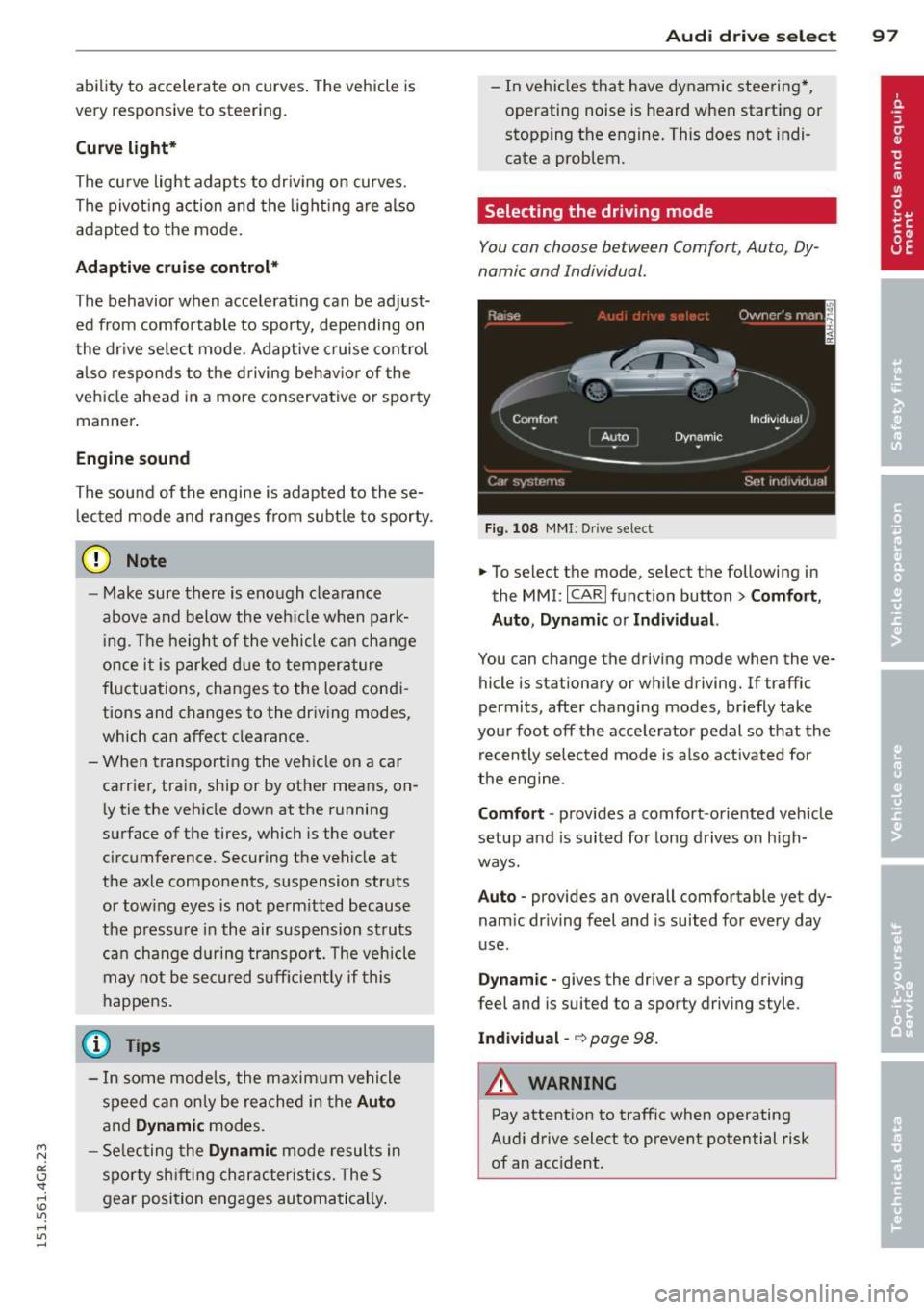
You can choose between Comfort, Auto, Dy
namic and Individual.
Fig. 108 M MI: Dr ive select
.,. To select the mode, select the following in
the
MMI: I CARI function button> Comfort ,
Auto , Dynamic or Individu al.
You can change the driving mode when the ve
hicle is stationary or while driving. If traffic
permits, after changing modes, br iefly take
your foot off the accele rator pedal so that the
recently selected mode is a lso activated for
the engine.
Comfo rt -prov ides a comfort-oriented veh icle
setup and is suited for long drives on h igh
ways.
Auto -provides an overall comfortable yet dy
nam ic dr iving feel and is suited for every day
use .
Dynam ic -gives the driver a sporty driving
feel and is suited to a sporty driving style.
Indi vidual -~page 98.
&_ WARNING
Pay attention to traffic when operating
Audi drive select to prevent potential risk
of an accident.
-
Page 110 of 302
108 Automatic Transmission
The transmission temperature has increased
significantly due to the sporty driving manner. Drive in a less sporty manner until the tem
perature returns to the normal range and the
indicator light switches of.
l'§J Transmission malfunction: You can con
tinue driving
There is a sys tem ma lf u nction in the transmis
sion. You may continue driving. Drive to your
authorized Audi dealer or qualified repair fa
cility soon to have the malfunction corrected .
l'§J Transmission malfunction: You can con
tinue driving with limited functionality
There is a system ma lf u nction in the transmis
sion. The transmission is switching to emer
gency mode. This mode only shifts into cer
tain gears or will no longer shift at a ll. The en
gine may stall. Drive to your authorized A udi
dealer or qualified repair facility immediately
to have the ma lfunction corrected.
l'§J Transmission malfunction: Stop vehicle
and shift to P
Do not continue driving. Select the P selector
lever position and see your auth orized Aud i
dealer or qualified repair facility for assis
tance.
(D Note
If the transmission switches to emergency
mode, you shou ld take the vehicle to an
authorized Audi dealers hip as soon as pos
sible to have the cond ition corrected.
Selector lever emergency release
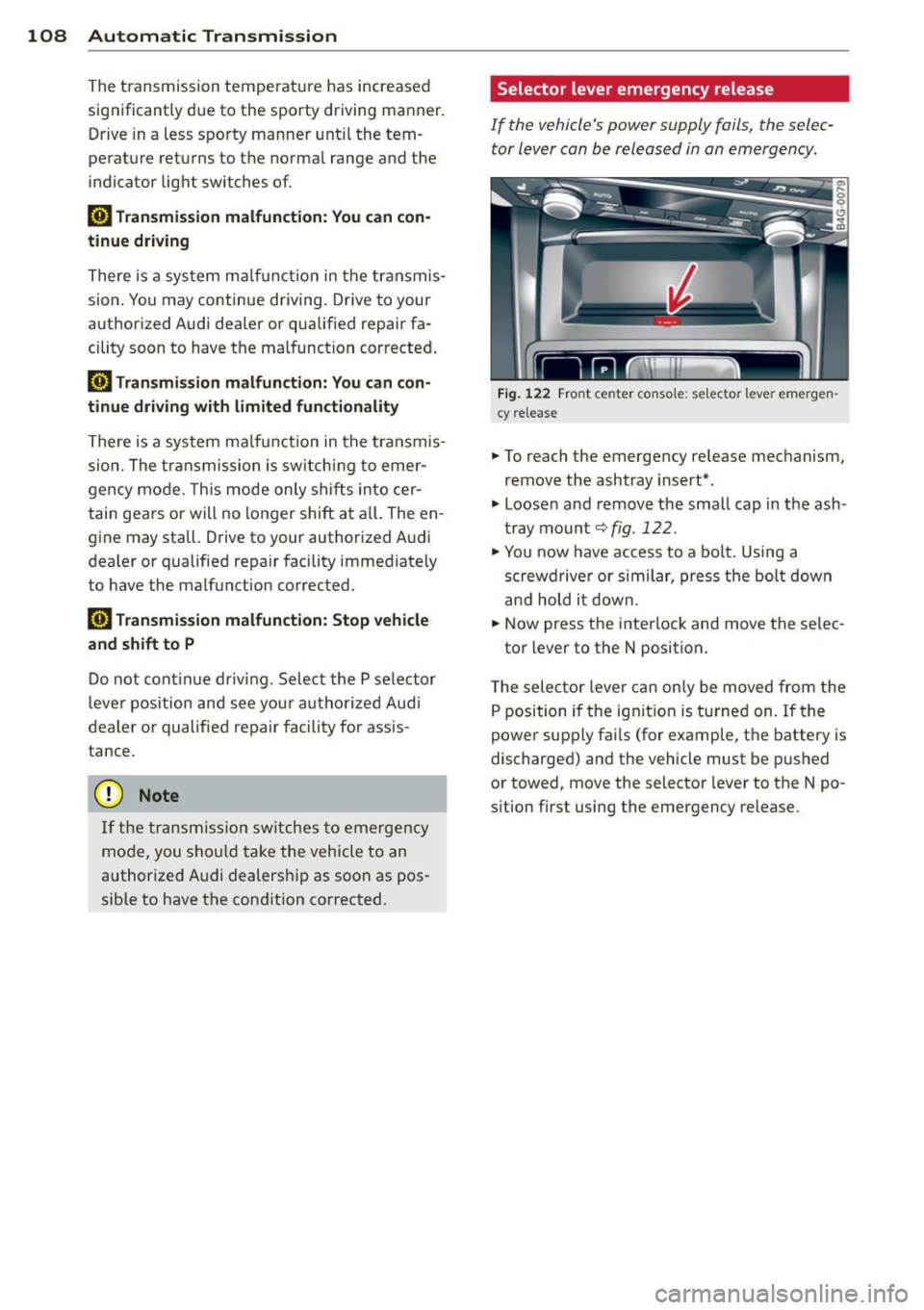
If the vehicle's power supply fails, the selec
tor lever can be released in an emergency.
Fig. 122 Fro nt center co nsole: se lector lever emerge n
cy release
.,. To reach the emergency release mechanism,
remove the ashtray insert*.
.,. Loosen and remove the small cap in the ash
tray mount
c:!;> fig. 122.
.,. You now have access to a bolt. Using a
screwdriver or similar, press the bolt down
and hold it down.
.,. Now press the interlock and move the selec-
tor lever to the N position.
T he selector leve r can only be moved from the
P position if the ignit ion is turned on. If the
power supply fai ls (for example, the battery is
discharged) and the vehicle must be pushed
or towed, move the selector lever to the N po
s ition first using the emergency release.
Page 114 of 302
112 Parking systems
example, after a collision, do not contin
ue to use the system for safety reasons.
Have it checked by your authorized Audi
dealership or authorized repair facility .
- Only use the rear view camera to assist
you if it shows a good, clear picture. For
example, the image may be affected by
the sun shining into the lens, dirt on the
lens or if there is a system fault .
- Use the rear view camera only if the lug
gage compartment lid is completely
closed. Make sure any objects you may
have mounted on the luggage compart
ment lid do not block the rear view cam
era.
- The camera lens enlarges and distorts
the field of vision. The object appears
both altered and inaccurate on the
screen.
- In certain situations, people or objects in the display appear closer or further
away:
- For objects that do not touch the
ground, such as the bumper of a
parked vehicle, a trailer hitch or the
rear of a truck. Do not use the help
lines in this case.
- If driven from a level surface onto an
incline, or a downward slope.
- If driven toward protruding objects.
- If the vehicle is carrying too much load
in the rear.
@ Note
- Always read and follow the applicable
warnings
r:> (D in General information on
page 109.
- The orange colored orientation lines in
the Infotainment display show the vehi
cle path depending on the steering
wheel angle. The front of the vehicle
front swings out more than the rear of
the vehicle. Maintain plenty of distance
so that your outside mirror or a corner of
your vehicle does not collide with any ob stacles.
Switching on/off
Applies to vehicles: with parking system plus with rear
v iew camera
Switching on
.,. Shift into reverse or
.,. press the
P'QA button in the center console
r:>page 110, fig. 124. A short confirmation
tone sounds and the LED in the button turns
on .
Switching between the rear view camera
and optical display
... Press the Graphic control button ®
¢ page 113, fig. 130 to see the optical dis
play .
.,. Press the
Rearview control button to see the
rear view camera image.
Switching off
... Drive forward faster than 6 mph (10 km/h),
or
.,. Press the
P,,1~ button, or
.,. Switch the ignition off.
{D Tips
The visual display in the left part of the
display should help you detect the critical
vehicle areas.
Page 124 of 302
122 Driving Safely
• Fasten and wear safety belts correctly
9 page 133.
• Always keep both feet in the footwell so
that you are in control of the vehicle at all
t imes.
Fo r detailed information on how to adjust the
driver's seat, see
<=> page 54.
A WARNING
Drivers who are unbelted, out of position
or too close to the airbag can be seriously
injured by an airbag as it unfolds . To help
reduce the risk of serious personal injury:
- Always adjust the driver's seat and the
steering wheel so that there are at least 10 inches (25 cm) between your breast
bone and the steering wheel.
- Always adjust the driver's seat and the
steering wheel so that there are at least
4 inches (10 cm) between the knees and
the lower part of the instrument panel.
- Always hold the steering wheel on the
outside of the steering wheel rim with
your hands at the 9 o'clock and 3 o'clock
positions to help reduce the risk of per
sonal injury if the driver's airbag inflates.
- Never hold the steering wheel at the
12 o'clock position or with your hands at
other positions inside the steering wheel
rim or on the steering wheel hub. Hold
ing the steering wheel the wrong way
can cause serious injuries to the hands,
arms and head if the driver's airbag in
flates.
- Pointing the steering wheel toward your
face decreases the ability of the supple
mental driver's airbag to protect you in a
collision.
- Always sit in an upright position and nev
er lean against or place any part of your
body too close to the area where the air
bags are located.
- Before driving, always adjust the front
seats properly and make sure that all
passengers are properly restrained. -
For adjustable head restraints: before
driving, always also adjust the head re
straints properly.
- Never adjust the seats while the vehicle
is moving. Your seat may move unexpect
edly and you could lose control of the ve hicle .
- Never drive with the backrest reclined or
tilted far back! The farther the backrests
are tilted back, the greater the risk of in
jury due to incorrect positioning of the safety belt and improper seating posi
tion .
- Children must always ride in child seats
<=> page 165. Special precautions apply
when installing a child seat on the front
passenger seat <=>
page 139.
Proper seating position for the front
passenger
The proper front passenger seating position
is important for safe, relaxed driving.
For your own safety and to reduce the risk of
injury in the event of an accident, we recom
mend that you adjust the seat for the front
passenger to the following position:
• Adjust the angle of the seatback so that it is
in an upright position and your back comes
in full contact w ith it whenever the vehicle is
moving.
• For ad justab le head restra ints: adjust the
head restraint so the upper edge is as even
as possible with the top of your head. If that
is not possible, try to adjust the head re
straint so that it is as close to this position
as possible <=>
page 124 . Move the head re
straint so that it is as close to the back of
the head as possible.
• Keep both feet flat on the floor in front of
the front passenger seat.
• Fasten and wear safety belts correctly
<=> page 133.
For detailed information on how to adjust the
front passenger's seat, see
<=> page 53. ...