tow AUDI RS7 SPORTBACK 2015 Owner's Guide
[x] Cancel search | Manufacturer: AUDI, Model Year: 2015, Model line: RS7 SPORTBACK, Model: AUDI RS7 SPORTBACK 2015Pages: 302, PDF Size: 74.76 MB
Page 194 of 302
192 Intelligent technology
overheat, premature wear and increased
stopp ing distance.
- Under certain climatic and operating
condit ions such as passing through wa
ter, driving in heavy ra in or after wash ing
the vehicle, the effect iveness of the
brakes can be reduced. In winter, ice ca n
accumulate on the brake pads, linings ,
discs and d rums . Carefully apply brakes
for a test . B rakes wi ll dry a nd ice coat
ings will be cleaned off after a few c are
f ul brake app lications .
- Dr iv ing fo r an ex tende d pe riod of time on
salt-covere d roads w ithout us ing yo ur
brakes can also affect braking efficiency.
Clean off accumulated salt coating from
bra ke discs and pads w ith a few caref ul
brake applicat ions.
- If you damage the front spoiler, or if you
install a different spoiler, be sure the air
flow to the front brakes is not obstruct ed. Otherwise the brake system could
over heat reducing the effectiveness of
the ent ire brake system .
- Failure of one brake c ircuit will impair
the braking capability res ulting in an in
creased stopp ing distance. Avoid driv ing
the vehicle and have it towed to t he near
est Aud i dea le r o r q ualified w ork sho p.
- Never let the vehicle ro ll to a stop w ith
the e ngine shu t off.
- If the brake booster is not working, the
brake pedal must be p ressed conside ra
bly harder to make up for the la ck of
booster assistance.
Electromechanical
power assist, dynamic
steering
The electromechanical power assist helps the
driver when steering .
Power stee ring adapts electronically based on
the vehicle speed .
Indicator lights and messages
• Steer ing defective! Stop the vehicle
If this indicato r light turns on and stays on
and this message appears, the power steering
may have failed.
Do
not con tinue dr iv ing . See your author ized
Audi dealer or other qualified repair facility
for assistance .
l;r-ij Steering: System fault You can continue
driving
If the indicato r light turns on and the mes
sage appea rs, the stee ring may be more diffi
cul t to move o r more sensi tive th an usua l. The
steering wheel may a lso be at an ang le when
driving straight .
Drive slowly to you r authorized Aud i dea le r o r
qualified wo rks hop to have the ma lf u nct ion
corre cted.
l;r,ij Dynamic steering: Initializing
If this driver message appears and t he indica
tor light is f lashing on the instrument panel,
dynam ic steer ing* is being rei nitia lized. Afte r
sta rting the engine, the stee ring wheel will
move s ligh tly. Re- ini tiali zation mig ht be ne c
e ssa ry if the stee ring wheel was moved h ard
to the left an d right wh ile the vehicle was not
moving . The display goes out as soon as initi
alization is complete.
D rive slowly to you r aut horized Audi de aler or
qualified wo rkshop to have the ma lf u nct ion
corrected.
A WARNING
Have t he dynamic stee ring * system mal
f u nction repa ired as soon as possib le by an
a uthorized Audi dealer or qua lified wor k
shop - risk of accident !
(D Tips
If the . or@ indicator light on ly stays
on for a short time, yo u may continue driv
i ng.
- The dynamic steering * sta bility systems
are not avai lab le in the event of a system
ma lf u nction.
- For add itiona l information on dynamic
steering *, refer t o
c> page 96.
Page 199 of 302
Avoid damaging the
vehicle
When you are driving on poor roads, or over
curbs, steep ramps, etc., make certain that
low-lying parts such as spoilers and exhaust
system parts do not bottom out and get dam
aged.
T his is especially true for vehicles with low
slung chassis (sports chassis) * and fully load
ed veh icles .
Driving through water
on roads
Note the following to avoid vehicle damage
when driving through water, for example on
flooded roads:
- T he water must not be any h igher than the
bottom of the veh icle body.
- Do not d rive faster than wa lking speed.
..&, WARNING
After driving through wate r, m ud, slush,
etc., the brakes may be slow to take effect
because o f wet brake rotors and pads . Dry
the brakes first by braking carefully to re
store the full braking effect.
(D Note
- Vehicle components such as the eng ine,
transmission, suspension or e lectrical
system can be severely damaged by driv ing through water.
- Check the depth o f the water before driv
ing through it.
- Do not s top the veh icle, drive in reverse
or switc h the engine off when driving
through water.
- Keep in mind that oncoming vehicles may create waves that raise the water
level and make it too deep for your vehi
cle to drive through safely.
- Avoid driving thro ugh sa lt water because
-
~ it can ca use corrosion. ,....,
Dri vin g and en vironm ent 197
Warming up and
cooling down
By carefully warming up and cooling down
your vehicle, you can help ensure that it is not
overstressed unnecessar ily during sporty dr iv
ing.
When warming up, the vehicle is dr iven at a
maximum engine speed of 6000 RPM in order
to raise the engine o il temperature to a mini
mum of 140
°F (60 °() . The t ires a lso on ly
reach the ir full road holdi ng capabi lity on ce
they have warmed up.
The cooli ng fan can cont inue to run in your ve
hicle after the engine is switched off . Howev
er, driving the veh icle to coo l it down is pa rti c
ul arly important. Dur ing spo rty driving , the
engine and b rakes, the exhaust system, and
the transmission a ll become extremely hot.
Before you park the vehicle, you should drive
it for a few miles/kilometers at light load in
the low rpm range to allow it to cool down .
Catalytic converter
App lies to vehicles: wi th gaso line e ngi ne
It is very important that your emission con
trol system (catalytic converter) is function
ing properly to ensure that your vehicle is run
ning in an environmentally sound manner.
"' Always use lead-free gasoline c:> page 206,
Fuel supply .
"' Never run the tank down all the way to emp
ty.
"' Never put too much mo to r o il in yo ur eng ine
c:> page 21 S, Adding engine oil "t:::r..
"' Never try to push -or tow -start you r vehicle .
T he catalytic co nve rter is an efficient "clean
u p" dev ice bui lt into t he exhaus t system of
the ve hicle . The cata lytic converter bu rns
many of the pollutants in the exha ust gas be
fore they are re leased into the atmosphere.
T he exclus ive use of unleaded fuel is c ritical ly
i mportant for the life of the catalyt ic convert -
er and proper functioning of the engine .
Iii>
•
•
Page 245 of 302
"' N
a:: I.J ""'. rl I.O
"' rl
"' rl
and luggage load capacity
calculated in Step 4.
6. If your vehicle will be towing
a trailer, load from your trail
er will be transferred to your
vehicle. Consult this manual
to determine how this re duces the available cargo
and luggage load capacity of
your vehicle.
.,.Check the tire sidewall
(c::> page 245, fig. 199) to de
termine the designated load
rating for a specific tire.
Ti re service life
The service life of tires depends
on a lot of different things in
cluding proper installation and
balancing , correct tire pressure
and driving style.
Fig. 197 Ti re tread: tread wear indi
cators (TWI)
Tires and wheels 243
Fig. 198 Rotating tires for more even
wear
Tread Wear Indicator (TWI)
The original tires on your vehi
cle have
1/16 inch (1.6 mm)
high "wear indicators"
c:::> fig. 197 running across the
tread. Depending on the make,
there will be six to eight of
them evenly placed around the
tire. Marks on the tire sidewall (for example "TWI" or other
symbols) indicate the positions
of the tread wear indicators.
Worn tires must be replaced.
Different figures may apply in
other countries
c:::> & .
Tire pressure
Incorrect tire pressure causes
premature wear and can cause
sudden tire blow-out. For this
reason, tire pressure must be
checked at least once a month
c:::> page 237.
Page 261 of 302
"' N
a:: I.J "". rl I.O
"' rl
"' rl
What do I do now? Emergency warning
triangle
App lies to vehicles: with emerge ncy warning triangle
The warning triangle is located on the inside
of the trunk lid .
D -
!I l
Fig. 203 Trun k lid: Warn ing triang le
.,. To open the cover, turn the locking mecha
nism and pull the cover downward . "'
M ~
~ .. m
.,.
Remove the warning triangle from its hold
er .
The rear lid is only designed to ho ld the warn
ing triangle offered by the original accessories
program. If you would like to retrofit your ve
hicle with a warning triangle, p lease contact
your authori zed Audi dealer.
Vehicle tool kit
Vehicle tool kit and jack
The vehicle tool kit is located in the luggage
compartment under the cargo floor cover.
F ig . 204 Trunk lid: V eh icl e too l kit
.,. Fold the floor to the seatback with the help
of the handle .
What do I d o now ? 259
.,. Turn the handwheel counter-clockwise and
remove the cover to reach the vehicle tool
kit .
T he onboard too l kit includes:
- T ire repair kit ( Tire Mobility System)
- Hooks to remove the wheel covers*
- Plastic hook to remove wheel bolt covers*
- Wheel bolt wrench
- Alignment pin for changing wheels
- Screwdriver with reversib le blade
- Tow ing eye
- Jack
Before storing the jack, make sure it is wound
back down as far as it will go.
A WARNING
Imp roper use of the vehicle jack can ca use
serious pe rsonal injur ies.
- Never use the screw driver hex head to
tighten wheel bo lts, since the bolts can
not attain the necessary tighten ing tor
que if you use the hex head, potentially
causing an ac cident .
- The fac tory-supplied jack is intended on
ly for yo ur vehicle model. Under no c ir
cumstances should it be used to lift
heavy vehicles or other loads; you risk in
juring yourself.
- Never start the engi ne when the vehicle
is raised, which could cause an acc ident.
- Support the vehicle securely with appro
priate stands if work is to be performed
underneat h the vehicle ; otherwise, there
is a potentia l risk for injury.
- Never use the jack supplied wit h your
Audi on another vehicle, particularly on a heav ier one. The jack is only su itable for
use on the veh icle it came with.
@ Tips
- Some of the on board items listed above
are provided on certa.in models only or
are opt ional extras.
- Before you can raise your vehicle using
the jack, you must activate the jacking
mode¢
page 265 .
Page 275 of 302
M N
0:: <.J 'SI: ,...., \!) ..,.,
,...., ..,., ,....,
Emergency situations
General
This chapter i s intended for trained emer
gency crews and working personnel who have the necessary tools and equipment to
perform these operations.
Starting by pushing or
towing
(D Note
Ve hicles w ith an au tomatic tra nsmission
cannot be started by pus hing o r tow ing.
Starting with jumper
cables
If necessary, the engine can be started by
connecting it to the battery of another vehi
cle.
If the engine shou ld fail to start because of a
discha rged o r wea k battery, the battery can be
connected to the battery o f
another vehicle,
using a
pair of jumper cables to start the en
g ine.
Jumper cables
Use only jumper cables of sufficiently la rge
c ross section to carry the starter c urrent safe
l y. Refer to the man ufacturer's specifications.
Use only jumper cables with
insulated te rm i
na l clamps wh ic h are d istinctly marked:
plus(+) cable i n mos t cases co lore d red
minu s(-) cable
in most cases colored black .
A WARNING
Batterie s contain e lec tricity, ac id, an d gas.
A ny of these can cause ve ry ser io us or fatal
inju ry. Follow the instructions below f or
safe han dling of your veh icle's b attery .
- Alway s shield you r eyes and avoid lean
ing over the bat te ry whenever possib le.
- A dis ch arged battery c an free ze at tem
peratures ju st be low 32 °F ( 0 °C ). Befo re
Emergency situations 273
connecting a jumpe r cab le, you must
thaw the fr ozen battery c omp lete ly, ot h
erwise it could explode.
- Do not allow battery acid to contact eyes
or skin. Fl ush any contacted area with
wate r immediately.
- Improper use of a booster battery to start a vehicle may cause an explosion.
- Vehicle batter ies genera te exp losive gas
es. Keep spar ks, flame and lighted c iga
rettes away from batte ries.
- Do not try to jump start any ve hicle w ith
a low ac id leve l in the battery.
- The vo ltage of the booste r batte ry m ust
a lso have a 12-volt rating. The capacity
(Ah) of the booster battery sho uld not be
lowe r tha n that of the discharged bat
tery . U se of batte rie s of d iffe ren t voltage
or substantially diffe rent "Ah" rat ing
may c au se an exp losion and persona l in
JU ry.
- N ever cha rge a fro zen battery. Gas trap
pe d in the ice may cause a n ex plosion.
- Never cha rge or use a batte ry tha t h as
been fr ozen. T he battery case may have
be weakened.
- Us e of b atter ies of differe nt voltage or
sub stant ia lly diffe ren t ca pa city (Ah) ra t
i ng may c ause an ex plosion an d injury .
Th e capac ity (Ah) of the booster bat tery
should not be lower than that of the dis
charged batte ry .
- Before you chec k any thing in the engine
compa rtment, always read and hee d all
WARNINGS
¢page 211.
(D Note
-App lyin g a higher vo ltage booster ba t
t ery w ill cause expens ive damage to se n
sit ive e lectronic com ponents, such as
cont ro l units, relays, rad io, etc.
- The re must be no electrical contact be
tween the vehicles as ot herwise c urrent
co uld a lready start to f low as soon as the
p o sit ive(+) term inals a re connected. ..,. •
•
Page 277 of 302
"' N
a:: I.J "". rl I.O
"' rl
"' rl
-When connecting jumper cables, make
sure that they cannot get caught in any
moving parts in the eng ine compart
ment .
- Before you check anything in the engine
compartment, always read and heed all
WARNINGS
¢ page 211.
(D Note
Improper hook-up of jumper cables can r u
in the generator.
- Always connect POSITIVE( +) to POSI
TIVE(+), and NEGATIVE(-) to NEGATIVE
( - ) gro und post of the battery manager
control unit .
- Check that all screw plugs on the battery
cells a re screwed in firmly . If not, tighten
pl ugs p rior to connecting clamp on nega
tive battery term inal.
- Please note that the procedure f or con
nect ing a jump er cable as desc ribed
above appl ies spec ifically to the case of
you r vehi cle be ing jump started. When
you are giv ing a jump star t to an othe r ve
hi cle, do
not connec t the negat ive (-) ca
ble to the negat ive (-) terminal on the
discharged battery @¢
fig. 220. In
stead, securely connect the negative( -)
cable to e ithe r a solid metal component
that is firmly bolted to the engine block
or to the e ng ine block itse lf. If the bat
te ry tha t is being charged does not vent
to the outside, escaping batte ry gas
could igni te and exp lode!
Emergency towing
with commercial tow truck
General hints
Your Audi requires special handling for tow
tng.
The follow ing information is to be used by
commercia l tow tr uck operators who know
h ow to ope rate thei r equipme nt safe ly.
Emergenc y situ ation s 2 7 5
- Ne ver tow your Audi. Towing will cau se
damage to the engine and tran smission.
- Never wrap the safety chain s or w inch ca
ble s around the brake lines.
- To prevent unnece ssary damage , your Audi
must be transported with a flat bed tru ck.
- To load the vehicle on to the fl at bed , use
the towing loop found in the vehicle tools
a nd attach to the front or rear anchora ge
¢pag e 275 and ¢ page 276 .
_& WARNING
A vehicle being towed is not safe for pas
sengers. Never allow anyo ne to ride in a
vehicle be ing towed, for any reason.
Front towing loop
Only install the front towing loop when it is
needed.
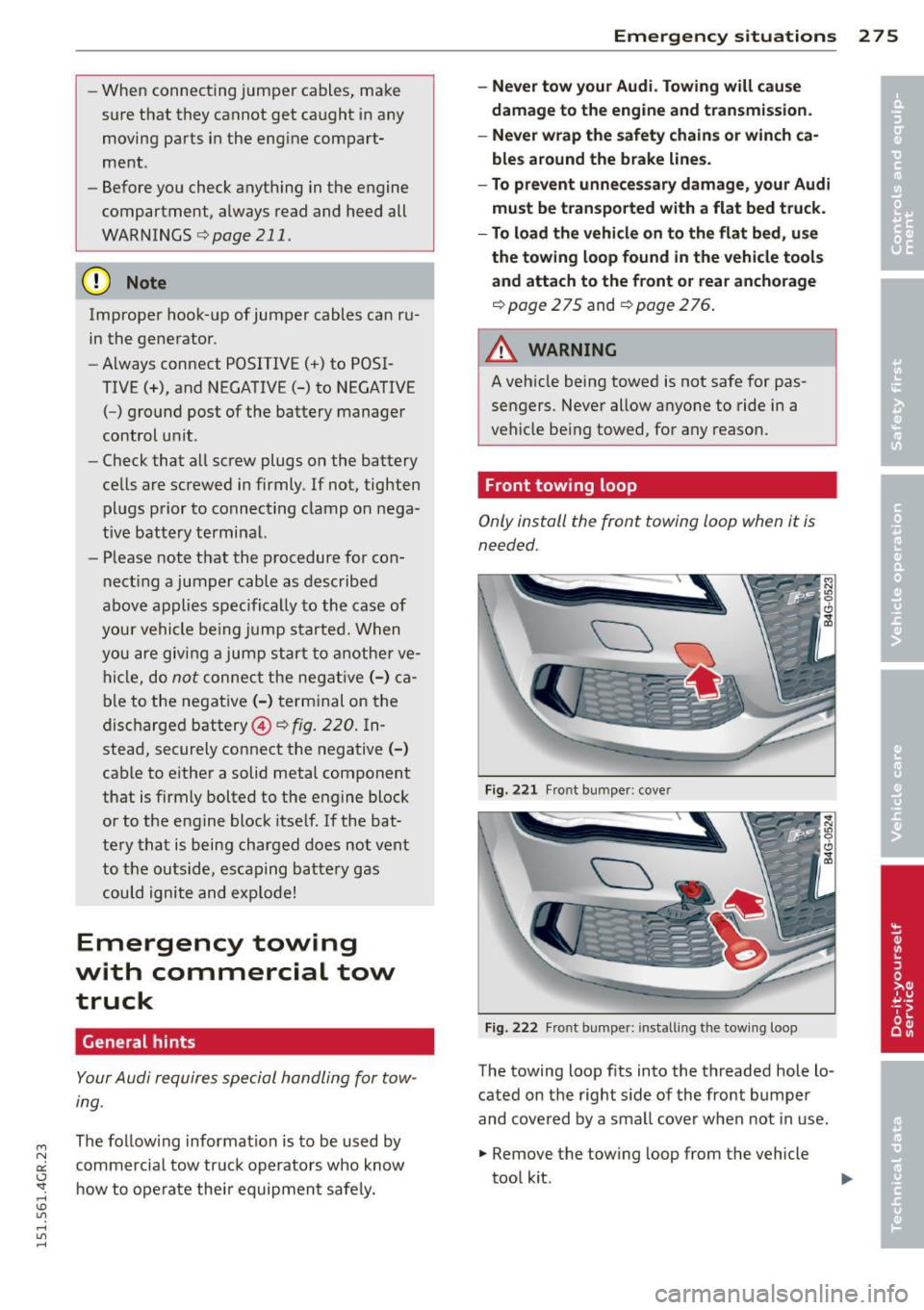
Fig. 22 1 Front bumpe r: cove r
Fig. 222 Front bu mpe r: in stall ing t he tow ing loop
-
The towing loop fits into the threaded hole lo
cated on the right s ide of the front bumpe r
and cove red by a sma ll cover when not in use.
.. Remove the tow ing loop from the vehicle
too l kit .
Page 278 of 302
2 76 Emergency situations
• Press the cover in by applying short strong
pressure to the bottom part to release it
from the bumper
¢ fig. 221 .
• Screw the towing loop tightly in the thread
ed hole as far as it will go and tighten it with
the wheel wrench
¢ fig . 222 .
Remove the towing loop when you are done
using it and place it back in the vehicle tool
kit . Install the cover in the bumper. Always
keep the towing loop in the vehicle.
A WARNING
If you do not screw the tow ing loop com
pletely, it could come out of the threaded
hole while the vehicle is being towed caus
ing damage to the vehicle and possible se
rious personal injury.
Rear towing loop
Only install the rear towing loop when it is
needed.
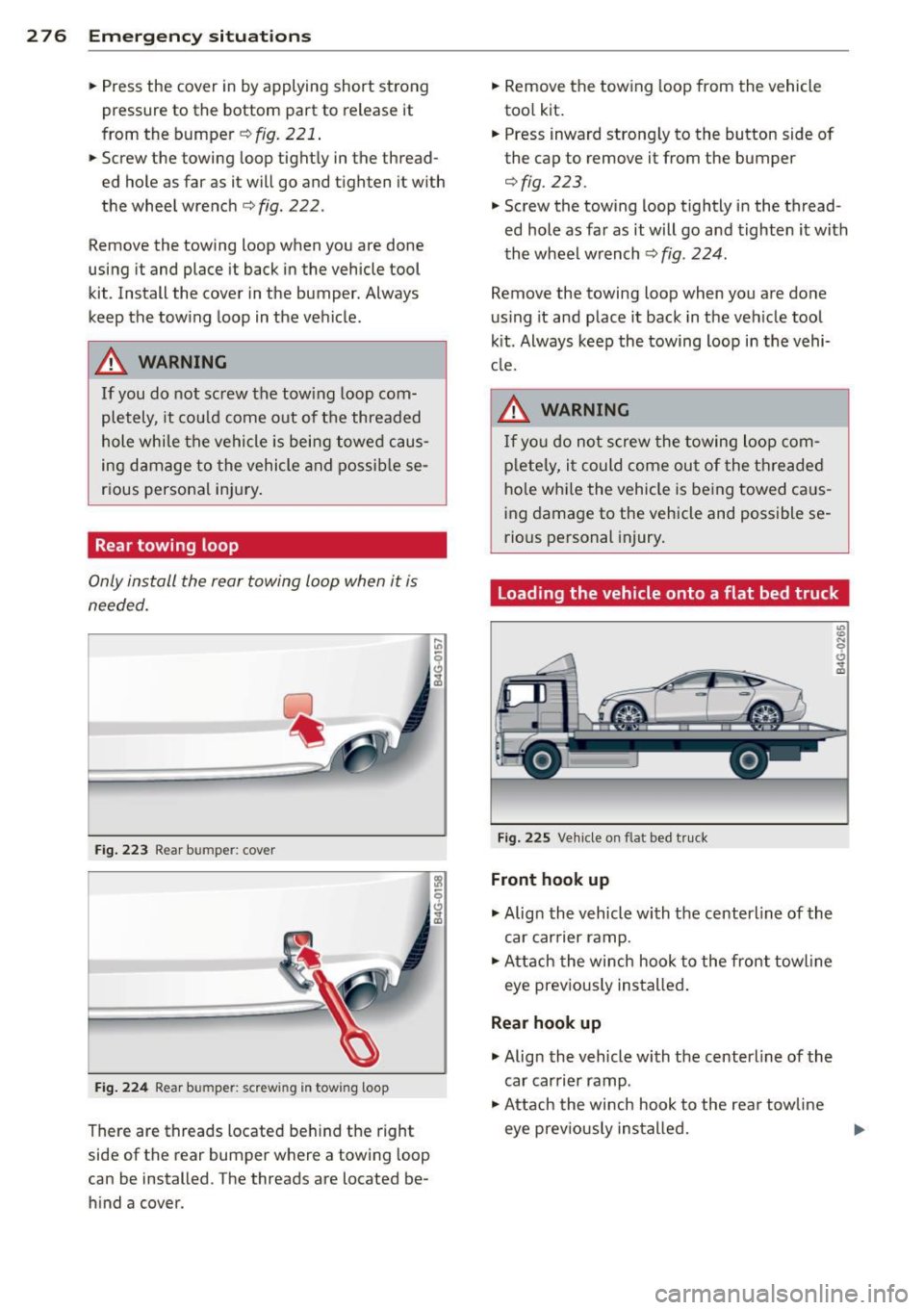
Fig . 223 Rear bum per: cover
Fig. 224 Rear bum per: screw ing in tow ing loop
There are threads located behind the right
side of the rear bumper where a towing loop
can be installed . The threads are located be
hind a cover.
-
• Remove the towing loop from the vehicle
tool kit.
• Press inward strong ly to the button side of
the cap to remove it from the bumper
¢fig. 223.
• Screw the towing loop tightly in the thread
ed hole as far as it will go and tighten it with
the wheel wrench¢
fig. 224.
Remove the towing loop when you are done
using it and place it back in the vehicle tool
kit. Always keep the towing loop in the vehi
cle.
A WARNING
If you do not screw the towing loop com
pletely, it could come out of the threaded
hole while the vehicle is be ing towed caus
ing damage to the vehicle and possible se
rious personal injury.
Loading the vehicle onto a flat bed truck
Fig. 225 Vehicle on flat bed truck
Front hook up
• Align the vehicle with the centerline of the
car carrier ramp.
• Attach the winch hook to the front towl ine
eye previously installed.
Rear hook up
• Align the vehicle with the centerline of the
car carrier ramp .
• Attach the winch hook to the rear tow line
eye prev iously installed.
-
Page 279 of 302
"' N
a:: I.J "". rl I.O
"'
@ Tips
Check carefully to make sure the hook-up
is secure before moving the car up the flat
bed truck ramp.
Vehicle transport
Whenever you hove your vehicle transported,
be sure to note the following:
(D Note
Mount the tie-down chains/cables over the
running surface (circumference) of the
tires. Never secure the vehicle by the axle,
the suspension struts or the front or rear
towline eye. For technical reasons, the
pressure in the suspension struts may
change du ring the transport and this will
adve rsely affect vehicle handling.
Lifting vehicle
Lifting with workshop hoist and with
floor jack
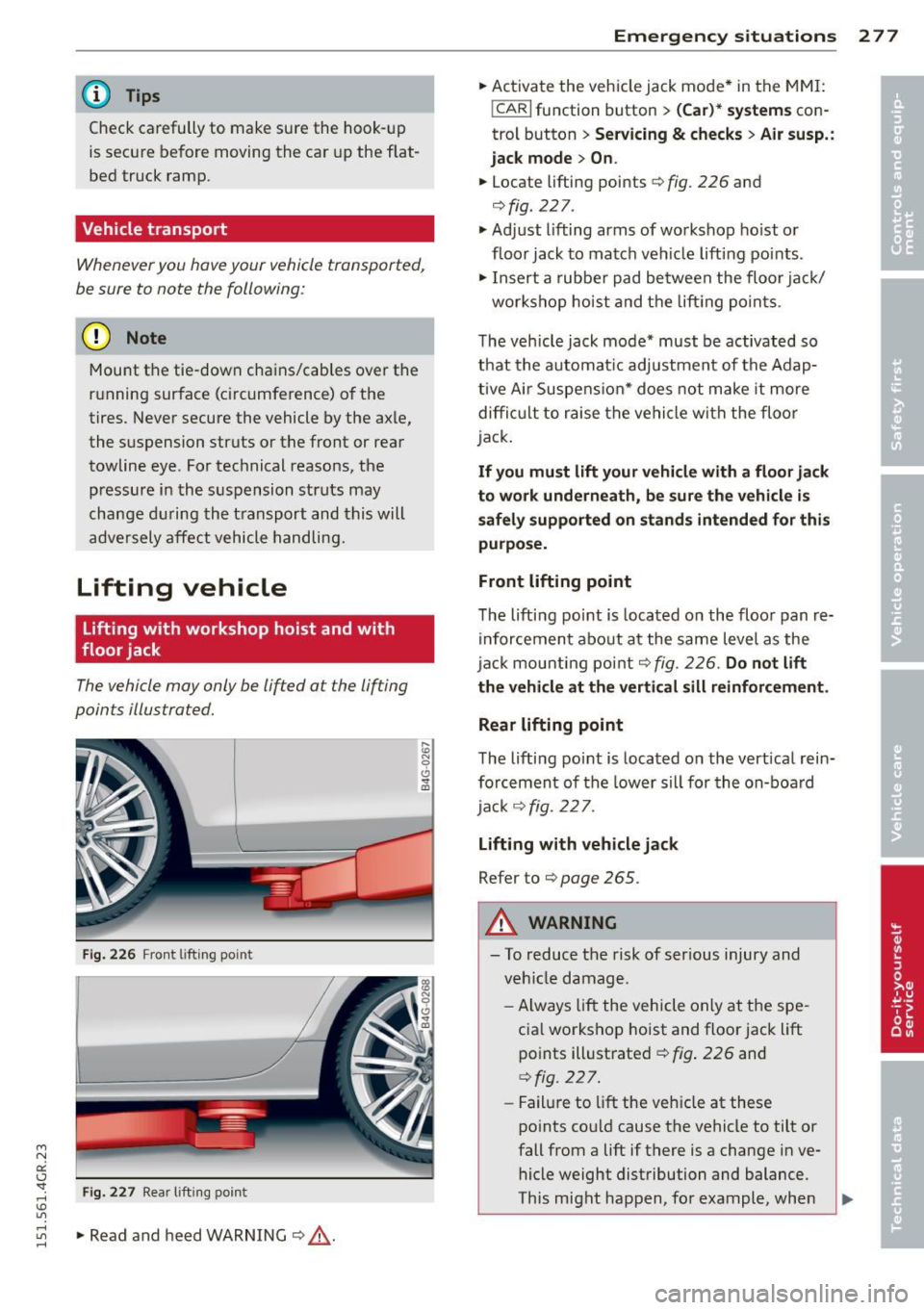
The vehicle may only be li~ed at the lifting
points illustrated.
Fig. 226 Front l ift ing po int
Fig. 22 7 Rea r lifti ng point
:;:; N 0 6 ., a,
5 .. Read and heed WARNING Q ,&..
Emergenc y situ ation s 2 77
.. Activate the vehicle jack mode* in the MM I:
!CARI function button > ( C ar)* s ystem s con
trol button>
S e rv ic ing & check s> Air su sp. :
jac k m od e> On .
.. Locate lifting points Q fig. 226 and
Qfig. 227.
.. Adjust lifting arms of workshop hoist or
floor jack to match veh icle lifting points.
.. Insert a rubber pad be tween the floor jack/
workshop hoist and the lift ing po in ts.
The vehicle jack mode* must be activated so
that the automat ic adjustment of the Adap
tive Ai r Suspens ion* does not make it more
diffi cult to raise the vehicle with the floor
jack.
If yo u must lift your v ehi cle with a floor jack
t o wo rk und ern eath , be sure th e vehicle i s
s af ely s upported on s tands intended for thi s
purpo se.
Front lifting point
The lifting po int is located on the floor pan re
inforcement abo ut at the same leve l as the
jac k mounting point
Q fig. 226. Do n ot lift
t h e ve hicle at th e verti cal sill reinforc em ent .
Re ar lifting point
The lifting point is located on the vert ical rein
forcement of the lower sill for the on-boa rd
ja ck
c::> fig. 22 7 .
Lifting with veh icle j ack
Refer to Q page 265 .
A WARNING
-To reduce the risk of ser ious injury and
veh icle damage.
- Always lift the veh icle only at the spe
cia l workshop hoist and floor jack lift
po ints illust rated
c::> fig . 226 and
<=:> fig. 227.
-Failu re to lift the vehicle at these
po ints could cause the vehicle to tilt or
fall from a lift if there is a change in ve
hicle weight distribution and balance.
This might happen, for example, when
-
Page 291 of 302
M N
0:: <.J 'SI: ,...., \!) 1.1'1 ,...., 1.1'1 ,....,
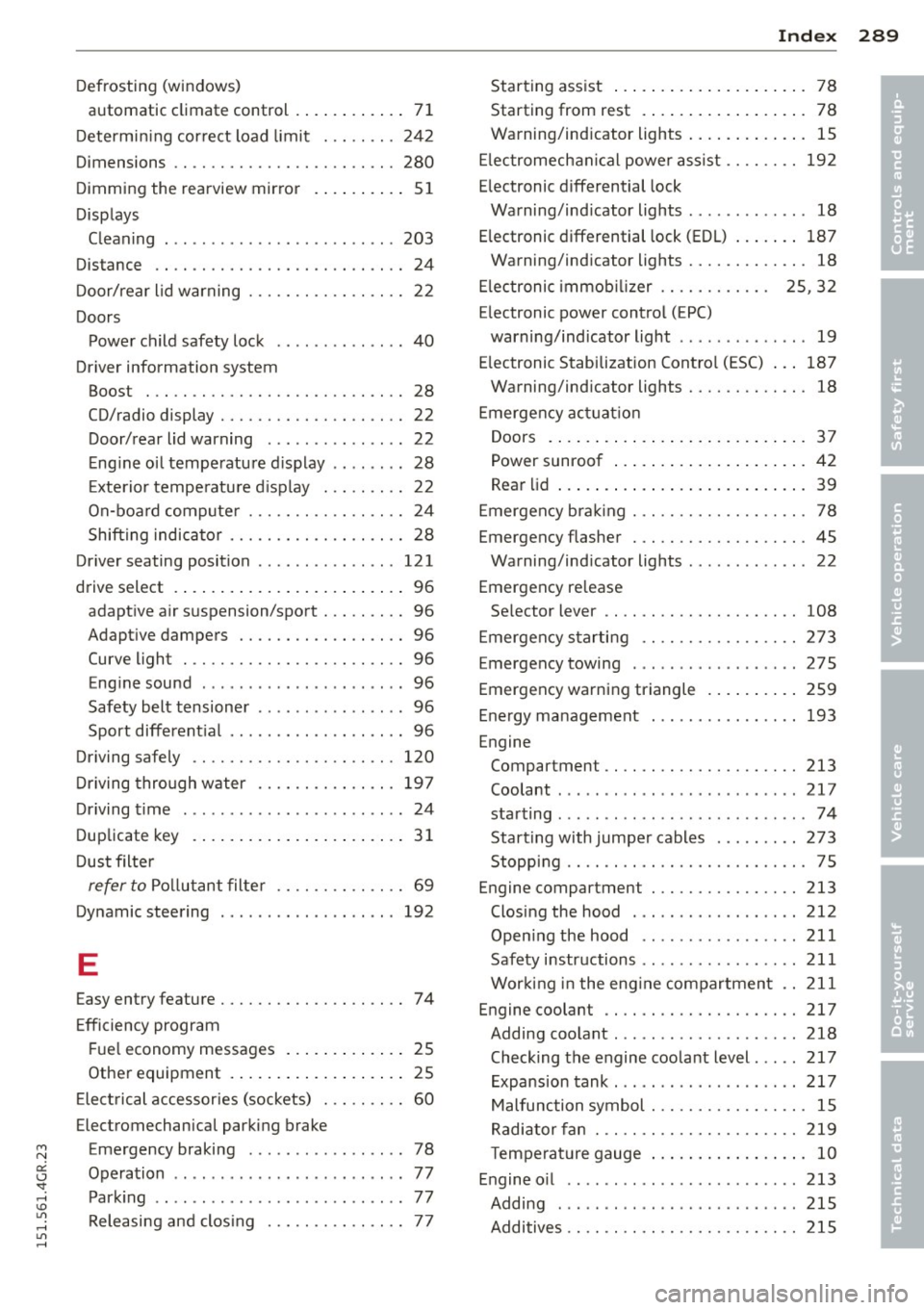
Defrosting (windows)
automatic climate control . ... .. .. .. ..
71
Determi ning cor rect load limit . .. .. .. . 242
Dimensions .. .. ........... .. .. .. ... 280
D imming the rearview mirro r .. .. .. .. .. 5 1
Displays
Clean ing . ..... ........... ... ... ..
203
Distance . . . . . . . . . . . . . . . . . . . . . . . . . . . 24
D oor/ rear lid warning . . . . . . . . . . . . . . . . . 22
Doors
Powe r ch ild safety lock ......... .... .
40
Driver information system
Boost . ... . .... ............. .. .. ..
28
CD/radio display . . . . . . . . . . . . . . . . . . . . 22
Door/rear lid warning . . . . . . . . . . . . . . . 22
E ng ine oil temperatu re d isplay .. ... ... 28
E xterio r tempe ratu re d isp lay . .. .. .. .. 22
On-boa rd compute r . . . . . . . . . . . . . . . . . 24
Shifting indicator . . . . . . . . . . . . . . . . . . . 28
Driver seating position . . . . . . . . . . . . . . . 121
drive select .. .... .. .... ... .. .. .. .... 96
adapt ive a ir s uspension/sport . .. .. .. .. 96
Adapt ive dampers . . . . . . . . . . . . . . . . . . 96
Curve light . . . . . . . . . . . . . . . . . . . . . . . . 96
Eng ine sound ............... ... ... .
96
Safety belt tensioner . . . . . . . . . . . . . . . . 96
Sport different ial . . . . . . . . . . . . . . . . . . . 96
Driving safe ly . . . . . . . . . . . . . . . . . . . . . . 120
D riving thro ugh w ater ...... .. .. .. .. . 19 7
Driving time . . . . . . . . . . . . . . . . . . . . . . . . 24
Dup licate key . . . . . . . . . . . . . . . . . . . . . . . 3 1
D ust filter
refer to Po llutant filte r . . . . . . . . . . . . . . 69
Dynamic steering ............. .... .. 192
E
Easy entry feature . . . . . . . . . . . . . . . . . . . . 7 4
E fficiency program
F ue l economy messages . . . . . . . . . . . . .
25
Other equipment . . . . . . . . . . . . . . . . . . . 25
E lect rical accessories (sockets) . . . . . . . . . 60
Elect romechanical parking brake
Eme rgency braking . . . . . . . . . . . . . . . . . 78
Opera tion . . . . . . . . . . . . . . . . . . . . . . . . . 77
P ark ing .. ... ......... .... ... ... ... 77
Releasing and clos ing ..... .. .. .. .. .. 77
Inde x 289
Starting ass ist . . . . . . . . . . . . . . . . . . . . . 78
Starting from rest . . . . . . . . . . . . . . . . . . 78
Warning/ind icator lights ..... ... .. .. .
15
El ec tromechani ca l powe r ass ist .... .. .. 192
E lectronic differential lock
Warning/ind icator lights . .......... ..
18
Electronic differential lock (EDL) ... .. .. 187
Warning/ind icator lights .......... .. . 18
El ectronic immob ilizer . . . . . . . . . . . . 25, 32
E lectronic power contro l (E PC)
warning/ind icator light ... .. ... ... .. .
19
Electronic Stabilization Cont ro l (ESC) . . . 187
Warning/ind icator lights ........ .. .. . 18
Emergency ac tuatio n
Doors . ... .. .... .. . .. .. ..... ... .. .
37
Power sunroof ..... . .. ..... ... .. .. . 42
Rea r lid ... .. .... ... .. .. ..... ... .. . 39
Emergency b ra ki ng . .. .. ......... .. .. . 78
Emergency flasher . ............. .. .. .
45
Warning/ind icator lights ........... .. 22
Emergency re lease
Se lector lever .. .. .................
108
E mergency s tar ting .... ......... .. .. 2 73
Emergency towing . .. .. .. ...... .... . 275
Emergency wa rn ing triangle ... ... .. .. 259
E nergy ma nagement . .... .... ... .. .. 193
Engine
Compartment .. .. .................
213
Coolant ......... .. ............... 217
starting . . . . . . . . . . . . . . . . . . . . . . . . . . . 7 4
Starting with jumpe r cables ..... .. ..
273
Stoppi ng .. .... .. .................. 75
Engine compartment ................ 213
Closing the hood ................. . 212
Opening the hood .. . .. .. .. ... ... .. 211
Safety i nstr uctions .. .............. . 211
Working in the eng ine compartmen t .. 2 11
Engine coolant .. .. ................. 217
Adding coo lant ... .. .. .. ...... .... . 218
Checking the engine coo lant level . .. .. 217
Expans ion tank .... ............... . 217
Malfunction sy mbol ............ .. .. . 15
Radi ator f an . .. .... ... .......... .. 2 19
Temperat ure gauge ... ...... ... .. .. . 10
Engine o il ..... ... .. ..... .......... 213
Adding ......... .. ..... .......... 215
Additives .. .. .. .. .. .. ........... .. 2 15
•
•
Page 294 of 302
292 Index
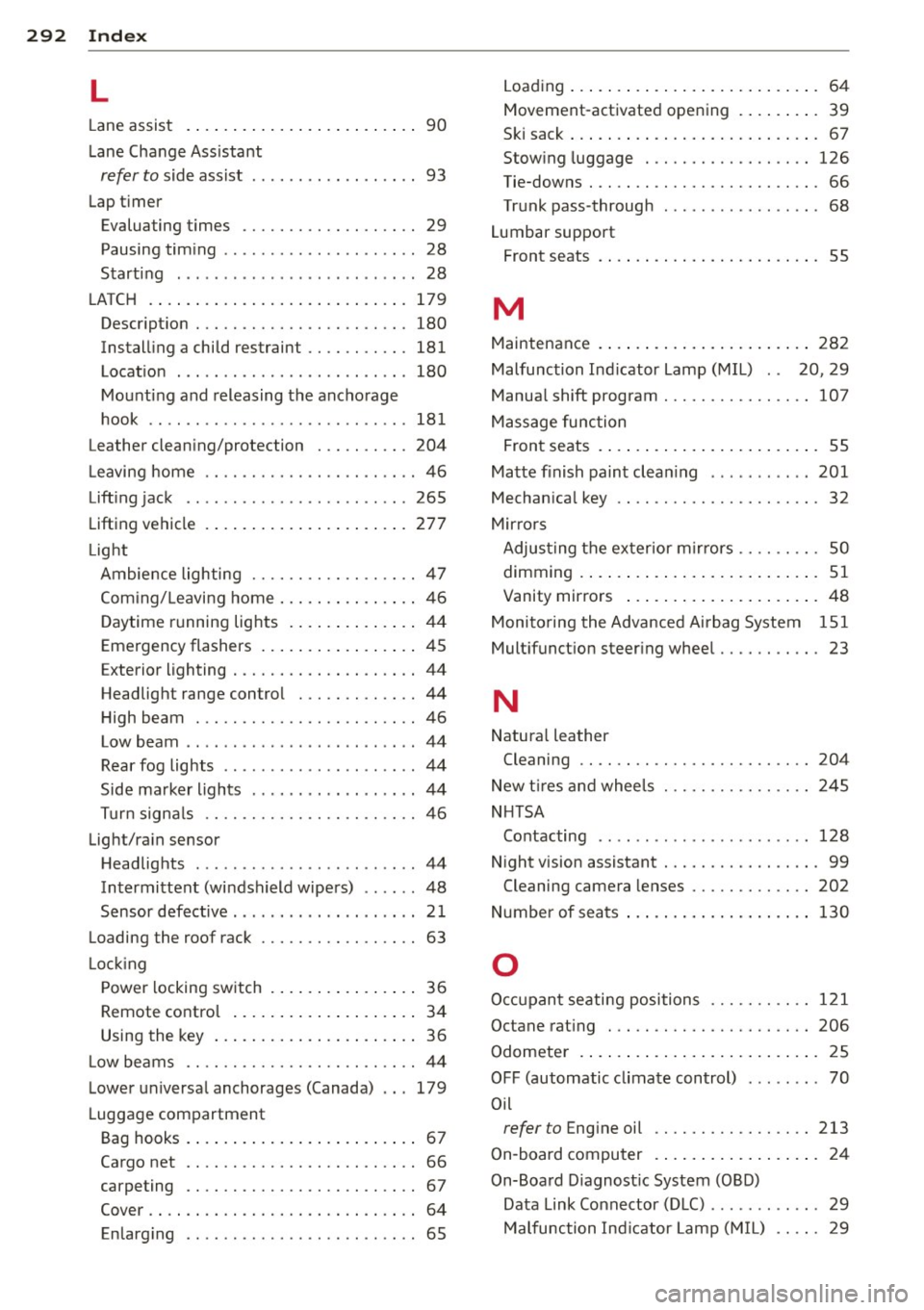
L
Lane assist . . . . . . . . . . . . . . . . . . . . . . . . . 90
L ane Cha nge Ass istant
refer to side assist . . . . . . . . . . . . . . . . . . 93
Lap t imer
Evaluating times . . . . . . . . . . . . . . . . . . . 29
Pausing tim ing .. .. .......... ... .. .. 28
Start ing ... ... .... .... .. .. .. .. .. .. 28
L ATCH . ..... ... ... .... ... .. .. .... . 179
Descr ipt ion .............. .. .. .. .. . 180
Instal ling a chi ld restraint .. .. .. .... . 181
Locat ion . .. .. .. ...... .... ... .. .. . 180
M ounting and releasing the ancho rage
hook .. .. .. ............ ... .. .. ... 181
Leather clean ing/protection ..... .... . 204
L eaving home ............... .. .. .. .. 46
Lift ing jack .. ... ......... ... .. .. ... 265
Lifting vehicle . .. .. ..... ... .. .. .... . 27 7
L ight
Ambie nce lighting ............ .... .. 47
Com ing/ Leaving home ... .. .. .. .... .. 46
D aytime running lights . ... .. .. .... .. 4 4
Emergency flashers .. ... .. .. .. .... .. 45
Exterior lighting .............. .... .. 44 L
oad ing ... .... .. ... .. ..... .... . .. . 6 4
Movement-activate d ope ning . ... .. .. . 39
S ki sack ... .. .. .. ... .. ..... ... .. .. . 67
Stow ing luggage .............. .... 126
Tie-downs . . . . . . . . . . . . . . . . . . . . . . . . . 66
Trunk pass -through . ............ ... . 68
Lumbar support Front seats . . . . . . . . . . . . . . . . . . . . . . . . 55
M
Maintenance . ..... .. ... ..... ... .. .. 282
Malfunction Ind icator Lamp (MIL) . . 20, 29
Manua l shift program ............ .... 107
M assage func tion
F ront seats . . . . . . . . . . . . . . . . . . . . . . . . 55
Matte finish pain t clea ning . ...... .. .. 201
Mechan ica l key .. .. ............. .. .. . 32
Mirro rs
Adjus ting the ex ter ior m irrors . . . . . . . . . 50
dimming . ..... .. .. ... ..... ... .. .. . 51
Vanity mirrors ... .. .... .... ... .. .. . 48
Monito ring the Advanced Ai rbag System 151
Mult ifunct ion steer ing whee l ....... ... . 23
Headlight range control ... .. .. .... .. 44
N
H igh beam .................. .... .. 46
Low beam .. .. .. ...... .... ... .. .. .. 44
Rear fog lights .. ...... .... ... .. .. .. 44
Side ma rker lights .... .. .. .. .. ...... 44
T ur n signa ls ............... .. .. .. .. 46
Light/ra in sensor
H eadlig hts .... .... ...... ... ... .. .. 44
Intermittent (windshield wipe rs) .. ... . 48
Sensor defective . . . . . . . . . . . . . . . . . . . . 2 1
Loading the roof rack . . . . . . . . . . . . . . . . . 63
L o cki ng
P ower locking sw itch . ... .. .. .. .... .. 36
R emote contro l . . . . . . . . . . . . . . . . . . . . 34
Using the key .. . ...... ... .. .. .... .. 36
L ow beams .... ................... .. 44
Lower universa l anchorages (Canada) ... 179
L uggage compartment
Bag hooks . . . . . . . . . . . . . . . . . . . . . . . . . 67
Ca rgo net . . . . . . . . . . . . . . . . . . . . . . . . . 66
carpeting . . . . . . . . . . . . . . . . . . . . . . . . . 67
Cover .. .. .. ............. .... .. ... . 64
Enlarg ing .. ... .... ...... ... ... .. .. 65 Natura
l leather
Cleaning .. ....................... 204
New t ires and wheels
N HT SA 24
5
Co ntacting .. .. .. ... .. .. ... ..... .. 128
N ight vision assistant ................. 99
Cleaning camera lenses ......... .... 202
N umber of sea ts ... .. .... .... ... .. .. 130
0
Occ upan t seati ng posi tions ....... .. .. 121
Octane rat ing ...................... 206
Odometer . ..... .. .. .... .... ... .. .. . 25
OFF (automatic climate control) . . . . . . . . 70
Oil
refer to Eng ine oil ............. .... 213
On-board computer . . . . . . . . . . . . . . . . . . 24
On-Boa rd Di agnost ic System (OBD)
Data Link Connector ( DLC) . . . . . . . . . . . . 29
Malfunction Ind ica tor Lamp (M IL) .... . 29