seat adjustment AUDI RS7 SPORTBACK 2015 Owners Manual
[x] Cancel search | Manufacturer: AUDI, Model Year: 2015, Model line: RS7 SPORTBACK, Model: AUDI RS7 SPORTBACK 2015Pages: 302, PDF Size: 74.76 MB
Page 55 of 302
M N
0:: <.J 'SI: ,...., \!) 1.1'1 ,...., 1.1'1 ,....,
Seats and storage
General recommen
dations
Why is your seat adjustment so important?
The safety belts and the airbag system can
only provide maximum protection if the front
seats are correctly adjusted.
There are various ways of adjusting the front
seats to provide safe and comfortable support
for the driver and the front passenger. Adjust
your seat properly so that :
- you can easily and quick ly reach all the
switches and controls in the instrument
panel
- your body is properly supported thus reduc ing physical stress and fatigue
- the safety belts and airbag system can offe r
maximum protection
¢ page 139.
In the following sections, you will see exactly
how you can best adjust your seats .
There are special regulations and instructions
for installing a child seat on the front pas
senger's seat. Always fo llow the information
regarding chi ld safety provided in
¢ page 165, Child Safety .
A WARNING
Incorrect seating position of the driver and
all other passengers can result in serious
personal injury.
- Always keep your feet on the f loor when
the vehicle is in motion -never put your
feet on top of the instrument panel, out
of the window or on top of the seat cush
ion. Th is applies especially to the passen
gers . If your seating position is incorrect,
you increase the r isk of injury in the case
of sudden braking or an acc ident. If the
airbag inflates and the seating position
is incorrect, this could result in persona l
injury or even death.
- It is important for both the driver and
front passenger to keep a distance of a t
Seat s an d sto rage 53
least 10 inches (25 cm) between them
selves and the steering wheel and/or in
strument panel. If you're s itting any
closer than th is, the airbag system can
not protect you properly. In addition, the
front seats and head restraints must be
adjusted to your body height so that they
can give you maximum protect ion.
- Always try to keep as much distance as
possible between yourself and the s teer
ing wheel o r instrument pane l.
- Do not adjust the driver's or front pas
senger's seat whi le the vehicle is moving.
Your sea t may move unexpected ly, caus
ing sudden loss of vehicle cont rol and
personal injury . If you adjust yo ur seat
while the veh icle is moving, yo u are out
of posit ion.
Driver's seat
The correct seat position is important for safe
and relaxed driving.
We recommend that you adjus t the dr iver's
seat in the fo llowing manner:
.,. Adjust the seat in fore and aft direction so
that you can easily push the peda ls to the
floor wh ile keeping your knees s lightly bent
i:::> A in Why is your seat adjustment so im
portant? on page 53.
.,. Adjust the backrest so that when you sit
w ith your back against the backrest, you can
still grasp the top of the steering wheel.
.,. For adjustable head restra ints: adjust the
head restra int so the upper edge is as even
as poss ible with the top of your head . If that
is not poss ible, try to adjust the head re
straint so that it is as close to this position
as possible ¢
page 56. Move the head re
straint so that it is as close to the back of
the head as possib le .
A WARNING
-Never place any objects in the dr iver's foot-
well. An object could get into the pedal
area and interfere with pedal funct ion . In
~
Page 58 of 302
56 Seats and storage
Armrest
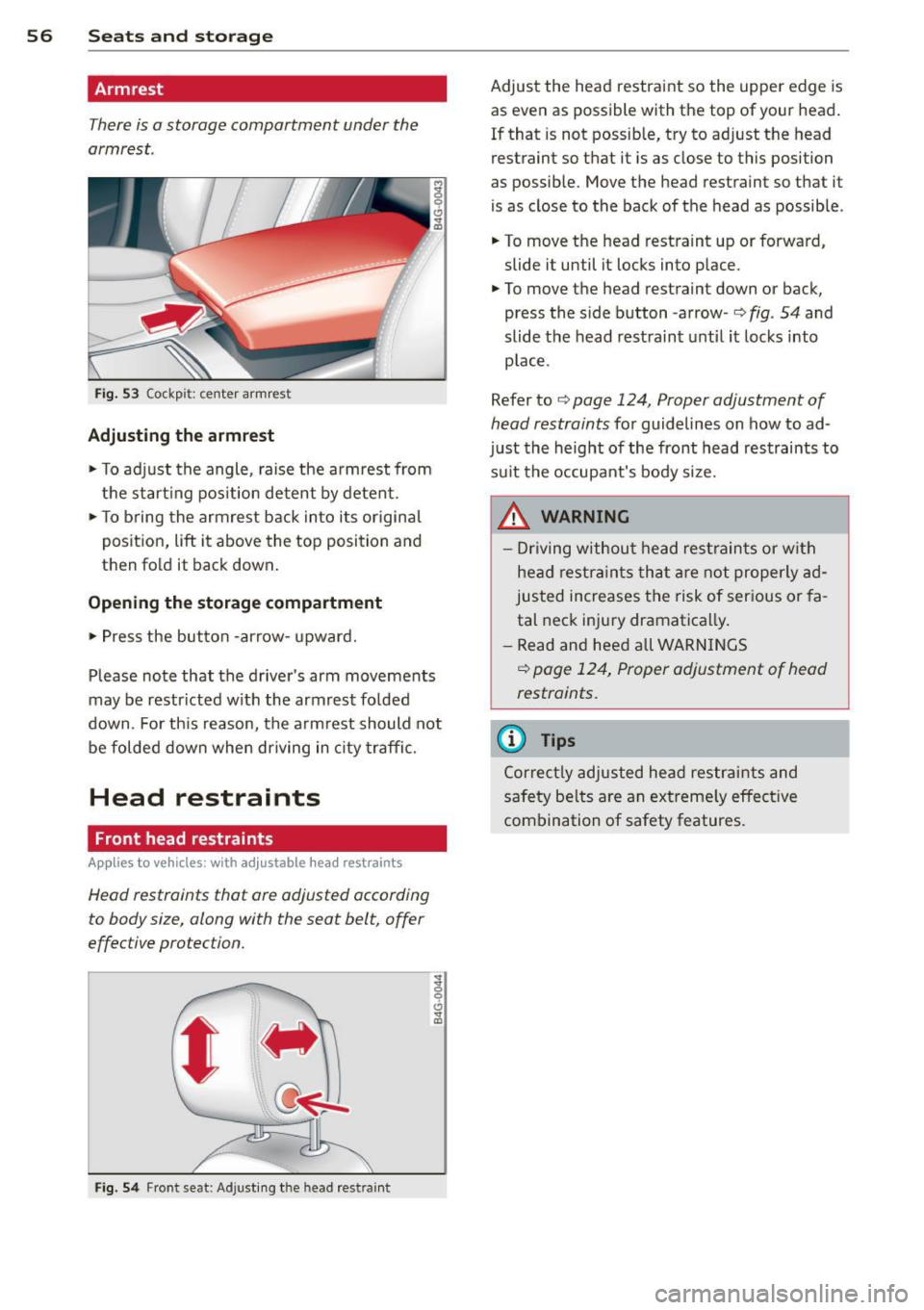
Th ere is a storage compartment under the
armrest.
F ig. 53 Cockp it : center arm rest
Adjusting th e armrest
• To ad just the angle, raise the armrest from
the start ing pos ition detent by detent.
• To bring the armrest back into its original
position, lift it above the top position and
then fold it back down .
Opening th e storage compartment
• Press the button -arrow-upward.
Please note that the driver's arm movements
may be restr icted w ith the armrest fo lded
down. Fo r th is reason, the armrest should not
be folded down when driving in city traffic.
Head restraints
Front head restraints
App lies to vehicles: with adjustable head restrain ts
Head restraints that are adjusted according
to body size, along with the seat belt, offer
effective protection.
F ig . 54 Fr ont seat: Adjusting t he head res tra int
Adjust the head restraint so the upper edge is
as even as possible with the top of your head.
If that is not possible, try to adjust the head
restraint so that it is as close to this position
as possible. Move the head restraint so th at it
is as close to the back of the head as possib le .
• To move the head restraint up or forward,
slide it until it locks into place.
• To move the head restraint down or back,
press the side button -arrow -
c::> fig. 54 and
slide the head restraint unt il it loc ks into
p lace.
Refer to
c::> page 124, Proper adjustment of
head restraints
fo r guidelines on how to ad
just the height of the front head restraints to
su it the occupant's body size.
_& WARNING
- Dr iving w ithou t hea d rest rain ts or with
hea d restra ints tha t ar e no t properly ad
justed increases t he risk of ser ious or fa
tal neck injury dramatica lly.
- Read and heed all WARN INGS
c::> page 124, Proper adjustment of head
restraints.
(D Tips
Cor rec tly adjusted hea d restr aints and
s a fety be lt s are an extreme ly effe ctive
com bination of safety features.
-
Page 59 of 302
"' N
a:: I.J "". rl I.O
"' rl
"' rl
Rear head restraints
Applies to vehicles: with adj ustable head restraints
--
/
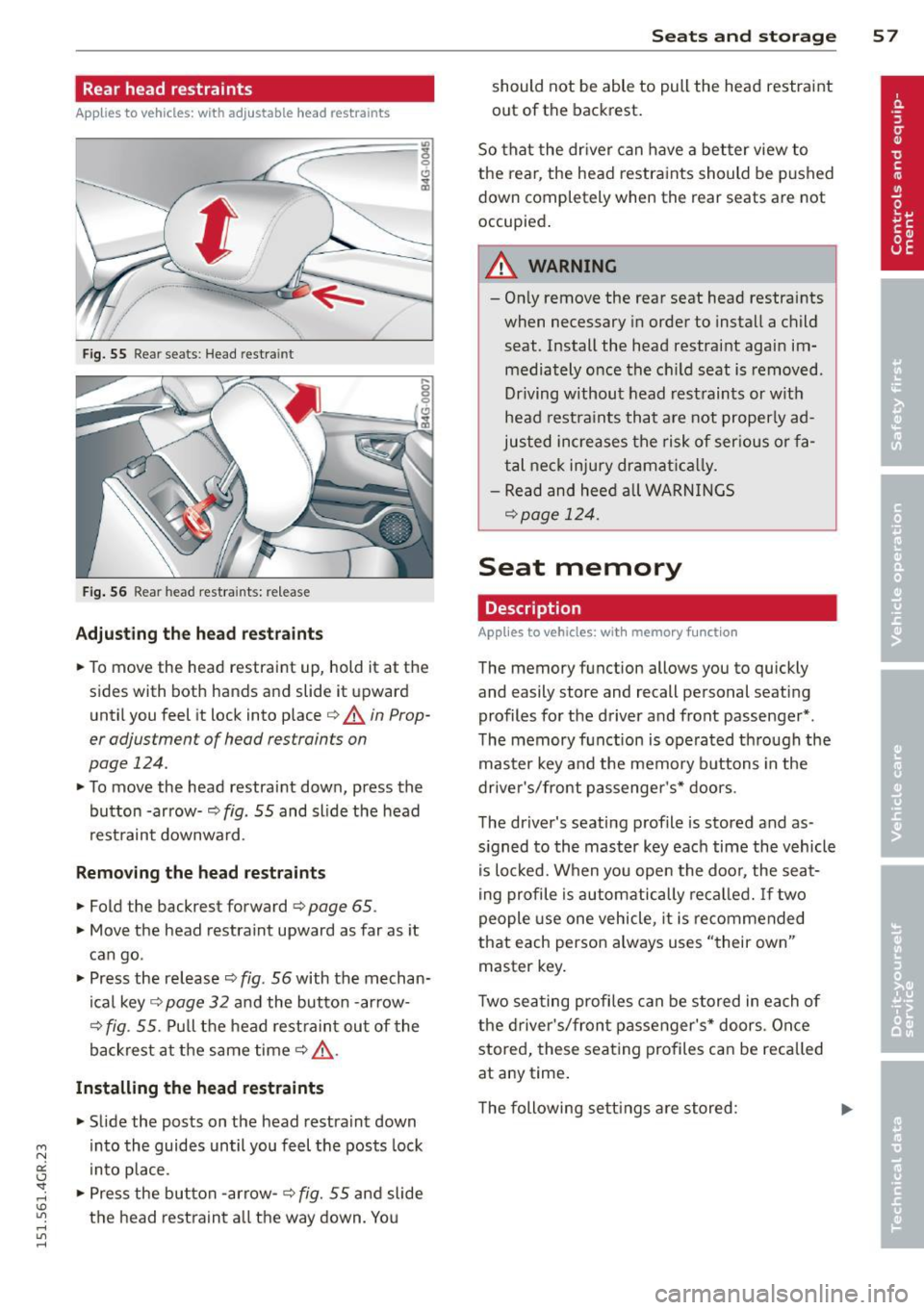
Fig. 55 Rear seats: Head restra int
Fig. 56 Rear head restraints: re lease
Adjusting the head restraints
• To move the head restraint up, hold it at the
sides with both hands and slide it upward
until you feel it lock into place
¢ .&. in Prop
er adjustment of head restraints on
page 124.
• To move the head restraint down, press the
button -arrow-
q fig. 55 and sl ide the head
restraint downward .
Removing the head restraint s
• Fold the backrest forward ¢ page 65.
• Move the head restraint upward as far as it
can go .
• Press the release¢
fig. 56 with the mechan
ical key ¢
page 32 and the button -arrow-
¢
fig. 55. Pull the head restraint out of the
backrest at the same time
q _&..
Installing the head restraints
• Slide the posts on the head restraint down
into the guides until you feel the posts lock
i nto place .
• Press the button -arrow-
¢ fig. 55 and slide
the head restraint a ll the way down. You
Seats and storage 57
should not be able to pull the head restraint
out of the backrest.
So that the driver can have a better view to
the rear, the head restraints should be pushed
down completely when the rear seats are not
occupied .
A WARNING
-On ly remove the rear seat head restraints
when necessary in order to install a child
seat. Install the head restraint again im mediately once the child seat is removed.
Driving without head restraints or with
head restraints that are not properly ad
justed increases the risk of serious or fa
tal neck injury dramat ically.
- Read and heed all WARNINGS
qpoge 124.
Seat memory
Description
Applies to vehicles: wit h memory function
The memory func tion allows you to quickly
and easily store and recall personal seating
profiles for the driver and front passenger* .
The memory function is operated through the
master key and the memory buttons in the
driver's/front passenger's* doors.
The driver's seating profile is stored and as
s igned to the master key each time the vehicle
is locked. When you open the door, the seat
ing profile is automatically recalled.
If two
people use one vehicle, it is recommended
that each person always uses "their own"
master key.
Two seating profiles can be stored in each of
the driver's/front passenger's* doors. Once
stored, these seating profiles can be recalled
at any time .
The following settings are stored:
Page 60 of 302
58 Seats and storage
Remote Memory button
control master
key
Dri ver Driver Front
passen -
ge r
Seat X X X
Stee ring X X
wheel*
Both exterior
X
X
rearview mir-
rors*
Remote control key
Applies to vehicles: with memory function
To assign the driver 's seat set tings to the re
mote contro l key when locking the vehicle, the
function must be switched on .
• Se lect:
I CAR I funct ion button > (Ca r)* sys
tem s
control button > V ehi cle se tt ings >
Sea ts > Dr ive r se a t > R emot e control k ey >
On.
@ Tips
If you do not want ano ther driver's set
tings to be assigned to the remote contro l
key, switch off the memory function using
the MMI or the
!OFF ! button c::> page 58.
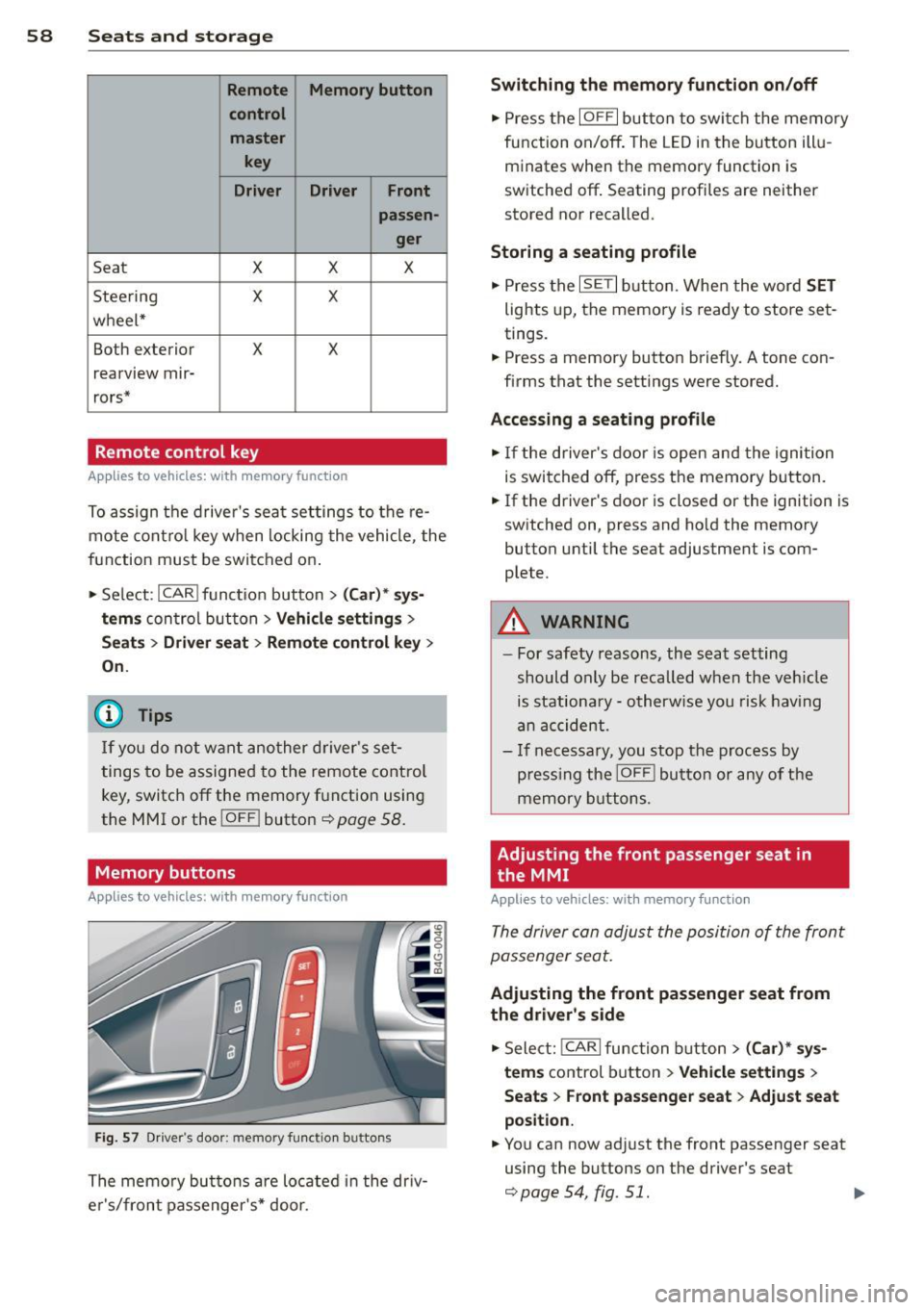
Memory buttons
Applies to vehicles: with memory function
Fi g. 57 D river's door: memory function buttons
The memory but to ns are located in the dr iv
e r's/front passenger 's* door.
Switching the memory function on /off
• Press the IOFFI button to swi tch the memory
function on/off. The LED in the button illu
minates when the memory function is
switched off. Seating profi les are neither
stored nor recalled.
Storing a seating profile
• Press the ISETI button. When the word SET
lights up, the memory is ready to store set
tings.
• Press a memory button briefly. A tone con
firms that the settings were stored.
Accessin g a seating profile
• If the driver's door is open and the ignition
is switched off, press the memory button.
.,. If the driver's door is closed or the ignition is
switched on, press and hold the memory
button until the seat adjustment is com
plete.
_&. WARNING
- For safety reasons, the seat setting
should only be recalled when the veh icle
is stationa ry - otherw ise you risk having
an accident .
- I f necessary, you stop the process by
p ress ing the
I OFF ! button or any of the
memory buttons.
Adjusting the front passenger seat in
the MMI
Applies to vehicles: with memory function
The driver con adjust the position of the front
passenger seat.
Ad ju stin g the front passeng er seat fr om
the driv er's s id e
• Select: !CARI function button> ( C a r)* sys
tem s
control button > Vehicle sett ings >
Seat s > Front pass enge r seat> Adju st seat
po siti on.
.,. You can now adjust the front passenger seat
using the buttons on the driver's seat
c::>page 54, fig. 51.
Page 122 of 302
120 Driving Saf ely
Driving Safely
General notes
Safe driving habits
Please remember -safety first!
This chapter contains important information,
tips, instructions and warnings that you need
to read and observe for your own safety, the
safety of your passengers and others . We have
summarized here what you need to know
about safety belts, a irbags, ch ild restra ints as
well as child safety. Your safety is for us
priori
ty number 1.
Always observe the info rmat ion
and warn ings in th is sect ion -fo r yo ur own
safety as well as that of your passengers .
The information in this se ction app lies to all
model ve rsions of your veh icle . Some of the
feat ures described in this sec tions may be
standard equipment on some models, or may
be optional equipment on others . If you are
not sure, ask your authorized Audi dealer.
A WARNING
- Always make sure that you follow the in
struct ions and heed the WARNINGS in
this Manual. It is in your interest and in
the inte rest of you r passengers.
- Always keep the complete Owner's Liter
ature in your Audi when you lend or sell
your vehicle so that this important info r
mation will always be ava ilable to the
dr iver and passengers.
- Always keep the Owner's literature handy
so that you can find i t eas ily if you have
ques tions.
Safety equipment
The safety features are part of the occupant
restraint system and work together to help
redu ce the risk of injury in a wide variety of
accident situations.
Your safety and the safety of your passenge rs
should not be left to chance. Advances in
technology have made a varie ty o f fea tures
avai la bl e to he lp re duce the risk of injury in an accident
. The following is a list of just a few of
the safety features in your Audi:
- sophis tic ated s afety be lts fo r drive r and a ll
passenger sea ting pos it ions,
- safety belt prete nsioners ,
- safety belt force lim iters fo r the front seats,
- safety belt he ight adjustment systems for
the front seats ,
- front airbags,
- knee airbags for the front seats *
- side airbags in the front seats a nd outer rear
seats*,
- side curtain airbags ,
- specia l LATCH anchorages for child re-
straints,
- hea d restr aints for each sea ting pos ition,
- ad justab le s teer ing colum n.
These ind iv idual safety features, can work to
ge ther as a system to help protect you and
you r passengers in a wide range of accidents .
T hese features canno t wo rk as a system if
they are not always cor re ct ly adjusted and co r
rect ly used.
Safety i s everybody' s respon sibility!
Important things to do before driving
Safety is everybody 's job! Vehicle and occu
pant safety always depends on the informed and careful driver .
For your safety and the safety of your passen
gers,
befor e driv ing always:
.. Make s ure that all lights and signals are op
erating correctly.
.. Make sure that the t ire pressure is correct .
.. Make s ure t hat all windows are clean and af
ford good vis ibility to the outs ide .
.. Sec ure all luggage a nd other items caref ully
q page 64, q page 61 .
.. Ma ke s ure t hat nothing can interfe re wi th
the peda ls .
.. Adjust front seat, head restraint and mirrors
correctly for your height.
.. Instruct passengers to adjust the head re-
straints according to the ir height . .,..
Page 126 of 302
124 Driving Safel y
Proper adjustment of head restraints
Applies to vehicles: with adj ustable head restraints
Correctly adjusted head restraints ore on im
portant port of your vehicle's occupant re
straint system and con help to reduce the risk of injuries in occident situations.
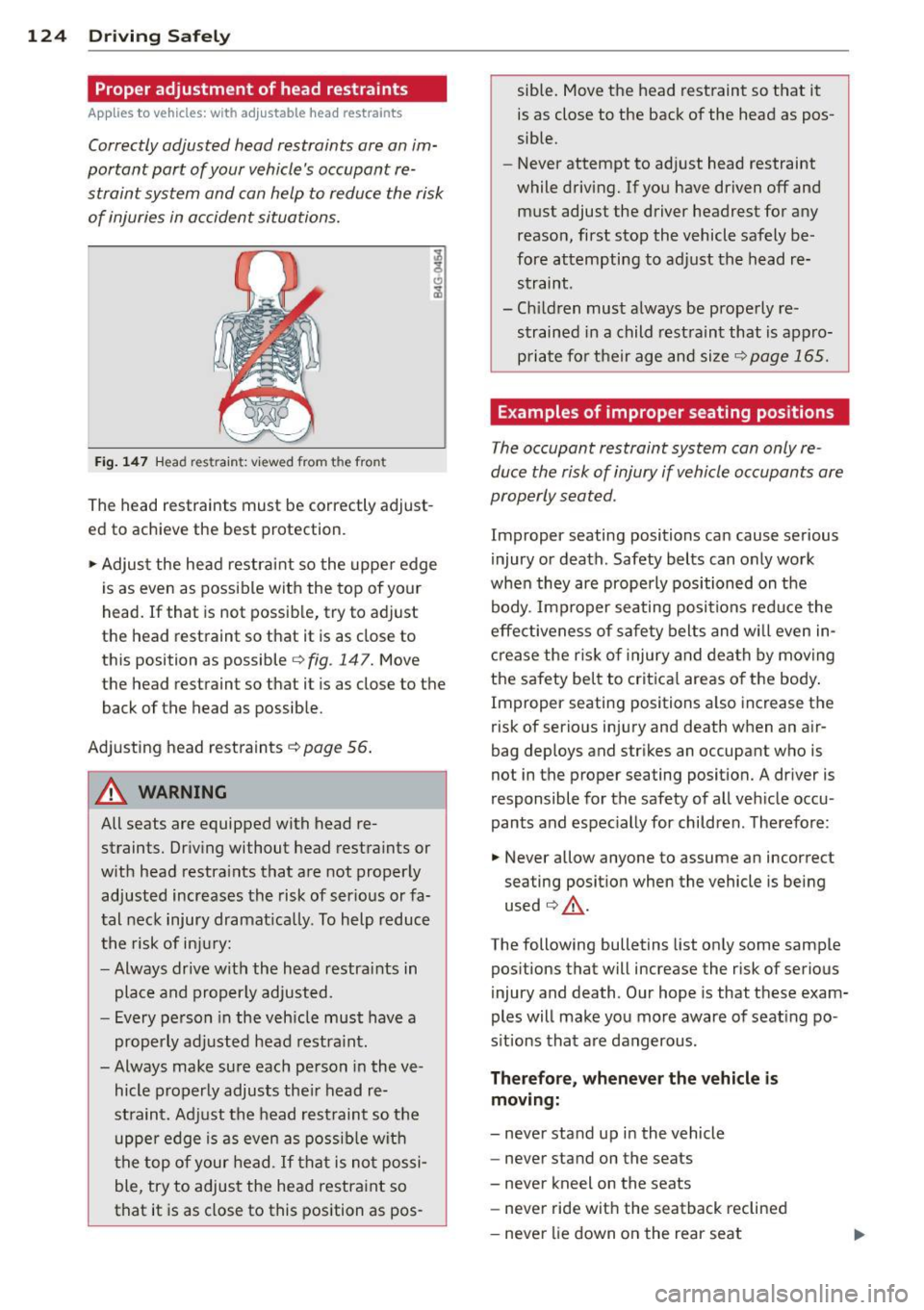
F ig . 147 H ead re str ain t: vi ew ed fro m the front
The head restraints must be correctly adjust
ed to achieve the best protection .
.. Adjust the head restr aint so the uppe r edge
is as even as possible with the top of your
head. If that is not possible, try to adjust
the head restraint so that it is as close to
this position as possible
c:> fig . 147. Move
the head restraint so that it is as close to the
back of the head as possible.
Adjusting head restraints ¢
page 56.
A WARNING
All seats are equipped with head re
straints. Driv ing without head restraints or
w ith head restra ints that are not properly
adjusted increases the risk of serious or fa
tal neck injury dramat ically . To help reduce
the risk of injury:
- Always drive with the head restraints in
place and properly adjusted.
- Every person in the veh icle must have a
properly adjusted head restra int .
-Always make sure each person in the ve
hicle properly adjusts the ir head re
straint. Adjust the head restraint so the
upper edge is as even as possible with
the top of your head. If that is not possi
ble, try to adjust the head restraint so
that it is as close to this position as pos- sible.
Move the head restraint so that it
is as close to the back of the head as pos
sible.
- Never attempt to adjust head restraint
while driving. If you have driven off and must adjust the driver headrest for any
reason, first stop the vehicle safely be
fore attempting to adjust the head re
straint .
- Ch ildren must always be properly re
strained in a child restraint that is appro
priate for their age and size ¢
page 165.
Examples of improper seating positions
The occupant restraint system con only re
duce the risk of injury if vehicle occupants ore
properly seated.
Improper seating positions can cause serious
injury or death . Safety belts can only wo rk
when they are properly positioned on the body . Improper seating positions reduce the
effectiveness of safety belts and will even in
crease the r isk o f injury and death by moving
the safety belt to critica l areas of the body .
Improper seating positions also increase the
risk of serious injury and death when an air
bag deploys and str ikes an occupant who is
not in the proper seating position. A driver is
responsible for the safety of all vehicle occu
pants and espec ially for children . Therefore :
.,. Never allow anyone to assume an incorrect
seating position when the vehicle is being
used ¢_& .
The following bulletins list only some sample pos itions that will increase the risk of serious
injury and death . Our hope is that these exam
ples will make you more aware of seating po
s itions that are dangerous.
Therefore, whenever the vehicle is
moving:
- never stand up in the vehicle
- never stand on the seats
- never kneel on the seats
- never ride with the seatback reclined
- neve r lie down on the rear seat
Page 136 of 302
134 Safet y belt s
To provide maximum protection, safety belts
must always be positioned correctly on the
wearer 's body .
.,. Adjust the front seat and head restr aint
properly
c::, page 53, General recommenda
t ions .
.,. Make sure the seatback of the rear seat
bench is in an upright pos ition and securely
latched in place before using the belt
c::, .&, .
.,. Hold the be lt by the tongue and pull it even
ly across the chest and pelv is
c::, .&, .
.,. Inse rt the tongue into the correct buckl e of
yo ur sea t until you hea r it latc h securely
c::>fig. 154.
.,. Pull on the be lt to make sure that it is se-
curely latched in t he buckle.
Automatic safety belt retractors
Every safety belt is equipped w ith an automat
i c belt retracto r on the shoulder be lt. This fea
ture locks the be lt whe n the belt is pulled out
fast, dur ing hard braking and i n an accident.
The belt may also lock when you drive up or
down a steep hill or throug h a sharp curve.
During normal driv ing the belt lets you move
freely.
Safety belt pretensioners
The sa fety belts are equipped with a be lt pre
tensioner that helps to tighten the safety belt
and remove s lack when the pretensioner is ac
tivated ¢
page 136. The function of the pre
tensioner is mon it ored by a warning light
¢ page 18.
Convertible locking retractor
Every safety belt except the one on the driver
seat is eq uipped w ith a convertib le loc king re
tractor that
must be used when the safety
be lt is used to attach a child seat. Be su re to
read the important information about this
featu re
c::> page 176.
.,& WARNING
Imprope rly posit ioned safety belts can
cause se rious injury in an accident
c::> page 13 4, Safety bel t posi tion.
- Safety belts offer opt imum protection
only when the seatback is upr ight and
be lts are properly posit ioned o n the
body .
- If the rear seat backrest is not securely
latched, the passenger w ill move for
ward with the bac krest dur ing sudden
b ra ki ng, in a sudden maneuver and espe
cially in a cra sh.
- N ever attach t he safety belt to t he buck
le for another seat . Attaching the belt to
the wrong buckle will reduce s afety be lt
effec tiveness and can cause seri ous per
sonal injury .
- A passenger who is not prope rly restrain
e d ca n be seriously injured by the safe ty
be lt itse lf w hen it moves from the st ron
ge r parts of the body into cr itical areas
like the abdomen.
- A lways loc k the conve rtible locking re
tractor when you are secu ring a child
seat in t he veh icle
c::, page 178.
(D Tips
F o r i nforma tion on safe ty belt pre tension
e rs, refer to
c::, page 136.
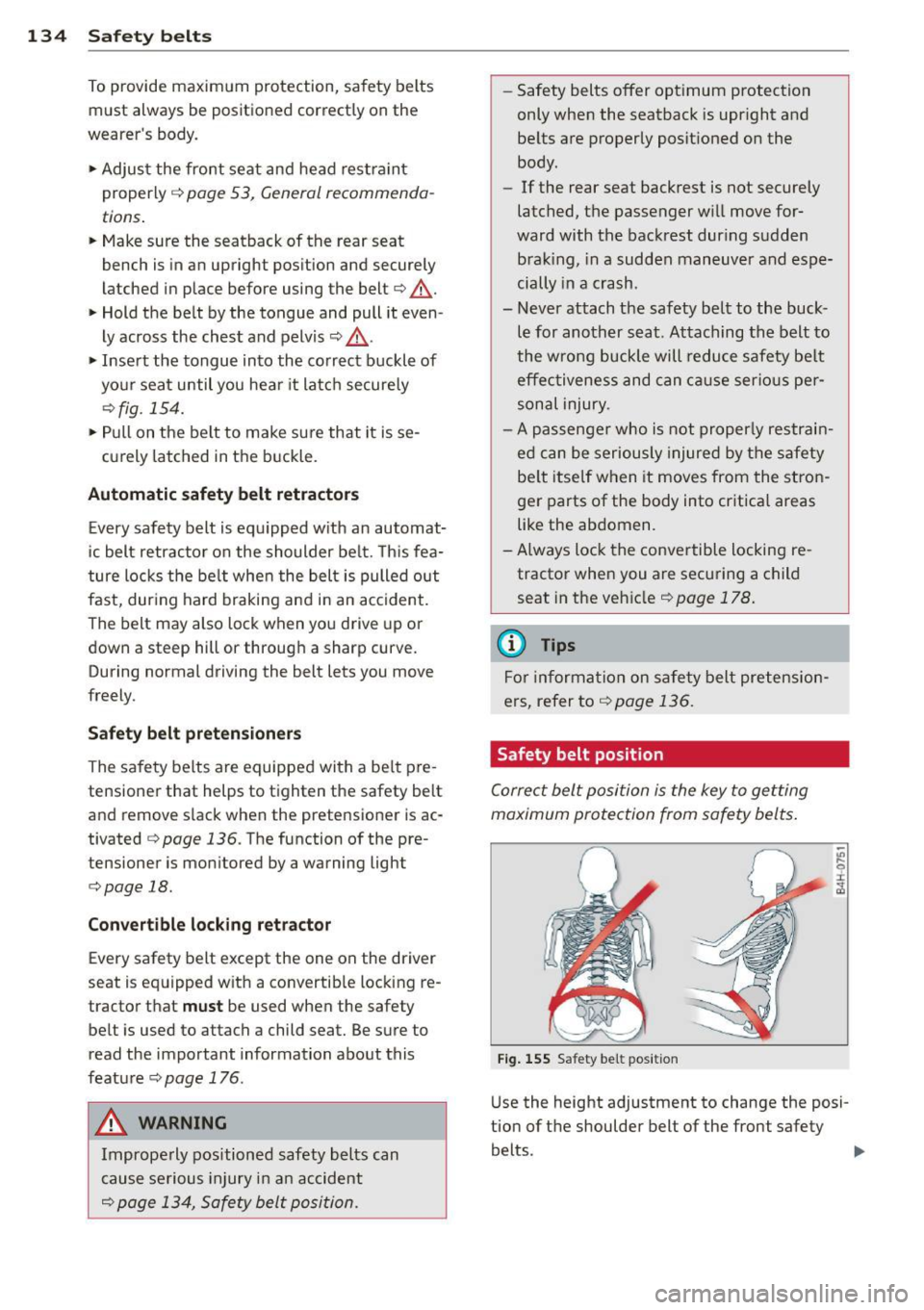
Safety belt position
Correc t belt position is the key to getting
maximum protection from safety belts .
Fig. 155 Sa fety belt pos it ion
U se the height adjustment to change the posi
tion of t he shoulder belt of the front safety
belts.
~
Page 141 of 302
M N
0:: <.J 'SI: ,...., \!) 1.1'1 ,...., 1.1'1 ,....,
Airbag system Important things to know
Importance of wearing safety belts and
sitting properly
Airbags are only supplemental restraints . For
airbags to do their job, occupants must al
ways properly wear their safety belts and be
in a proper seating position.
F or your safety and the safety of your passen
gers, before driving off, always:
"" Adjust the driver's seat and steering wheel
properly ¢
page 121,
"" Adjust the front passenger's seat properly
¢ page 54,
""Wear safety be lts properly ¢ page 133,
""Always properly use the proper child re-
stra int to protect ch ildren
r::::> page 165.
In a collision, airbags must inflate within the
blink of an eye and with considerable force .
The supplementa l airbags can cause injuries if
the dr iver or the front seat passenger is not
seated prope rly . T herefore in order to help the
a irbag to do its job, it is impo rtant, both as a
d river and as a passenge r to s it properly at all
times.
By keep ing room between your body and the
steer ing whee l and the front of the passenge r
compartment, the airbag can i nflate fully and
comp lete ly and provide supp lemen tal protec
tion in ce rtain frontal collisions
r::::> page 121,
Proper occupant seating positions .
For deta ils
on the operation of the seat adjustment con
trols
¢ page 54.
It's espe cially important that children a re
p roperly restrained
r::::> page 165.
There is a lot that the d river and the passen
ge rs ca n and must do to help the individua l
safety features ins talled in your A ud i work to
gether as a system.
P rope r seat ing pos ition is important so that
the front airbag on the dr iver s ide ca n do its
job. If yo u have a physical impa irment or con-
A irbag system 139
dition that prevents yo u from sitting properly
o n the driver seat with the safety belt properly
f astened and reach ing the peda ls, or if you
have concerns with regard to the function or
operation of the Advanced Airbag System,
please contact your author ized Audi dealer or
qualified wo rkshop, o r call Audi Customer Re
l ations at 1-800-822-2834 fo r poss ible modi
fica tions to your veh icle.
When the airbag system dep loys, a gas gener
ator will fill t he a irbags, break open the pad
ded cove rs, and inflate between the steer ing
whee l and the dr ive r and between the instru
ment pane l and the fron t passenger. The a ir
bags will deflate immedia tely after dep loy
ment so that the front occupants can see
thro ugh the windshie ld again witho ut inter
ruption .
A ll of th is takes place in t he blink o f an eye, so
f ast that many people don't even realize that
the airbags have deployed. The airbags a lso
inflate with a great dea l of force and nothing
shou ld be in their way when they deploy.
Front a irbags in combination with properly
wor n safety belts slow down and lim it the oc
c u pant's fo rward movement . Togethe r they
help to preve nt the drive r and front seat pas
senger from h itti ng pa rts of the inside of the
vehicle while reducing the forces act ing on the
occupant dur ing the crash . In this way they
help to reduce the risk of injury to the head
and upper body in the crash. Airbags do not
protect the arms or the lower parts o f the
body.
Both front airbags wi ll not inflate in all fronta l
collisions . The trigge ring of the airbag system
depends on the vehicle dece lerat ion rate
ca used by the co llision and registered by the
electron ic control unit. If t his rate is below
the reference value programmed into the con
tro l unit, the airbags will not b e trigge red,
even t hough the car may be bad ly damaged as
a res ult of the co llision . Ve hicl e damage, re
pair costs or even the lack of ve hicle damage
is not necessarily an indica tion of whether an
airbag shou ld inflate or not . .,. •
•
Page 168 of 302
166 Child Safety
-Always install rear-facing child safety
seats on the rear seat.
- If you must install a rearward facing
child safety seat on the front passenger
seat in exceptional circumstances and
the
PASSENGER AIR BAG OFF light does
not come on and stay on, immediately
install the rear-facing child safety seat in
a rear seating position and have the air
bag system inspected immediately by
your Audi dealer.
_&, WARNING
- Forward-facing child seats installed on
the front passenger seat may interfere
with the deployment of the airbag and
cause serious personal injury to the
child.
- If exceptional circumstances require the
use of a forward-facing child restraint on
the front passenger 's seat, the child's
safety and well-being require the follow ing special precautions to be taken:
- Always make sure that the forward-fac
ing seat has been designed and certi
fied by its manufacturer for use on a
front passenger seat with a front and
side airbag.
- Always carefully follow the manufac
turer's instructions provided with the
child seat or infant carrier.
- Never install a child restraint without a
properly attached top tether strap if
the child restraint manufacturer's in
structions require the top tether strap
to be used.
- Never put the forward-facing child re
straint up against or very near the in
strument panel.
- Always set the safety belt upper an
chorage to the adjustment position
that permits proper installation in ac
cordance with the child restraint manu
facturer's instructions.
-Always move the passenger seat into
its rearmost position in the seat's fore
and aft adjustment range, as far away
.
from the airbag as possible before in
stalling the child restraint. The back
rest must be adjusted to an upright po
sition .
- Always make sure that nothing pre
vents the front passenger's seat from
being moved to the rearmost position
in its fore and aft adjustment range.
- Never place objects on the seat (such
as a laptop, CD player, electronic
games device, power inverter or seat
heater for child seats) . These may in
fluence the electrical capacitance
measured by the capacitive passenger
detection system and can also fly
around in an accident and cause serious
personal injury.
- Never place or use any electrical device
(such as a laptop, CD player, electronic
games device, power inverter or seat
heater for child seats) on the front pas
senger seat if the device is connected
to the 12 -volt socket or the cigarette
lighter socket.
- If a seat heater has been retrofitted or
otherwise added to the front passen
ger seat, never install any child re
straint system on this seat.
- Make sure that there are no wet objects
(such as a wet towel) and no water or
other liquids on the front passenger
seat cushion .
- Always make sure that the
PASSENGER
AIR BAG OFF
light comes on and stays
on all the time whenever the ignition is
switched on.
- If the PASSENGER AIR BAG OFF light
does not come on and stay on, immedi
ately install the forward-facing child seat in a rear seating position and have
the airbag system inspected by your
authori zed Audi dealer.
- Always buckle the child seat firmly in
place even if a child is not sitting in it.
A loose child seat can fly around during
a sudden stop or in a collision.
~
Page 172 of 302
1 70 Child Safety
an accident. The child will strike the in
terior of the vehicle and can also be
struck by the passenger.
- The child and the passenger can also
injure each other in an accident .
- Never install rear-facing child safety
seats or infant carriers on the front pas
senger seat. A child will be seriously in
jured and can be killed when the passen ger airbag inflates - even with an Ad
vanced Airbag System.
- The inflating airbag will hit the child safety seat or infant carrier with great
force and will smash the child safety seat
and child against the backrest, center
armrest, door or roof.
- Always install rear-facing child safety
seats or infant carriers on the rear seat.
- Forward-facing child safety seats instal
led on the front passenger's seat can in
terfere with the airbag when it inflates
and cause serious injury to the child. Al
ways install forward-facing child safety
seats on the rear seat.
- If exceptional circumstances require the use of a forward-facing child restraint on
the front passenger's seat, the child's safety and well-being require that the
following special precautions be taken:
- Make sure the forward-facing seat has
been designed and certified by its man
ufacturer for use on a front seat with a
passenger front and side airbag.
- Always carefully follow the manufac
turer's instructions provided with the
child safety seat or carrier.
- Always move the front passenger seat
into the rearmost position of the pas
senger seat's fore and aft adjustment
range, and as far away from the airbag
as possible before installing the child
restraint.
- Always make sure that nothing pre
vents the front passenger 's seat from
being moved to the rearmost position
in its fore and aft adjustment range.
- Always make sure that the backrest is
in the upright position . -
Never place or use any electrical device
(such as a laptop, CO player, electronic
games device, power inverter or seat
heater for child seats) on the front pas
senger seat if the device is connected
to the 12-volt socket or the cigarette
lighter socket.
- If a seat heater has been retrofitted or
otherwise added to the front passen
ger seat , never install any child re
straint system on this seat.
- Make sure that there are no wet objects
(such as a wet towel) and no water or
other liquids on the front passenger
seat cushion.
- Never place objects on the seat (such
as a laptop, CO player, electronic
games device, power inverter or seat
heater for child seats) . These may in
fluence the electrical capacitance
measured by the capacitive passenger
detection system and can also fly
around in an accident and cause serious
personal injury .
- Always buckle the child safety seat firmly
in place even if a child is not sitting in it.
A loose child safety seat can fly around
during a sudden stop or in a collision.
-Always read and heed all WARNINGS
whenever using a child restrained in ave
hicle is being used
~page 130, Safety
belts,
~ page 139, Airbag system and
~ page 165, Child Safety.
A WARNING
To reduce the risk of serious injury, make
sure that the
PASSENGER AIR BAG OFF
light comes on and stays on whenever a
child restraint is installed on the front pas
senger seat and the ignition is switched
on.
- Take the child restraint off the front pas
senger seat and install it properly at one
of the rear seat positions if the
PASSEN
GER AIR BAG OFF
light does not stay on .
- Have the airbag system inspected by
your authorized Audi dealer immediate ly .